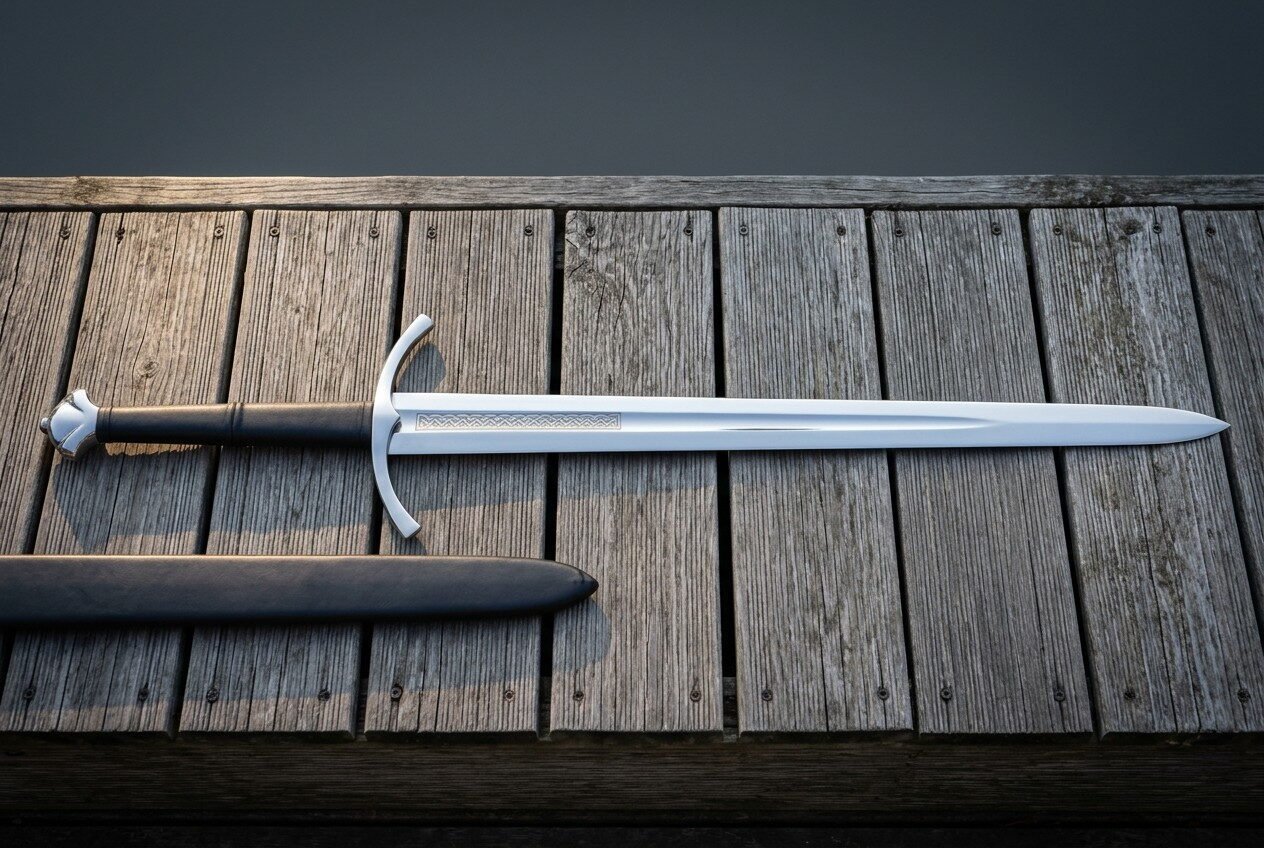
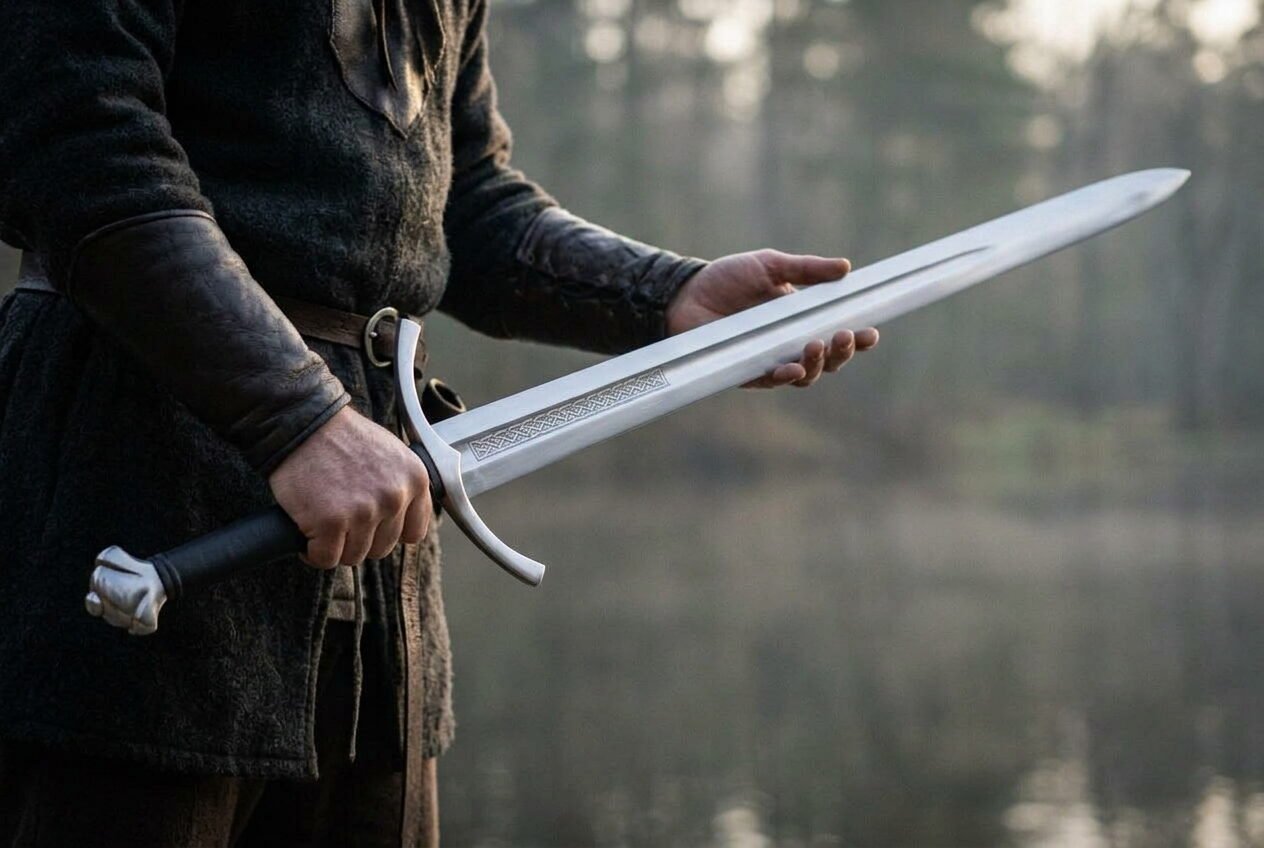
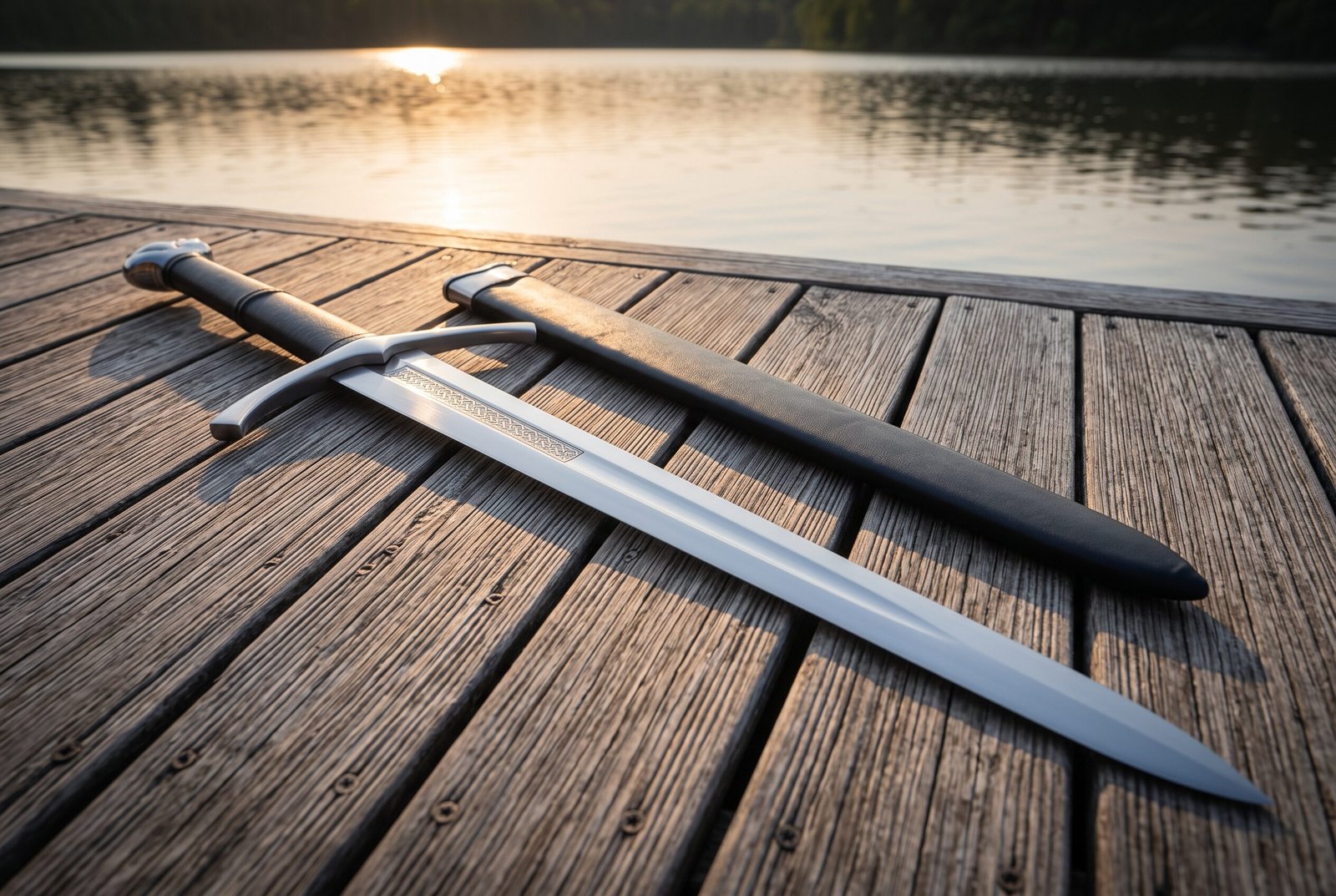
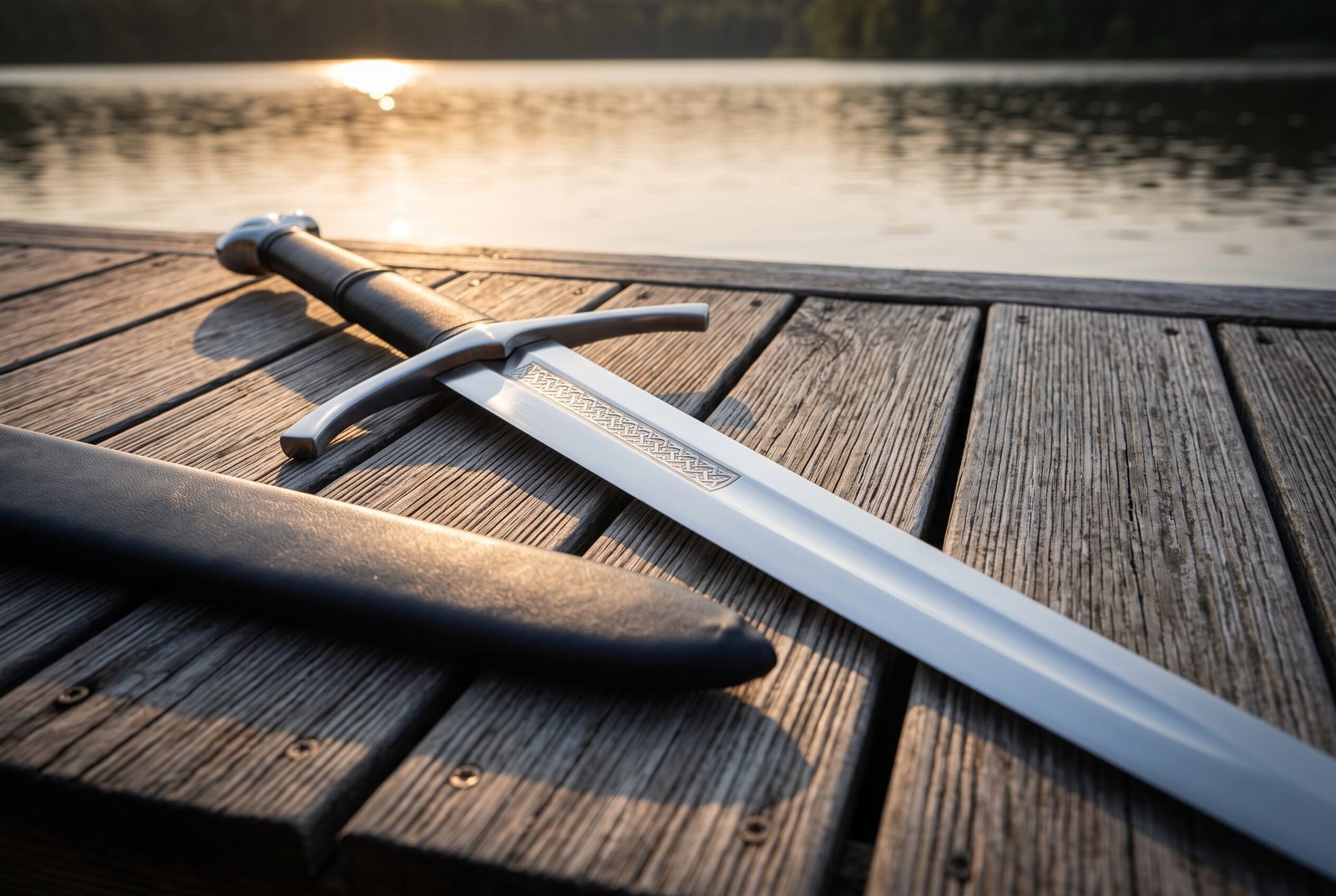
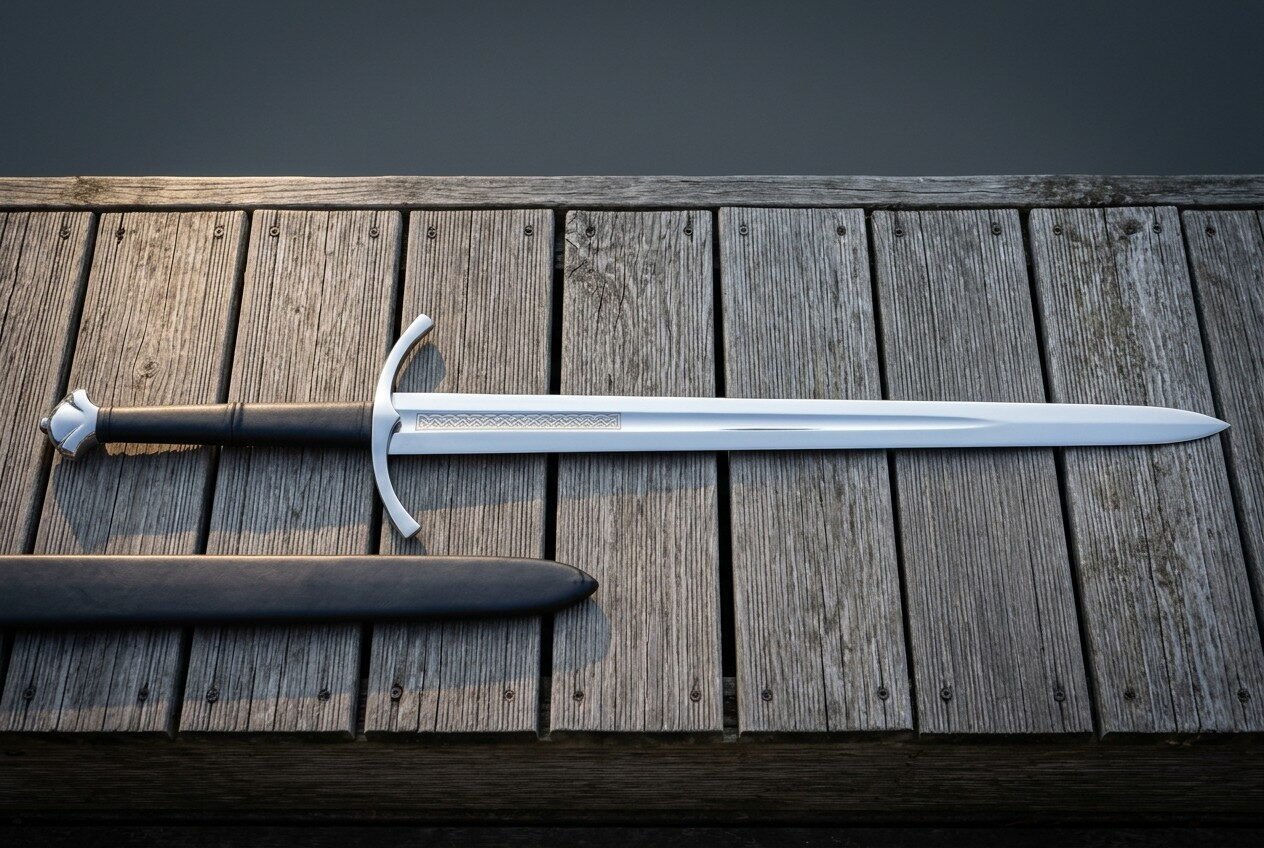
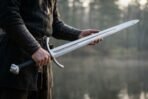
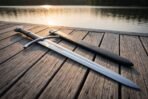
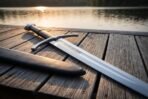
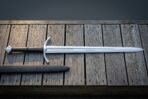
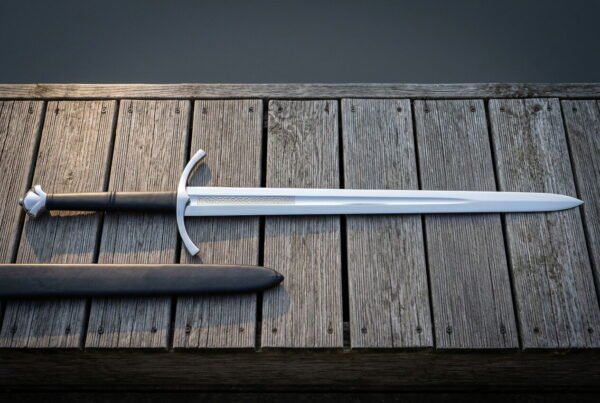
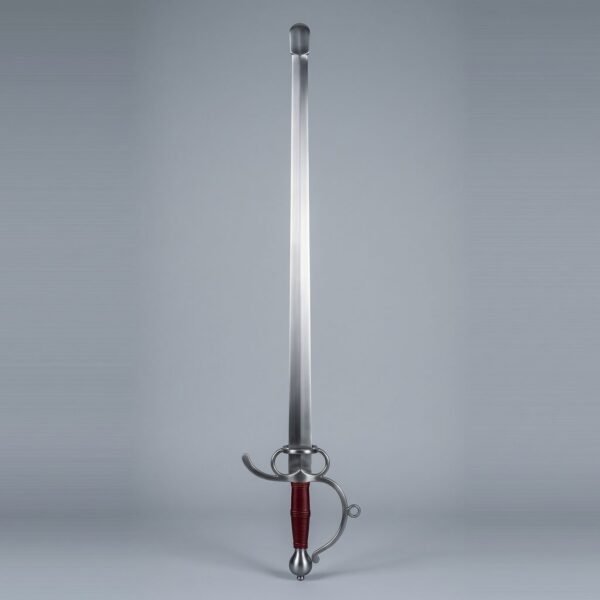
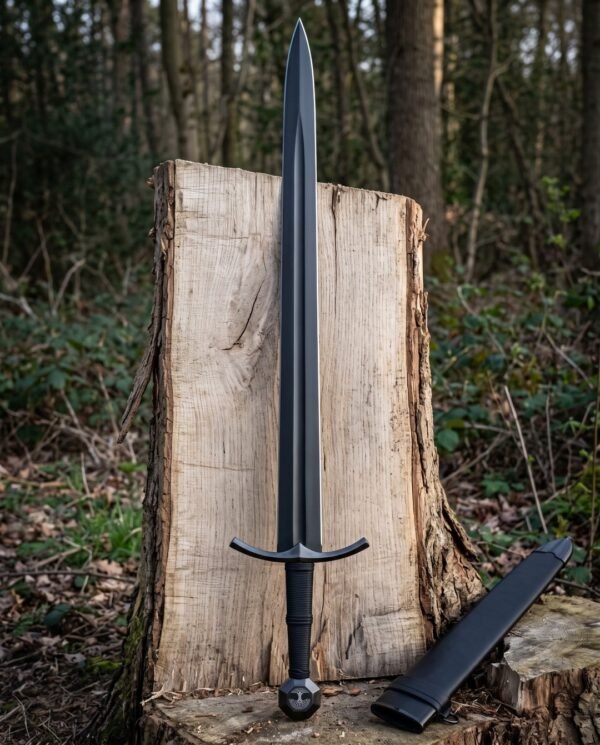
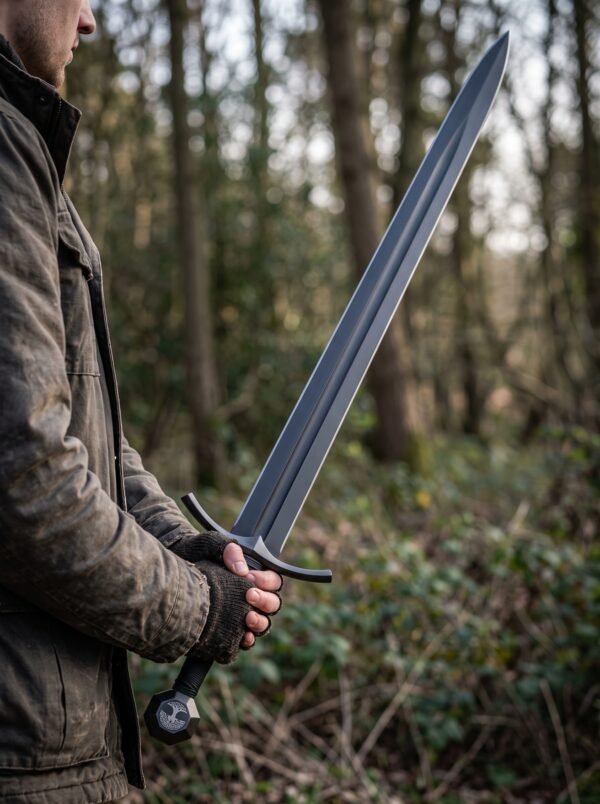
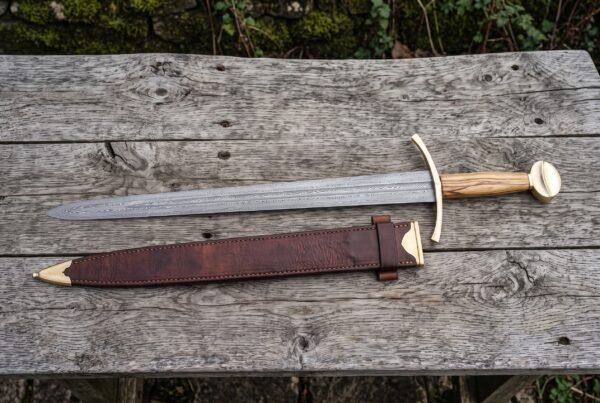
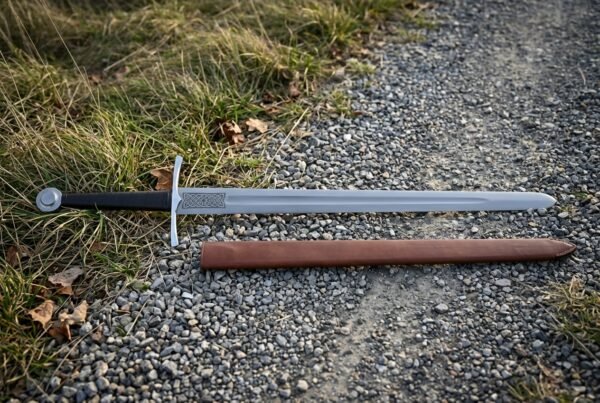
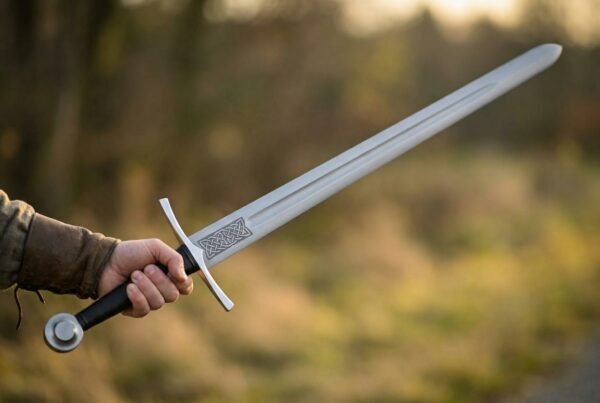
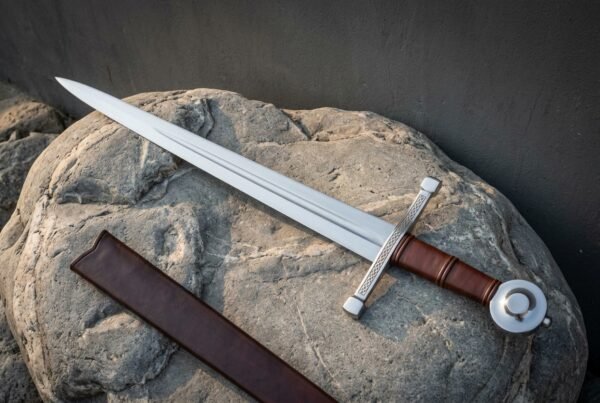
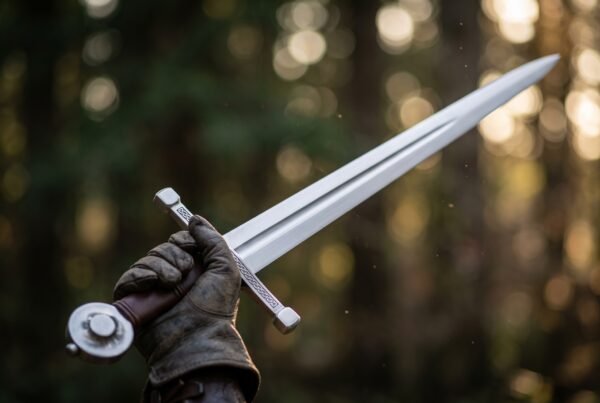
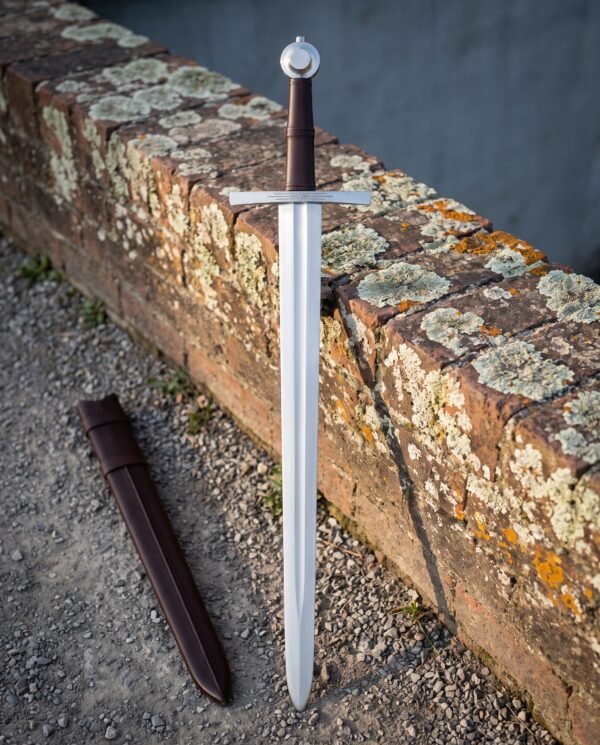
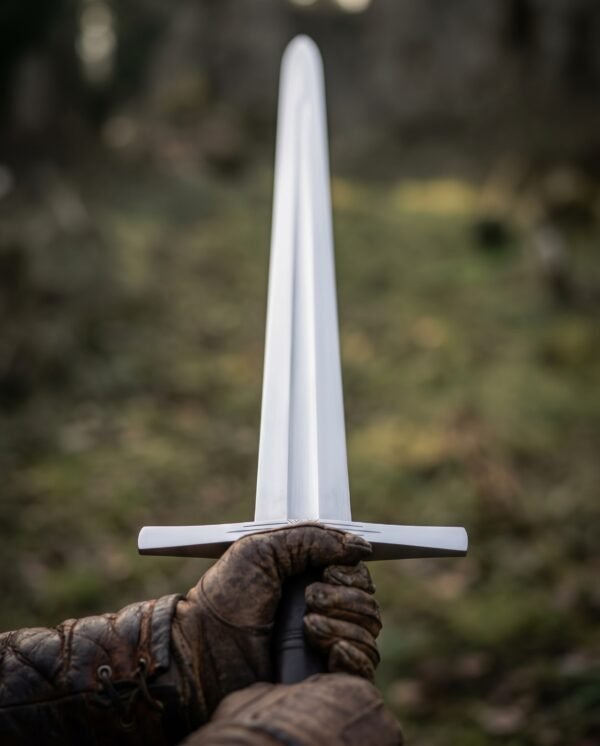
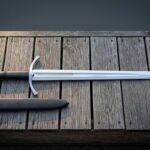
A long single hand arming sword with a hilt that leans forward. The crossguard is downswept, curving towards the point on both sides rather than sitting square across the blade, and it ends in flattened tips. The grip is dark leather over a shaped core, the pommel is a small lobed cap, and the blade is hand forged 1095 high carbon steel, double edged, with a broad fuller that carries a panel of etched knotwork for the first few inches below the guard. A dark leather scabbard ships with it.
The downswept guard is a real historical feature and it exists for a reason people rarely explain. A straight cross protects the hand only if the incoming blade slides down your edge and stops on the guard. A curved cross does that too, but it also gives you a hook. Swept towards the point, the quillons let you catch and control an opponent’s blade at the bind and steer it off line, and the shape puts the tips where a hand travelling up the blade will meet them. It is a small change to a shape and a significant change to what the sword can do. Forged, ground, etched and hilted by hand in the Czech Republic. It sits in the arming swords. The short swords cover the same ground from a different angle.
Specifications
| Blade steel | 1095 high carbon steel, hardened to 54 to 58 HRC |
|---|
| Blade profile | Double edged with a broad fuller and a steady taper to the point |
|---|
| Etching | Knotwork panel etched into the fuller just below the guard |
|---|
| Guard | Downswept steel crossguard with flattened, rounded quillon tips |
|---|
| Pommel | Small lobed steel cap with a peened button over the tang |
|---|
| Grip | Black leather over a shaped core, with a raised band near the pommel |
|---|
| Scabbard | Plain black leather scabbard with a rounded tip and no metal fittings, stitched and edge finished by hand |
|---|
| Finish | Satin polished blade, brushed steel fittings, etched fuller panel |
|---|
| Included | Sword, leather scabbard, care card |
|---|
| SKU | RK-1798 |
|---|
The bind, and why hilts changed shape
Almost everything interesting in medieval swordsmanship happens at the bind, which is the moment two blades are in contact and neither has landed. From there the fight is decided by leverage, by who has the stronger part of their blade against the weaker part of the other, and by who can feel through the steel what the other is about to do. That is the whole basis of the German fencing tradition and its idea of feeling in the bind.
Hilt shapes evolved to serve that moment. Straight crosses gave way to swept, curved and ring guards over three centuries not because anyone got tired of the look but because each change gave the hand a little more protection and the blade a little more control at the point of contact. By the time you get to the sixteenth century the guard has grown into a basket. This sword sits early in that story, where the cross has started to curve but has not yet grown rings or a knuckle bow.
1095 high carbon steel and the etched panel
The blade is 1095, a plain high carbon steel with roughly one percent carbon and no alloying elements to complicate the heat treat. We take it to 54 to 58 HRC, which keeps a keen edge without making a long blade brittle at the guard, where a sword takes the worst shock loading.
The knotwork panel in the fuller is acid etched rather than engraved. Etching bites a shallow figure into the surface and leaves it matte grey against the satin polish, which suits a fuller because the recessed floor of the fuller already sits in shadow. A cut engraving in the same place would fill with oil and disappear. The etch is in the steel, not on it, so it will not wear off with handling.
Engraving, runes and your own design
Use the rune converter on this page to turn a name, a date or a short phrase into Elder Futhark and we will cut it into the steel, the leather or the wood. If you would rather have a Viking pattern than a rune line, choose your own design in the engraving option above the add to cart button and tell us where it goes. Where a piece already carries an engraved design, your chosen engraving replaces it rather than sitting alongside it, so a custom fuller panel takes the place of the knotwork rather than joining it. The scabbard face is the alternative if you want to keep the existing panel. See the engraving page.
Handling and balance
This is a longer blade than most single hand arming swords and it carries its reach honestly, with the balance a little further forward than a shorter sword of the same pattern. That gives more authority in a cut and slightly less speed in recovery, which is the trade that comes with length. The small lobed pommel is a counterweight rather than a decoration and the sword would feel very different without it.
It is a sharpened display and collector sword. It is not sold for battle ready sparring and it must not be used for contact work against another blade or a person. Reenactment fighting uses purpose built blunts with rolled edges.
Care
Wipe the blade every time it is handled and keep a light film of mineral oil on the steel. Pay particular attention to the etched panel, because an etch leaves a slightly textured surface that holds moisture where a polished flat would shed it. Do not store the sword sheathed for months, since vegetable tanned leather is mildly acidic and traps humidity against steel. Feed the grip and the scabbard with a leather conditioner once or twice a year, worked in with the fingers and left overnight. Never use an abrasive polish over the etched panel, which will lift the figure out of the steel. Our full method is under steel care.
Made in the Czech Republic
This is a handmade piece from the Czech Republic, made in a workshop that still forges, grinds and finishes by hand instead of stamping parts out. The smiths there have kept the older way of working, and the wood, horn and leather are shaped and fitted by hand as well. Two pieces of the same design will never be identical, and that is part of what you are buying.
Ransack Viking is a United States company. We handle the import ourselves, look over every piece when it lands and ship from our warehouse in Chicago, Illinois. Engraving is done in the United States after the piece arrives, so your design goes on before we send it out.
A note on handmade variation
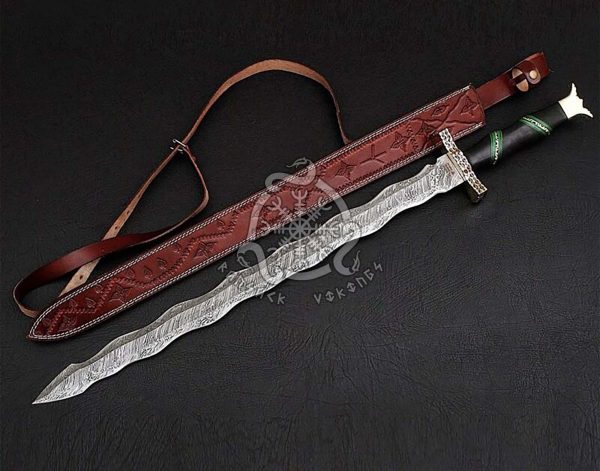
Hand made, not machine made or bulk produced, so what arrives will not be a pixel for pixel copy of the photograph. The sweep of the two quillons is forged by eye and will never be perfectly symmetrical, which is true of every historical example as well. The etch depth and contrast vary a little batch to batch. The leather takes dye differently hide to hide and the satin polish carries its own direction. The steel, the heat treat, the dimensions and the build are the same every time. The character is not. We go further into it in Excalibur and its replicas, and pick it up again in buying a first sword.
Frequently asked questions
Does it arrive sharp
Yes. Both edges are given a hand put working edge before it ships. It is not a blunted display copy.
Is the knotwork etched or engraved
Etched. The figure is bitten into the steel with acid so it sits below the surface and cannot wear away with handling.
Can this be used for sparring
No. It is a sharpened collector and display sword. Contact sparring needs a blunt trainer designed for it.
Why is the crossguard curved
A downswept cross gives the hand more protection and lets the quillons catch and steer an opposing blade at the bind. It is a functional shape, not a decorative one.
Is the scabbard part of the price
Yes. The dark leather scabbard shown ships with the sword.
Can I put a name on it in runes
Yes. Use the rune converter on this page. A rune line in the fuller replaces the knotwork panel, or it can go on the scabbard instead.
What is in the box
- Hand forged 1095 high carbon steel medieval arming sword
- Downswept steel crossguard with flattened quillon tips
- Etched knotwork panel worked into the fuller
- Dark leather grip and matching hand stitched leather scabbard
- Care card covering oiling, etched surfaces and leather feeding
- Lifetime warranty against defects in forging, grind, heat treat and fittings
- Forged and finished in the Czech Republic
Explore the range
Browse the arming swords, the longswords, the full sword range and the guides.
Worth a look beside this
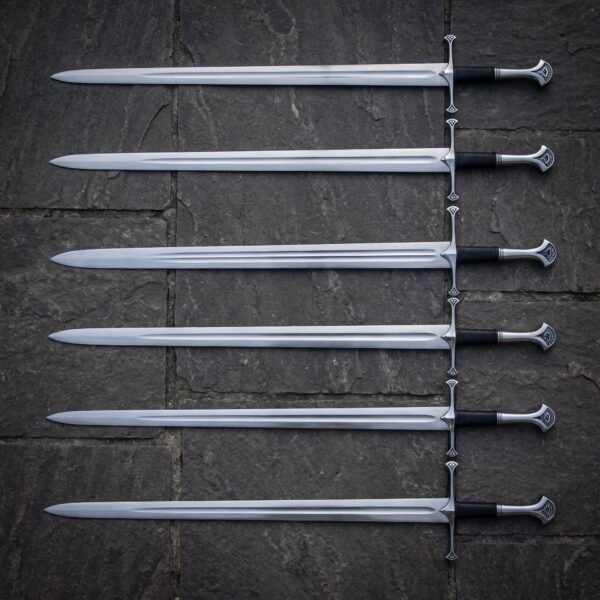
If this one is not quite right, there is the Ashenroot arming sword, 36 inches overall. Also in this group is the Snowhilt arming sword, 37 inches overall. Sitting beside it in the catalogue is the Duskwing arming sword, 36 inches overall.
From the same corner of the shop, there is the Emberhilt Viking sword. Or start from a blank sheet on the custom Viking sword page.
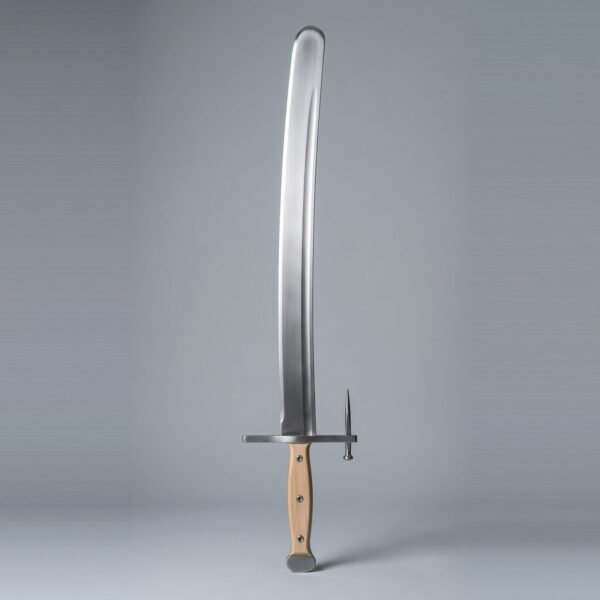
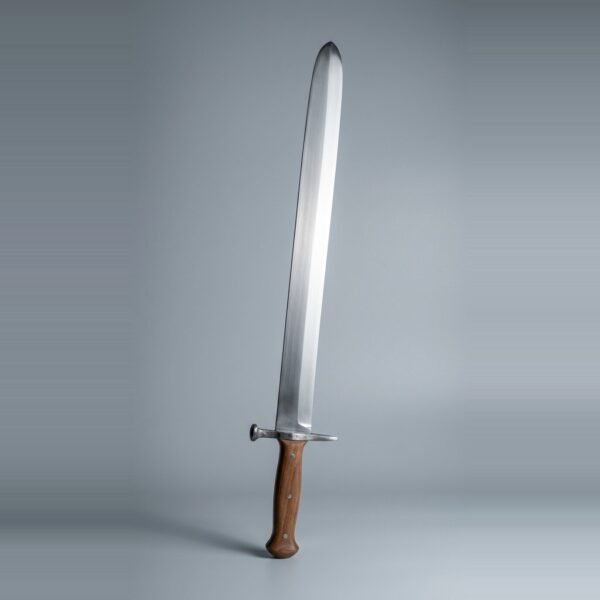
Collectors of this style may like the Torvhaug langes messer, one of the four sharps in our HEMA line and not meant for sparring; our messer guide has more on it.

Got this as a gift and now I want one for myself too. Already telling my friends to check this out.