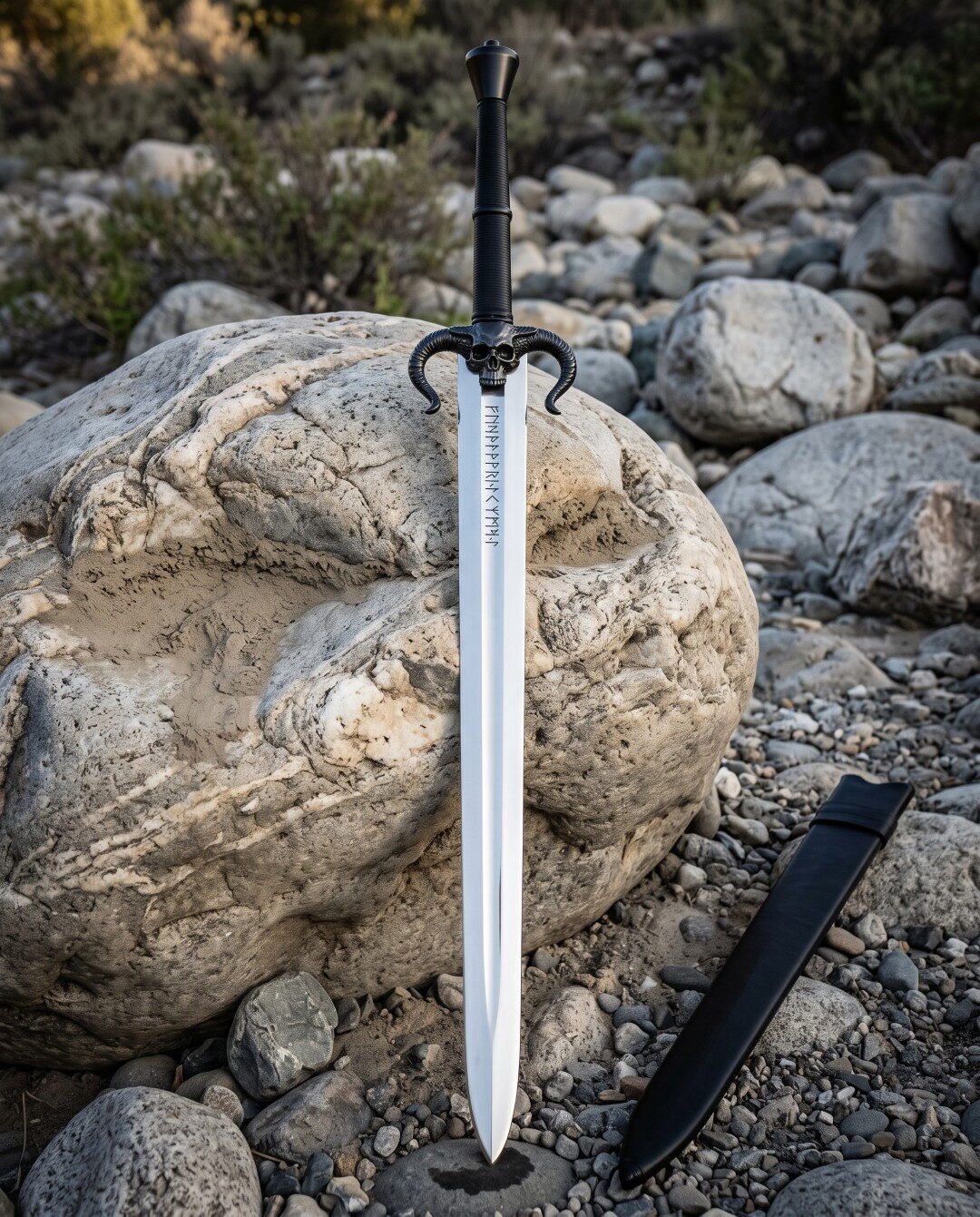
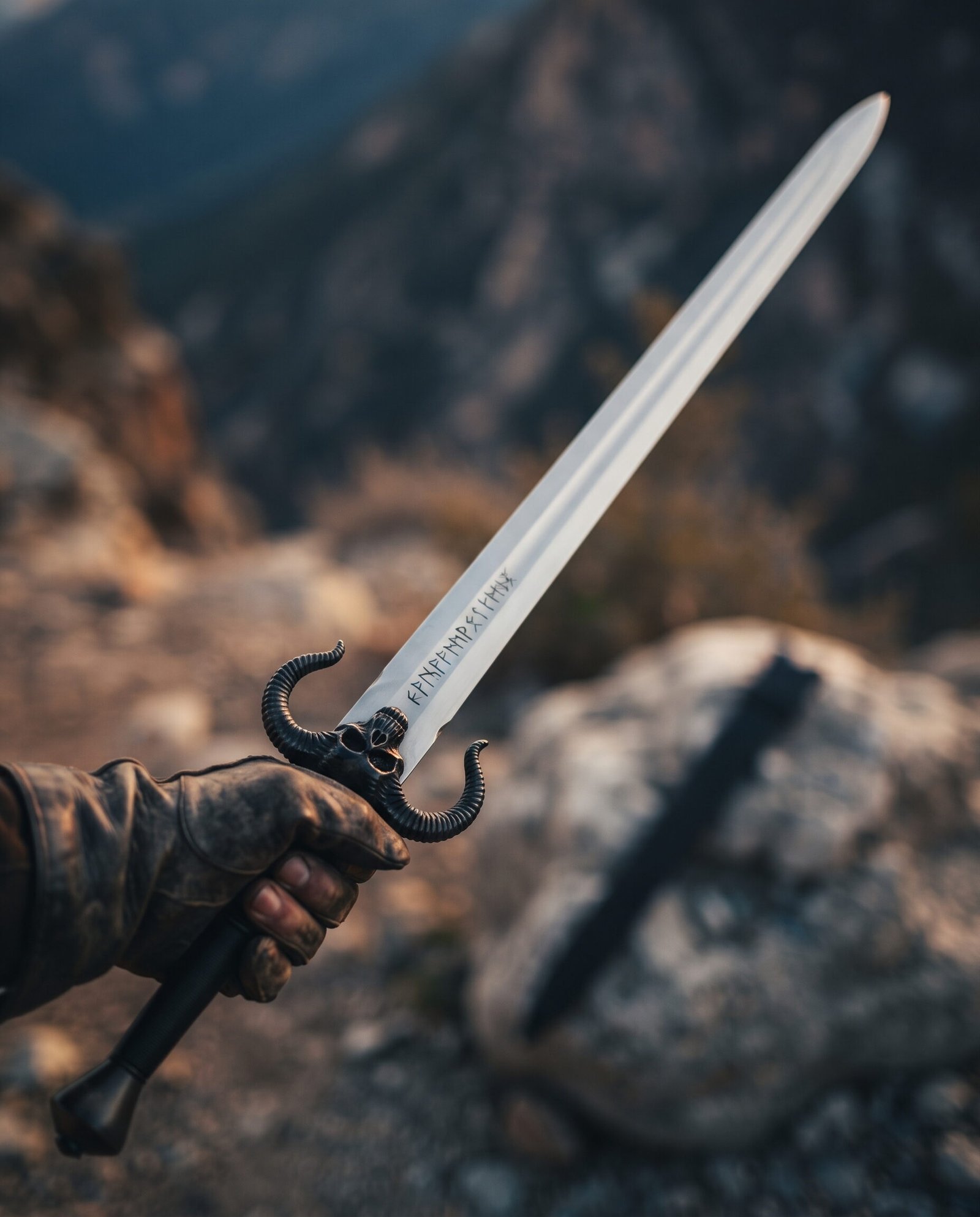
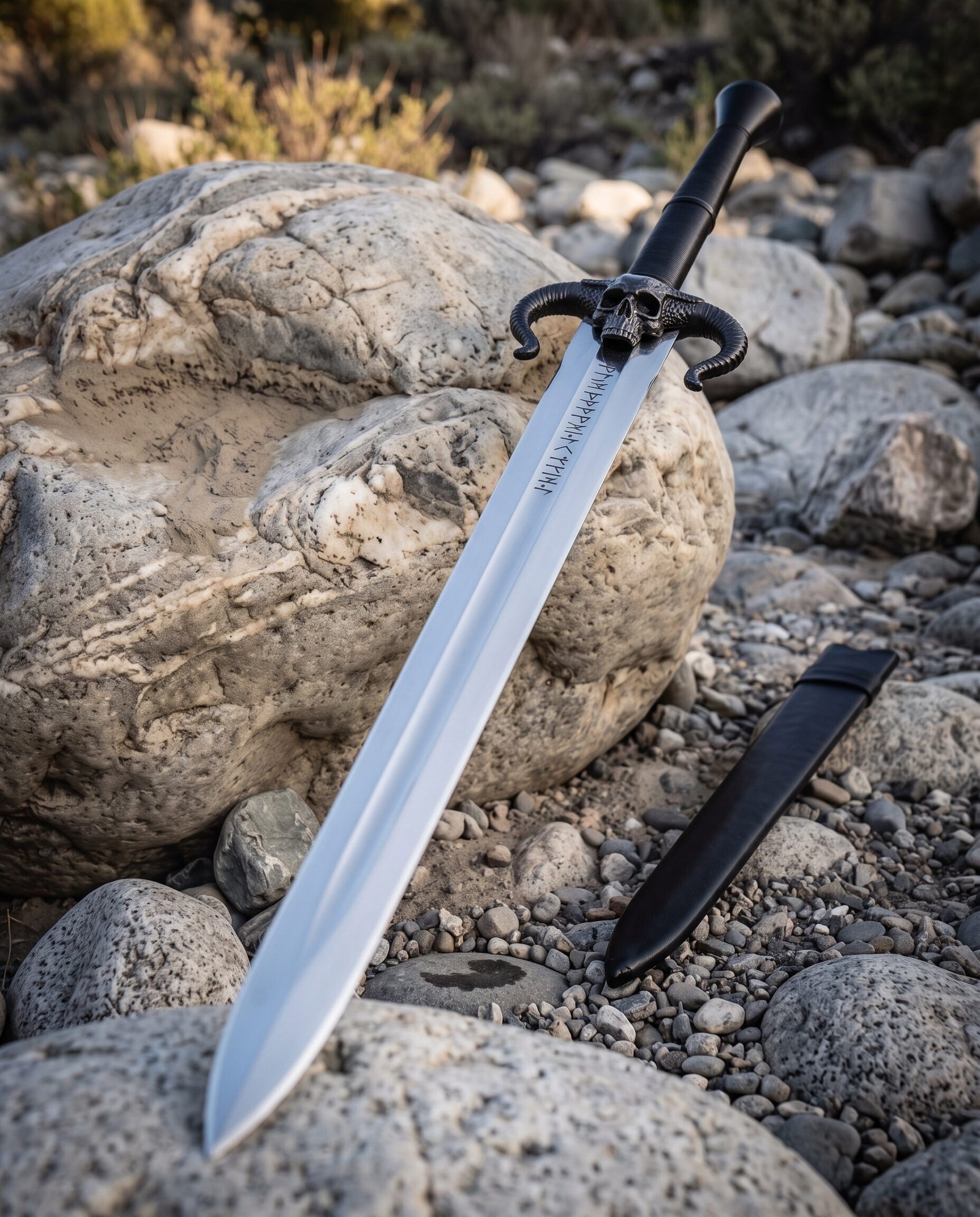
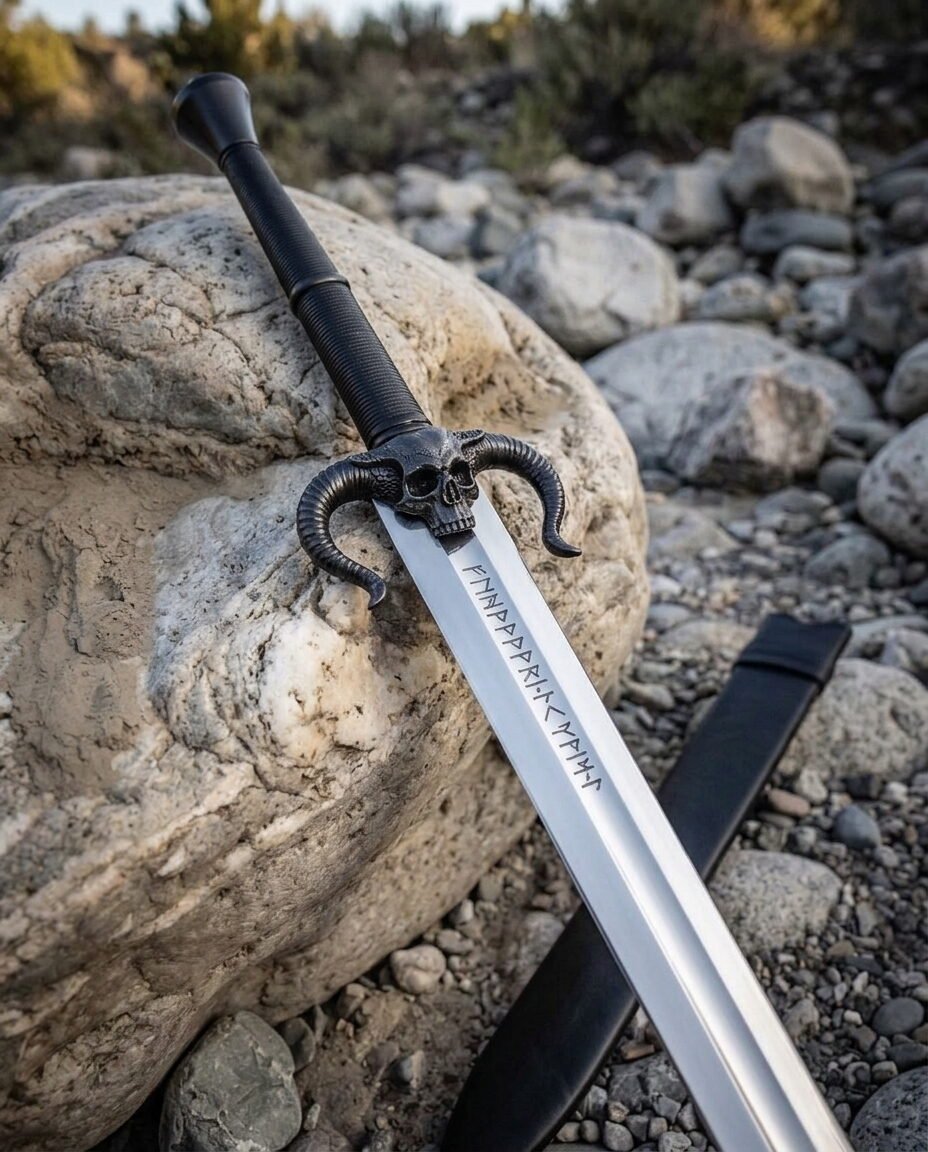
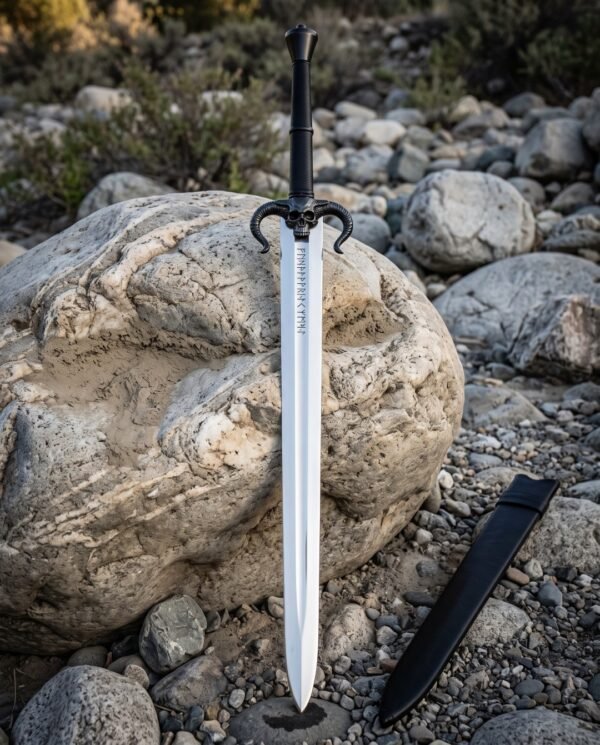
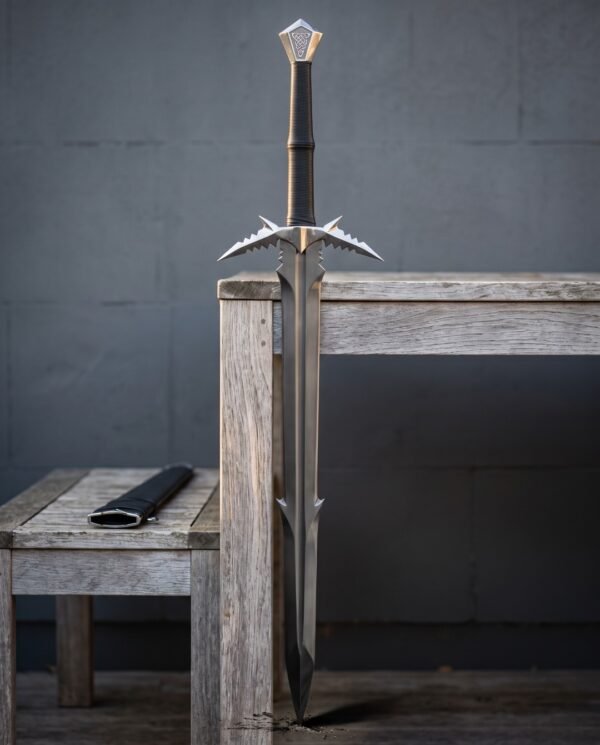
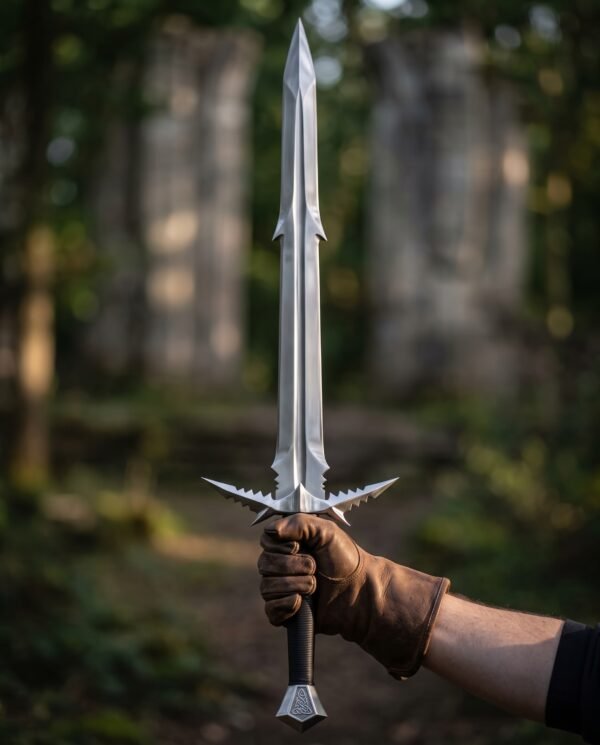
The Ramskull is a fantasy sword built around a cast hilt. A skull sits at the base of the blade with a pair of heavy ram horns curling out and down from behind it to form the quillons, and the whole assembly is finished in a deep blackened tone. Above it the grip is bound black with raised ribs and topped by an urn shaped pommel. A line of Elder Futhark runes is etched down the flat of the blade below the guard. It ships with a plain black leather scabbard.
Since the horns are the first thing anyone notices, here is a thing worth knowing. Viking warriors did not wear horned helmets. Not one horned helmet has ever been excavated from a Viking age military context. The horned helmets that do exist from Scandinavia, such as the pair from Viksoe in Denmark, are Bronze Age ceremonial objects made more than a thousand years before the Viking age began. The image we all carry around comes from a costume designer named Carl Emil Doepler who dressed Wagner’s Ring cycle in 1876. This sword is forged and assembled in the Czech Republic.
Nothing here claims to be historical, and display or battle ready is worth reading before you decide what you want it to do. For where 1095 sits on the hardness scale and what that buys you, see the steel and hardness page. If you would rather have something historical at the same length, look at the claymores.
Specifications
| Material | 1095 high carbon steel blade, hardened to 54 to 58 HRC |
|---|
| Overall length | 36 inches |
|---|
| Blade length | 28 inches, double edged with a central fuller |
|---|
| Blade finish | Bright polished with an etched Elder Futhark line below the guard |
|---|
| Guard | Cast skull with curled ram horn quillons, blackened finish |
|---|
| Grip | Long black wrap over a timber core with raised ribs, room for a hand and a half |
|---|
| Pommel | Blackened urn shaped pommel |
|---|
| Scabbard | Plain black leather over a timber core |
|---|
| Weight | About 2 lb 14 oz for the sword alone |
|---|
| SKU | RK-1945 |
|---|
Where the horns actually come from
The horned Norseman is one of the most successful pieces of invented history in the world, and unpicking it is genuinely interesting.
The real archaeology is thin and specific. Scandinavian rock carvings of the Bronze Age, around 1000 BC, show figures wearing horned headgear in what look like ritual processions. The Viksoe helmets, found in a Danish bog in 1942, are physical examples from the same period and they are ceremonial objects, far too fragile and far too top heavy for fighting. There is also a scattering of small horned figures on Migration period metalwork, again in ritual contexts.
Between those and the Viking age there is a gap of a thousand years and a complete silence in the record. The helmets that turn up in Viking age graves, such as the Gjermundbu helmet from Norway, are plain iron caps with a nasal or a spectacle guard and no horns of any kind. Contemporary writers who watched Norse armies, and there were many, never mention horns either.
What happened is that nineteenth century Romantic nationalism wanted a heroic northern past, artists supplied it, and Doepler’s Wagner costumes fixed the image permanently. That does not make horns any less good on a sword hilt. It just means a piece like this belongs to the fantasy tradition rather than the historical one, and we would rather tell you that plainly than sell you a myth as archaeology.
1095 high carbon steel and the cast hilt
The blade is 1095 hardened and tempered to 54 to 58 HRC, double edged with a central fuller taking weight out of the middle of the section. It is polished bright rather than satin, which suits a piece whose whole visual idea is a dark hilt against a light blade.
The skull and horns are cast rather than forged, because forging cannot produce undercut eye sockets, teeth or the tight inner curl of a horn. Casting the guard as one body means the horns and the block they spring from share continuous metal with no join at the root, which is where a fabricated version would fail.
The blackening is an oxide finish rather than a paint layer. It will wear on the high points, the brow of the skull, the outer curve of each horn, and the crown of the pommel, revealing a brighter tone underneath as the piece is handled. That is the finish behaving normally and on a sculpted hilt it improves the piece, because wear falls exactly where a sculptor would have highlighted.
This is our own design. It is not licensed by, endorsed by or connected to any film, game, series or franchise, and it is not a replica of any specific fictional sword.
Engraving, runes and your own design
Use the rune converter on this page to turn a name, a date or a short phrase into Elder Futhark and we will cut it into the steel, the leather or the wood. If you would rather have a Viking pattern than a rune line, choose your own design in the engraving option above the add to cart button and tell us where it goes. Where a piece already carries an engraved design, your chosen engraving replaces it rather than sitting alongside it, so a personal inscription takes the place of the existing rune line rather than being added beneath it. The scabbard leather is the alternative surface if you want the blade left as it is. See the engraving page.
Handling and display
The cast hilt puts a great deal of mass behind the hand, so the balance point sits close in at about three inches ahead of the guard and the sword feels far lighter than its weight on paper. It hangs level on a horizontal mount without the point dropping, which is exactly what you want on a display sword.
Be clear about the intended use. This is a hand forged blade with a real heat treat, sold for collecting, display, costume and photography. It is not sold for battle ready sparring, it is not built for contact work against another person or another blade, and the cast horns are decorative rather than structural. Do not test them.
For wall display use a two point horizontal mount that takes the weight under the blade near the guard and near the point, not a single hook through the horns. Hanging a sword by a cast feature is how cast features break.
Care
Keep the bright blade wiped and lightly oiled. Mineral oil or camellia oil both work. A mirror polished 1095 blade will take a fingerprint mark within days in a humid room, and the etched rune line holds moisture in its cut strokes, so dry it properly if it ever gets damp.
The blackened castings want a dry cloth and nothing abrasive. Do not use metal polish on them, because an oxide finish is thin and polish takes it off in one pass. A trace of oil wiped over the skull slows the wear on the high points if you want to keep it dark.
Feed the scabbard leather twice a year with a neutral balm and do not store the sword sheathed for long stretches. Our steel care page has the full routine for high carbon blades.
If it is going on a wall, hanging swords and axes safely covers mounts, fixings and what not to do.
Made in the Czech Republic
This is a handmade piece from the Czech Republic, made in a workshop that still forges, grinds and finishes by hand instead of stamping parts out. The smiths there have kept the older way of working, and the wood, horn and leather are shaped and fitted by hand as well. Two pieces of the same design will never be identical, and that is part of what you are buying.
Ransack Viking is a United States company. We handle the import ourselves, look over every piece when it lands and ship from our warehouse in Chicago, Illinois. Engraving is done in the United States after the piece arrives, so your design goes on before we send it out.
A note on handmade variation
This sword is hand made rather than machine made or bulk produced, so what arrives will not be a pixel for pixel copy of the photograph. Every casting is dressed and blackened by hand, so the depth of black across the skull and the crispness of the teeth, sockets and horn ridges vary from one to the next. The rune line differs slightly in weight, and the leather of the scabbard has its own grain. The dimensions, the steel, the heat treat and the build are the same every time. The character is not.
Frequently asked questions
Did Vikings really wear horned helmets?
No. Not one has ever been found in a Viking age military context. The horned helmets from Scandinavia are Bronze Age ceremonial pieces and the popular image comes from an 1876 opera production.
Is this from a game or a film?
No. It is our own design, unlicensed and unconnected to any franchise, and it is not a replica of a specific fictional sword.
Is the blade real steel?
Yes, hand forged 1095 with a genuine heat treat. It is still sold as a display and collector piece, because the cast hilt is not built to absorb impact.
Does it arrive sharp?
It ships with a working edge by default. Many buyers hanging it on a wall ask for it blunt, and we will do that free of charge if you say so in the order notes.
What do the runes say?
The line as supplied is the Elder Futhark alphabet in its traditional order. Order a personal inscription and yours replaces it.
How should I hang it?
On a two point horizontal mount supporting the blade, never on a single hook through a horn. Cast features are for looking at, not for load bearing.
What is in the box
- One Ramskull horned skull sword with a 1095 high carbon steel blade
- One fitted plain black leather scabbard
- A protective film of oil on the blade for transit
- Care notes for polished high carbon steel, blackened castings and leather
- Lifetime warranty against defects in forging, grind, heat treat and fittings
- Forged and finished in the Czech Republic
Explore the range
More display steel: fantasy and movie swords, swords, sword stands and displays and engraved and personalised pieces. Background reading lives in the guides.
Also in this part of the catalogue
A near match for this one is the Boneclasp movie sword, 32 inches overall. Closest to this in the range is the Dawnhollow movie sword, 34 inches overall. If this one is not quite right, there is the Thornreaver movie sword, 42 inches overall.
The Duneclaw scimitar covers the other half of the same kit. Or start from a blank sheet on the design your own page.


This sword fell a little short for me. Handle had some rough edges that needed sanding down myself. Blade arrived with a couple small nicks in the edge. Just an average purchase. Wouldn’t rush to buy again.