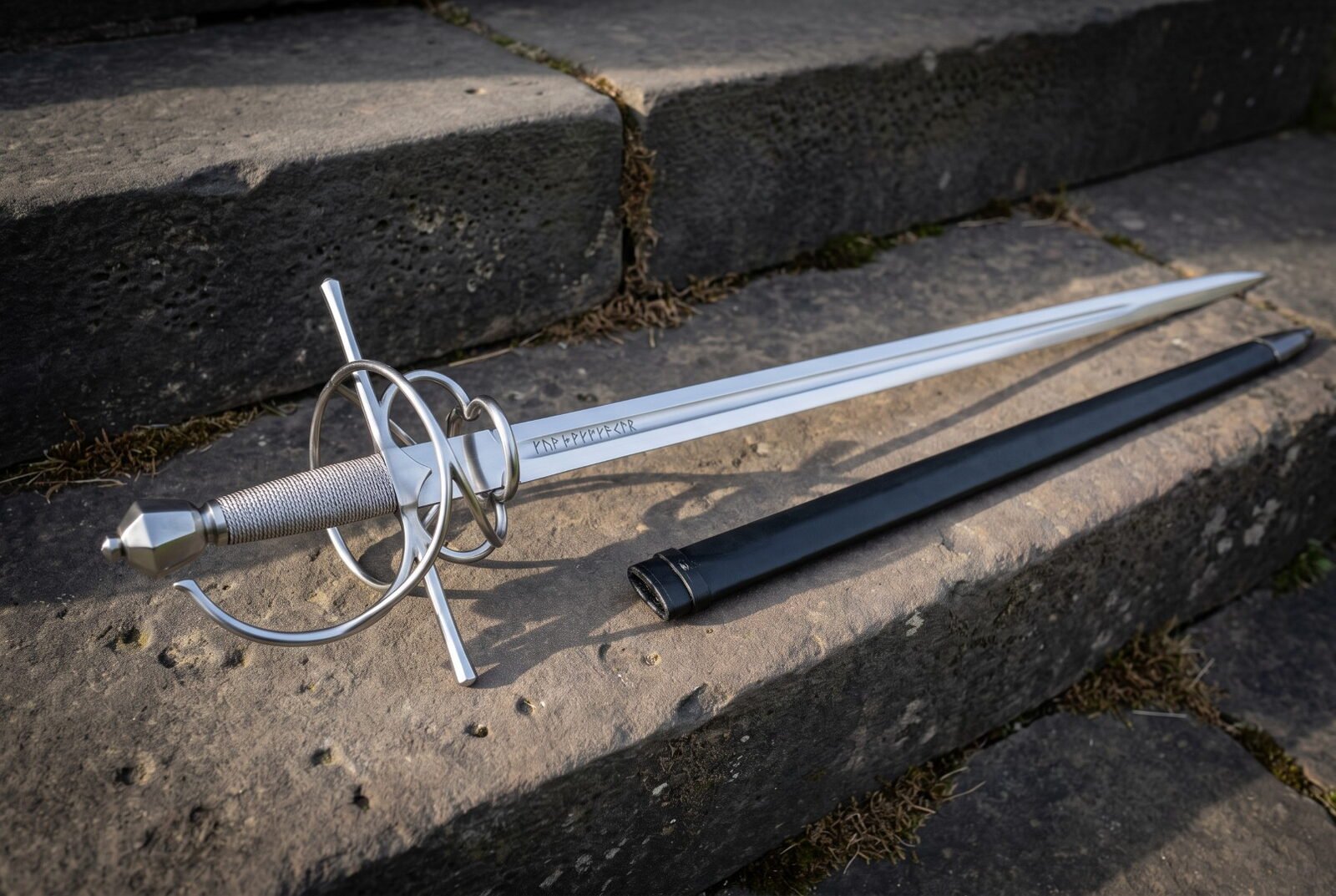
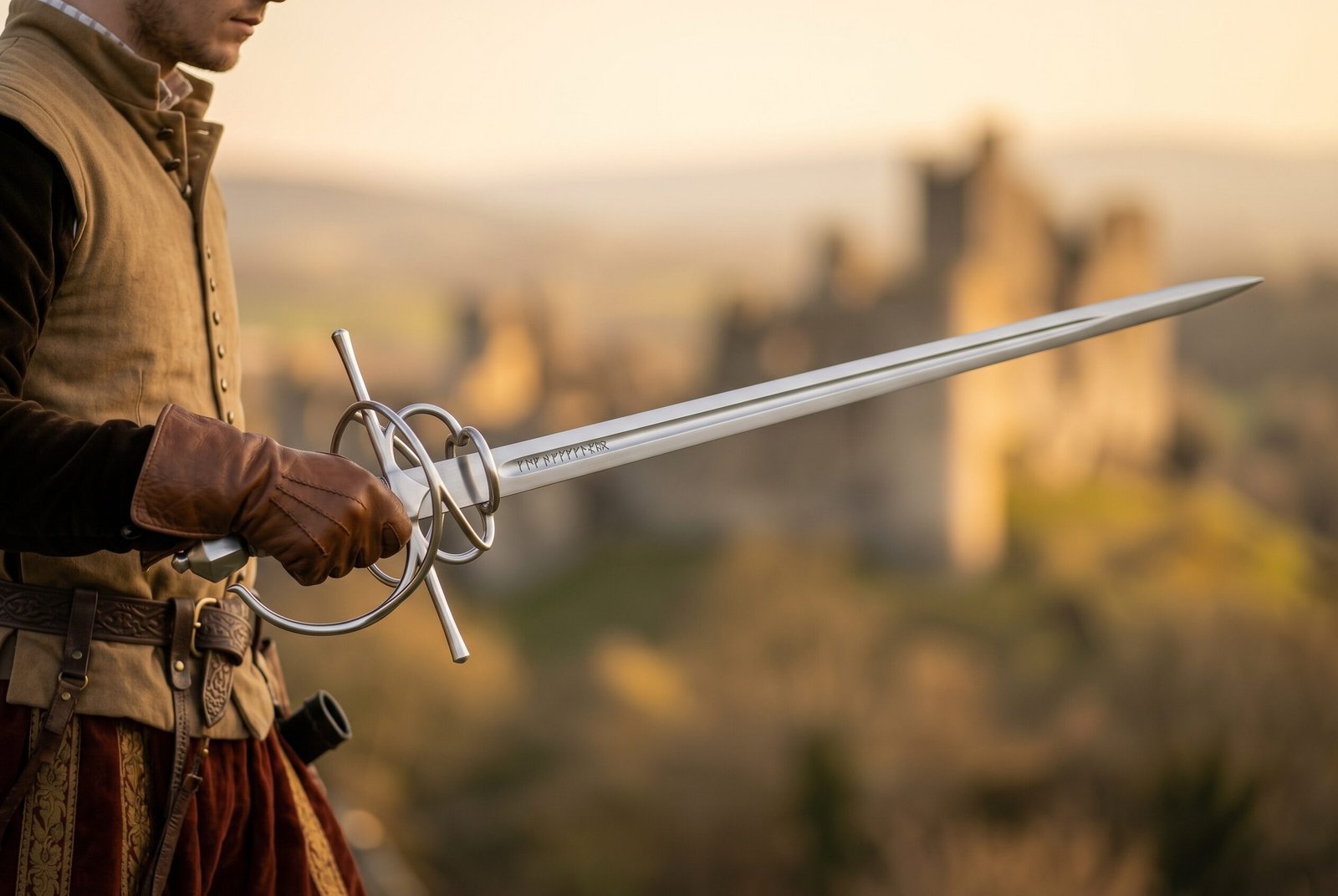
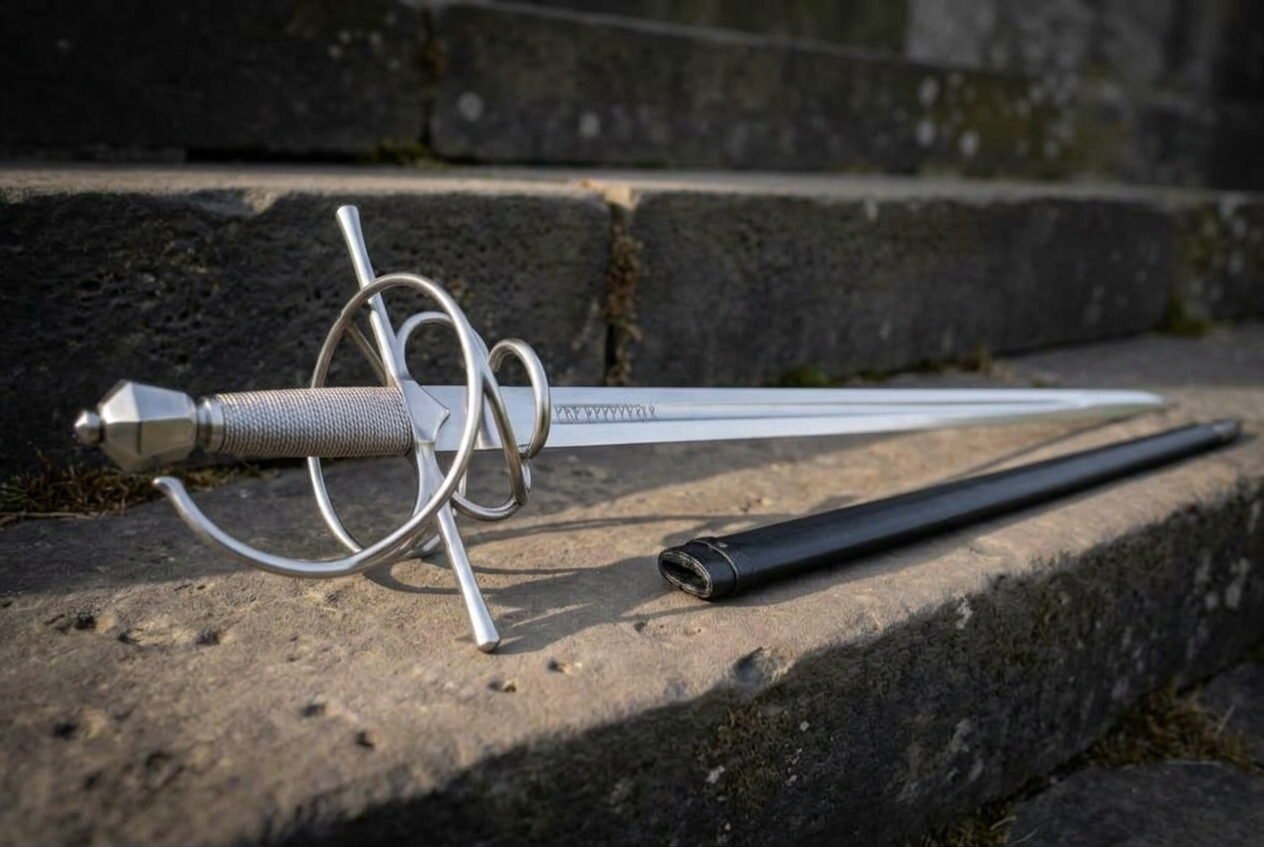
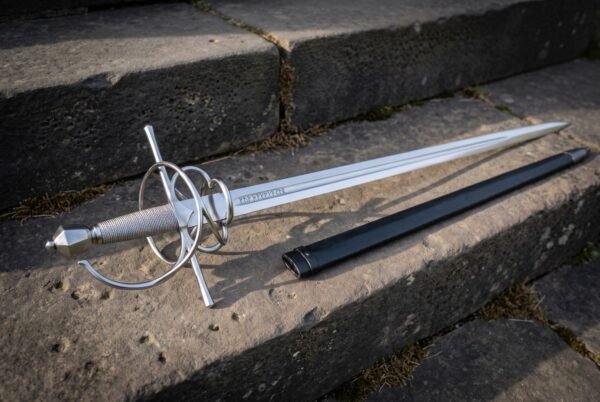
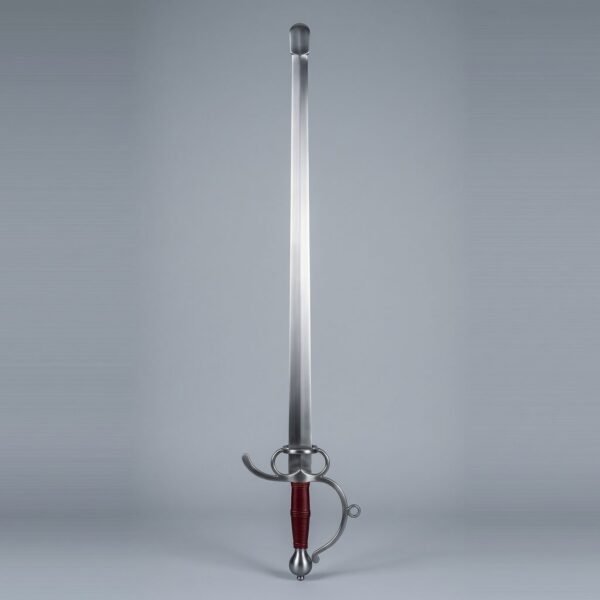
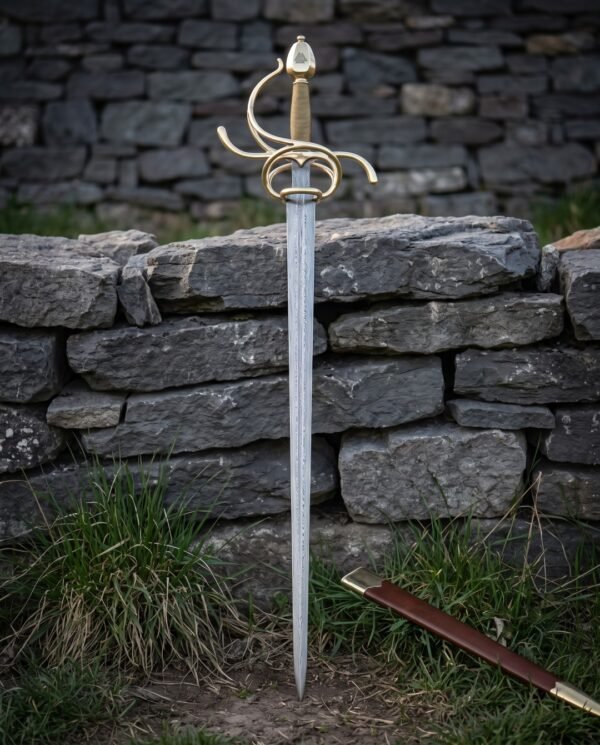
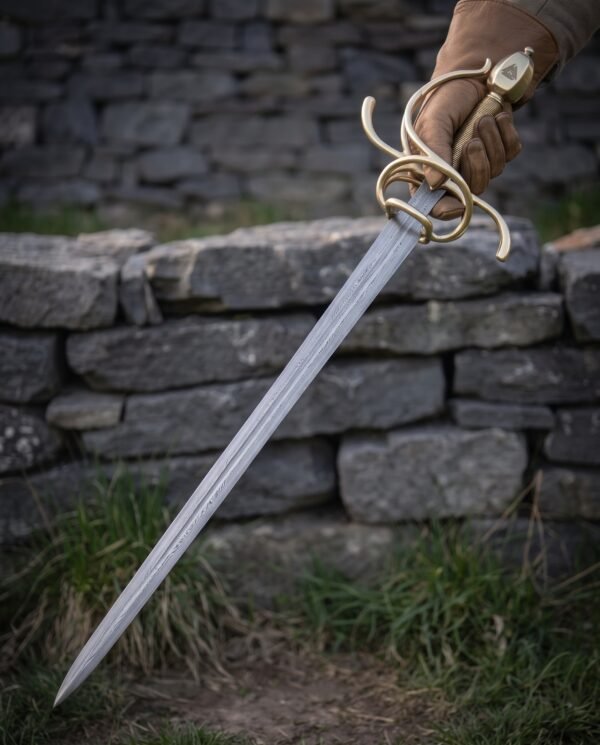
The Runecage is a swept hilt rapier with a narrow straight blade of diamond section, a wire wrapped grip and a faceted steel pommel. The hilt is built from a long knuckle bow, a pair of side rings and two straight quillons, all in bright polished steel, so the hand sits inside a cage of curved bars rather than behind a flat cross. A line of Elder Futhark runes is etched into the flat of the blade just above the guard. It ships with a fitted black scabbard.
Hilts like this one exist because of a change in how people held a sword. As blades got longer and thinner and fencing moved from cutting to thrusting, fencers started hooking the index finger over the crossguard and around the base of the blade, because that grip gives far finer control of the point. It also puts a bare finger in front of the guard where an opposing blade can take it off. The swept hilt is the answer to a self inflicted problem. Every ring and bar is placed to close a line that the new grip opened up. Runecage is forged, ground, heat treated, etched and assembled by hand in the Czech Republic, and it comes with its scabbard.
A rapier is built around the point rather than the edge, and how to buy a first sword covers what that means for a buyer. Elder Futhark is where these marks come from, and the full rune chart tells you what is actually cut into the steel. Cutting blades with a similar guard sit in the sabres.
Specifications
| Material | 1095 high carbon steel, hardened to 54 to 58 HRC |
|---|
| Overall length | Approximately 42 inches |
|---|
| Blade length | Approximately 35 inches, straight, narrow diamond section |
|---|
| Handle | Approximately 4 inch grip, twisted steel wire over a shaped core |
|---|
| Guard | Swept bright steel hilt with a knuckle bow, side rings and long straight quillons |
|---|
| Pommel | Faceted steel pommel, peened over the tang |
|---|
| Engraving | Elder Futhark rune line etched on the blade flat above the guard |
|---|
| Scabbard | Black leather over a shaped core with a steel throat and chape |
|---|
| Finish | Bright hand polished blade and hilt |
|---|
| Weight | Approximately 2 lb 6 oz bare |
|---|
| Included | Rapier, fitted scabbard, care card |
|---|
| SKU | RK-1975 |
|---|
Reading the swept hilt
Look at the hilt from the side and you can trace what each part does. The knuckle bow is the long bar running from the quillon down to the pommel. It stops a descending cut from landing across the back of your hand and it also gives you something to hook a thumb against when you want the blade to stay put. The two rings stand out at right angles to the quillons and cover the gap in front of the guard, which is where a fingered index would otherwise be exposed. The quillons themselves are still there because a crossbar is still the best tool for catching and turning an incoming blade at the strong.
The word rapier arrives in English in the sixteenth century, probably from the Spanish espada ropera, the sword worn with civilian clothes rather than armour. That is the important context. This is a town sword, not a battlefield one. It was designed for unarmoured opponents at close conversational distance, which is why it favours the point over the edge, why it is long enough to keep an opponent out, and why so much care went into protecting a hand that has no gauntlet on it.
The steel and the wire grip
The blade is 1095 high carbon steel, tempered to 54 to 58 HRC. On a blade this narrow and this long, toughness matters more than on almost any other sword shape, because a thin diamond section will flex a great deal in normal handling and a hard brittle blade would take a set or snap. At this hardness the blade springs back rather than bending permanently. The section is a shallow diamond, thickest along the centre line, which is what gives a narrow bar of steel enough stiffness to drive a thrust without whipping.
The grip is a shaped core wrapped tightly in twisted steel wire. Wire was the standard for this class of sword and it is a genuinely good solution. It never gets slippery when a palm sweats, it cannot rot or absorb sweat the way leather does, and the ridges give a strong tactile sense of blade alignment through the hand. It also survives handling by hundreds of visitors at a show, which is why so many museum pieces still have their original wrap.
Engraving, runes and your own design
Use the rune converter on this page to turn a name, a date or a short phrase into Elder Futhark and we will cut it into the steel, the leather or the wood. If you would rather have a Viking pattern than a rune line, choose your own design in the engraving option above the add to cart button and tell us where it goes. Where a piece already carries an engraved design, your chosen engraving replaces it rather than sitting alongside it. This blade already carries the Futhark row above the guard, so if you order your own text there it takes the place of the standard line rather than joining it. The other side of the blade is free if you want both. See the engraving page for lettering sizes.
Handling and balance
The balance sits close to the hand, around two to three inches ahead of the guard, which is much further back than on a cutting sword and is what a thrusting sword needs. The result is that the sword pivots almost around your wrist. Small movements at the hand become large ones at the point, so aiming is quick and correcting is quicker. The cost is that it has very little forward mass to carry a cut, and it is not meant to have any.
The classic grip is thumb and forefinger pinching the flats just below the guard, index finger hooked over the quillon inside the ring, and the remaining fingers loose on the grip. Held that way the sword feels like an extension of your forearm. This is a sharp functional blade for display and solo handling. It is not a fencing trainer, it has no blunted tip and no flexible foible, and it must never be used against another person or another blade.
Care
A bright polished blade shows every fingerprint and carbon steel turns those prints into permanent etched marks within a day or two. Wipe the blade every time you put it down and keep a light film of oil on it. The hilt needs the same attention and is harder to reach, so use a rag over a chopstick or a cotton bud to get oil into the inside of the rings and the join between the bars, which is where rust starts on a swept hilt.
The wire grip should be brushed rather than oiled, since oil in the wire holds dust. A soft brass brush used gently along the wire keeps it clean. Feed the leather scabbard with a neutral cream twice a year and store the sword out of it in a humid climate. Full guidance is on our steel care page.
If it is going on a wall, hanging swords and axes safely covers mounts, fixings and what not to do.
Made in the Czech Republic
Every piece we sell is made by hand in the Czech Republic. The smiths there work the way the trade has been worked for a long time, heating and hammering the steel, taking the bevels down by eye, and fitting the handle and the leather one at a time. There is no automated line anywhere in it, so small differences from one piece to the next are normal and expected.
Ransack Viking is a United States company based in Chicago, Illinois. We bring the pieces in ourselves, inspect them on arrival and ship them from our own warehouse. If you add engraving, that is carried out here in the United States before your order goes out.
A note on handmade variation
This rapier is hand made rather than machine made or bulk produced, so what arrives will not be a pixel for pixel copy of the photograph. The sweep of the bars is formed by hand over a former, so the exact curve and the spacing of the rings differ slightly from one hilt to the next. The etched rune line varies a little in depth. The polish carries faint hand finishing lines under raking light and the leather of the scabbard takes dye differently across a hide. The dimensions, the material and the build are the same every time. The character is not.
Frequently asked questions
Can I fence with this
No. It is a sharp sword with a live point and a rigid blade. Fencing needs a blunt trainer with a flexible foible and a button. Use this for display and solo handling only.
What do the runes on the blade say
The standard etch is the Elder Futhark row itself, the twenty four character alphabet in its traditional order. If you want words instead, use the rune converter on this page and we will cut yours in place of it.
Is the tip sharp
Yes, the point is finished sharp because a blunt tipped rapier looks wrong. Tell us in the order notes if you would rather it were rounded off for a household with children.
Will the wire grip come loose
It is wound under tension and secured at both ends under the collars, so it should not. If a turn ever lifts, send us a photograph and we will sort it under the lifetime warranty.
How flexible is the blade
It has noticeable spring, which is correct for a narrow thrusting blade. It flexes and returns straight. If a blade of this shape were stiff enough not to move it would be brittle enough to break.
When will it ship
One to two weeks of processing because each hilt is fitted by hand, then free tracked shipping inside the US from Chicago.
What is in the box
- Runecage swept hilt rapier with the Futhark etch
- Fitted black scabbard with a steel throat and chape
- Care card and lifetime warranty note
- Forged and finished in the Czech Republic
Explore the range
See more in swords, arming swords, short swords and scabbards and sheaths, or read the guides.
Near neighbours in the shop
Sitting beside it in the catalogue is the Brassguard sword, 30 inches overall. Another in the same line is the Leatherspine sword, 30 inches overall. Next along the rack is the Shortfell sword, 23 inches overall.
Fitting out further, the Petalward rapier belongs with it. You can have this made your way instead on the custom Viking sword page.



Reviews
There are no reviews yet