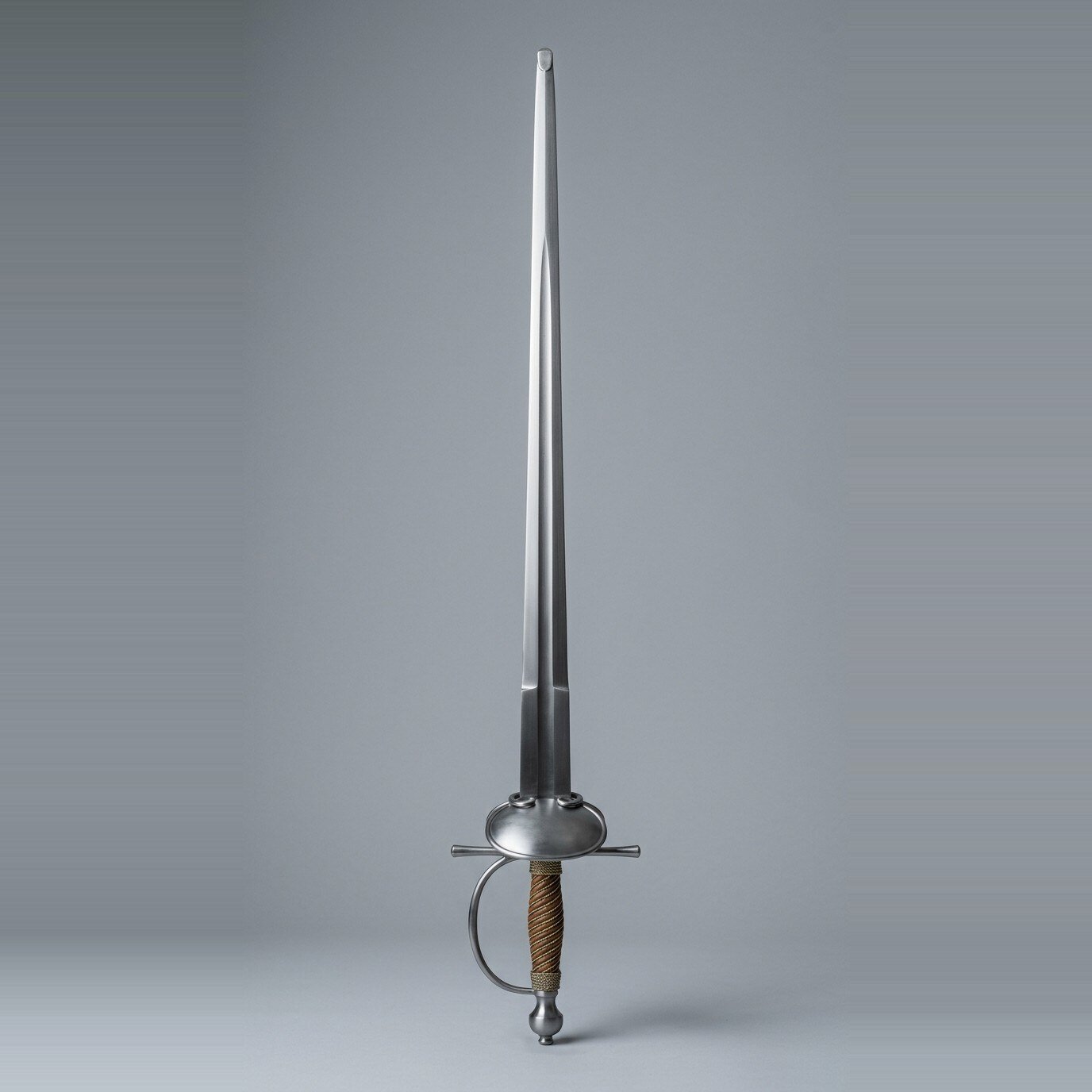
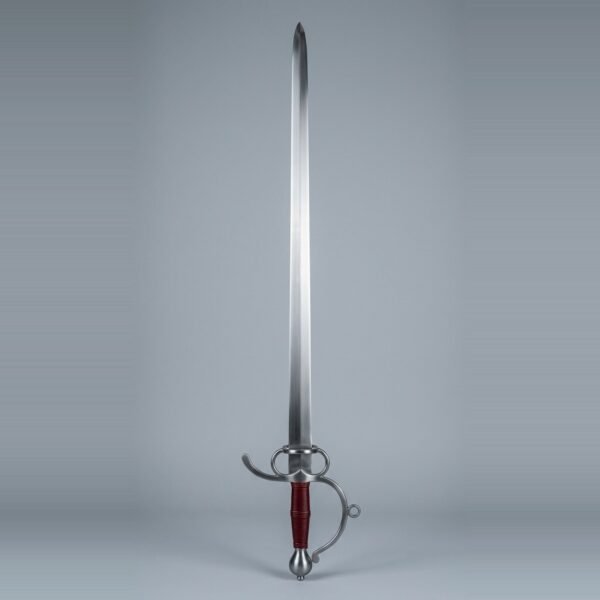
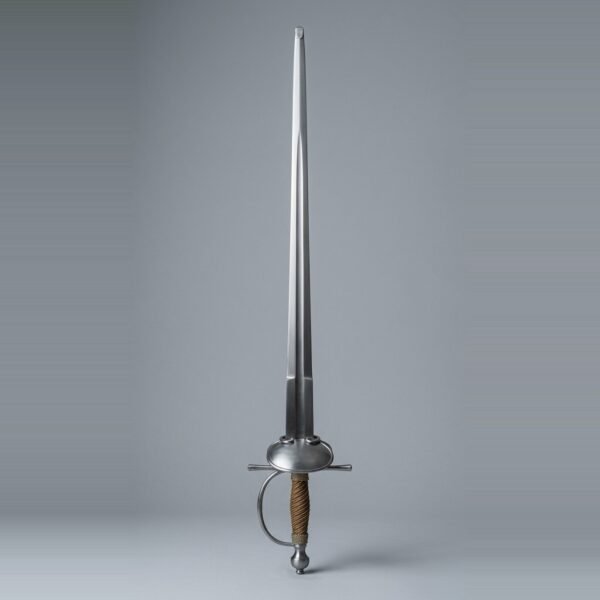
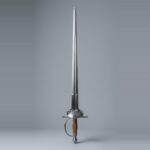
The smallsword is the end of the line for the civilian sword and the beginning of modern fencing. Everything unnecessary has been taken off it. The guard is a plain oval dish with the arms of the hilt beneath, the quillon is a stub, the pommel is a small urn and the blade is short, narrow and built to do one thing properly.
This one carries a stepped forte, the visible change of section just ahead of the hilt where the blade is at its thickest before it thins away to the point. The grip is brass wire over a shaped core, tight enough to hold a fingered grip through a long bout. It is blunted 51CrV4 spring steel throughout. About 39 inches overall, hand made so it varies a little piece to piece.
If you are deciding between this and a rapier, read the smallsword and spadroon guide and then how to choose your first HEMA sword, because they suit very different clubs. The rest of the shelf is in smallswords and spadroons.
Specifications
What we can state without guessing. Lengths are approximate because every one is forged and fitted by hand.
| Material | 51CrV4 spring steel, hardened to 49 to 52 HRC |
|---|
| Overall length | About 39 inches, hand made so it varies a little piece to piece |
|---|
| Blade length | About 32 inches |
|---|
| Blade type | Narrow thrusting blade with a stepped forte, thinning hard to the point |
|---|
| Edge | Blunted, about 3 mm flat land, not sharpened |
|---|
| Tip | Blunted and rounded off, not a spatulated tournament tip |
|---|
| Guard | Plain oval dish, undecorated, with a short rear quillon |
|---|
| Arms of the hilt | Twin loops beneath the dish, the pas d’ane, for the fingers |
|---|
| Pommel | Urn shaped, peened over the tang |
|---|
| Grip | Brass wire wrapped over a shaped core |
|---|
| Flex | Light to medium, with the give held in the last third |
|---|
| Included | The smallsword only. No scabbard and no tip protector |
|---|
| SKU | RK-3025 |
|---|
The smallsword and the fencing that came out of it
By the early eighteenth century the rapier had shortened, lightened and lost its cutting pretensions, and what was left was the smallsword. It was worn with civilian dress across Europe and it was the sword the great fencing masters taught: L’Abbat, Girard, and above all Domenico Angelo, whose plates of 1763 are still the clearest instruction anyone has drawn for a thrusting sword.
The system is narrow and deep. There are no cuts worth the name, so everything is engagement, disengagement, the feint and the parry riposte, fenced in a single line with the body in profile. The lunge as modern fencers know it comes from here, and so do the parry numbers. Anyone who has done sport foil will recognise most of the vocabulary immediately, which makes the smallsword a very fast sword to pick up and a very slow one to master.
In a HEMA club today the smallsword usually turns up late, after longsword and after rapier, and it tends to convert the people who try it. The measure is short, the exchanges are fast and the margin for a sloppy parry is very small. It is also the cheapest sword in the tradition to kit up for, because the mask and a light jacket cover most of what the rules ask.
The arms of the hilt, the twin loops beneath the dish that the French call the pas d’ane, are the reason the grip works. Two fingers go over the block and through the loops, the dish covers them, and the point becomes an extension of the forefinger rather than something held at arm’s length. Take the loops away and the whole system of fine point control loses its anchor.
The stepped forte, the section and the flex a smallsword needs
51CrV4 spring steel at 49 to 52 HRC. A smallsword blade is the thinnest thing we make, and thin blades under a hard parry are precisely what a spring temper is for. It bends and returns rather than taking a set. We reserve 1095 at 54 to 58 HRC for the cutting swords, where hardness pays for itself and nobody is leaning on the blade.
The stepped forte is not decoration. The blade is at its thickest and stiffest immediately ahead of the hilt, where every parry lands, then steps down and thins away so the last third can flex. That is the whole engineering of a smallsword in one feature, and it is why a well made one feels stiff in the bind and soft at the point at the same time.
Flex here is the light to medium tier. A smallsword is fenced with the point at the body constantly, so too stiff a blade is genuinely unpleasant to receive and too soft a one will not hold a parry. Sitting at the lower end of the range is the right answer for the type. The tiers and what they mean are set out in HEMA sword flex explained.
Engraving, runes and your own design
Use the rune converter on this page to turn a name, a date or a short phrase into Elder Futhark and we will cut it into the steel or the grip. If you would rather have your own design than a rune line, choose your own design in the engraving option above the add to cart button and tell us where it goes. Where a piece already carries an engraved design, your chosen engraving replaces it rather than sitting alongside it. More on the engraving page.
The plain oval dish is the single best engraving surface in this batch. There is no piercing or chiselling to work around, so a rune line, a monogram or a family crest sits cleanly in the middle of it. The urn pommel will take a short mark as well. Tell us which and we will orient it to read with the sword point up.
Handling and balance
Two fingers through the arms of the hilt, the thumb flat on the block and the last two fingers loose on the wire. From there the sword steers off the fingers rather than the wrist and the point sits very still. The urn pommel is small, so the balance is closer to the hand than any other sword in this batch, and it changes line almost without being asked.
It is light in the hand and light on the arm, which is exactly why smallsword bouts run longer than longsword bouts. We do not publish a weight or a point of balance, because every one is finished by hand and a printed figure would be a guess dressed up as a specification.
Care
Wipe the blade after every session. The place that rusts on a smallsword is the underside of the dish and the inside of the arms of the hilt, where the fingers sit and where a cloth does not naturally go. Work a rag with mineral or camellia oil into both loops.
Brass wire will dull over time, which most owners prefer to a polished look. If you want it bright, a soft cloth is enough and brass polish is not needed. Check the pommel peen every few months by twisting the grip gently, because a hand fitted hilt settles in its first season and a loose pommel is felt straight away in the point. The full routine is in the knife care guide.
Made in the Czech Republic
Made by hand in the Czech Republic and imported by Ransack Viking. Nothing here is drop shipped out of an importer catalogue straight to a customer. Every one is checked for hilt tightness, pommel seating and blade straightness at our North Babylon, New York warehouse, and ships from there. Shipping in the United States is free, returns run for seven days, and the lifetime warranty against defects in the forging, the grind, the heat treat and the fittings has no end date and needs no receipt.
The smallswords and rapiers here come off the same bench, so the wire wrapping and the dish finishing match across the range. Two pieces bought together will read as a pair.
A note on handmade variation
This is hand forged. It is not machine made, not cast and not bulk produced, so what arrives will not be a pixel for pixel copy of the photograph on this page.
On a smallsword that shows in the exact oval of the dish, the pitch of the brass wire and the height of the step at the forte. The blade section, the length and the flex tier stay consistent. The hand work does not, and that is the reason to buy one made by a person.
Frequently asked questions
What is the difference between this and a spadroon
A spadroon has a proper cutting edge and is fenced with cuts as well as thrusts. A smallsword is a thrusting sword only. If you want both, the spadroons on the same shelf are the ones to look at.
Is it sharp
No. It is a blunt trainer with a flat land on the edge and a rounded point. It is made for drill and sparring, not for cutting.
What are the loops under the guard for
They are the arms of the hilt, the pas d’ane. Two fingers pass over the block and through them, which is what gives a smallsword its point control.
Is it tournament ready
Check the ruleset you are entering. The Berlin HEMA Cup asks for a spatulated or rolled tip of at least 1.5 cm and this point is blunted and rounded rather than spatulated, so a tip protector may be required. We never claim legality without naming the rules.
Does a scabbard come with it
No. Nothing in this batch ships with a scabbard.
Can it be personalised
Yes. Elder Futhark runes or your own design, engraved in the United States after arrival. Text and runes are 19 dollars, a symbol 39 dollars, a family crest 49 dollars.
What is in the box
- One Lindmoor smallsword, about 39 inches overall
- A light coat of protective oil on the blade for transit
- Care and warranty details for the piece
- Ransack Viking packaging, inspected and shipped from North Babylon, New York
Explore the range
The rest of the point work is in smallswords and spadroons and HEMA rapiers. For a cutting hand, look at HEMA sabres or the wider rapiers shelf. The writing is collected in the guides hub.
If this one is not it
Close in size and role you have Hrafnstede smallsword, about 39 inches overall, Orlunde spadroon, about 38 inches overall, Skaldrun spadroon, about 37 inches overall and Corvalde rapier, about 48 inches overall to compare against this one.
The full smallsword and spadroon category and the wider HEMA sword hub hold the rest of the line, and you can specify your own on the custom sword builder.








Reviews
There are no reviews yet