Blog
Viking Food: What a Midwinter Feast Actually Looked Like

Viking food was mostly porridge, bread, dairy, fish and whatever meat the farm could spare, kept through the winter by drying, salting, smoking and souring. A midwinter feast was the moment that changed. Animals that could not be fed through the winter were slaughtered, ale was brewed, and a hall full of people ate boiled meat and drank until the supply ran out. Below is what archaeology and the sagas actually tell us about the everyday table and the feast, and where the evidence gets thin.
The sources are of two kinds. Archaeology gives us bones, seeds, charred bread and cooking pots, which are reliable and say nothing about manners. The sagas give us manners, written down in Christian Iceland in the thirteenth century, which are vivid and sometimes less reliable. The best picture comes from using both and trusting neither too much.
Viking food at a glance
| Food | How it was eaten | How we know |
|---|---|---|
| Barley, oats, rye | Porridge daily, flatbread, malt for ale | Seeds from settlements, charred bread from graves |
| Beef, mutton, goat, pork | Mostly boiled, some roasted, much salted or dried | Animal bones from farms and towns |
| Horse | Eaten at sacrificial feasts | Snorri’s sagas, Icelandic conversion law, butchered bones |
| Fish | Dried cod, herring, freshwater fish | Fish bones, ancient DNA, isotopes in skeletons |
| Milk, butter, cheese, skyr, whey | Daily staples, whey used to preserve | Sagas, dairy residues, Icelandic tradition |
| Peas, beans, cabbage, onions, angelica | Pottage and flavouring | Plant remains, later law codes |
| Berries, apples, hazelnuts | Gathered wild | Oseberg ship burial and settlement finds |
| Ale, mead, imported wine | Ale for everyone, mead and wine for the wealthy | Sagas, poetry, drinking vessels in graves |
The everyday table
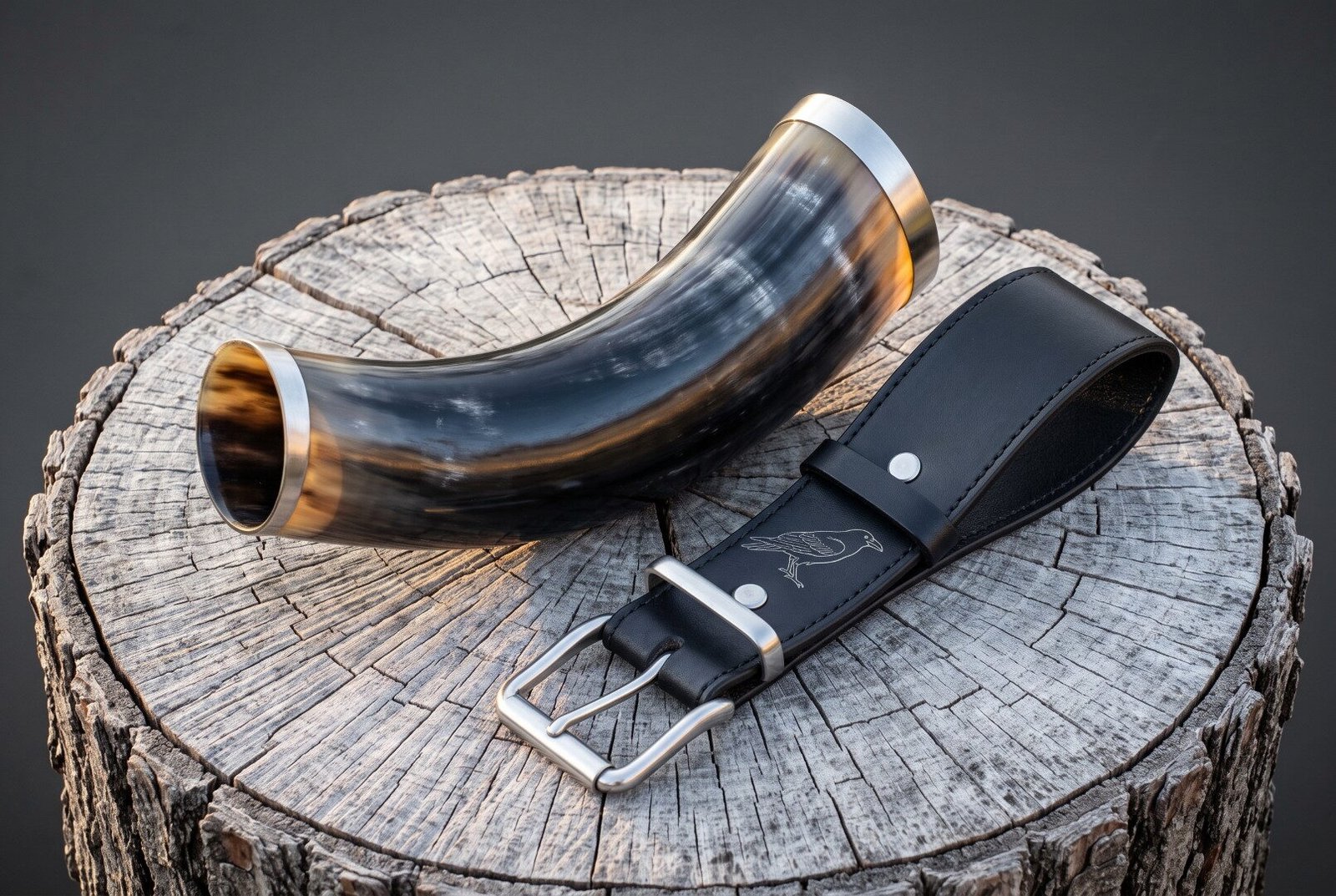
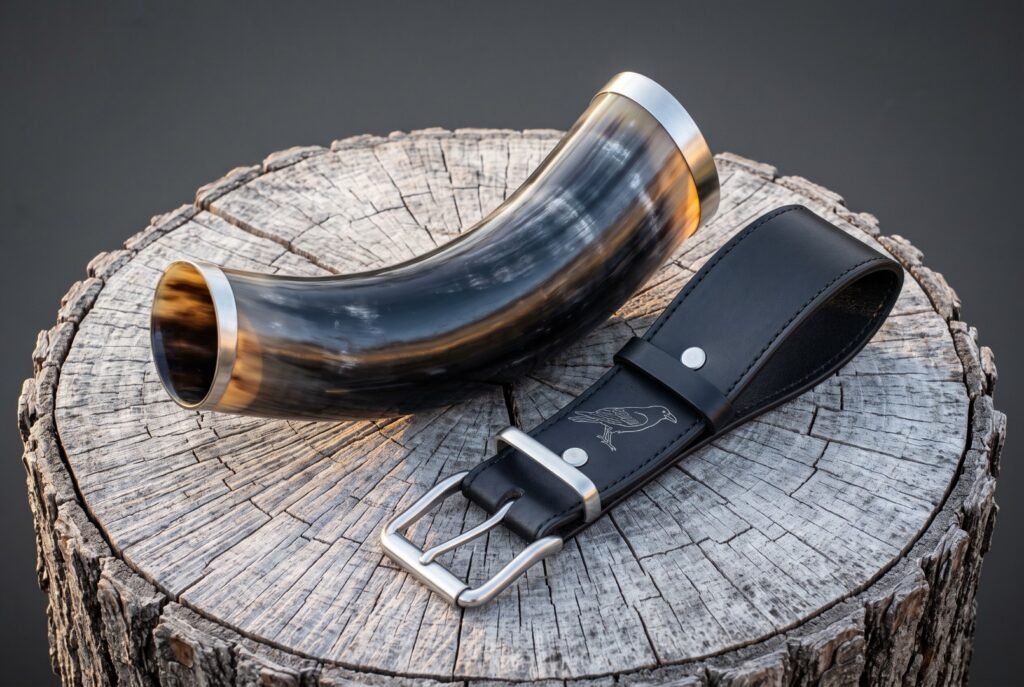
 Draughtraven Hand Made Viking Drinking Horn and Leather Belt Hanger | Natural Ox Horn | Polished Steel Rim and Tip Band with Engraved Raven Strap | Norse Feast Gift | RK-1672
 Hornmead Hand Made Viking Drinking Horn with Polished Brass Rim | Roughly 14 to 16 Inches Along the Curve | Vegvisir Stamped Leather Belt Hanger | Norse Mead Gift | RK-1711
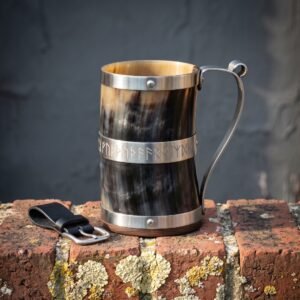 Hornmoot Hand Made Ox Horn Tankard with Rune Engraved Steel Band | Full Pint Drinking Vessel | Stainless Bands and Wooden Base and Leather Belt Hanger | Norse Mead Gift | RK-1611
Two meals a day
The sagas mention two main meals, dagmál, the day meal, taken in the morning after the first work of the day, and náttmál, the night meal, in the evening. Whether everyone kept to that neatly is anyone’s guess, since farm work does not care much for timetables, but it is the pattern the texts assume.
Grain, porridge and bread
Barley was the main crop across most of Scandinavia, with oats and rye alongside it and wheat grown where the climate allowed, mostly in the south. Most of it went into porridge, which was the daily food of almost everyone and is about as exciting as it sounds. Bread was usually flat and unleavened or lightly risen, baked on a griddle or a hot stone. Charred loaves found in graves at Birka in Sweden were mostly made of barley, and some had peas or flax seed worked into the dough. Fine wheat bread was a luxury, which is why it turns up in the poem Rígsþula on the table of the wealthy household and not the poor one.
Dairy, all day long
Milk was more often turned into something that kept. Butter, soft cheeses and skyr, a thick cultured milk product still eaten in Iceland, were everyday food. The sour whey left over, sýra, was drunk thinned with water and was also used to preserve. In Egil’s saga a stingy host serves Egil skyr and claims to have no ale, then produces ale once his guest is full of skyr. The evening ends very badly for the host. It tells you skyr was ordinary fare and ale was what a guest expected.
Fish
Along the coasts fish was as important as meat. Cod, wind dried on racks in the north of Norway into stockfish, kept for years and travelled well. Ancient DNA from cod bones found at Hedeby, the Viking Age trading town in what is now northern Germany, shows that some of that dried fish came all the way from arctic Norway. Herring was taken in huge numbers in the Baltic. Isotope studies of skeletons from coastal sites show a lot of marine protein in people’s diets, which is the scientific way of saying they ate a great deal of fish.
Vegetables and wild food
Peas and a small field bean were grown, along with cabbage and members of the onion family, and angelica was valued enough to be mentioned in later Norwegian and Icelandic law codes. Wild food filled the gaps: berries, crab apples, hazelnuts, seaweed and birds’ eggs. The Oseberg ship burial in Norway, dated to 834, held a bucket of wild apples and a store of hazelnuts among its grave goods, which is about as good as evidence for a packed lunch gets.
Preserving food for winter
A Scandinavian winter is long, and anything not stored by autumn was not going to be eaten. Most of the year’s work went into making food last.
Drying needed only cold wind and patience and suited fish especially. Smoking was used for meat and fish. Salt was valuable and had to be produced by boiling seawater or burning seaweed, so heavy salting was not cheap. In Iceland, where salt was harder still to come by, meat and fish were soured in whey, which preserves them and gives them a taste that divides opinion to this day. The Icelandic midwinter buffet of soured and cured foods served at Þorrablót is often sold as a Viking feast. The festival name is old, but the modern buffet was put together in the twentieth century, so treat the claim of an unbroken Viking menu with suspicion.
Butter could be salted and stored in wooden tubs, and grain kept dry in storehouses. Cattle were kept through winter on hay and leaves, and any animal the farm could not feed was slaughtered in autumn. That timing matters. It is the reason a midwinter feast had meat to spare, and why the feast and the slaughter season sit so close together in the calendar.
What a Viking feast actually looked like
The meat, and mostly it was boiled
The most detailed description of a pagan feast comes from Snorri’s saga of Hakon the Good. Livestock of all kinds were slaughtered, horses included. The blood was caught in bowls and sprinkled over the altars and the walls, and the meat was boiled in cauldrons over fires along the middle of the floor. Snorri was a Christian writing in the 1220s about events three centuries earlier, so the details may be his own reconstruction, but the boiling fits the archaeology. Iron cauldrons hung from chains, and in Norway soapstone cooking pots were made in large numbers. Roasting on a spit happened too, but boiling fed more people from less meat and the broth was not wasted.
Horse meat deserves a word. Eating horse was tied closely enough to pagan ritual that when Iceland accepted Christianity around the year 1000, the agreement recorded by Ari the Learned let people go on eating horse flesh in private for a while. The church later banned it outright. A Norse midwinter feast, in other words, may well have included the one dish most guests today would politely decline.
Ale, mead and the occasional wine
Ale was the drink of the feast and of ordinary days. The laws of Hakon the Good, as Snorri reports them, required every household to brew ale for Yule from a set measure of malt, and the later Christian Norwegian laws kept the same requirement for Christmas. Mead, made from fermented honey, was more expensive because honey was, and in poetry it is the drink of gods, kings and Valhalla. Wine was imported and found its way into wealthy households, sometimes with the glass to drink it from. Old Norse also has a word, bjórr, that looks like beer, but scholars disagree about what it meant, and some argue it was a strong fruit drink. Nobody knows for certain, which is a reasonable excuse to taste both.
Seating, toasts and rules
A hall feast followed an order. The host sat in the high seat, the öndvegi, with the most honoured guest placed opposite or beside him, and everyone else seated down the benches by rank. Getting the seating wrong is a reliable way to start a saga feud. Drink was carried round by the women of the household, and the sagas mention guests drinking in pairs, sharing a horn between them.
Toasts had their own order. According to Snorri the first cup was drunk to Odin for victory and power, then to Njord and Freyr for good harvests and peace, and many then drank a toast in memory of dead kinsmen, the minni. At a funeral feast the heir drank the bragafull, the chieftain’s cup, made a vow, and only then took his father’s seat. Vows made over the cup were binding and frequently regretted the next morning, which is a tradition that has survived the centuries without any help from scholars.
Drinking horns and cups
Horns were the prestige vessel. The great horns from the Sutton Hoo ship burial in England, made from aurochs horn with silver gilt fittings, belong to the seventh century and an Anglo Saxon king, but metal mounts for drinking horns turn up in Scandinavian graves too, and horns appear in the hands of women greeting riders on Gotland picture stones. Most people drank from wooden cups and bowls, and the very wealthy from glass. Everyone carried their own knife to the table, and spoons of wood or horn did the rest. Forks had not arrived yet. Our article on the Viking drinking horn covers the finds and fittings in detail.
How long it lasted
Snorri says pagan Yule lasted three nights, and Hakon’s law said the Christian feast was to be kept for as long as the ale lasted, which is a deadline anyone can respect. Weddings and funeral feasts could run for days. An outside view comes from the Arab traveller Ibn Fadlan, who met Scandinavian traders called the Rus on the Volga in 922 and wrote that they drank day and night, sometimes dying with a cup in hand. He was describing traders far from home, and he was not a sympathetic witness, but he was at least there. For the wider story of how the season was kept, see our piece on Yule traditions.
Cooking a Viking feast now
If you want to put a Viking feast on the table this winter, the evidence gives you a sensible menu. Slow boiled or braised beef, lamb or pork with barley, flatbread from a hot pan, butter, skyr or a soft cheese, smoked or dried fish, peas or beans, onions, and apples with hazelnuts at the end. Ale for everyone and mead for the toast. You can leave out the horse.
The kitchen side is easier with a proper blade. The Blockward hand forged cleaver is a tall 1095 steel blade ground thin for prep work, with a Celtic knot cut at the heel, and is $249. For carving the joint and everything else, the Hearthfold Damascus chef knife set includes an 8 inch slicer and a chef knife among its five blades and is $529. The rest are under chef knives.
For the toast, the Draughtraven drinking horn with its raven belt hanger is $149, and the Hornmoot ox horn tankard, which does stand up on its own, is $189. The full range is under drinking horns. Prices quoted are the regular prices; if a sale is running when you read this, the cart shows the current offer.
Every piece on the site is handmade in the Czech Republic by workshops that still work by hand, and imported by Ransack Viking.
Questions people ask
What did Vikings eat every day?
Mostly porridge and flatbread made from barley and oats, dairy such as butter, cheese and skyr, fish on the coasts, and meat when the farm could spare it. Peas, beans, cabbage and onions were grown, and berries, nuts and wild apples were gathered.
What was served at a Viking feast?
Boiled meat above all, from cattle, sheep, pigs and at pagan sacrificial feasts horses, with bread, dairy and plenty of ale. Mead and imported wine appeared in wealthier halls. Snorri describes the meat boiled in cauldrons over fires down the middle of the hall.
How did Vikings preserve food for winter?
By drying, smoking, salting and souring. Cod was wind dried into stockfish, meat and fish were smoked, butter was salted, and in Iceland food was soured in whey because salt was scarce. Animals that could not be fed through the winter were slaughtered in autumn.
Did Vikings drink mead or ale?
Both, but ale far more often. Ale was the everyday drink and the one the laws required for Yule. Mead needed honey, which was expensive, so it was a drink for special occasions and wealthy households, and in poetry it is the drink of the gods.
Did Vikings eat horse meat?
Yes, especially at pagan religious feasts. When Iceland converted around the year 1000, people were allowed to keep eating horse in private for a time, which shows how closely the practice was tied to the old religion. The church later banned it.
Did Vikings use forks?
No. Everyone carried a knife, and spoons of wood or horn were used for porridge and broth. Forks for eating did not reach Scandinavia until long after the Viking Age.
Shop the range
Draughtraven Hand Made Viking Drinking Horn and Leather Belt Hanger | Natural Ox Horn | Polished Steel Rim and Tip Band with Engraved Raven Strap | Norse Feast Gift | RK-1672Hornmead Hand Made Viking Drinking Horn with Polished Brass Rim | Roughly 14 to 16 Inches Along the Curve | Vegvisir Stamped Leather Belt Hanger | Norse Mead Gift | RK-1711Hornmoot Hand Made Ox Horn Tankard with Rune Engraved Steel Band | Full Pint Drinking Vessel | Stainless Bands and Wooden Base and Leather Belt Hanger | Norse Mead Gift | RK-1611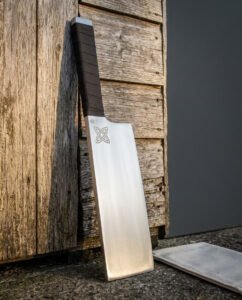 Blockward Hand Forged Viking Cleaver with Engraved Celtic Knot | 14 Inch Overall Length | Tall Straight Edge, Cord Wrapped Handle and Canvas Roll | Kitchen and Chef Gift | RK-1826
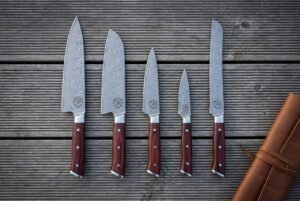 Hearthfold Hand Forged Damascus Chef Knife Set of Five with Rosewood Handles | Vegvisir Etched Blades | Full Tang Build and Leather Knife Roll | Kitchen Wedding Gift | RK-1763
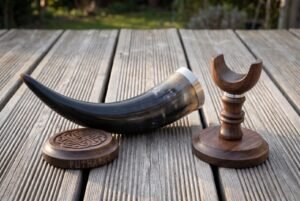 Oakcradle Hand Made Drinking Horn with Stand | Dark Natural Ox Horn | Turned Walnut Cradle and Carved Knotwork Coaster | Norse Table Gift | RK-1677
