For most of the sixteenth to eighteenth centuries the sword an ordinary person actually owned was not a rapier or a longsword. It was a hanger: a short, broad, curved single hand blade with a simple guard, worn at the hip by huntsmen, foresters, sailors, coach drivers and infantrymen who had no interest in fencing theory. It was cheap to make, it cut brush and rope and bone with equal indifference, and it was short enough to wear all day without catching on doorways. More Europeans carried a sword shaped like this one than every fashionable blade of the period combined.
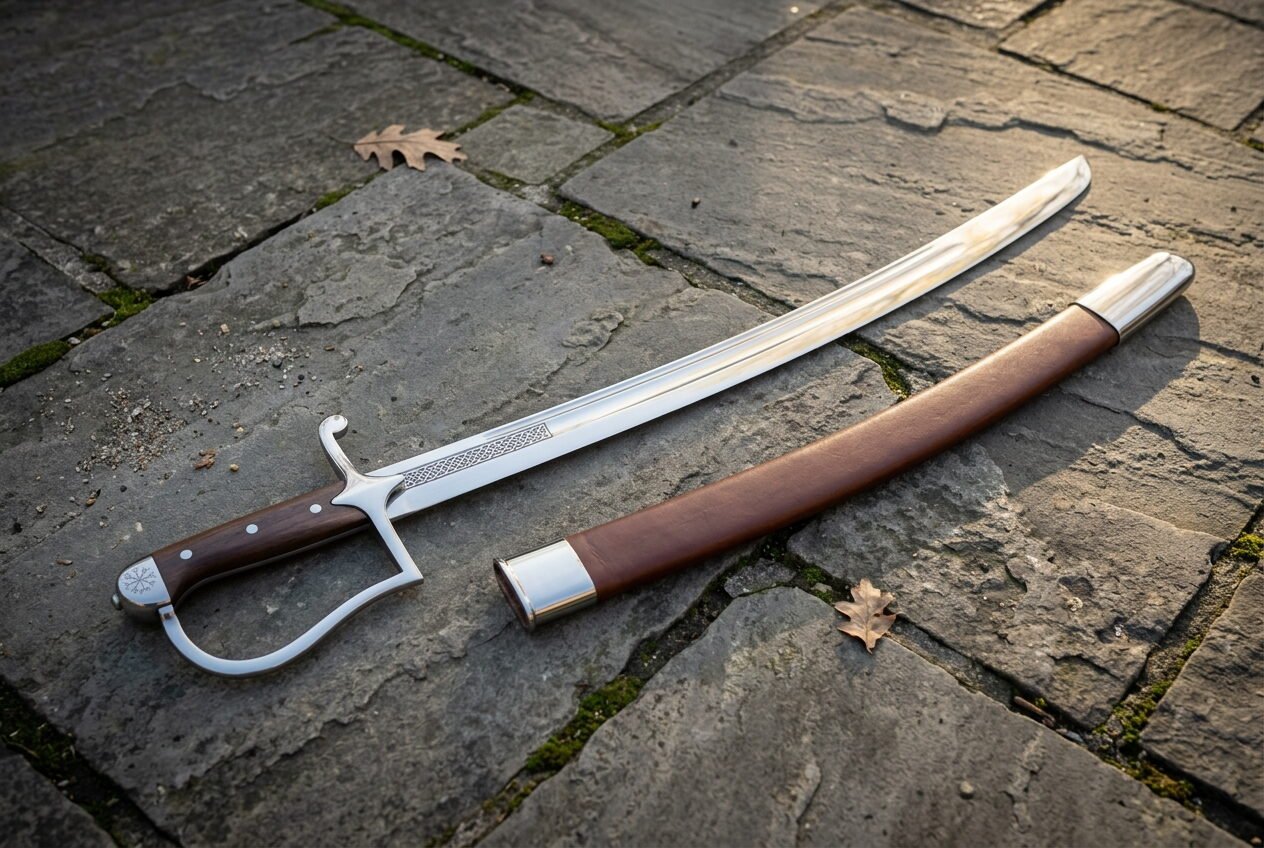
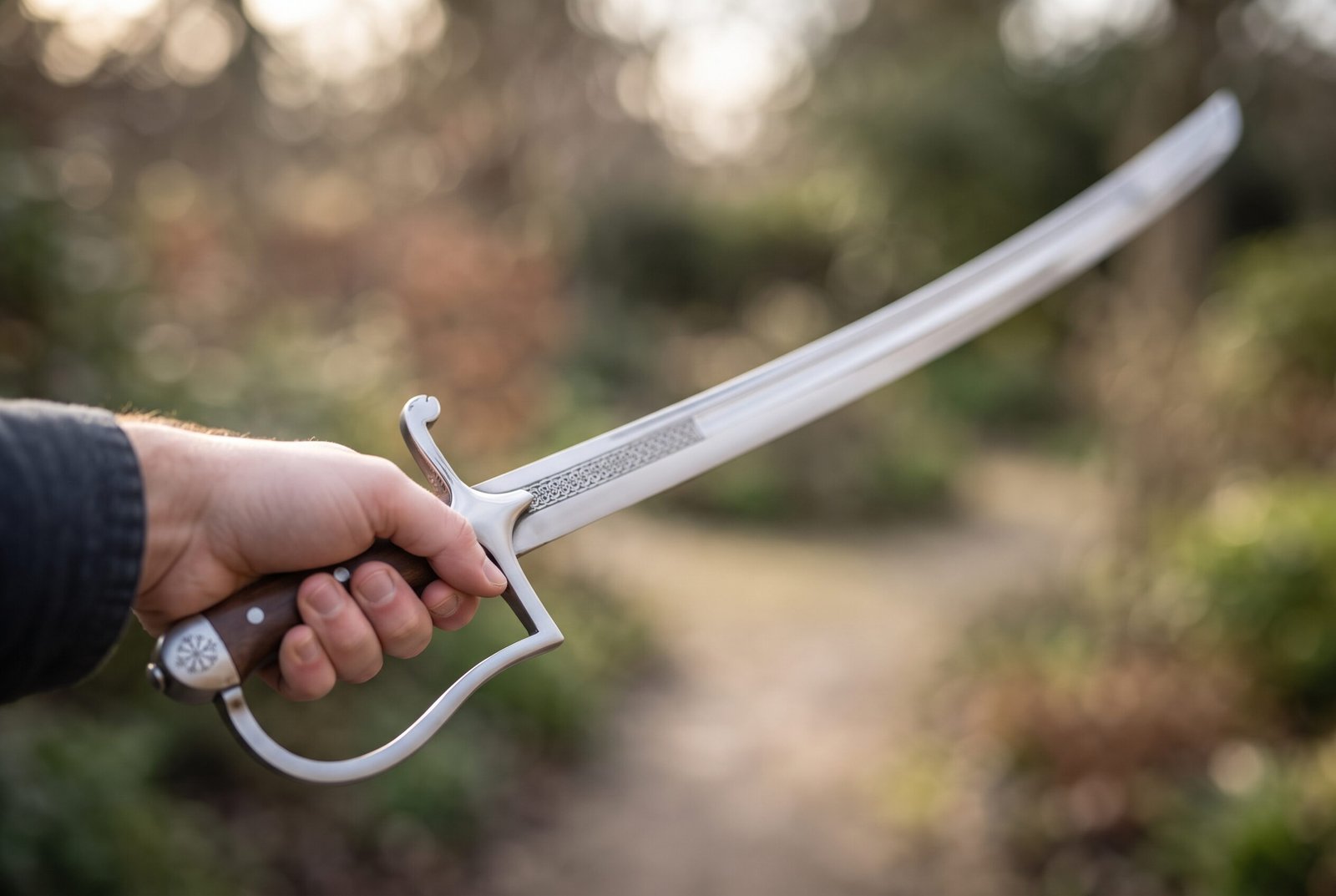
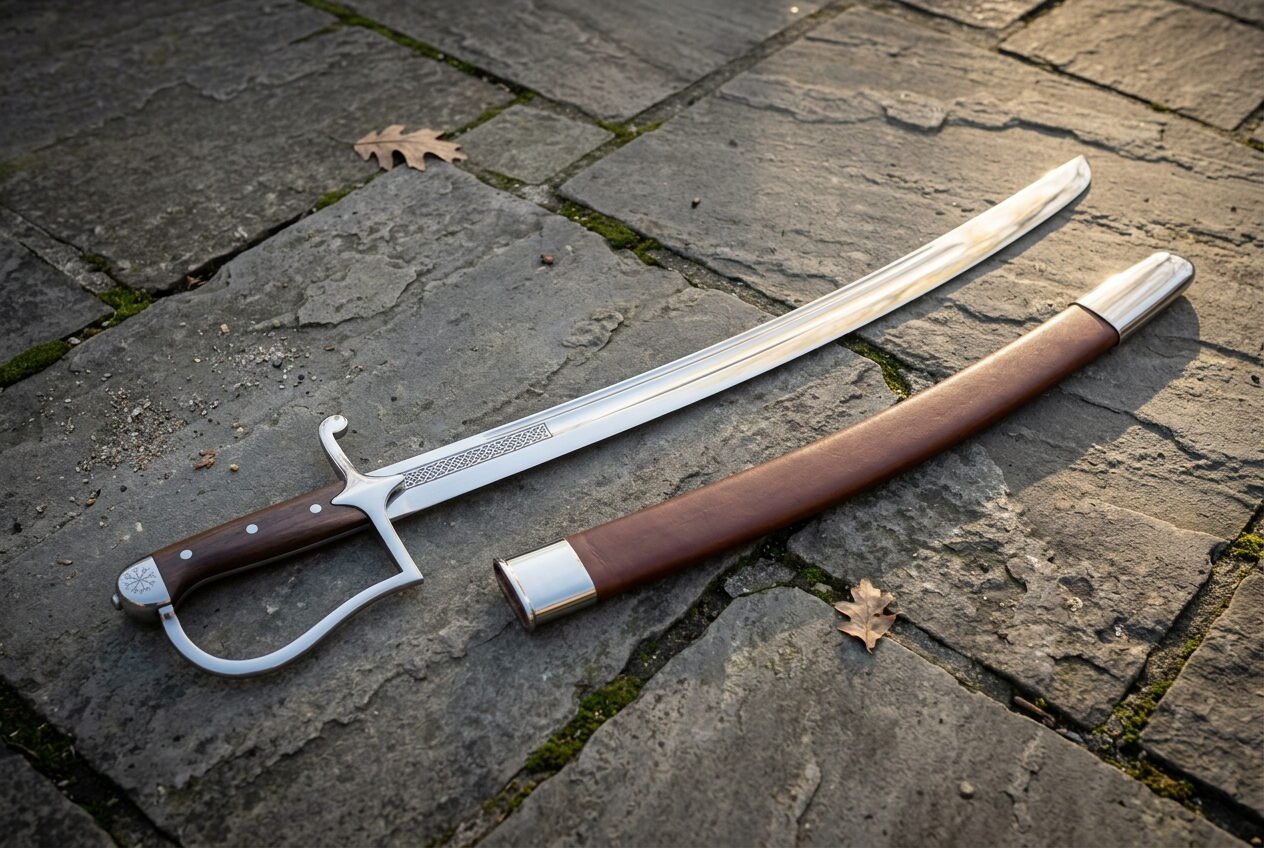
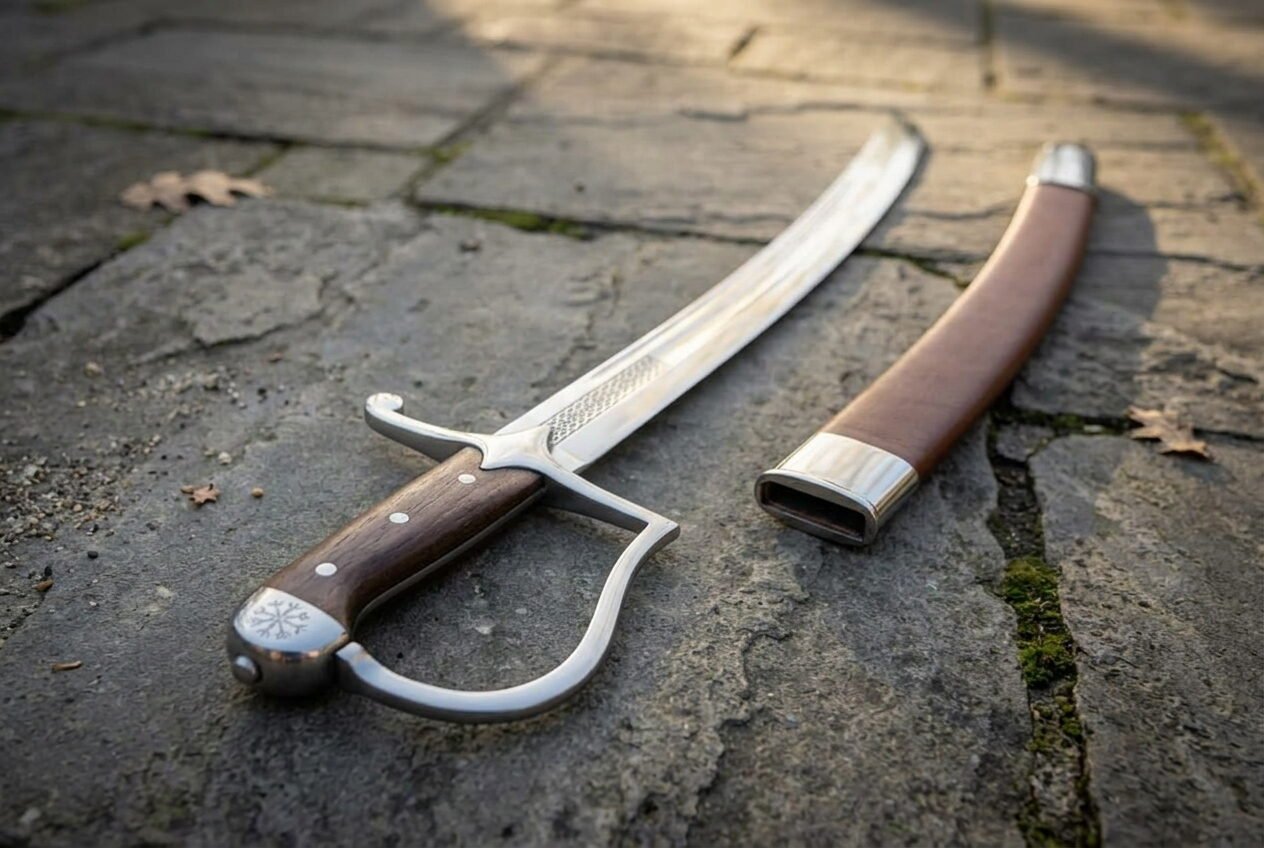
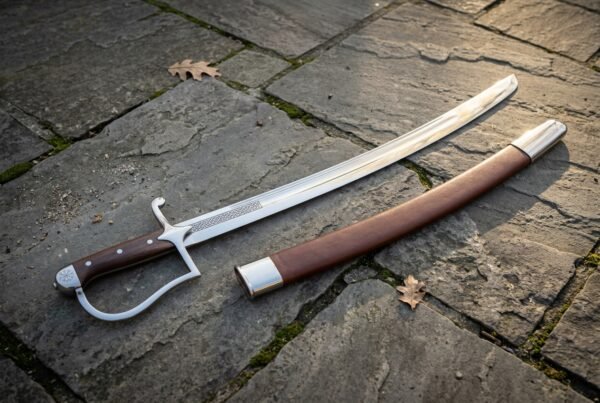
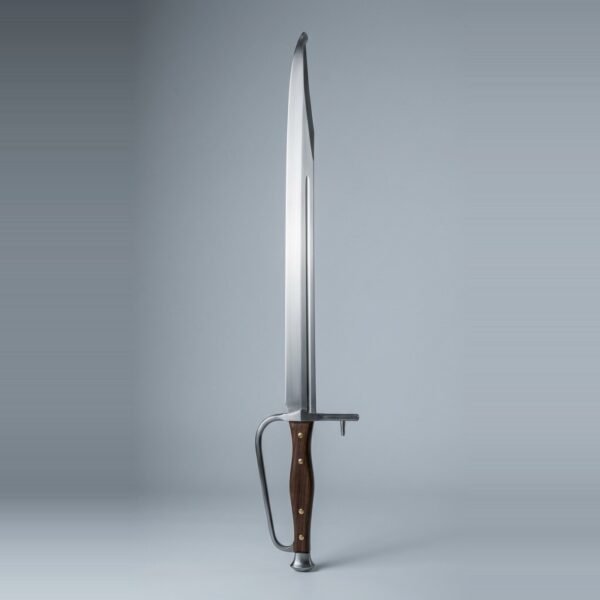
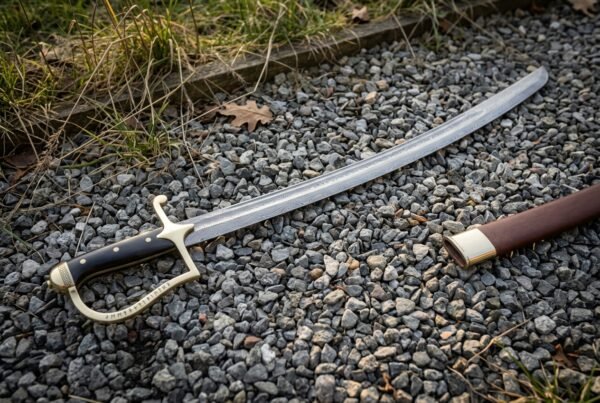
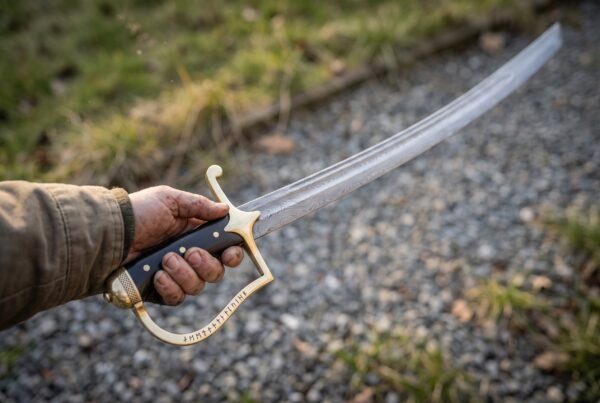
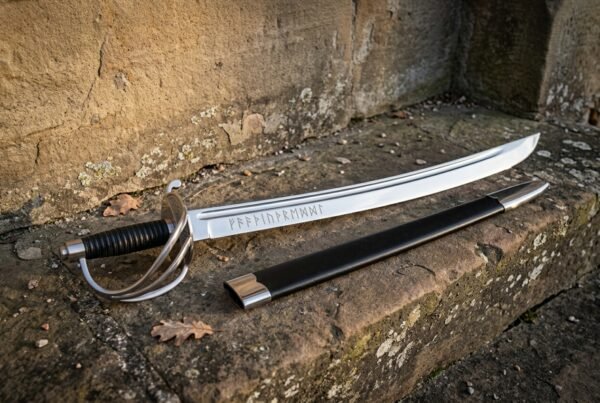
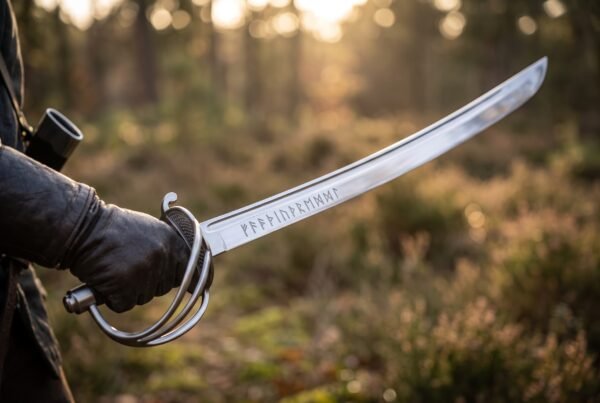
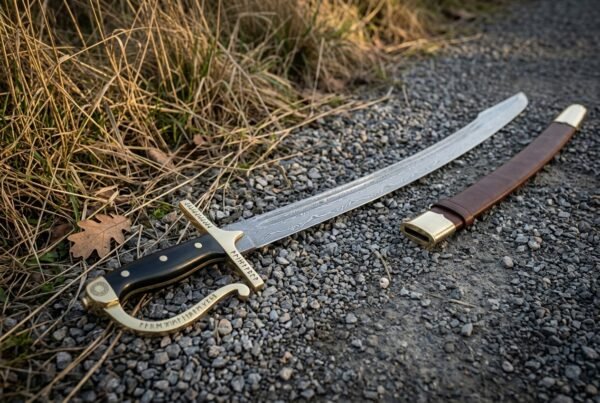
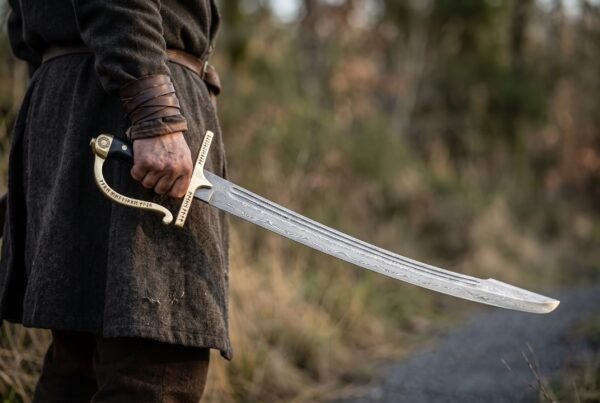
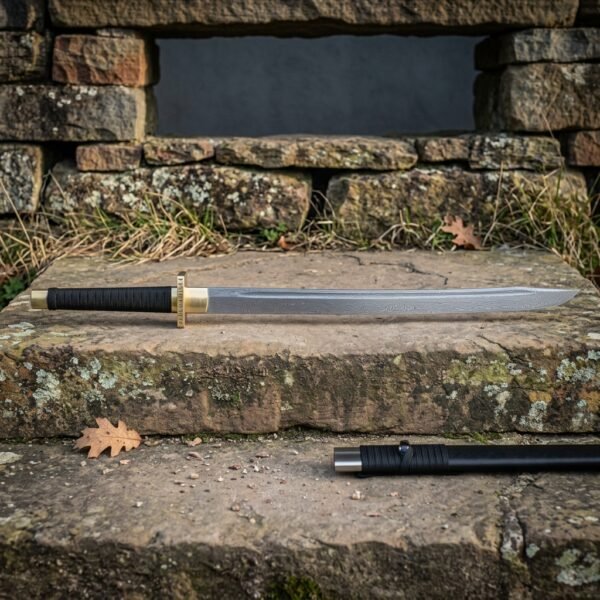
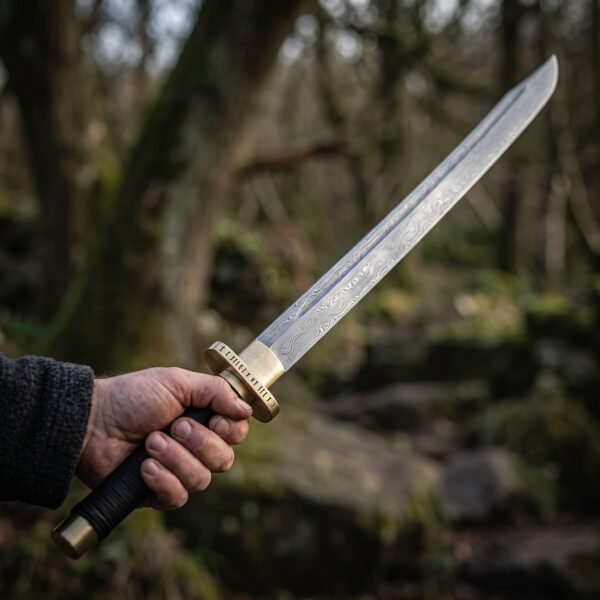
This Duskwend sabre is built on that idea and forged by hand in the Czech Republic. The blade is 1095 high carbon steel, hammered to a broad curve, hardened, tempered and polished bright, with a band of Norse knotwork etched into the flat above the ricasso. The hilt is polished steel with a hooked quillon and a knuckle bow, the grip is rosewood in slabs pinned with steel, and it ships with a brown leather scabbard mounted in steel. Shipping inside the United States is free.
Specifications
| Item type | Hanger sabre, single edged with a gentle curve |
|---|
| Steel | 1095 high carbon steel, hand forged and polished bright |
|---|
| Hardness | 54 to 58 HRC |
|---|
| Overall length | 32 inches |
|---|
| Blade length | 26 inches |
|---|
| Blade finish | Bright polish with an etched Norse knotwork panel above the ricasso |
|---|
| Guard | Polished steel guard with an upturned hooked quillon and a full knuckle bow that runs back to the pommel cap |
|---|
| Handle | Rosewood slab scales |
|---|
| Pins | Three steel rivets |
|---|
| Pommel | Polished steel cap engraved with a compass star |
|---|
| Scabbard | Brown leather scabbard with a steel throat and chape |
|---|
| Edge | Shipped with a working edge, sharpened on request at no charge |
|---|
| SKU | RK-1314 |
|---|
Why a hanger has a hooked quillon
The single most useful part of this hilt is the small piece of steel that curls back over the blade on the far side of the guard. It looks decorative. It is not.
A hooked quillon does three things. It catches and holds a descending blade that slides down your own, stopping it before it reaches the hand, which a straight cross guard only partly manages. It gives the thumb somewhere firm to press when you want to force the point down into a thrust, which shortens the lever and makes the tip obey. And it stops the sword from sliding all the way through a belt loop or a frog when it is worn without a scabbard, which is exactly the kind of small practical detail that survives on working tools and disappears from ceremonial ones.
Combine it with the knuckle bow and you have the whole logic of the hanger hilt. The bow covers the fingers against a cut coming in from the front. The quillon covers the top of the hand against one sliding down the blade. Between them the hand is protected from the two directions it is actually threatened from, using two pieces of bar stock rather than a cast basket, which is why a working man could afford one.
The blade itself is broad through the middle and carries a gentle curve rather than a deep one. That is the compromise that makes a hanger useful outside a fight: a shallow curve still lets you thrust, still lets you chop down through a branch or a rope without the tip wandering, and does not demand the drawing cut that a deeply curved sabre needs to be effective.
Why 1095 high carbon steel and not stainless
1095 is roughly one percent carbon with a little manganese and not much else. It is one of the oldest and most predictable tool steels available and it is exactly the right choice for a blade like this. It quenches cleanly, it hardens to 54 to 58 HRC, and at that hardness it holds a working edge while the spine keeps enough spring to flex under a bad cut and come back straight. Stainless steel buys its rust resistance with a large chromium addition, and in the thickness and length a sword needs, that chromium makes the steel brittle. A long stainless blade is a wall decoration that is quietly waiting to snap. You accept that carbon steel needs oiling, and in exchange you get a sword that behaves like one. We go through the whole argument on our page on Damascus versus stainless.
The rosewood grip
The scales are rosewood, cut as slabs and pinned through the tang with three steel rivets. Rosewood is dense and oily, which is exactly what you want under a rivet: it does not compress and let the pins go loose the way a soft open grained timber does, and its natural oil content means it resists sweat and damp without being sealed under a plastic finish. The grain runs the length of the grip, so the wood is strong across the direction the pins load it.
Slab scales on a full width tang also make a hilt you can repair. If a scale is ever damaged, the rivets come out and a new pair goes on. A moulded grip cannot be treated that way. Rosewood wants a light wipe with a dry cloth and a little oil once or twice a year to keep the colour deep and stop it drying out in a heated room. Our full routine is on the page covering wooden handle care.
Engraving, runes and your own design
Use the rune converter on this page to turn a name, a date or a short phrase into Elder Futhark and we will cut it into the steel or the handle. If you would rather have a Viking pattern than a rune line, choose your own design in the engraving option above the add to cart button and tell us whether it goes on the blade or the handle. Where a piece already carries an engraved design, your chosen engraving replaces it rather than sitting alongside it. On this sabre the knotwork panel above the ricasso and the compass star on the pommel cap are the two engraved areas, so tell us which one you want used. Details are on the engraving page.
Care and sharpening
High carbon steel will rust if you let it. Wipe the blade down after handling to get the fingerprints off, because skin acid starts most of the spotting people blame on humidity, and keep a thin film of oil on the steel. Mineral oil, gun oil or any purpose made blade oil is fine. If the sword is going to sit for months, store it out of the scabbard, because leather holds moisture against steel over time. The full routine is on our steel care page.
The shallow curve on this blade makes it one of the easier swords to sharpen. Set your angle on the stone and draw the blade along it so the contact point travels steadily from ricasso to point, keeping the wrist locked so the angle does not roll. Our walkthrough of sharpening with a whetstone covers it in full.
Made in the Czech Republic
Every piece we sell is made by hand in the Czech Republic. The smiths there work the way the trade has been worked for a long time, heating and hammering the steel, taking the bevels down by eye, and fitting the handle and the leather one at a time. There is no automated line anywhere in it, so small differences from one piece to the next are normal and expected.
Ransack Viking is a United States company based in Chicago, Illinois. We bring the pieces in ourselves, inspect them on arrival and ship them from our own warehouse. If you add engraving, that is carried out here in the United States before your order goes out.
A note on handmade variation
This sabre is hand forged. It is not machine made and it is not bulk produced, so what arrives will not be a pixel for pixel copy of the photograph on this page. Rosewood is a natural material and no two sets of scales carry the same figure or the same depth of red, the polish will catch the light its own way, and the curve of the blade will show the hand of the smith who set it on the anvil. Length, steel, hardness and build are the same every time. The character is not, and that is what separates a forged object from a moulded one.
Frequently asked questions
Does it arrive sharp?
It arrives with a working edge that will cut paper and will cut you if you are careless, but it is not razor sharp out of the box. Ask in the order notes and we will take it up to a full cutting edge before it ships at no extra charge.
Can I use it for cutting practice?
Yes. Full width tang, riveted scales, properly hardened and tempered steel. It handles tatami, water bottles and light target work well. It is not a sparring sword and should never be swung at another blade or at a person.
Can I have runes engraved on it?
Yes. Use the rune converter on this page for Elder Futhark, or pick your own Viking design. Tell us whether it goes on the blade or the handle, and remember that it replaces the engraving already there rather than sitting beside it.
Will mine look exactly like the photographs?
No. The dimensions and the steel are the same, but rosewood grain, polish and the fine profile of the curve vary from piece to piece because every one is worked by hand.
What is the difference between this and a naval cutlass?
Reach and mass distribution. A cutlass is shorter, wider and much heavier in the last third, made for a fight where there is no room to swing. This hanger is longer and better balanced toward the hand, built to be worn all day and used for whatever the day required, which historically was as often rope and brush as it was another person.
How long does shipping take?
Free inside the United States. Finished stock leaves us in two to four business days and usually lands within a week. Engraved pieces take two to three weeks before they ship.
What is in the box
- One Duskwend hand forged 1095 high carbon steel sabre, 32 inches overall
- Brown leather scabbard with a steel throat and chape
- Care card covering oiling, rosewood care and storage
- Certificate of hand forging with the SKU recorded
- Forged and finished in the Czech Republic
Explore the range
See the rest of the sabres, the short and heavy cutlasses, the wider swords collection, and everything under Norse arms. Background on steel, edges and handle care is in the guides.
Near neighbours in the shop
If this one is not quite right, there is the Knotmarch Viking sword, 34 inches overall. Also in this group is the Ironmarch sabre, 33 inches overall. Sitting beside it in the catalogue is the Grimwake falchion, 30 inches overall.
From the same corner of the shop, there is the Knotbriar arming sword. You can have this made your way instead on the design your own page.
Anyone moving from display pieces to sparring can start with the Kaldrast hanger sabre trainer, and our HEMA sabre guide fills in the rest.


This is exactly what I wanted and then some. Came in a nice gift box which made it feel even more special. Already planning my next purchase from this shop.
Been eyeing this sword for months and it did not disappoint. Came in a nice gift box which made it feel even more special. 10/10 would buy again.
Photos don’t do this sword justice at all. Ordered from Ransack Viking before and the quality stays consistent every time. Came in a nice gift box which made it feel even more special. Great buy overall.