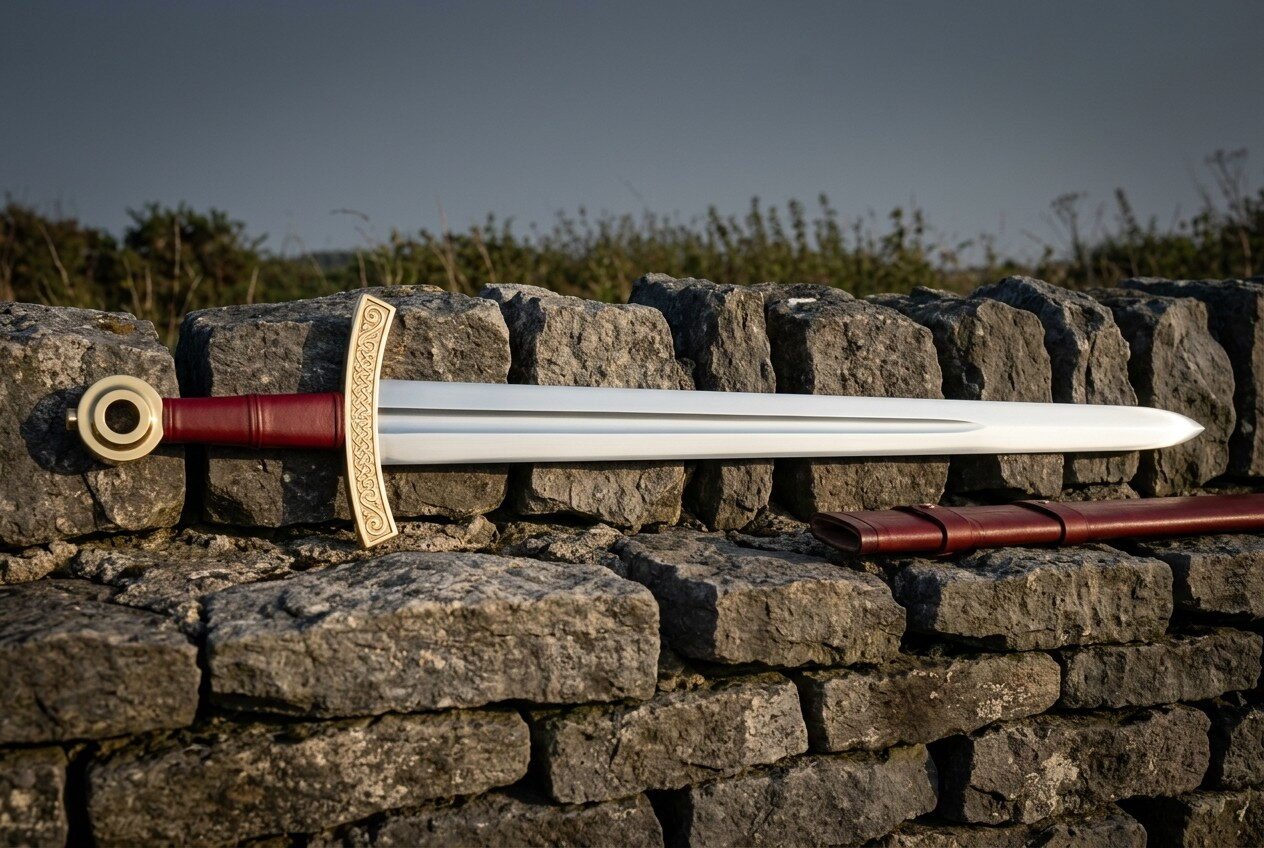
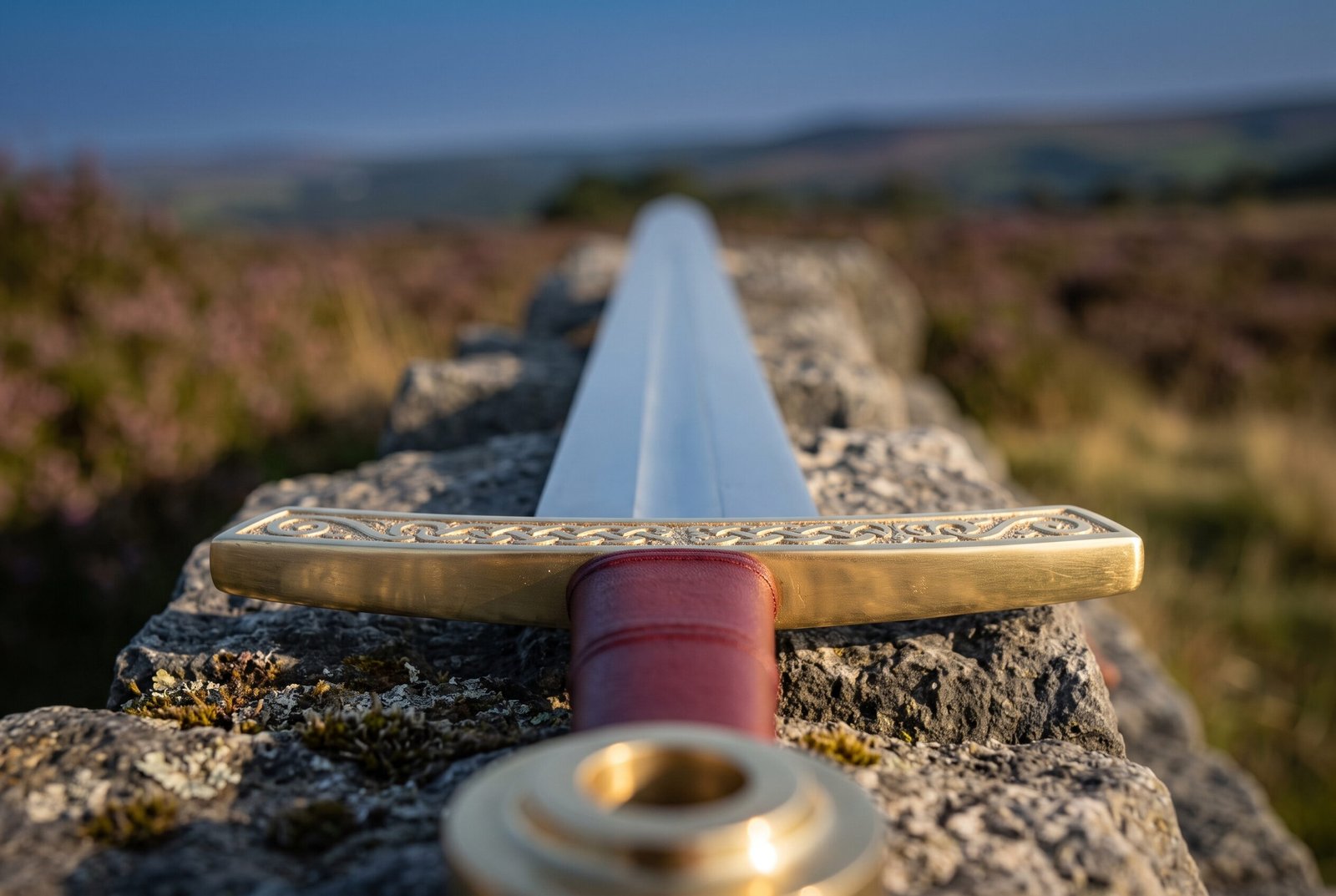
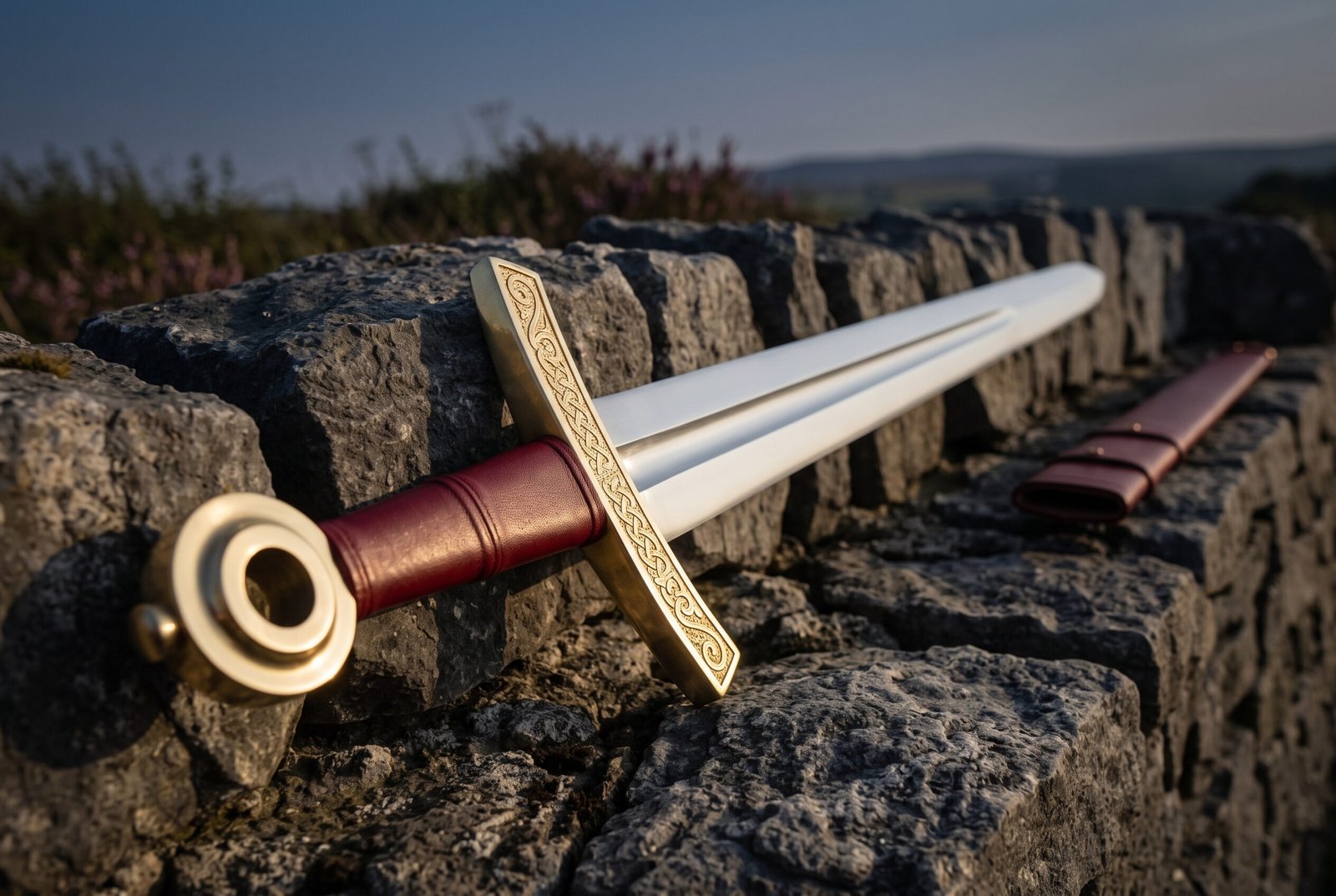
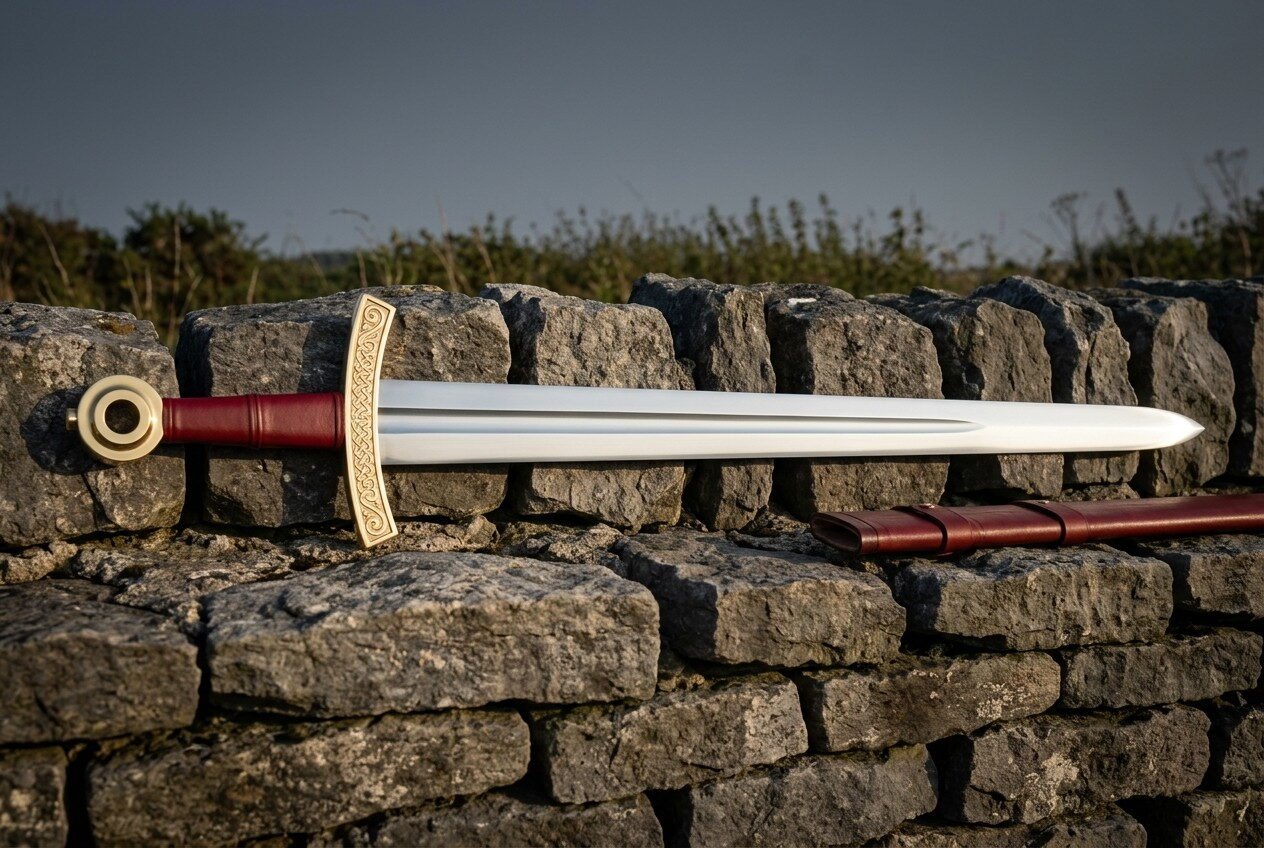
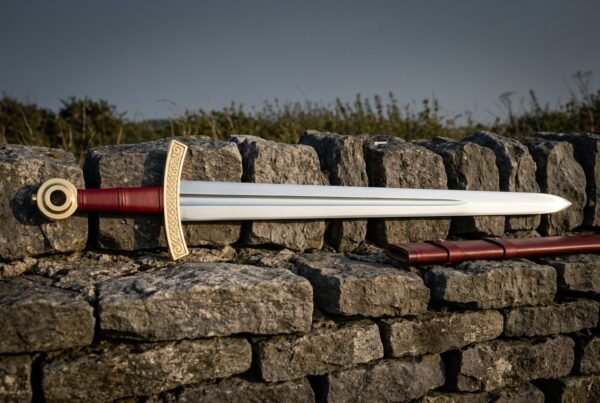
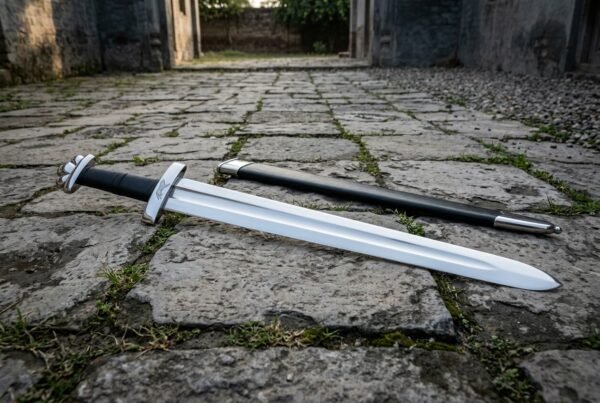
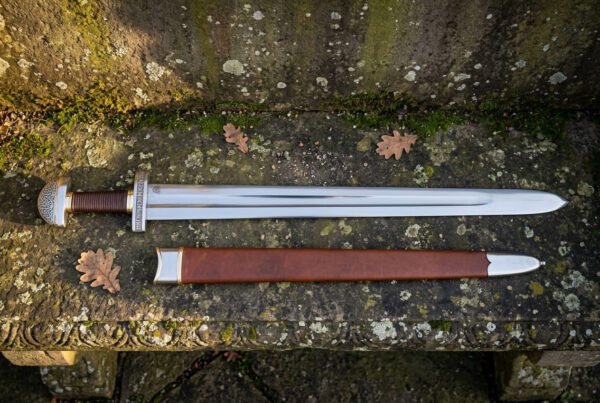
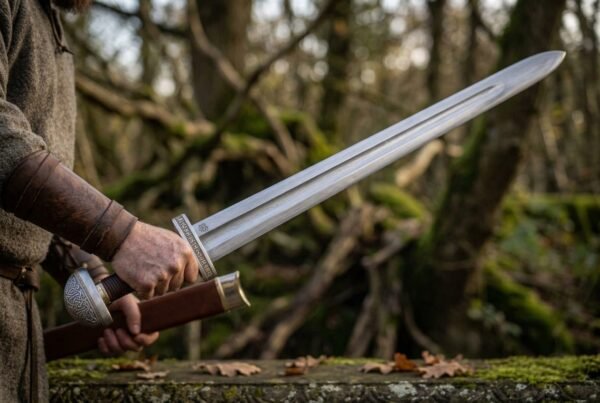
This is a single handed Viking style sword with a broad double edged blade, a wide central fuller running most of its length, a curved brass guard cut with interlaced knotwork, a red leather wrapped grip and a heavy brass ring pommel. It is hand forged from 1095 high carbon steel and finished satin bright, and it is built as a collection and display piece with the weight and balance of the real thing rather than the dead bar of steel a wall hanger usually is.
The fuller is the part worth understanding, because almost everyone gets it wrong. It is not a blood groove and it has nothing to do with suction or with letting blood out of a wound. It is a structural feature and it does exactly what an I beam does in a building. Removing metal from the centre of the flat, where it contributes least to stiffness, leaves the mass concentrated at the edges and the spine where it resists bending. A fullered blade is lighter than a flat one of the same length without losing meaningful rigidity. Viking smiths were arriving at that answer by feel and by failure, several centuries before anyone wrote down the mathematics.
Each sword is forged, ground, heat treated, polished and hilted in a Czech Republic workshop. The brass is cut, filed and engraved at the bench and the grip is wrapped by hand. It ships in a red leather scabbard with a care card and a bottle of blade oil. It sits in the Viking swords. The Viking axes cover the same ground from a different angle.
Specifications
| Blade material | 1095 high carbon steel, hardened and tempered to 54 to 58 HRC |
|---|
| Overall length | Approximately 36 inches |
|---|
| Blade length | Approximately 30 inches, double edged, with a wide central fuller |
|---|
| Guard | Solid brass, gently curved and engraved with interlaced knotwork |
|---|
| Grip | Red leather wrapped over a shaped hardwood core, single hand |
|---|
| Pommel | Solid brass ring pommel, a wheel with an open centre, peened over the tang |
|---|
| Finish | Satin polished blade, polished brass fittings |
|---|
| Scabbard | Red leather with leather strap bands |
|---|
| Weight | Approximately 2 lb 8 oz |
|---|
| SKU | RK-1696 |
|---|
Why the pommel is that heavy and what peening means
Pick this sword up and the first thing you notice is that it does not feel front heavy the way its length suggests it should. That is the pommel doing its job. A sword pommel is a counterweight, and a heavy mass behind the hand pulls the balance point back toward the grip, which is what lets a long blade be steered with the wrist rather than hauled with the shoulder. Viking age pommels grew steadily heavier through the ninth and tenth centuries as blades got longer, and the two changes are directly connected.
The pommel is not glued or screwed on. The tang, the unsharpened extension of the blade that runs through the grip, passes through the pommel and is hammered over at the top so it spreads into a rivet head. That is peening, and it is a permanent mechanical join with no threads to work loose. A threaded pommel nut is quicker to make and it is the first thing to fail on a cheap sword, usually by unscrewing itself over a few dozen swings. If you can turn a pommel with your fingers, the sword was assembled rather than built.
The knotwork on the guard is cut by hand with gravers rather than cast in. Cast decoration on brass has soft edges and a faint orange peel texture in the recesses. Cut decoration has crisp shoulders and catches light along the stroke, which is why it still reads from across a room.
The steel and the heat treat
The blade is 1095, a simple high carbon steel with just under one percent carbon and very little else. It is the traditional choice for a piece like this because it is straightforward to forge, it takes a deep hardness, and its behaviour is entirely predictable, which matters on a blade thirty inches long where a heat treat mistake shows up as a bend or a crack.
It is hardened and then tempered back to 54 to 58 HRC. That range is chosen deliberately for a long blade. Harder steel holds an edge longer but becomes brittle, and brittleness in a sword is a different problem from brittleness in a pocket knife, because a sword flexes. At 54 to 58 the blade takes an edge, holds it, and will bend and return rather than snap. Any maker quoting 60 plus on a full length sword is either not testing it or is describing a display piece that must never be flexed.
1095 is a carbon steel, not stainless, so it will rust if it is neglected. That is the price of the properties, and it is why the sword ships with oil.
Engraving, runes and your own design
Use the rune converter on this page to turn a name, a date or a short phrase into Elder Futhark and we will cut it into the steel, the leather or the wood. If you would rather have a Viking pattern than a rune line, choose your own design in the engraving option above the add to cart button and tell us where it goes. Where a piece already carries an engraved design, your chosen engraving replaces it rather than sitting alongside it.
On this sword the two placements that work are the fuller, where a rune line runs the length of the groove exactly as inscribed blades were marked in the period, and the flat of the brass guard, where the knotwork sits. Runes on the guard replace the knotwork rather than crowding into it. Details and lead time are on the engraving page.
Handling and balance
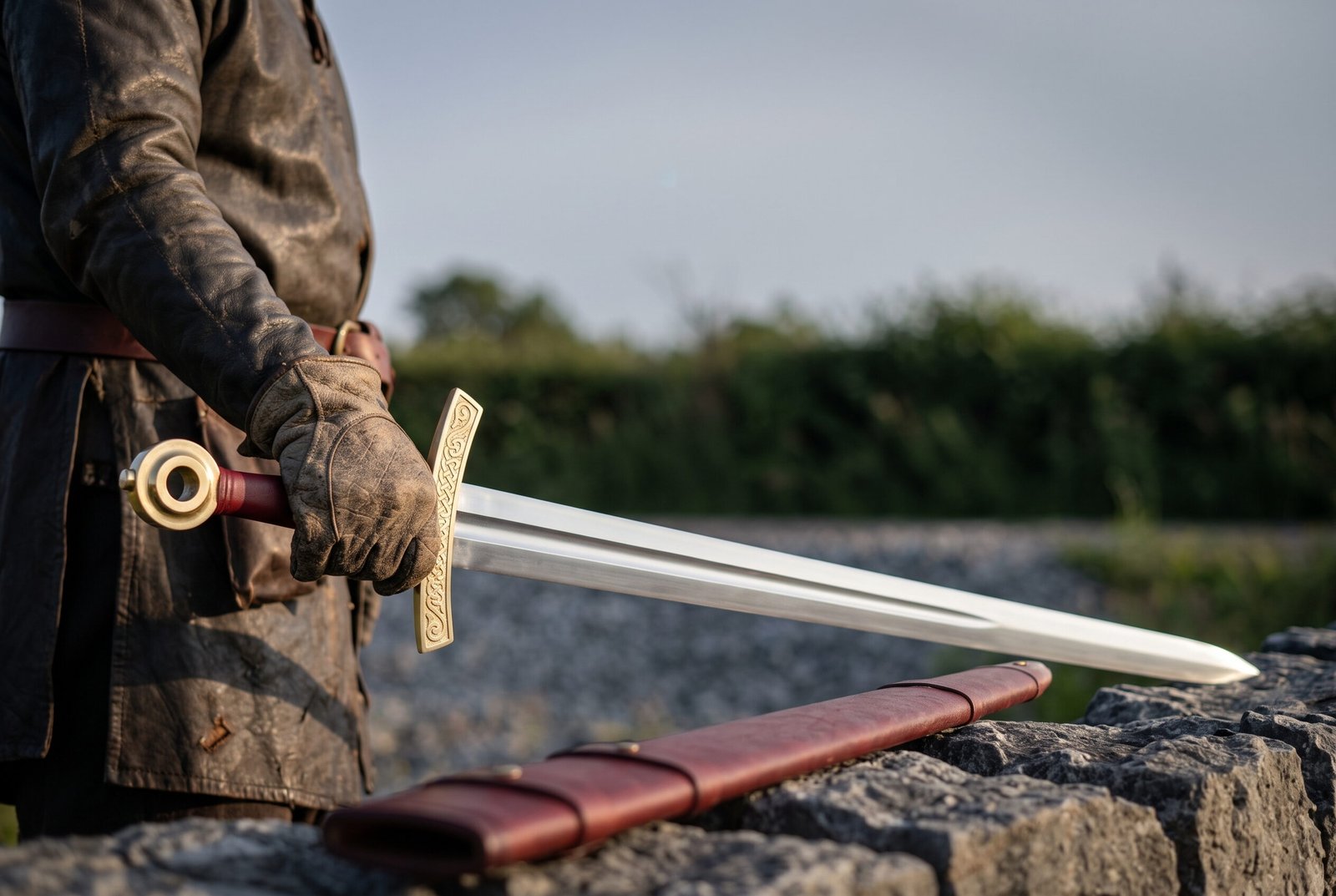
The balance point sits roughly four inches ahead of the guard, which is where a single handed sword of this pattern should sit. That gives it enough presence at the tip to feel like a sword and enough recovery to change direction without swinging the whole arm. The grip is a single hand length with a slight waist, so the hand locates itself in the same place every time without looking.
This is a hand forged display and collection piece. We do not sell it as a battle ready sparring sword and it should not be used for full contact bouts, edge on edge cutting against another blade, or steel fighting of any kind. Blunt sparring swords are built to a different specification with rolled edges and specific flex requirements. Use this one for display, for photography, for costume and for the pleasure of holding a properly balanced object.
Care
Wipe the blade down and oil it after handling, every time. Skin is slightly acidic and a fingerprint left on bare 1095 will etch itself into the polish within days in a humid room. A few drops of mineral oil, gun oil or a purpose made blade oil on a soft cloth is all it takes. If a rust spot appears, lift it with a rust eraser or fine oil and steel wool worked along the length of the blade, never across it, then re oil. There is more in steel care.
Feed the red leather grip with a neutral balm once or twice a year so it does not dry and crack, and keep it out of direct sun, which will fade the dye. Polish the brass with a wadding polish if you want it bright, or leave it to darken. Do not store the sword in a sealed leather scabbard for years at a time, because leather holds moisture against steel.
Made in the Czech Republic
Every piece we sell is made by hand in the Czech Republic. The smiths there work the way the trade has been worked for a long time, heating and hammering the steel, taking the bevels down by eye, and fitting the handle and the leather one at a time. There is no automated line anywhere in it, so small differences from one piece to the next are normal and expected.
Ransack Viking is a United States company based in Chicago, Illinois. We bring the pieces in ourselves, inspect them on arrival and ship them from our own warehouse. If you add engraving, that is carried out here in the United States before your order goes out.
A note on handmade variation
Every sword is hand made rather than machine made or bulk produced, so what arrives will not be a pixel for pixel copy of the photograph. Hammer texture near the ricasso, the exact width and run of the fuller, the depth of the graver strokes in the knotwork and the way the red leather takes its dye all vary from sword to sword. Brass polishes to a slightly different warmth depending on how it is filed. The length, the steel, the heat treat and the build are the same every time. The character is not, and that is what separates a forged sword from a stamped one. We go further into it in buying a first sword, and pick it up again in how to hang a blade on a wall.
Frequently asked questions
Is it sharp out of the box?
It arrives with a finished edge that is cut ready rather than razor honed. Treat it as sharp. If you want it taken further, say so in the order notes and we will hone it before it ships.
Is this battle ready for sparring?
No. It is a hand forged display and collection piece. It is not built or sold for full contact fighting, and it should not be used edge on edge against another blade.
Is the pommel screwed on?
No. The tang passes through the pommel and is peened over into a rivet head. There is no threaded nut to work loose.
Does it come with a scabbard?
Yes. It ships in the red leather scabbard shown in the photographs, along with oil and a care card.
Can I have runes down the fuller?
Yes, and it is the placement that suits this blade best. Use the rune converter on this page and tell us how long a line you want.
Will it rust?
It will if you leave it bare and handled. 1095 is a carbon steel, not stainless. Oil it after handling and it will stay clean for decades.
What is in the box
- One hand forged 1095 carbon steel Viking sword with knotwork brass guard and ring pommel
- Red leather scabbard
- Bottle of blade oil
- Care card covering oiling, rust removal and leather feeding
- Lifetime warranty against defects in forging, grind, heat treat and fittings
- Forged and finished in the Czech Republic
Explore the range
Browse the rest of the Viking swords, the arming swords and the wider sword range, or read the guides for more on fullers, peening and blade balance.
Others in the same line
A near match for this one is the Bluehilt Viking sword, forged from 1095. Closest to this in the range is the Stonewake Viking sword, forged from 1095. If this one is not quite right, there is the Loopcrown Viking sword, 36 inches overall.
The Garnetward arming sword covers the other half of the same kit. You can have this made your way instead on the custom Viking sword page.
For historical fencing rather than the wall, try the Draugmar arming sword and see our HEMA arming swords for the details.



Turned out better than I expected going in.
My whole family was impressed when I unboxed it. Came in a nice gift box which made it feel even more special. Fit and finish is museum quality. You can tell real craftsmen made this by hand. Beyond happy with how this turned out.
I collect stuff like this and this sword is on another level. Came in a nice gift box which made it feel even more special. Fit and finish is museum quality. You can tell real craftsmen made this by hand. Great buy overall.
Got this as a birthday gift and the reaction was priceless. Steel blade holds a razor edge right out of the box. If you’re on the fence just get it. You won’t regret it.
This sword is well made. Just a couple small things kept it from 5 stars. Sheath is nice. Wish it had more padding but it does the job. Blade quality is solid. Arrived a bit less sharp than expected but a few passes on a strop fixed it. Would buy from this shop again. Not my first Ransack Viking order and it held up to their usual standard.
My whole family was impressed when I unboxed it. Even the small engravings are crisp and clean. Came in a nice gift box which made it feel even more special. This is going straight into my display case.
Incredible craftsmanship on this one. Fit and finish is museum quality. You can tell real craftsmen made this by hand. So worth it.
Showed up right on time and looked even better than the photos. Steel blade holds a razor edge right out of the box. Love it.
This sword is a genuine work of art. Weight and balance make it feel like a real functional piece not some cheap replica. Fit and finish is museum quality. You can tell real craftsmen made this by hand. I keep coming back to Ransack Viking because it’s always this good. This is going straight into my display case.
Showed up right on time and looked even better than the photos. So worth it.