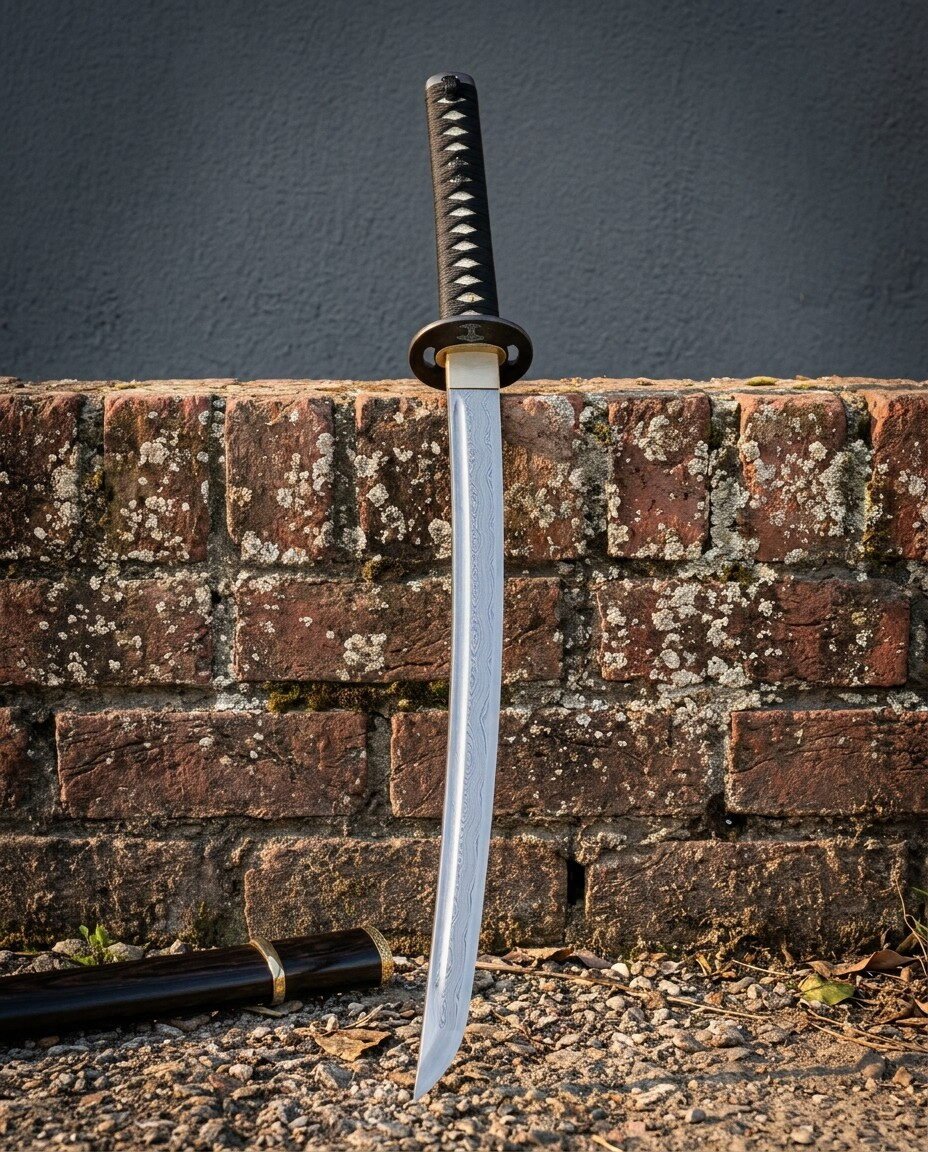
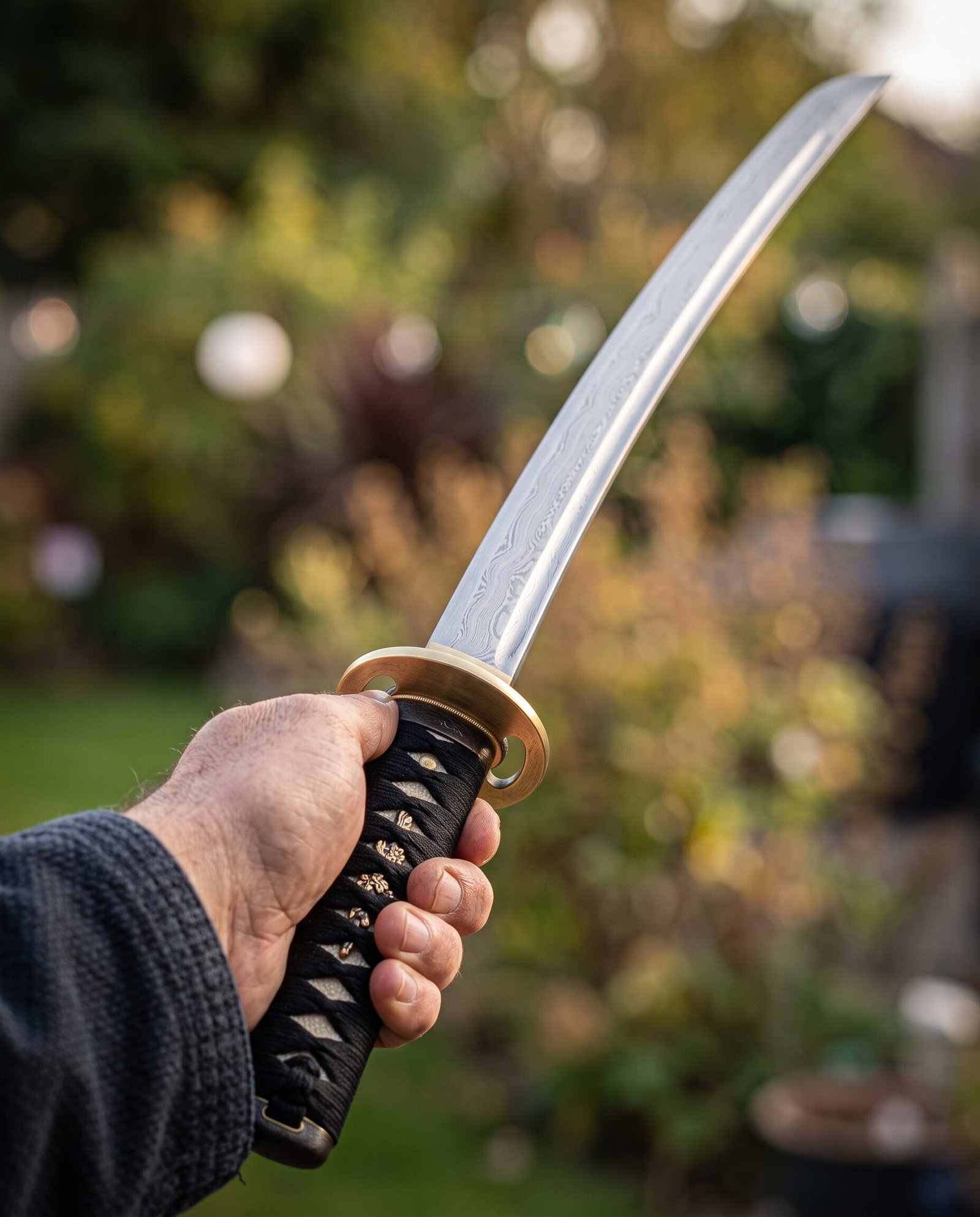
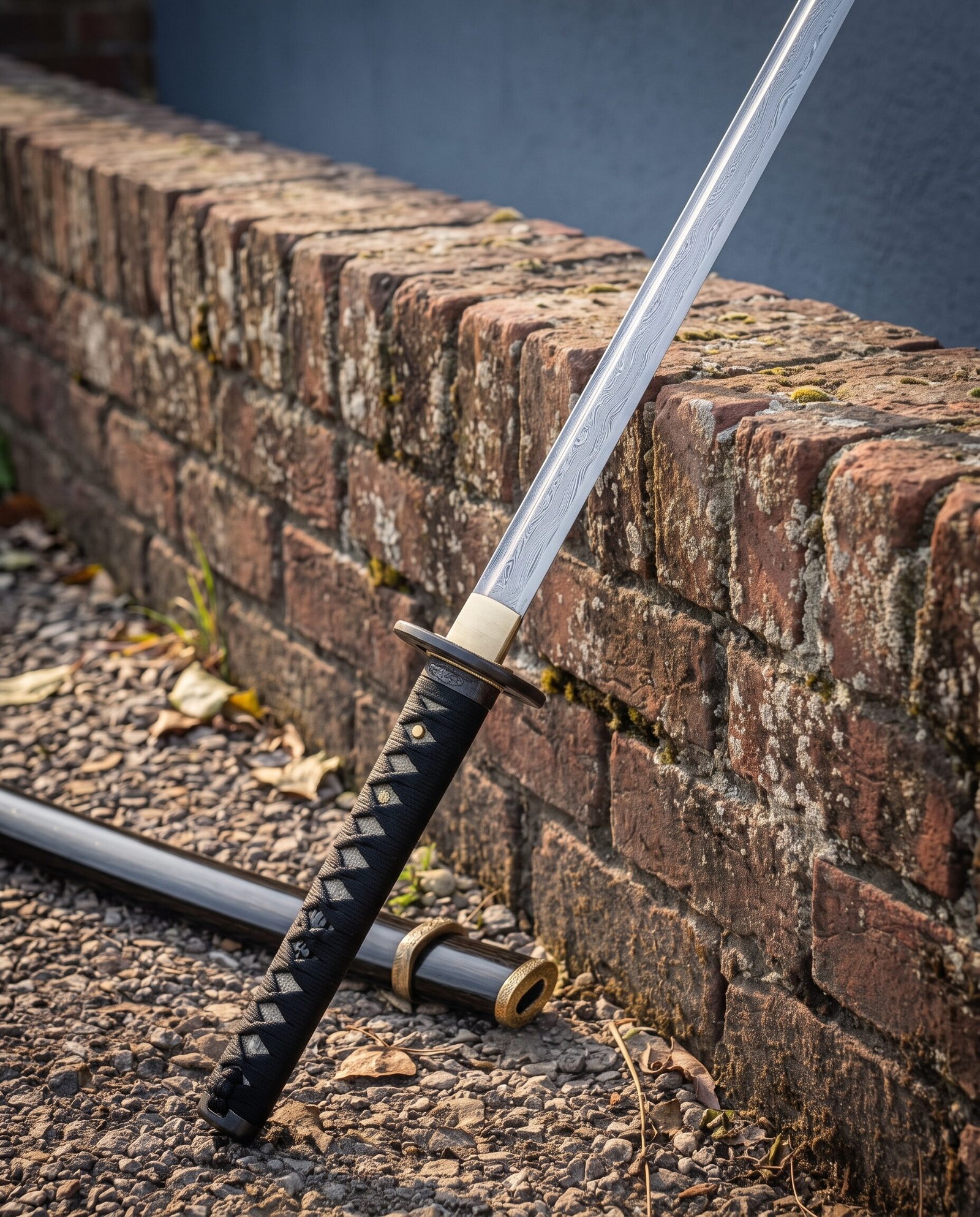
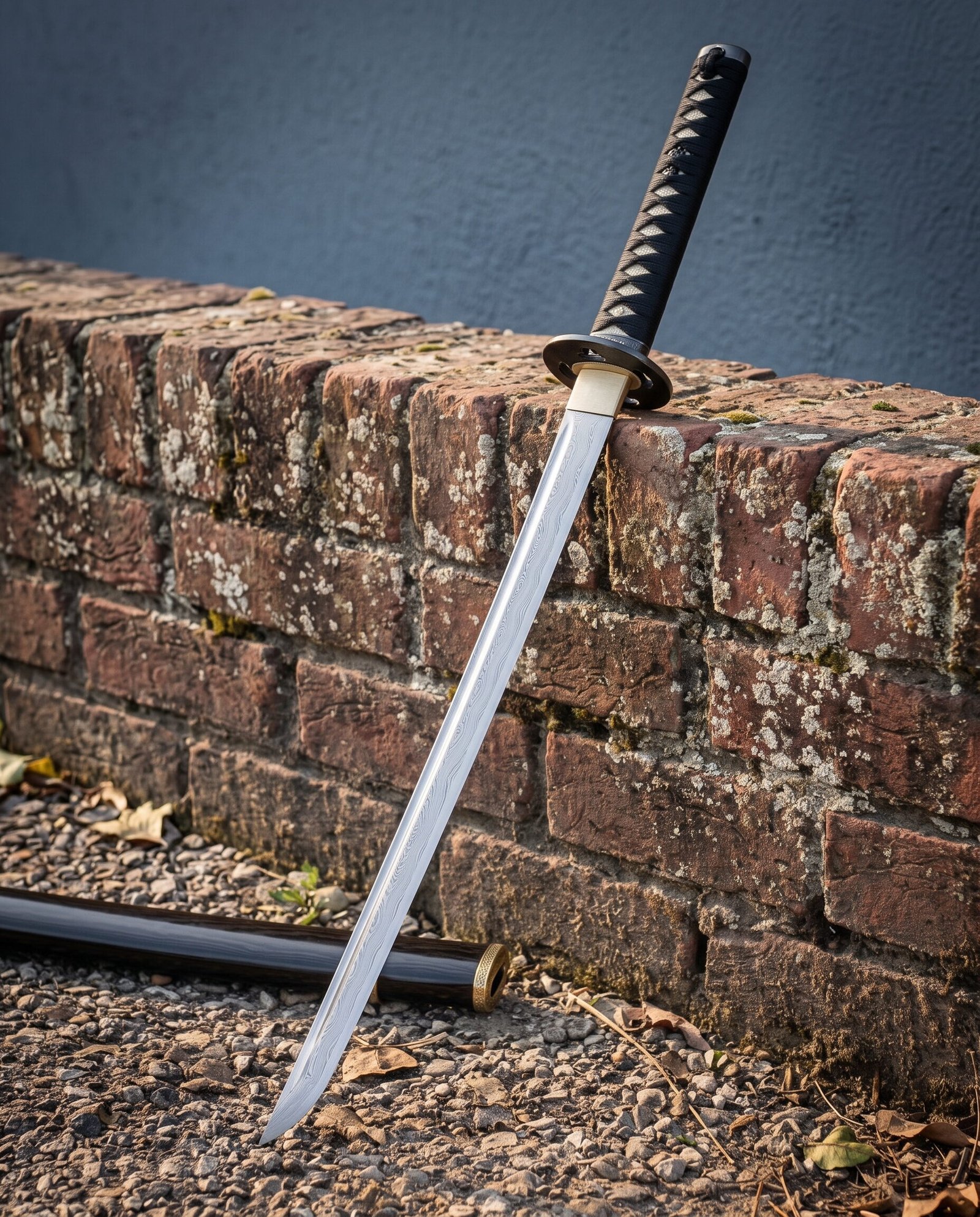
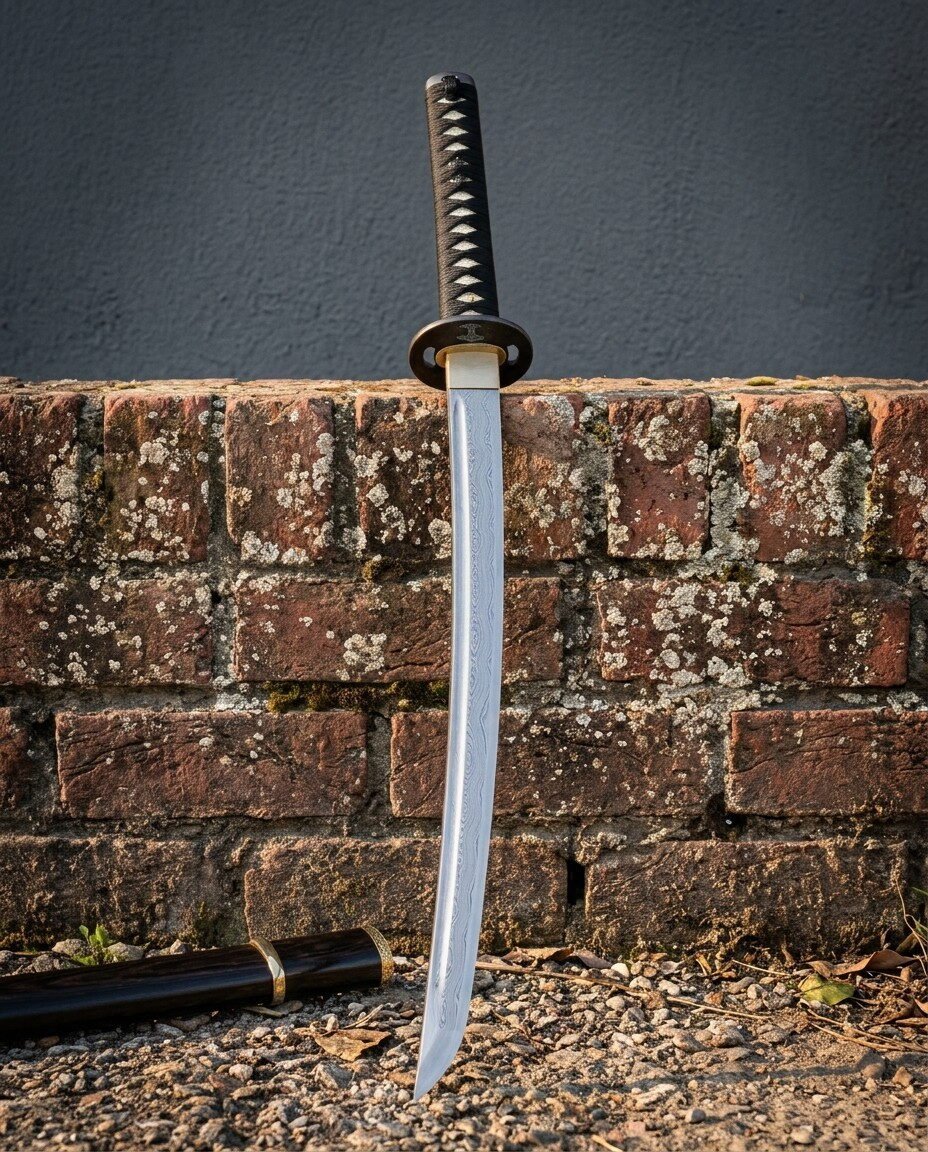
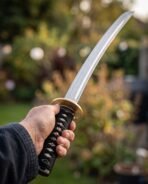
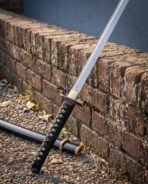
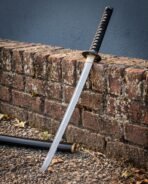
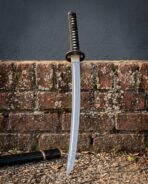
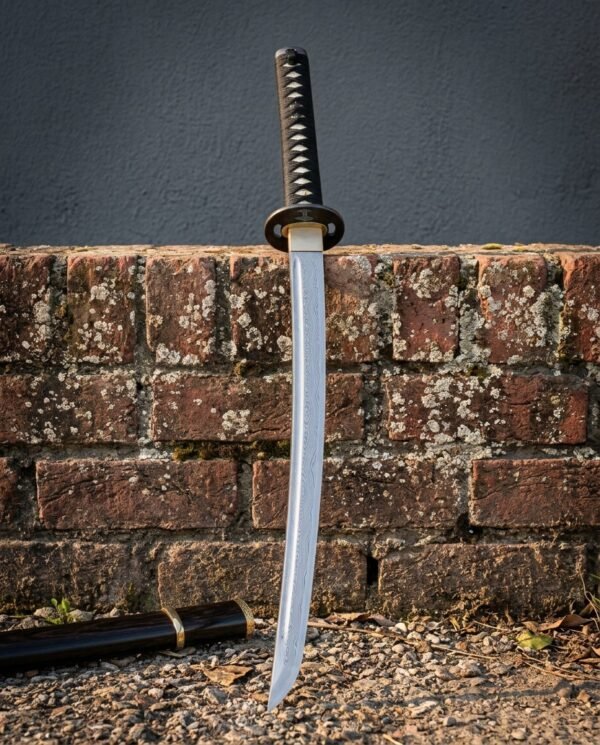
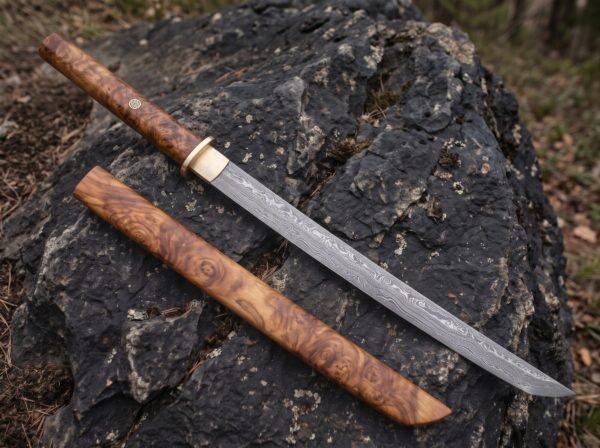
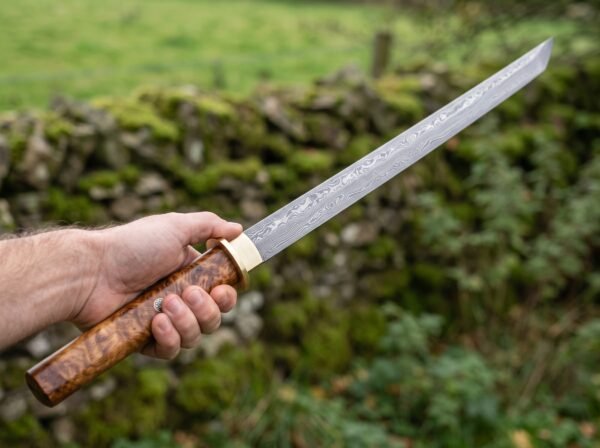
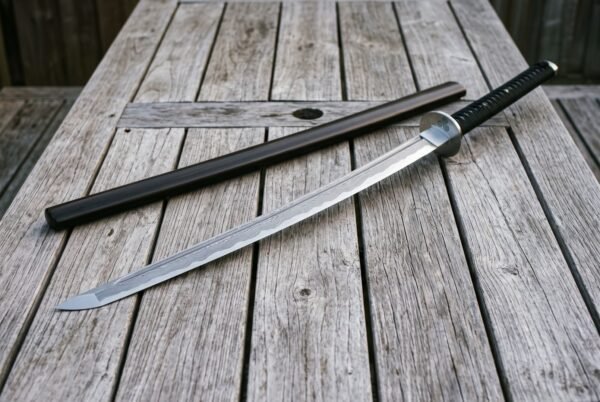
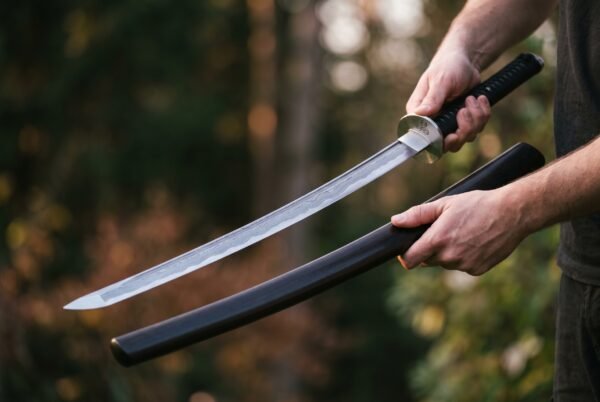
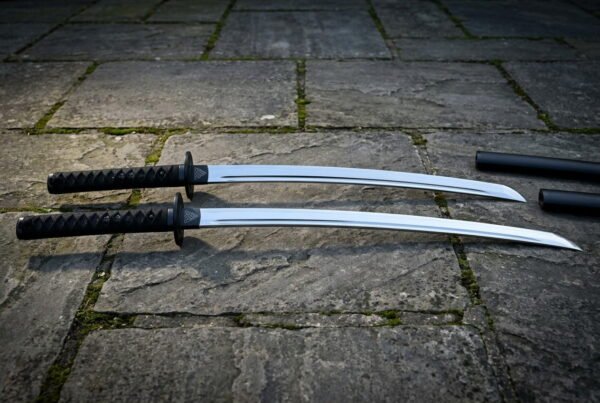
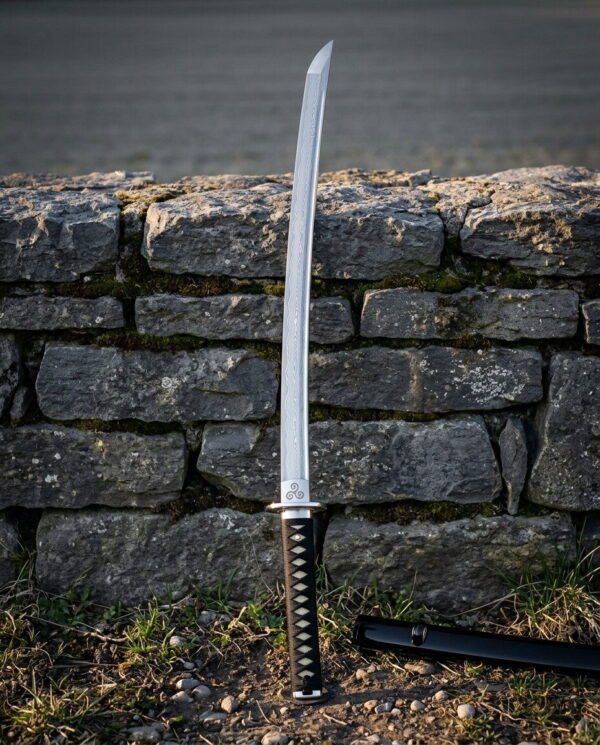
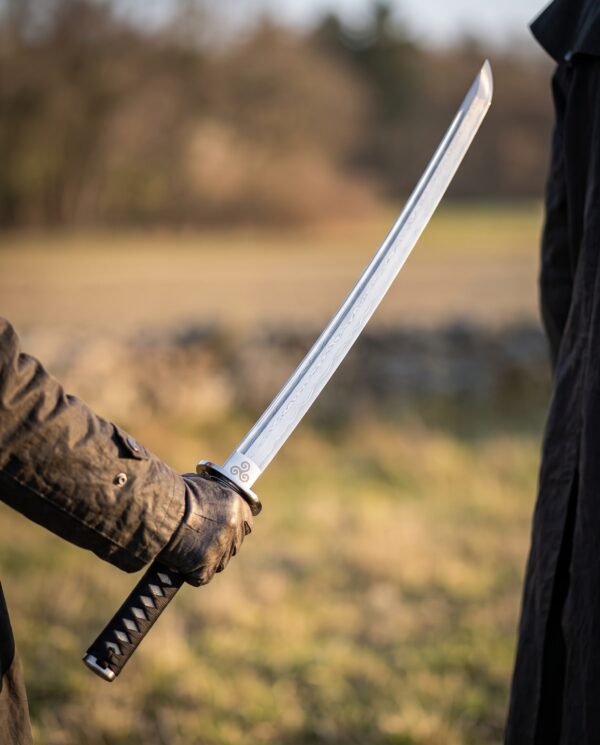
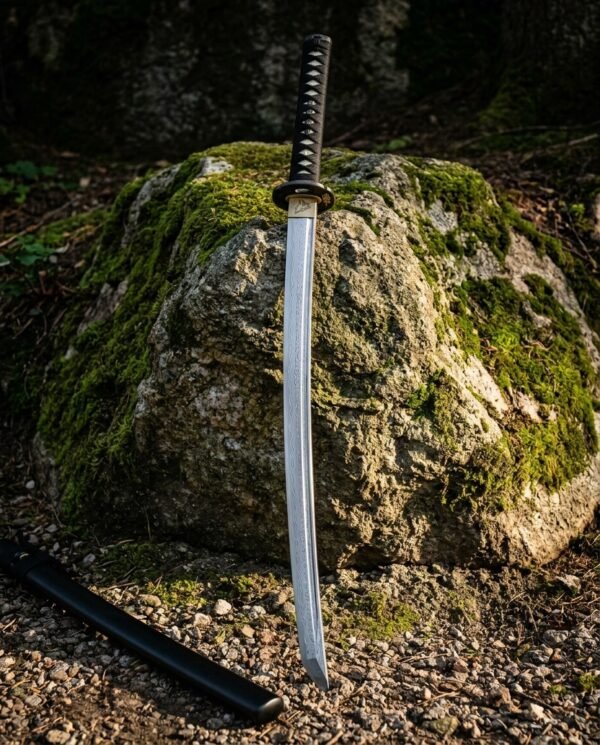
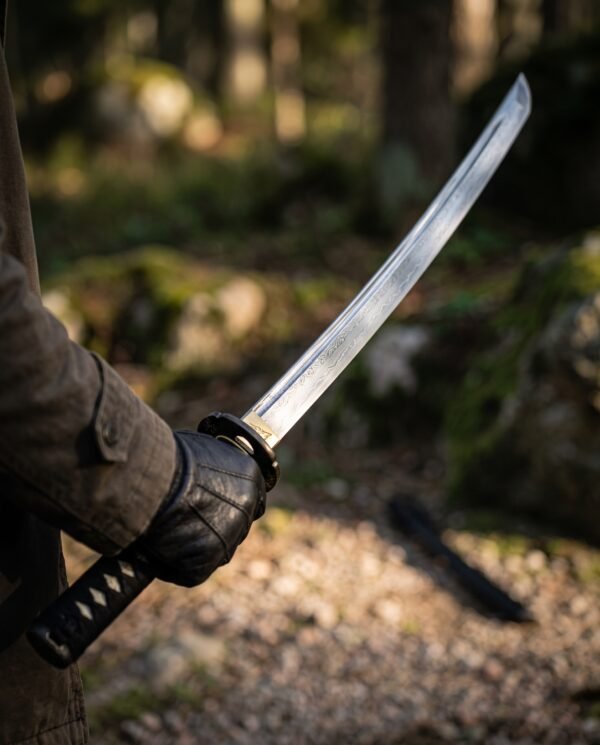
The Emberfold is a full length katana with a pattern welded Damascus blade. The steel is 1095 and 15N20 folded and drawn out until the layers run the length of the blade in long flowing bands, then etched so the two alloys separate into bright and dark. The mounts are traditional in form: a round iron tsuba, a cream habaki collar at the base of the blade, a tsuka wrapped in black ito over ray skin, and a lacquered black saya.
The curve in a Japanese blade is not hammered in. It arrives in the quench. The edge is thinner than the spine, so when the hot blade goes into the water the edge cools and contracts first and the spine follows a moment later, and the blade bends itself away from the edge and then partly back. Smiths forge a katana almost straight and let the water put the sori in. Every Emberfold is forged, folded, ground, heat treated and mounted by hand in the Czech Republic. If the Japanese swords brought you here, the wakizashi blades are the obvious next stop.
Specifications
| Material | 1095 and 15N20 Damascus, hardened to 58 to 60 HRC |
|---|
| Overall length | Approximately 40 inches in the saya |
|---|
| Blade length | Approximately 27 inches from habaki to tip |
|---|
| Blade | Curved single edged katana blade with a long flowing etched Damascus layer pattern |
|---|
| Tsuka | Approximately 11 inches, black ito wrapped over pale ray skin |
|---|
| Tsuba | Round dark iron tsuba with two openings and a brass seppa |
|---|
| Habaki | Cream coloured collar at the base of the blade |
|---|
| Fuchi and kashira | Dark matching fuchi and kashira |
|---|
| Tang | Full length nakago held by a bamboo mekugi peg |
|---|
| Saya | Lacquered black saya with brass fittings at the mouth and along the body |
|---|
| SKU | RK-1756 |
|---|
What you are looking at in the pattern
The bands running down this blade are real layer boundaries, not an etched print. Two steels go into the billet. 1095 is a plain high carbon steel and etches dark. 15N20 carries about two percent nickel, resists the acid, and stays bright. Fold the stack, weld it under the hammer, draw it out and fold again, and the two alloys stretch into ribbons. Grinding the bevel cuts through those ribbons at an angle, which is why the pattern flows along the edge rather than sitting flat like wallpaper.
This is a Damascus blade rather than a clay hardened one, and the two are different things that shops routinely confuse. A clay hardened blade carries a hamon, a hard bright temper line following the edge, produced by insulating the spine before the quench. A Damascus blade carries a layer pattern across the whole flat, produced by welding two steels together. The Emberfold has the second, not the first. If you want a visible hamon rather than a layer pattern, look at our plain 1095 Japanese blades instead.
The steel and the heat treat
The billet is 1095 and 15N20, hardened to 58 to 60 HRC. That is harder than we take a European sword, and it suits this geometry. A katana blade is thick at the spine, deeply tapered to the edge, and used with a draw cut rather than a chop, so the edge is supported by a great deal of steel behind it and can be run harder without chipping out.
Neither of these alloys is stainless. Nickel in 15N20 improves toughness and gives the pattern its contrast, and it does nothing for corrosion resistance. Fingerprints left on an etched Damascus flat show up faster than they do on a polished one, because the acid etched surface is microscopically rough and holds skin oil in the recesses. Oil the blade every time you handle it and this is a non issue.
Engraving, runes and your own design
Use the rune converter on this page to turn a name, a date or a short phrase into Elder Futhark and we will cut it into the steel. If you would rather have a Viking pattern than a rune line, choose your own design in the engraving option above the add to cart button and tell us where it goes. Where a piece already carries an engraved design, your chosen engraving replaces it rather than sitting alongside it. On the Emberfold the nakago, the tang under the wrap, is the traditional place for a maker mark and it takes a short rune line without touching the visible blade. A line on the flat is also possible, though it will interrupt the Damascus pattern, and we will tell you honestly how it will look before we cut it. See the engraving page.
Handling and balance
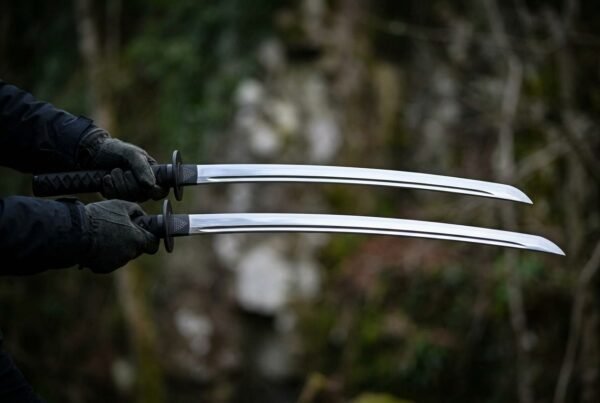
Balance sits about five inches ahead of the tsuba. A katana is meant to feel slightly point heavy, because the cut is a draw and the weight ahead of the hand is what pulls the edge through. The long tsuka is not there to be gripped in the middle. The right hand goes just below the tsuba and the left hand at the very end of the wrap, and the two hands work against each other like the ends of a lever. Most of the power comes from the left hand pulling down, not the right hand pushing.
The blade arrives sharp and it cuts. It is suited to collection, to display and to cutting practice on soft targets by someone who has been taught how. It is not a blunt trainer, and it should never be used in contact practice against another person or another blade. Keep the mekugi peg checked before every use: it is bamboo, it is meant to be the sacrificial part, and a loose peg is the one failure that matters on a Japanese mounted blade.
Care
Traditional practice exists for a reason. After handling, wipe the blade down along its length with a soft cloth, never across the edge. Apply a thin film of camellia oil or a light mineral oil with a clean cloth. Do not store the katana in the saya long term in a humid room, because lacquered wood traps moisture against etched steel and that is where rust starts. Never touch the bare blade with fingers if you can help it, and if you do, wipe and oil it straight away. The ito wrap should be kept dry and away from direct sun, which fades black cotton faster than anything. More detail is on our steel care page.
Made in the Czech Republic
The work behind this piece happens in a Czech Republic workshop that has kept to the old methods. Steel is forged and heat treated by hand, the grind is taken down by eye rather than by machine, and the handle, fittings and sheath are cut and finished one at a time. Because of that, every piece carries small marks of the hand that made it.
Ransack Viking is a United States company. We import direct, check each piece when it reaches us, and ship from our Chicago, Illinois warehouse. Engraving is added here in the United States after arrival, so the piece you receive is finished to your order.
A note on handmade variation
Every Damascus blade is made by hand and not machine produced in bulk, so what arrives will not be a pixel for pixel copy of the photograph. The pattern is the direct fingerprint of how that particular billet was folded and drawn, and it is impossible to repeat exactly. Layer spacing, the tightness of the bands near the tip, the depth of the etch and the exact tone of the ito wrap all vary. The length, the steels, the hardness and the build are the same every time. The pattern is not, and that is the whole reason to own a folded blade. There is more on that in how the Japanese blade lengths line up, and in the gap between a display sword and a battle ready one if you want the background.
Frequently asked questions
Is it sharp when it arrives
Yes, it comes with a working edge. If you want it blunted for display, say so in the order notes and we will roll the edge before it ships at no extra cost.
Is this a real hamon
No, and we will not pretend it is. The line you can see is a Damascus layer pattern from two steels welded together, not a clay hardened temper line. They look different and they are made in different ways, and it matters to anyone who knows Japanese blades.
Can I use it for tameshigiri
It is a sharp forged blade with a full length tang and it will cut soft targets, but only with training. It is not for sparring and should never be used in contact practice against another person or another blade.
Will the pattern wear off
No. The pattern goes all the way through the steel because it is made of the steel. Polishing the blade hard would reduce the etch contrast, and a light re etch brings it straight back.
Is the saya included
Yes. The lacquered black saya shown in the photograph is made to this blade and comes with it, along with a matching koiguchi fit so the sword seats with a click rather than rattling.
How long before it ships
One to two weeks of processing, and a little longer than a plain steel blade because the billet has to be welded and folded first. Engraving adds a few days. Shipping in the United States is free and returns are accepted within seven days.
What is in the box
- Emberfold Damascus katana in folded 1095 and 15N20
- Lacquered black saya fitted to this blade
- Black ito wrapped tsuka over ray skin with a bamboo mekugi peg
- Care sheet with oiling and storage instructions
- Lifetime warranty against defects in forging, grind, heat treat and fittings
- Forged and finished in the Czech Republic
Explore the range
See the rest of the katana and Japanese swords, our Damascus swords, the full range of swords, and the guides.
Compare it with these
Closest to this in the range is the Tidefold Japanese sword, 40 inches overall. If this one is not quite right, there is the Mistfold Japanese sword, 40 inches overall. Also in this group is the Ravenwake Japanese sword, pattern welded Damascus.
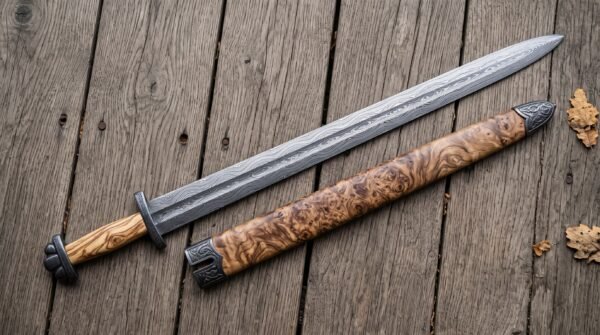
If you are putting a set together, the Fanghowl arming sword sits alongside it. Pick the steel, the length and the fittings yourself on the design your own page.

I collect stuff like this and this sword is on another level. Came in a nice gift box which made it feel even more special. Weight and balance make it feel like a real functional piece not some cheap replica. Already telling my friends to check this out.
My husband was speechless when he opened this. Even the small engravings are crisp and clean. Worth every penny.
Wanted to like this more than I actually do. Just an average purchase. Wouldn’t rush to buy again.