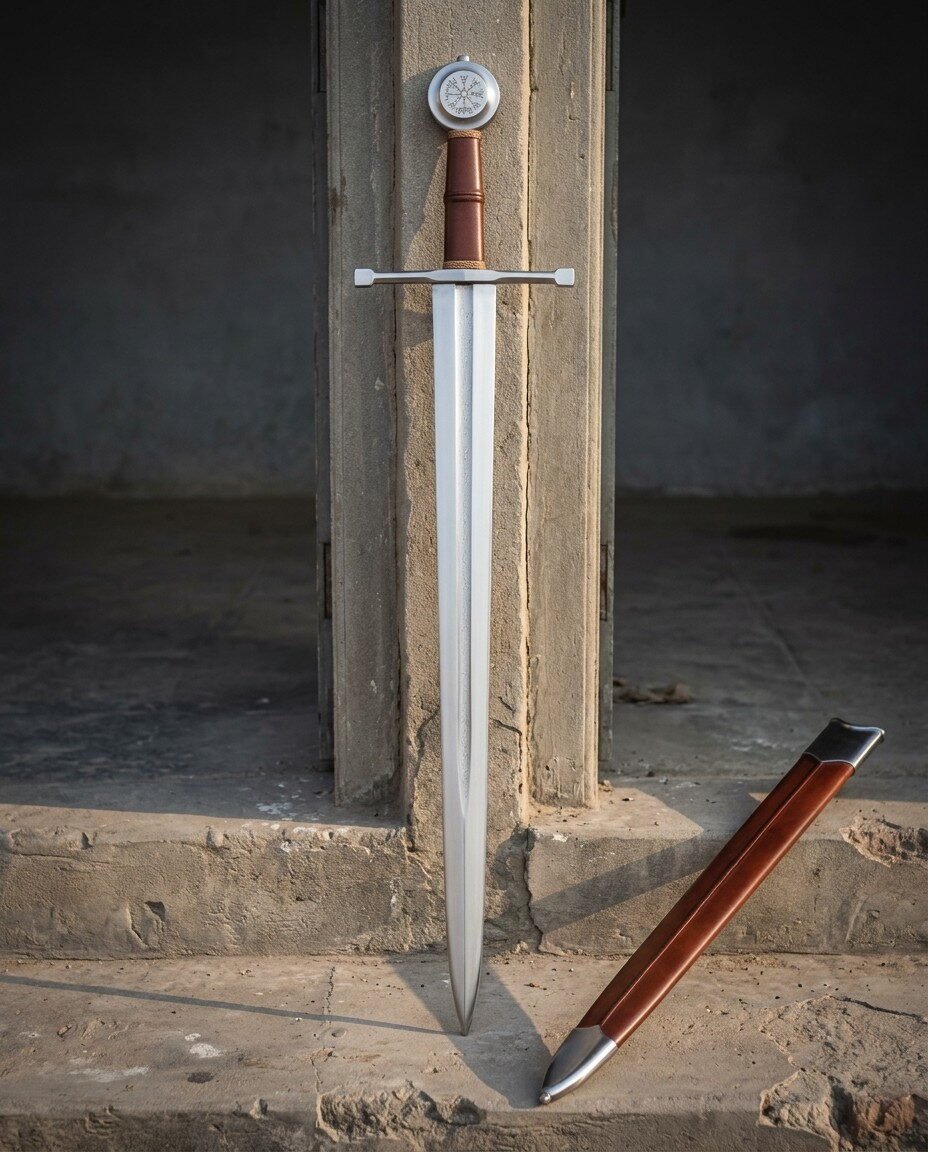
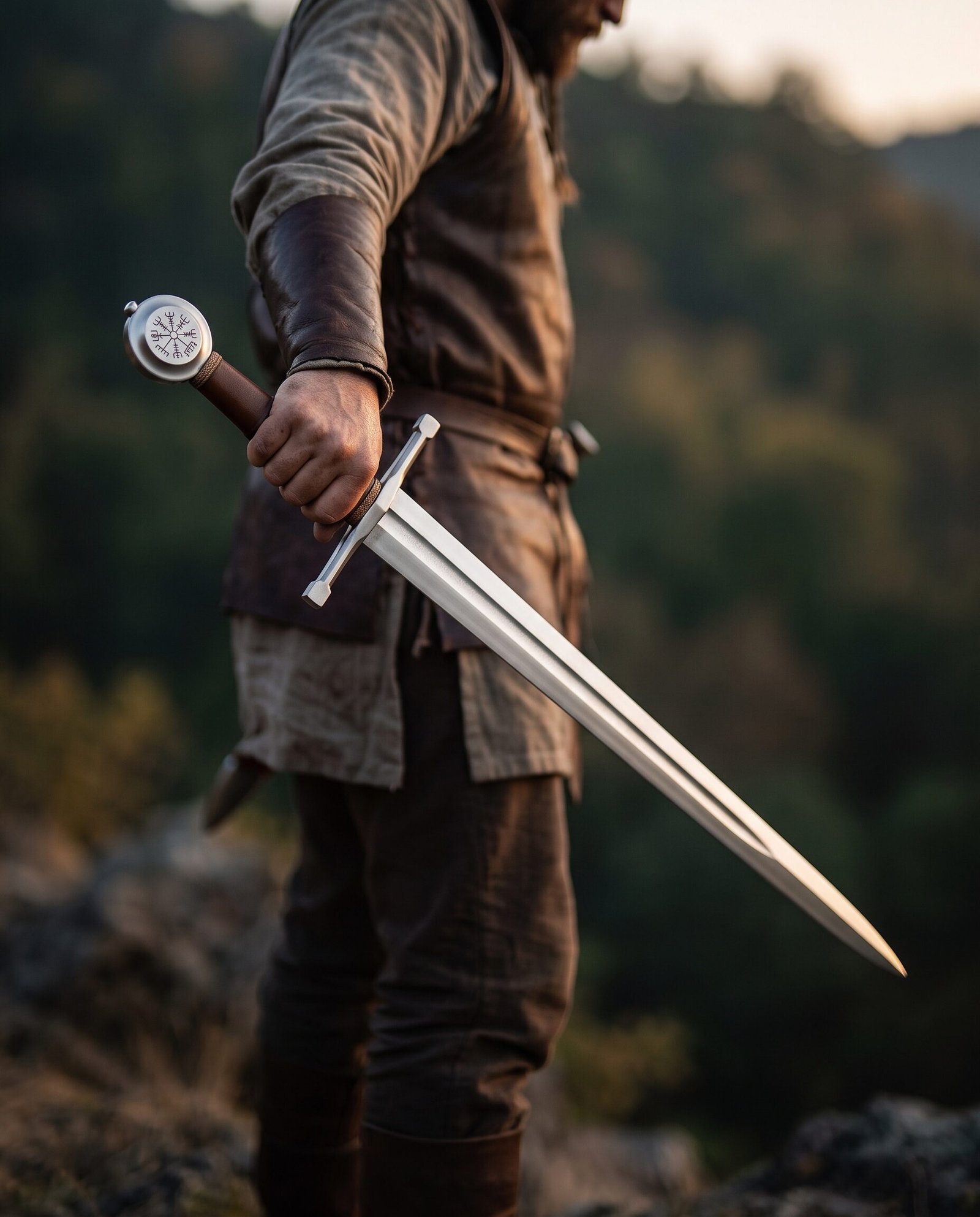
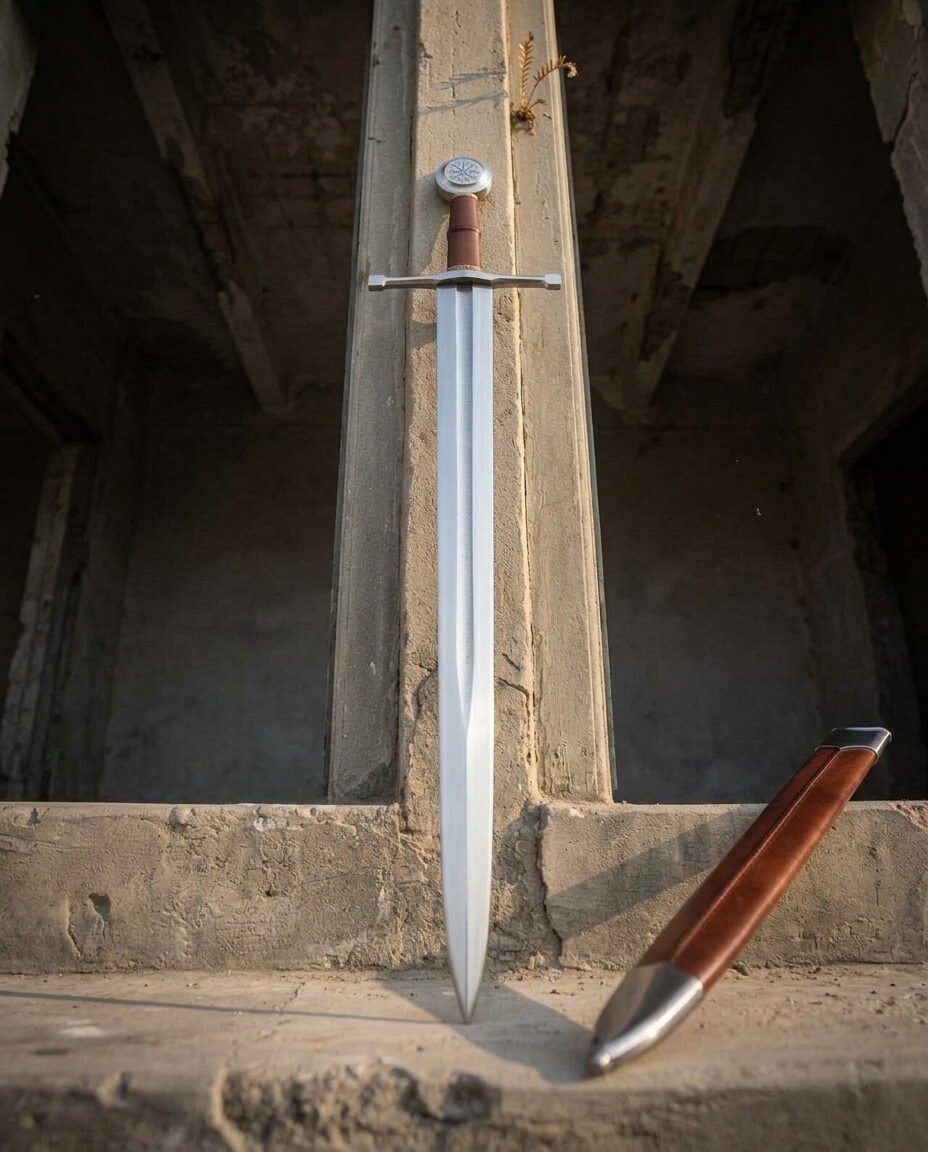
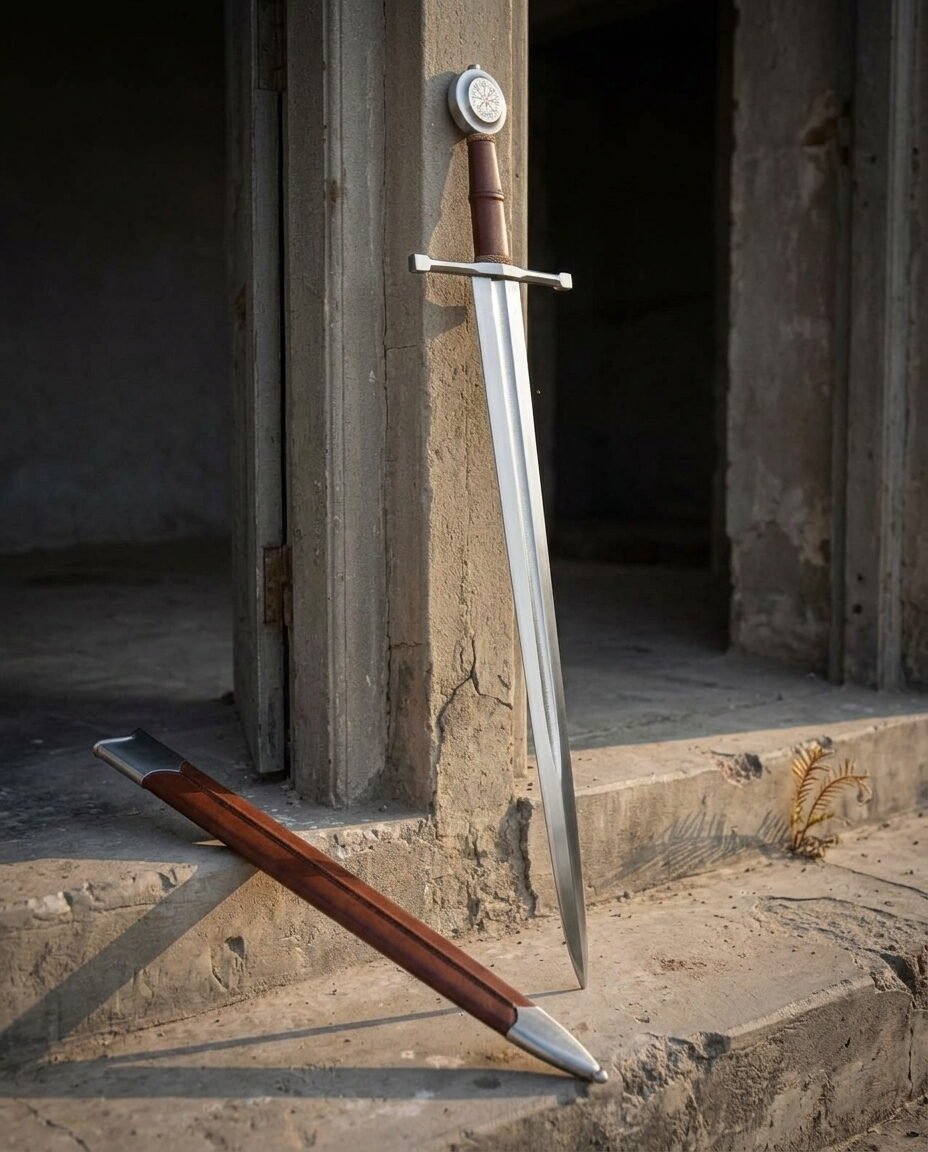
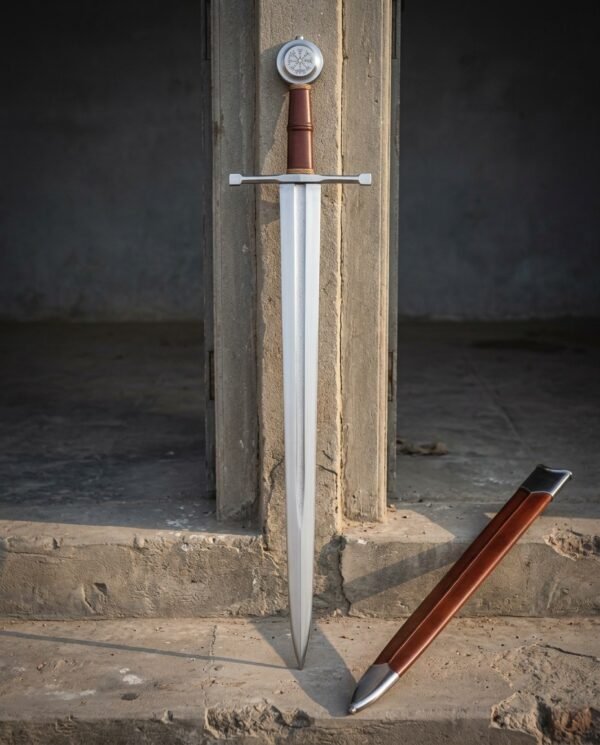
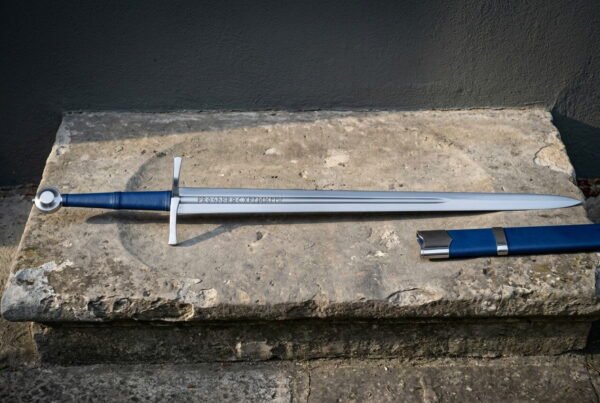
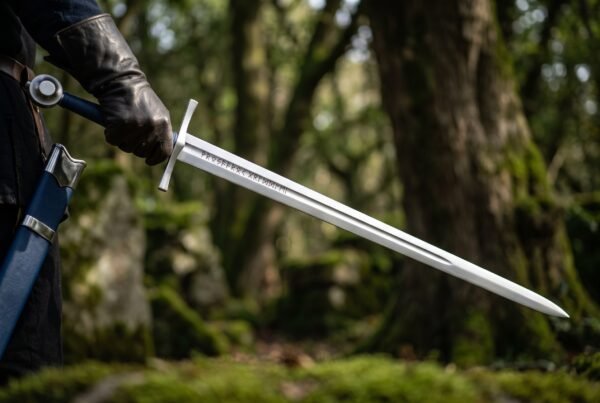
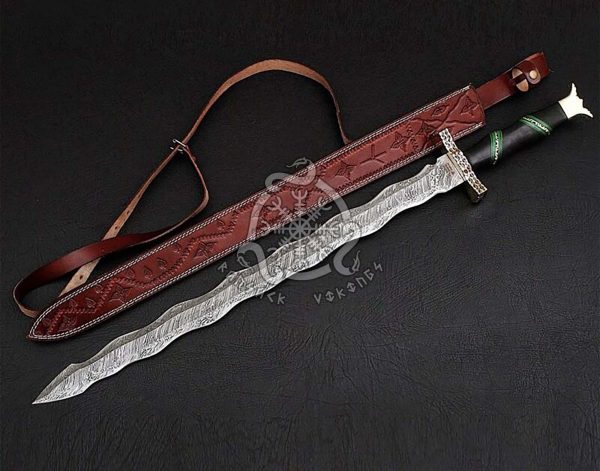
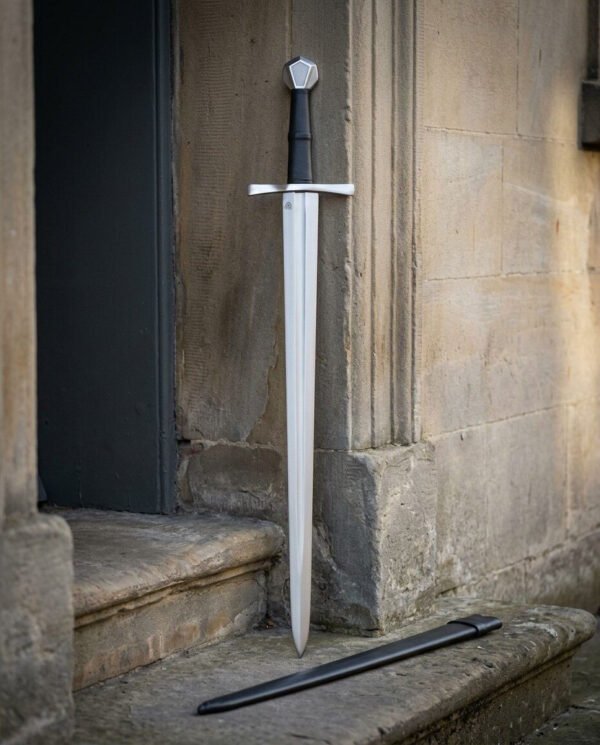
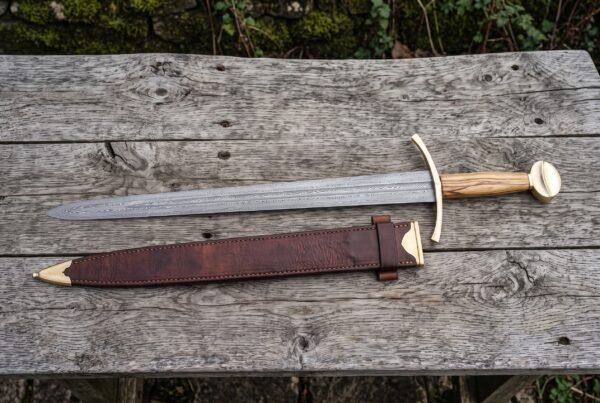
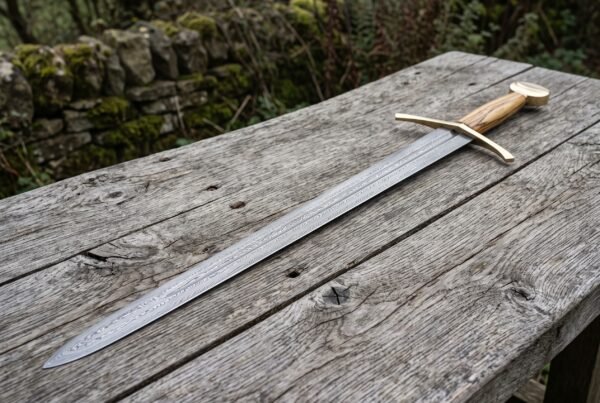
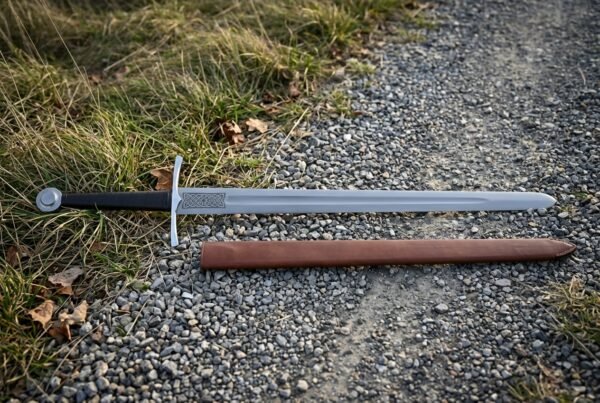
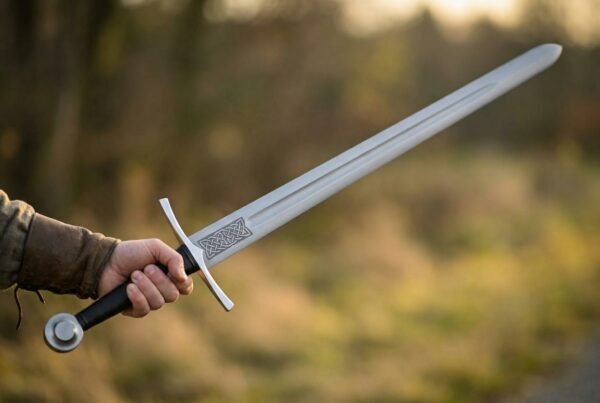
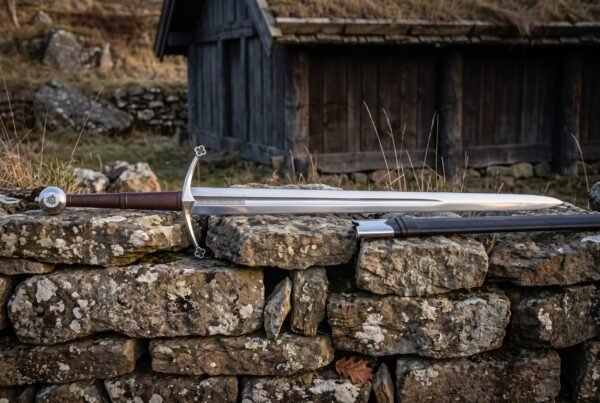
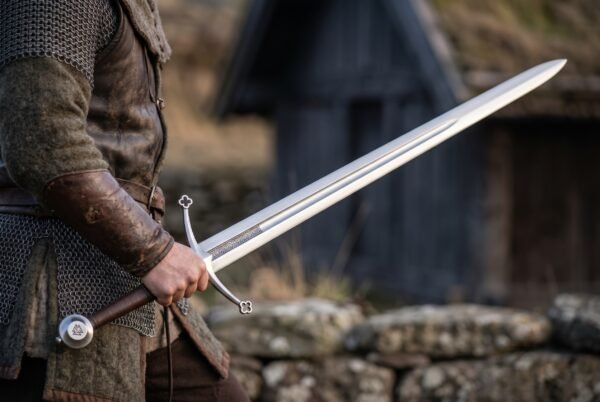
The Pathstave is a broad single hand sword with a straight steel crossguard, a brown leather grip laid over cord risers and a steel disc pommel cut with a Vegvisir. The blade is wide at the shoulder, tapers evenly and finishes in an acute point, and the sword ships in a russet leather scabbard with a polished steel throat and chape.
The Vegvisir is worth being straight about, because it is one of the most misdescribed symbols in the whole Norse revival. It is a genuine Icelandic stave, but it is not Viking Age. Its earliest appearance is in the Huld manuscript, compiled by Geir Vigfusson at Akureyri in 1860, where it is drawn beside a note saying that a man carrying this sign will not lose his way in storms or bad weather even when the way is unknown. That is a nineteenth century Icelandic charm book, roughly eight hundred years after the Viking Age ended. It is a real piece of Icelandic magical tradition and it is a beautiful piece of geometry, and it is not something a Norse raider ever carried. This sword is forged and finished in the Czech Republic. It is part of the arming swords, and the Viking swords are put together the same way.
Specifications
| Material | 1095 high carbon steel blade, steel guard and pommel, leather over timber grip |
|---|
| Overall length | Approximately 35 in / 89 cm |
|---|
| Blade length | Approximately 28 in / 71 cm |
|---|
| Blade profile | Broad double edged blade with a wide central fuller, an even taper and an acute point |
|---|
| Hardness | 54 to 58 HRC |
|---|
| Finish | Hand worked satin |
|---|
| Guard | Straight steel crossguard with squared terminals |
|---|
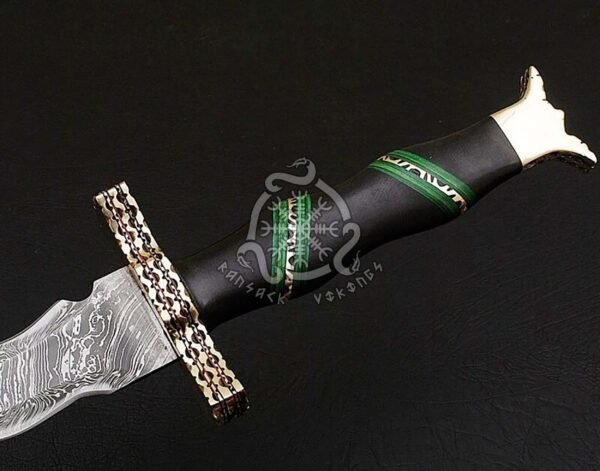
| Grip | Brown leather over timber with cord risers under the wrap, a raised centre band and cord whipping at both ends |
|---|
| Pommel | Steel disc pommel with the Vegvisir cut into the face, peened tang |
|---|
| Scabbard | Russet leather with a polished steel throat and chape |
|---|
| Included | Sword and fitted leather scabbard |
|---|
| SKU | RK-1679 |
|---|
Reading the Vegvisir on the pommel
The stave is built on an eight spoke frame radiating from a central point, and each of the eight arms ends in a different terminal. That asymmetry is the whole thing. A wheel with eight identical spokes is a wheel. A wheel with eight different endings is a set of directions, and the Icelandic tradition treats each arm as a distinct bearing rather than as decoration.
Count them on the pommel and you will find forks, cross bars, hooks and small enclosed shapes, no two the same. The manuscript does not explain the terminals, which is one reason the Vegvisir has attracted so much modern invention. What the Huld text actually says is short and practical, that the bearer will not lose their way in storms and bad weather even when the way is unknown, and that is the honest limit of what is recorded about it.
People often confuse it with the Helm of Awe, the Aegishjalmur. They are different staves. The Helm of Awe has eight identical trident tipped arms and is about protection and striking fear, while the Vegvisir has eight different arms and is about finding the way. If you want the other one on your sword instead, tell us in the engraving notes.
The steel and the grip
The blade is 1095, a straightforward high carbon steel with roughly one percent carbon and very little else. Nothing exotic. It is the steel a village smith would recognise, it forges cleanly, it takes a keen edge and it responds to heat treatment in a way you can rely on. Normalised, quenched and tempered, the blade sits at 54 to 58 HRC, which is where a long blade should live so it can flex under load and come back straight instead of breaking.
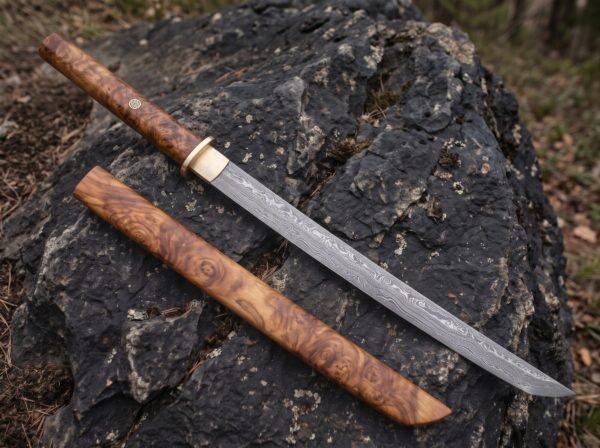
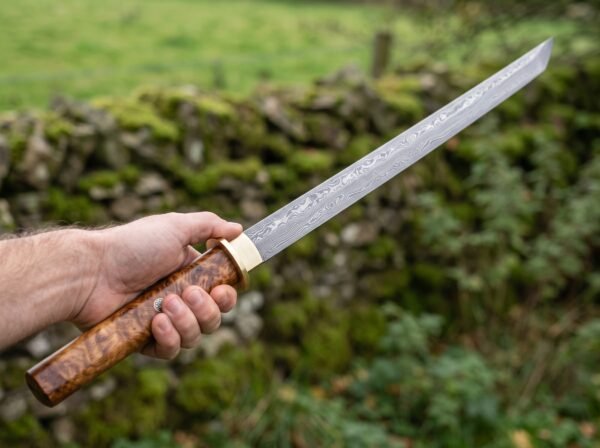
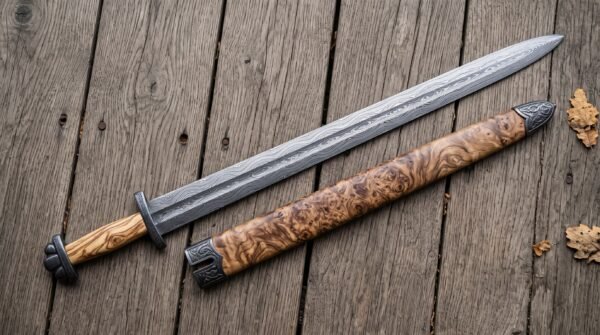
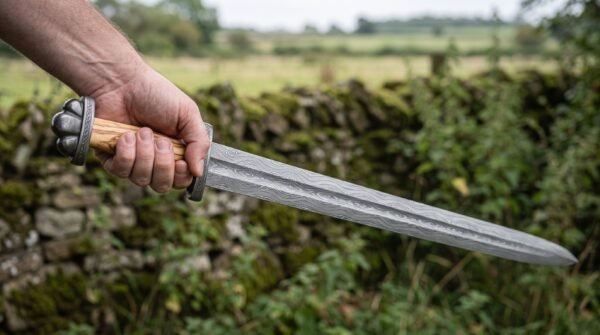
It is finished in a hand worked satin rather than a mirror. Satin hides the everyday marks a handled sword picks up, and it reads better against the warm brown of the grip than a bright polish would. There is no pattern in the steel because there is only one steel. If you want a pattern, our Damascus blades are folded from two.
The grip is where the sword is quietly well made. Cord is wound onto the timber core first, then the leather is laid over it, so the wrap has raised ridges under your fingers rather than being a smooth tube. That is the historically correct construction and it is the difference between a grip that stays put in a wet hand and one that turns. Guard and pommel are steel with the tang peened over the pommel, and the scabbard is russet leather over a fitted core with a polished steel chape.
Engraving, runes and your own design
Use the rune converter on this page to turn a name, a date or a short phrase into Elder Futhark and we will cut it into the steel, the leather or the wood. If you would rather have a Viking pattern than a rune line, choose your own design in the engraving option above the add to cart button and tell us where it goes. Where a piece already carries an engraved design, your chosen engraving replaces it rather than sitting alongside it, so your runes or your stave take the place of the Vegvisir on the pommel. A rune line can also run along the blade flat if you would rather keep the pommel as it is. Full details are on the engraving page.
Handling and balance
This is a shorter and broader sword than a knightly arming sword and it handles accordingly. The balance point sits close in front of the guard, so the sword is quick in the wrist and does its work in the first third of the blade. It is a one handed sword that assumes a shield in the other hand.
Hold it with the heel of the hand under the disc pommel. The pommel is the counterweight and it only earns its keep if your hand is behind it. The cord risers under the leather give you a positive grip without having to squeeze, which matters more than people expect, because a tight fist is a slow fist.
The sword arrives sharp. It is a display, collecting and light cutting piece. It is not built for edge to edge sparring or full contact reenactment and we do not sell it as such.
Care
Wipe the blade down after handling and put a thin film of oil on the steel before it goes back into the scabbard. Bare high carbon steel greys where skin acid has been sitting, so a soft cloth and a light mineral oil belong with the sword rather than in a drawer somewhere else. Do not leave it sheathed for months in a damp room.
Take rust spots off with oil and a fine synthetic pad, working along the blade rather than across it, then re oil. Feed the brown grip and the russet scabbard with a leather balm once or twice a year, and keep both out of long direct sun because light dyes fade faster than dark ones. Wipe the pommel and chape dry. Our full notes are in steel care.
Made in the Czech Republic
This is a handmade piece from the Czech Republic, made in a workshop that still forges, grinds and finishes by hand instead of stamping parts out. The smiths there have kept the older way of working, and the wood, horn and leather are shaped and fitted by hand as well. Two pieces of the same design will never be identical, and that is part of what you are buying.
Ransack Viking is a United States company. We handle the import ourselves, look over every piece when it lands and ship from our warehouse in Chicago, Illinois. Engraving is done in the United States after the piece arrives, so your design goes on before we send it out.
A note on handmade variation
This is hand made rather than machine made or bulk produced, so what arrives will not be a pixel for pixel copy of the photograph. The satin finish runs its own way, the cord risers under the grip fall at slightly different spacings, the Vegvisir is cut one piece at a time and tan leather in particular takes dye unevenly from hide to hide, so your grip may be lighter or redder than the one shown. The dimensions, the steel, the hardness and the build are the same every time. The character is not. The long form of that is buying a first sword, with how steel and hardness actually work next to it.
Frequently asked questions
Is the Vegvisir a real Viking symbol
It is a real Icelandic stave but it is not Viking Age. Its earliest known appearance is the Huld manuscript of 1860. We would rather tell you that than sell you a myth.
Is the sword sharp out of the box
Yes. Both edges arrive with a working edge and the point is fully formed.
Can I have the Helm of Awe instead
Yes. Choose your own design in the engraving option and say Aegishjalmur in the notes. It replaces the Vegvisir on the pommel.
Is this battle ready for sparring
No. It is a sharp display, collecting and light cutting sword, not a blunt trainer for contact work.
Why does the grip have ridges under the leather
Cord is wound onto the core before the leather goes on. It is the historical construction and it stops the hand sliding on the wrap.
How long does it take to arrive
One to two weeks of processing, then free shipping inside the United States.
What is in the box
- Pathstave sword in 1095 high carbon steel at 54 to 58 HRC
- Vegvisir engraved steel disc pommel
- Corded and leather wrapped grip
- Fitted russet leather scabbard with a polished steel chape
- Care card for high carbon steel and vegetable tanned leather
- Lifetime warranty against defects in forging, grind, heat treat and fittings
- Forged and finished in the Czech Republic
Explore the range
See more in viking swords, arming swords, Norse arms and engraved and personalised, or read the guides.
Worth a look beside this
Next along the rack is the Nightbough arming sword, 37 inches overall. For a straight comparison, see the Crimsonring arming sword, high carbon steel. Worth putting side by side with this is the Serpentward arming sword, high carbon steel.
If you are putting a set together, the Runewhet Viking sword sits alongside it. Or start from a blank sheet on the custom Viking sword page.
The Skarnvik arming sword is our blunt option for club training, and our blunt versus sharp guide is there if you want to compare.

This sword is a genuine work of art. Even the small engravings are crisp and clean. Steel blade holds a razor edge right out of the box. Edge retention has been great even after regular use. Great buy overall.