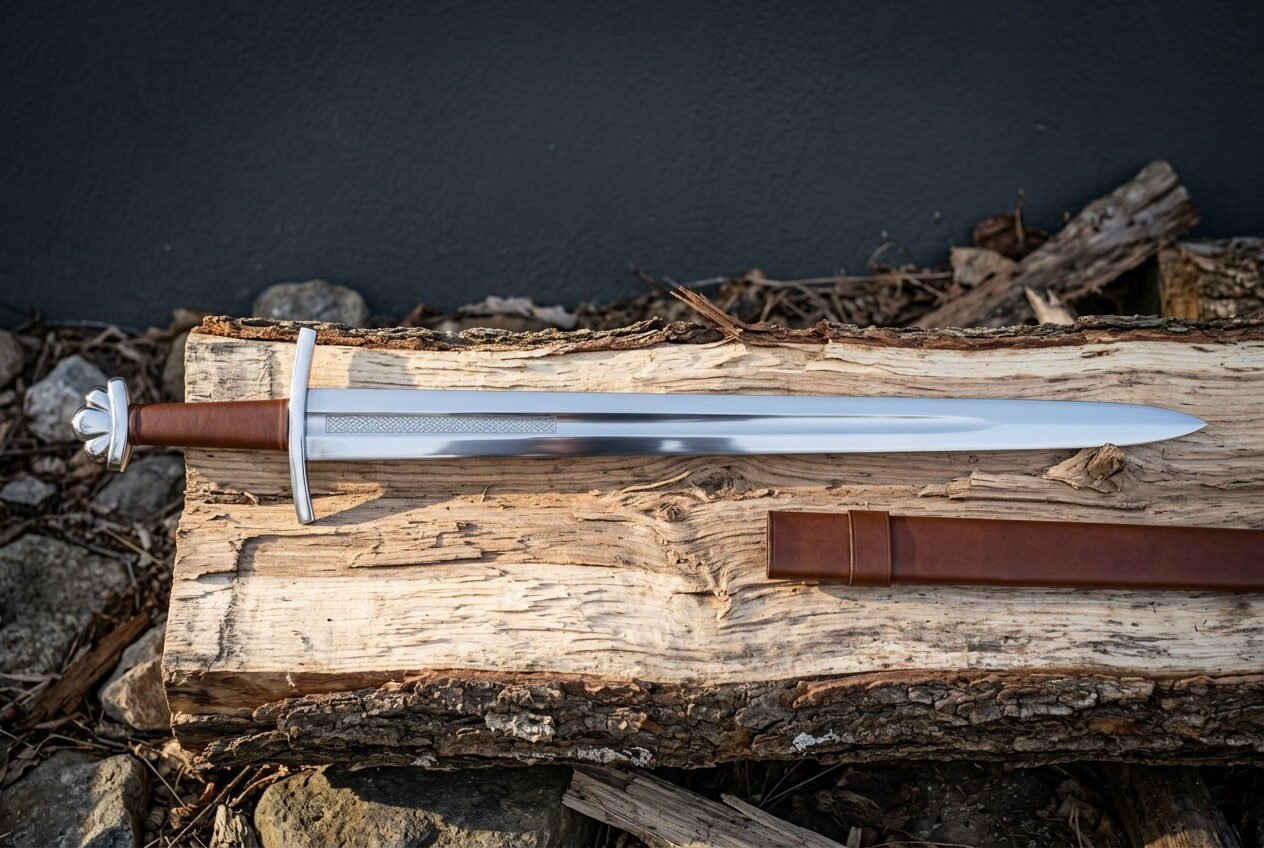
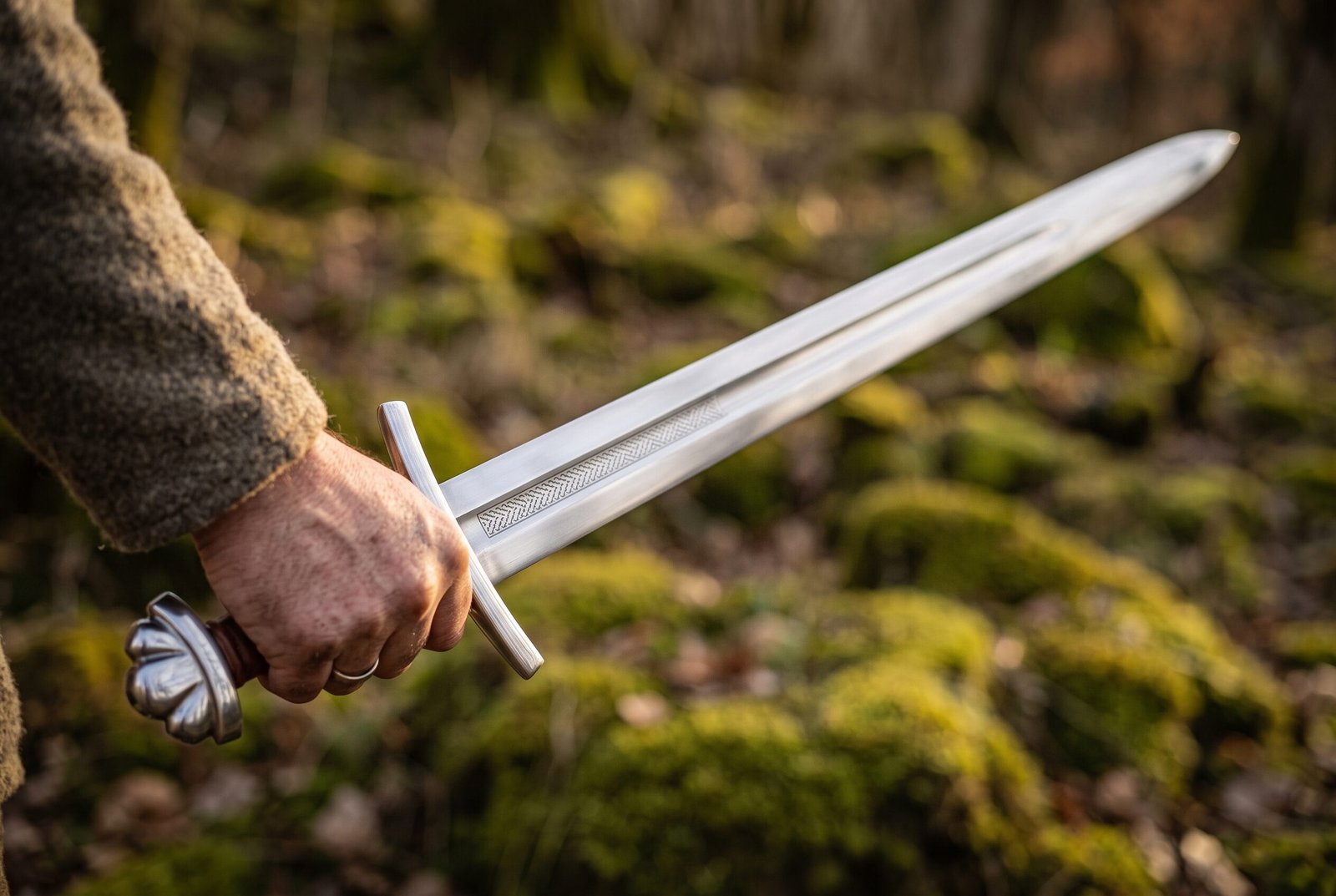
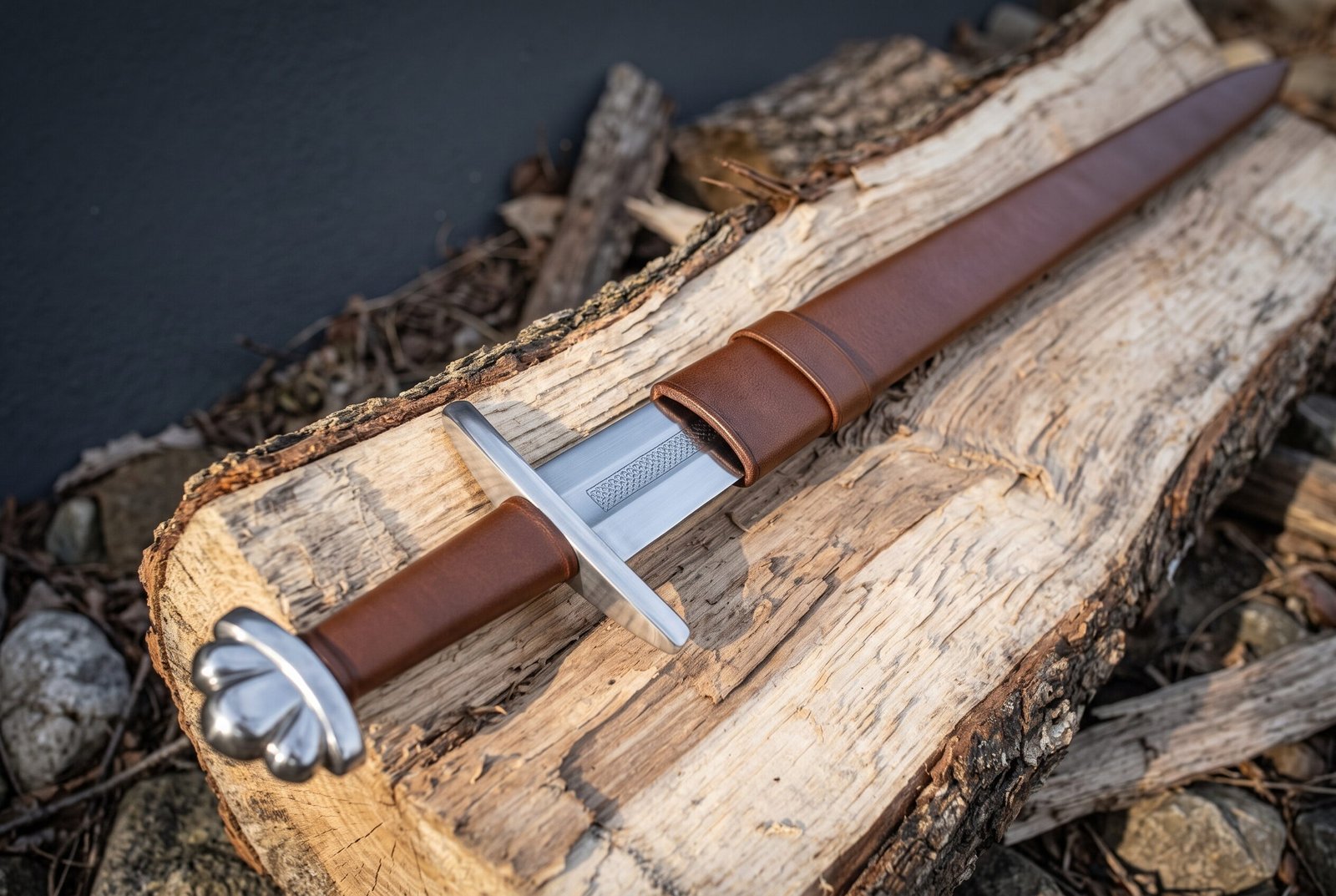
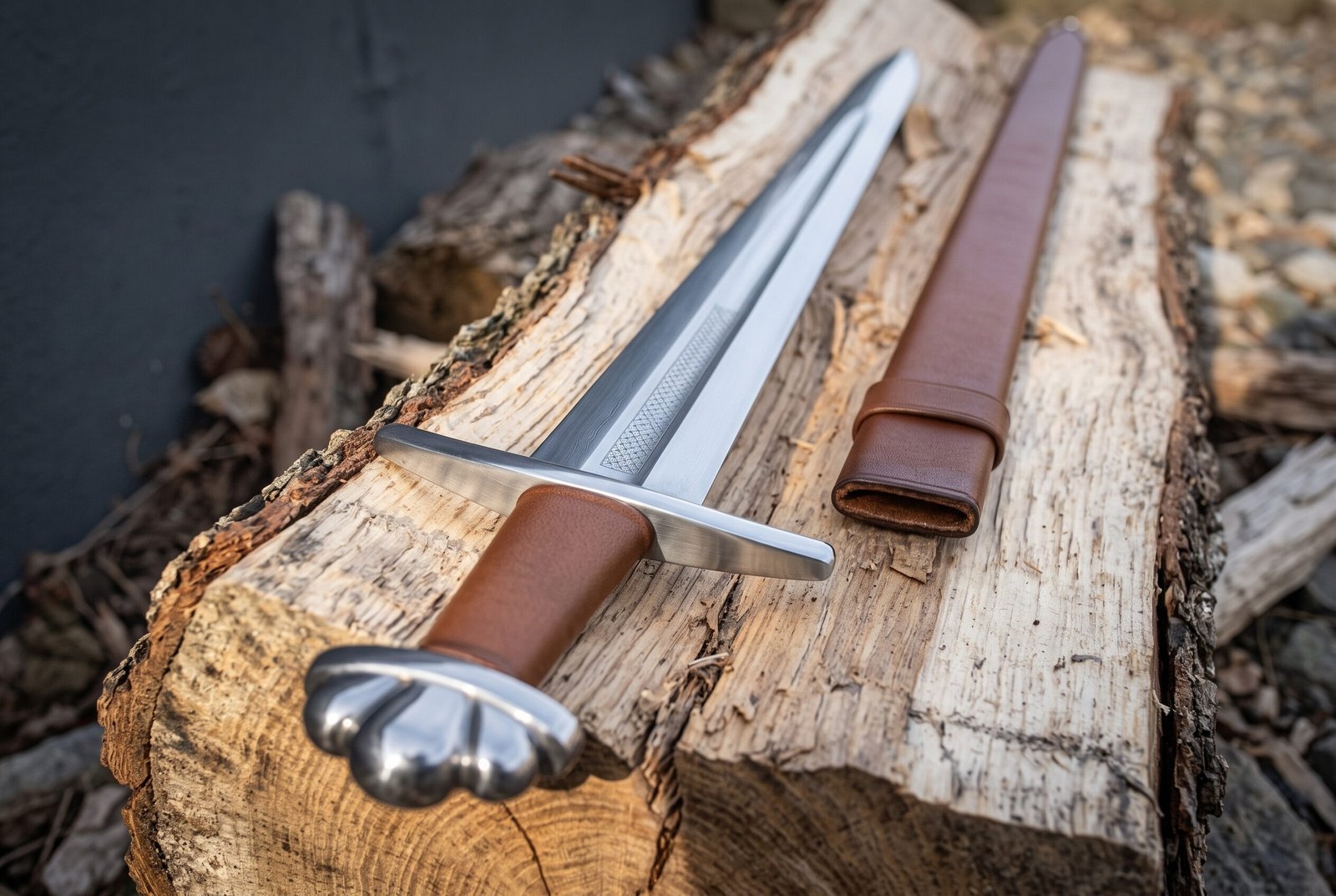
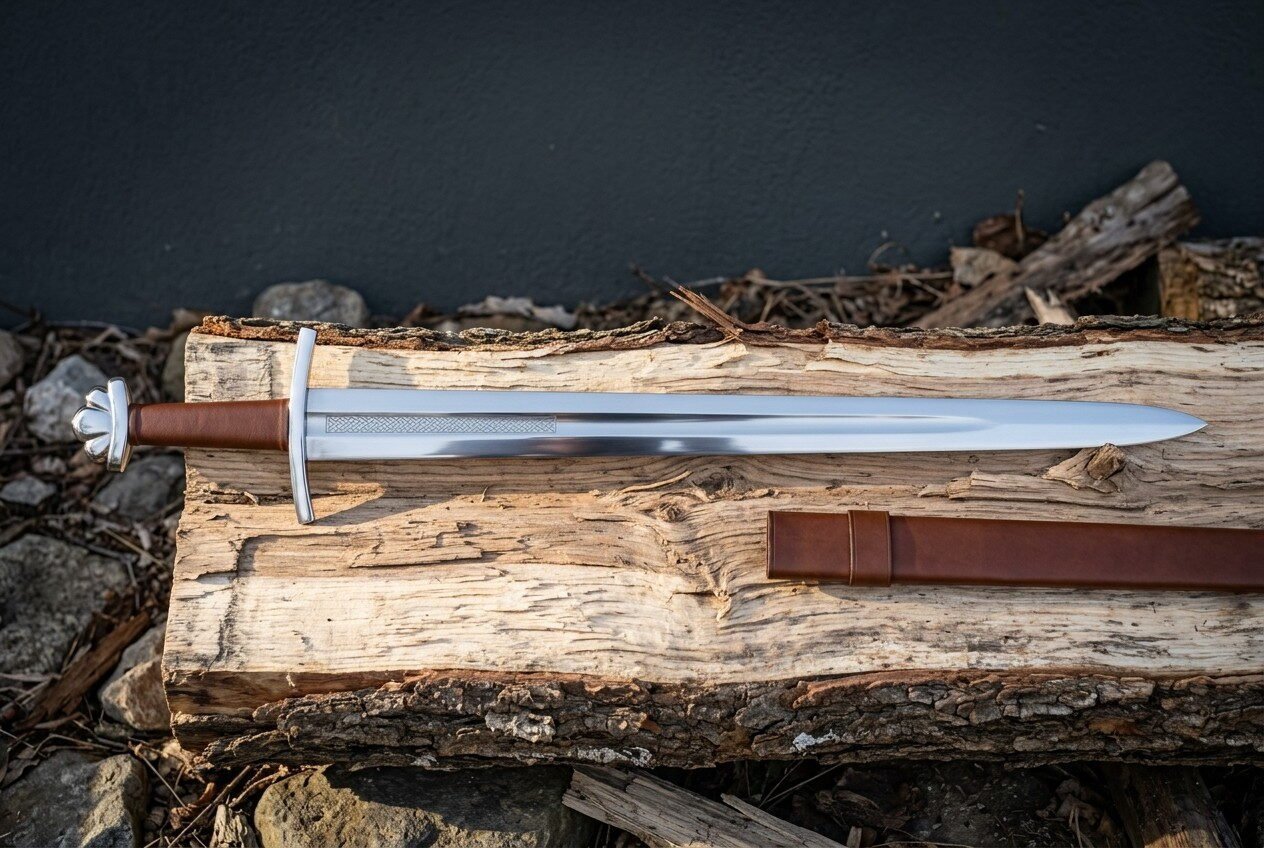
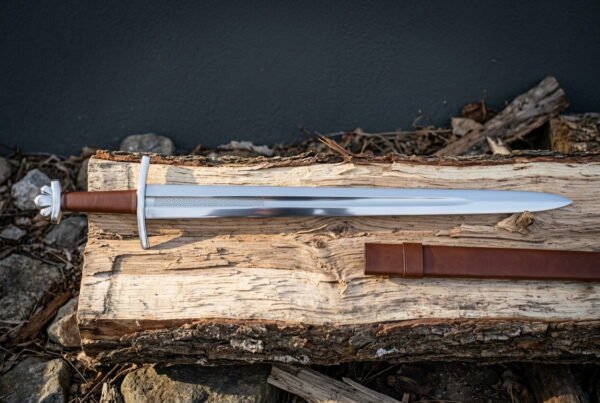
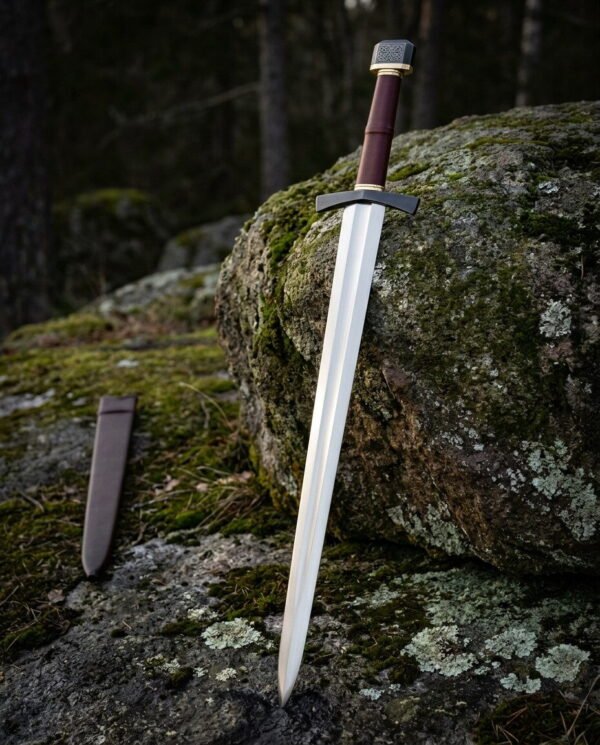
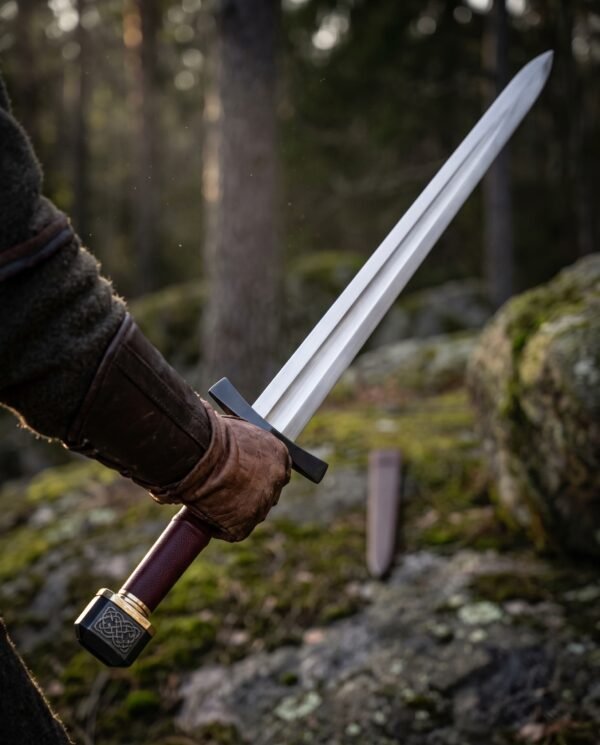
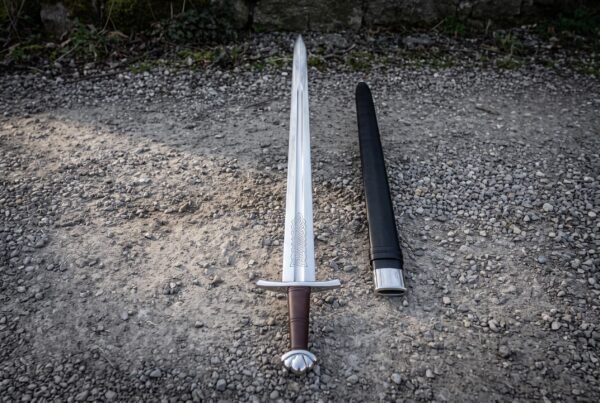
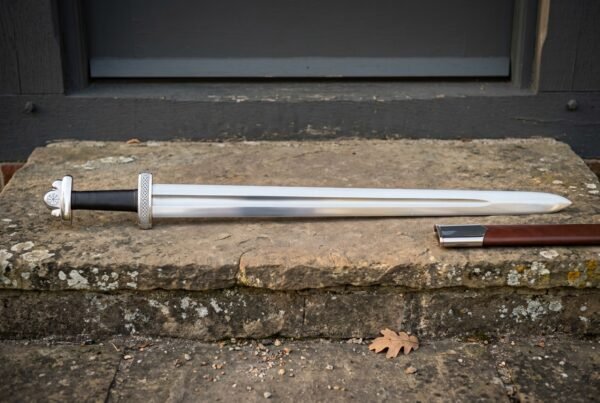
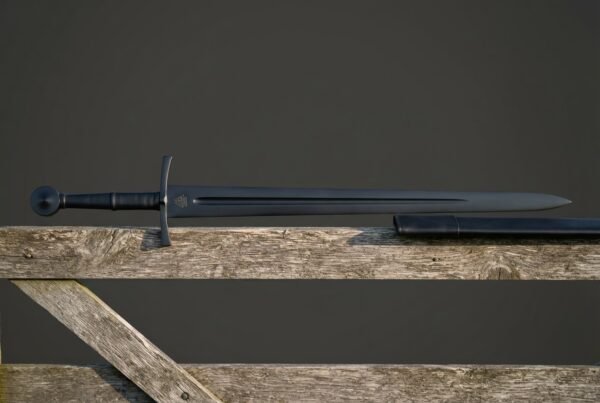
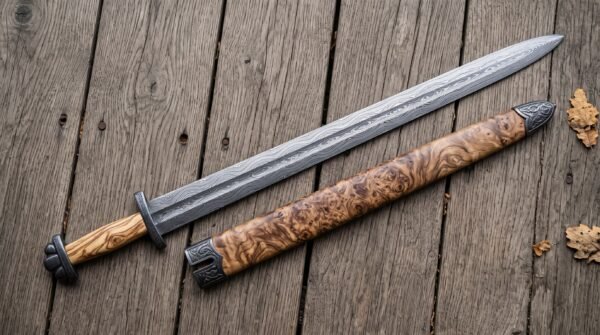
A Viking age sword built around the feature that dates it most clearly, the lobed pommel. Instead of a single wheel or a plain cap, the pommel is divided into several rounded lobes sitting side by side above a straight upper guard. The blade is hand forged 1095 high carbon steel, double edged, with a wide shallow fuller running most of its length, and a panel of etched diamond lattice worked into the fuller just below the guard. The grip is brown leather over a shaped core and a brown leather scabbard ships with it.
Lobed pommels are the single most useful dating feature on an early medieval sword. Petersen’s typology, published in 1919 and still the framework archaeologists use, sorts Viking swords largely by hilt shape, and the number and arrangement of pommel lobes is central to it. Three lobes, five lobes, seven lobes, lobes with a separate upper guard or lobes cast in one piece, each combination clusters into a period and often into a region. Show an archaeologist a pommel and no blade and they can still put a rough century on it. Forged, ground, etched and hilted by hand in the Czech Republic. You will find it filed with the Viking swords, and the pattern welded alternatives sit with the Damascus swords.
Specifications
| Blade steel | 1095 high carbon steel, hardened to 54 to 58 HRC |
|---|
| Blade profile | Double edged with a wide shallow fuller, hand polished satin finish |
|---|
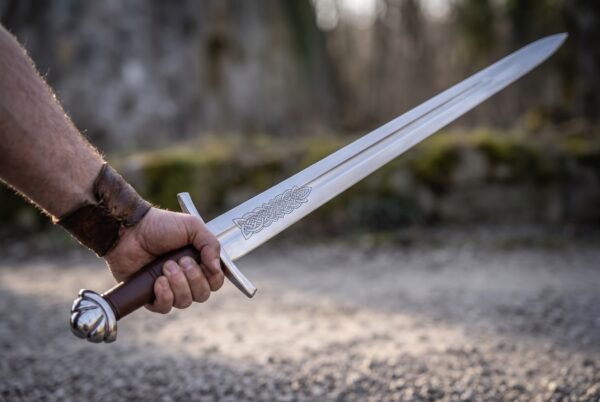
| Etching | Diamond lattice panel etched into the fuller below the guard |
|---|
| Guard | Straight steel crossguard, square in section, reaching well past the blade on both sides |
|---|
| Pommel | Five lobed polished steel pommel over a straight upper guard |
|---|
| Grip | Brown leather over a shaped core, fitted between the guards |
|---|
| Scabbard | Brown leather scabbard with a stitched band below the throat, no metal fittings |
|---|
| Finish | Satin polished blade, polished steel fittings, etched fuller panel |
|---|
| Included | Sword, leather scabbard, care card |
|---|
| SKU | RK-1805 |
|---|
What the lobes were originally covering up
There is a good practical explanation for why lobed pommels appear at all, and it has nothing to do with looks. The earliest versions were not solid. They were built as a separate upper guard bar with a decorated cap riveted onto its top, and the lobes were the individual elements of that cap, sometimes made from different metals and sometimes inlaid with silver or copper wire between them.
Building a pommel in two parts solved a manufacturing problem. A smith could forge a simple functional bar to take the tang and then attach a decorative element made separately, possibly by a different craftsman entirely, without either of them having to do the other’s job. As casting and forging improved, the whole assembly started being made in one piece, but the shape was kept because by then it was what a sword was supposed to look like. This one follows the later single piece construction with the lobed form preserved.
1095 high carbon steel and the etched panel
The blade is 1095, a plain high carbon steel of about one percent carbon and very little else, hardened to 54 to 58 HRC. That range is chosen deliberately for a long double edged blade. Harder steel holds a finer edge but a Viking sword takes shock loading right at the guard, and a blade taken too hard cracks there rather than flexing.
The diamond lattice in the fuller is acid etched rather than cut. Etching leaves a matte grey figure sitting slightly below a satin polished surface, which reads clearly in the shadowed floor of a fuller where a cut engraving would simply fill with oil and vanish. Because the figure is bitten into the steel rather than applied to it, handling will not wear it away.
Engraving, runes and your own design
Use the rune converter on this page to turn a name, a date or a short phrase into Elder Futhark and we will cut it into the steel, the leather or the wood. If you would rather have a Viking pattern than a rune line, choose your own design in the engraving option above the add to cart button and tell us where it goes. Where a piece already carries an engraved design, your chosen engraving replaces it rather than sitting alongside it, so custom work in the fuller takes the place of the lattice panel. If you want to keep that panel, the leather scabbard face and the flats of the pommel lobes are both good alternatives. See the engraving page.
Handling and balance
The lobed pommel is heavy, and that is the whole reason it is there. All the mass sitting behind your hand pulls the balance point back close to the guard, which is what gives a Viking sword its characteristic liveliness. The blade turns around the wrist and can be checked mid cut rather than having to be swung through. The grip is short because this was a one hand sword used with a shield in the other, and it is meant to fill the palm rather than allow sliding.
It is a sharpened display and collector sword. It is not sold for battle ready sparring and it must not be used for contact drills against another blade or against a person. Reenactment fighting uses purpose built blunts with rolled edges.
Care
Carbon steel rusts if it is left alone. Wipe the blade every time you handle it and keep a light film of mineral oil on the steel, working a little into the fuller where oil runs out first. Pay attention to the etched panel, since an etch leaves a slightly textured surface that traps moisture. Do not store the sword sheathed for long stretches, because vegetable tanned leather is mildly acidic and holds humidity against the blade. Feed the grip and the scabbard with a leather conditioner once or twice a year. Never take an abrasive polish across the etched panel, which will lift the figure out of the steel. Our full method is under steel care.
Made in the Czech Republic
The work behind this piece happens in a Czech Republic workshop that has kept to the old methods. Steel is forged and heat treated by hand, the grind is taken down by eye rather than by machine, and the handle, fittings and sheath are cut and finished one at a time. Because of that, every piece carries small marks of the hand that made it.
Ransack Viking is a United States company. We import direct, check each piece when it reaches us, and ship from our Chicago, Illinois warehouse. Engraving is added here in the United States after arrival, so the piece you receive is finished to your order.
A note on handmade variation
This sword is hand made, not machine made or bulk produced, so what arrives will not be a pixel for pixel copy of the photograph. The lobes are shaped by hand and their proportions and spacing shift a little sword to sword, which is also true of every excavated example. Etch depth and contrast vary. Leather takes dye differently hide to hide, so the grip and scabbard may read warmer or cooler brown than the picture. The satin polish carries its own direction. The steel, the heat treat, the dimensions and the build are the same every time. The character is not. More on the Ulfberht blades elsewhere on the site, along with the gap between a display sword and a battle ready one.
Frequently asked questions
Is it sharp when it arrives
Yes. Both edges get a hand put working edge before the sword leaves us. It is not a blunted display copy.
Is this suitable for reenactment combat
No. It is a sharpened collector and display sword. Contact reenactment needs a blunt trainer with rolled edges built specifically for that purpose.
Why does the pommel have lobes
Because early versions were built as a decorated cap riveted onto a plain upper guard, and the lobes were the elements of that cap. The shape outlived the construction method and became what a Viking sword was expected to look like.
Is the lattice etched or engraved
Etched with acid, so it sits below the surface of the steel and will not wear off with handling. That is also why it reads clearly inside a fuller.
Is the scabbard included
Yes. The brown leather scabbard shown ships with the sword as part of this listing.
Can I have a name put on it in runes
Yes. Use the rune converter on this page. A rune line in the fuller replaces the lattice panel, or it can go on the scabbard instead.
What is in the box
- Hand forged 1095 high carbon steel Viking battle sword
- Multi lobed polished steel pommel over a straight upper guard
- Etched diamond lattice panel worked into the fuller
- Brown leather grip and matching hand stitched leather scabbard
- Care card covering oiling, etched surfaces and leather feeding
- Lifetime warranty against defects in forging, grind, heat treat and fittings
- Forged and finished in the Czech Republic
Explore the range
See the rest of the Viking swords, the full sword range, the Norse arms and the guides.
If this one is not it
Closest to this in the range is the Oathbright Viking sword, 30 inches overall. If this one is not quite right, there is the Knotfell Viking sword, 30 inches overall. Also in this group is the Moorsweep Viking sword, 36 inches overall.
If you are putting a set together, the Twinreave movie sword sits alongside it. Pick the steel, the length and the fittings yourself on the custom Viking sword page.


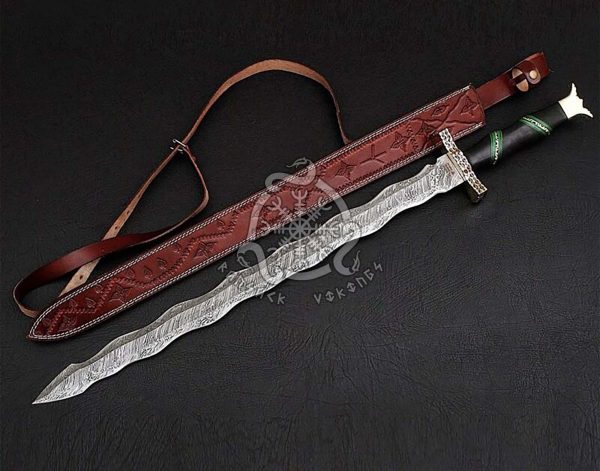
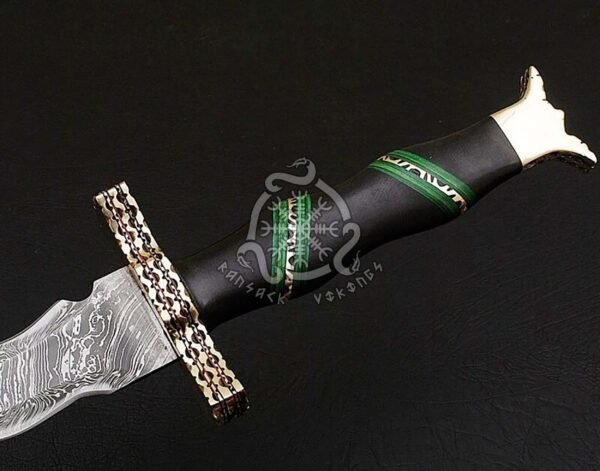
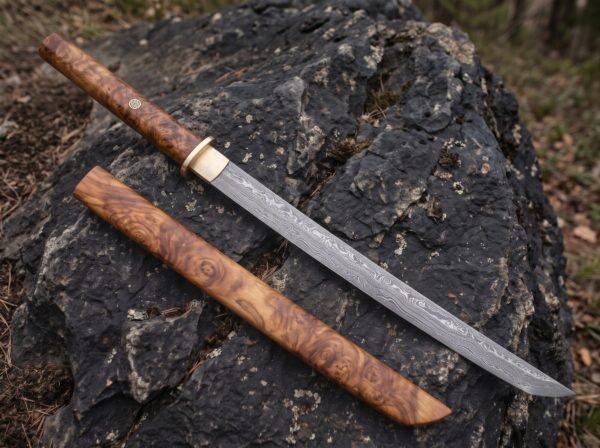
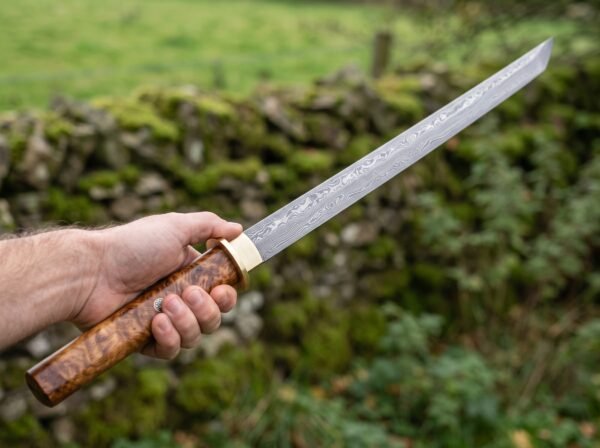
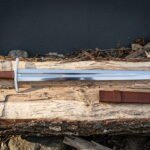
Best sword I’ve ever owned. Weight and balance make it feel like a real functional piece not some cheap replica. Great buy overall. This is my third order from Ransack Viking and they never disappoint.
Solid sword. Glad I ordered it. Sheath is nice. Wish it had more padding but it does the job. Glad I made this purchase.
My husband was speechless when he opened this. 1095 Steel blade holds a razor edge right out of the box. The wood handle feels amazing and the balance is perfect. Even the small engravings are crisp and clean. This shop clearly takes pride in their work.
Overall a good buying experience. Blade quality is solid. Arrived a bit less sharp than expected but a few passes on a strop fixed it. Sheath is nice. Wish it had more padding but it does the job. Would still tell others to give this a try.
This is exactly what I wanted and then some. Edge retention has been great even after regular use. Weight and balance make it feel like a real functional piece not some cheap replica. Love it.