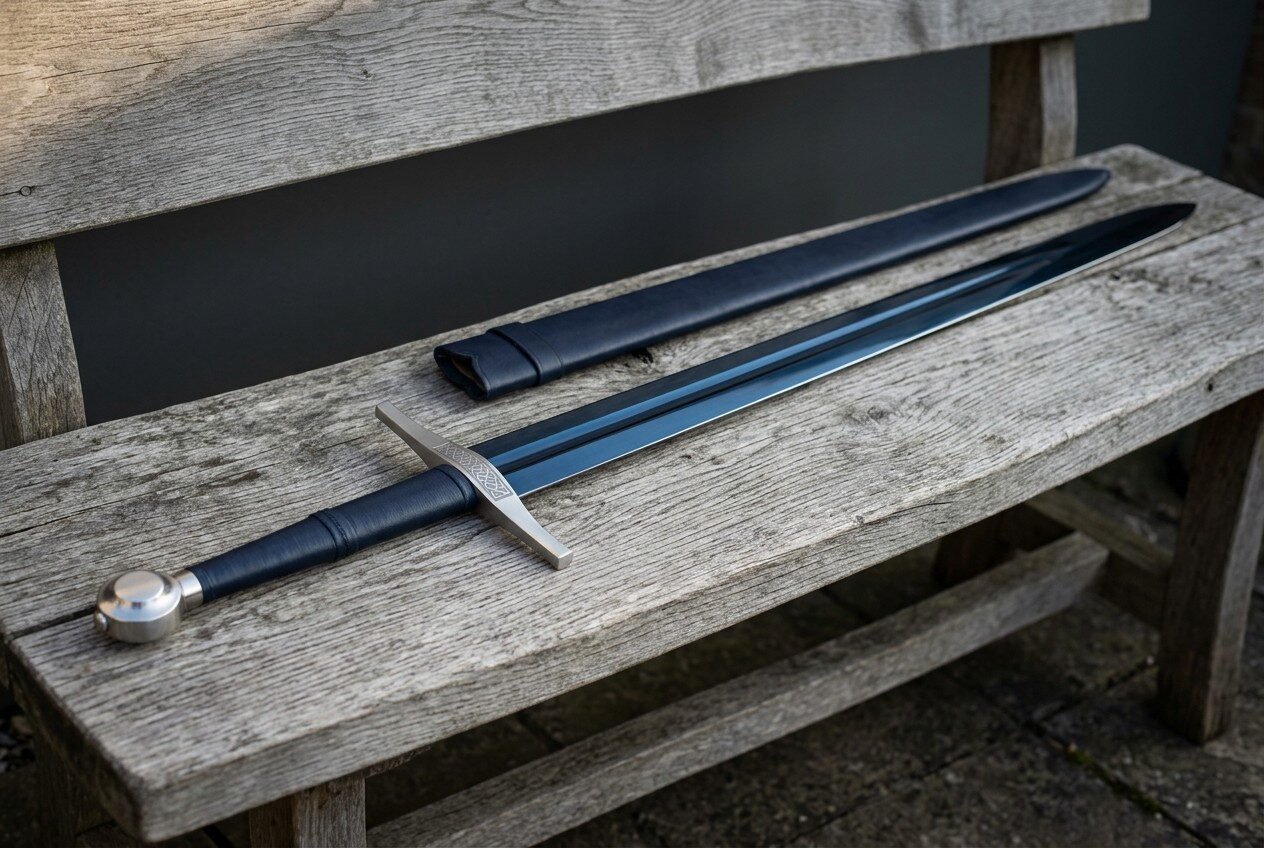
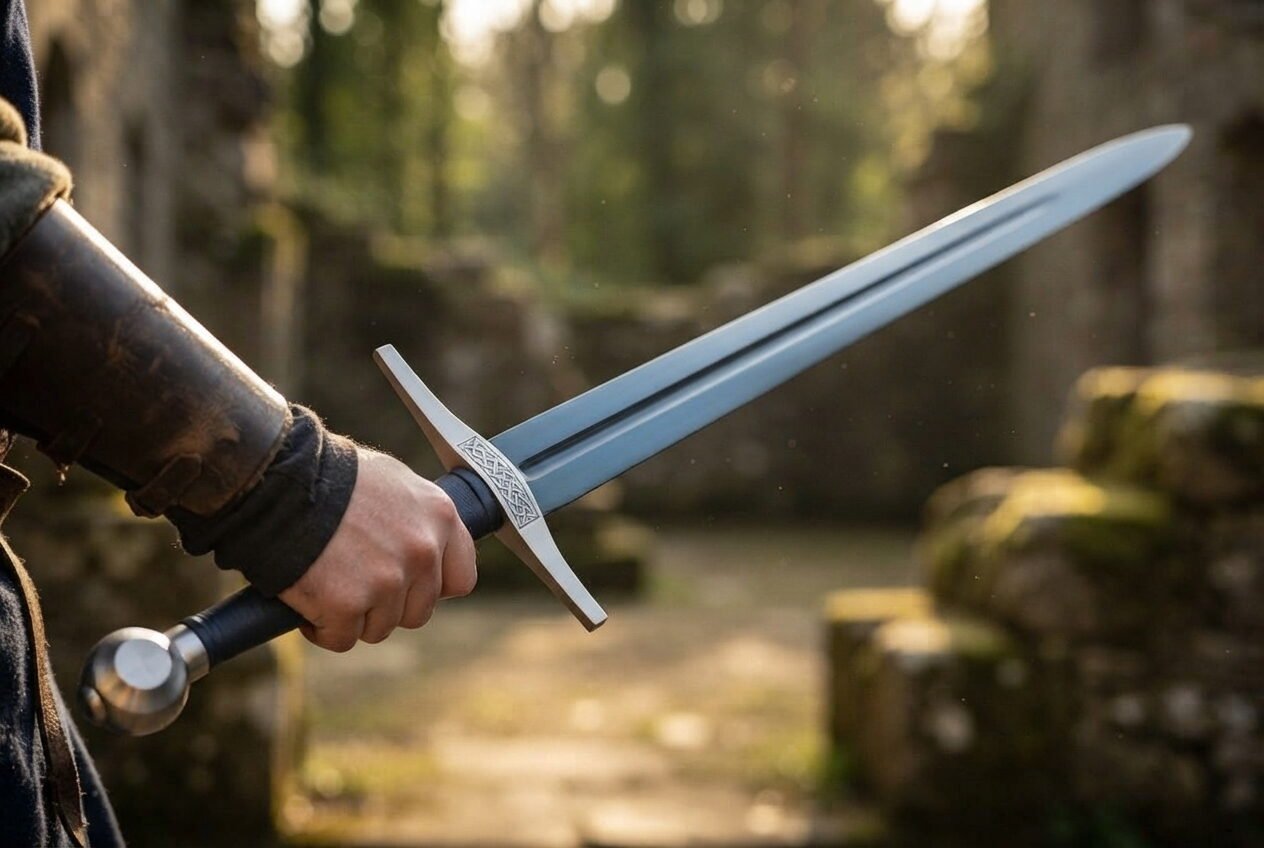
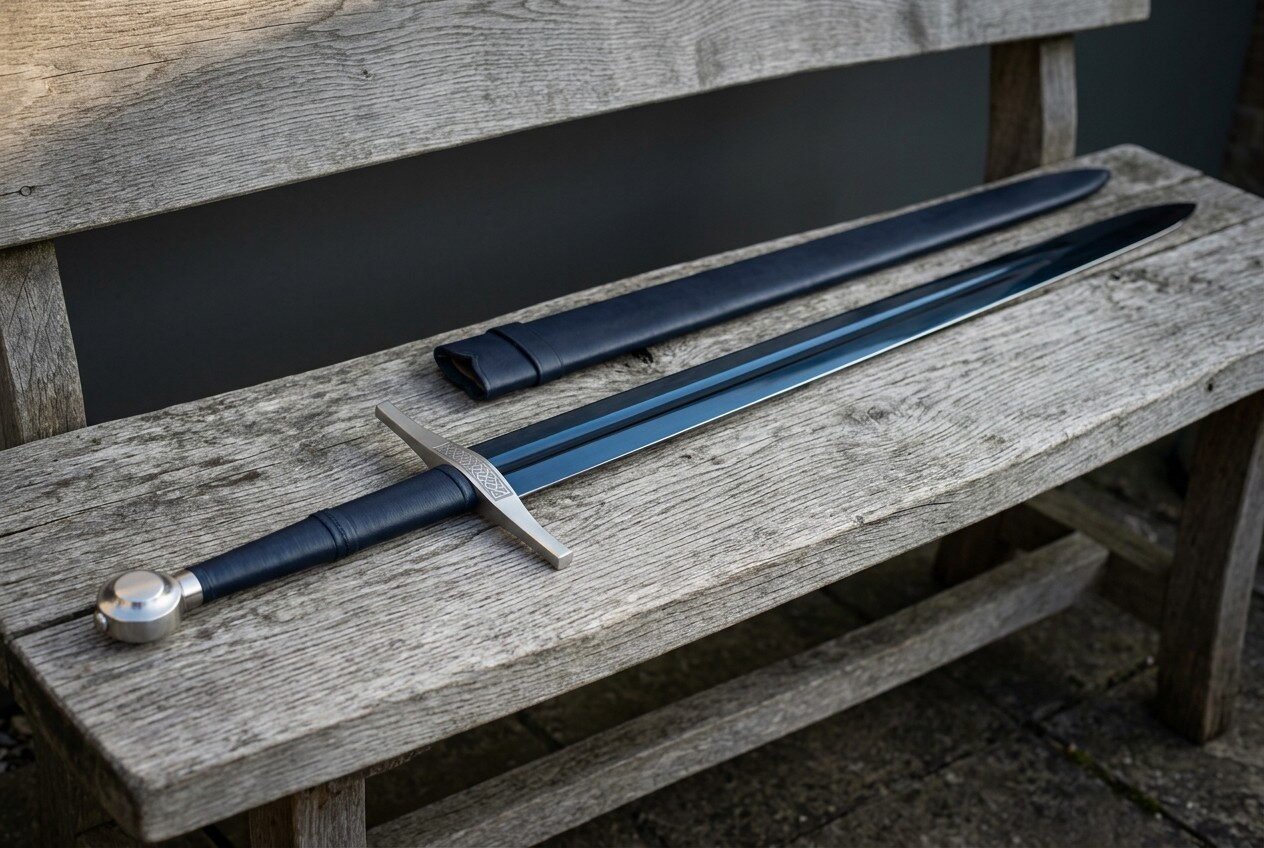
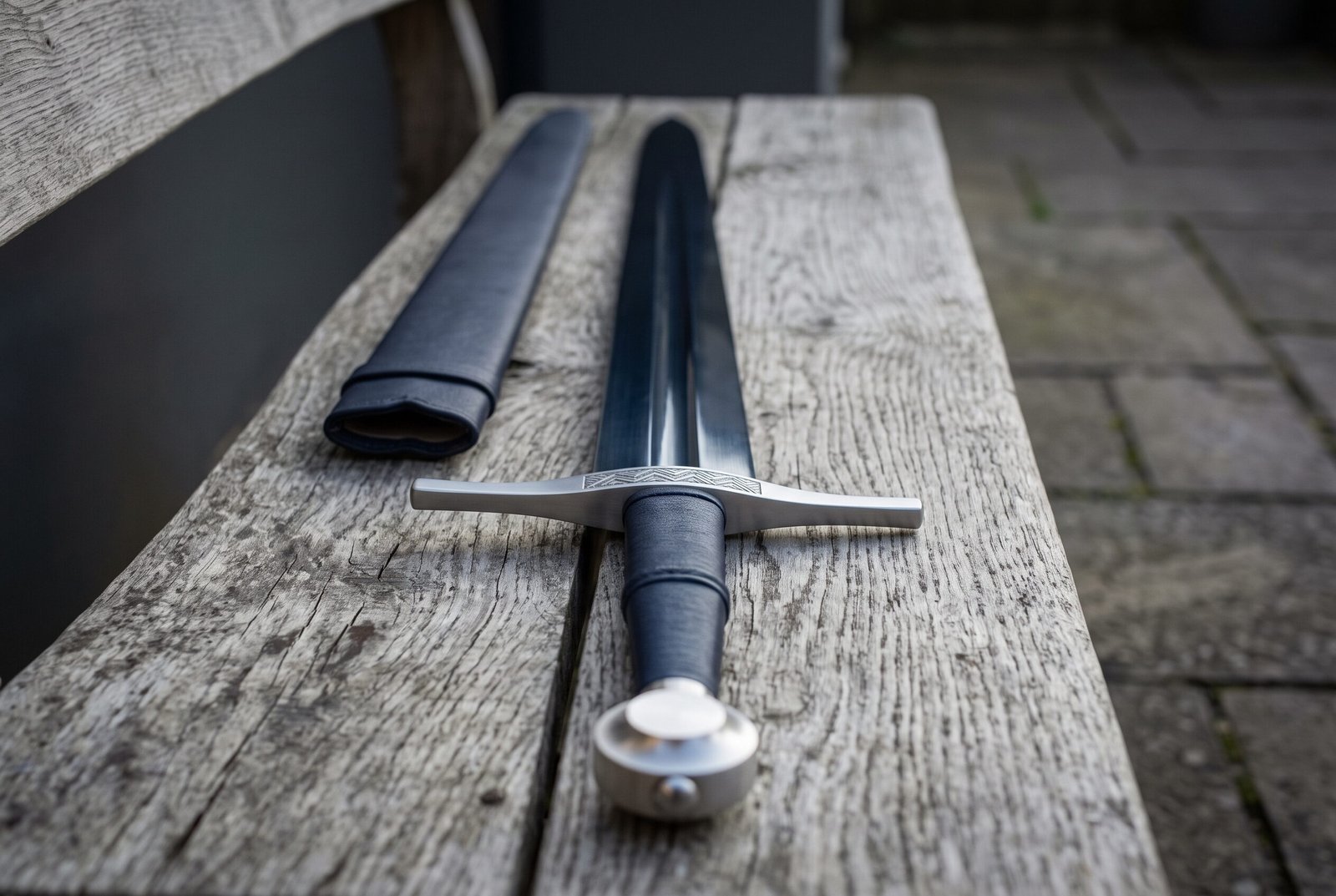
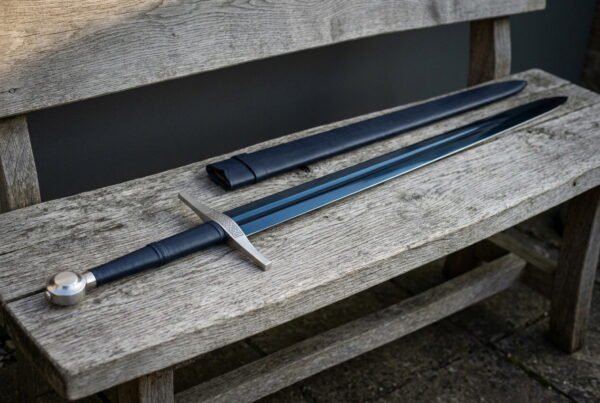
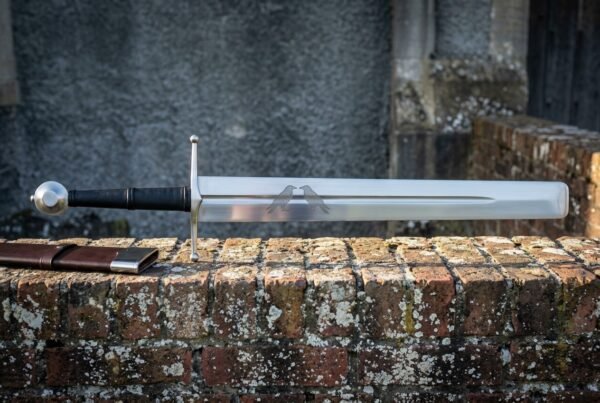
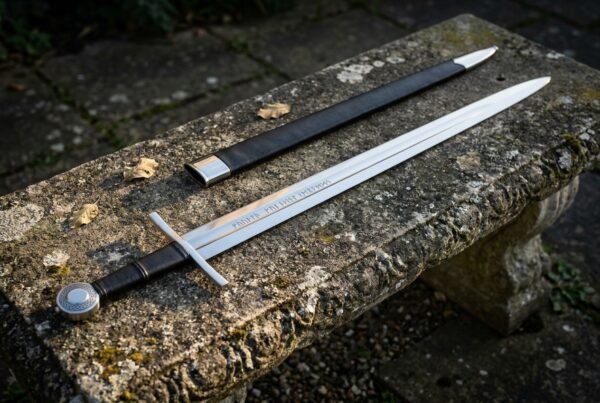
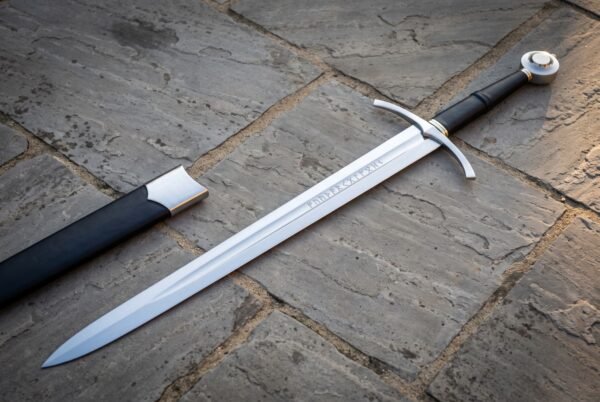
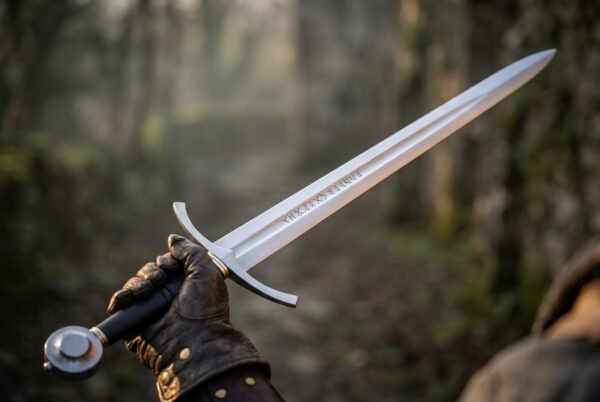
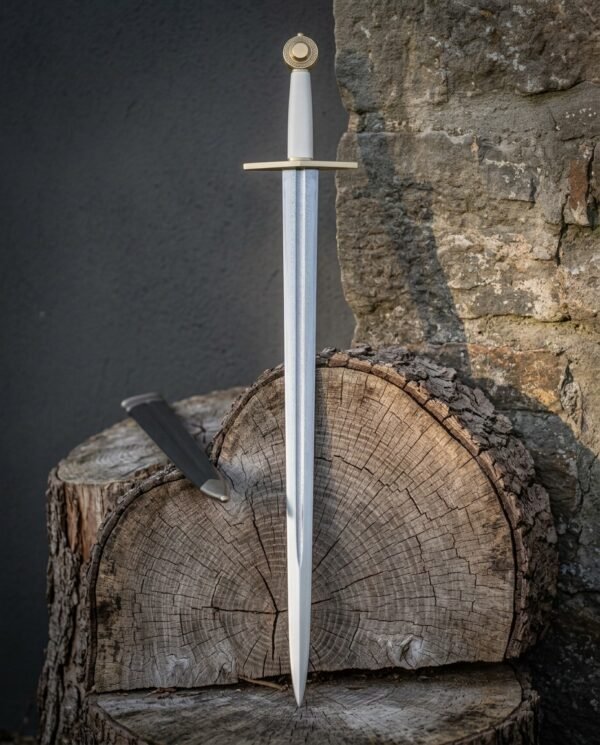
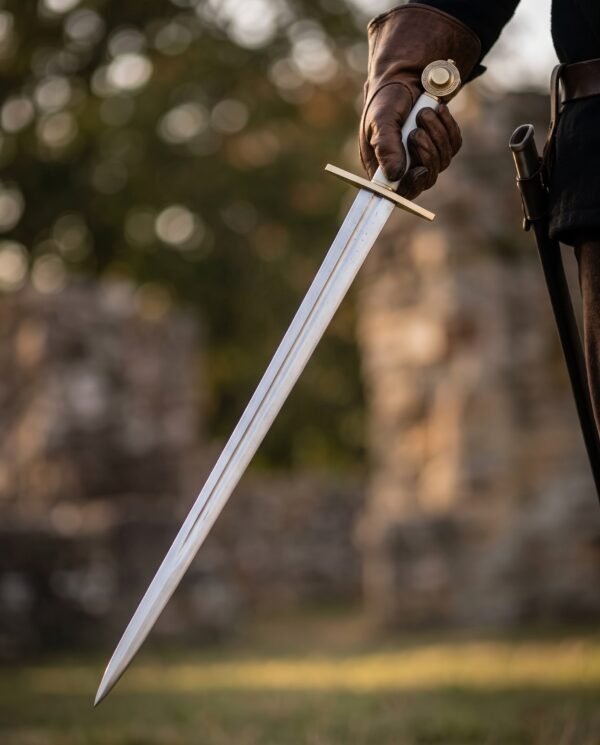
The Bluewake is a single handed arming sword with a blued blade. The steel has been taken to a deep blue black across the flats and the fuller, and the edge bevels are then brought back to bright polish, so the blade reads as a dark body with two lines of light running the whole way down it. The cross is polished steel with a panel of interlaced knotwork cut into the block at the ricasso, the grip is black leather, and the pommel is a large bright wheel. It ships with a black leather scabbard.
Bluing is one of those processes that sounds decorative and is actually chemistry. What you are looking at is not paint, dye or plating. It is a layer of black iron oxide, magnetite, grown deliberately on the surface of the steel to a controlled thickness. Left to itself, bare iron in air makes red iron oxide, which is rust, flakes off and takes more metal with it every time. Magnetite is the other oxide iron can form, and it is stable, tightly bonded and does not flake. Armourers worked this out long before anyone could explain it, and by the fifteenth century a blackened or blued harness was both a status finish and a practical one, since a plate that had already been given its oxide layer did not need to be scoured every week. The colour comes from the thickness of the layer: thin films read straw and bronze, thicker ones go purple, then blue, then black. Ours is forged, ground, hardened, blued and assembled by hand in the Czech Republic. It sits in the arming swords. The short swords cover the same ground from a different angle.
Specifications
| Blade material | 1095 high carbon steel, hardened to 54 to 58 HRC |
|---|
| Blade finish | Blued flats and fuller with the edge bevels polished back to bright |
|---|
| Blade type | Double edged and straight, with a long central fuller |
|---|
| Overall length | Approximately 38 inches |
|---|
| Blade length | Approximately 31 inches |
|---|
| Grip | Black leather over a wooden core with a single raised riser and a steel collar at the pommel |
|---|
| Guard | Straight polished steel cross with flared ends and a knotwork panel cut into the centre block |
|---|
| Pommel | Large polished steel wheel pommel with a raised centre boss, tang peened over |
|---|
| Scabbard | Plain black leather over a timber core |
|---|
| SKU | RK-1842 |
|---|
Why the edges are left bright and the flats are not
The two thin lines of polished steel running down either side of this blade are not there for contrast alone, although the contrast is the reason people notice the sword across a room. They are there because you cannot blue a working edge and keep it.
An oxide layer is thin, a few ten thousandths of an inch, and it sits on the surface. The moment you take a stone to a blued edge, the first pass removes it. Any sword finished blue right to the edge has either never been sharpened or has a ragged line where the finish has been worn through unevenly. Polishing the bevels deliberately, right from the start, means the sword looks the same after its first sharpening as it did on the day it arrived, and the boundary between the bright and the blue is a crisp line you put there rather than a mess that appeared.
The knotwork panel at the ricasso is cut into the polished steel of the guard block, where it is protected between the guard and the start of the fuller. Interlaced work of this kind is Insular in origin and runs through Irish, Northumbrian and Norse metalwork, and the defining rule of it is that the cord never terminates. It crosses over, crosses under and comes back to itself.
The steel and the finish
The blade is 1095 high carbon steel run at 54 to 58 HRC, which is sword hardness rather than knife hardness. A long blade has to bend under load and return straight, and hardness bought beyond the mid fifties is paid for in the risk of a break.
Bluing gives a modest amount of corrosion resistance and no more. A blued blade left wet still rusts, because the oxide layer is porous at a microscopic level and it is the oil sitting in those pores that does most of the actual protecting. Treat a blued sword exactly as you would treat a bright one and it will keep its colour for decades. Treat it as though the finish is doing the work and it will show red freckles through the blue within a season.
The cross, ricasso block and wheel pommel are polished steel, left bright against the dark blade. The tang runs the length of the grip and is peened over the pommel.
Engraving, runes and your own design
Use the rune converter on this page to turn a name, a date or a short phrase into Elder Futhark and we will cut it into the steel or the leather. If you would rather have a Viking pattern than a rune line, choose your own design in the engraving option above the add to cart button and tell us where it goes. Where a piece already carries an engraved design, your chosen engraving replaces it rather than sitting alongside it, so on this sword the knotwork panel at the ricasso is what your chosen mark takes the place of. Cutting into a blued flat also reads beautifully, since the cut comes out bright against the dark. The engraving page shows exactly that effect.
Handling and balance
A long single handed blade with a heavy wheel pommel balances close in, roughly four inches ahead of the cross. That is what lets a sword of this length be used in one hand at all. The pommel is a genuine counterweight and it is sized to the blade, which is why it looks large: a smaller one would leave the sword point heavy and tiring.
The fuller matters to the handling too. It removes mass from the centre of the blade section where it contributes least to stiffness, so the sword is lighter than a solid blade of the same width without being noticeably more flexible. That weight saving is spread along the whole blade, which is why fullered swords change direction more willingly than their dimensions suggest.
Care
Wipe the blade down after handling and keep a thin film of oil on it, over the blue as well as the bright bevels. Do not use abrasive metal polish on the blued surface, since it will cut straight through the oxide and leave a bright patch that cannot be blended back. A soft cloth and oil is the whole routine. Feed the leather grip and scabbard with a neutral conditioner once or twice a year. Do not store the sword permanently in its leather scabbard in a humid room. Sharpen along the polished bevels only, keeping the stone off the blued flats. Our page on steel care covers oiling, finish care and dealing with early rust.
Made in the Czech Republic
This is a handmade piece from the Czech Republic, made in a workshop that still forges, grinds and finishes by hand instead of stamping parts out. The smiths there have kept the older way of working, and the wood, horn and leather are shaped and fitted by hand as well. Two pieces of the same design will never be identical, and that is part of what you are buying.
Ransack Viking is a United States company. We handle the import ourselves, look over every piece when it lands and ship from our warehouse in Chicago, Illinois. Engraving is done in the United States after the piece arrives, so your design goes on before we send it out.
A note on handmade variation
This sword is hand made rather than machine made or bulk produced, so what arrives will not be a pixel for pixel copy of the photograph. Bluing is the most variable part of it. The depth of colour depends on the surface, the temperature and the time, and no two blades come out at the same shade; some read closer to navy and some closer to black, and the same blade will look different under warm light and daylight. The line where the bright bevel meets the blue is polished by hand. Leather takes dye its own way. The length, the steel, the heat treat and the build are the same every time. The character is not. We go further into it in how steel and hardness actually work, and pick it up again in the steel glossary.
Frequently asked questions
Will the blue rub off
No, it is not a coating. It is an oxide layer grown into the surface of the steel. It can be abraded off with polish or a stone, which is why the edges are bright and the flats should only ever see a soft cloth.
Does the blue stop it rusting
Only partly. It slows corrosion but it does not replace oil. Look after a blued blade exactly as you would a bright one.
Is it sharp when it arrives
Yes. Tell us in the order notes if you would prefer it blunt for display or reenactment.
Can I sharpen it without ruining the finish
Yes, because the bevels are already bright. Keep the stone on the bevel and off the blued flat and the sword will look exactly the same afterwards.
Is the scabbard included
It is. The black leather scabbard ships with the sword and is fitted to that blade.
How long does it take to arrive
One to two weeks of processing, then free shipping inside the United States. Engraved orders take the longer end.
What is in the box
- Bluewake arming sword in 1095 high carbon steel with a blued blade
- Black leather scabbard over a timber core
- Care card covering oiling and looking after a blued finish
- Lifetime warranty against defects in forging, grind, heat treat and fittings
- Forged and finished in the Czech Republic
Explore the range
See the rest of the arming swords, the longswords, the wider sword range, or read the guides for how bluing is done and how to keep it.
Worth a look beside this
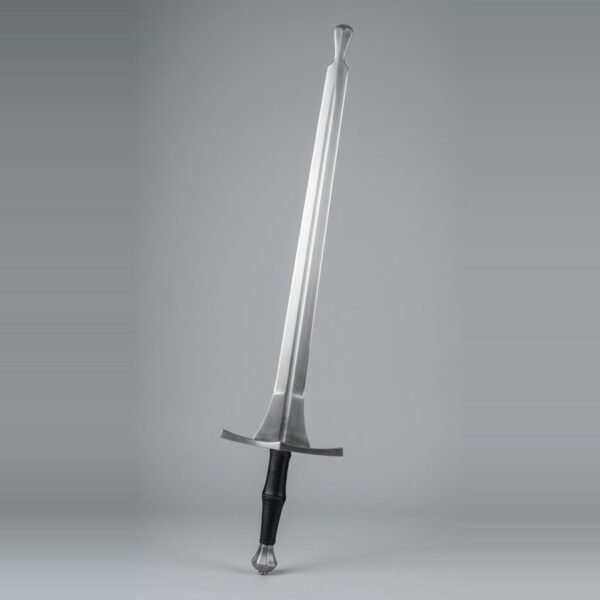
If this one is not quite right, there is the Azurehold arming sword, 37 inches overall. Also in this group is the Stavemark arming sword, 35 inches overall. Sitting beside it in the catalogue is the Oathmark arming sword, 37 inches overall.
From the same corner of the shop, there is the Palefrost longsword. Or start from a blank sheet on the custom Viking sword page.
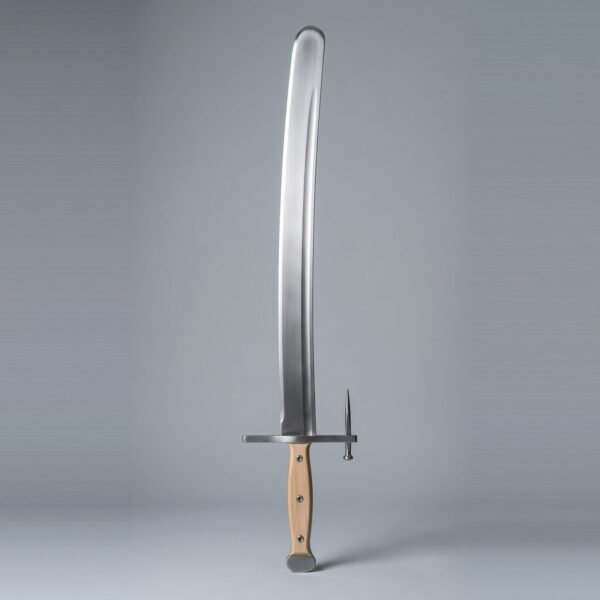
Anyone moving from display pieces to sparring can start with the Brenvald messer trainer, and our messer guide fills in the rest.

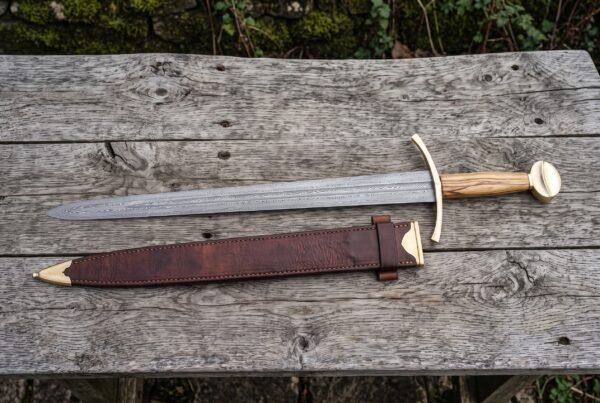
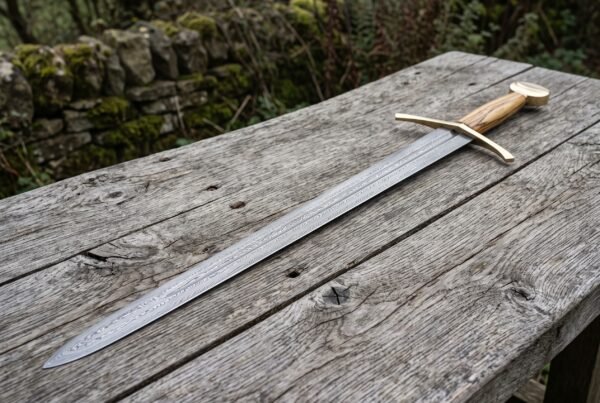
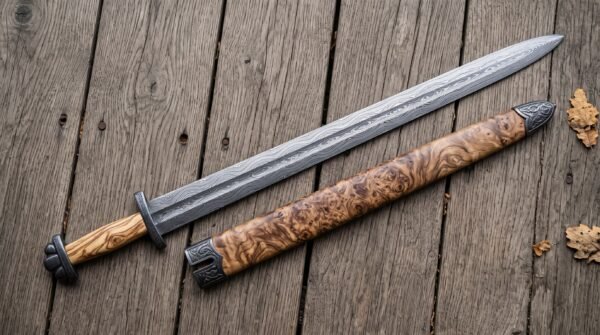
Feels way more premium than the price suggests. Came in a nice gift box which made it feel even more special. The wood handle feels amazing and the balance is perfect. Weight and balance make it feel like a real functional piece not some cheap replica. Love it.