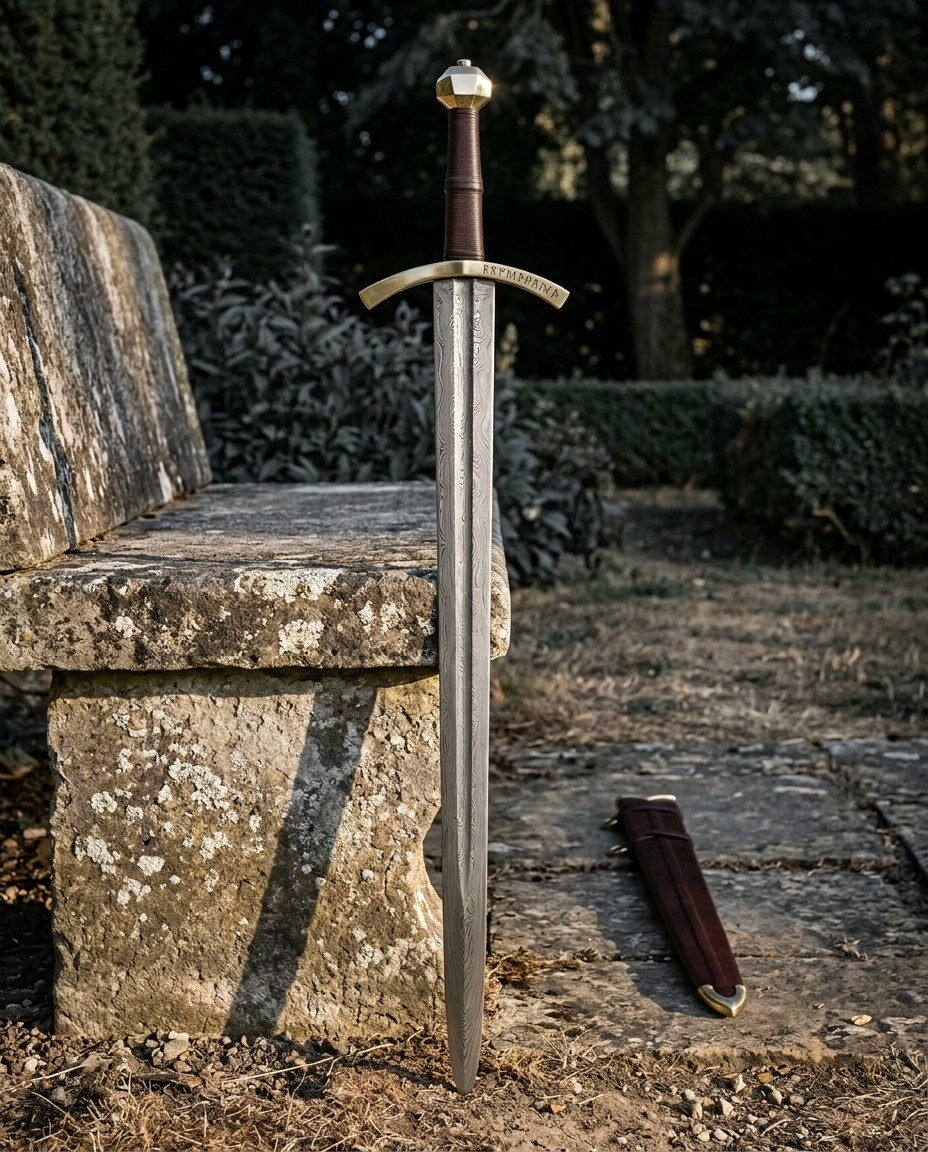
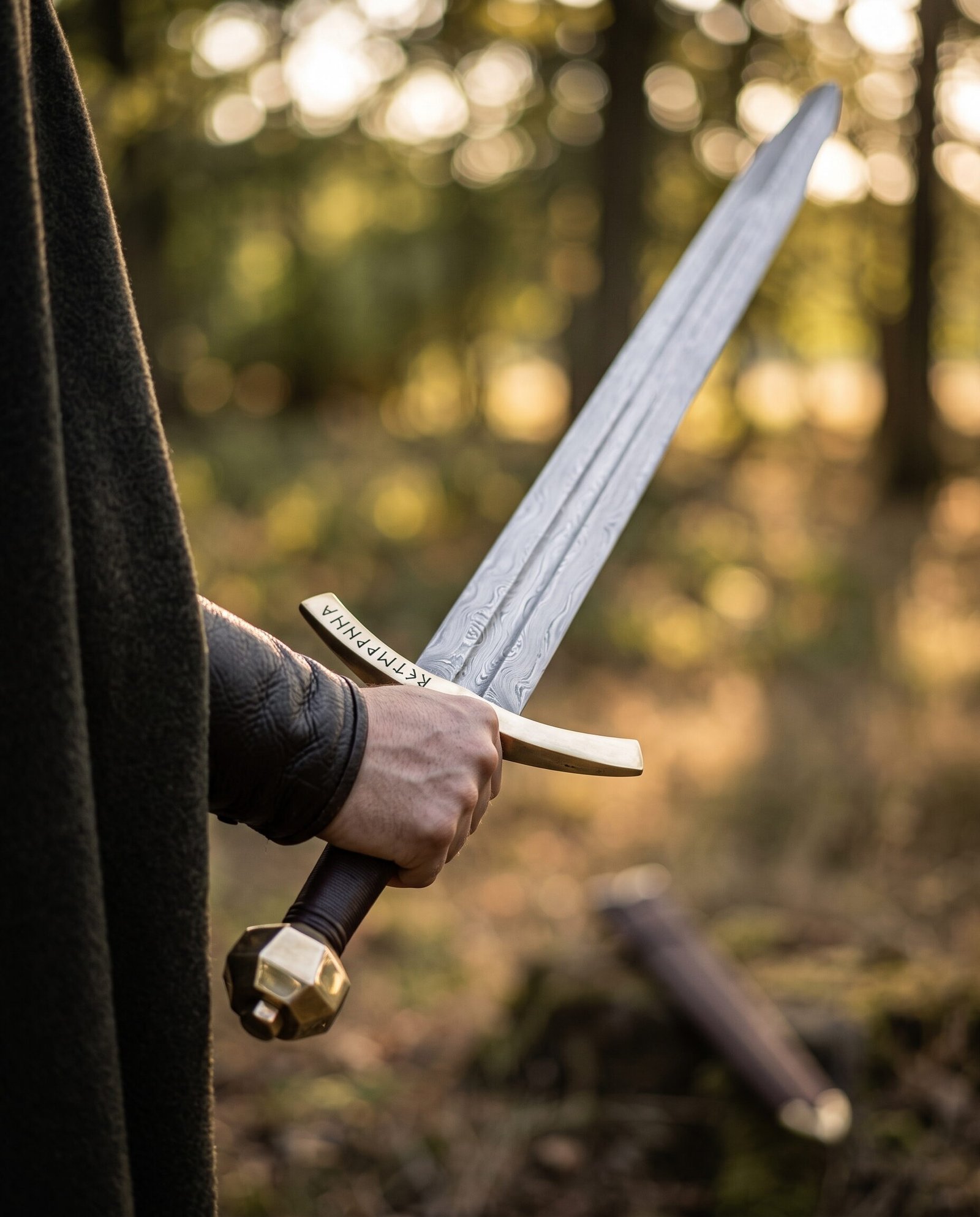
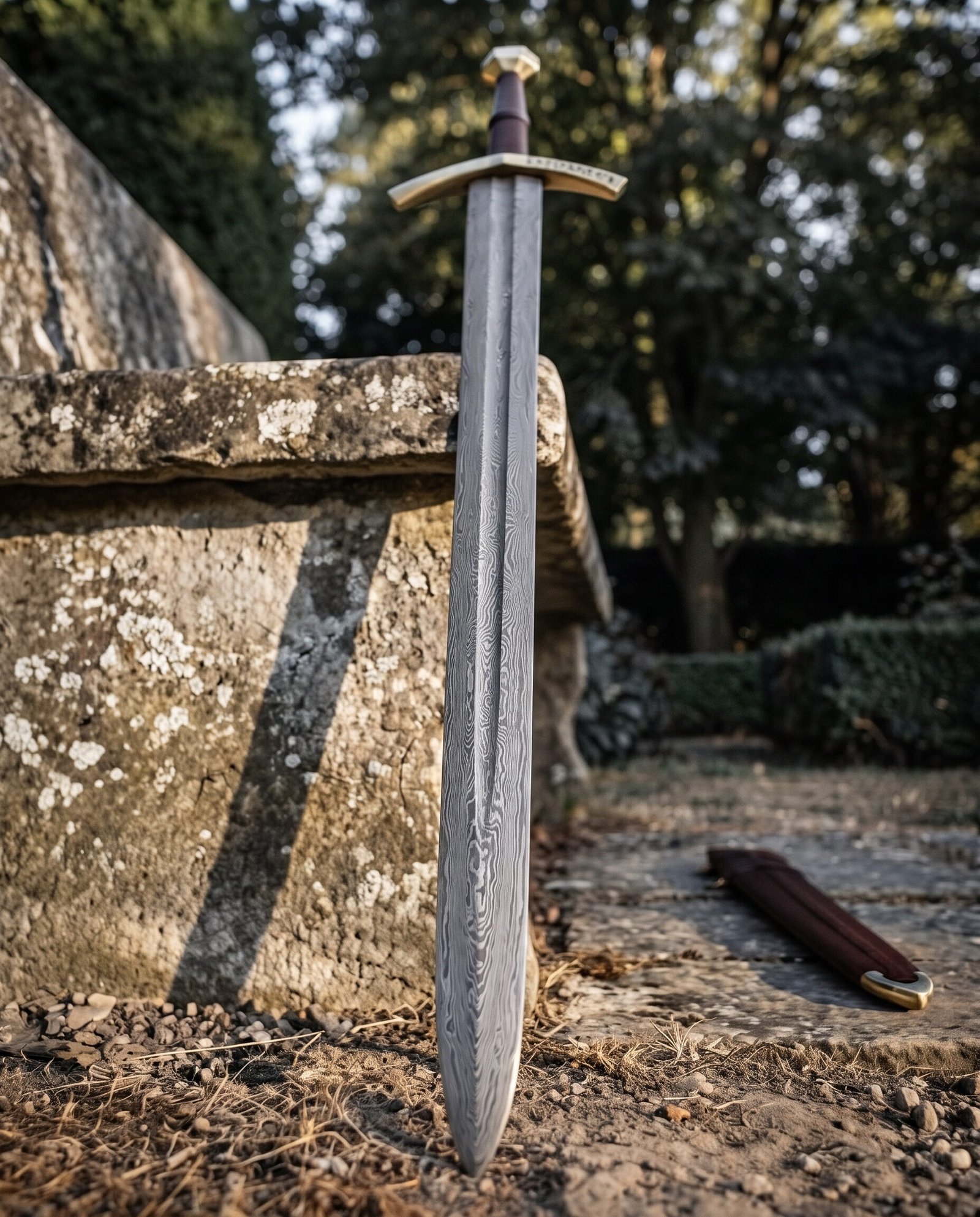
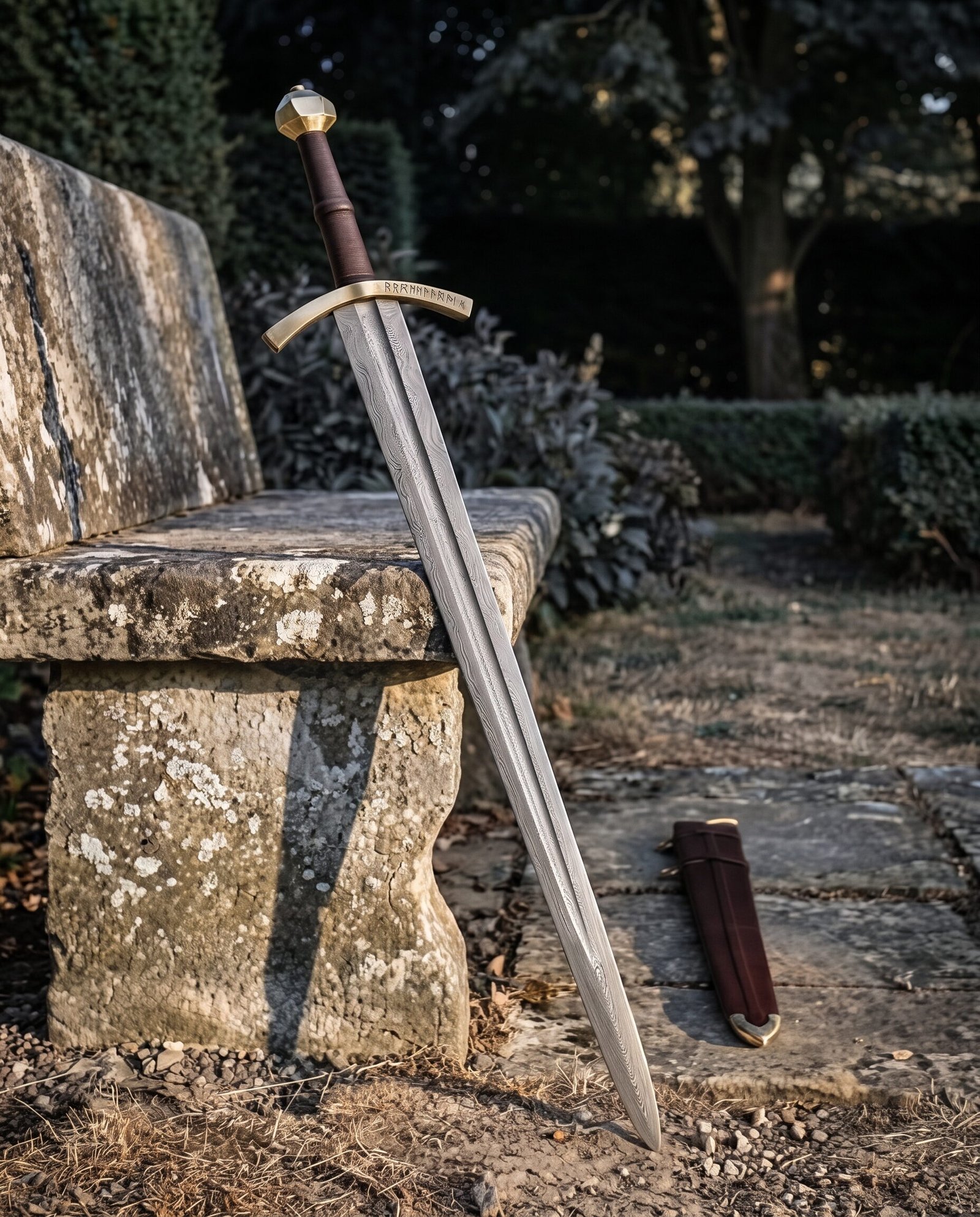
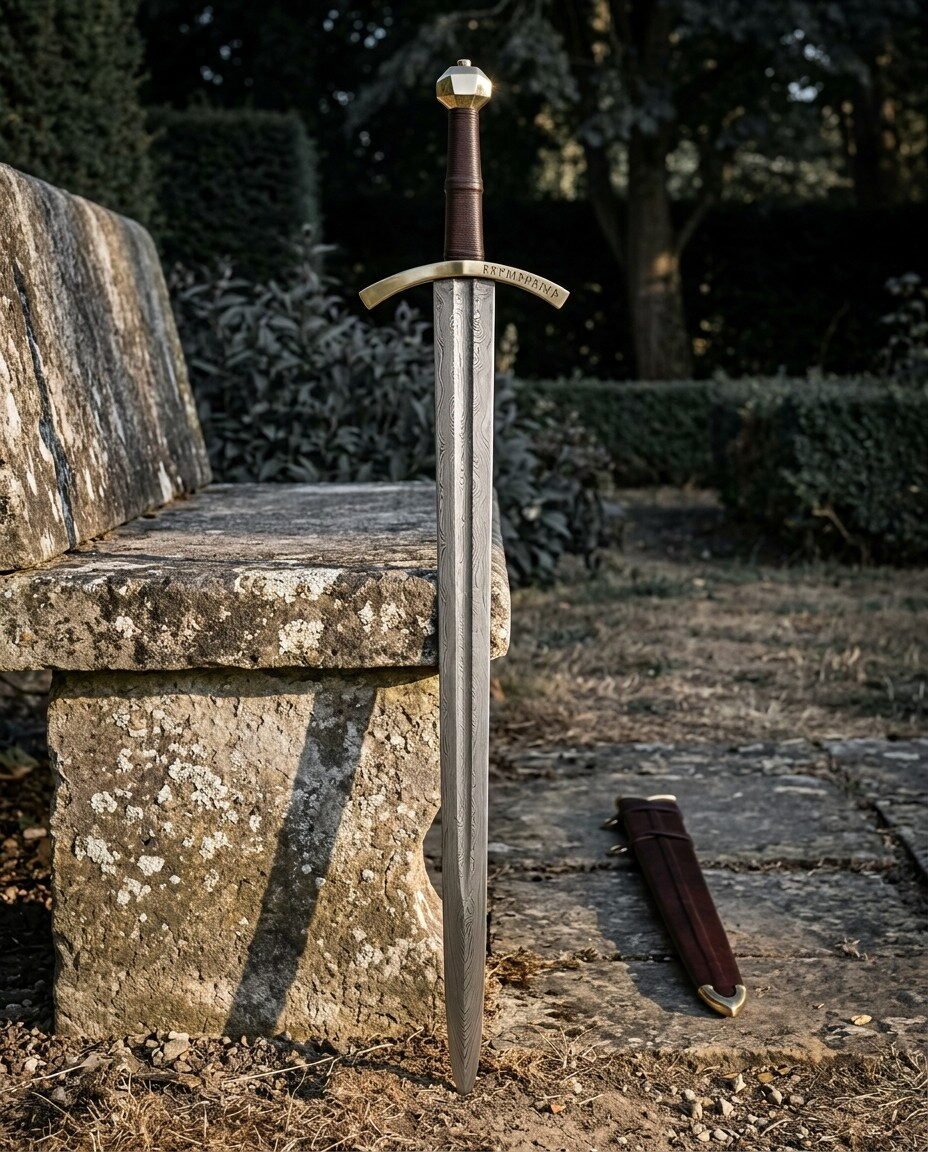
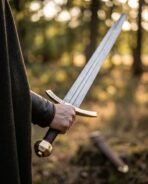
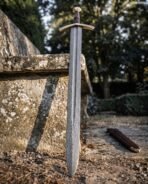
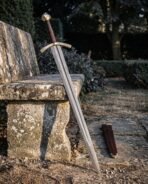
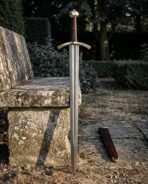
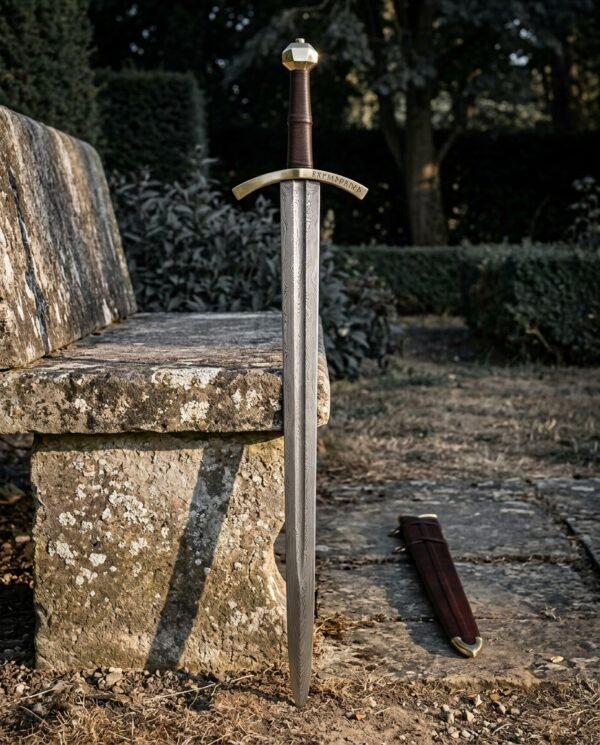
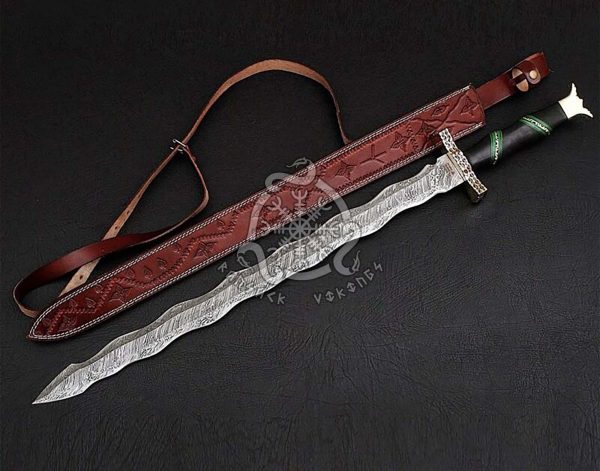
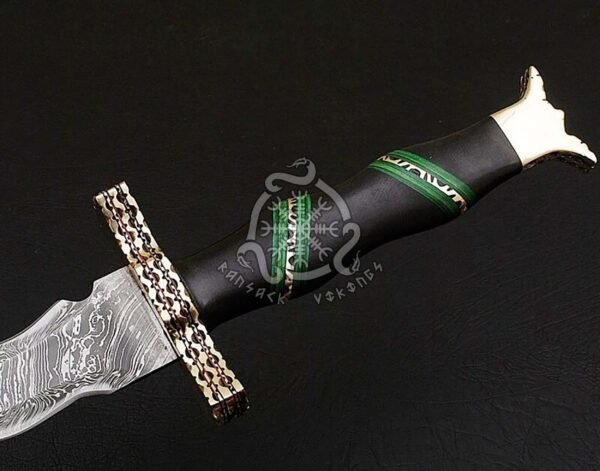
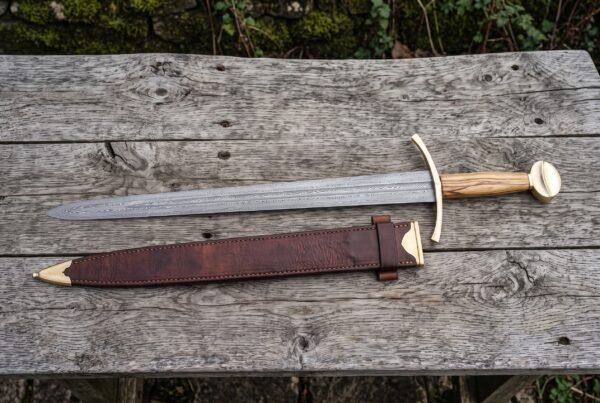
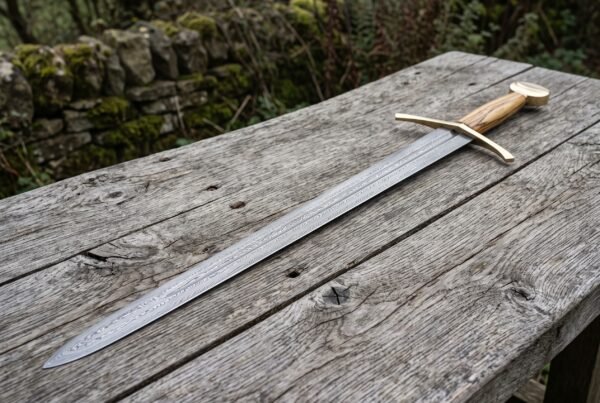
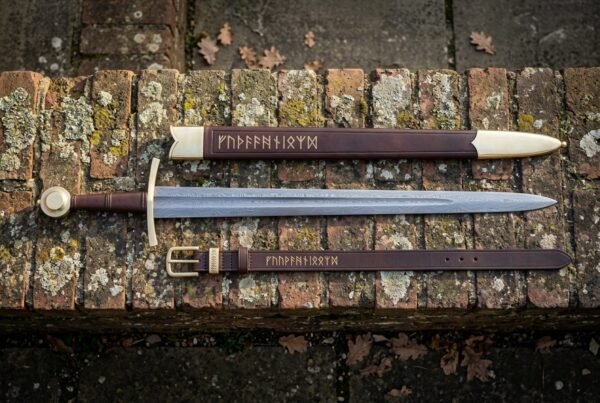
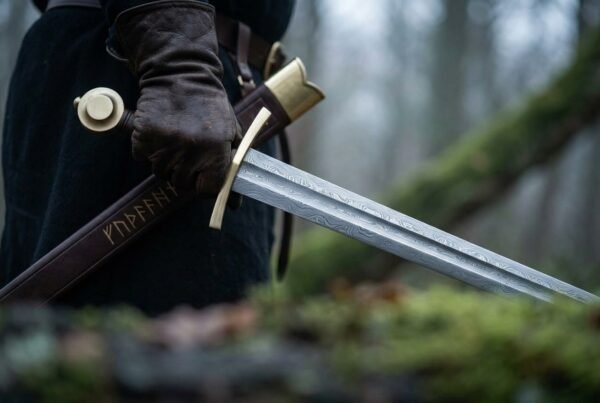
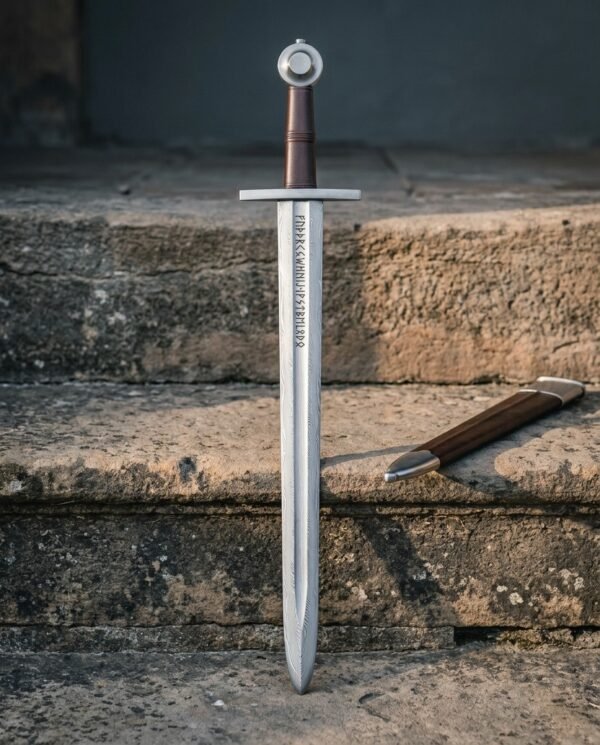
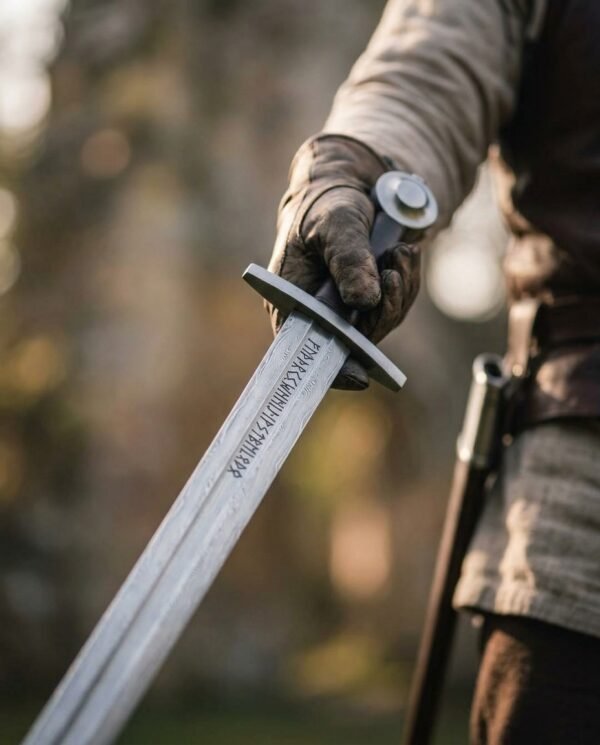
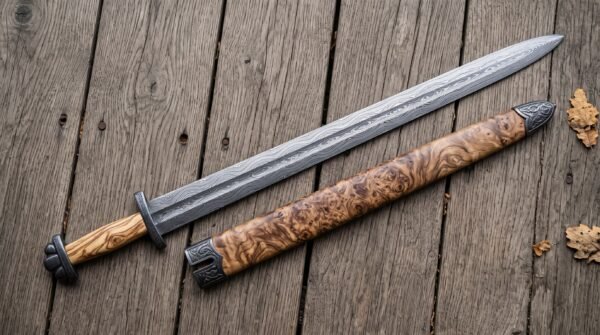
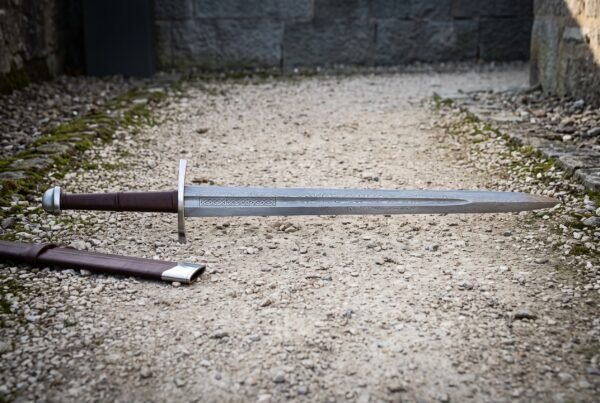
The Brassfeather pairs a full length random pattern Damascus blade with a solid brass hilt. The cross is brass, curved gently toward the point, with a line of Elder Futhark runes cut along its face. The grip is oxblood leather wound over a shaped wooden core and the pommel is a faceted brass cap peened over the tang. It ships in an oxblood scabbard finished with a brass chape.
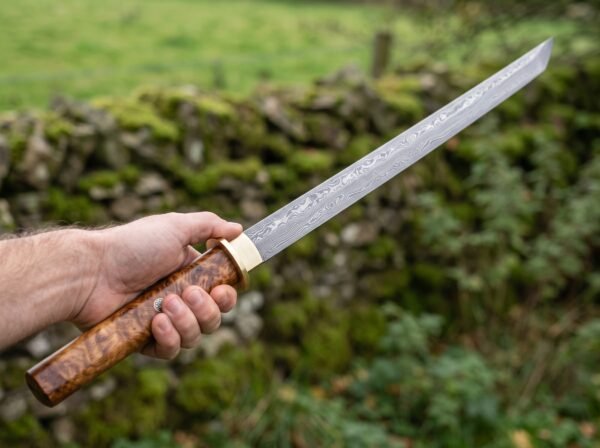
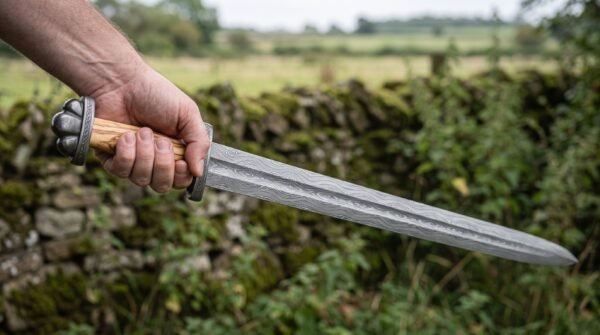
The pattern on this blade is a random, flowing Damascus figure that wanders down the full length of both flats like grain in timber. There is no way to fake it and no way to add it after the fact. It is built into the billet by stacking, welding and drawing out the layers before the blade exists. This sword is welded, forged, ground, etched, hardened and fitted in the Czech Republic. It is catalogued with the Damascus swords, and the Damascus knives sit one click away.
Specifications
| Blade steel | Pattern welded 1095 and 15N20 Damascus, hardened to 58 to 60 HRC |
|---|
| Blade finish | Acid etched random Damascus pattern running the full blade length |
|---|
| Blade | Straight double edged blade with a central fuller and a tapering point |
|---|
| Overall length | Approximately 37 inches |
|---|
| Blade length | Approximately 30 inches |
|---|
| Guard | Solid brass cross curved toward the point, cut with an Elder Futhark line |
|---|
| Grip | Approximately 4 inches, oxblood leather over a shaped wooden core with a raised riser at the middle |
|---|
| Pommel | Faceted brass pommel, peened over the tang |
|---|
| Scabbard | Oxblood leather over a wooden core with a brass chape |
|---|
| Included | Sword and scabbard |
|---|
| SKU | RK-1860 |
|---|
How a random pattern billet is made
Start with a layered billet of 1095 and 15N20, welded and drawn out. The bar is folded and rewelded several times so the layer count climbs, and the layers ripple a little under every hammer blow.
Grind the flat and you cut through those rippled layers at shifting angles, which is what gives a random pattern its wandering, wood grain look. No two billets open the same way.
The difficulty is in clean welds. A scale inclusion leaves a cold shut in the blade, so every weld has to be clean from the first fold to the last, over the full length of a thirty inch blank.
Brass, leather and the two steels
Brass has been used for sword furniture for as long as swords have had furniture, because it is easy to cast and cut, it is soft enough that it will never mark the blade, and it takes an engraved line beautifully. It is also heavy, which is useful in a pommel that has to counterbalance a thirty inch blade. It will tarnish to a warm gold over time. Most owners leave it and prefer it that way.
The blade is 1095 and 15N20. The nickel bearing 15N20 stays bright in acid and the 1095 goes dark, and that contrast is what makes the pattern visible. Both harden together in the same quench, and the finished blade sits at 58 to 60 HRC through the pattern, so it behaves as one homogeneous piece of steel because that is what it is. The grip leather is vegetable tanned hide dyed oxblood through rather than surface coated.
Engraving, runes and your own design
Use the rune converter on this page to turn a name, a date or a short phrase into Elder Futhark and we will cut it into the steel, the brass or the leather. If you would rather have a Viking pattern than a rune line, choose your own design in the engraving option above the add to cart button and tell us where it goes. Where a piece already carries an engraved design, your chosen engraving replaces it rather than sitting alongside it. On this sword the rune line on the brass cross is that design, so your inscription is cut there in its place. Brass takes a finer and deeper line than steel, so a longer phrase fits than you might expect. See the engraving page.
Handling and balance
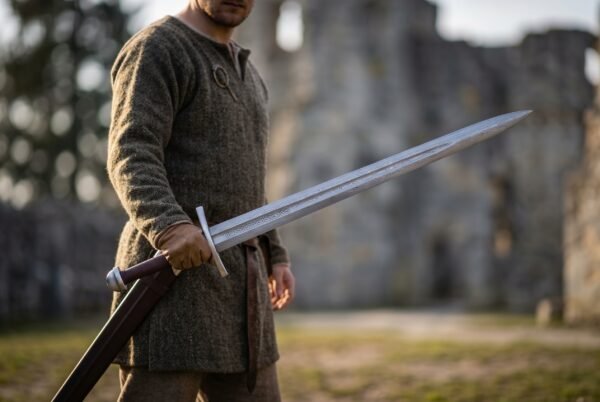
Brass fittings shift the balance backward compared with steel ones of the same size, so despite the thirty inch blade this sword balances about four inches ahead of the cross and weighs a little under three pounds. It feels controlled rather than heavy at the point. The curved brass cross turns a descending edge aside instead of catching it square, and the faceted pommel tells your palm which way the edge is facing without you having to look.
This is a hand finished collector and display sword. It is not sold as full contact sparring equipment and should not be struck against another blade.
Care
Etched Damascus takes fingerprints badly, so wipe the blade down and keep a light film of mineral oil on it. Neither steel in the billet is stainless. Brass can be left to go gold on its own or brought back with a metal polish, but keep polish off the blade because it will dull the etch. Feed the oxblood leather with a neutral balm once or twice a year and keep it out of direct sun. Do not store the sword in the scabbard for months at a time. Our steel care page covers spotting, oiling and refreshing a tired etch.
Made in the Czech Republic
The work behind this piece happens in a Czech Republic workshop that has kept to the old methods. Steel is forged and heat treated by hand, the grind is taken down by eye rather than by machine, and the handle, fittings and sheath are cut and finished one at a time. Because of that, every piece carries small marks of the hand that made it.
Ransack Viking is a United States company. We import direct, check each piece when it reaches us, and ship from our Chicago, Illinois warehouse. Engraving is added here in the United States after arrival, so the piece you receive is finished to your order.
A note on handmade variation
This sword is hand made rather than machine made or bulk produced, so what arrives will not be a pixel for pixel copy of the photograph. Random patterns never repeat. Where the lines swirl and where they run straight is decided by how the billet moved under the hammer that day. The tone of the brass, the depth of the oxblood dye and the hammer texture also vary. The dimensions, the steels and the build are the same every time. The character is not. If you want the longer version, look at buying a first sword and then at how Damascus compares with plain high carbon.
Frequently asked questions
Is the pattern real Damascus?
Yes. It is forge welded 1095 and 15N20, folded and drawn out to create the pattern. The pattern goes through the steel.
Why does this cost more than the plain steel swords?
A forge welded Damascus billet of this length takes far longer to make than a bar of plain steel, and some are scrapped before they ever become a blade.
Will the brass tarnish?
Yes, slowly, to a warmer gold tone. Polish reverses it whenever you like.
Does it come sharp?
It arrives with a clean cutting edge. Tell us in your notes if you want it left blunt for display.
Is it suitable for sparring?
No. It is a hand finished collector and display sword and should never be struck against another blade.
How long is the lead time?
One to two weeks of processing, then free shipping inside the United States.
What is in the box
- One Brassfeather random pattern Damascus sword in 1095 and 15N20
- One oxblood leather over wood scabbard with a brass chape
- A light protective oil film on the blade
- Forged and finished in the Czech Republic
Explore the range
More in Damascus swords, arming swords and swords, with pattern welding notes in the guides.
If this one is not it
For a straight comparison, see the Fellwhorl arming sword, 36 inches overall. Worth putting side by side with this is the Rootcrown arming sword, 37 inches overall. In the same category sits the Wheelbraid arming sword, 36 inches overall.
From the same corner of the shop, there is the Emberkeel Viking sword. Pick the steel, the length and the fittings yourself on the custom Viking sword page.
If you would rather train with a sword than hang one up, the Skelvard sidesword suits club work, and our HEMA sidesword range covers the choices.


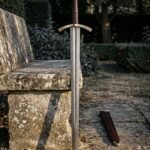
Knew this sword was special the second I opened the box. Came in a nice gift box which made it feel even more special. 10/10 would buy again.
Feels way more premium than the price suggests. Ordered from Ransack Viking before and the quality stays consistent every time. Damascus blade holds a razor edge right out of the box. Fit and finish is museum quality. You can tell real craftsmen made this by hand. So worth it.
Photos don’t do this sword justice at all. Even the small engravings are crisp and clean. This shop clearly takes pride in their work.