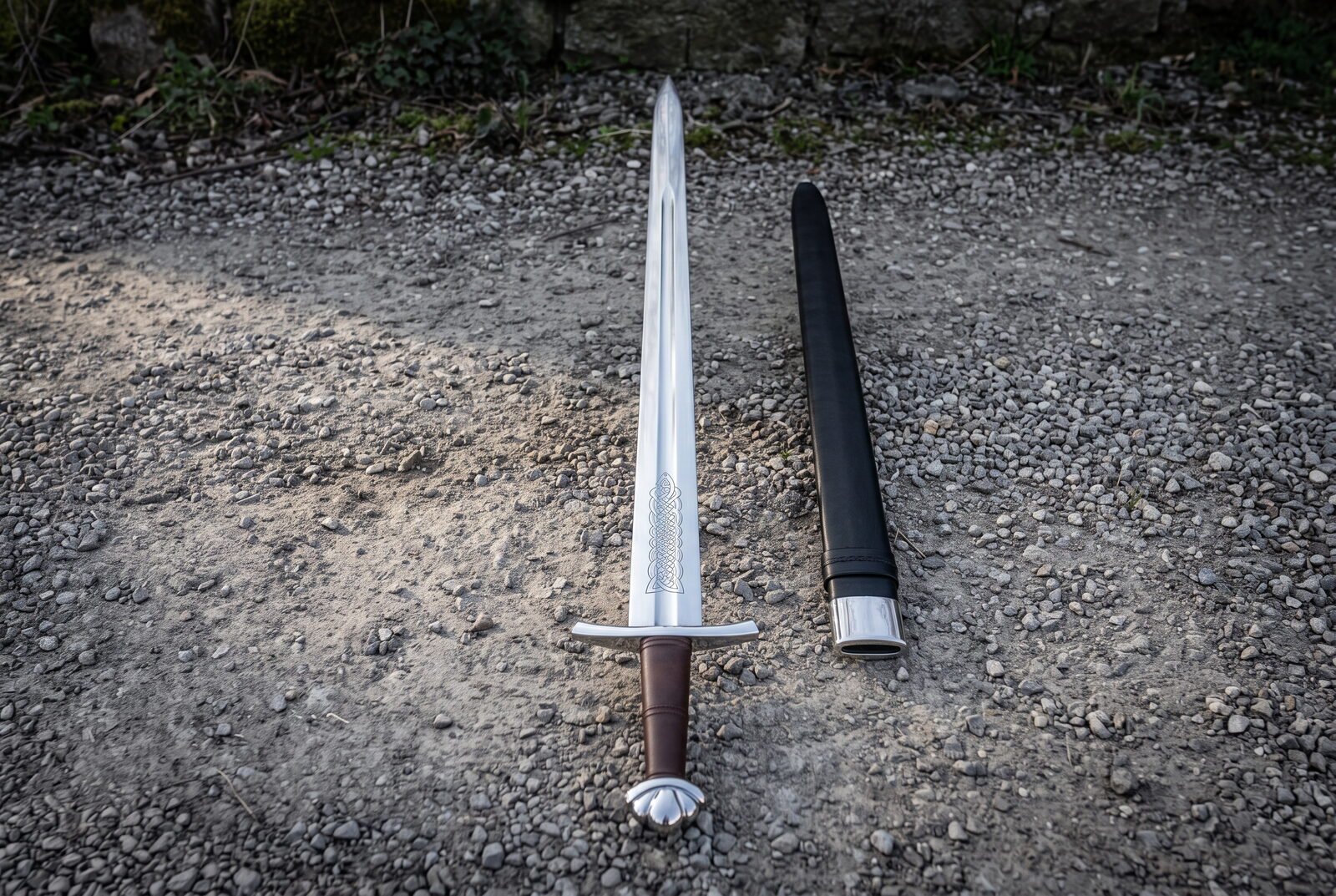
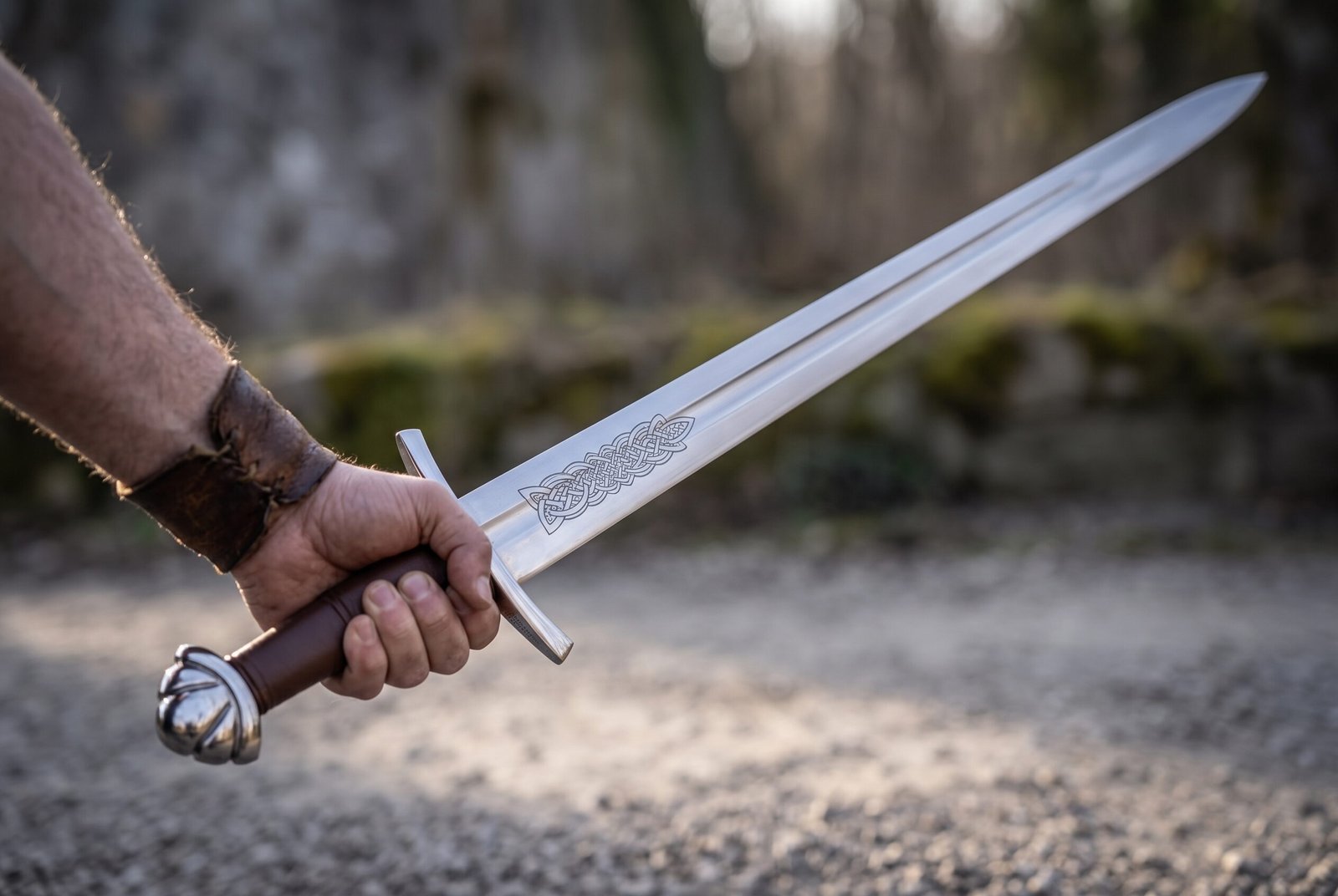
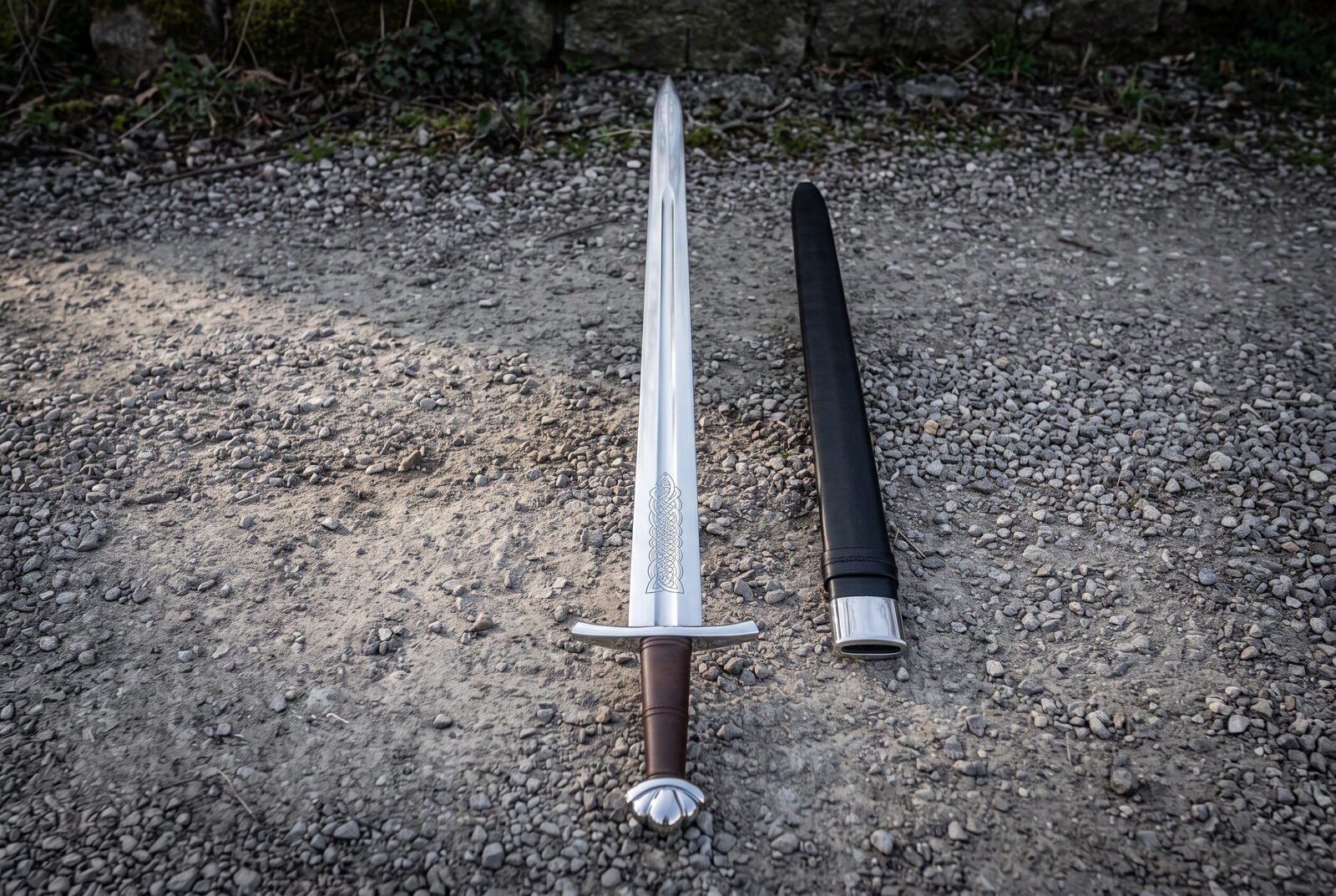
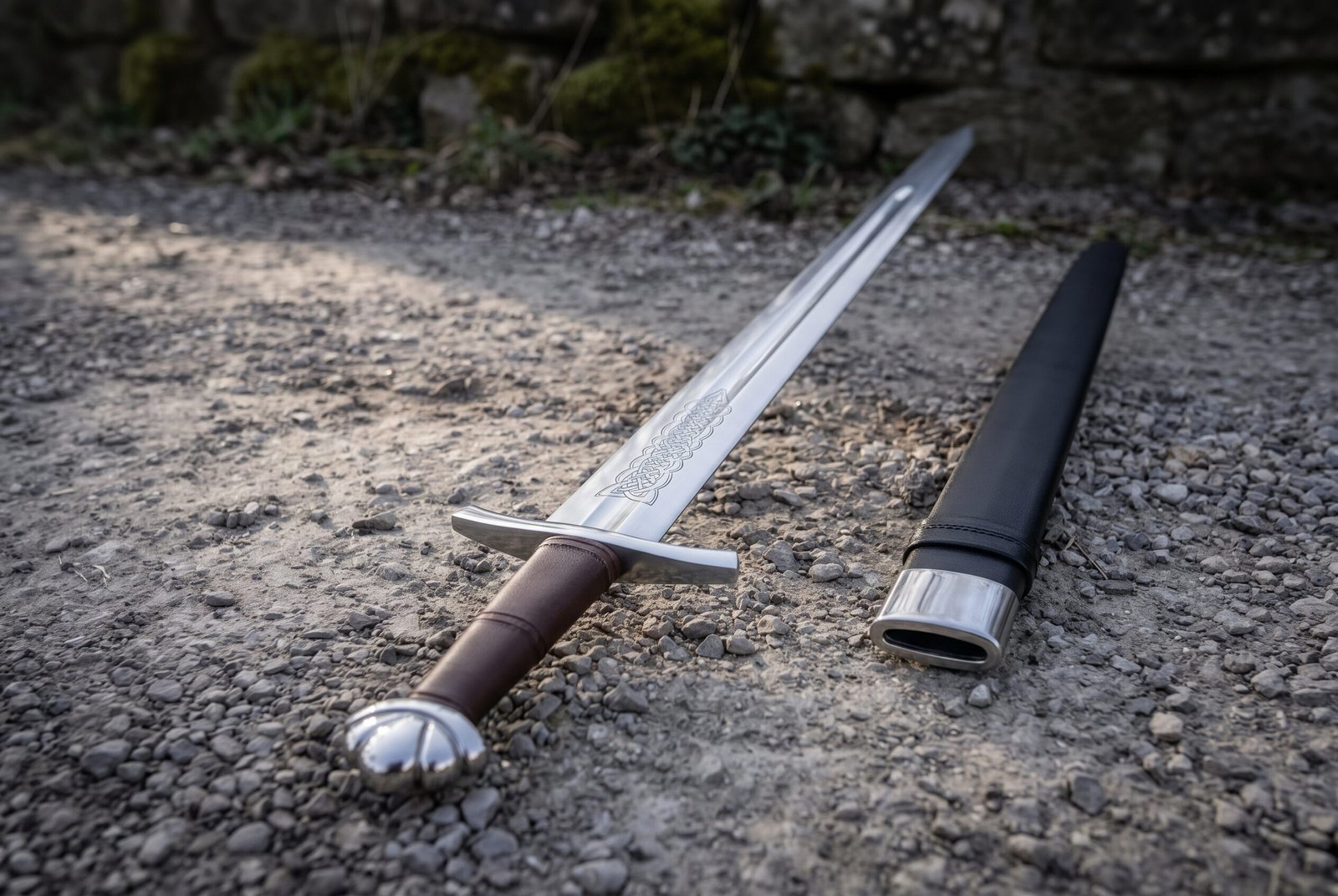
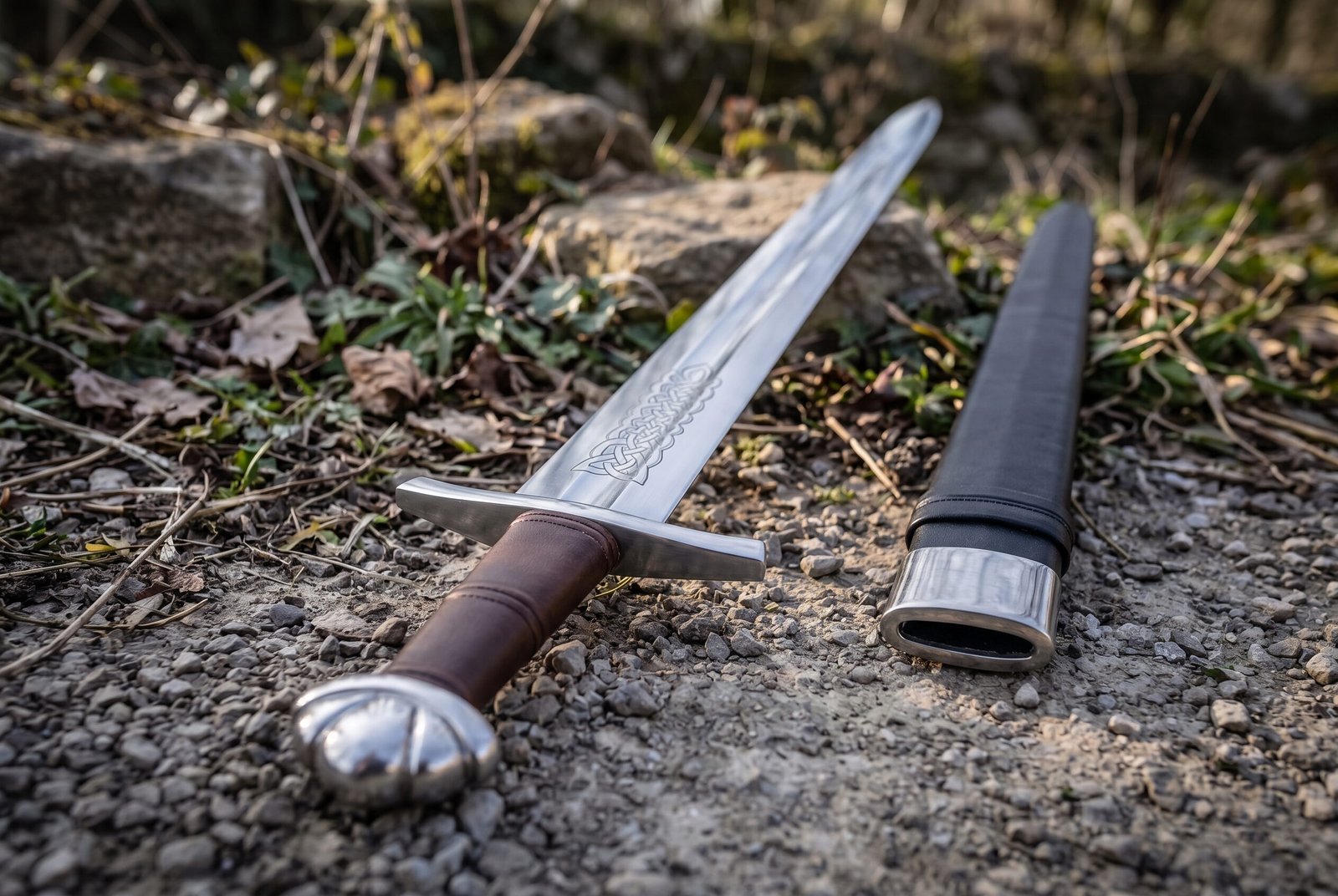
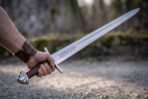
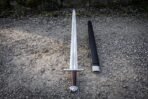
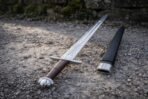
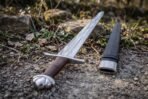
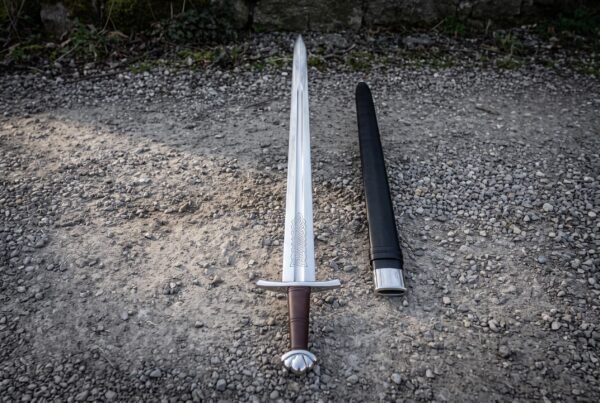
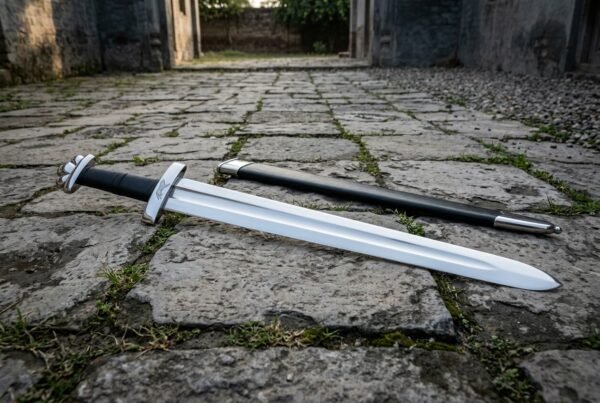
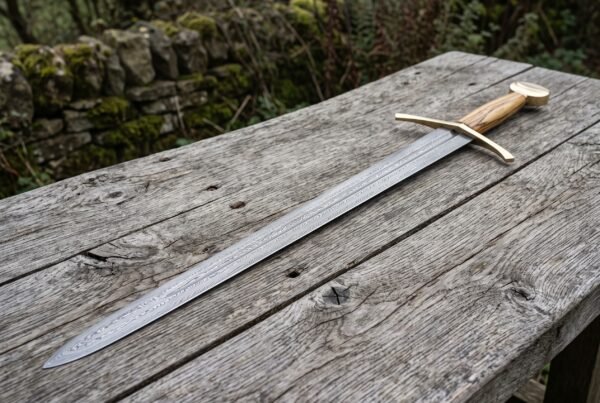
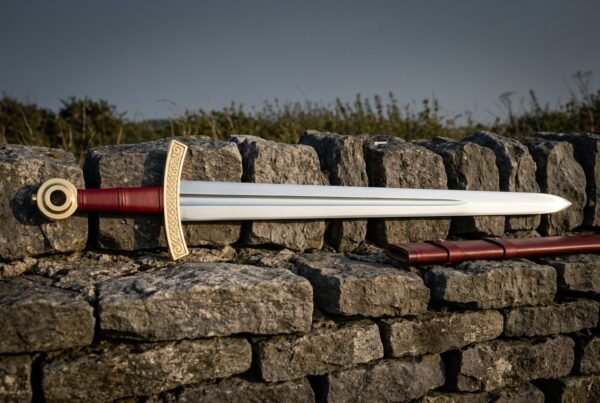
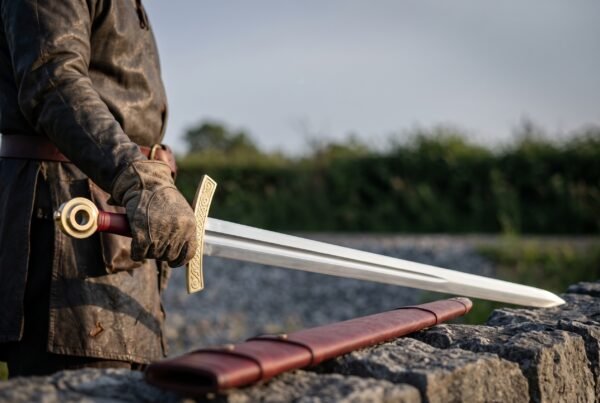
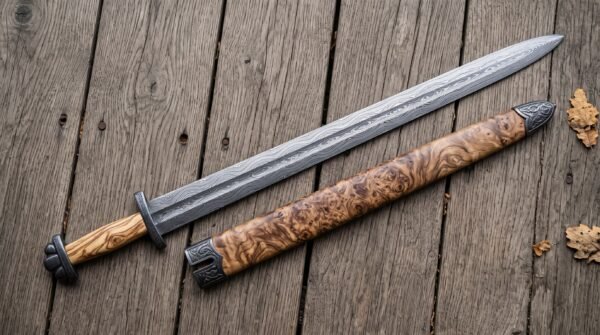
The Grainhilt is a Viking sword with a brown leather wrapped grip, a lobed pommel, a straight lower guard and a broad fullered blade carrying a panel of etched knotwork just above the ricasso. It ships with a black leather scabbard finished with a bright steel throat. The leather on the grip is left with its natural grain showing rather than dyed flat and burnished, which is where the name comes from and which is closer to how a working hilt would have looked.
One detail worth knowing about Norse swords: the grip was almost never bare wood. Surviving hilts show wood cores dressed in leather, in cord, in birch bark and occasionally in wire, and the reason is friction rather than comfort. A sword hand in the tenth century was often wet, and a bare wooden grip in a wet hand turns in the fist. Leather grips even when soaked. This one is forged, ground, heat treated and finished in the Czech Republic.
Screen Norse kit gets the sword wrong more often than it gets it right, and the screen arms rated for accuracy rates the ones you have seen. Knotwork carried meaning as often as it was pure decoration, and our note on Norse symbols works through the recurring shapes. A board from the round shields is what usually stands beside one.
Specifications
| Material | 1095 high carbon steel, hardened to 54 to 58 HRC |
|---|
| Overall length | 35 inches |
|---|
| Blade length | 29 inches |
|---|
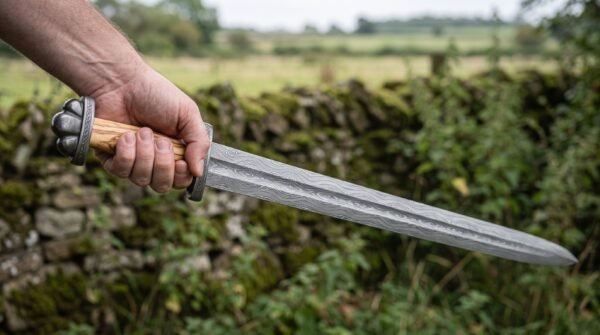
| Blade finish | Satin polished, double edged, with a broad central fuller and an etched knotwork panel above the guard |
|---|
| Grip | Brown leather over a shaped timber core, natural grain finish with a stitched seam and a raised band, about 3.5 inches |
|---|
| Guard | Straight lower guard in polished steel, tapering toward the tips |
|---|
| Pommel | Lobed polished steel pommel |
|---|
| Scabbard | Black leather over a timber core with a bright steel throat and a leather belt band |
|---|
| Weight | About 2 lb 10 oz for the sword alone |
|---|
| Included | Sword and fitted scabbard |
|---|
| SKU | RK-1935 |
|---|
What the fuller really does
The long shallow groove down the centre of the blade is a fuller, and the folklore about it is almost entirely wrong. It is not a blood groove. It does not stop suction, which is not a thing that happens, and it was not put there to let a blade come free of a body.
A fuller is a stiffness trick borrowed from the same physics that gives an I beam its strength. Steel resists bending mainly at the outer surfaces of a section, and the material sitting in the middle contributes very little. Hollow that middle out and you remove weight without removing much of the resistance to bending. On a Viking blade a wide fuller can take out a fifth of the mass while leaving the blade nearly as stiff, and on a 29 inch sword that fifth is the difference between a sword you can hold in a guard for a minute and one you cannot.
The way it is made matters too. A true fuller is forged in with a rounded tool while the steel is hot, which moves the metal outward and widens the blade rather than cutting material away. That is why an original blade with a deep fuller is often wider than the bar it started from. Ours is ground rather than hammered in, but it is put in before heat treat for the same reason, so the hardening happens after the geometry is set and the blade comes out of the quench in its final shape.
1095 high carbon steel and the etched panel
The blade is 1095, hardened and tempered into the 54 to 58 HRC band. That range is chosen for length rather than for edge holding alone. A sword blade has to survive being flexed, and steel taken too hard along a 29 inch span will crack instead of springing back. In the mid fifties it takes a good edge, sharpens on a simple stone and returns to straight after a flex.
The knotwork panel above the guard is masked and chemically etched after the blade is polished, so the pattern is bitten into the surface to a real depth rather than printed on it. It sits over the strongest part of the blade, well away from the working edge, which is where northern smiths put decoration for the good reason that an etch removes metal and you do not want metal removed near a cutting edge.
1095 is not stainless. There is no chromium in it and no plating over it. That is the price of a steel that behaves the way a historical blade behaved, and it means the sword needs oil rather than neglect.
Engraving, runes and your own design
Use the rune converter on this page to turn a name, a date or a short phrase into Elder Futhark and we will cut it into the steel, the leather or the wood. If you would rather have a Viking pattern than a rune line, choose your own design in the engraving option above the add to cart button and tell us where it goes. Where a piece already carries an engraved design, your chosen engraving replaces it rather than sitting alongside it. On the Grainhilt the etched panel above the guard is the obvious space, and a rune line running down the fuller itself is the second most requested option because the groove frames the text. See the engraving page for how it is laid out.
Handling and balance
Balance sits around three and a half inches ahead of the guard. The short hilt locks the hand in one position between the pommel and the cross, and the fullered blade keeps the mass low, so the sword comes up fast and stays under control on the horizontal. It rewards cutting from the wrist and the forearm rather than from the shoulder, which is how a one handed sword paired with a shield was meant to be used.
Be clear about the intended use. This is a sharp, hand forged sword for collecting, display, photography and controlled solo cutting practice. It is not sold for sparring and it should not be used in contact work against another person or another blade.
Care
Wipe the blade after handling and keep a thin film of oil on it. Mineral oil, camellia oil or a purpose made blade oil are all fine. The satin finish hides fingerprints better than a mirror does but bare 1095 will still spot if it is left damp, and the salt in skin does more damage than water alone.
Do not leave the sword sheathed for months. Leather traps moisture against steel and the residues from tanning will mark a bright blade. Wipe the scabbard down, feed it twice a year with a neutral leather balm, and keep the natural grain grip out of strong sun so it does not dry and crack. Our steel care page has the whole routine and it applies to plain high carbon steel as well as pattern welded.
If it is going on a wall, hanging swords and axes safely covers mounts, fixings and what not to do.
Made in the Czech Republic
Every piece we sell is made by hand in the Czech Republic. The smiths there work the way the trade has been worked for a long time, heating and hammering the steel, taking the bevels down by eye, and fitting the handle and the leather one at a time. There is no automated line anywhere in it, so small differences from one piece to the next are normal and expected.
Ransack Viking is a United States company based in Chicago, Illinois. We bring the pieces in ourselves, inspect them on arrival and ship them from our own warehouse. If you add engraving, that is carried out here in the United States before your order goes out.
A note on handmade variation
This sword is hand made rather than machine made or bulk produced, so what arrives will not be a pixel for pixel copy of the photograph. Natural grain leather is the most variable material we use, so the tone and the pattern of the grip will differ from the one shown, sometimes noticeably. The spacing of the pommel lobes, the exact width of the fuller and the weight of the etched line all vary a little as well. The dimensions, the steel, the heat treat and the build stay the same every time. The character does not.
Frequently asked questions
Is the fuller a blood groove?
No. It is a stiffness and weight feature borrowed from the same principle as an I beam. The blood groove story is modern folklore and has no basis in the archaeology or the metallurgy.
Will my grip look like the photograph?
Close, but not identical. The leather is finished so its natural grain shows, and grain is different on every hide, so the tone and the figure will be your own.
Is it sharp when it arrives?
Yes, with a working edge rather than a razor finish. Ask in the order notes and we will send it blunt for display at no extra cost.
Can I use it in a reenactment fight?
No. It is a sharp sword and it is not built for contact. Reenactment combat needs blunt rebated steel with a thickened edge, which is a different product entirely.
Does it come with a belt or a frog?
The scabbard is included, a belt is not. The plain body takes a frog, a lashed suspension or a baldric of your choosing.
Can you cut runes into the fuller?
Yes, and it is a popular choice because the groove gives the line a natural frame. Set your text with the converter above the add to cart button.
What is in the box
- One Grainhilt Viking sword in 1095 high carbon steel
- One fitted black leather scabbard with a bright steel throat
- A protective film of oil on the blade for transit
- Care notes for high carbon steel and natural grain leather
- Lifetime warranty against defects in forging, grind, heat treat and fittings
- Forged and finished in the Czech Republic
Explore the range
More from the same bench: Viking swords, Norse arms, swords and engraved and personalised pieces. Background reading lives in the guides.
Near neighbours in the shop
A near match for this one is the Duskbrand Viking sword, forged from 1095. Closest to this in the range is the Stavesong Viking sword, 35 inches overall. If this one is not quite right, there is the Loopcrown Viking sword, 36 inches overall.
The Prowcrown longsword covers the other half of the same kit. You can have this made your way instead on the custom Viking sword page.

Reviews
There are no reviews yet