
Blog
The Arms of Vikings and The Last Kingdom, Rated for Accuracy

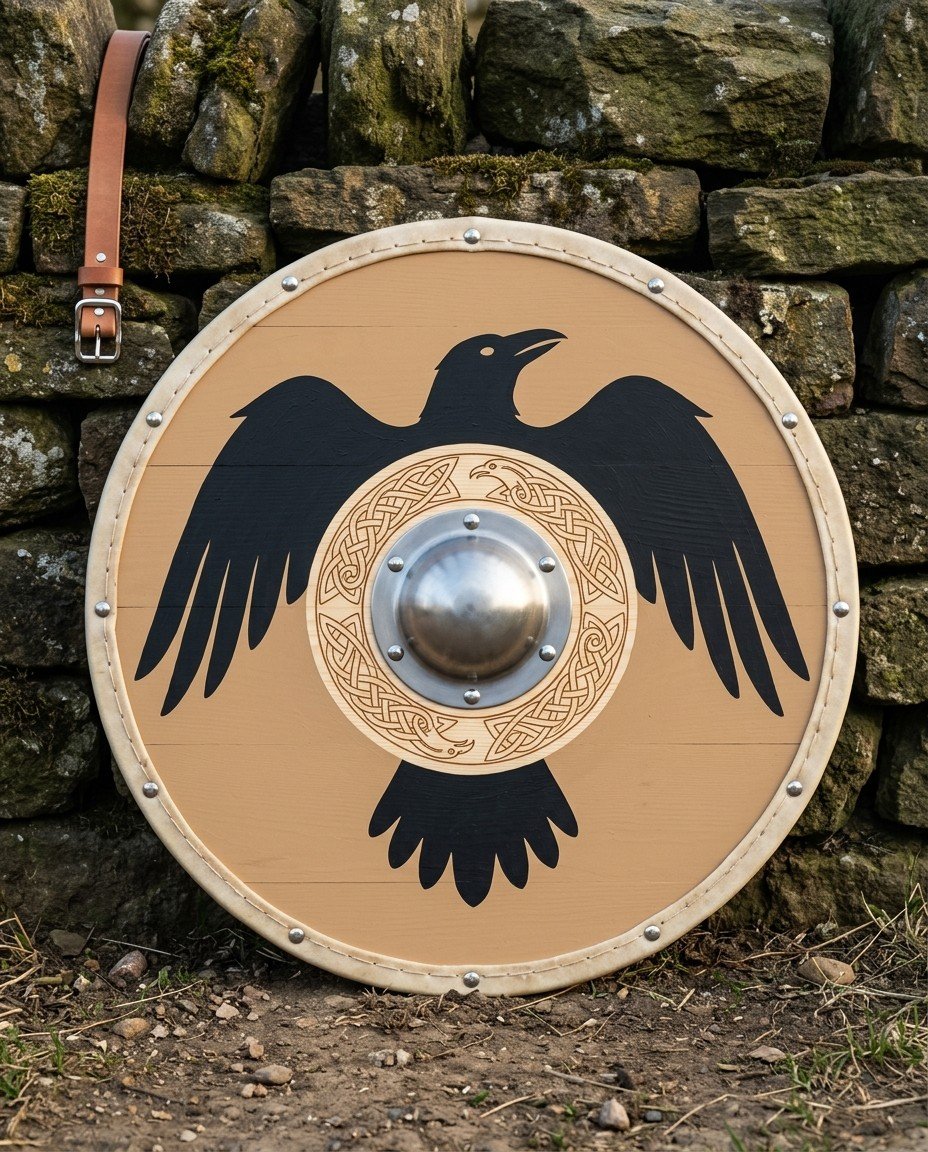
Both shows get the big shapes right and the details wrong in the same places. Round shields, spears, single edged knives and long hafted axes are all correct for the ninth and tenth centuries. Where both series lose their nerve is armour: far too much mail on ordinary fighters, and a great deal of strapped and studded leather for which there is no evidence at all, only a costume department with a deadline.
Below is a category by category assessment of the gear in the History Channel series Vikings and in The Last Kingdom, the adaptation of Bernard Cornwell’s Saxon Stories. Neither show set out to be a documentary, and both are better than their reputations in some places and considerably worse in others. The aim here is to say which is which, without pretending to be scandalised.
Helmets
Start with credit where it is due. Neither show puts horns on anybody, which after a hundred and fifty years of correction should not count as an achievement, and somehow does. That alone puts both ahead of a century of book covers and beer advertising, and if you want the history of how that mistake began, our piece on the horned helmet myth traces it to nineteenth century stage design rather than to anything Norse.
The problem is the opposite one. Both series show a lot of bare heads in battle, and Vikings in particular treats helmets as optional for major characters. That is a cinematography decision, since audiences need to read faces, and it is completely understandable. It is also wrong. A helmet was the single most valuable piece of protection a fighter could own relative to its cost, and anyone who could get one wore one.
The awkward fact underneath all of this is that we have almost nothing to go on. The Gjermundbu helmet from Norway, dated to the tenth century, is the only Viking Age helmet recovered in anything close to a complete state. It has a rounded iron bowl built from riveted panels and a spectacle style guard over the eyes and nose. Everything else on screen is extrapolated from that one find, from earlier Vendel period helmets, and from artistic sources. One helmet is a thin foundation for an entire genre. Our page on what Viking helmets actually looked like sets out the evidence and its limits.
Verdict: the shapes are plausible. The frequency of bare heads is not.
Shields
This is where The Last Kingdom does its best work. The shield wall is treated as the central fact of a battle rather than as a formation people break out of after ten seconds, and that reflects the sources properly. Anglo-Saxon and Norse writing both describe fighting as a matter of holding a line, and the shield does most of the work in it.
The physical shields on both shows are reasonable. Round, flat, plank built, with a central iron boss over a hand grip. The Gokstad ship burial in Norway produced a set of shields hung along the vessel’s sides, painted alternately in two colours, which is the origin of a good deal of the screen colour scheme. Real shields were built from planks of light wood, faced or backed with hide or linen, and rimmed with rawhide.
Where both shows go astray is durability. Screen shields absorb enormous punishment and stay whole. A real plank shield was closer to a consumable. It split, it was expected to split, and a good deal of shield design is about failing in a way that traps a blade rather than about surviving the day. Our guide to how Viking shields were built and used goes through the construction in detail.
Verdict: strong on both counts, apart from shields that outlast the men holding them.
Armour
Here both series fail, and they fail in the same direction.
Mail shirts appear on screen as ordinary battlefield equipment worn by rank and file raiders. In the ninth century they were nothing of the sort. A mail shirt represents an enormous quantity of skilled labour, thousands of rings individually made and joined, and its value put it in the hands of leaders and their close retainers. Complete Viking Age mail is very rare in the archaeological record. The Gjermundbu burial produced fragments, and that is a large part of what we have from Scandinavia.
So a beach full of mailed raiders is a costume department decision rather than a historical picture. The honest version would show a handful of mailed men surrounded by a great many in wool.
Leather
The studded and strapped leather harness that both shows use as a visual shorthand for a fighting man has essentially no evidential support for this period. There is no Viking Age find of the sculpted leather cuirass that fills the screen. It exists because it looks tough, moves well for stunt performers, and photographs better than a wool tunic.
What people actually wore under and instead of mail was textile: thick wool, and quite possibly quilted or layered garments, which are hard to find archaeologically because organic material rarely survives. Our overview of Viking armour and what the evidence supports works through what survives and what does not.
Verdict: the least accurate part of both productions, and the part most copied by everyone else.
Axes
Both shows lean on axes heavily, and for once that emphasis is defensible. The axe was the affordable arm. Iron cost money, a sword took a great deal of it, and an axe head took much less while also splitting firewood on the days nobody was fighting.
The long hafted two handed axe that appears in the later seasons of both series is a real thing, well documented in the eleventh century and shown clearly in the Bayeux Tapestry. It is genuinely fearsome and genuinely awkward, because using it means giving up your shield, and both shows do at least acknowledge that trade.
The exaggeration is in weight. Screen axes are choreographed to look heavy, with wide swings and long recovery. Surviving heads are much lighter than that suggests, and a real fighter’s advantage with an axe came from speed and from hooking a shield rim aside rather than from brute mass. Our history of the Viking axe covers the range of types across the period.
Verdict: right in principle, overweighted in practice.
Spears and knives
The most common arm of the Viking Age was the spear, and both shows underuse it badly. A spear is cheap, it works in a line, it can be thrown, and it is associated with Odin himself. It also makes for repetitive television, which is why the camera keeps finding axes instead. Our page on the Viking spear and its place in the shieldwall makes the case for it.
The single edged knife, the seax, is handled better. Both series show it as an everyday tool that becomes an arm at close quarters, which is exactly right. The name is Anglo-Saxon and the type is found across early medieval northern Europe in sizes from a small belt knife up to a substantial blade.
Verdict: knives good, spears neglected.
Swords
Screen swords in both series are broadly the right shape for the period: straight, double edged, built for cutting, with lobed or brazil nut pommels and short crossguards. That is a real improvement on older productions, which tended to hand Vikings whatever medieval sword was in the props store.
The frequency is again the issue. Swords are everywhere on screen and were nowhere near that common in the ninth century. A good blade was an heirloom, named, given as a royal gift and buried with its owner. Its social meaning was closer to a title than to a piece of kit.
What is real and what is invented
Real: round plank shields with iron bosses, the shield wall as a way of fighting, long hafted axes, the seax, spears in quantity, straight cutting swords with lobed pommels, riveted iron helmets with eye guards, ships good enough to cross open water.
Invented: sculpted leather armour of every kind, mail as common equipment, bare heads in pitched battle, shields that never break, and most of the personal grooming choices. Also invented is a good deal of the character material. Uhtred of Bebbanburg is Cornwell’s creation, though Alfred, Guthrum and Aethelflaed are historical people. On the other series, the historical basis for Ragnar Lothbrok is far shakier than the show implies, and the saga material about him reads as legend rather than biography.
One point sits in between. Arab and Byzantine accounts of Norse traders in the east describe body markings, and Ibn Fadlan’s tenth century description of the Rus is the passage usually cited for the tattoos both shows use. Translations of the relevant word are debated, and what he saw may have been paint rather than tattooing. It is not made up, but it is not settled either.
Building the look from our range
If a show sends you looking for gear, the useful move is to buy the historical object rather than a costume copy. Our hand made round shields follow the plank built pattern with steel bosses, rawhide style rims and painted faces, in sizes from twenty inches for display up to thirty for reenactment. The riveted steel helmets include spangenhelm and spectacle types drawn from the surviving evidence rather than from a costume drawing. For blades, the hand forged Norse swords carry lobed and brazil nut pommels with fitted scabbards, and the bearded axes cover the belt sized and long hafted heads.
Steel is plain 1095 hardened to 54 to 58 HRC, or Damascus of 1095 and 15N20 forge welded and taken to 58 to 60 HRC. Everything is handmade in the Czech Republic the old way, then imported, inspected and shipped from Memphis, Tennessee. Engraving is done in the US after arrival.
The games get the same treatment in the arms of Assassin’s Creed Valhalla, and the axe most associated with the series is examined in the axe attributed to Ragnar. For the fantasy end, see the swords of Middle earth.
Questions people ask
Which show is more accurate about gear?
The Last Kingdom, slightly, mostly because it takes the shield wall seriously as a way of fighting rather than as a starting position. Both series share the same major error, which is putting mail and sculpted leather on ordinary fighters who would have worn wool. Neither uses horned helmets, which by the standards of the genre counts as rigour.
Did Vikings really wear leather armour?
There is no archaeological support for the strapped and studded leather that television uses. Organic materials survive badly, so absence of evidence is not proof, but nothing in the finds, the art or the written sources describes anything like it. Thick wool and possibly layered textile garments are the likelier reality for most fighters, and they photograph like a jumper, which is the whole explanation.
Was mail common in the Viking Age?
No. Making a mail shirt meant producing and joining thousands of rings by hand, which put it far beyond an ordinary farmer. Complete Scandinavian examples are very rare, and the fragments from the Gjermundbu burial are among the better known finds. On screen it is standard issue, which reverses the real distribution.
Is Uhtred of Bebbanburg a real person?
The character is Bernard Cornwell’s invention, though he draws on the author’s own family history and the real lordship of Bamburgh. Several people around him are historical, including Alfred of Wessex, the Danish leader Guthrum and Alfred’s daughter Aethelflaed. The plot is fiction laid over a real political map.
Were Viking shields as tough as the shows suggest?
No. Plank shields were built to be replaced. They split under sustained blows, and part of the design logic is that a splitting board can trap an edge. Screen shields that survive a whole battle intact are one of the most consistent inaccuracies in the genre, and one of the least noticed.
What is the best single purchase for someone starting a Norse kit?
A round shield. It defines the silhouette more than anything else, it is the item both shows get closest to right, and it works for display or for a reenactment group. A helmet is the sensible second purchase, and a spear costs least of all while being the most historically typical thing you could carry, which is a bargain almost nobody takes.
Shop the range
 Boarshield Hand Made Greek Hoplon Shield | 30 Inch Bronze Faced Aspis | Riveted Rim, Painted Running Boar and Leather Carry Strap | Ancient Warrior Gift | RK-1478
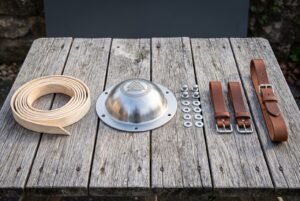 Rimbind Hand Forged Steel Viking Shield Boss and Fitting Kit with Valknut Engraving & Full Leather Strap Set | Shield Building Gift | RK-1532
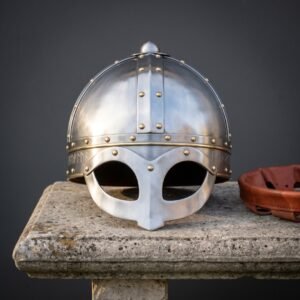 Gazeward Hand Forged Steel Viking Spectacle Helmet | Riveted Skull | Brass Browband and Elder Futhark Runes | Norse Reenactment Gift | RK-1431
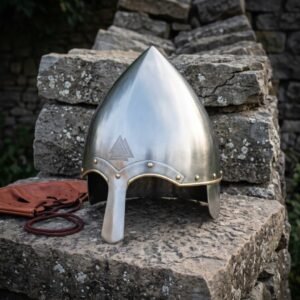 Thornpeak Hand Forged Steel Viking Conical Nasal Helmet | Pointed Skull | Brass Rivets and Valknut Engraving | Norse Reenactment Gift | RK-1443
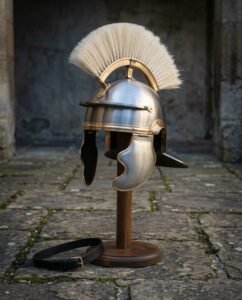 Legionplume Hand Forged Steel Roman Imperial Gallic Helmet | 18 Gauge Mild Steel | Brass Trim, Horsehair Crest and Hinged Cheek Guards | Roman Reenactment Gift | RK-1460
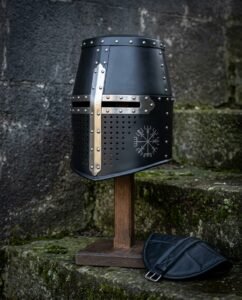 Nightcrux Hand Forged Blackened Great Helm | 16 Gauge Crusader Helmet | Polished Steel Cross Reinforce, Chased Vegvisir and Domed Rivets | Medieval Gift | RK-1483