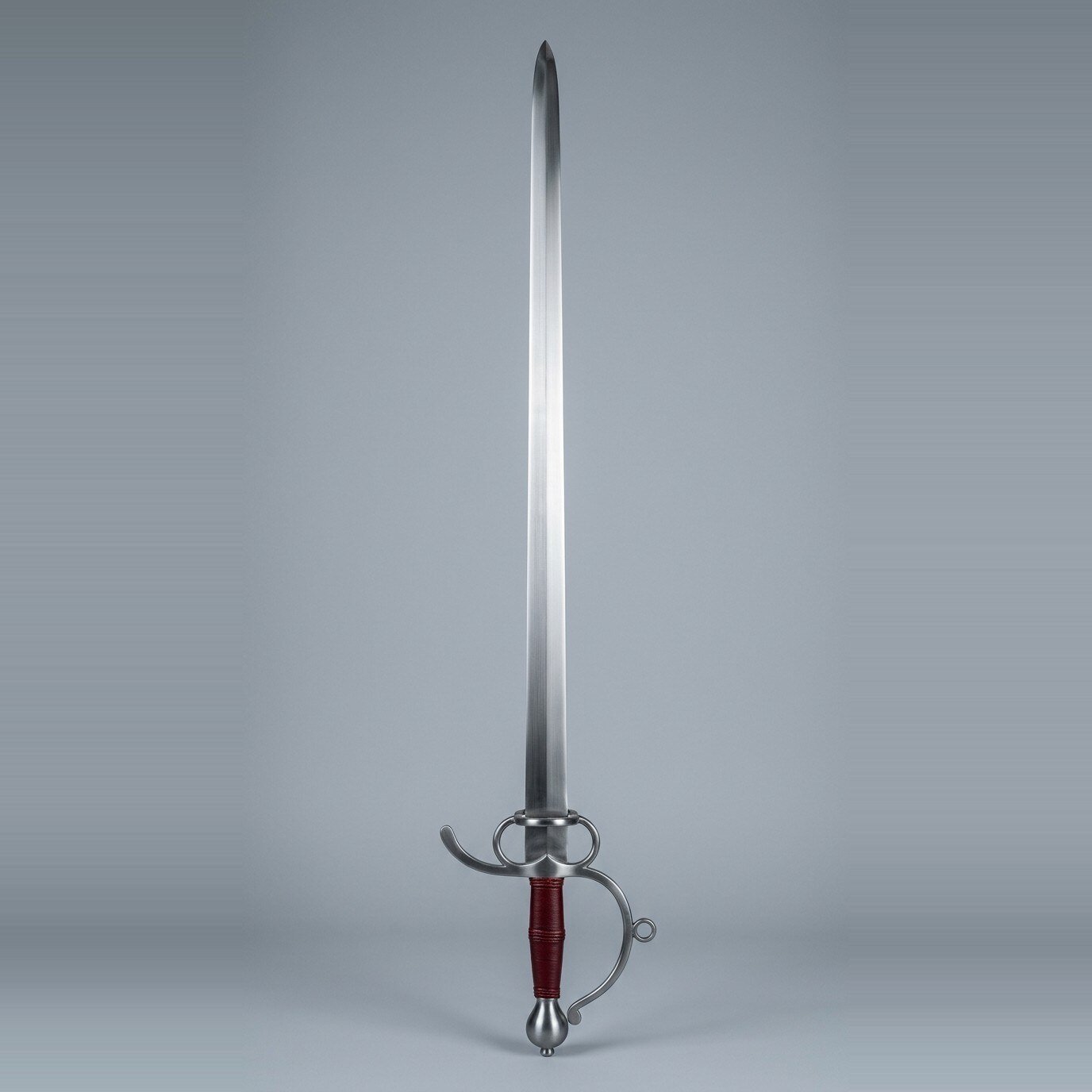
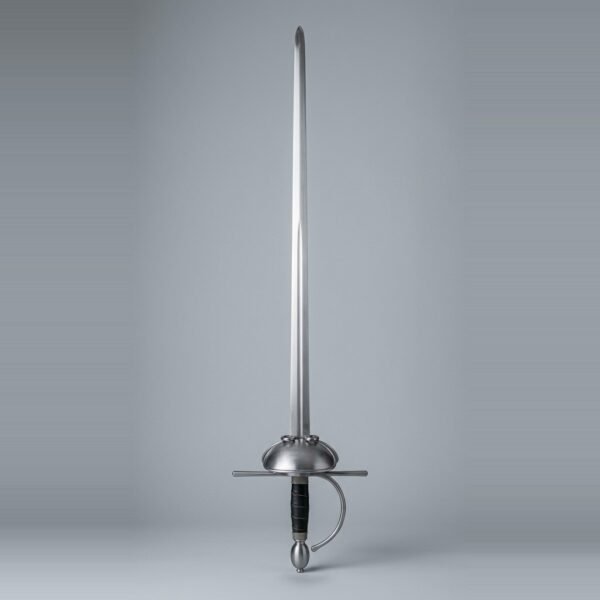
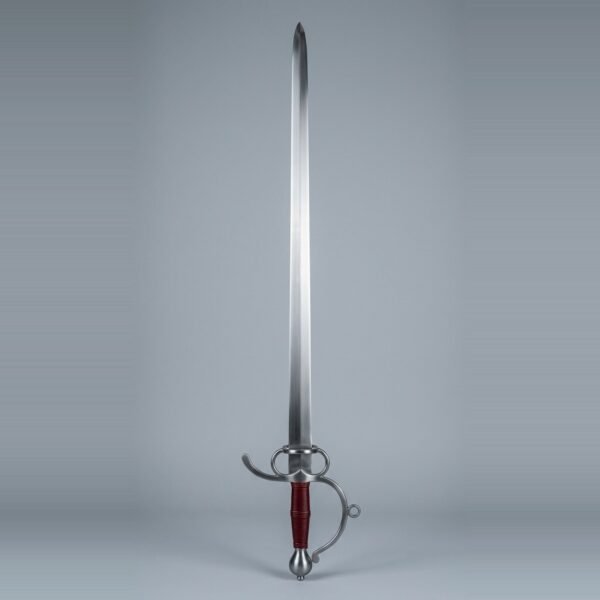
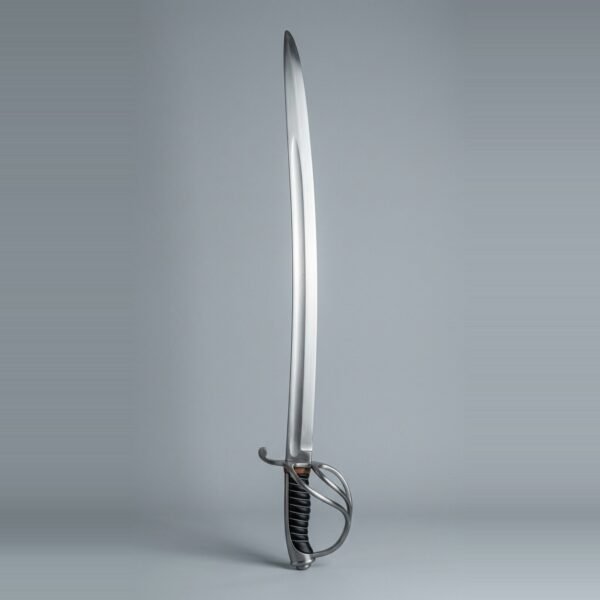
The Skelvard is a sidesword with a hilt worth reading carefully. Two finger rings sit above the cross, one on each side, and a knuckle bow rises from the cross carrying a side ring on its outer face. The bow does not reach the pommel. It stops short and finishes in a free scroll turned back on itself, so the hand is covered from the front but the guard stays open at the top. Nothing about this hilt fully encloses the hand and we are not going to tell you it does.
Below the rings the grip is oxblood leather laid over wood, one hand long, with a pear shaped pommel peened over the tang above it. The blade is double edged and tapers towards the point, cut and thrust geometry rather than the narrow thrusting section of a rapier. It is a blunt, hardened for sparring, with the edges left as flat land and the tip rolled and flared.
If you are trying to place this form, rapier versus sidesword is the piece to read, with HEMA sword flex explained for the tiers. The rest of the complex hilted single handers are in HEMA sideswords.
Specifications
Every figure below is a nominal build figure. This is made by hand, so treat each one as close rather than exact.
| Material | 51CrV4 spring steel, hardened to 49 to 52 HRC |
|---|
| Overall length | About 40 inches, hand made so it varies a little piece to piece |
|---|
| Blade length | About 33 inches |
|---|
| Blade type | Double edged cut and thrust blade, tapering towards the point |
|---|
| Edge | Blunted, about 3 mm flat land, not sharpened |
|---|
| Tip | Rolled and flared, about 15 mm across |
|---|
| Guard | Cross with two finger rings above it and a side ring on the outer face of the bow |
|---|
| Knuckle bow | Rises from the cross and ends in a free scroll, not joined to the pommel |
|---|
| Pommel | Pear shaped, peened over the tang |
|---|
| Grip | Oxblood leather over wood, one hand length |
|---|
| Included | The sword, a care cloth and a care card. No scabbard is supplied |
|---|
| SKU | RK-3049 |
|---|
The sidesword between the arming sword and the rapier
The sidesword is the sixteenth century answer to a question the arming sword could not settle. Armour was coming off, fencing was moving into the street and the salle, and a bare hand on a plain cross was getting cut. So the hilt grew. Rings appeared above the cross so a finger could be hooked over the quillon without risking it, a bow came up to cover the knuckles, and the blade kept enough width to cut properly while narrowing enough to thrust well.
Italian masters of the period built their systems on exactly this sword. Achille Marozzo printed his treatise in 1536 with the spada da lato at the centre of it, and the same blade carries the sword and buckler, sword and dagger, sword and cloak and single sword material that fills the books of the middle of the century.
For a modern fencer the sidesword is a sensible place to stand between systems. It cuts, so the messer and arming sword habits transfer. It thrusts, so the rapier material makes sense on it. And the finger rings teach you to hold a sword with a finger over the quillon, which is the grip that most of the later single handed art assumes.
Finger rings, a free scrolled bow and cut and thrust steel
Take the hilt apart in your head. The two finger rings are the oldest part of the arrangement and they exist because fencers started hooking an index finger over the cross for point control. That finger needs covering, so a ring was forged round it. The side ring on the outer face of the bow covers the back of the hand from a blade coming in flat. The bow itself covers the knuckles from the front.
What the bow does not do is close. It rises from the cross, carries its ring, and then stops and turns back on itself in a free scroll rather than landing on the pommel. Plenty of later hilts do join bow to pommel and those ones genuinely shut the hand in. This one does not, so there is a gap at the top of the guard and a thrust or a slide can find it. Gloves matter on a hilt like this, and we would rather say that than sell an enclosure that is not there.
The blade is 51CrV4 spring steel hardened to 49 to 52 HRC. Spring steel is chosen because it bends and returns instead of taking a set or snapping under a hard bind, which is what a cutting steel at 54 to 58 HRC will not do. The section is cut and thrust, wide enough at the forte to bind and hold, tapering enough to give the point authority. Flex is medium tier with no pound figure published, because we do not measure every blade. The steel glossary covers the alloy.
Engraving, runes and your own design
Use the rune converter on this page to turn a name, a date or a short phrase into Elder Futhark and we will cut it into the steel or the grip. On a hilt this busy the cleanest field is the blade flat just below the rings, though the pear pommel takes a short line or a single symbol well. Elder Futhark has no sign for every sound in English, so the converter maps what it can and we cut what it gives back. If you want to read the alphabet before you choose, the Elder Futhark runes guide sets it out.
Engraving is priced by what you ask for. Text and runes are $19, a symbol is $39 and a family crest is $49. All of it is cut in the United States after the piece has landed and passed inspection, so nothing leaves the Czech Republic already marked.
If you would rather have your own design than a rune line, choose your own design in the engraving option above the add to cart button and tell us where it goes. Where a piece already carries an engraved design, your chosen engraving replaces it rather than sitting alongside it. More on the engraving page.
Handling and balance
With a finger over the cross and through a ring, the point control on this is a different experience from gripping a plain cross hilted sword. The hand sits further forward relative to the blade, the pear pommel counters that from below, and small movements at the wrist translate straight into the point.
We do not publish a weight or a point of balance. The photographs carry no scale, we do not weigh every example, and we are not going to print a figure we have not taken. What can be said is that a cut and thrust blade of this length is a two hour sword for most arms, and the oxblood leather gives a warmer grip than cord or wire once your hand warms it up.
Care
Wipe the blade after every session and pay attention to the hilt. A complex guard has corners, and the inside of a finger ring where it meets the cross is exactly the sort of place sweat sits and quietly starts rusting while the flats look perfect. Get a cloth into the rings and under the bow, and keep a light film of oil on the steel between sessions.
The oxblood leather wants no standing water and no direct heat. Let it dry naturally if it gets soaked and give it a little leather conditioner once or twice a year to stop the grain drying out. Check the pommel for movement now and then, since a peened hilt on a sparring sword is worth watching, and a loose hilt is a defect and ours to fix with no end date and no receipt. Full instructions are in the care guide.
Made in the Czech Republic
Made by hand in the Czech Republic and imported by Ransack Viking. Nothing here is drop shipped out of an importer catalogue straight to a customer. Every one is checked for hilt tightness, pommel seating and blade straightness at our North Babylon, New York warehouse, and ships from there. Shipping in the United States is free, returns run for seven days, and the lifetime warranty against defects in the forging, the grind, the heat treat and the fittings has no end date and needs no receipt.
If you want the longer version of how the line is sourced and what we do and do not claim about it, the country of origin page lays it out, and order and shipping information covers timings.
A note on handmade variation
This is hand forged. It is not machine made, not cast and not bulk produced, so what arrives will not be a pixel for pixel copy of the photograph on this page.
Every bar of this hilt is bent by hand, so the rings are not identical circles and the scroll at the end of the bow will curl a little differently on each piece. Oxblood leather takes dye unevenly and shifts a shade between hides. The pommel is peened by hand and the peen shows. None of that is a defect.
Frequently asked questions
Whether the hand is fully enclosed
No. The knuckle bow ends in a free scroll and does not join the pommel, so there is an open gap at the top of the guard. Wear gloves and do not treat it as a closed hilt.
Whether this is a rapier
No. The blade is cut and thrust geometry, wider and shorter than a rapier blade, and the hilt is a sidesword arrangement rather than a swept or cup hilt.
Whether it is sharp
No. It is a blunt trainer with a flat edge land of about 3 mm on both edges and a rolled flared tip of about 15 mm across.
What the finger rings are for
They cover an index finger hooked over the quillon, which is the grip most of the sixteenth century single handed art assumes and the reason the hilt grew in the first place.
What flex tier this sits in
Medium. We do not publish a pound figure because we do not measure every blade and will not print a number we have not taken.
Whether a scabbard is included
No. Nothing in this line ships with a scabbard and we do not sell one cut to this blade.
What is in the box
- The Skelvard sidesword, about 40 inches overall
- A light protective coat of oil on the blade and hilt
- A care cloth for wiping down after sessions
- A care and storage card with the warranty terms
Explore the range
The complex hilted single handers are in HEMA sideswords, with the whole training line in HEMA swords. For the narrower thrusting blades look at HEMA rapiers, and the older catalogue of single handers sits in arming swords. The written material is collected in the guides hub.
If this one is not it
Close in size and role you have Elmgarth sidesword, about 41 inches overall, Brekavik schiavona, about 41 inches overall, Valdris sidesword, about 41 inches overall and Velstrand cup hilt rapier, about 47 inches overall to compare against this one.
The full HEMA sidesword category and the wider HEMA sword hub hold the rest of the line, and you can specify your own on the custom sword builder.








Reviews
There are no reviews yet