Blog
Viking Santa: Is Father Christmas Really Odin?

No, Father Christmas is not Odin in a red coat. The theory is popular, it is fun at parties, and the evidence for it is thin. Odin did carry a Yule name, Jólnir, and he did ride an eight legged horse. Santa Claus, though, has a well documented family tree, and it runs through a fourth century bishop, the Dutch Sinterklaas, a group of New York writers and an illustrator at Harper’s Weekly. Below is what the Viking Santa theory says, which parts hold up, and where it starts filling gaps with wishful thinking.
A warning before we start. The Norse sources on Yule are few and mostly written down by Christians two centuries after the fact, so anyone who tells you exactly what a Viking did on 24 December is guessing. Where the evidence is thin, this page says so.
The Viking Santa theory in one table
| Claim | What the evidence says | Verdict |
|---|---|---|
| Odin had a Yule name | Jólnir appears among his names in the Old Norse name lists | True |
| Odin brought gifts at midwinter | No Norse source describes it | Not supported |
| Santa’s eight reindeer are Sleipnir’s eight legs | The eight reindeer first appear in an American poem of 1823 | Coincidence at best |
| Children left food in boots for Sleipnir | Widely repeated online, no early source cited | Unproven |
| Odin led the Wild Hunt at Yule | Recorded in later folklore, not in Viking Age sources | Later folklore |
| Santa comes from Saint Nicholas and Sinterklaas | Continuous record from the medieval saint to the Dutch feast to New York | Well supported |
| Christmas in Scandinavia absorbed Yule | Hakon the Good’s law and the Norwegian church laws | Well supported |
Where the Odin and Santa Claus idea comes from
The argument usually goes like this. Odin was a long bearded old man who wandered about in a cloak and a wide hat. One of his names was Jólnir, the Yule one. He rode Sleipnir through the sky. At midwinter he led a host of ghosts across the heavens. Children, the story continues, left carrots and straw in their boots for Sleipnir, and Odin filled the boots with sweets in return. Line that up next to a bearded man who flies through the sky at Christmas and fills stockings, and the case seems to make itself.
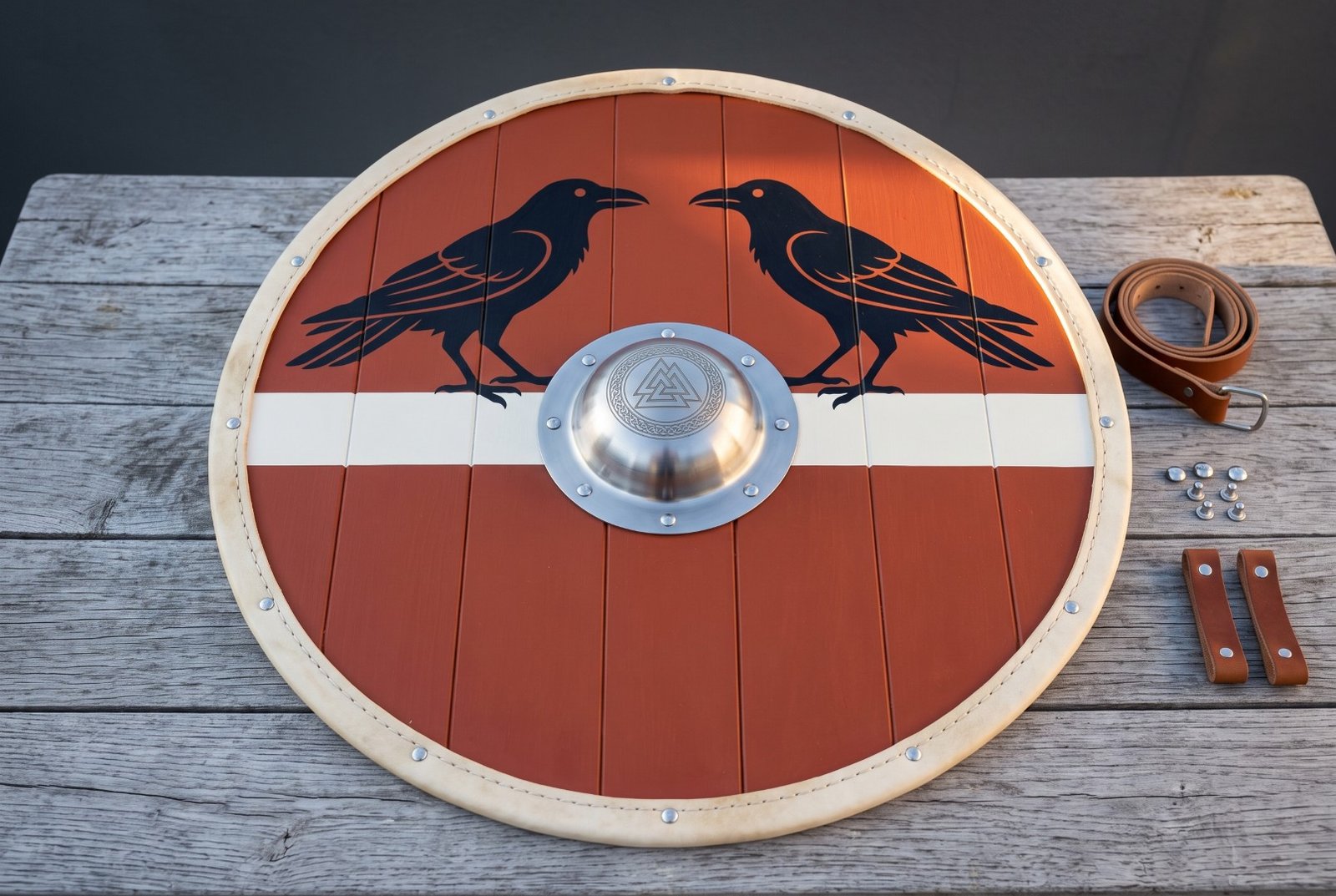
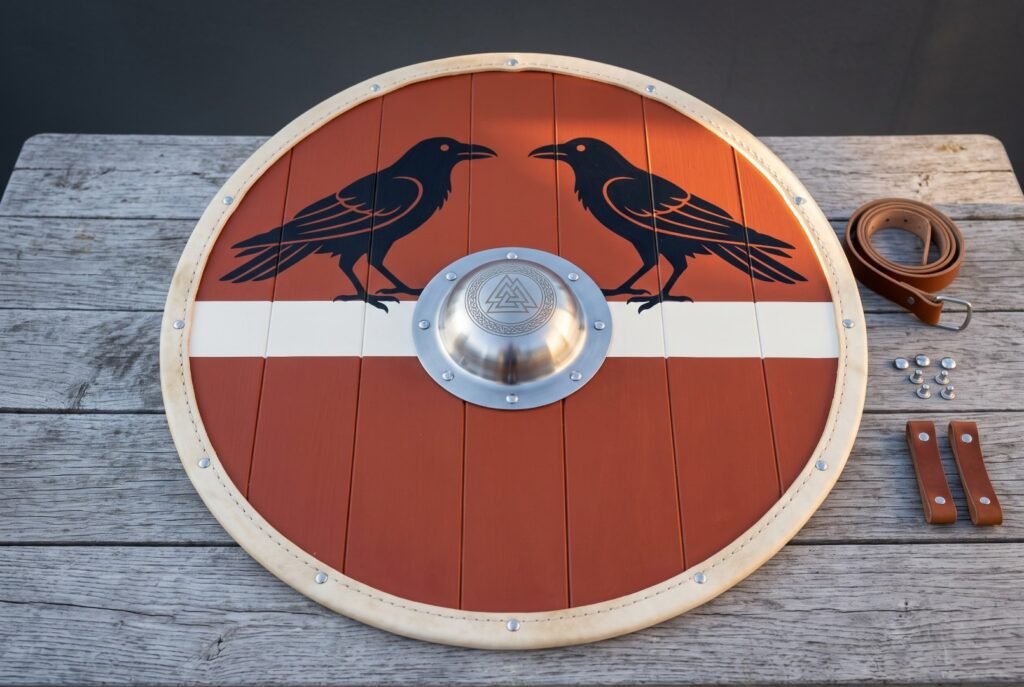
 Ravenhold Hand Made Viking Round Shield | 24 Inch Diameter | Twin Ravens on Red and White with Steel Valknut Boss | Norse Reenactment Gift | RK-1433
 Huginandmunin Hand Forged High Carbon Steel Viking Seax Knife with Camel Bone Handle and Bolster & Tooled Leather Sheath | Norse Raven Collector Gift | RK-606
 Rookhelm Hand Forged Bearded Axe on Walnut Raven Wall Plaque | 14 Inch Ash Haft and 5 Inch Cutting Edge | Solid Brass Mounting Brackets | Norse Wall Display Gift | RK-1712
Some of those pieces are real. Others are much younger than they look, and one of them has no source anyone has managed to produce. The trouble with the theory is the order of events. Every link that points from Odin to Santa runs through material written down long after Scandinavia was Christian, while the Santa story has its own paper trail that never needs Odin at all.
Jólnir, the Yule name
This part holds up. Odin collected names the way some people collect hats, and Jólnir is among them in the Old Norse name lists preserved with Snorri Sturluson’s Edda in the thirteenth century. Skaldic poets also used the plural jólnar for the gods as a group, which suggests the season and the gods were linked in the poetic mind. What it does not tell you is what Odin did at Yule. A name connected to a feast is a long way from a man sliding down a chimney.
The gifts
Nothing in the Eddas, the sagas or the skaldic poems describes Odin bringing presents at midwinter. The Odin of the sources gives things, certainly, but usually to kings and poets, and usually with a catch. He grants victory and then withdraws it, and in the Volsung story he hands Sigmund a sword only to shatter it later in battle. Mostly he is collecting the dead for Valhalla. If you found Odin in your living room on Christmas Eve, the sensible response would be to check that everyone in the house was still breathing. Our longer piece on Odin the All Father goes through what the sources actually credit him with.
What the evidence actually supports: Saint Nicholas to Sinterklaas
Santa Claus has a family tree you can trace with dates on it, which is more than most gods can say.
Saint Nicholas of Myra
Nicholas was a bishop of Myra, in what is now southern Turkey, in the fourth century. Very little about his life is certain. His legend, built up over the following centuries, made him the patron of children and sailors, and the best known story has him secretly dropping gold into the house of a poor man so his three daughters could marry. That is your gift bringer, already working at night and already avoiding being seen. His relics were carried off to Bari in Italy in 1087, and his cult spread across medieval Europe. His feast day is 6 December.
Sinterklaas in the Low Countries
In the Netherlands the saint became Sinterklaas, an elderly bishop with a mitre, a staff and a white horse, who leaves gifts for children on the eve of his feast. The white horse is the detail Viking Santa fans lean on hardest, since Sinterklaas rides it over the rooftops. A horse in the sky is a striking parallel to Sleipnir. It is also all there is. No medieval source connects the saint’s horse to Odin’s, and a bishop on a white horse needs no pagan explanation in a culture where important churchmen rode horses.
Dutch America and the New York writers
The usual story says Dutch settlers carried Sinterklaas to New Amsterdam and he grew into Santa Claus. The real picture is odder. Historians have found remarkably little evidence of Sinterklaas being celebrated in colonial New York. What did happen is that a circle of New York writers in the early nineteenth century, Washington Irving and John Pintard among them, promoted Saint Nicholas as the city’s patron and dressed up its Dutch past as a cosy heritage. Irving’s comic History of New York in 1809 has Saint Nicholas flying over the treetops in a wagon. Santa Claus, in other words, owes a fair amount to a satire and a historical society.
Clement Moore and the eight reindeer
The first reindeer turns up in 1821, in a small illustrated New York booklet called The Children’s Friend, where Old Santeclaus drives a single reindeer. Two years later, on 23 December 1823, a newspaper in Troy, New York printed A Visit from St. Nicholas anonymously. Clement Clarke Moore later claimed it, and the family of Henry Livingston Jr. has disputed that claim ever since. Whoever wrote it, the poem gave Saint Nicholas a miniature sleigh, eight tiny reindeer and the names Dasher, Dancer, Prancer, Vixen, Comet, Cupid, Dunder and Blixem. The last two are Dutch for thunder and lightning, which is a nod to New York’s Dutch past, not to Asgard.
Thomas Nast draws the rest
Thomas Nast, the cartoonist at Harper’s Weekly, drew Santa Claus for more than twenty years from the Civil War on. His drawings settled the round body and white beard, put Santa’s home at the North Pole, and gave him a workshop and a list of good and bad children. The red suit was common well before a soft drinks company used it in the 1930s, so that myth can go in the same box as the horned helmet.
Sleipnir and the eight reindeer
Sleipnir is Odin’s horse, grey and eight legged, the best of all horses according to Snorri. He was born after Loki, in the shape of a mare, distracted the stallion Svadilfari to stop a giant finishing the walls of Asgard on time. Eight legged horses also appear on picture stones from Gotland, usually read as Sleipnir, so the image is older than Snorri. The full story is in our piece on Sleipnir in Norse mythology.
Eight legs, eight reindeer. It is a neat match, and that is about all it is. The reindeer count changed over time. The 1821 booklet has one reindeer, the 1823 poem has eight, and Rudolph made nine in 1939, courtesy of a department store booklet. If the number came from Sleipnir, the poet left no hint of knowing it, and the names he picked are Dutch and classical. Someone wanting four pairs to pull a sleigh does not need a Norse horse to think of eight.
The story of children leaving straw and carrots in boots for Sleipnir deserves its own note. It is repeated on a great many websites and in some popular books, but none of the versions we have seen cite a source older than the twentieth century. It may preserve a real folk custom. Until somebody produces where it was recorded, treat it as a good story, not as evidence.
The Wild Hunt is later folklore
The Wild Hunt is a host of ghostly riders crossing the sky on winter nights, and in parts of Scandinavia and Germany it was said to be led by Odin, or Wode. The folklore is real. It is also late. Medieval Christian writers describe ghostly hunts, the Peterborough Chronicle in 1127 among them, but they do not name Odin. Odin as huntsman comes from folk belief recorded in the early modern period and from Jacob Grimm, who pulled the strands together in his Deutsche Mythologie in 1835. No Viking Age or saga source describes Odin leading a hunt at Yule. Our page on Yule traditions covers the rest of the season’s later inventions, including the log and the goat.
How Christianisation folded Yule into Christmas
This is where the real connection between Vikings and Christmas lies, and it is better documented than anything involving reindeer.
According to Snorri’s saga of Hakon the Good, the king who ruled Norway in the middle of the tenth century had been raised a Christian in England. He passed a law moving Yule to the date of Christmas, and requiring every household to brew ale for it and keep the feast as long as the ale lasted. Snorri was writing three centuries later, so the details may be tidied, but the result is not in doubt. The name stuck. Christmas is still jul in Danish, Norwegian and Swedish, and jól in Icelandic.
The conversion took most of the following century. Harald Bluetooth claimed on the Jelling stone, raised around 965, that he had made the Danes Christian. Iceland accepted Christianity by decision of the Althing around the year 1000. Norway was pushed into it by Olaf Tryggvason and then Olaf Haraldsson, later Saint Olaf, who died in battle in 1030. Sweden held out longer, and Adam of Bremen was still describing a pagan temple at Uppsala in the 1070s.
The church did not try to abolish the feast. It took it over. The old Norwegian Gulathing law still required farmers to brew ale for Christmas and bless it in thanks to Christ and Saint Mary for a good year and peace. The ale, the gathering and the toast survived. The gods being toasted were swapped out. It is a fair example of how conversion usually worked in the north. The calendar and the drinking survived, and the paperwork changed.
So did Vikings celebrate Christmas?
Some did. Christian Norsemen kept Christmas from the tenth century on, under the old name, and pagan Norsemen kept Yule. For a few generations both went on side by side, sometimes in the same family. The Christmas they kept had no Santa Claus in it. The Scandinavian gift bringers came later too. The Yule goat and the nisse, a small farm spirit from folklore, took on the job of bringing presents in the nineteenth century, partly under the influence of the Santa figure arriving from elsewhere.
So, is Father Christmas really Odin?
The fair answer is no, with a footnote. Father Christmas himself is English, a personification of the season who appears as a character called Christmas in plays from the seventeenth century, a figure of feasting and drink rather than gifts. He merged with the American Santa Claus in the Victorian period. Santa Claus descends from Saint Nicholas through Sinterklaas and nineteenth century New York. None of those steps needs Odin.
The footnote is that winter customs travel and borrow. The image of a mysterious old man out on the coldest nights is common to a lot of northern folklore, and some of it may have rubbed off on the saint over the centuries. That is possible. It is also impossible to prove from the evidence we have, and anyone who presents it as settled is selling something, probably a T shirt.
Keeping a Viking Christmas anyway
If you want a Viking Christmas, the sources give you more than enough to work with without Santa. Ale brewed for the occasion, meat, a fire, a horn passed round, a toast to the people you have lost. The Oakcradle drinking horn with its walnut stand is $189 and solves the old problem of a horn that will not sit down. For the wall, the Ravenhold round shield carries Odin’s two ravens on red and white and is $339, and the Rookhelm bearded axe on a walnut raven plaque is $329. The rest of the range is under Viking home decor and drinking horns. Prices quoted are the regular prices; if a sale is running when you read this, the cart shows the current offer.
If you are buying for someone, Viking Christmas gifts sorts the options by who they are for, and if you are wondering what actually went on the Yule table, Viking food and the midwinter feast covers it, boiled horse included.
Every piece on the site is handmade in the Czech Republic by workshops that still work by hand, and imported by Ransack Viking.
Questions people ask
Is Santa Claus based on Odin?
Not on the evidence available. Santa Claus can be traced from Saint Nicholas of Myra through the Dutch Sinterklaas to New York writers and illustrators of the nineteenth century. Odin shares a beard, a sky ride and a Yule name, but no Norse source has him bringing gifts.
What is Odin’s Yule name?
Jólnir, roughly the Yule one, which appears among Odin’s names in the Old Norse name lists. Skaldic poets also called the gods as a group jólnar. The name shows a link between Odin and the season, not what he did during it.
Are Santa’s eight reindeer Sleipnir’s eight legs?
Probably not. The eight reindeer first appear in A Visit from St. Nicholas in 1823, two years after a New York booklet gave Santa one reindeer. The poem names them with Dutch and classical names and shows no sign of Norse influence.
Did Vikings celebrate Christmas?
Christian Norsemen did, from the tenth century on. Hakon the Good is said to have moved Yule to the Christmas date, which is why Christmas is still called jul in Scandinavia. Pagan Norsemen kept Yule, and for a while both existed side by side.
What is a Viking Christmas?
In the sources, a midwinter feast with ale brewed for the occasion, meat, a fire and formal toasts, first to the gods and later, after conversion, to Christ and Saint Mary. Gifts were exchanged in Norse society, but no source ties a gift giving custom to Yule specifically.
Is the Wild Hunt a Viking Christmas tradition?
Not on present evidence. The Wild Hunt is recorded in Scandinavian and German folklore, and Jacob Grimm linked it to Odin in 1835, but no Viking Age or saga source describes it.
Shop the range
Ravenhold Hand Made Viking Round Shield | 24 Inch Diameter | Twin Ravens on Red and White with Steel Valknut Boss | Norse Reenactment Gift | RK-1433Huginandmunin Hand Forged High Carbon Steel Viking Seax Knife with Camel Bone Handle and Bolster & Tooled Leather Sheath | Norse Raven Collector Gift | RK-606Rookhelm Hand Forged Bearded Axe on Walnut Raven Wall Plaque | 14 Inch Ash Haft and 5 Inch Cutting Edge | Solid Brass Mounting Brackets | Norse Wall Display Gift | RK-1712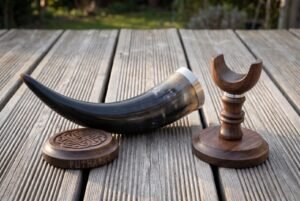 Oakcradle Hand Made Drinking Horn with Stand | Dark Natural Ox Horn | Turned Walnut Cradle and Carved Knotwork Coaster | Norse Table Gift | RK-1677
 Thundermark Hand Made Engraved Slate Rune Plaque with Mjolnir and Full Elder Futhark Ring | 10 by 7 Inch Riven Slate | Solid Walnut Display Base | Norse Home Gift | RK-1714
 Hornmoot Hand Made Ox Horn Tankard with Rune Engraved Steel Band | Full Pint Drinking Vessel | Stainless Bands and Wooden Base and Leather Belt Hanger | Norse Mead Gift | RK-1611
