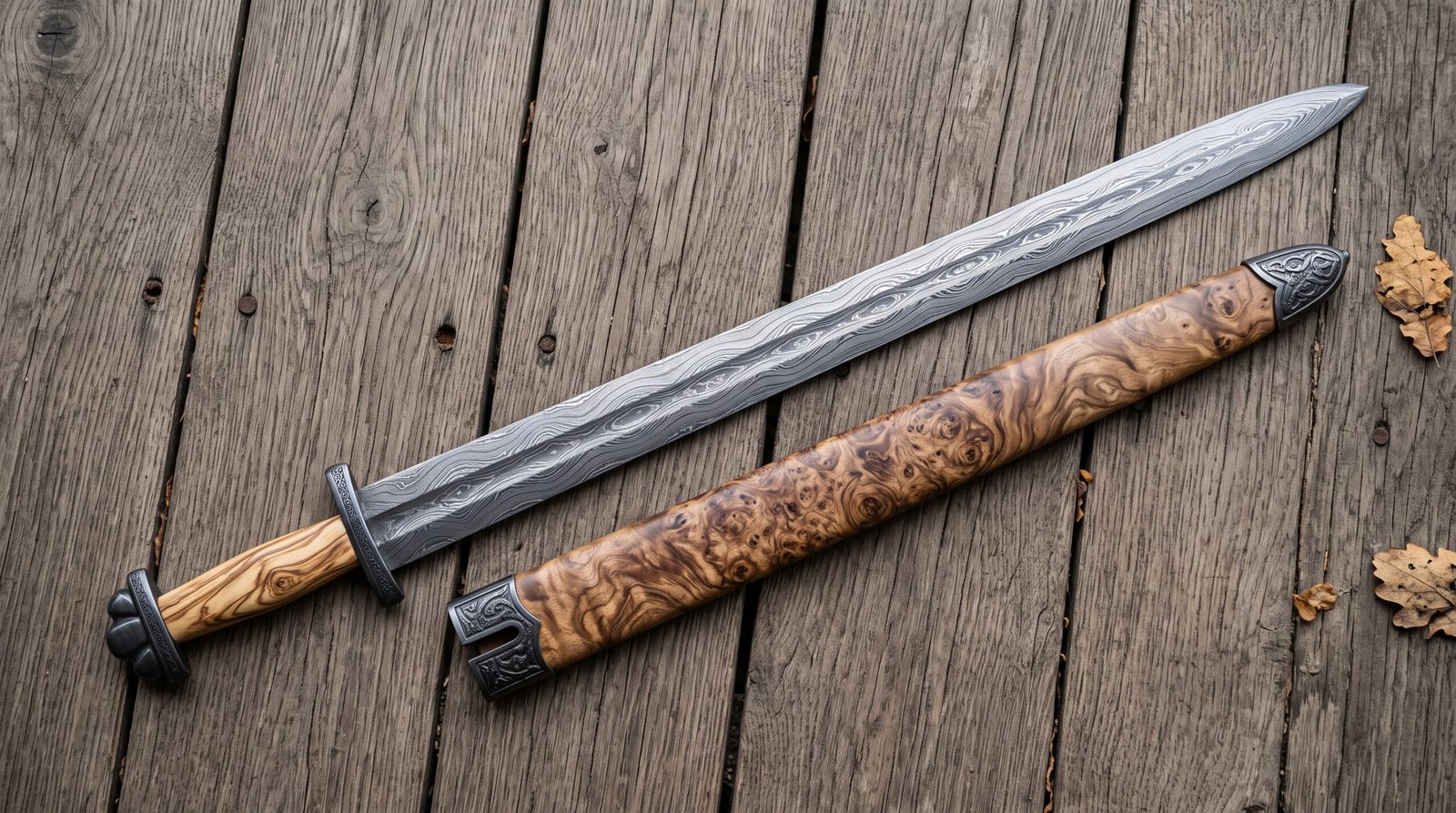
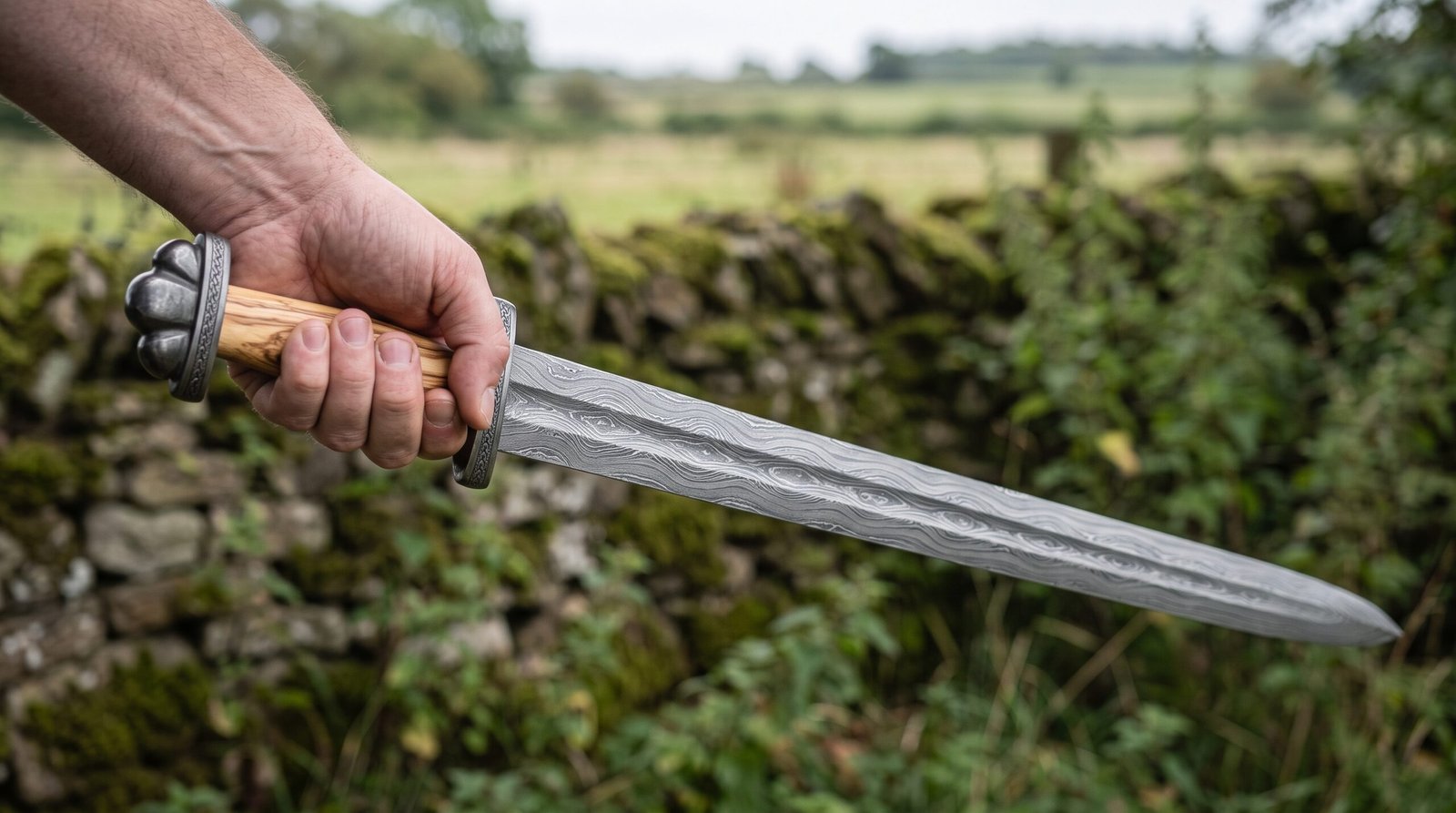
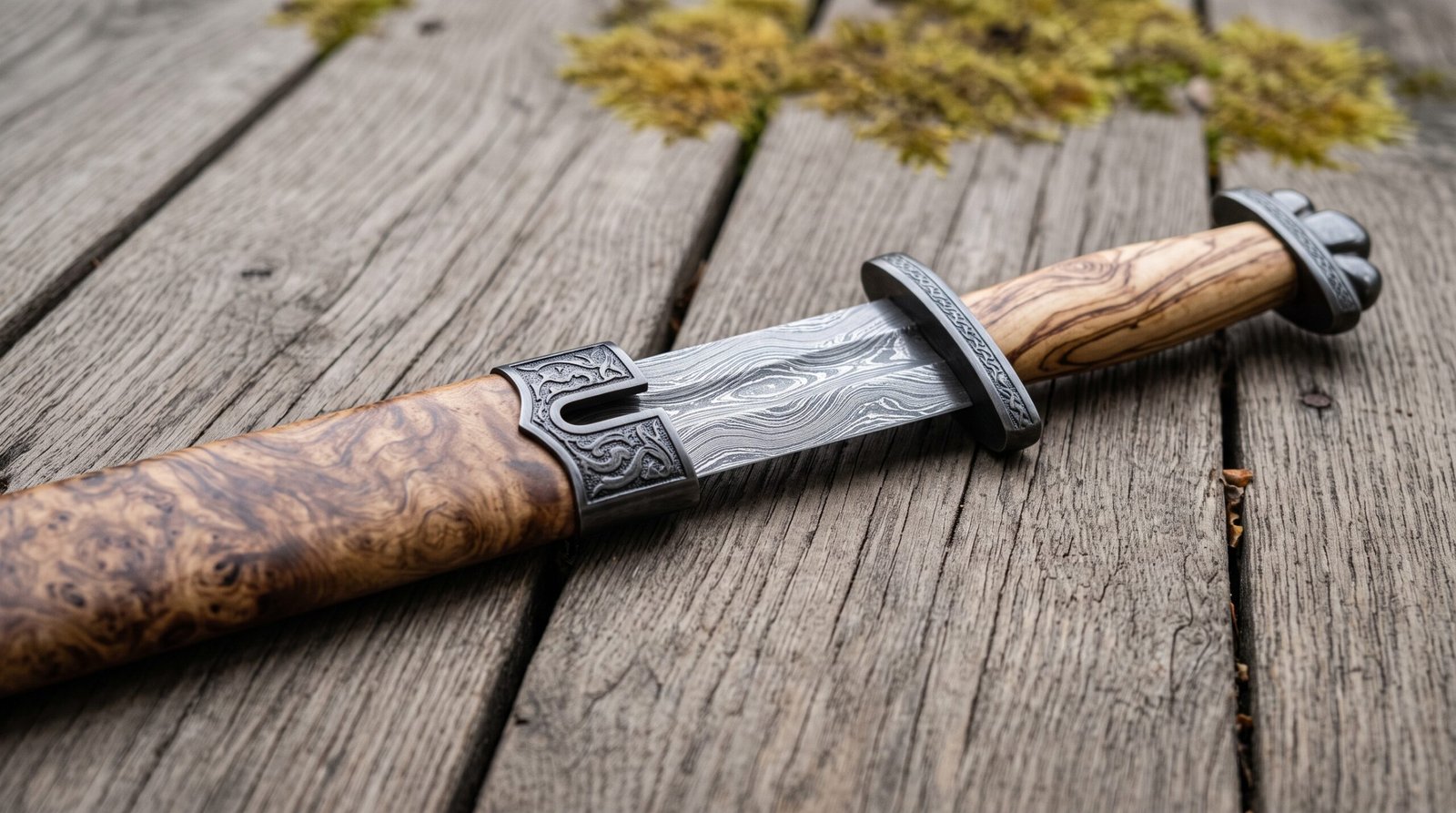
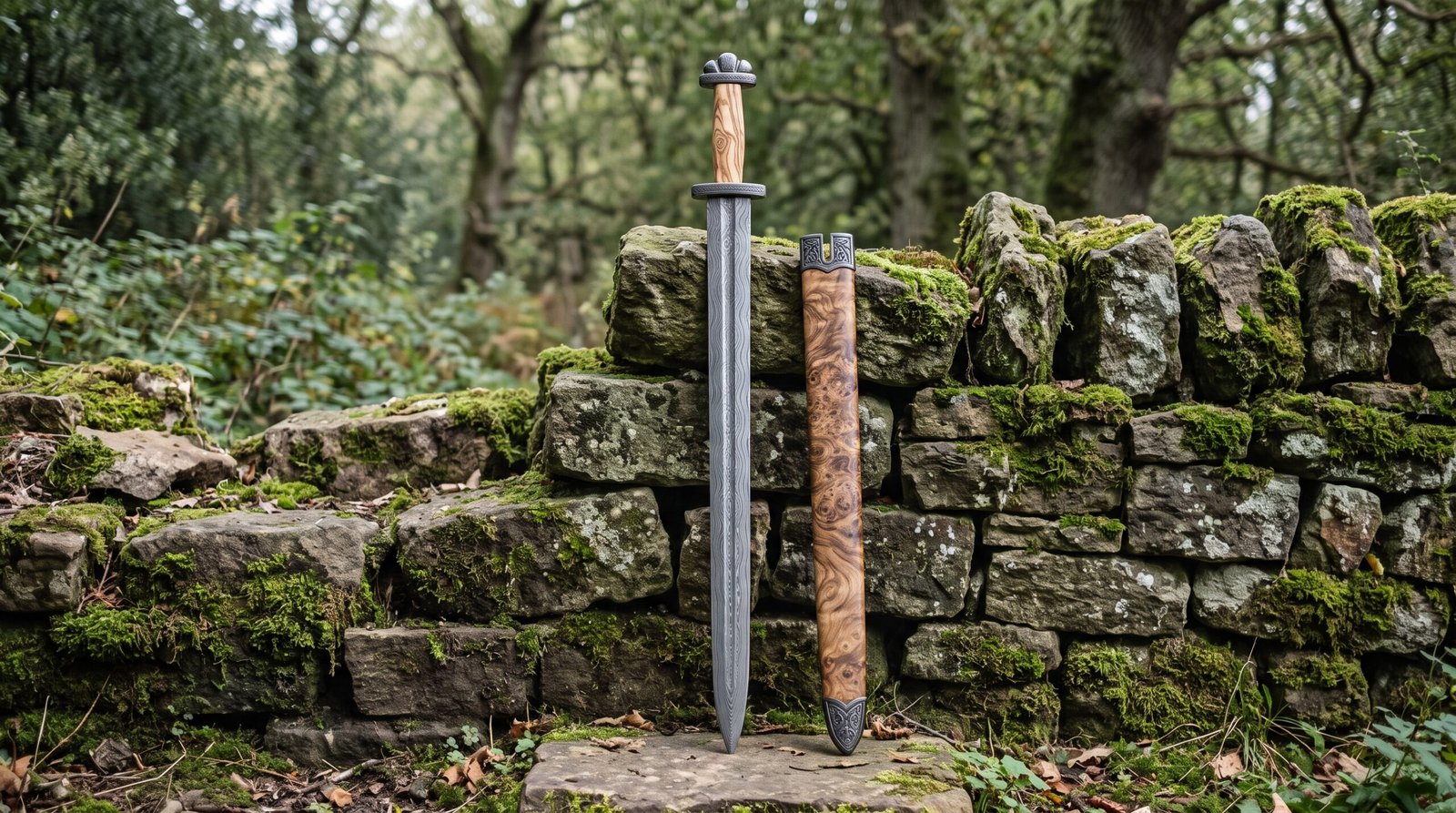
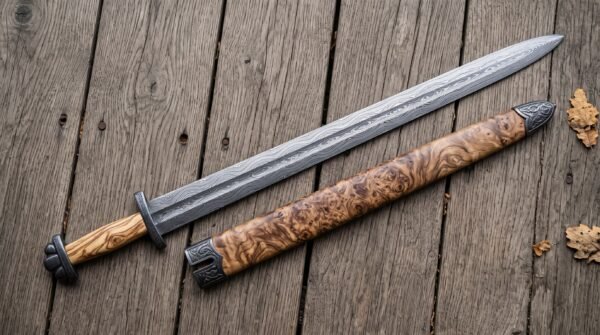
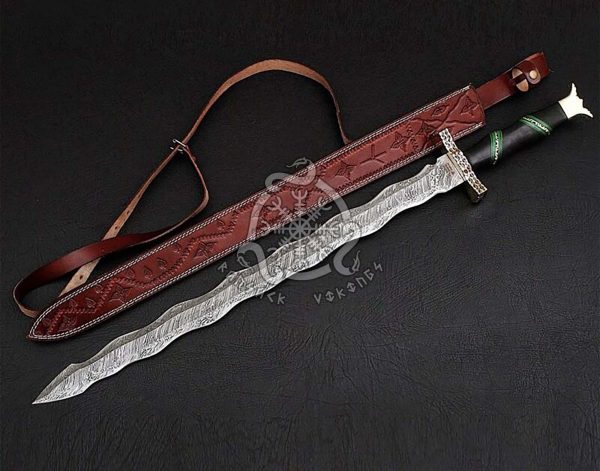
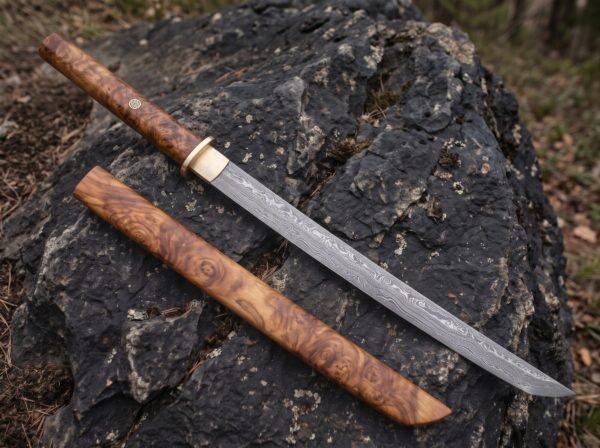
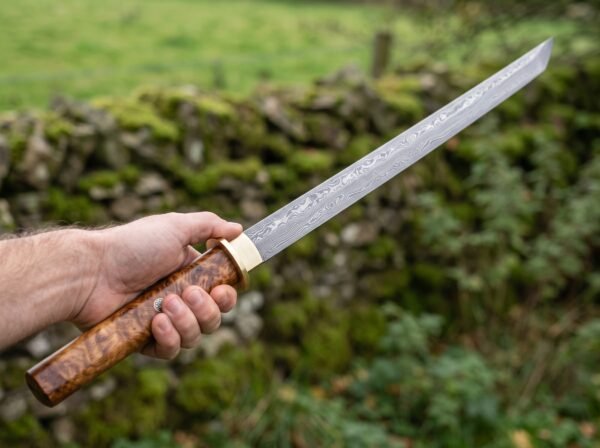
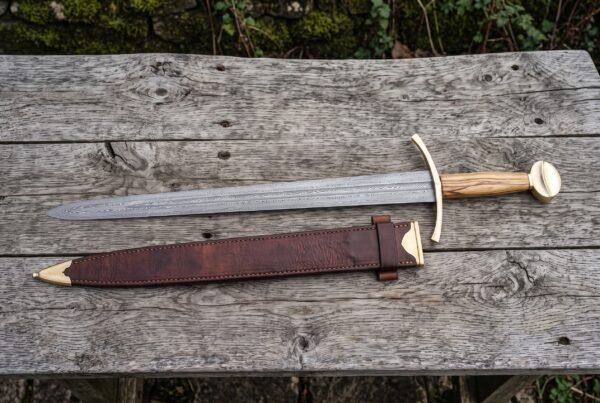
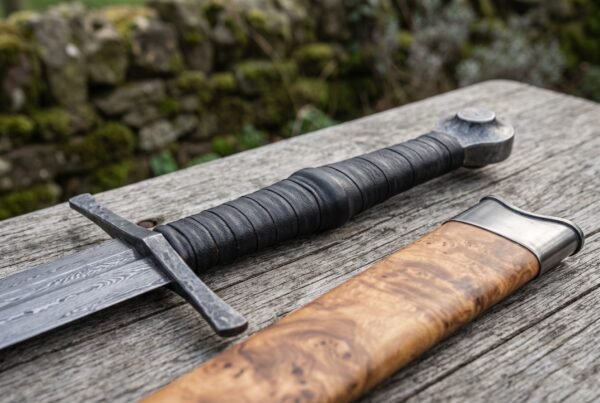
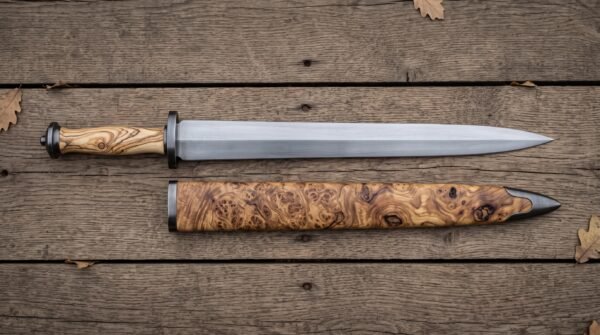
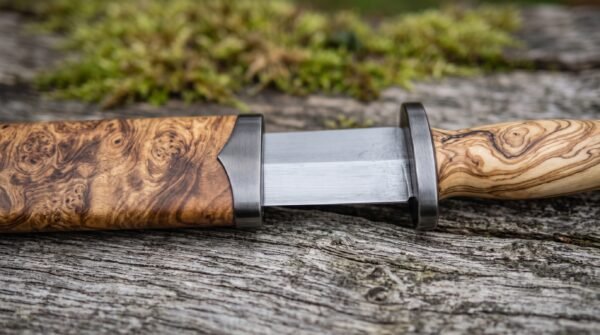
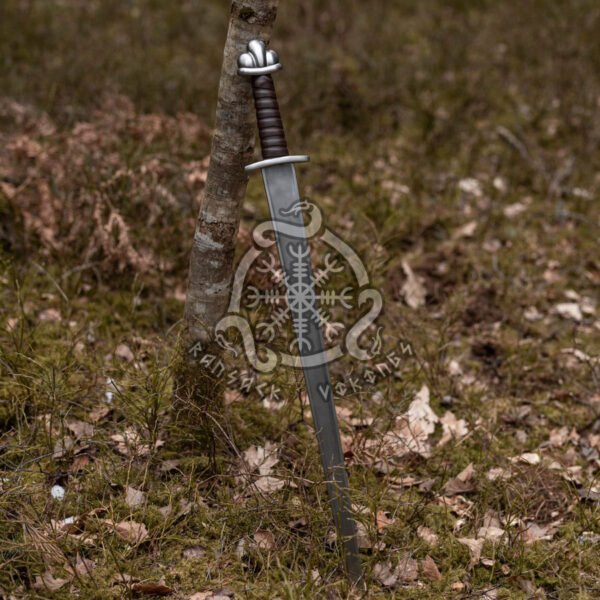
The Sealord follows the lines of the swords it is modelled on. A 29 inch layered Damascus blade, a 6 inch olive wood grip, 35 inches overall and 35 ounces, with the weight kept back near the hand where a Viking age sword carried it. It comes home in a scabbard turned from olive burl.
Pattern welded blades are not a modern decorative idea. They are what Norse and Migration period smiths actually did, and they did it because early bloomery iron was wildly inconsistent. Forge welding alternating rods of harder and softer material together evened out those inconsistencies and produced a blade far more reliable than any single bar of the same iron. The patterns that emerged were a by product of the metallurgy, and the smiths clearly noticed, because they began twisting the rods deliberately to control how the figure showed. By the time of the Ulfberht blades, around the ninth to eleventh centuries, the very best swords were being made from imported high carbon steel and were signed, which is about as close to a brand name as the early medieval world got. You can read the whole story of those blades in the Ulfberht swords.
This one is forged, hardened, ground and assembled in the Czech Republic, and it ships in its olive burl scabbard with free shipping inside the United States.
Specifications
| Steel | Hand forged Damascus, 1095 and 15N20 forge welded |
|---|
| Hardness | 58 to 60 HRC |
|---|
| Damascus layers | 352 layers |
|---|
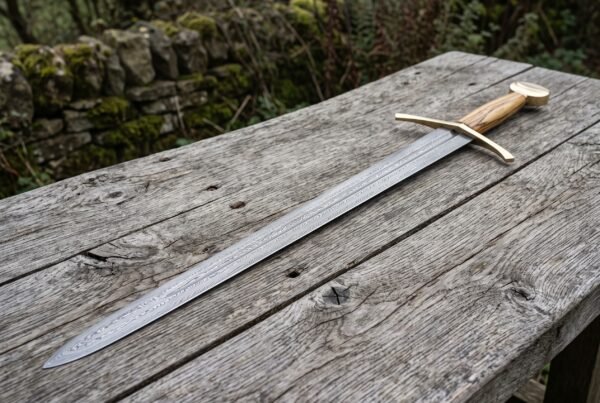
| Blade | Double edged Viking blade with a central fuller and visible Damascus pattern |
|---|
| Overall length | 35 inches |
|---|
| Blade length | 29 inches |
|---|
| Handle length | 6 inches |
|---|
| Weight | 35 oz |
|---|
| Guard | Short straight steel crossguard, darkened, with engraved knotwork border |
|---|
| Grip | Olive wood, one handed |
|---|
| Pommel | Lobed Viking pommel in darkened steel with an engraved knotwork base |
|---|
| Scabbard | Olive burl wooden scabbard with engraved darkened steel throat and chape |
|---|
| SKU | RK-509 |
|---|
What makes a Viking sword a Viking sword
Four things, and none of them is the decoration.
First, it is a one handed sword. The grip is short, around six inches, because the other hand is holding a shield. Everything about how the sword was used follows from that: it is a cutting blade swung from the wrist and elbow, not a two handed fencing tool, and the fighting style is built around the sword and shield working as a pair.
Second, the blade is broad and relatively parallel sided for most of its length, tapering only toward the point. A Viking age sword was optimised for cutting through mail, padding and bone rather than for thrusting into gaps in plate armour, which is the problem later European swords were solving.
Third, the pommel. Norse pommels are heavy and often lobed, and the mass is the entire point. Putting weight behind the hand shortens the effective lever of the blade and brings the balance point back toward the grip, which is what makes a broad 29 inch blade recoverable after a swing instead of dragging the wielder off balance.
Fourth, distal taper, which no photograph will show you. The blade thins progressively from the shoulders toward the point. That removes mass exactly where it hurts the balance most while keeping stiffness where the load is highest, and it is the single detail that separates a sword that feels alive from one that feels like a length of bar stock. Collectors judge a sword by balance, taper and fittings rather than by how sharp it arrives, and this one is built with that in mind.
Why Damascus and not stainless
The blade is built from alternating 1095 and 15N20 layers, forge welded into one bar and drawn out to 352 layers before the shape is cut from it. Because the layers run through the steel, grinding reveals the pattern rather than removing it.
For a sword the case against stainless is not a matter of taste. High chromium stainless alloys are relatively brittle in the thick sections a long blade needs and they do not respond to deep hardening and tempering the way carbon steel does, which is why stainless display swords have a bad reputation for snapping at the tang. The 1095 here provides the hardness at 58 to 60 HRC and the nickel bearing 15N20 provides the toughness, so a 29 inch blade flexes under load and returns straight. The cost is that it is not rust proof and wants an oiled cloth twice a year. The comparison is set out in Damascus versus stainless.
Olive wood in the hand
Olive wood gives this piece its balance. It is one of the densest timbers in normal use, naturally high in its own oils, and its interlocked grain resists splitting along the length, which matters a great deal in a grip that is clamped between a guard and a pommel and loaded every time the sword moves.
It is also spectacular to look at. The grain wanders in dark streaks across pale gold and no two blocks are alike, and the burl used for the scabbard is the most figured section of the tree. A wipe of oil now and then is the whole maintenance routine, along with keeping it out of standing water, away from radiators and out of direct sunlight, which will bleach it over years. The method is covered in wooden handle care.
Engraving, runes and your own design
Use the rune converter on this page to turn a name, a date or a short phrase into Elder Futhark and we will cut it into the steel or the handle. If you would rather have a Viking pattern than a rune line, choose your own design in the engraving option above the add to cart button and tell us whether it goes on the blade or the handle. Where a piece already carries an engraved design, your chosen engraving replaces it rather than sitting alongside it.
On a Viking sword this is more than a personalisation option, it is historically the correct thing to do. Norse blades were inscribed and inlaid, and runic inscriptions appear on sword fittings and scabbard mounts across the archaeological record. A name in Elder Futhark down a 29 inch blade sits exactly where the originals carried theirs. All of it is cut here before the sword is packed. Details on the engraving page.
Care and sharpening
Two rules cover it. Dry it, and oil it. Wipe the blade with an oiled cloth after handling, because skin oils are acidic and will print themselves into a polished Damascus surface if they sit for weeks, and give it a proper wipe of mineral or camellia oil twice a year.
Do not store it long term in the scabbard in a damp room, and keep it off exterior and bathroom walls where condensation forms on cold surfaces. If the edge ever needs dressing, take the stone to the blade in overlapping sections rather than dragging the sword across a bench stone. Full method in steel care and sharpening with a whetstone.
Made in the Czech Republic
This is a handmade piece from the Czech Republic, made in a workshop that still forges, grinds and finishes by hand instead of stamping parts out. The smiths there have kept the older way of working, and the wood, horn and leather are shaped and fitted by hand as well. Two pieces of the same design will never be identical, and that is part of what you are buying.
Ransack Viking is a United States company. We handle the import ourselves, look over every piece when it lands and ship from our warehouse in Chicago, Illinois. Engraving is done in the United States after the piece arrives, so your design goes on before we send it out.
A note on handmade variation
This sword is hand forged. It is not machine made and it is not bulk produced, so the piece that arrives will not be a pixel for pixel copy of the photograph on this page. Twenty nine inches of Damascus gives the pattern a great deal of room to be individual and no two billets draw out the same way under the hammer. The olive wood grip and the burl scabbard came from different material than the ones photographed, so the figure and the tone will be their own.
The dimensions, the weight, the steel, the layer count, the hardness and the build are the same every time. The grain, the tone, the pattern and the exact profile are not, because each one is worked by hand from natural materials. Small variations are the proof it was made rather than moulded.
Frequently asked questions
Is this sharpened for cutting
It arrives with a finished display edge rather than a shaving edge. It is sold as a collector and display piece and is not warranted for test cutting, sparring or any kind of contact, and a fully sharpened 29 inch blade on a wall is a hazard rather than a feature.
Can it be used for reenactment
For display, photography, costume and static reenactment, yes, and it is a far better looking piece for that than a cast reproduction. It is not a blunt built for contact drill, so it should not be used in any activity where two swords meet.
Why is the grip only 6 inches
Because a Viking age sword is a one handed blade used alongside a shield. The short grip is historically correct and it is what gives the sword its characteristic feel, with the pommel sitting right behind the hand as a counterweight.
How does it compare to the longsword in the range
The longsword has a longer grip for a hand and a half hold, a longer and more sharply tapered blade and a later fencing tradition behind it. This is broader, shorter in the grip and earlier, built around the sword and shield pairing of the Norse world.
How do I mount it on a wall
Use a mount that supports the blade at two points rather than one that hangs it by the scabbard, keep it out of direct sunlight and off damp exterior walls, and oil it a couple of times a year.
How long is the wait
Processing is one to two weeks while the sword is forged, ground, assembled and scabbarded by hand, plus transit, with engraved orders at the longer end. Shipping inside the United States is free and returns are open for seven days from delivery.
What is in the box
- One Sealord Damascus Viking sword
- Olive burl wooden scabbard
- Protective packaging
- Forged and finished in the Czech Republic
Explore the range
More from the forge: Viking Swords, Swords and Viking Knives. The background reading lives in the guides.
Also in this part of the catalogue
Sitting beside it in the catalogue is the Ragnar sword, 38 inches overall. Another in the same line is the Rosecrest sword, 28 inches overall. Next along the rack is the Elvenking sword, 40 inches overall.
Fitting out further, the Rhinewarden Viking sword belongs with it. Or start from a blank sheet on the custom Viking sword page.


Got this as a birthday gift and the reaction was priceless. Came in a nice gift box which made it feel even more special. This is going straight into my display case.
I collect stuff like this and this sword is on another level. Even the small engravings are crisp and clean. Came in a nice gift box which made it feel even more special. This is going straight into my display case. This is my third order from Ransack Viking and they never disappoint.
So happy I finally pulled the trigger on this one. Weight and balance make it feel like a real functional piece not some cheap replica. 10/10 would buy again.
Can’t stop showing this off to everyone who comes over. Fit and finish is museum quality. You can tell real craftsmen made this by hand. Highly recommend this one.
Not worth the money in my opinion.
Best sword I’ve ever owned. Came in a nice gift box which made it feel even more special. If you’re on the fence just get it. You won’t regret it.
Five stars isn’t even enough honestly. Came in a nice gift box which made it feel even more special. Great buy overall.
Perfect gift. Perfect quality. No complaints. The olive wood handle feels amazing and the balance is perfect. Can’t recommend this enough.
Overall a good buying experience. Second time ordering from Ransack Viking and still happy overall.
Nice piece for the price. Olive Wood handle looks great though it’s a little smaller than I imagined. Would buy from this shop again.