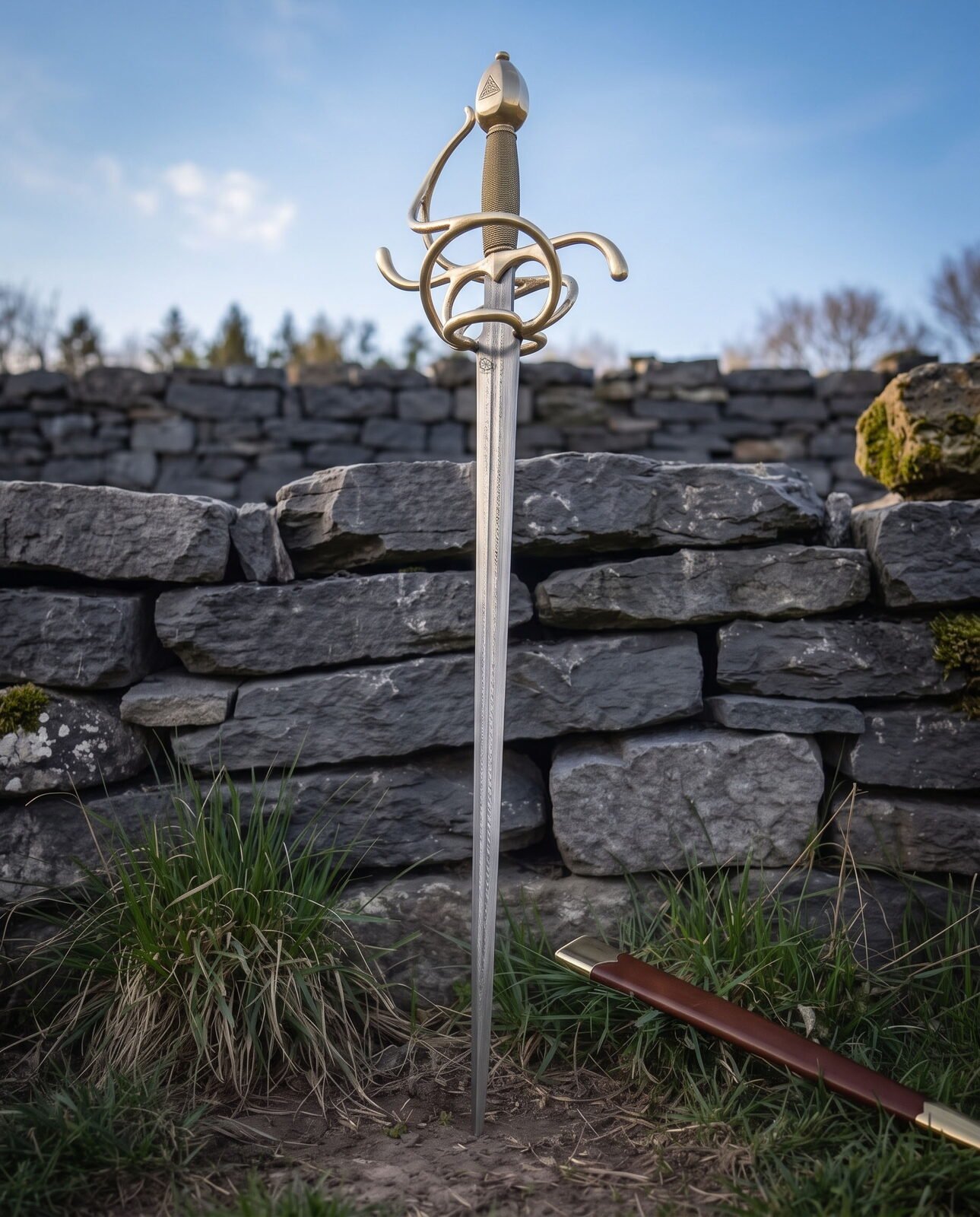
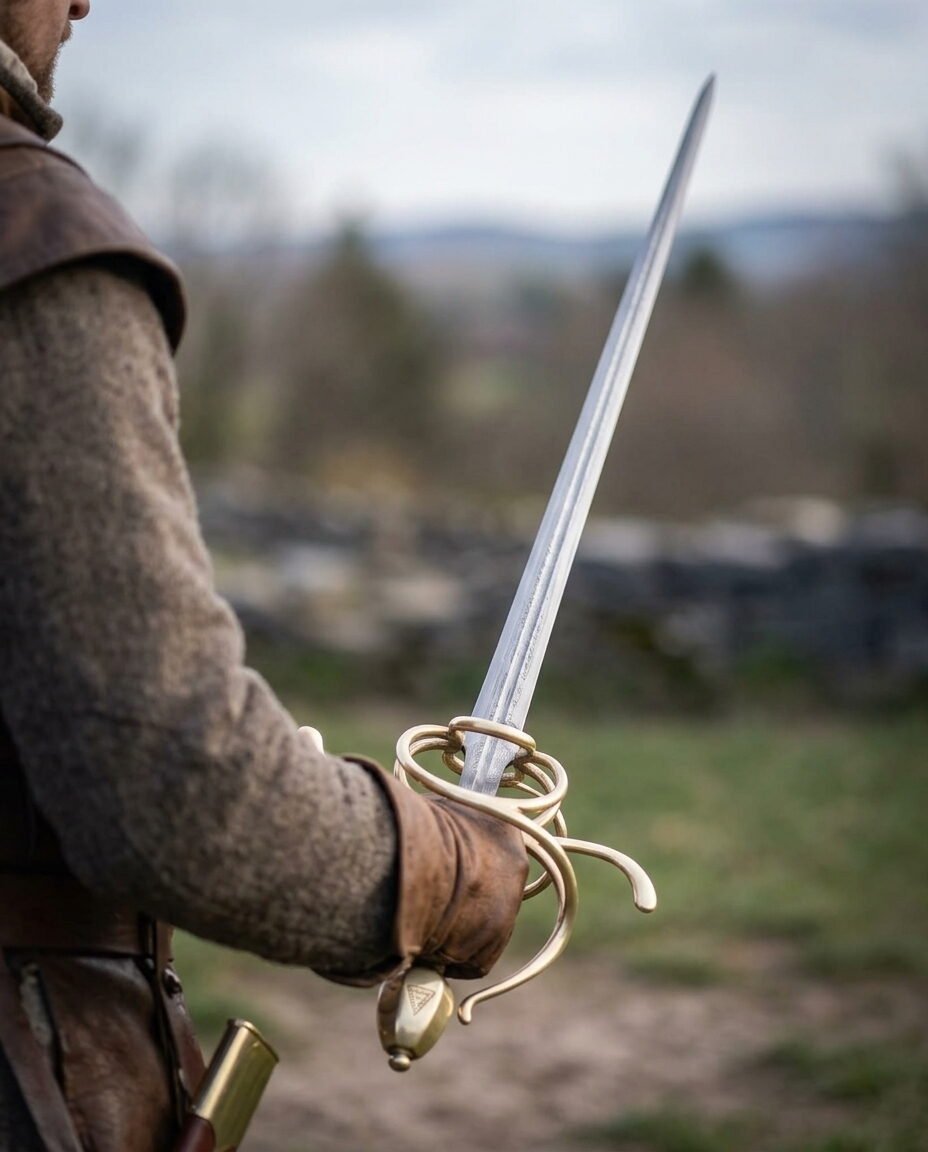
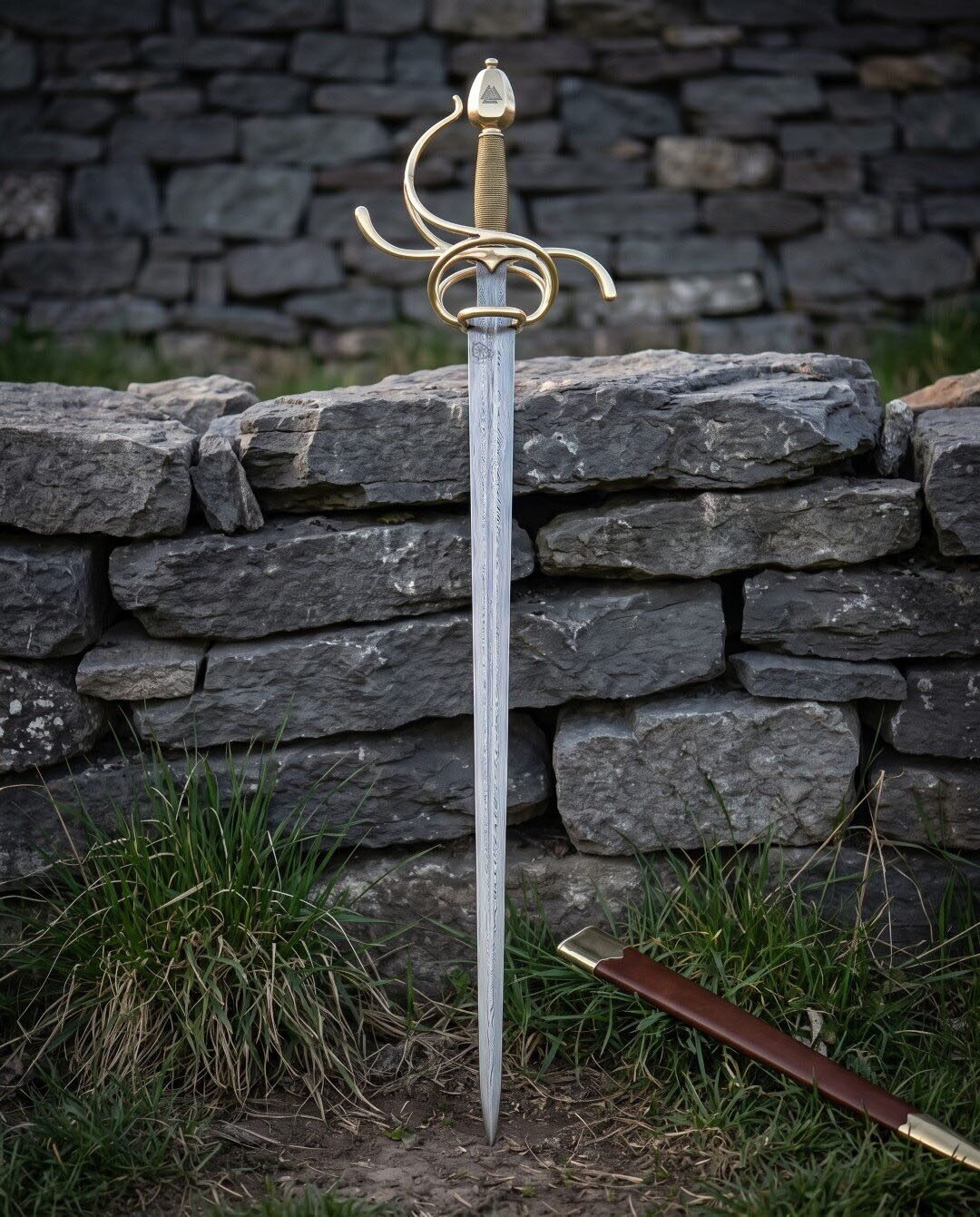
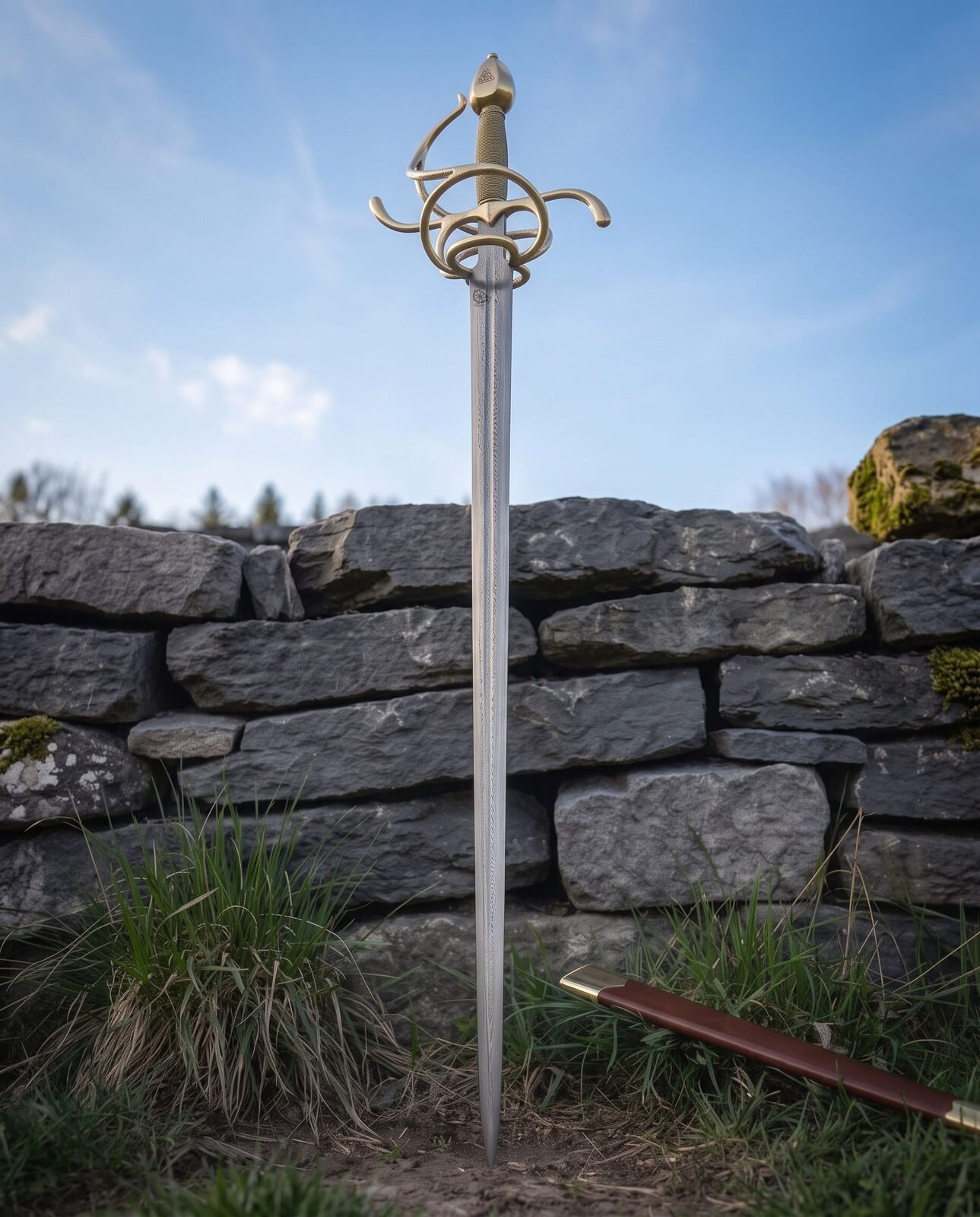
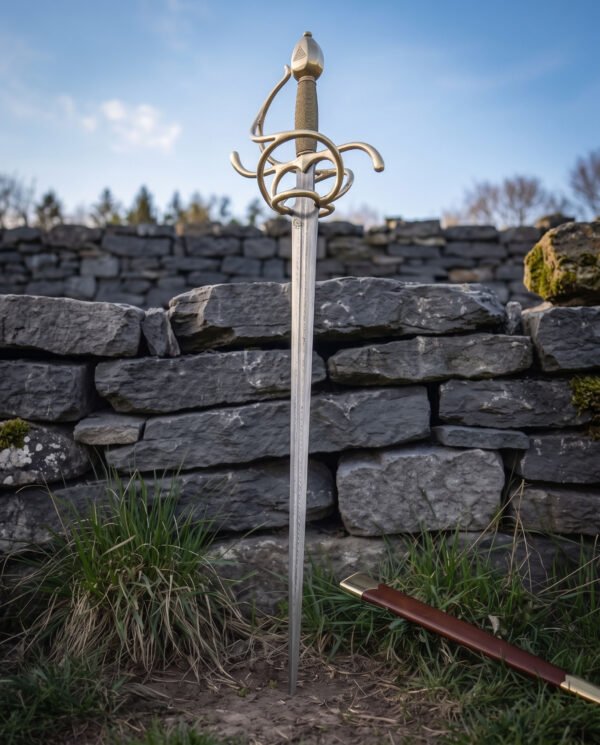
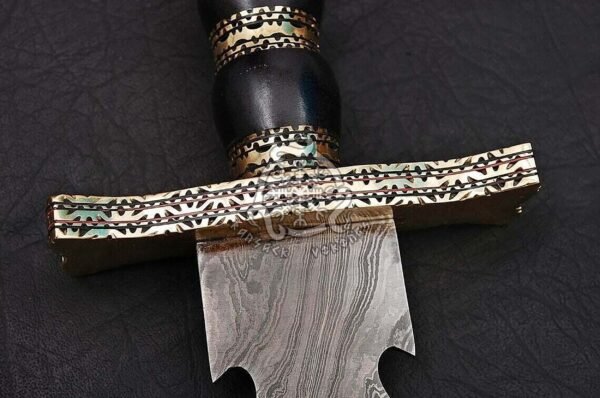
Brambleguard is a swept hilt side sword, the civilian sword of Renaissance Europe, and the whole character of the piece is in the cage of curved bars around the hand. A knuckle bow runs from the pommel down to the front of the crossguard, two quillons sweep in opposite directions, a ring sits over the ricasso on the outer face, and a set of counterguard bars curl back and across to close the gaps. The pommel is an olive, a faceted teardrop drawn to a small button, and the grip between it and the guard is wound tight in fine wire. The blade is Damascus, long and slender with a long shallow taper to a fine point, and the layered pattern runs the full length in a flowing wild figure.
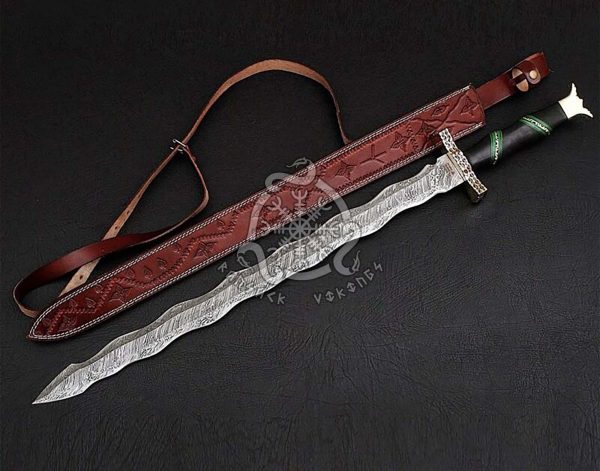
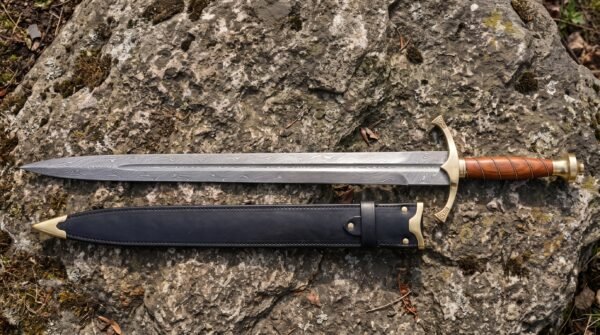
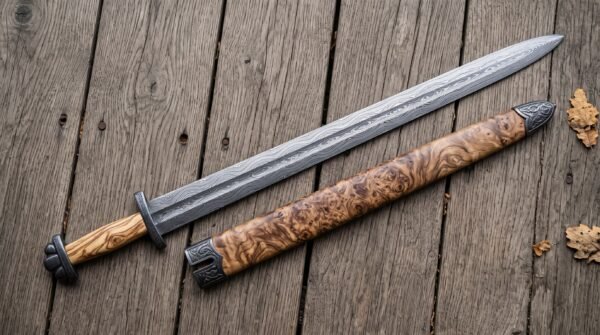
Hilts like this appeared for a specific reason. As plate armour left everyday life in the sixteenth century, a gentleman walking through a city carried a sword and wore no gauntlet, which meant his sword hand was suddenly the most exposed thing about him. Cutlers answered by growing steel around it: first a finger ring so the index finger could hook over the guard for point control, then a knuckle bow, then side rings and counterguards, until within about eighty years the simple cross of the medieval sword had become a basket. Nothing about it was decorative in origin, though a great deal of it became decorative later. This sword is hand made in the Czech Republic. Ransack Viking imports it, checks the weld pattern, the brazing on the hilt bars and the wire wrap, and ships it from our Chicago, Illinois warehouse. It arrives with the brown leather scabbard shown, fitted with a brass toned throat and chape.
If this is early in a collection, how to buy a first sword covers what is worth paying for. Damascus here means 1095 and 15N20 forge welded and etched, and what Damascus steel actually is covers how the layers get there. For a longer grip and more reach, look at the bastard swords.
Specifications
| Blade steel | 1095 and 15N20 Damascus, hardened to 58 to 60 HRC |
|---|
| Overall length | 40 inches nominal |
|---|
| Blade length | 33 inches nominal |
|---|
| Blade form | Slender double edged blade with a long shallow taper to a fine point |
|---|
| Pattern | Wild flowing Damascus figure running the full length of the blade |
|---|
| Hilt | Swept hilt with knuckle bow, opposed curled quillons, side ring and curled counterguards |
|---|
| Pommel | Faceted olive with a small button |
|---|
| Grip | Fine brass toned wire wound tight over a shaped core |
|---|
| Fittings | Polished metal with a warm brass tone |
|---|
| Blade marking | Small etched maker roundel at the ricasso |
|---|
| Scabbard | Brown leather with a brass toned throat and chape |
|---|
| SKU | RK-1995 |
|---|
What every bar on a swept hilt is doing
Take the hilt apart with your eye and each element has a job. The finger ring, the loop sitting just forward of the crossguard over the flat of the ricasso, exists so you can put your index finger over the guard and around the blade root. That single change moves your grip forward, shortens the lever between your hand and the point, and transforms how precisely you can steer a long blade. It is also why the ricasso on swords of this family is left unsharpened: you are meant to hold it.
Once the finger is outside the guard it is exposed, so the ring is there to shield it. The knuckle bow does the same job for the back of the hand, running from the pommel to the front quillon and turning a downward cut away from the fingers. The counterguard bars that sweep across and back fill in the remaining gaps on the outside of the hand, which is the side that faces an opponent when you stand with your sword shoulder forward. The inside of the hilt is deliberately more open, because that side faces your own body and closing it would only make the sword harder to carry against the hip.
Damascus steel and the heat treat
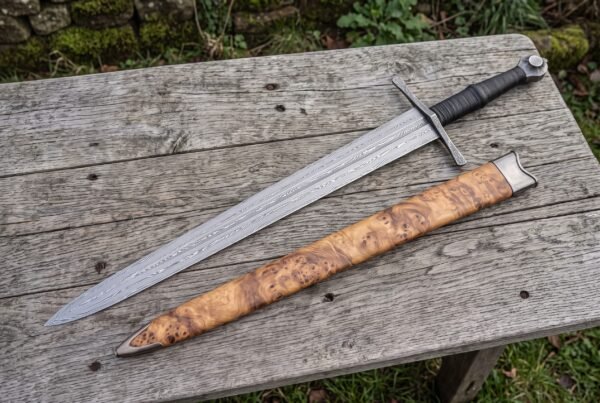
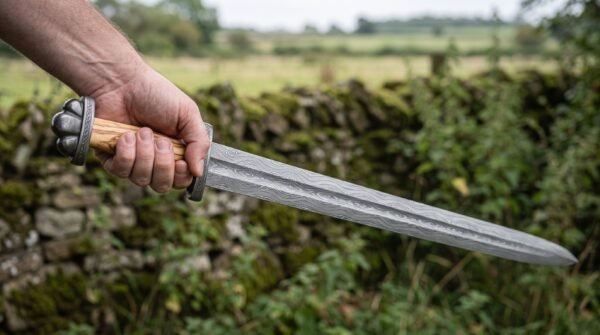
The blade is forge welded from alternating layers of 1095 and 15N20. The two steels differ mainly in nickel content, so when the finished blade is etched the 15N20 resists the acid and stays bright while the 1095 darkens, and the boundaries between the layers surface as the pattern you see. This is a wild pattern rather than a controlled one, which means the billet was drawn, folded and manipulated without forcing the layers into a repeating grid, so the figure flows and swirls differently along the length instead of repeating. The pattern goes all the way through the steel. Sharpening will not remove it.
This blade is taken to 58 to 60 HRC. That is harder than the plain carbon swords in our range and it is the right window for a laminated blade, where the layered structure itself supplies toughness and lets the smith push hardness further than a monosteel of the same section would tolerate. Neither steel is stainless, and the etch that reveals the pattern leaves the surface chemically more open than a mirror polish, so a Damascus blade needs oil more consistently than a plain one does.
Engraving, runes and your own design
Use the rune converter on this page to turn a name, a date or a short phrase into Elder Futhark and we will cut it into the steel, the leather or the wood. If you would rather have a Viking pattern than a rune line, choose your own design in the engraving option above the add to cart button and tell us where it goes. Where a piece already carries an engraved design, your chosen engraving replaces it rather than sitting alongside it. On a Damascus blade an engraved line cuts through the etched surface and reads bright against the pattern, which works well but competes with the figure, so most people put their line on the ricasso or on the scabbard rather than down the blade. Engraving is done here in the United States after the sword arrives. Placement options are on the engraving page.
Handling and balance
A swept hilt sword hangs differently from a medieval cross hilt and it takes a moment to adjust. The steel around the hand adds mass behind the guard, which pulls the balance point back and makes a long slender blade feel lighter than its length suggests. Put your index finger over the guard and inside the ring as the design intends and the point comes alive: small movements at the hand become controlled movements at the tip, which is the entire reason this hilt exists.
It is a collector and display sword. The blade is genuinely forged, genuinely laminated and genuinely hardened, but it has not been proofed for full contact sparring against another blade and it should not be used that way. The fine point is the part to respect. Slender points are easy to bend if the sword is dropped or leaned on, so store it flat, hung or in the scabbard rather than standing in a corner.
Care
Damascus asks for more attention than plain steel. Wipe the blade after every handling session, because an etched surface holds a fingerprint in a way a mirror polish does not, and keep a light film of oil on it at all times. Mineral oil, camellia oil or a light gun oil all work. The swept hilt has a lot of interior surfaces that a cloth cannot reach, so a soft brush with a drop of oil once in a while is worth the two minutes. Never store the sword sheathed for long periods in a humid room, since leather draws and holds moisture against steel. Do not use abrasive polish on the blade, which flattens the etch contrast and dulls the pattern. Our steel care notes go through this properly.
Damascus wants oil more than plain steel does, because the etch that shows the pattern also opens the surface, and caring for a Damascus pattern covers what to use.
Made in the Czech Republic
This sword is hand made in the Czech Republic. It is not drop shipped from an importer catalogue and it has not passed through a chain of warehouses before reaching us. Ransack Viking brings the pieces in, opens every one, checks the weld pattern for cold shuts, the alignment of the hilt bars, the seating of the pommel on the tang, the tension of the wire wrap and the fit of the blade in the scabbard, and only then does it go on the shelf in our Chicago, Illinois warehouse. Processing runs one to two weeks and longer with engraving, because that work is done here in the United States after the sword arrives. Shipping inside the United States is free. Returns are accepted within seven days. There is a genuine lifetime warranty against defects in forging, grind, heat treat and fittings, with no end date and no receipt needed.
A note on handmade variation
This sword is hand made rather than machine made or bulk produced, so what arrives will not be a pixel for pixel copy of the photograph. Wild pattern Damascus is the extreme case: no two billets fold the same way, so the figure on your blade will be recognisably the same style and unmistakably a different blade. The sweep of each hilt bar is bent and fitted by hand, so the curves sit slightly differently from one sword to the next. Polish tone varies with the buff, the pitch of the wire coils varies with the winding, and the colour and grain of the scabbard leather vary with the hide. The steel, the dimensions and the build are the same every time. The character is not, and that is what a hand made sword is for.
Frequently asked questions
Is this a rapier?
It sits just before one. This is a side sword, the transitional form that still cuts as well as thrusts, with a blade broad enough to have real edges. A true rapier has a longer and narrower blade built almost entirely around the thrust. The hilt family is shared, the blade is not.
Is the Damascus pattern genuine?
Yes. The blade is forge welded from alternating layers of 1095 and 15N20 and then etched to bring out the contrast between them. The pattern goes through the steel, so it survives sharpening and it cannot be polished off.
Where does my finger go?
Over the front quillon and inside the side ring, resting against the unsharpened ricasso. That is what the ring is for and it is how the sword was designed to be held. Grip it behind the guard like a medieval sword and you lose most of the point control the hilt was built to give you.
Can I use it for fencing or reenactment?
No. It is a collector and display sword with a sharp fine point and it has not been proofed for contact work. Historical fencing groups use purpose built blunt trainers with flexible blades and rolled tips.
Is the scabbard included?
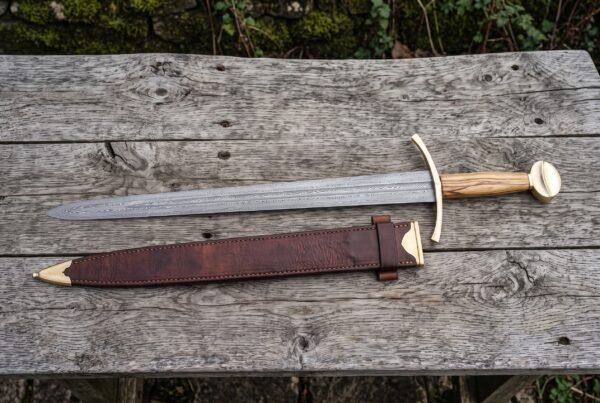
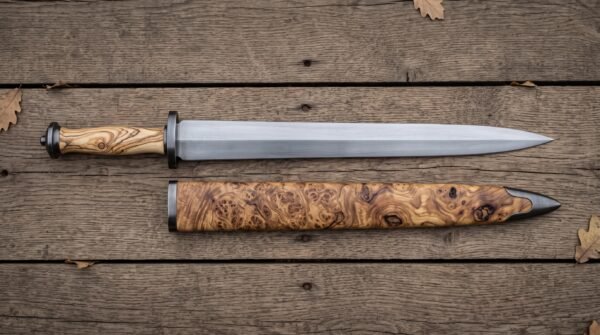
Yes. The brown leather scabbard shown in the photographs ships with the sword, with its metal chape fitted.
How long does delivery take?
Processing is one to two weeks from our Chicago warehouse, longer if you add engraving because that is cut here in the United States after the sword arrives. Shipping within the United States is free.
What is in the box
- Brambleguard swept hilt side sword with a 1095 and 15N20 Damascus blade
- Brown leather scabbard with a metal chape
- Protective wrap and a padded shipping carton
- Care card covering oiling, etch protection and hilt cleaning
- Hand made in the Czech Republic, shipped from our Chicago, Illinois warehouse
Explore the range
See more in Damascus swords, the wider sword range, our scabbards and sheaths and sword stands and displays. Background reading lives in the guides.
Compare it with these
In the same category sits the Nightflame flamberge sword, pattern welded Damascus. A near match for this one is the Stormcairn bastard sword, 37 inches overall. Closest to this in the range is the Stormlace longsword, 45 inches overall.
Fitting out further, the Oakflank rapier belongs with it. Pick the steel, the length and the fittings yourself on the custom Viking sword page.


This one was a letdown compared to the listing. Would not recommend based on my experience. Not sure the Czech craftsmanship justifies the price given the shipping issues I had.