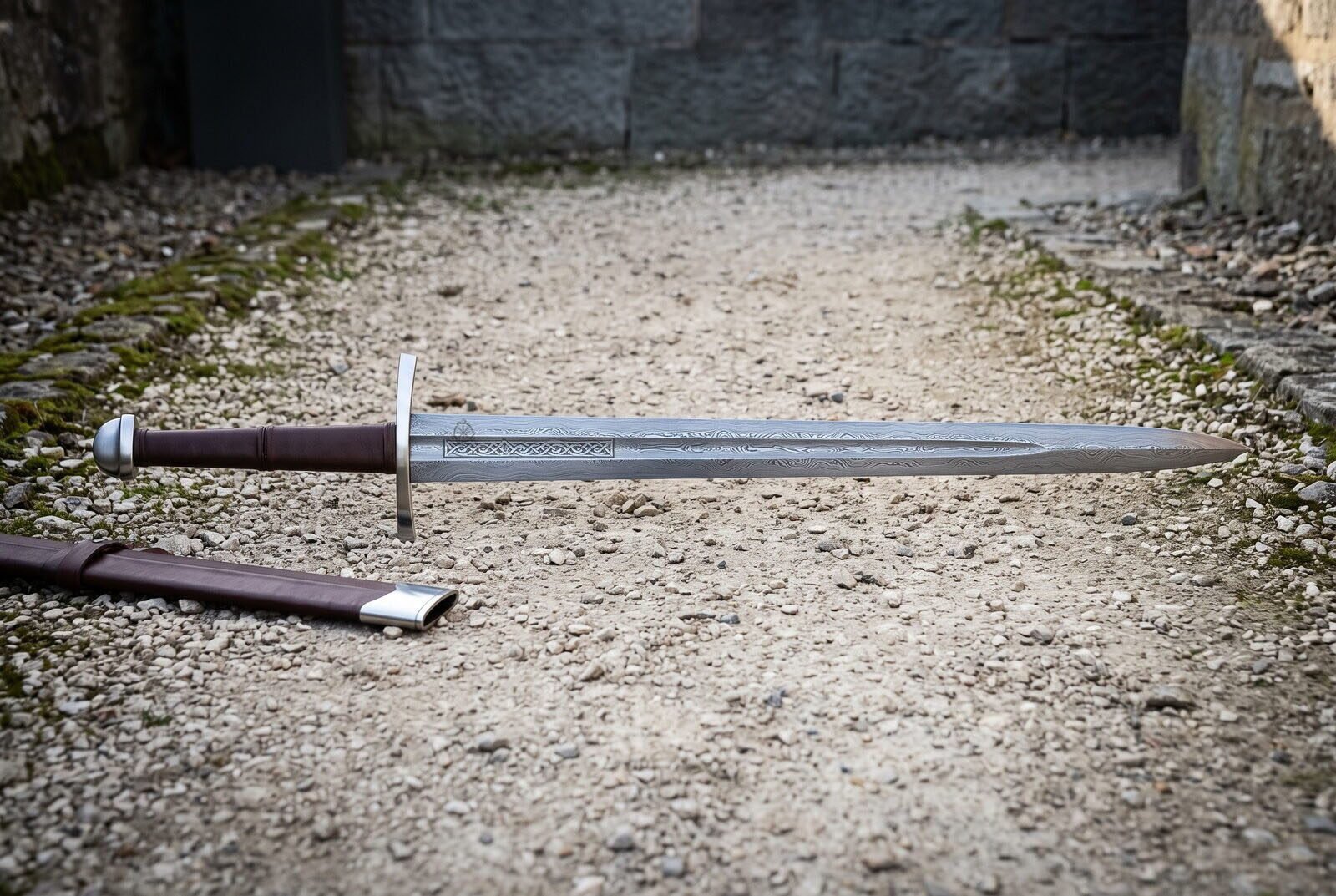
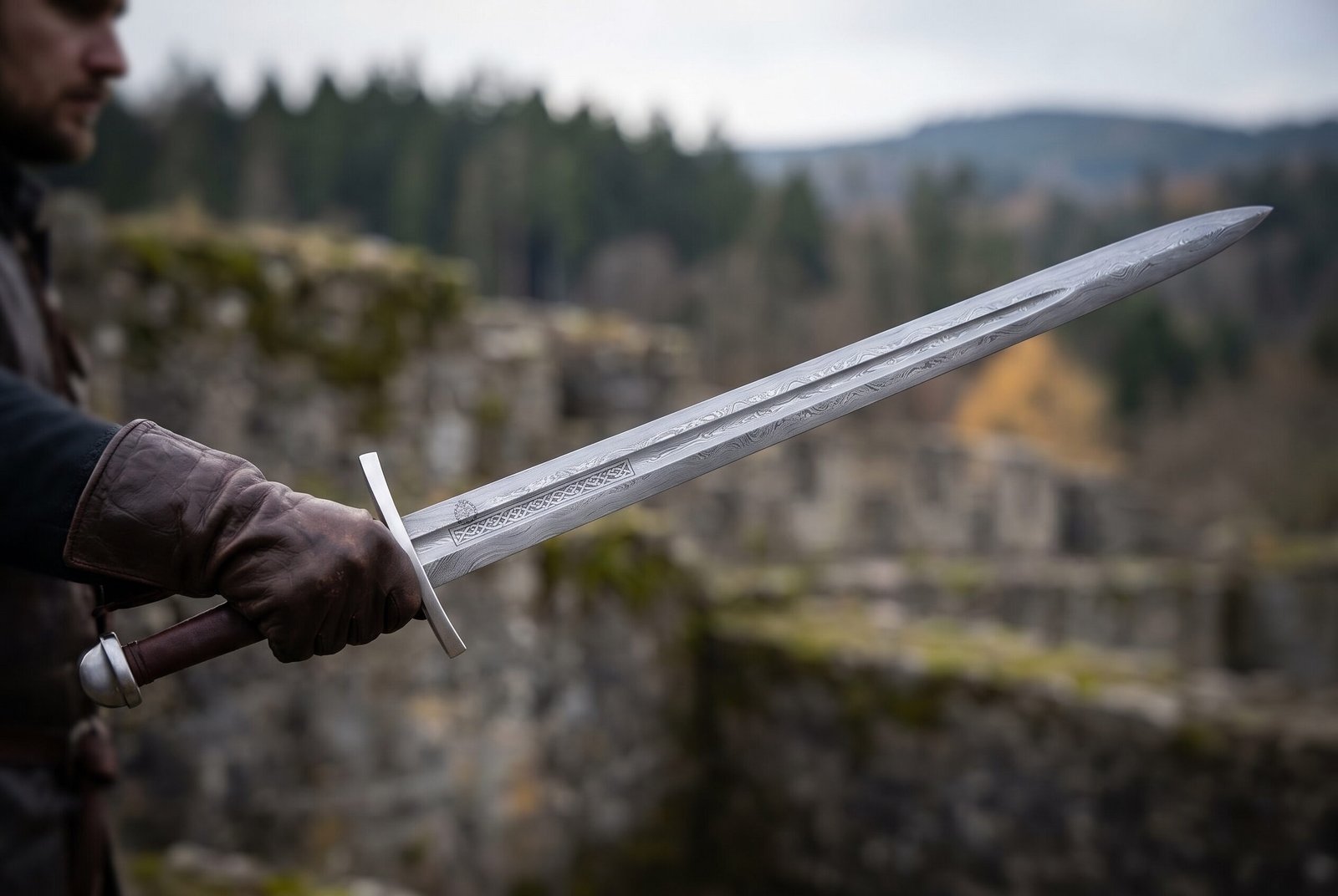
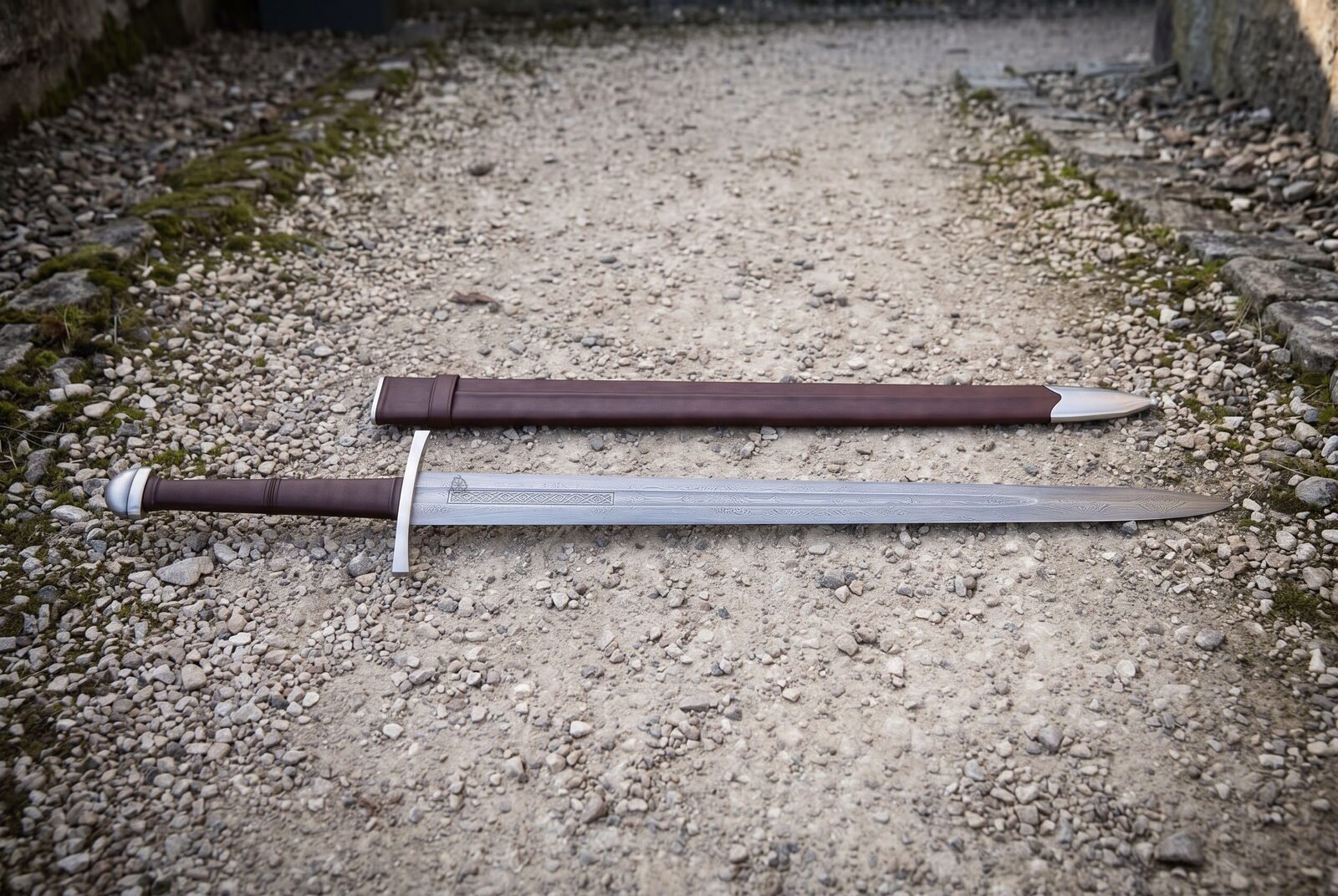
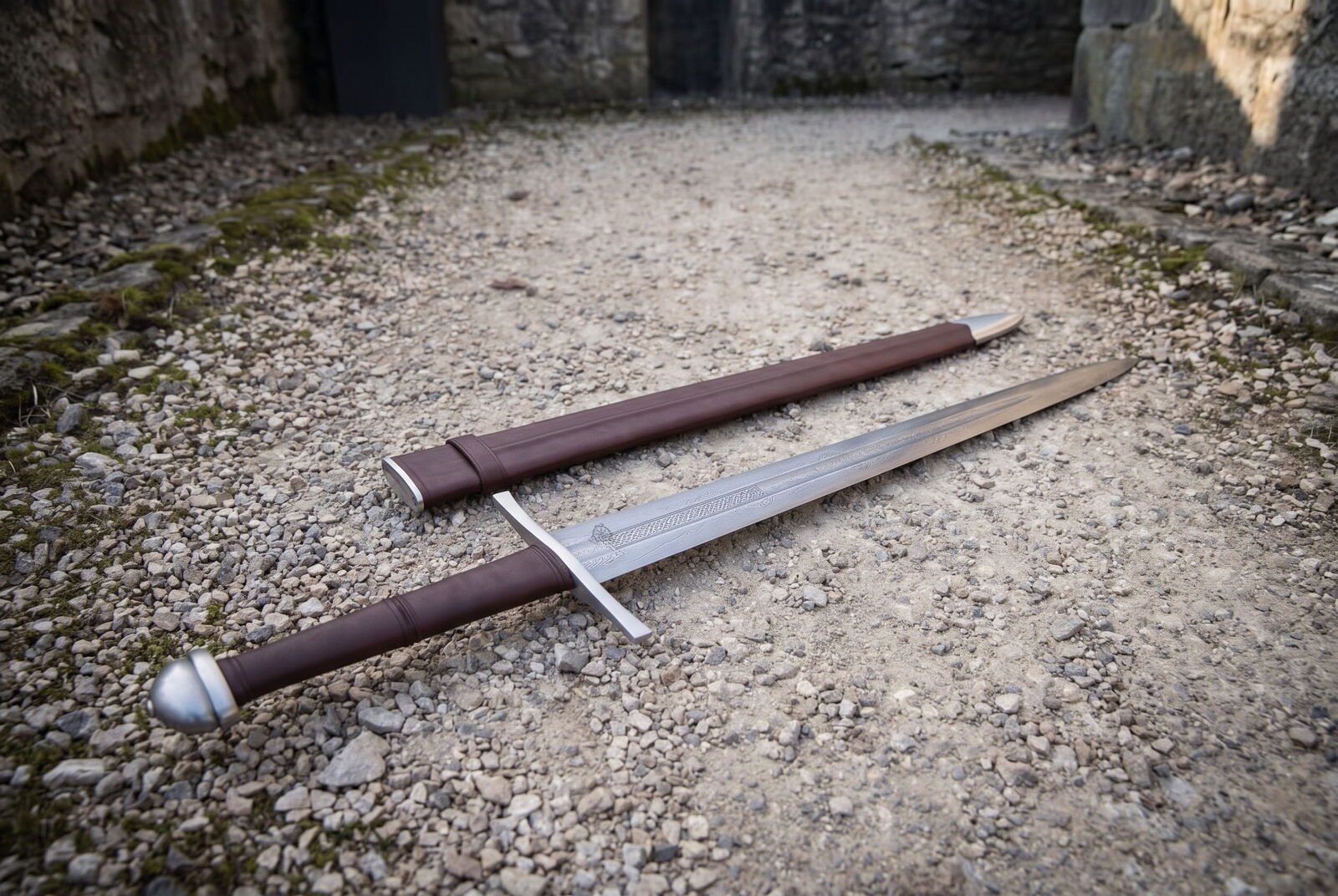
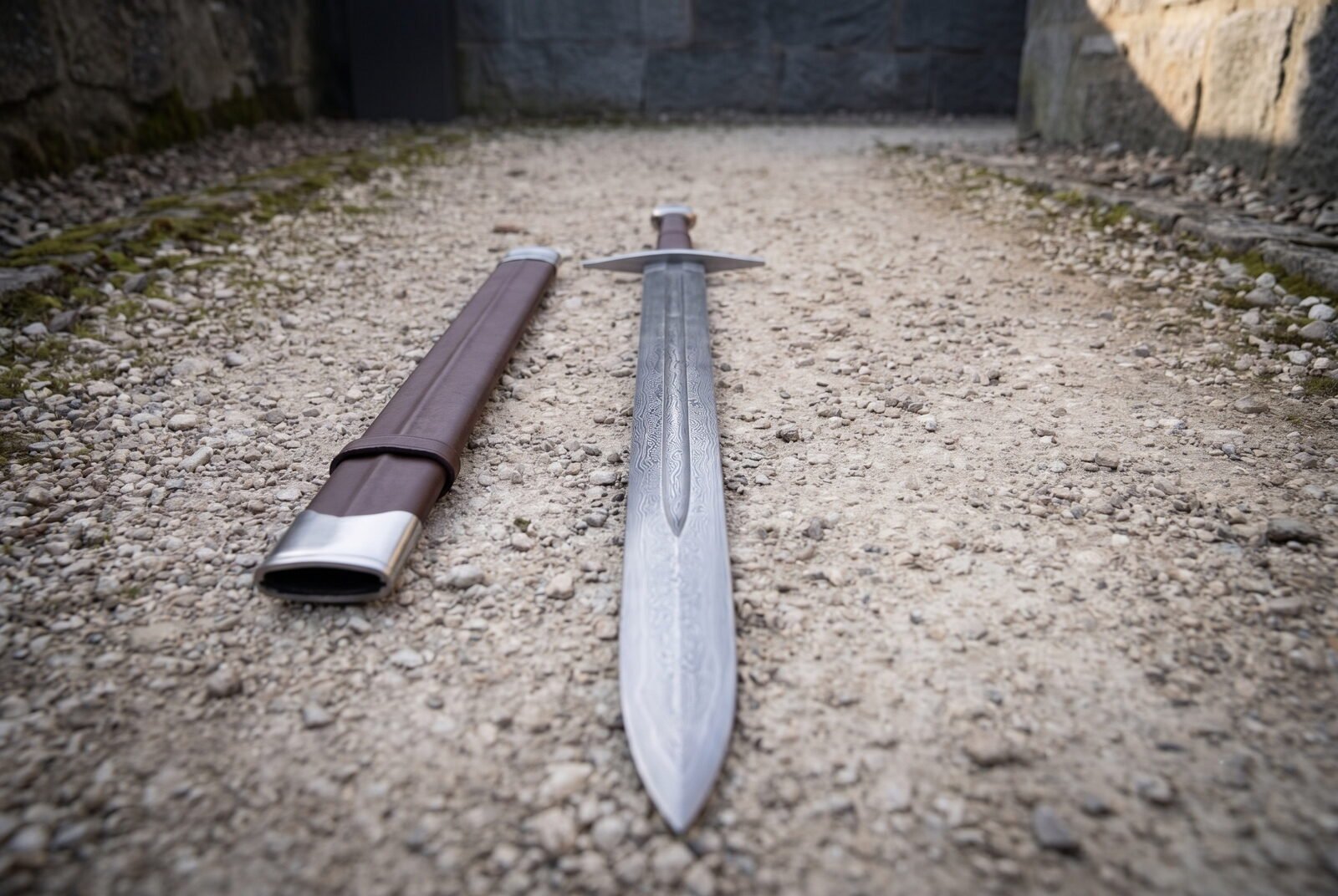
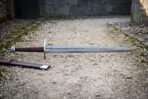
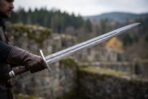
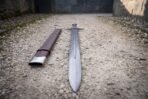
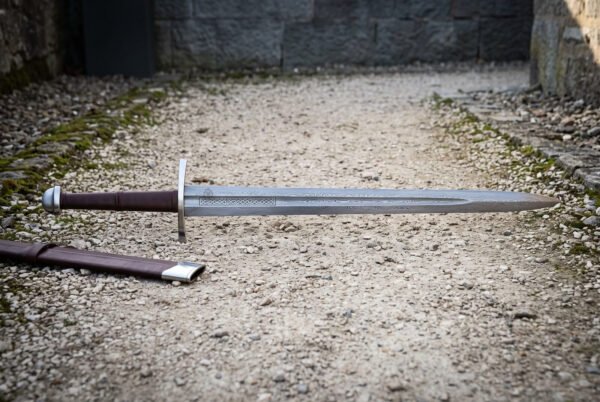
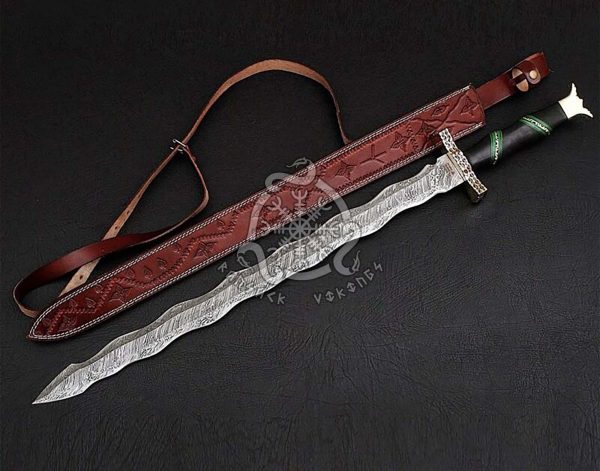
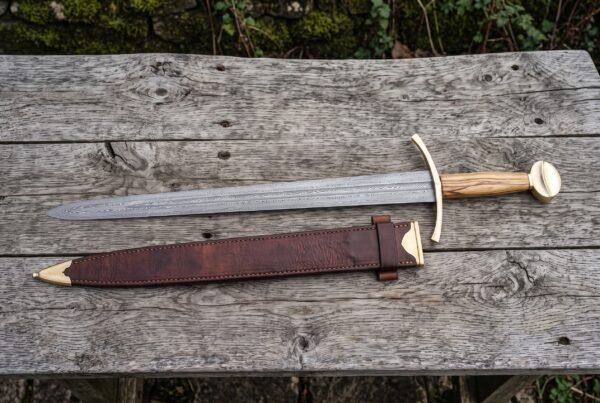
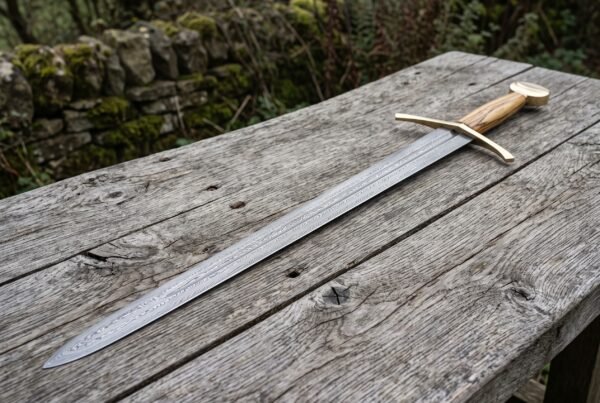
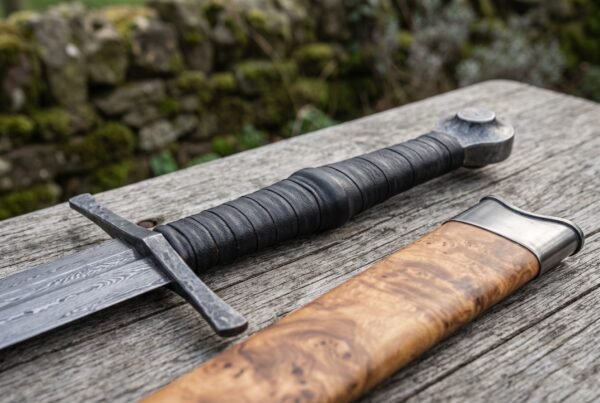
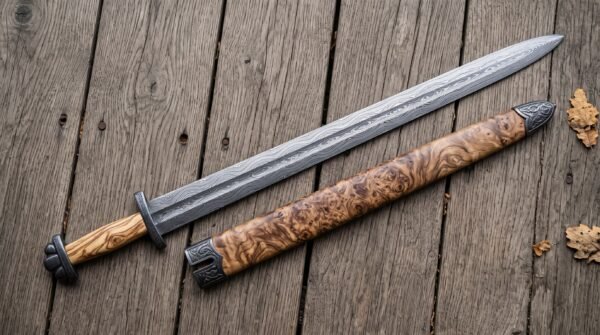
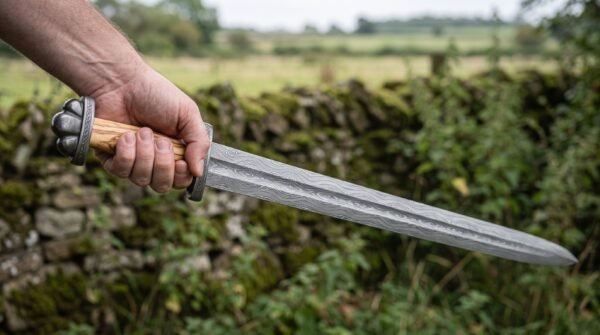
The Knotmere is a single handed arming sword with a pattern welded blade, a narrow fuller running most of its length and a band of etched interlace framed above the ricasso. The layers in the steel are real rather than printed, which is why the pattern changes as you turn the blade in the light and why it runs through the fuller instead of stopping at it. Under the etched knotwork panel sits a small roundel, and the whole flat carries the flowing lines that only come from folded and drawn stock.
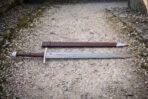
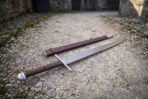
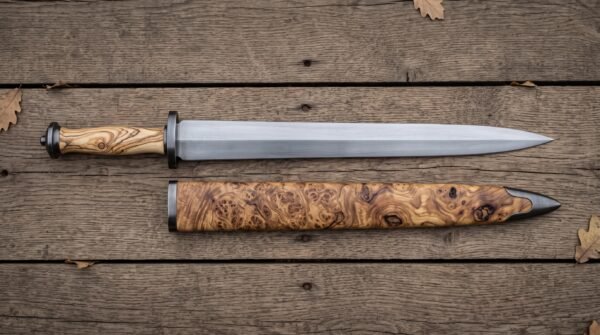
The pommel is the shape collectors call a brazil nut, a broad low lens with a slight ridge across the middle. It is one of the most firmly dated forms in European sword design, common through the eleventh and twelfth centuries and visible on the Bayeux Tapestry, and it exists because a wide flat counterweight balances a single handed blade without adding the bulk of a disc. The Knotmere is made by hand in the Czech Republic, imported and inspected by Ransack Viking, and shipped from our Chicago, Illinois warehouse. It comes with the fitted brown leather scabbard shown in the photographs.
A single handed sword of this class is the usual first purchase, and how to buy a first sword covers what matters. Interlace of this kind was the standard decorative language of the period, and the symbols guide covers the patterns that keep coming back. The medieval helmets are the obvious thing to hang beside it.
Specifications
| Type | Single handed arming sword, medieval knightly form |
|---|
| Blade | Pattern welded 1095 and 15N20 Damascus |
|---|
| Hardness | 58 to 60 HRC |
|---|
| Blade profile | Straight double edged blade with a narrow central fuller |
|---|
| Blade etching | Framed interlace knotwork panel and a small roundel above the ricasso |
|---|
| Guard | Polished steel crossguard, straight bar with a slight forward sweep |
|---|
| Grip | Brown leather over a shaped core with a raised riser band |
|---|
| Pommel | Polished steel brazil nut form with a peened tang button |
|---|
| Scabbard | Brown leather with a polished steel throat and steel chape |
|---|
| Finish | Etched Damascus blade, bright polished fittings |
|---|
| SKU | RK-2071 |
|---|
What a fuller actually does, and why it is not a blood groove
The long shallow channel down the centre of this blade is a fuller. It is the single most misunderstood feature on a sword, and the nickname blood groove is pure invention with no historical basis at all. A fuller is a stiffness and weight feature borrowed from the same engineering that gives you an I beam rather than a solid bar.
When a smith forges a fuller he is not cutting a channel out of the blade, he is moving steel. A fullering tool pushes material sideways from the centre towards the edges and lengthways down the blade. The result is a cross section with most of its mass concentrated at the spine ridges and the edges, which are the places that resist bending, and less mass in the middle, which contributes little to stiffness. You end up with a blade that is measurably lighter than a flat one of the same width and length while being just as resistant to flexing along its length.
That matters more than it sounds. A single handed sword lives or dies on how quickly it changes direction, and every ounce you remove from the middle of the blade is an ounce that is not fighting you at the end of a long lever. It also shifts the balance point back towards the hand. A fullered blade of this class feels alive in a way a flat bar of the same outline never does. On a pattern welded blade the fuller has a second effect, which is that grinding it exposes the layers at a different depth and the pattern inside the channel reads differently from the pattern on the flat.
The steel and the pattern
This blade is pattern welded from 1095 and 15N20, forge welded into a billet, drawn out, folded and drawn again before the blade is ground from it. The finished blade is hardened and tempered to 58 to 60 HRC.
The reason those two steels are paired is contrast. Both are hardenable carbon steels with almost identical working behaviour, so the billet moves as one piece under the hammer and hardens evenly through the whole cross section. The difference is that 15N20 carries around two percent nickel. Nickel resists the acid used to bring out the pattern, so when the finished blade is etched the 1095 layers darken and the 15N20 layers stay bright. What you see is the actual internal structure of the steel cut open by the grind, not a surface treatment. Sand this blade back and the pattern is still there all the way through.
At 58 to 60 HRC the edge holds well through cutting and takes a fine finish on a stone. Pattern welded carbon steel is not stainless and will rust if it is left damp, and the etched surface is slightly more open than a mirror polish, so it wants oiling a little more often than a plain blade would.
Engraving, runes and your own design
Use the rune converter on this page to turn a name, a date or a short phrase into Elder Futhark and we will cut it into the steel or the leather. If you would rather have a Viking pattern than a rune line, choose your own design in the engraving option above the add to cart button and tell us where it goes. Where a piece already carries an engraved design, your chosen engraving replaces it rather than sitting alongside it. On the Knotmere that means your rune line or pattern takes the place of the interlace panel above the ricasso. Engraving is done here in the United States after the piece arrives, so allow a little extra time. Everything is explained on the engraving page.
Handling and balance
An arming sword is a one handed sword, and everything about this build points that way. The grip is sized for a single hand with the riser band giving the fingers a reference point, and the brazil nut pommel sits behind the hand as a counterweight rather than as somewhere to put a second hand. Balance comes forward of the guard by a short distance, which is where a cutting sword of this family wants to be. Too far back and it feels dead in the cut, too far forward and it will not recover.
The straight crossguard is long enough to protect the hand and short enough not to catch. There is no fancy compound hilt here because there does not need to be. This is the form that served across most of medieval Europe for three hundred years, and it survived that long by being simple.
Treat this as a hand made collector and display sword with a real edge. It is not sold as a full contact sparring sword and should not be used for contact work against another blade or against hard targets.
Care
Wipe the blade after handling and keep a light film of oil on it. Etched pattern welded steel shows fingerprints quickly and will spot with rust if it is left in a damp room or stored wet in leather. Mineral oil, camellia oil or any dedicated blade oil is fine, applied thinly and wiped almost dry so the surface is not sticky.
Do not store the sword in the scabbard long term. Leather is tanned with substances that hold moisture and will encourage corrosion against bare steel over months. Feed the scabbard with a leather cream once or twice a year and let it dry naturally if it gets wet. The steel throat and chape polish up with the same cloth you use on the blade. More detail is in our steel care guide.
Damascus wants oil more than plain steel does, because the etch that shows the pattern also opens the surface, and caring for a Damascus pattern covers what to use.
Made in the Czech Republic
This sword is made by hand in the Czech Republic. Ransack Viking imports it, checks the blade, the guard seating, the pommel peen and the fit of the scabbard, and ships it from our Chicago, Illinois warehouse. Nothing goes out of here drop shipped from an importer catalogue without a person having looked at it. Shipping within the United States is free. Processing usually runs one to two weeks, and engraving adds to that. Returns are accepted within seven days. There is a genuine lifetime warranty against defects in forging, grind, heat treat and fittings, with no end date and no receipt needed.
A note on handmade variation
This sword is hand made rather than machine made or bulk produced, so what arrives will not be a pixel for pixel copy of the photograph. Pattern welded steel in particular is never twice the same: the layer count is fixed but the way the pattern flows across the flat depends on how that individual billet drew out under the hammer, so your blade will carry its own figure. The leather of the grip and scabbard will vary in grain and tone, and the etched panel will sit a fraction differently. The dimensions, the material and the build are the same every time. The character is not.
Frequently asked questions
Is the pattern in the steel or on the surface
In the steel. This blade is forge welded from alternating layers of 1095 and 15N20 and then etched, so the light and dark bands are the real layers exposed by the grind. It is not a print, a laser mark or an applied finish.
What is the difference between this and an arming sword in plain steel
Mostly the blade. A pattern welded blade takes far more forge work, which is why it costs more than the same sword in plain carbon steel. Both hold an edge well. Damascus is chosen for the figure in the steel rather than for a performance jump.
Can I hang this on a wall
Yes, and it displays well because the pattern reads from across a room. Hang it away from bathrooms, kitchens and exterior walls where condensation collects, and give it an oil wipe every few months if the room is at all damp.
Does the scabbard have a belt hanger
The scabbard is a fitted leather scabbard with a steel throat and chape. It is made to be worn on a separate sword belt or frog, or displayed alongside the blade, rather than having a loop built into the back.
Is the blade sharp
It arrives with a working edge. Handle it as a sharp sword from the moment it comes out of the box, and keep it out of reach of children.
Can I have runes cut into this one
Yes. Use the rune converter on this page for Elder Futhark, or choose your own design. Bear in mind that your engraving replaces the existing knotwork panel rather than being added beside it.
What is in the box
- Knotmere Damascus arming sword
- Fitted brown leather scabbard with steel throat and chape
- Light protective oil film on the blade
- Hand made in the Czech Republic, shipped from our Chicago, Illinois warehouse
Explore the range
More in arming swords, Damascus swords, swords and engraved and personalised pieces, or read the guides.
Other pieces in this group
In the same category sits the Brassfeather arming sword, 37 inches overall. A near match for this one is the Rootcrown arming sword, 37 inches overall. Closest to this in the range is the Wheelbraid arming sword, 36 inches overall.
Fitting out further, the Ravenmark Viking sword belongs with it. Nothing here exactly right, build one to your own spec on the custom Viking sword page.


Reviews
There are no reviews yet