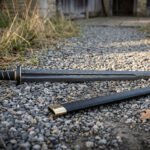
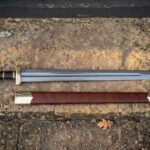
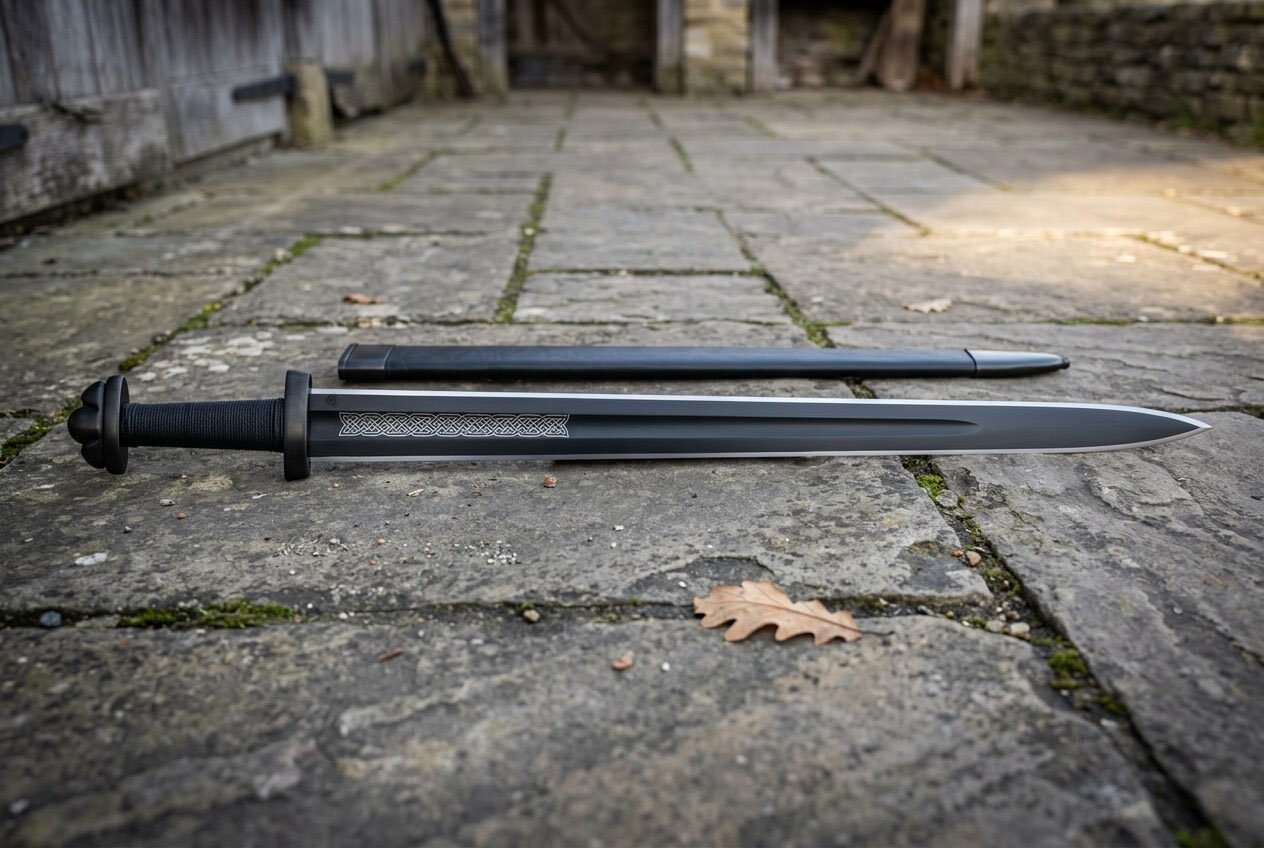
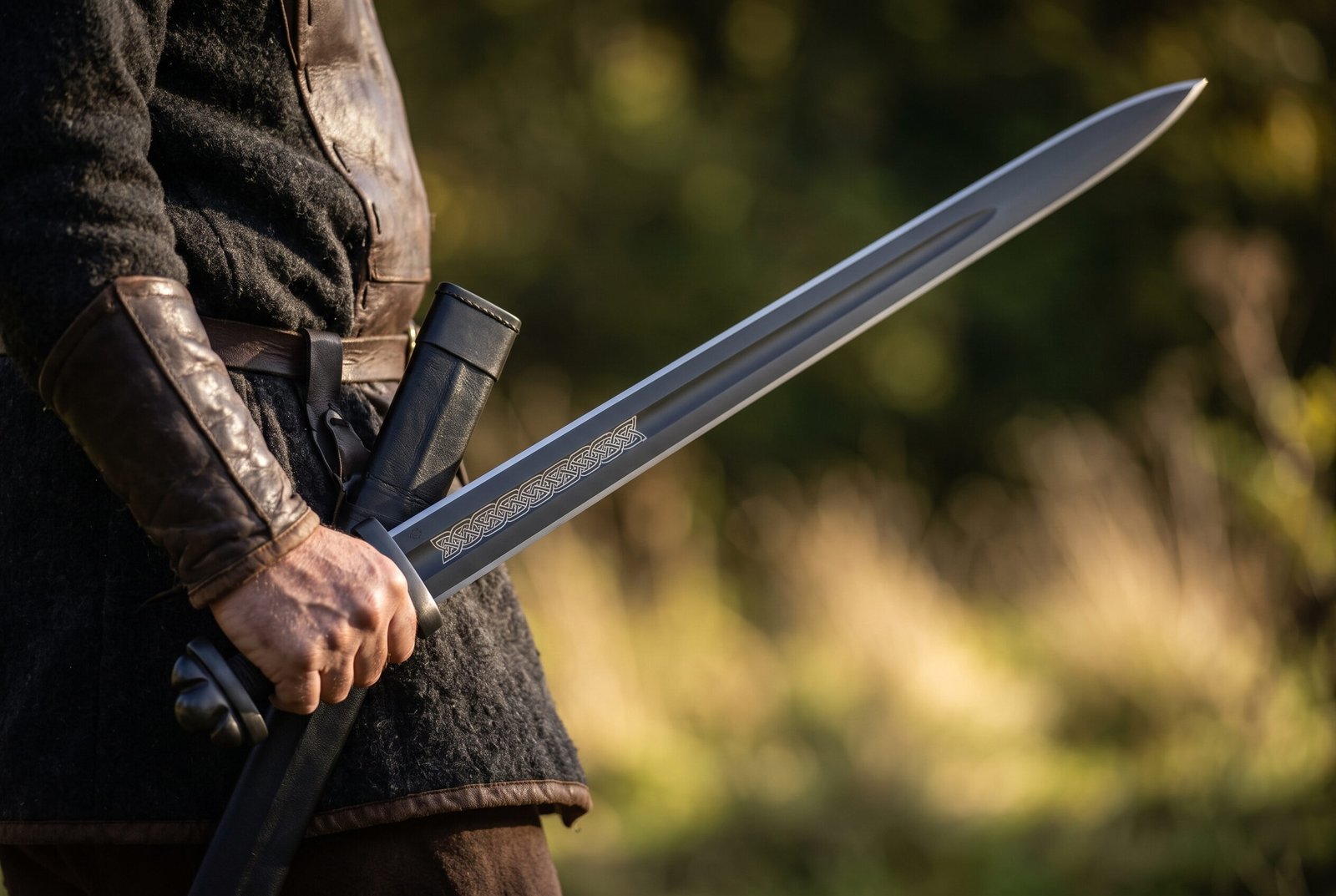
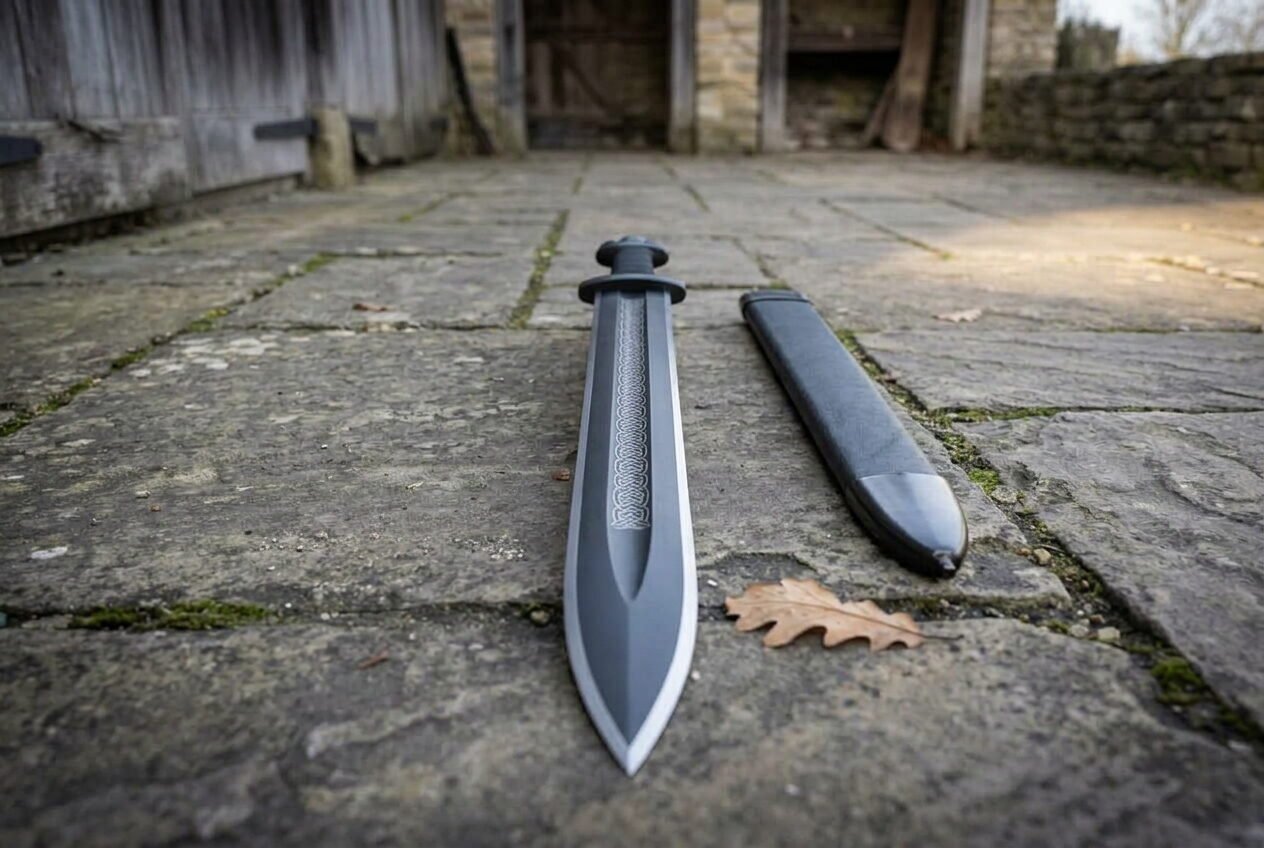
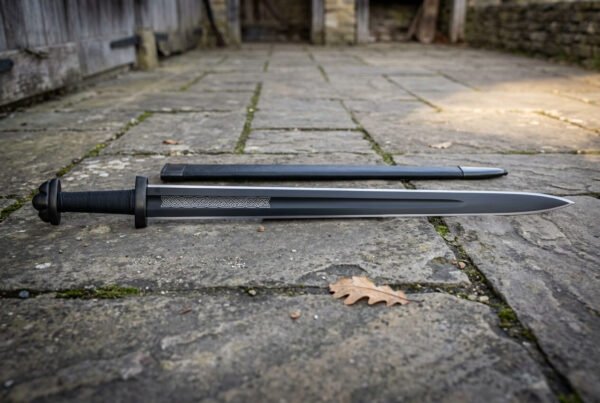
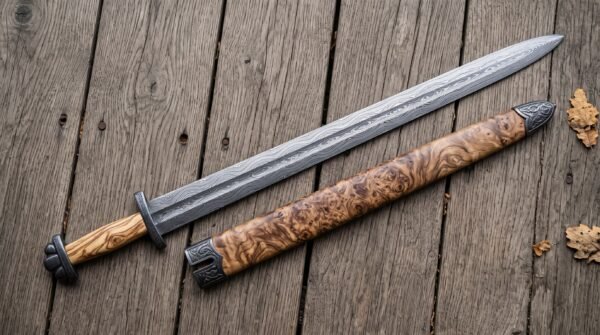
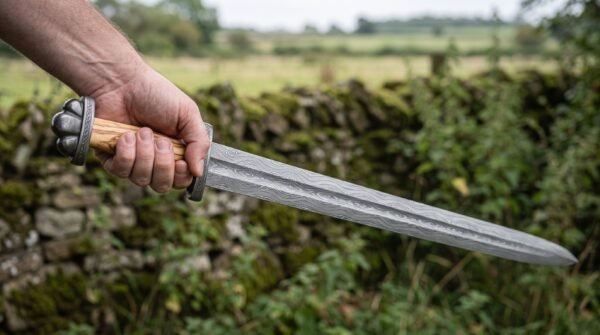
The Ravenmark is a blackened high carbon steel Viking sword, 36 inches overall with a 30 inch fullered blade carrying an etched knotwork panel just above the guard. Interlace is the oldest decoration in Norse metalwork. It runs across brooches, belt fittings, rune stones and sword hilts, a band that loops back on itself with no start and no end. On this sword a long knotwork panel sits low on the blade just above the guard, where the eye lands first. The panel is our own drawing rather than a copy of any museum piece. For oiling and keeping rust off carbon steel, read our steel care notes.
It is forged and finished by hand in the Czech Republic from 1095 high carbon steel, ground with a central fuller, hardened, tempered and given a black finish with bright bevels along both edges. The guard and lobed pommel are blackened to match, the tang is peened over the pommel, and the sword ships in a fitted black leather scabbard over a wooden core with a belt hanger, blade oil and a care card. Shipping inside the United States is free, and the engraving option above the add to cart button is open on every piece.
Specifications
| Steel | 1095 high carbon steel with a blackened finish |
|---|
| Hardness | 54 to 58 HRC |
|---|
| Overall length | 36 inches |
|---|
| Blade length | 30 inches |
|---|
| Blade width at guard | 2 inches, tapering to a point |
|---|
| Edges | Double edged with bright ground bevels |
|---|
| Fuller | Single central fuller |
|---|
| Blade marking | Etched knotwork panel above the guard, replaced by your own engraving if you order one |
|---|
| Grip | Black cord wrap over a wooden core |
|---|
| Guard | Blackened steel straight guard |
|---|
| Pommel | Blackened steel lobed pommel, peened tang |
|---|
| Scabbard | Black leather over a wooden core with a steel chape, belt hanger |
|---|
| Weight | Approximately 2 lb 13 oz |
|---|
| SKU | RK-1238 |
|---|
The knotwork panel
The knotwork is etched into the black face of the blade, low down above the guard, so it reads pale against the dark steel. It is our own drawing rather than a copy of any museum piece.
If you order a custom engraving on this sword, your work replaces the standard knotwork panel rather than joining it. There is only one blade face and two competing marks on it look like a mistake.
Why high carbon steel and not stainless
The blade is 1095 high carbon steel, hardened and tempered to 54 to 58 HRC, which keeps a long blade tough enough to flex and return rather than snap. Stainless in a sword this long tends toward brittle behaviour. The black finish helps against rust but does not stop it, so carbon steel still asks for a wipe and a film of oil. The comparison is set out on our Damascus versus stainless page.
The grip and the fittings
The grip is a shaped hardwood core, waisted so the hand indexes the edge alignment by feel, with cord risers bound under the wrap to give the fingers positive stops. Black cord is wrapped tight over it for a firm, non slip hold. The guard and lobed pommel are blackened steel, filed and fitted by hand to sit with the dark blade, and the tang is peened over the pommel button so the assembly is locked mechanically with no adhesive doing structural work.
There is hardwood under that cord, so treat the grip as wood. Keep it dry, keep it out of hot vehicles, wipe rather than wash and never dry it with heat. Our note on wooden handle care covers the same core and the same problems, and a light conditioner on the black leather scabbard once or twice a year keeps it from drying out and cracking.
Engraving, runes and your own design
Use the rune converter on this page to turn a name, a date or a short phrase into Elder Futhark and we will cut it into the steel or the handle. If you would rather have a Viking pattern than a rune line, choose your own design in the engraving option above the add to cart button and tell us whether it goes on the blade or the handle. Where a piece already carries an engraved design, your chosen engraving replaces it rather than sitting alongside it. That applies directly to this sword, which ships with an etched knotwork panel as standard. Order your own rune line or pattern for the blade and it takes the place of the standard marking. Order it on the handle instead and the blade knotwork stays. The engraving page shows the placements and how long a line will fit at this size.
Care and sharpening
A blackened blade still needs oil, because the finish is thin and carbon steel underneath will hold the moisture and salt from a fingerprint. Wipe it every time you handle it and keep a light film on. Do not store the sword inside its scabbard for months, since leather holds damp and tanning residue that will pit steel over a season. Keep it on a rack with the scabbard alongside. Our steel care guide covers storage and early rust.
Sharpening is standard high carbon technique over a longer edge. Work in overlapping sections along a coarse stone and then a fine one at a steady angle, and finish on a strop. Keep the flat of the blade off the abrasive, because a blackened face dragged across a stone comes back with a bright streak through the finish and the knotwork. The angle control in our guide to sharpening with a whetstone transfers directly.
Made in the Czech Republic
The work behind this piece happens in a Czech Republic workshop that has kept to the old methods. Steel is forged and heat treated by hand, the grind is taken down by eye rather than by machine, and the handle, fittings and sheath are cut and finished one at a time. Because of that, every piece carries small marks of the hand that made it.
Ransack Viking is a United States company. We import direct, check each piece when it reaches us, and ship from our Chicago, Illinois warehouse. Engraving is added here in the United States after arrival, so the piece you receive is finished to your order.
A note on handmade variation
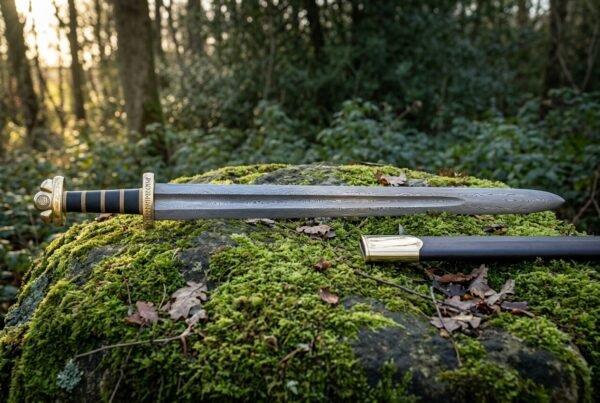
This sword is hand forged. It is not machine made and it is not bulk produced, so what arrives will not be a pixel for pixel copy of the photograph on this page. Small differences in the grind, the depth of the etch and the tone of the black finish vary from one sword to the next because every stage is worked by hand. What stays fixed is the specification: the steel, the heat treatment, the dimensions, the construction and the finish standard are the same every time.
Frequently asked questions
What is the design etched on the blade?
It is a Norse knotwork panel of our own drawing rather than a copy of any specific museum sword, and we do not present it as a historical reproduction. If you want a particular phrase, name or date instead, order the engraving option and your text replaces the standard knotwork panel.
Is the sword functional?
Yes. It is 1095 high carbon steel through hardened to 54 to 58 HRC with a peened full tang and will handle target cutting on bottles, mats and pool noodles. It is not for contact sparring, steel on steel, or throwing.
Can I have the knotwork removed and my own runes put on instead?
Yes, that is exactly how the engraving option works on this piece. Use the rune converter on this page for Elder Futhark, select the engraving option above the add to cart button, and tell us the blade is the placement. Your line goes on in place of the standard knotwork panel.
Will the knotwork look like the photograph?
Yes. The knotwork is laid out the same way on every sword. Small differences in the black finish and the grind come from hand work, and the photograph is an accurate guide to the model rather than a picture of the individual sword.
How long does shipping take?
Free inside the United States with tracking. In stock pieces leave within two business days. Allow three to four weeks of bench time for a sword of this length, plus a few days more for custom engraving.
What is in the box
- One Ravenmark blackened Viking sword, 36 inches overall with a 30 inch blade
- Fitted black leather scabbard over a wooden core with a steel chape
- Leather belt hanger with buckle
- Blade oil and a lint free cloth for first storage
- Care card for blackened high carbon steel
- Forged and finished in the Czech Republic
Explore the range
See the rest of the Damascus swords, the full Viking swords range, our engraved and personalised pieces and the wider swords collection. Etching, steel and care are covered in the guides.
Compare it with these
Also in this group is the Knotdrift Viking sword, pattern welded Damascus. Sitting beside it in the catalogue is the Valkbraid Viking sword, pattern welded Damascus. Another in the same line is the Trinefold Viking sword, pattern welded Damascus.
For a different piece from the same family, look at the Stonerune broadsword. Pick the steel, the length and the fittings yourself on the custom Viking sword page.

Reviews
There are no reviews yet