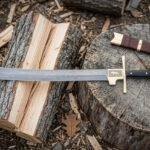
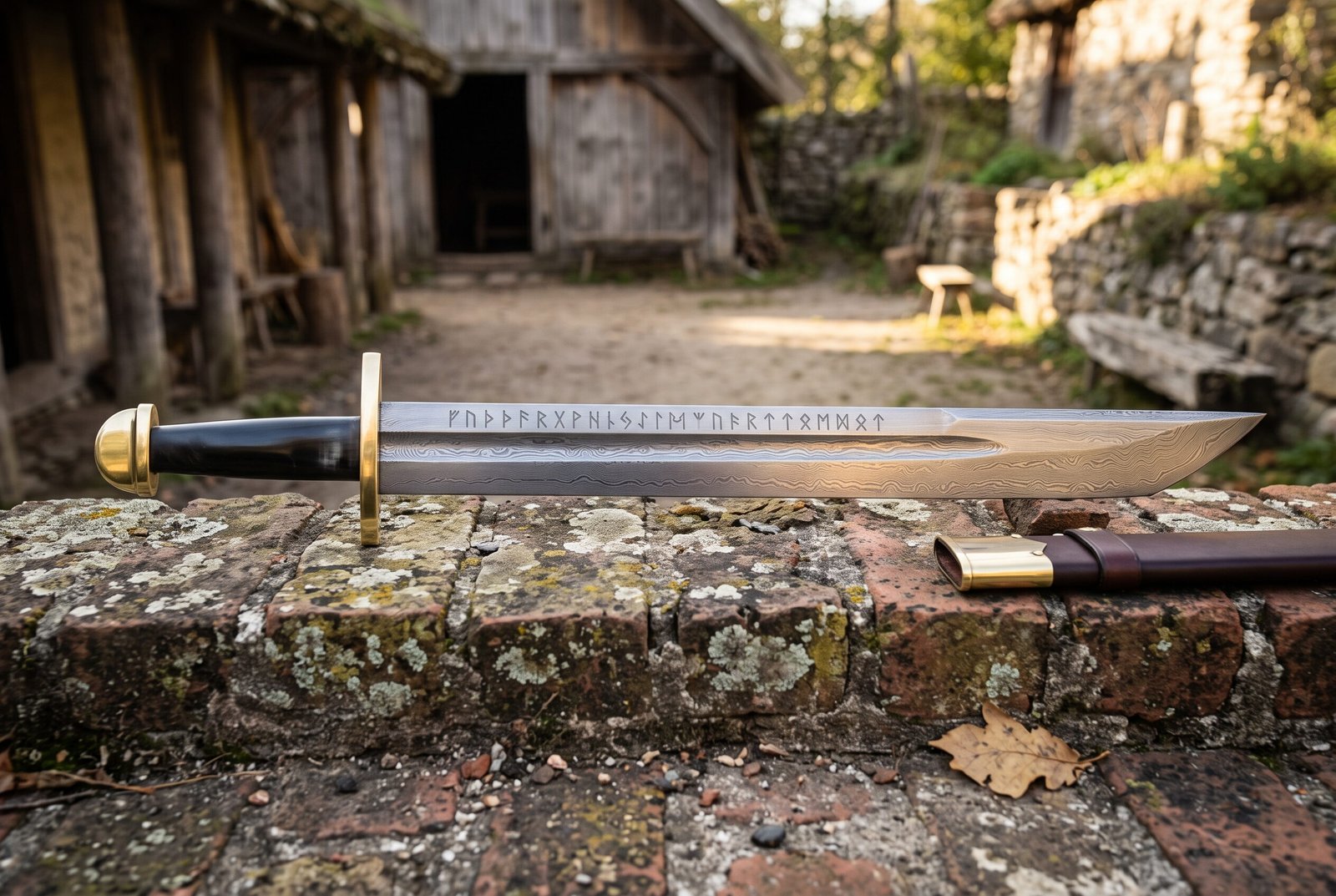
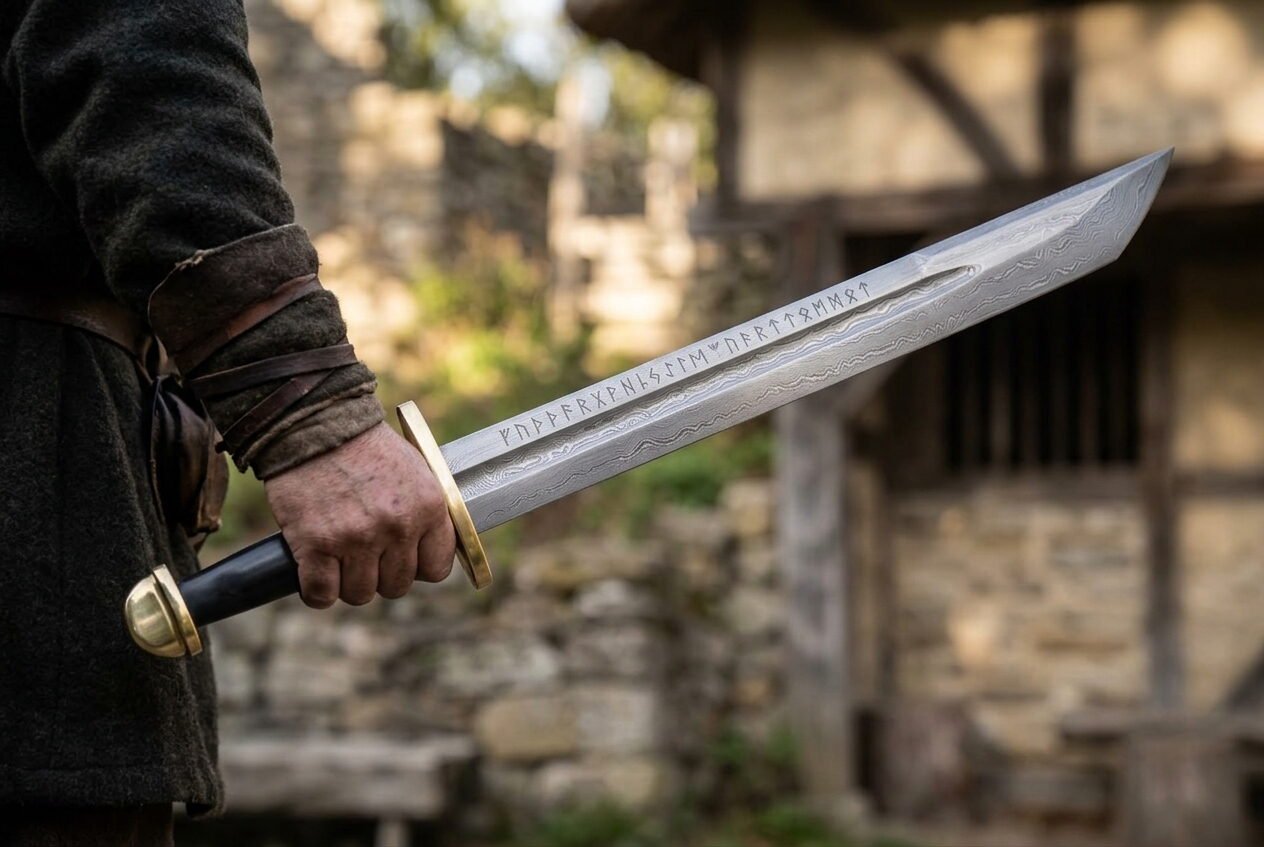
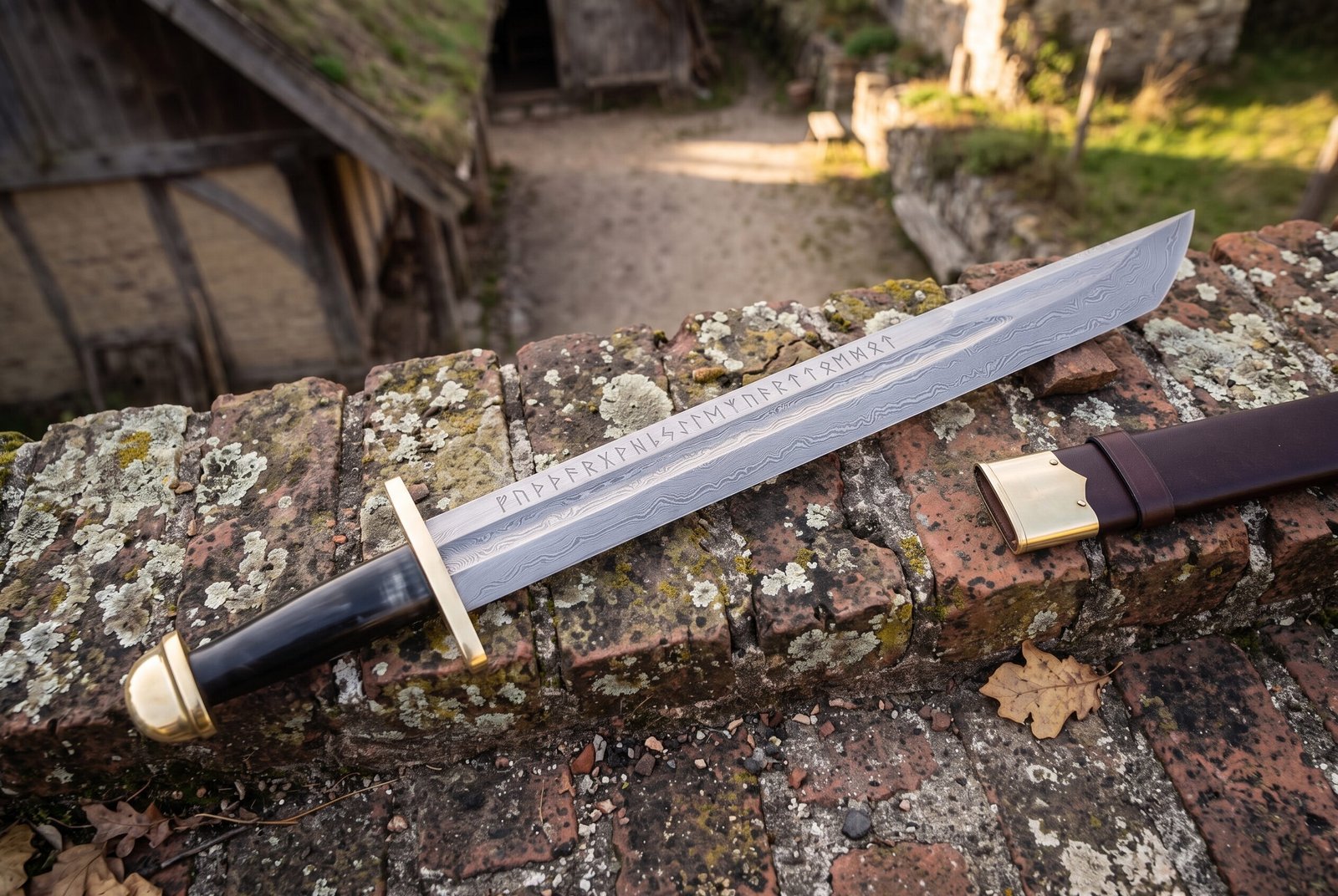
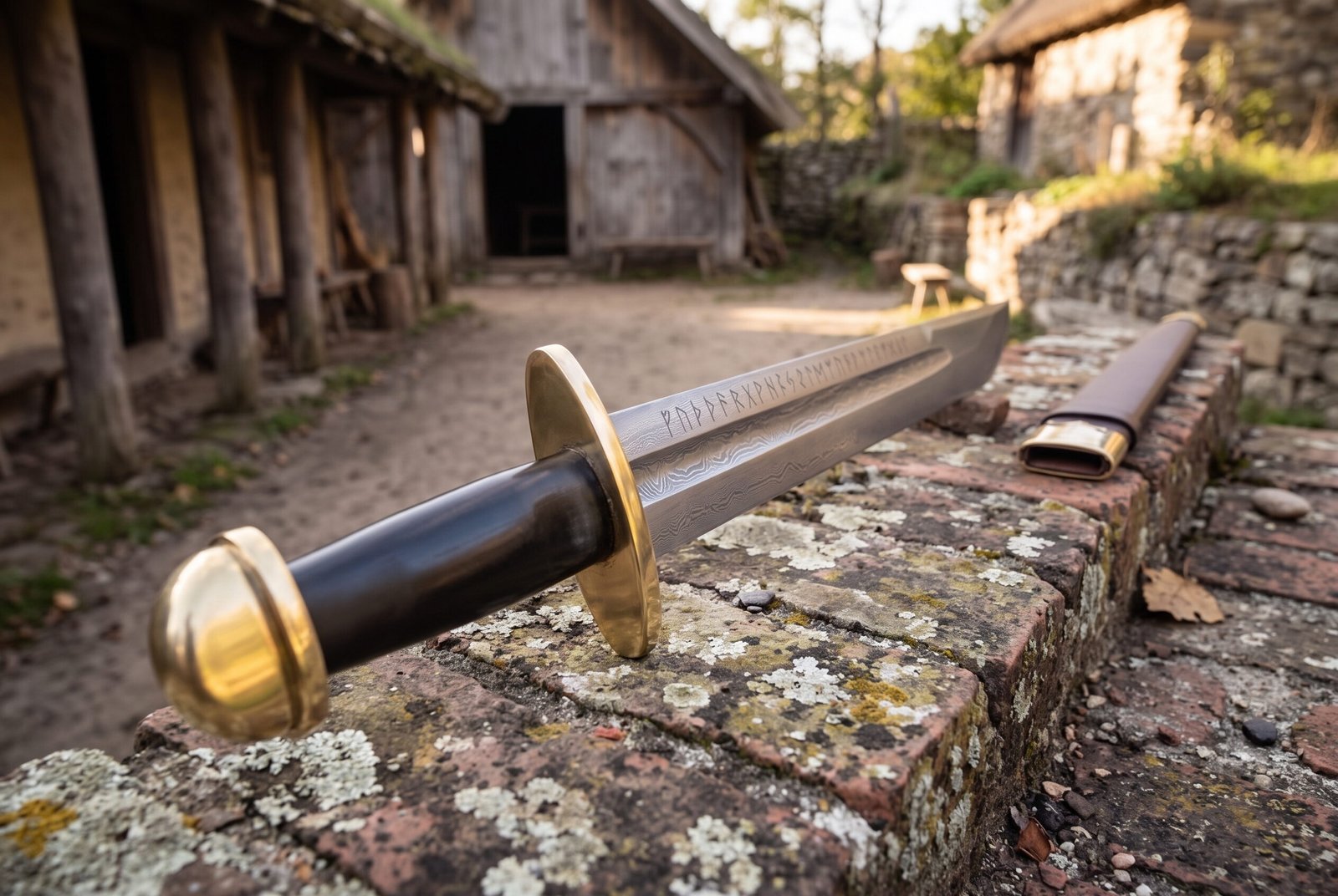
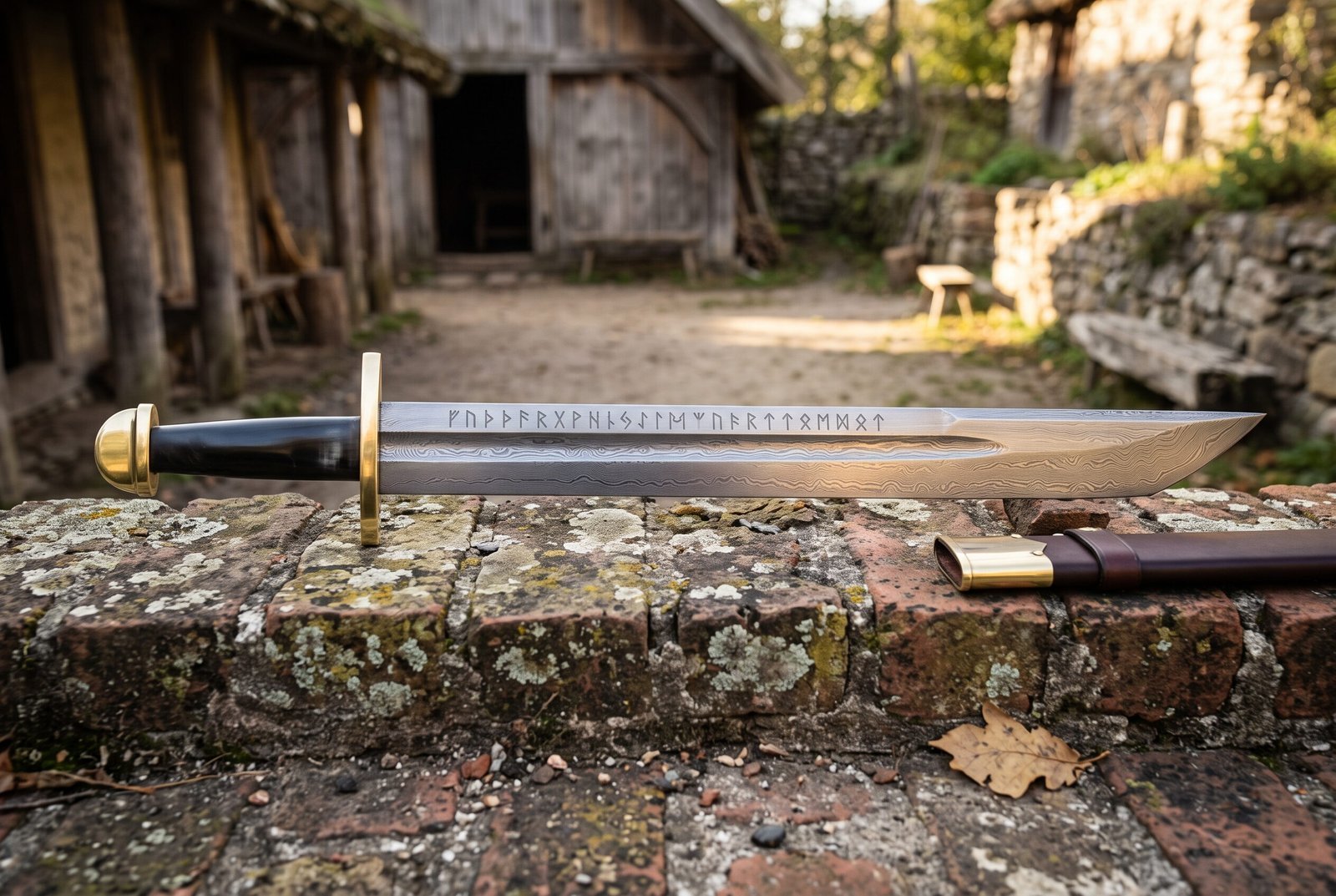
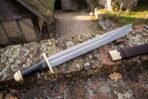
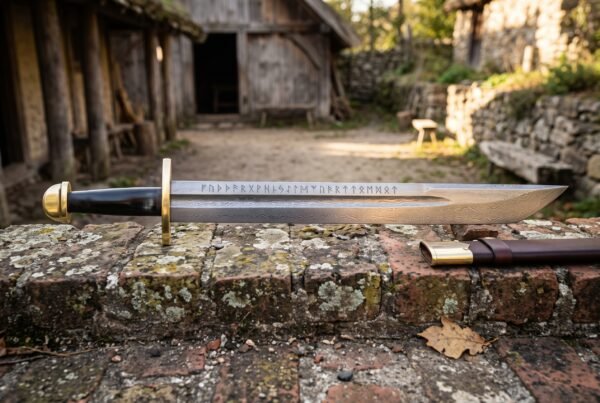
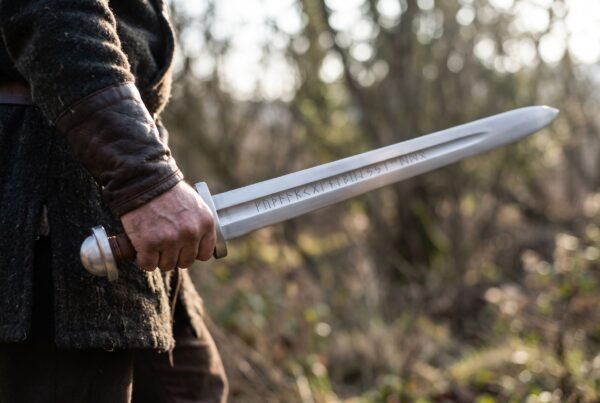
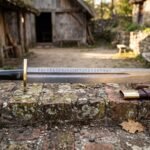
Inscribed blades are older than the Vikings and outlived them by centuries. Migration period smiths cut owner marks into spearheads, ninth century Frankish workshops stamped ULFBERHT down the fuller of their best swords, and Anglo Saxon seaxes carried whole runic alphabets along the spine. The Thames scramasax in the British Museum is the famous example, with a complete Anglo Saxon futhorc inlaid in copper and brass. This falchion belongs to that tradition. The Elder Futhark line runs along the upper flat of the blade, deep enough to read across a room and cut before the final polish so the letters sit into the steel rather than on top of it. If you are choosing runes for it, the Elder Futhark lists every character with its name and sound.
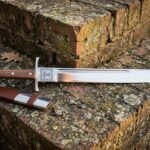
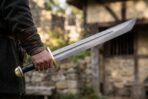
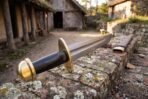
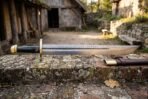
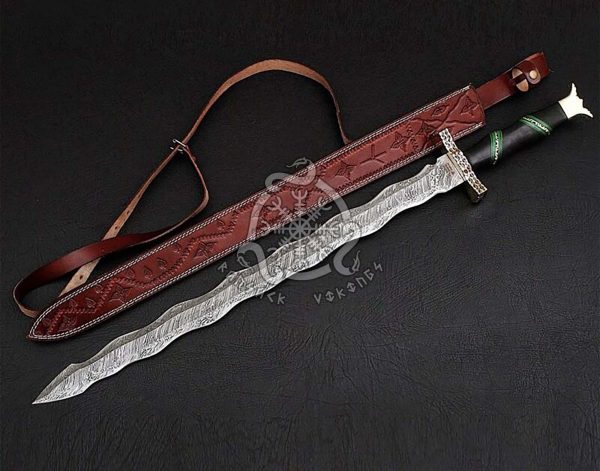
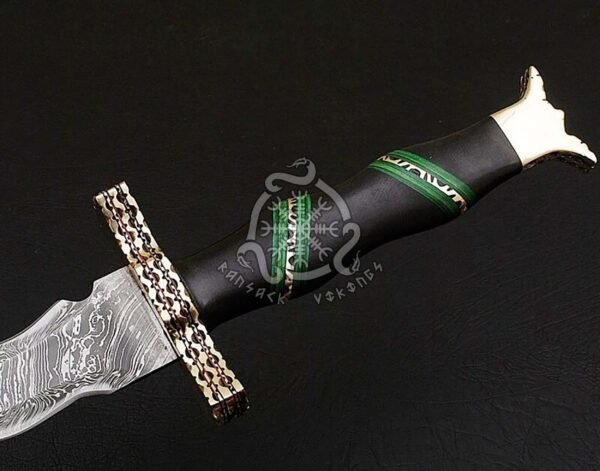
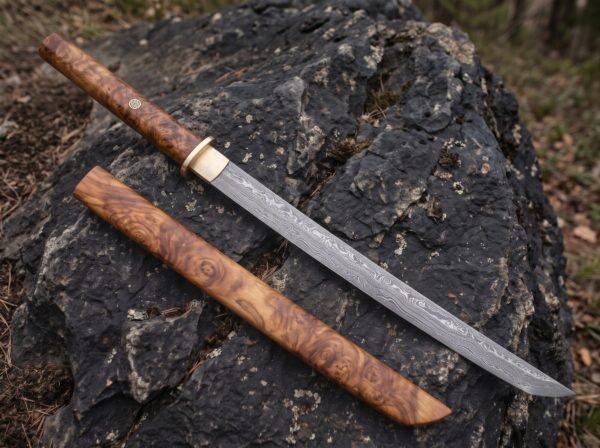
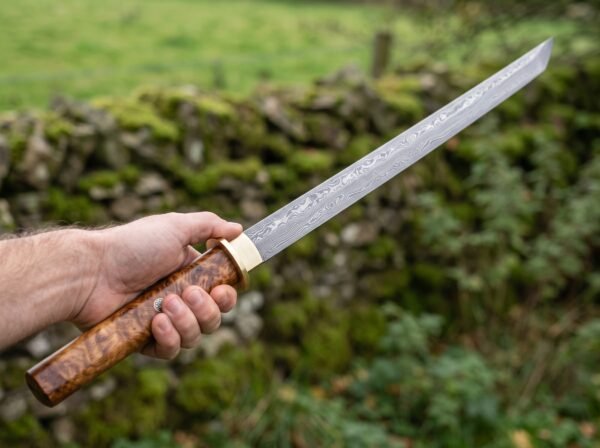
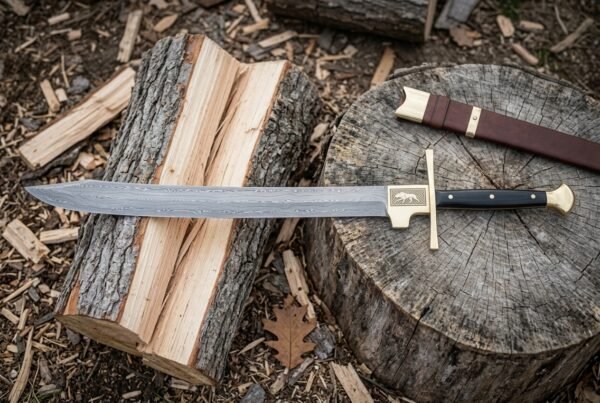
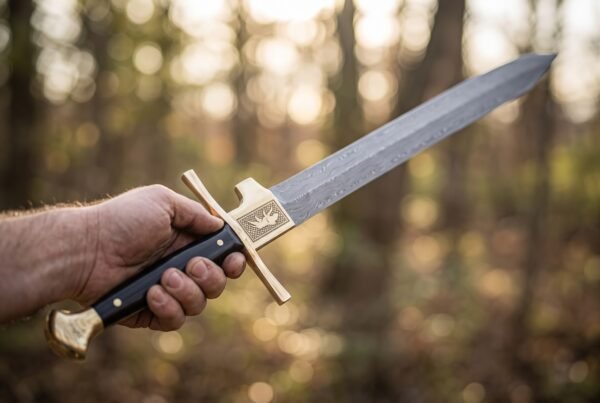
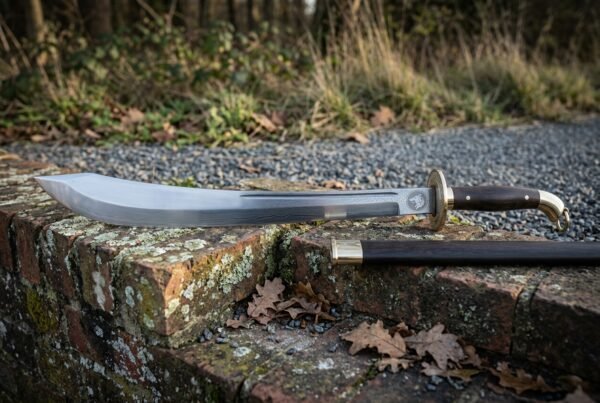
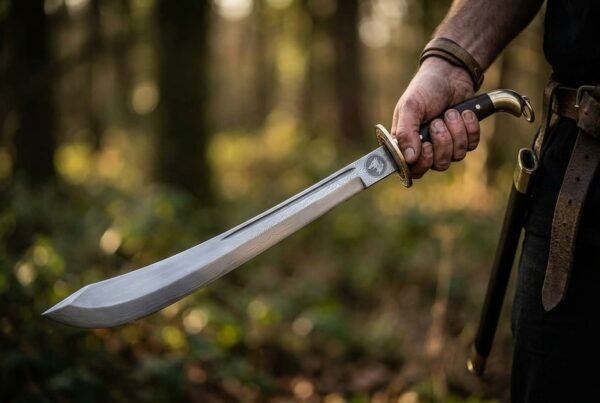
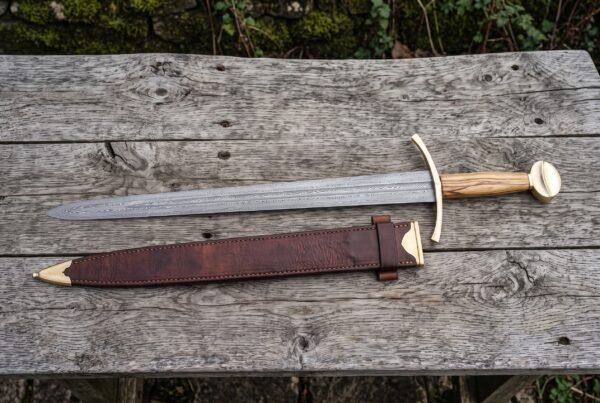
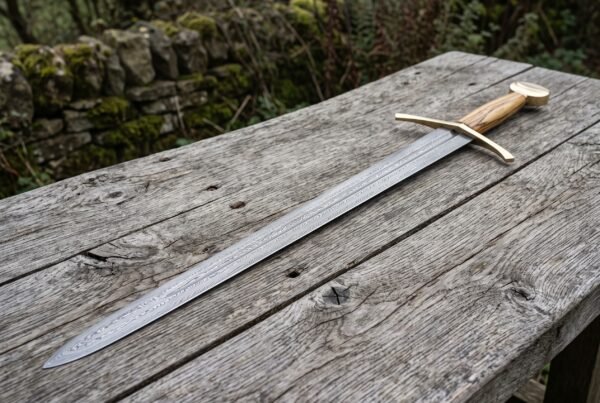
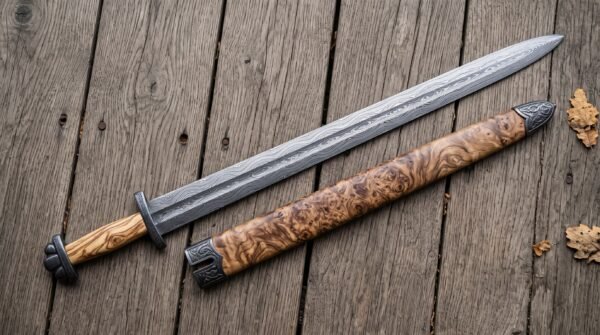
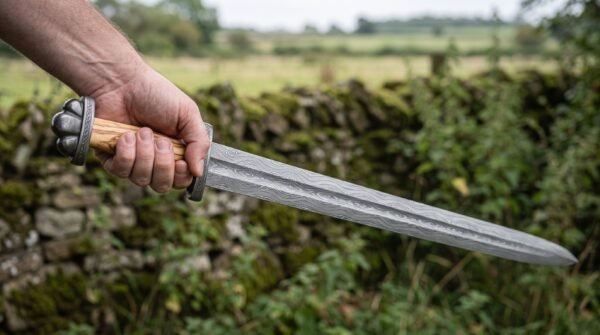
The blade underneath the inscription is forge welded 1095 and 15N20 Damascus, hardened to 58 to 60 HRC, with the pattern etched up so the layers read as light and dark bands. Everything is made by hand in the Czech Republic. The hilt is gilt brass with a dark grip, and the sword ships in a dark brown leather scabbard. Shipping inside the United States is free.
Specifications
| Steel | 1095 and 15N20 forge welded Damascus |
|---|
| Hardness | 58 to 60 HRC |
|---|
| Overall length | 29 inches |
|---|
| Blade length | 23 inches |
|---|
| Blade width | 2 inches at the widest point |
|---|
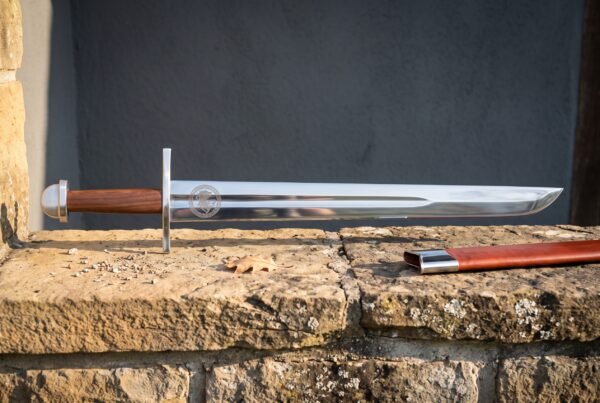
| Blade | Straight single edged blade with an angled clipped point |
|---|
| Blade engraving | Elder Futhark rune line along the upper flat |
|---|
| Guard | Gilt brass oval plate guard |
|---|
| Grip | Dark hardwood, black finish, 6 inches |
|---|
| Pommel | Gilt brass domed cap pommel |
|---|
| Scabbard | Dark brown leather with a brass throat |
|---|
| Weight | Approximately 2 pounds 5 ounces |
|---|
| SKU | RK-1293 |
|---|
How a rune line is cut and why placement matters
Elder Futhark has twenty four characters, all of them built from straight strokes. That is not decoration, it is engineering. The alphabet was designed to be carved across the grain of wood and cut into metal with a chisel, so it contains no curves that would follow a grain line and split the material. The same property makes it read cleanly when it is cut into a blade flat, which is why runic inscriptions on steel stay legible after a thousand years while cursive scripts blur.
On a falchion the inscription goes on the upper flat, close to the spine. That is the part of the blade that flexes least and takes the least contact, so the cut lines do not become stress risers and they are not scrubbed away by use. It is also the part a viewer sees first when the sword is on a wall rack with the edge down. On this piece the runes are cut before the final etch so the pattern of the Damascus runs through and around the letters rather than being interrupted by them.
Why a falchion carries an inscription so well
Broad single edged blades give you room. A slim double edged sword has a narrow flat and usually a fuller taking up most of it, which leaves very little space for lettering at a size anyone can read. A falchion is wide from the guard forward, and because it is sharpened on one side only, the spine side stays thick and flat. That flat is a natural panel. Medieval Malchus and long knife blades often carry maker marks, crosses and running wolf stamps in exactly this position for the same reason.
Why Damascus and not stainless
Only two steels come through this forge. Plain blades are 1095 high carbon steel at 54 to 58 HRC. Damascus blades are 1095 and 15N20 forge welded and taken to 58 to 60 HRC.
The 15N20 in the mix carries nickel, which resists the acid etch and stays bright while the 1095 goes dark, producing the banding you can see on this blade. It also toughens the billet, which is what lets us run the hardness a little higher than on our plain pieces without making the sword fragile. Stainless steel cannot be used here for three separate reasons. Its chromium content blocks a clean forge weld, it refuses to etch into contrast, and in a blade this long the chromium carbides make the steel brittle. The trade for choosing carbon steel is that it rusts if you neglect it. Our note on Damascus versus stainless goes through the chemistry.
The hardwood grip and gilt brass hilt
The grip is dark hardwood, oval in section and hand fitted between a gilt brass cross guard and a gilt brass pommel. Gilding was chosen to match the warm tone of the etched Damascus and to pick up the rune line, which reads as bright metal against the darker flat. The tang runs the full length of the grip and is peened over the pommel cap.
Give the wood a thin coat of oil once or twice a year and keep it away from radiators and direct sun. Our wooden handle care guide covers what to use.
Engraving, runes and your own design
Use the rune converter on this page to turn a name, a date or a short phrase into Elder Futhark and we will cut it into the steel or the handle. If you would rather have a Viking pattern than a rune line, choose your own design in the engraving option above the add to cart button and tell us whether it goes on the blade or the handle. Where a piece already carries an engraved design, your chosen engraving replaces it rather than sitting alongside it. That applies directly here, because this falchion already carries a rune line from the workshop. If you order your own inscription, yours takes its place. Details and character limits are on the engraving page.
Care and sharpening
Wipe the blade with an oiled cloth after handling and keep it lightly oiled in storage. Do not use abrasive polish, wire wool or a rust eraser on the flats, because that will lift the etch and dull the contrast, and it will also soften the crisp edges of the cut runes. Light spotting comes off with oil and a soft cloth. Our steel care page explains the safe method.
The edge is on one side and runs straight to the point, so freehand sharpening is easy. Follow the bevel you already have on a medium stone, refine on a fine stone, then remove the burr with a few passes on the back. The inscription is nowhere near the edge, so sharpening will never touch it. See sharpening with a whetstone.
Made in the Czech Republic
The work behind this piece happens in a Czech Republic workshop that has kept to the old methods. Steel is forged and heat treated by hand, the grind is taken down by eye rather than by machine, and the handle, fittings and sheath are cut and finished one at a time. Because of that, every piece carries small marks of the hand that made it.
Ransack Viking is a United States company. We import direct, check each piece when it reaches us, and ship from our Chicago, Illinois warehouse. Engraving is added here in the United States after arrival, so the piece you receive is finished to your order.
A note on handmade variation
This falchion is hand forged, not machine made and not bulk produced, so what arrives will not be a pixel for pixel copy of the photograph. The Damascus figure is different in every billet, the depth and spacing of the cut runes vary slightly because they are done by hand, and the wood grain and gilding tone will be their own. Dimensions, steel, hardness and build are the same every time. The character is not.
Frequently asked questions
What do the runes on the blade say?
The stock inscription is an Elder Futhark line cut in the workshop. If you want a specific word, name or date instead, use the rune converter on this page and your text will replace it.
Is the sword sharp and can it be used for cutting?
Yes. It arrives with a cutting edge and it is built as a functional sword, full tang and peened, so it will cut tatami, bottles and light green wood. It is not made for steel to steel sparring.
Will sharpening damage the engraving?
No. The rune line sits high on the flat near the spine, several inches from the edge bevel, so normal sharpening never reaches it.
Will my blade look like the photograph?
The lettering style, layout and blade shape will match. The Damascus pattern will be unique to your billet, because no two folds come out the same.
What is the difference between this and the plain Damascus falchion?
Both are forge welded 1095 and 15N20 at the same hardness. This one carries a cut Elder Futhark inscription along the flat and a dark brown scabbard, and it costs a little more because the engraving is a separate hand operation before the final etch.
How long does delivery take?
Shipping is free inside the United States and stock pieces arrive five to seven business days after dispatch. A Damascus blade with engraving takes three to four weeks before it ships.
What is in the box
- One hand forged 1095 and 15N20 Damascus falchion with a cut Elder Futhark rune line, 29 inches overall
- One dark brown leather scabbard
- Card giving the transliteration of the rune line supplied
- Care card written for etched Damascus
- Forged and finished in the Czech Republic
Explore the range
See the other Damascus swords, the falchions, the engraved and personalised pieces and the full sword range, or read the guides.
If this one is not it
In the same category sits the Staveholm Viking sword, 35 inches overall. A near match for this one is the Trineholt arming sword, 36 inches overall. Closest to this in the range is the Awehelm arming sword, 35 inches overall.
Fitting out further, the Brambleguard Damascus sword belongs with it. Pick the steel, the length and the fittings yourself on the custom Viking sword page.
If sparring is on your mind, the Molgarth langes messer is made for that job, and our HEMA messer range is a useful next stop.

Reviews
There are no reviews yet