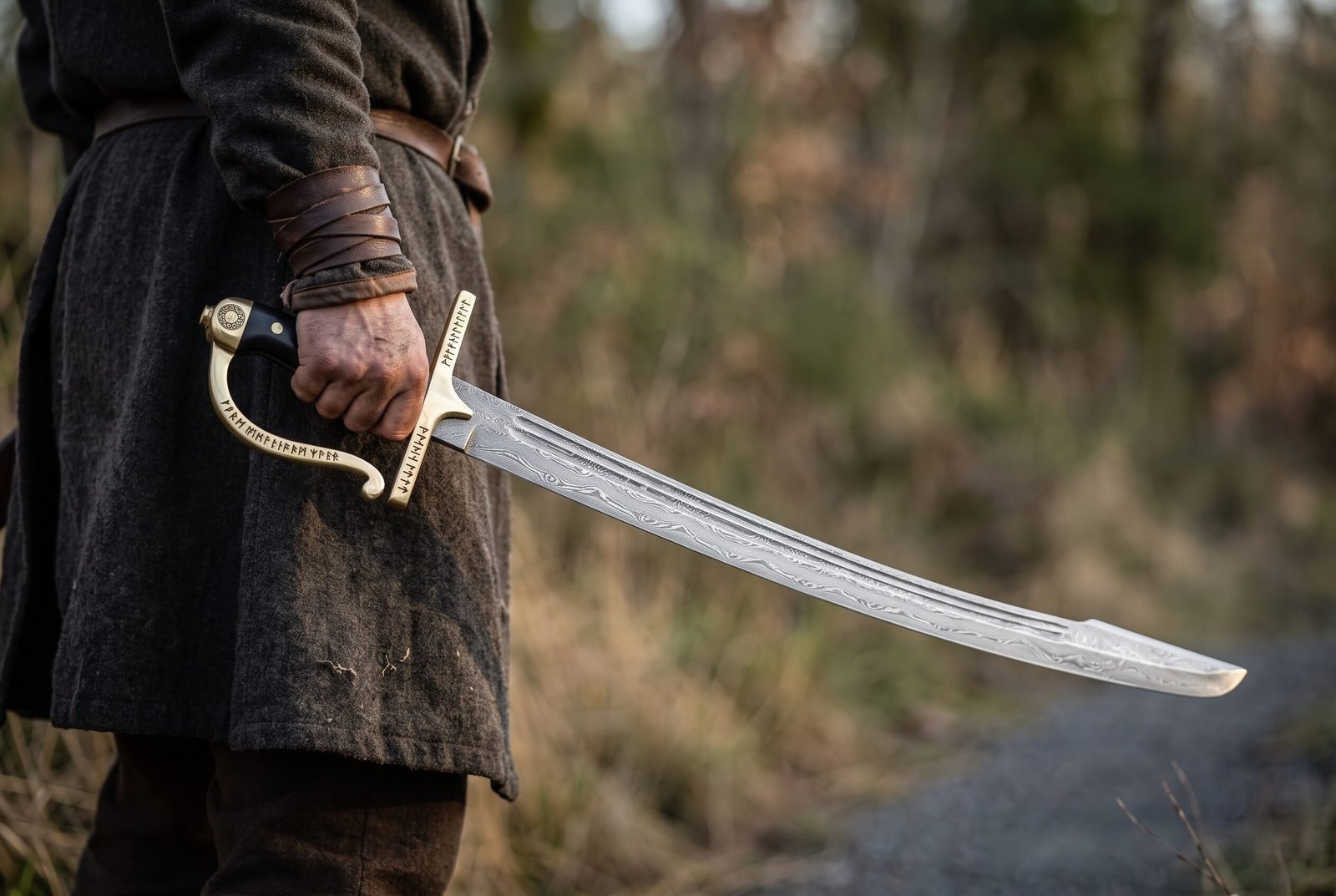
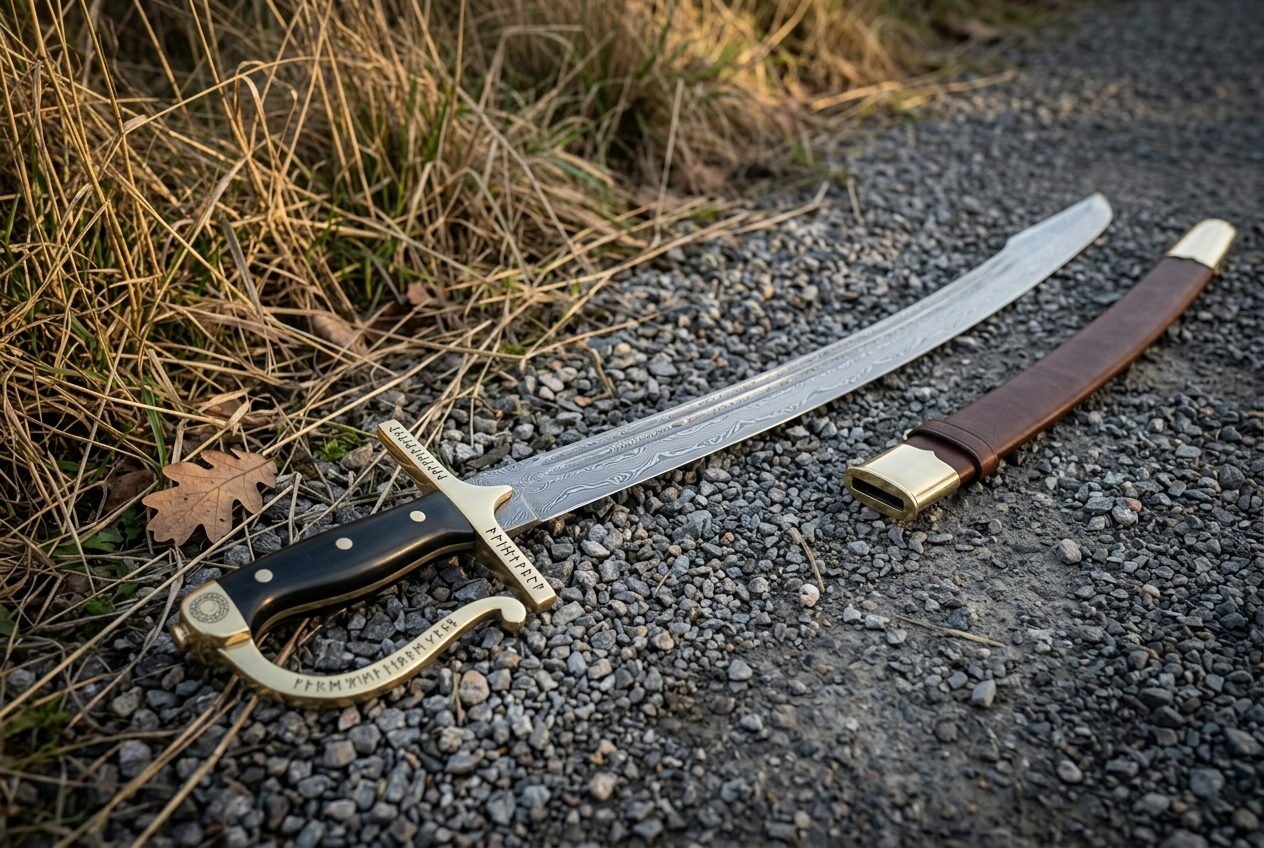
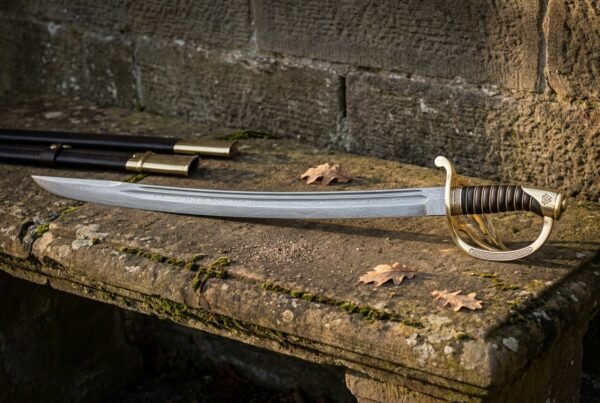
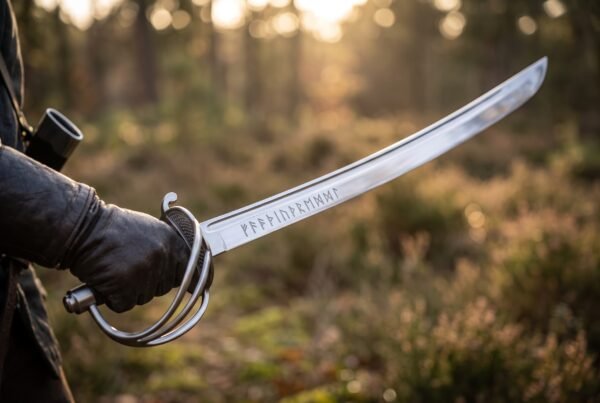
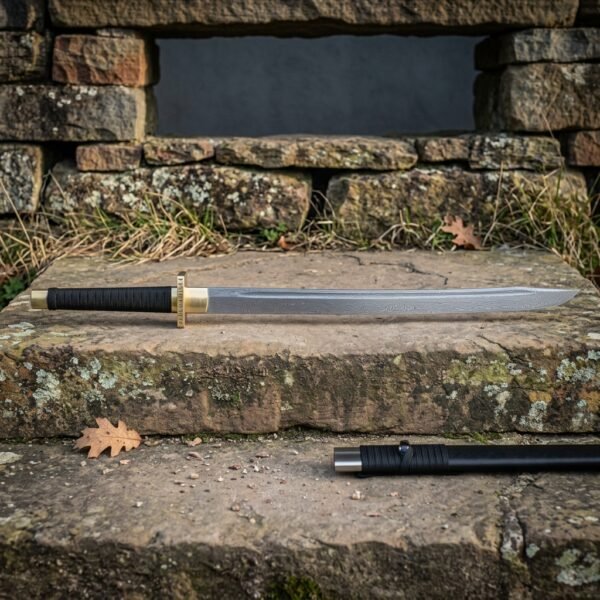
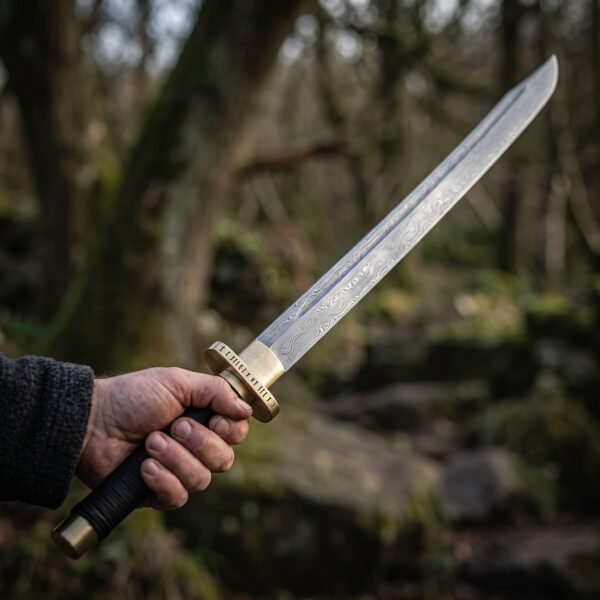
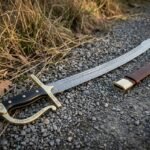
Look at the last third of this blade and you will see it get wider rather than narrower before it reaches the point. That widening is called a yelman, and it is one of the cleverest pieces of engineering on any sword. A cutting blade delivers most of its work through a single spot along its length, the centre of percussion, and if you put extra mass at that spot the cut lands harder without the whole sword becoming heavier to hold. Turkic and Persian smiths worked this out centuries before anyone could write down the physics, and the eastern European sabres that borrowed the shape kept it. A szabla with a yelman cuts noticeably above its weight.
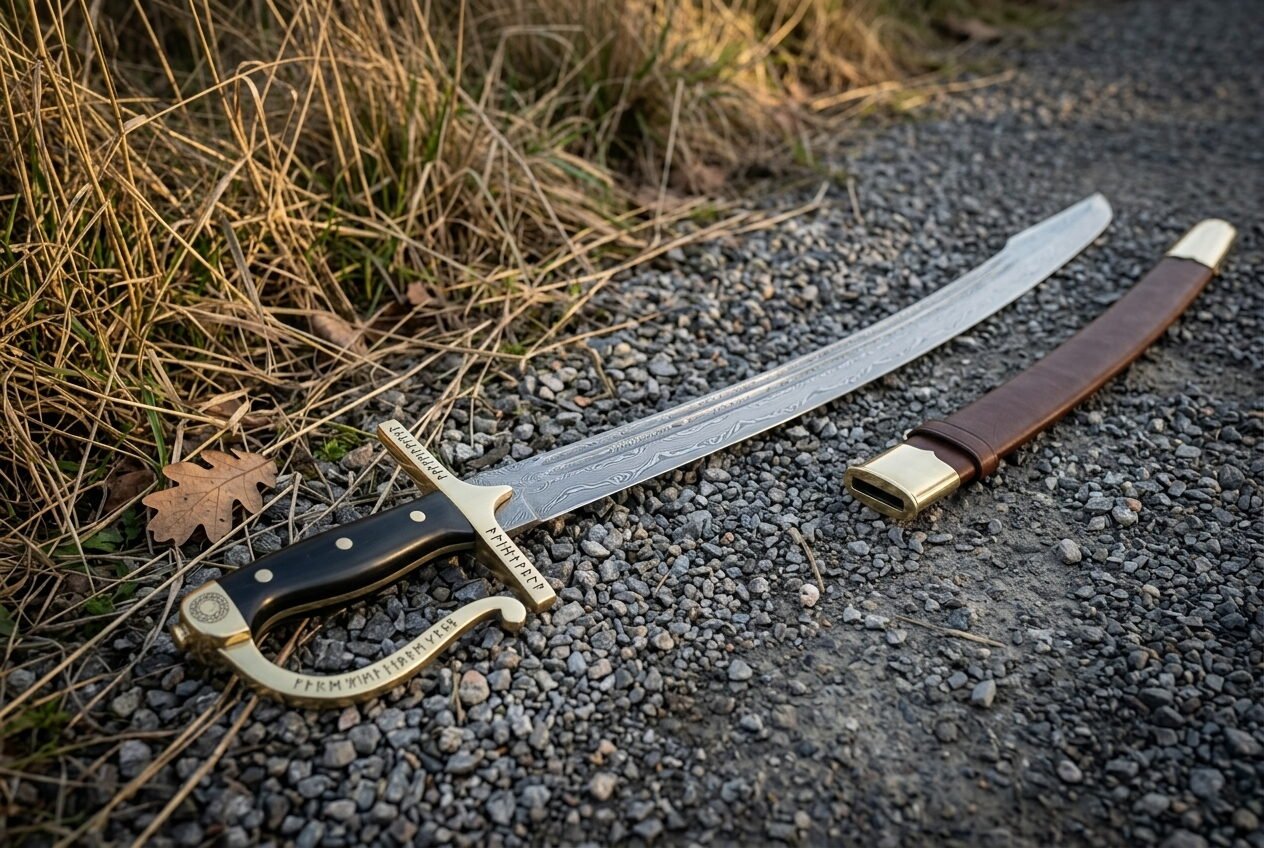
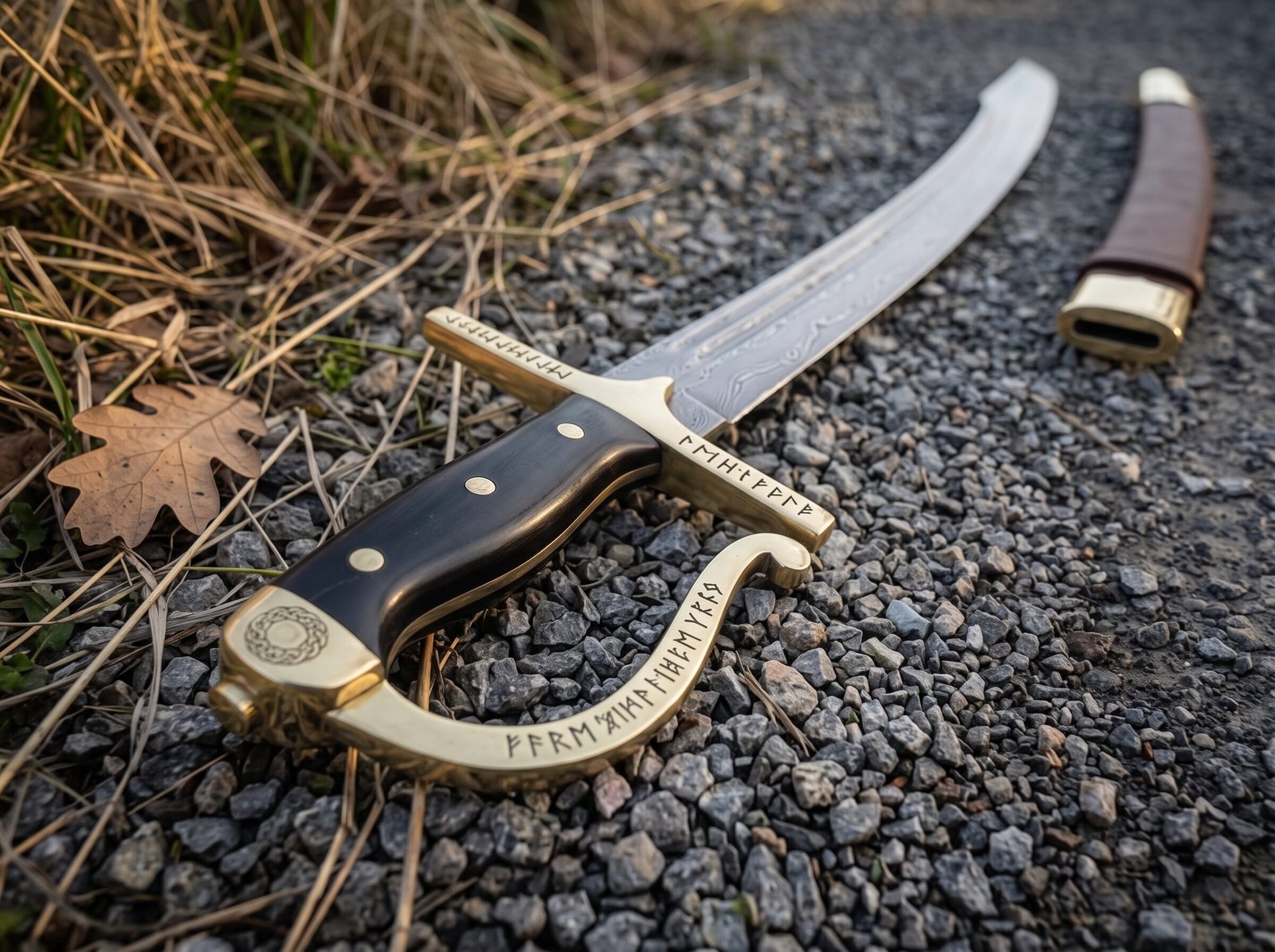
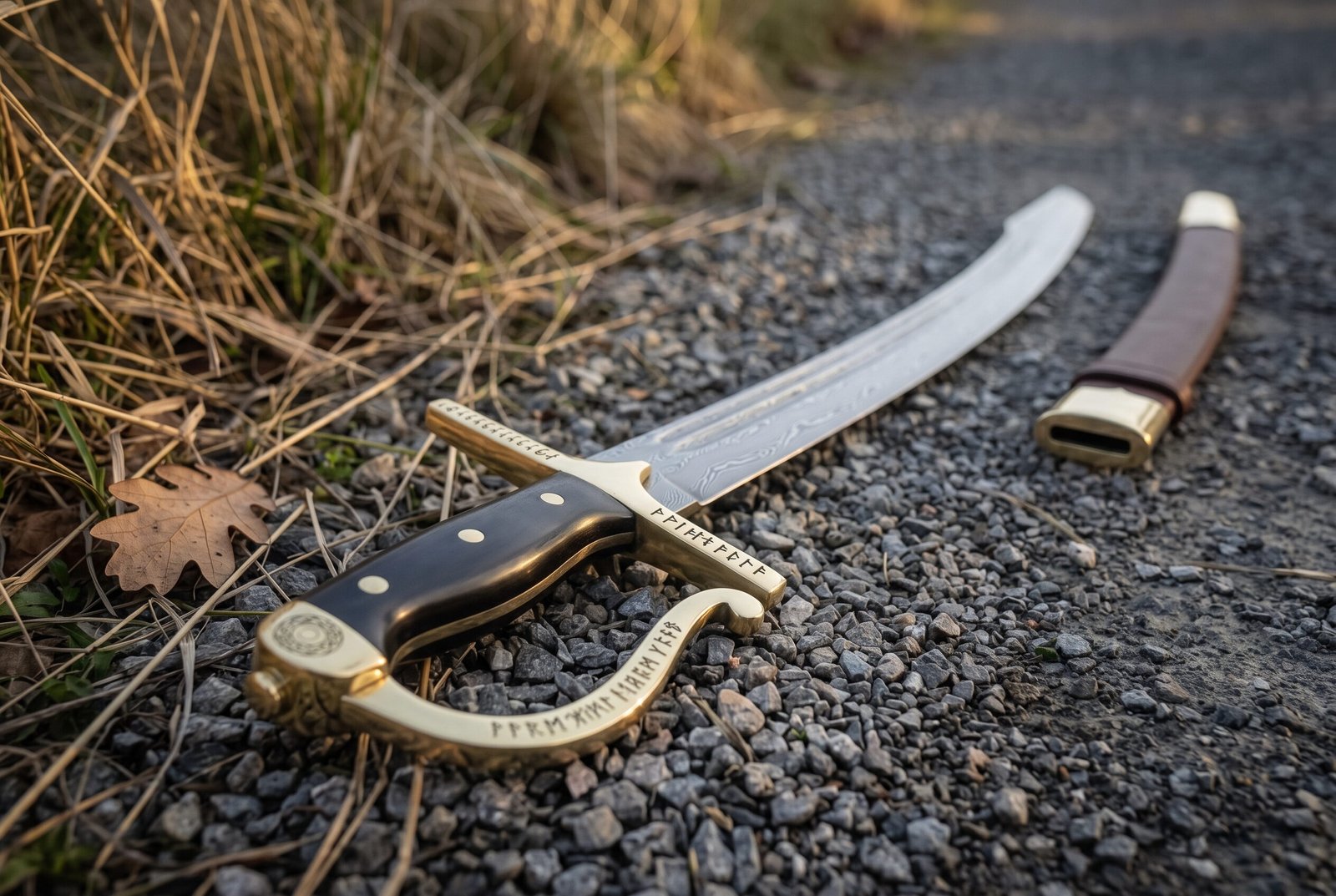
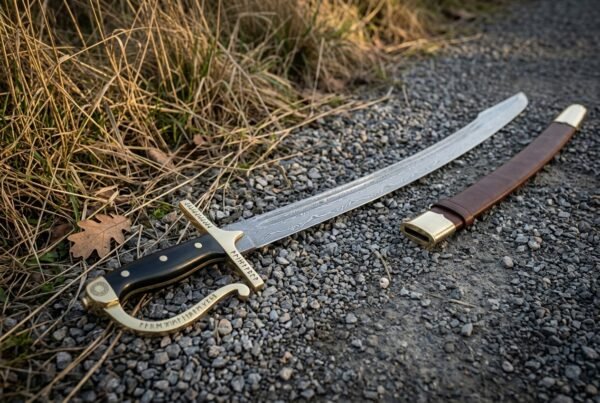
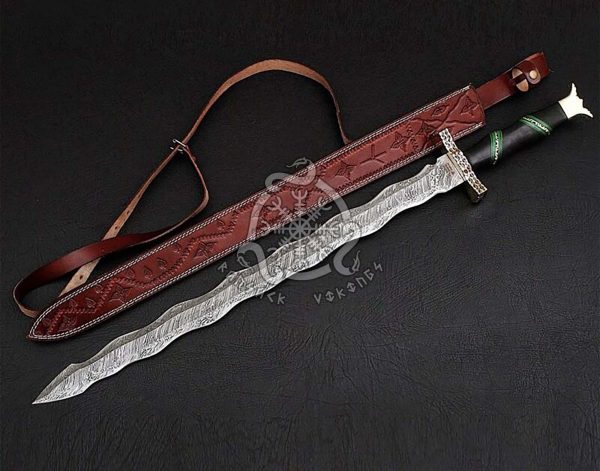
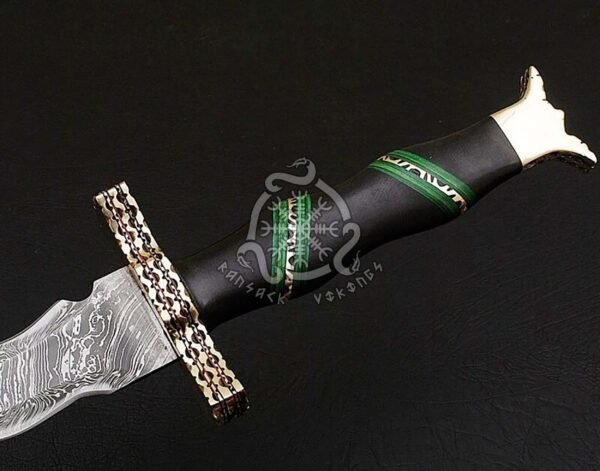
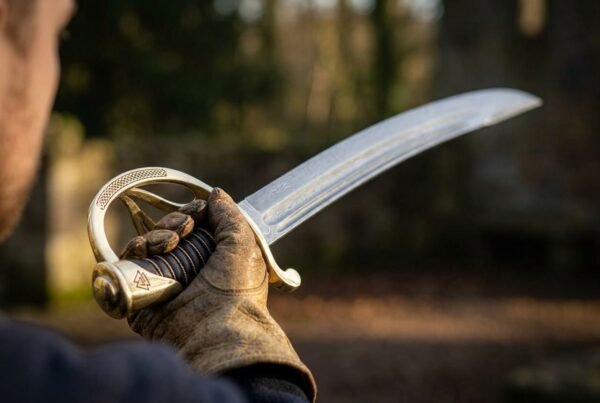
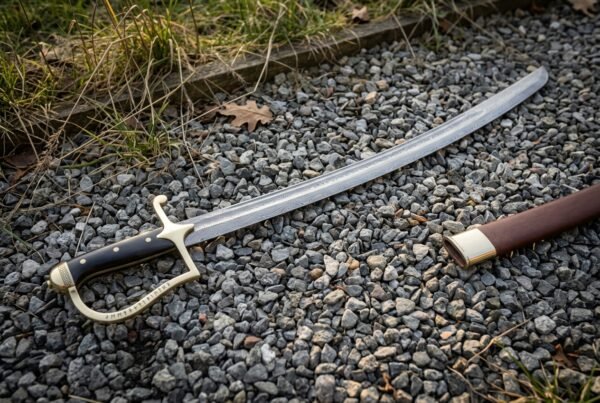
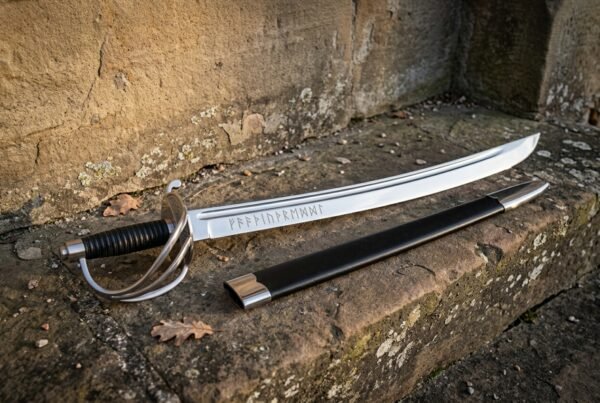
This Runecrest sabre is forged by hand in the Czech Republic. The blade is welded from 1095 and 15N20, shaped with a broad belly and a widened false edge at the tip, hardened, tempered and etched to bring the layers up. The hilt is brass with a rune cut cross and knuckle bow and an engraved roundel on the pommel cap, the grip is black horn pinned with brass, and the piece ships with a brown leather scabbard mounted in brass. Shipping inside the United States is free.
Specifications
| Steel | 1095 and 15N20 forge welded Damascus, hand etched |
|---|
| Hardness | 58 to 60 HRC |
|---|
| Overall length | 33 inches |
|---|
| Blade length | 27 inches |
|---|
| Blade profile | Curved single edged blade with a broad belly and a widened yelman at the tip |
|---|
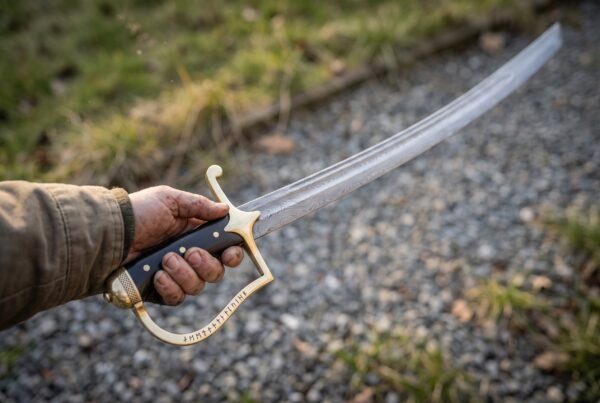
| Guard | Brass cross guard and knuckle bow, both cut with lines of Elder Futhark runes |
|---|
| Handle | Black horn slab scales |
|---|
| Pins | Three brass pins |
|---|
| Pommel | Brass pommel cap with an engraved knotwork roundel, joined to the knuckle bow |
|---|
| Scabbard | Brown leather scabbard with a brass throat and chape |
|---|
| Edge | Shipped with a working edge, sharpened on request at no charge |
|---|
| SKU | RK-1313 |
|---|
The yelman and why the blade widens
Hold any sword loosely between finger and thumb at the grip and tap it along its length. There is one point where the tap produces almost no shock in the hand. That is the centre of percussion, and it is where a cut should land. Everything a smith does to the last third of a cutting blade is aimed at that point.
The yelman is the most direct solution: widen and thicken the blade there, and you increase the mass exactly where the energy is delivered without adding weight near the hand, which is where extra weight would slow the sword down. The effect is that the blade feels light on the draw and heavy on the arrival. The same widening also gives you a genuine second edge along the back of the tip on many historical examples, useful on a back cut, and it moves the point slightly forward of the spine line so a thrust still lands.
The trade off is real and worth knowing. A yelman makes the sword tip heavy, so recovery after a missed cut is slower than on a plain tapered blade, and the wrist has to work harder to reverse direction. Cavalry accepted that because a horseman gets one pass. The same reason explains why infantry sabres of the nineteenth century mostly dropped the feature.
Why Damascus and not stainless
This blade is two steels welded into one. 1095 is a plain high carbon steel that hardens hard and etches dark. 15N20 carries roughly two percent nickel and stays bright under the same acid. Stack them, weld them at heat, draw the bar, fold it, weld again, and the layer count doubles each time until the pattern is where the smith wants it. Stainless cannot be worked this way in a normal forge, because chromium builds an oxide skin at welding heat and the layers will not bond through it. Beyond that, chromium at the levels needed for corrosion resistance makes a long blade brittle. Carbon steel gives you a hard edge at 58 to 60 HRC over a spine that flexes and comes back. The price is that it will spot if left wet. We set the whole comparison out on our page covering Damascus versus stainless.
Horn scales and a rune cut hilt
The grip is horn, cut into slabs and riveted through the tang with brass. Horn has been the default sabre grip material across eastern Europe and the Ottoman world for centuries because it does not split when a pin is driven through it, it will not compress and loosen under the rivets, and it takes body heat fast so the sword does not feel like a cold bar in winter. Every slab has its own figure. Held against the light this one carries brown and amber depth inside the black.
The brass knuckle bow is cut with a line of Elder Futhark, and the brass pommel cap carries an engraved knotwork roundel. Brass is the right metal for a guard that is going to be handled: it files to a clean line, it does not rust, and when it takes a hard knock it deforms rather than cracking. Keep horn out of long direct sun and away from radiators, because heat dries it. A dry cloth is usually all it needs, with a drop of neutral oil once a year. Where a piece has wooden furniture instead, our notes on wooden handle care apply.
Engraving, runes and your own design
Use the rune converter on this page to turn a name, a date or a short phrase into Elder Futhark and we will cut it into the steel or the handle. If you would rather have a Viking pattern than a rune line, choose your own design in the engraving option above the add to cart button and tell us whether it goes on the blade or the handle. Where a piece already carries an engraved design, your chosen engraving replaces it rather than sitting alongside it. On this sabre the rune line on the brass bow is the space we would work in, so anything you order replaces it. What we can cut, and the few things we cannot, are on the engraving page.
Care and sharpening
The etched pattern is a shallow relief only a few thousandths of an inch deep, so heavy polishing will flatten it. Clean with a soft cloth, never an abrasive pad, and keep a thin film of oil on the steel. Wipe fingerprints off promptly, since skin acid keeps etching and leaves marks that stand out against the layers. Do not store the sabre in its scabbard for months at a time, because leather holds moisture against steel. The full routine is on our steel care page.
The edge needs a little attention at the yelman. The widened section carries a slightly different geometry from the rest of the blade, so work it as its own segment rather than trying to run one continuous stroke from ricasso to point. Keep the angle steady and let the contact point travel. Our guide to sharpening with a whetstone covers the technique step by step.
Made in the Czech Republic
This piece is made by hand in the Czech Republic, in a workshop that still works the old way. The steel is forged, ground, heat treated and finished by smiths who learned the trade from the people before them, and the wood, horn and leather are cut and fitted by hand rather than pressed out on a line. That is also why no two pieces come out exactly the same.
Ransack Viking is a United States company. We import these pieces ourselves, check every one when it lands and ship from our warehouse in Chicago, Illinois. Engraving is done here in the United States after the piece arrives, so your runes or your own design go on before it leaves for you.
A note on handmade variation
This sabre is hand forged. It is not machine made and it is not bulk produced, so what arrives will not be a pixel for pixel copy of the photograph on this page. The Damascus figure belongs to the billet it was cut from and cannot be repeated. The horn will carry its own colour and grain, the brass will have taken the graver its own way, and the exact sweep of the curve and the width of the yelman will show the hand of the smith who forged them. Dimensions, steel, hardness and build are the same every time. The character is not.
Frequently asked questions
What is the yelman for?
It puts mass where the cut lands. Widening the blade in the last third increases the weight at the centre of percussion without adding weight near the hand, so the sabre stays quick to swing and hits considerably harder than its total weight suggests.
Is the Damascus real or is the pattern applied?
Real. The blade is forge welded from alternating layers of 1095 and 15N20 and the pattern goes through the whole thickness of the steel. Sharpening will never remove it.
Does it arrive sharp enough to cut?
It comes with a working edge. Say the word in the order notes and we will take it to a full cutting edge before it ships, at no extra charge.
Can I have my own runes put on it?
Yes. Use the rune converter on this page for Elder Futhark, or pick your own Viking design in the engraving option. Your engraving takes the place of the rune line already cut into the brass rather than being added next to it.
How is this different from the longer Polish szabla?
This one is shorter, broader and tip heavy, with a yelman built for the cut. The long szabla is slender and even in its curve, built for reach and for a drawing cut from horseback. Side by side, this one feels like a heavy chopper and the long szabla feels like a scythe.
How long does shipping take?
Free inside the United States. Stock pieces leave in two to four business days. Engraved pieces take three to four weeks before they ship.
What is in the box
- One Runecrest hand forged Damascus szabla sabre in 1095 and 15N20, 33 inches overall
- Brown leather scabbard with a brass throat and chape
- Care card covering oiling, etched surfaces, horn and storage
- Certificate of hand forging with the SKU recorded
- Forged and finished in the Czech Republic
Explore the range
Browse the full damascus swords collection, the rest of the sabres, the short and heavy cutlasses, and the wider swords range. Background on pattern welding, geometry and care lives in the guides.
Other pieces in this group
Another in the same line is the Hornreach sabre, 37 inches overall. Next along the rack is the Wolfrune Viking sword, 36 inches overall. For a straight comparison, see the Emberkeel Viking sword, 37 inches overall.
The Wolfmark Viking sword covers the other half of the same kit. Nothing here exactly right, build one to your own spec on the design your own page.
For partner drills and sparring we carry the Sturvang sabre trainer, and our HEMA sabre range is a good place to start.

Got this as a gift and now I want one for myself too. The craftsmanship really shows in the small details. Exactly as described and clearly made with care. Already planning my next purchase from this shop.
Feels way more premium than the price suggests. Packaging was excellent and it arrived in perfect condition. Great buy overall.
Photos don’t do this piece justice at all. Feels way more premium in person than the listing photos. The craftsmanship really shows in the small details. Beyond happy with how this turned out. Ordered from Ransack Viking before and the quality stays consistent every time.
Been eyeing this piece for months and it did not disappoint. Exactly as described and clearly made with care. Love it.
Been eyeing this piece for months and it did not disappoint. Exactly as described and clearly made with care. Made overseas in the Czech Republic yet shipped from a US location so no long customs wait. This shop clearly takes pride in their work.
Feels way more premium than the price suggests. Already telling my friends to check this out.
Absolutely blown away by this piece. The craftsmanship really shows in the small details. Exactly as described and clearly made with care. If you’re on the fence just get it. You won’t regret it. Ransack Viking is quickly becoming my go to shop for anything Norse themed.
This is exactly what I wanted and then some. Packaging was excellent and it arrived in perfect condition. Already telling my friends to check this out.
Bought this on a whim and it turned out to be one of my favorite purchases this year. Feels way more premium in person than the listing photos. Already planning my next purchase from this shop.
Good quality piece for the price. Good product. Just not quite perfect.