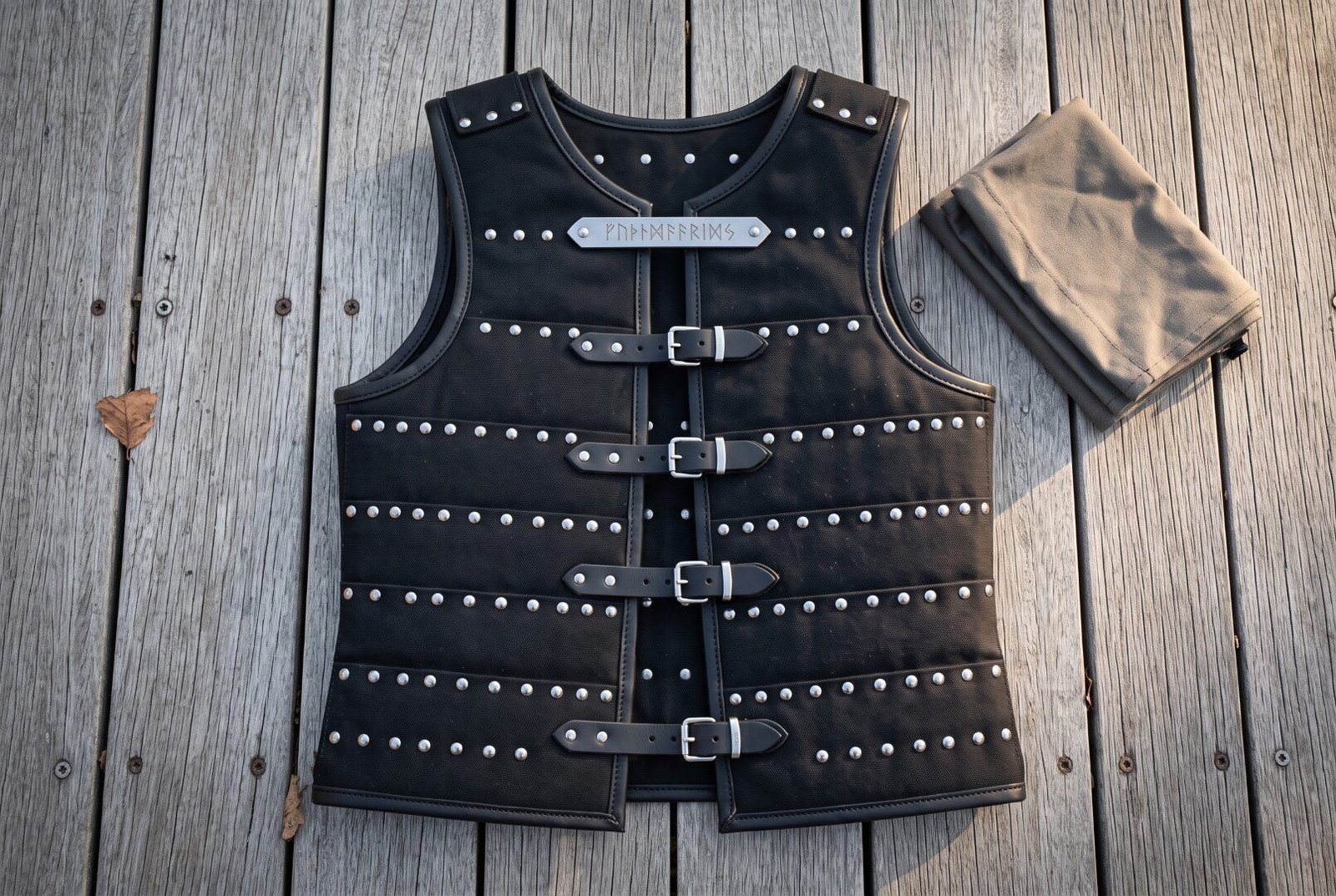
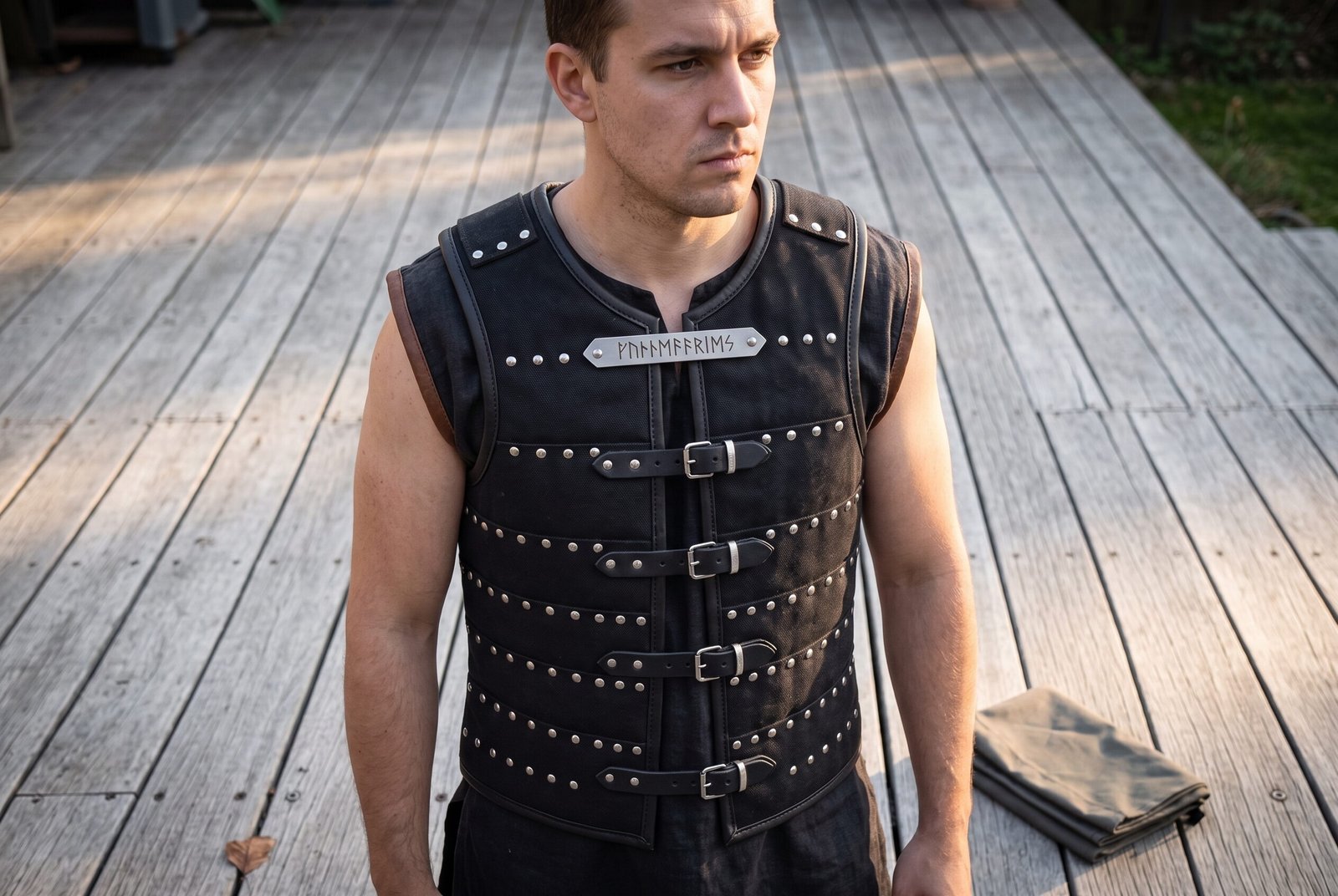
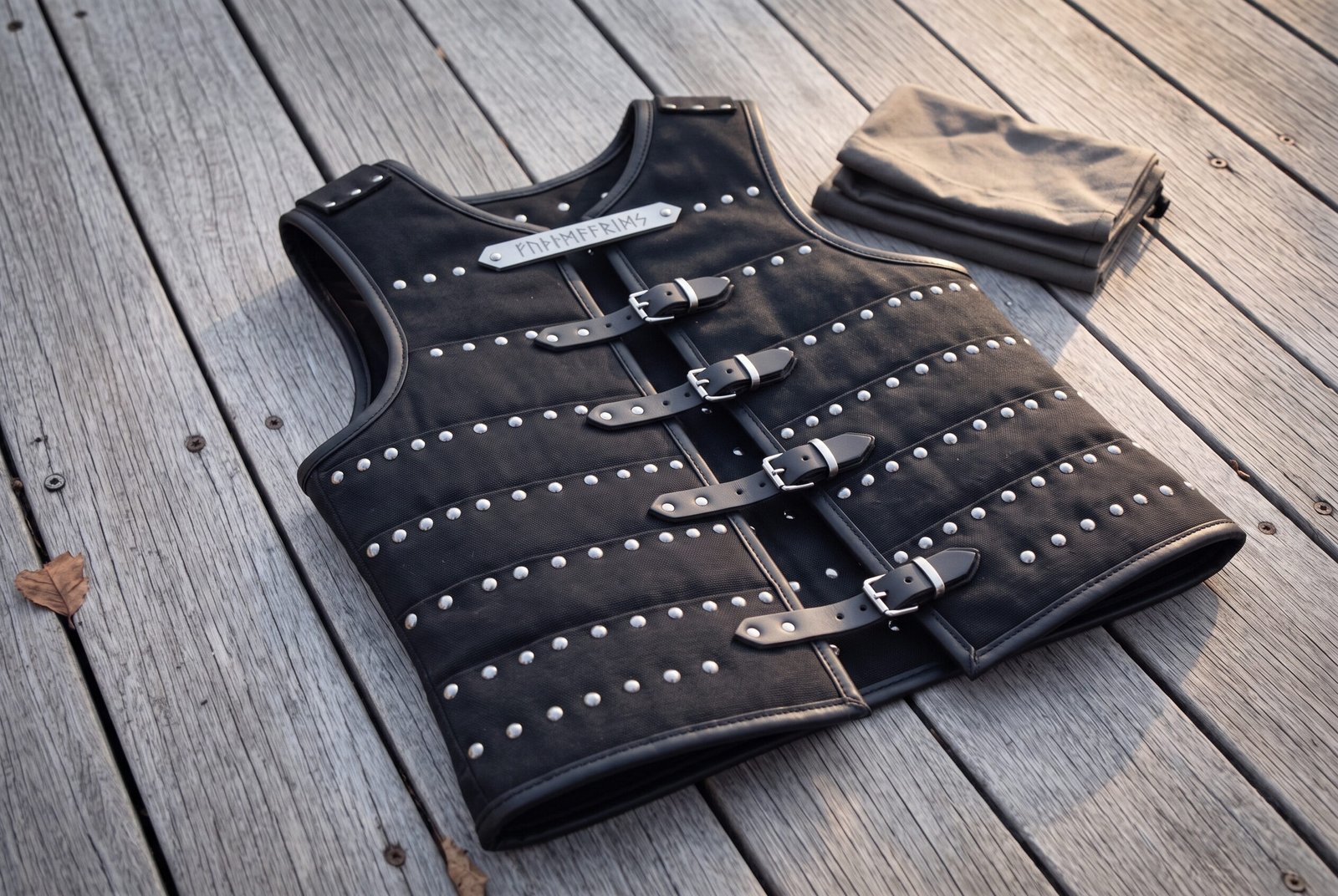
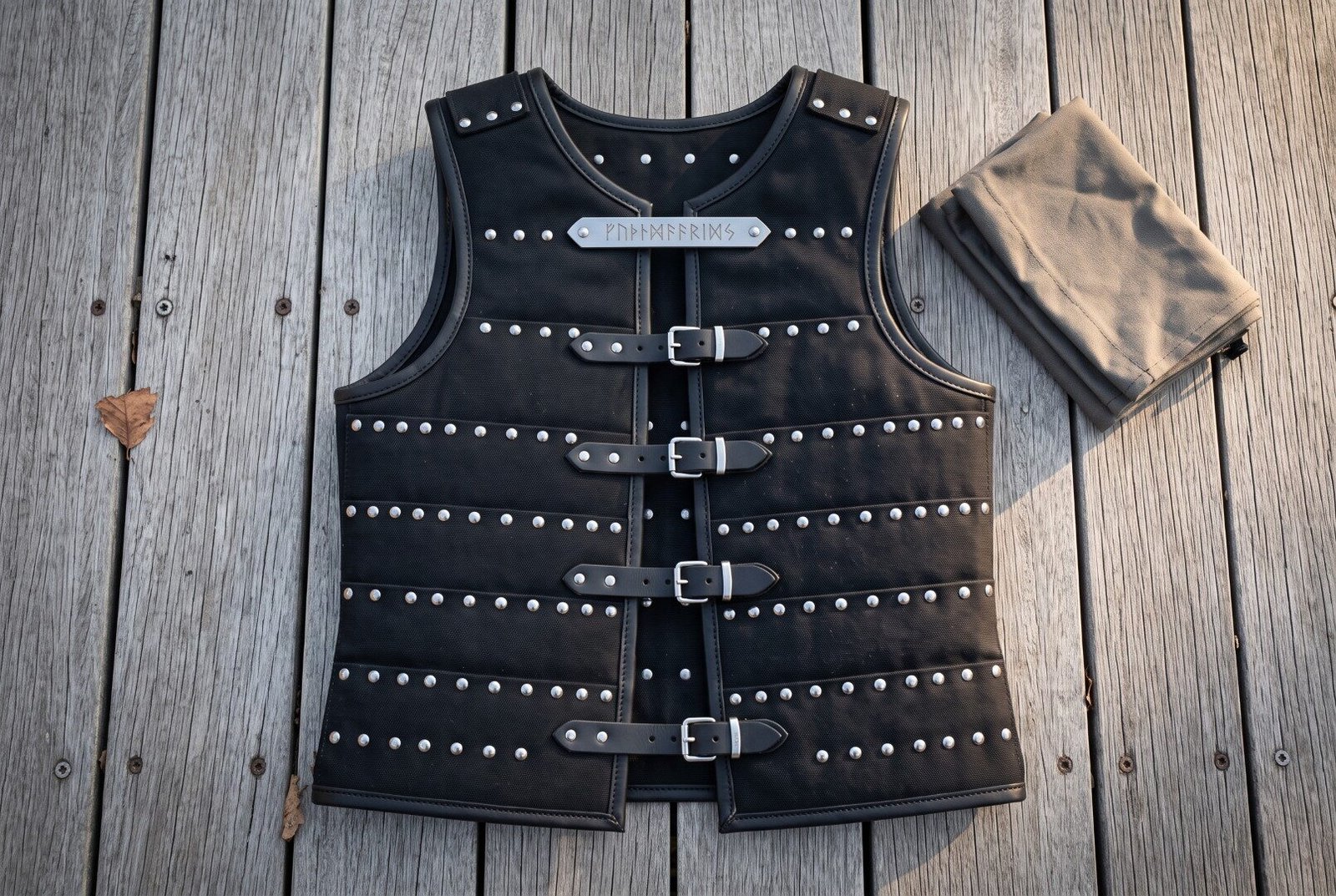
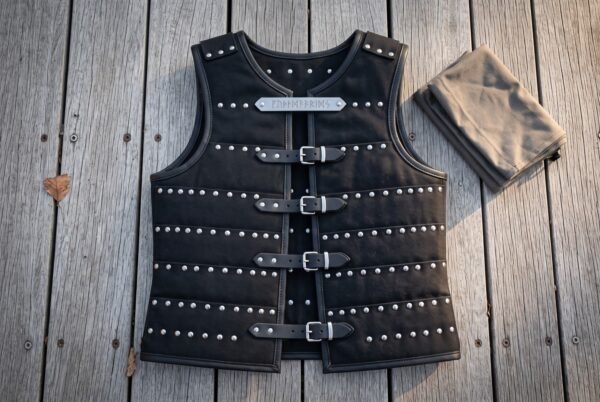
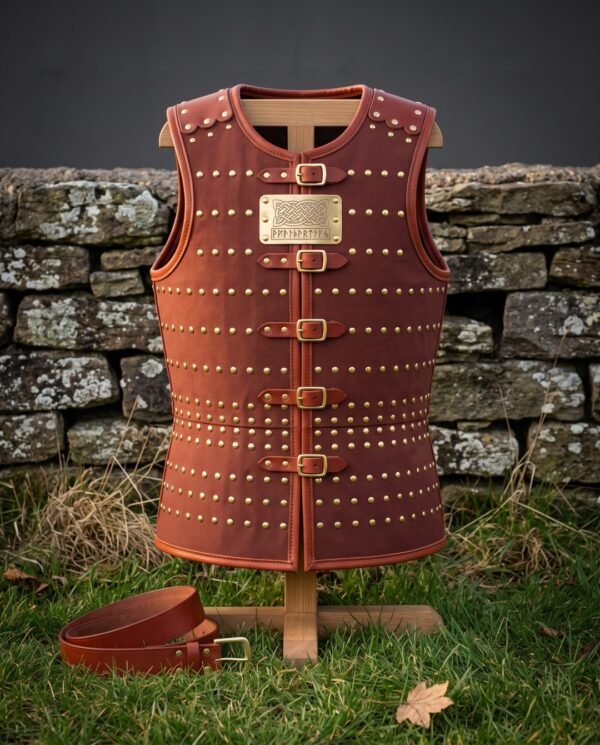
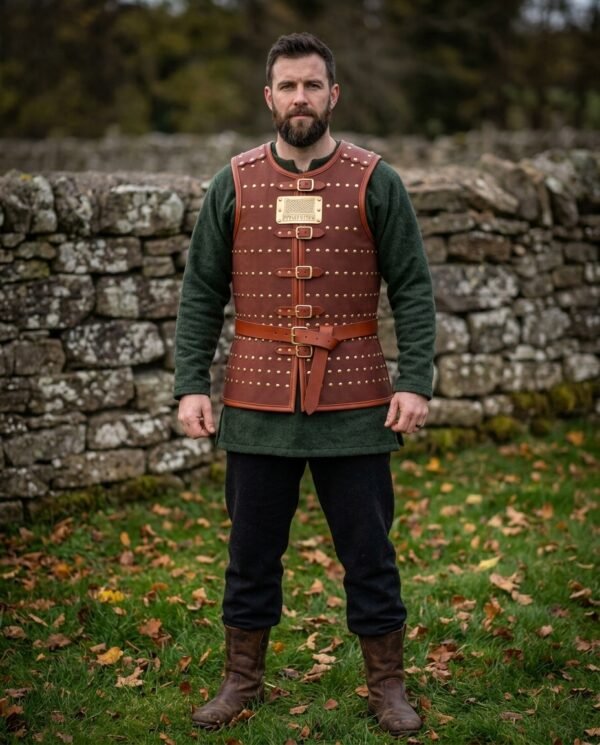
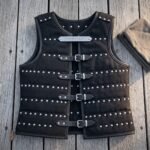
A sleeveless body defence in black canvas trimmed with black leather, closed down the front by four steel buckle straps and covered in ordered rows of rivet heads, with a small engraved plaque at the sternum carrying a line of Elder Futhark. The rows of rivets are not decoration. Each row marks where a band of steel plate is riveted to the inside face of the canvas cover, so the outside stays flexible black cloth and the inside is a layer of overlapping metal. That construction has a name, and the name is brigandine.
Here is the fact that trips almost everyone up. The studded leather armour of films and role playing games never existed. What medieval artists were painting was this, a brigandine, seen from the outside, where all you can see of a coat of plates is the ordered grid of rivet heads holding hidden steel to a fabric or leather cover. Someone in the twentieth century looked at those pictures, decided the studs themselves were the armour and invented a category out of a misreading. The real thing is a genuinely good piece of engineering, and this is built as the real thing. Cut, riveted, buckled and engraved in a Czech Republic workshop. The folded cloth in the photograph is a studio prop and is not included. What Norsemen actually wore, and how the padded layer under it worked, is set out in our piece on Viking armour.
Specifications
| Item type | Sleeveless brigandine body armour |
|---|
| Shell material | Black canvas cover with black leather edge binding |
|---|
| Plates | Overlapping mild steel bands riveted inside the shell, approximately 18 gauge |
|---|
| Rivets | Steel dome rivets in banded rows, front and back, and along the shoulders |
|---|
| Closure | Four steel buckles on black leather straps down the centre front |
|---|
| Size or fit | Built to a stated chest measurement, roughly three inches of buckle adjustment |
|---|
| Weight | Approximately 9 to 12 pounds depending on the size built |
|---|
| Lining | Unlined for airflow, intended to be worn over a padded garment |
|---|
| Decoration | Riveted steel plaque at the chest engraved with an Elder Futhark line |
|---|
| Coverage | Chest, back and flanks to the waist, arms and shoulders left open |
|---|
| SKU | RK-1516 |
|---|
What a brigandine does that a solid cuirass cannot
A breastplate is one piece of steel. It is excellent at what it does and it is a rigid box. A brigandine takes the same protective idea and cuts it into strips, then hangs those strips on a flexible skin so they overlap like roof tiles. The result bends where your body bends and stays stiff where a blow lands, because a strike falls across several overlapping plates at once and they support each other.
Overlap direction matters. The plates run in horizontal courses with each course lapping over the one below on the chest, so a downward cut skids across the laps instead of catching a plate edge, and so the whole front closes up rather than gapping when you bend forward. Around the waist the courses shorten, which is what lets you sit down in it, and the flanks are cut away slightly under the arms so you can bring a shield or a blade across your body.
The rivets themselves are structural. Each plate is held by at least two so it cannot pivot, and the heads are domed rather than flat so a point sliding across the surface is deflected rather than caught. Every one of those rivet heads is a place a determined thrust could theoretically find, which is the honest weakness of the pattern and the reason brigandines were worn over a padded garment rather than over a shirt.
The canvas and the steel
The cover is black canvas, a tight woven cloth that moves with the body and does not crack or stiffen with age the way an untreated hide can, and every edge is bound in black leather so the openings at the neck, arms and hem do not fray. That is how a great many original brigandines were made: a cloth cover outside, steel plates riveted inside, and the rivet heads the only part of the metal you ever see.
The internal plates are mild steel at approximately 18 gauge. Be clear about the limits. This is a light and display grade defence. It will turn a glancing LARP strike, take the hits of a stage fight, and look and behave correctly in a display line, and it is not certified armour and not built or rated for full contact steel combat leagues, which set their own gauge and impact standards. If you fight buhurt, buy plate that certifies to your league rules.
Engraving, runes and your own design
Use the rune converter on this page to turn a name, a date or a short phrase into Elder Futhark and we will cut it into the steel or the leather. If you would rather have a Viking pattern than a rune line, choose your own design in the engraving option above the add to cart button and tell us where it goes. Where a piece already carries an engraved design, your chosen engraving replaces it rather than sitting alongside it. On this brigandine the chest plaque is the obvious place, and the back panel between the rivet rows is a large clean area if you want a bigger piece of knotwork or a house mark. See the engraving page.
Fit and sizing
Give us your chest circumference measured over the padded garment you will actually wear underneath. A gambeson or a heavy arming jacket is worth two to three inches on its own and is the single most common sizing mistake people make. The four front buckles then give around three inches of adjustment either way.
Torso length matters as much as chest. This is built to end at the waist so it does not foul the hips when you sit or crouch, so tell us your height and your measurement from the base of the neck to the top of the hip bone. A long bodied wearer in a short brigandine leaves a gap above the belt, and a short bodied wearer in a long one gets the bottom course digging in every time they bend. Shoulder width sets how far in the armholes are cut, so send that too if you have broad shoulders or plan to wear arm armour under it.
Care
Cloth and steel want different things, so treat them separately. Brush the canvas down after wearing and let it dry fully before it is put away, and give the leather binding and the buckle billets a thin coat of neutral leather dressing once or twice a year. Do not dry it near a heater or in a car in summer, since heat dries out the leather trim. Wipe the rivet heads and keep a light oil film on them so they do not weep rust into the black. Store it hanging on a broad shouldered hanger or laid flat, never folded across the plates, and never in a sealed plastic tub. The general oiling advice on steel care covers the metal side. If you are building a whole kit rather than buying one piece, our notes for reenactors cover what gets used and what sits in a box.
Made in the Czech Republic
This piece is made by hand in the Czech Republic, in a workshop that still works the old way. The steel is forged, ground, heat treated and finished by smiths who learned the trade from the people before them, and the wood, horn and leather are cut and fitted by hand rather than pressed out on a line. That is also why no two pieces come out exactly the same.
Ransack Viking is a United States company. We import these pieces ourselves, check every one when it lands and ship from our warehouse in Chicago, Illinois. Engraving is done here in the United States after the piece arrives, so your runes or your own design go on before it leaves for you.
A note on handmade variation
This is hand made, not machine made or bulk produced, so what arrives will not be a pixel for pixel copy of the photograph. The weave of the canvas, the depth of the black, the exact spacing of a rivet row and the tone of the steel all vary a little, because every piece is cut and set by hand from natural materials. The dimensions, the material and the build are the same every time. The character is not.
Frequently asked questions
Is this studded leather or a real brigandine
A real brigandine. The rivet heads you can see are holding overlapping steel plates against the inside of the canvas cover. Studded leather with nothing behind the studs is a modern invention and we do not make it.
Can I wear it for full contact fighting
No. It is light and display grade with 18 gauge internal plates and no impact certification. It is right for LARP, film, stage, display and light reenactment, and heavy list or buhurt combat needs league approved armour.
What do I wear under it
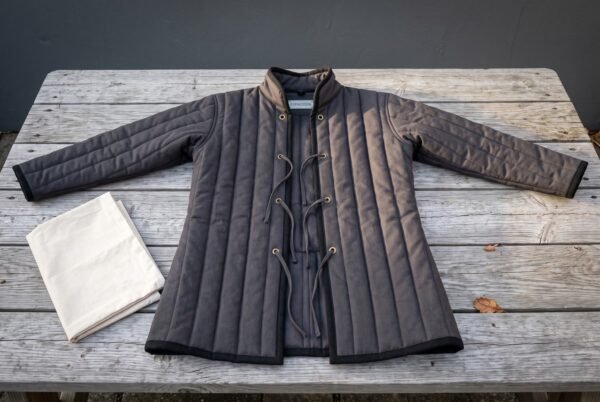
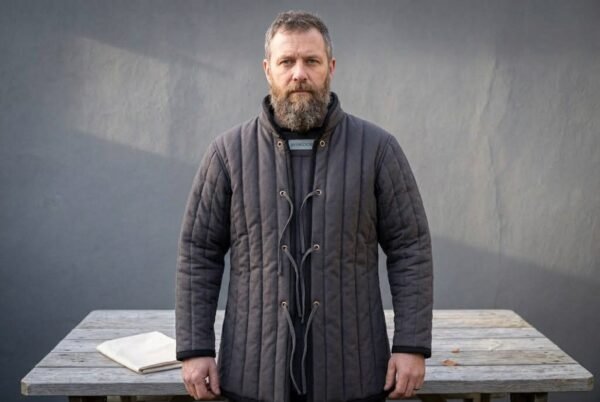
A gambeson or a padded arming jacket. The padding spreads the load off your shoulders, stops the rivet backs pressing on you and is part of how the armour works. Measure your chest over it.
How heavy is it to wear all day
Around nine to twelve pounds depending on size, and most of that sits on your shoulders and hips rather than hanging off your neck. Most wearers find it far easier over a long day than a rigid cuirass of the same coverage.
Can I have it in brown instead of black
Yes. We dye in black, russet brown or natural at no extra cost, and we can fit brass buckles instead of steel on request. Put it in the order notes.
How long before it ships
One to two weeks of processing because every piece is cut to your measurements, then shipping inside the United States is free.
What is in the box
- One riveted canvas brigandine body defence
- Four steel buckles on leather straps, fitted
- Engraved chest plaque with your rune line or ours
- Care and fitting sheet for leather and steel
- Lifetime warranty against defects in stitching, riveting and fittings
- Forged and finished in the Czech Republic
Explore the range
See more in brigandine and gambeson, leather armor, viking armor and chainmail armor, or read the guides on armour sizing.
Other pieces in this group
In the same category sits the Roanward gambeson. A near match for this one is the Legiondrake plate armor. Closest to this in the range is the Runecuff leather armor.
Fitting out further, the Knotwold leather armor belongs with it. Nothing here exactly right, build one to your own spec on the design your own page.


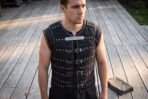

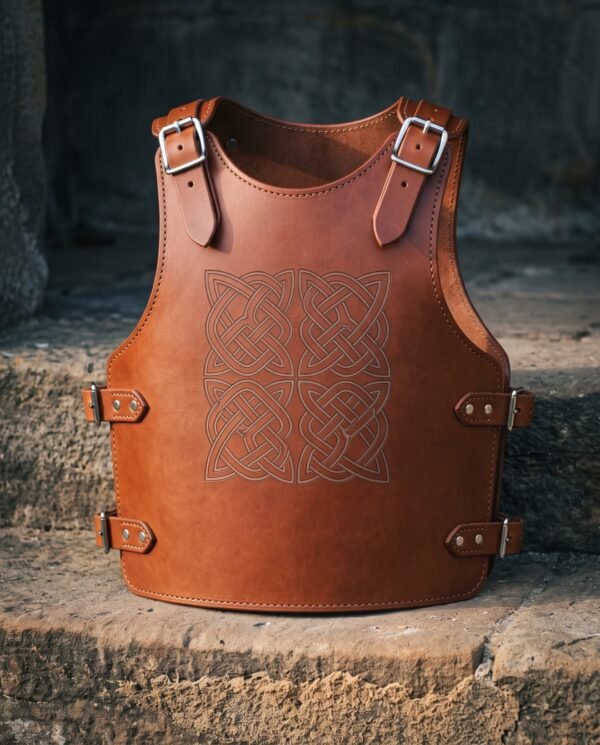
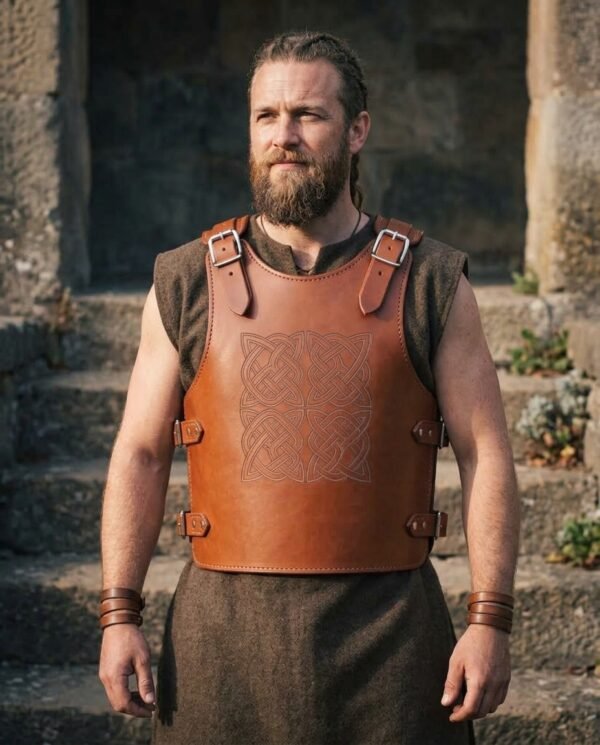
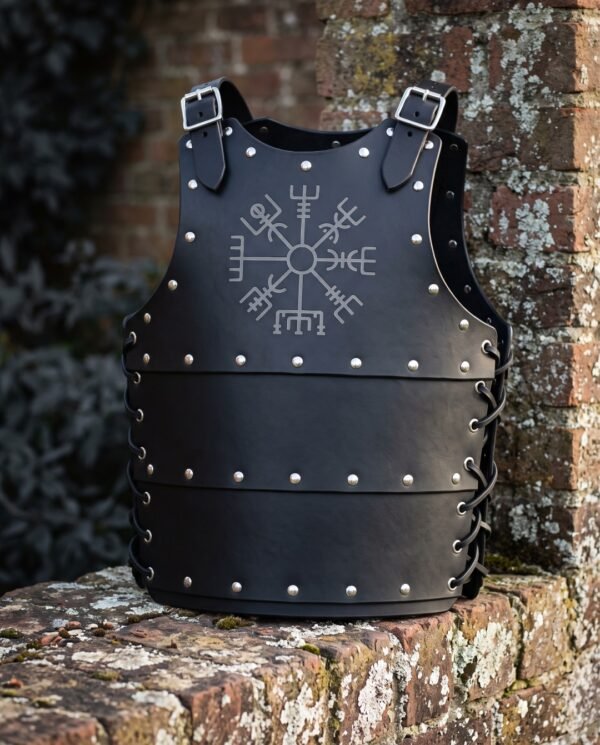
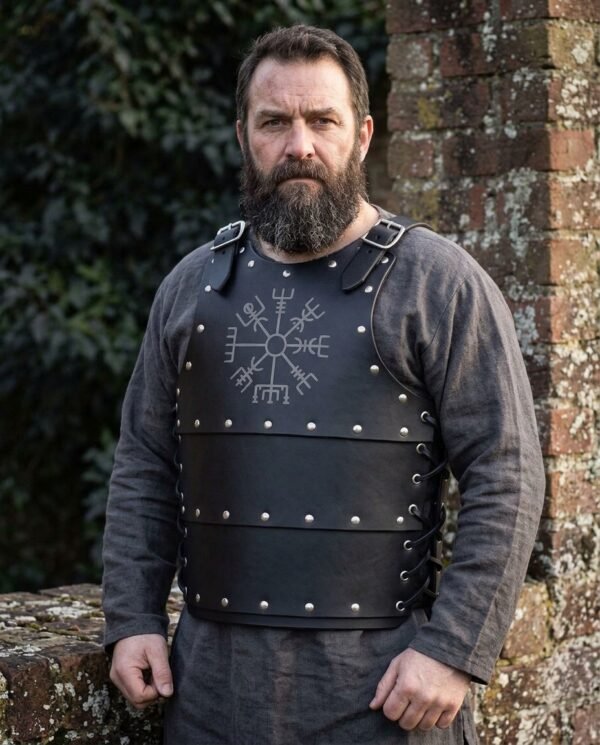
Bought this on a whim and it turned out to be one of my favorite purchases this year. Looks incredible with the rest of my reenactment kit. This will be a family heirloom for sure.