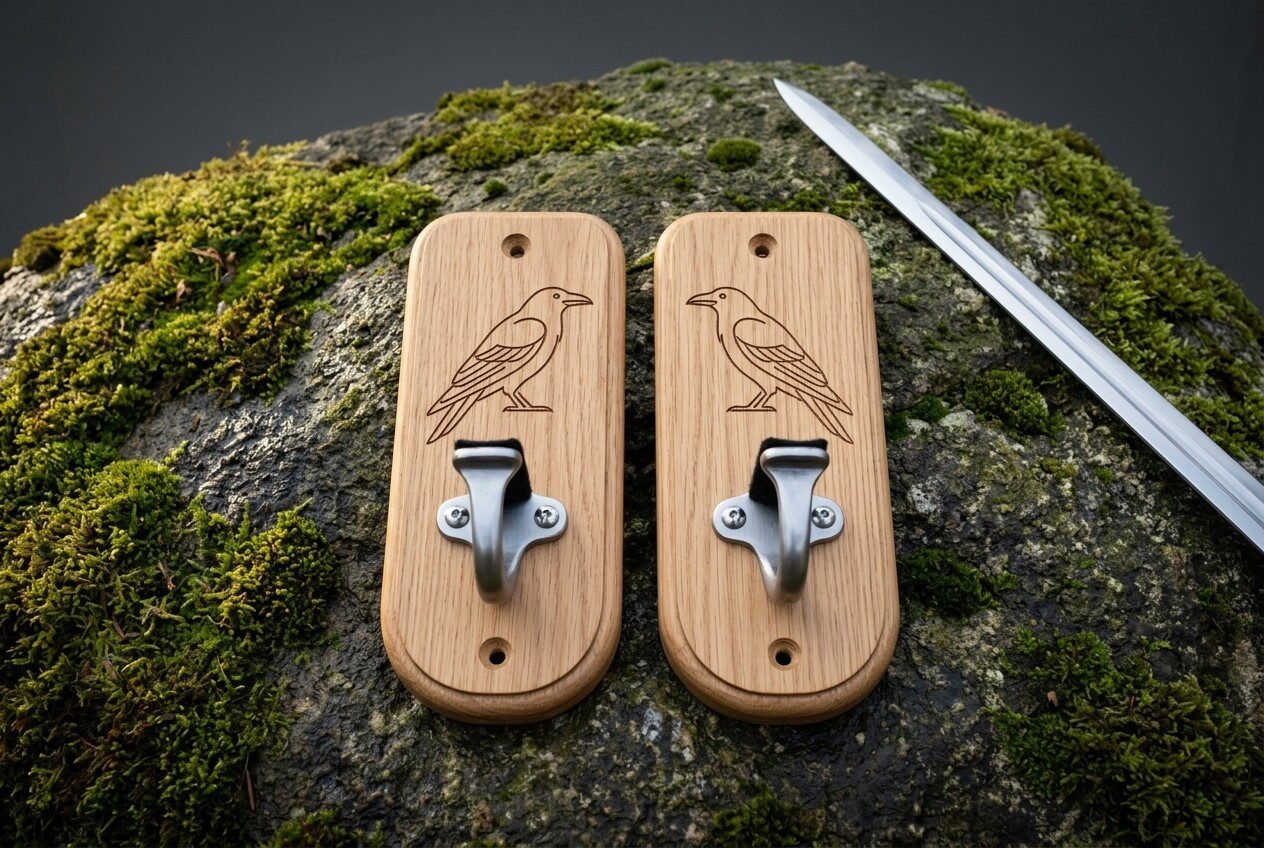
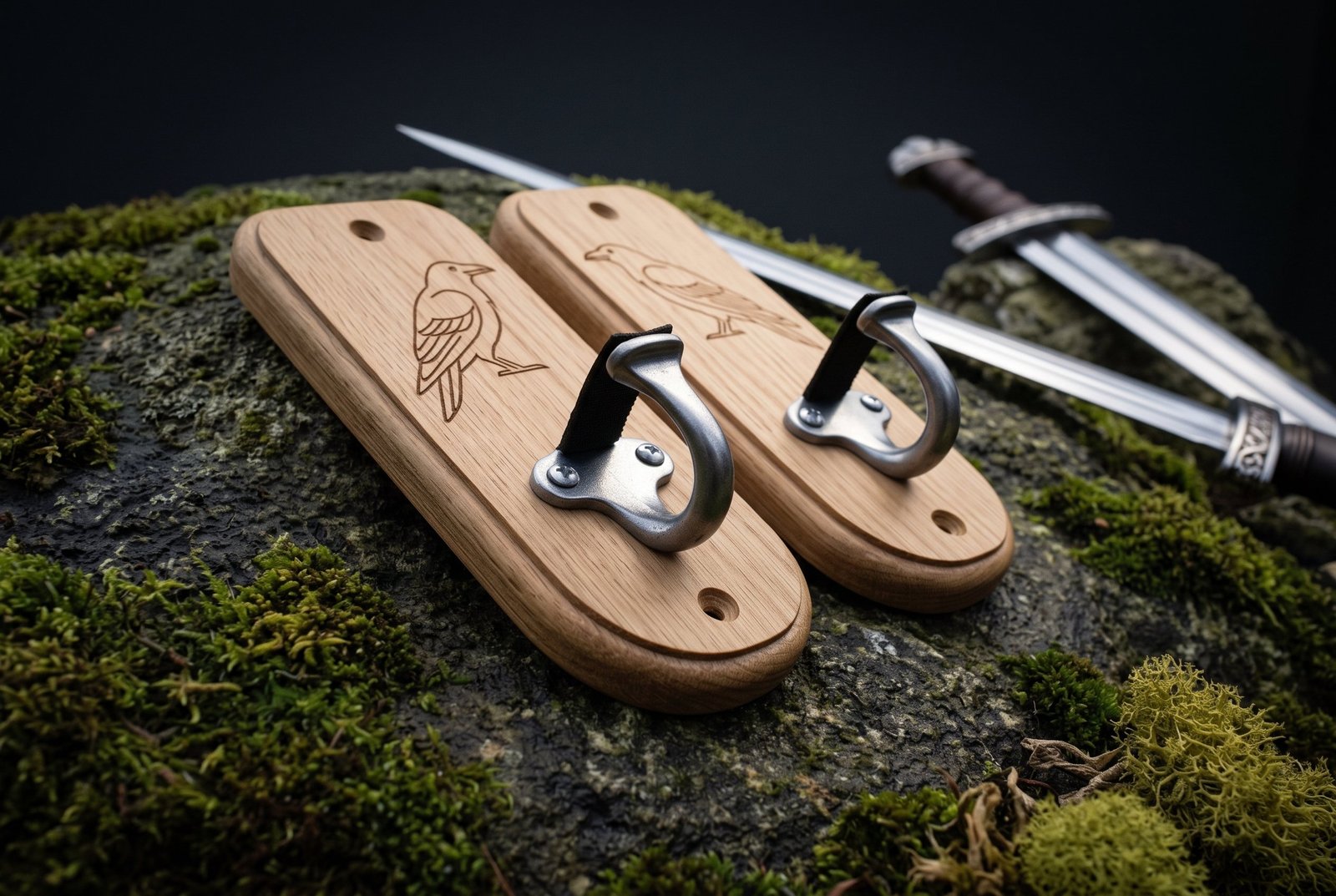
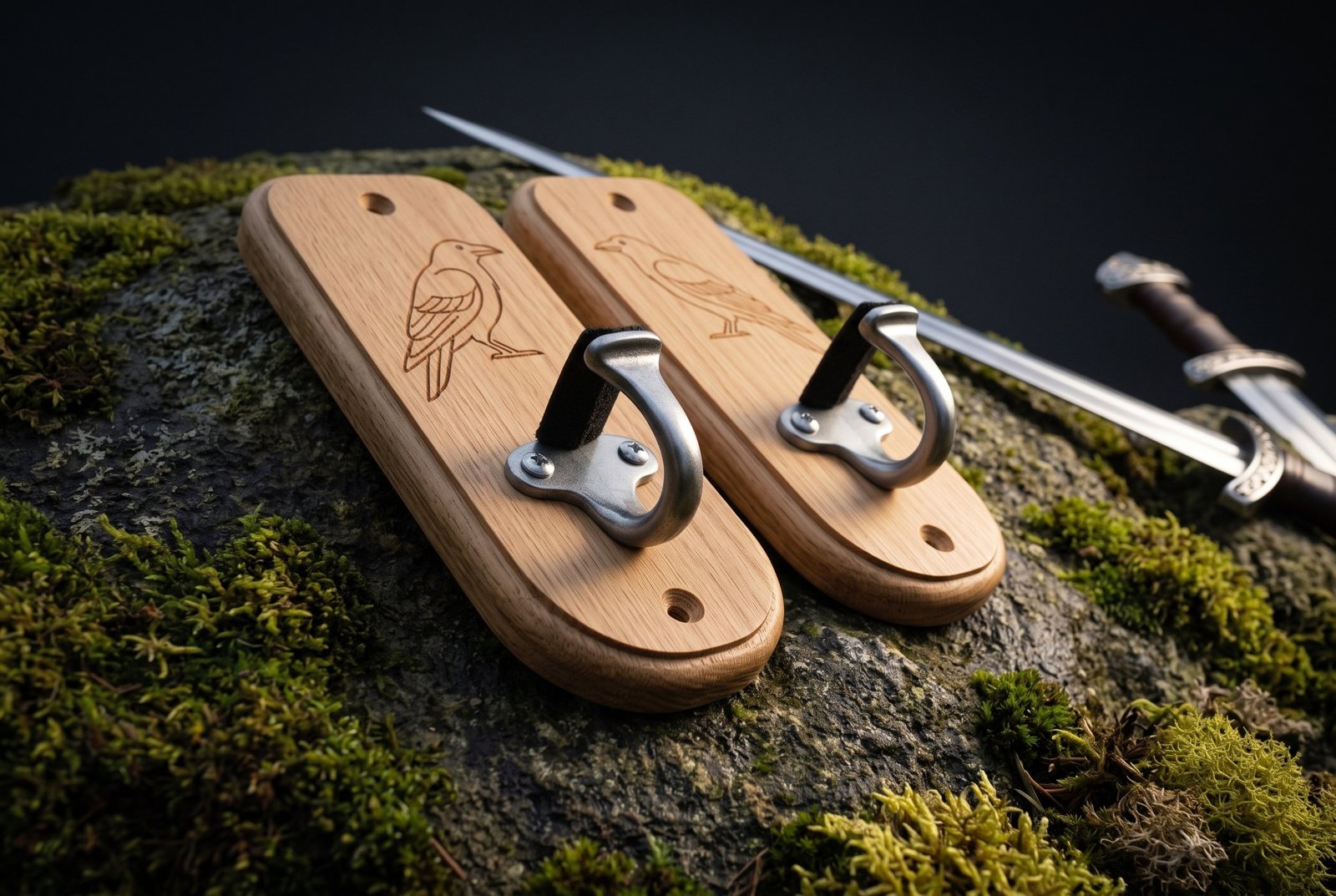
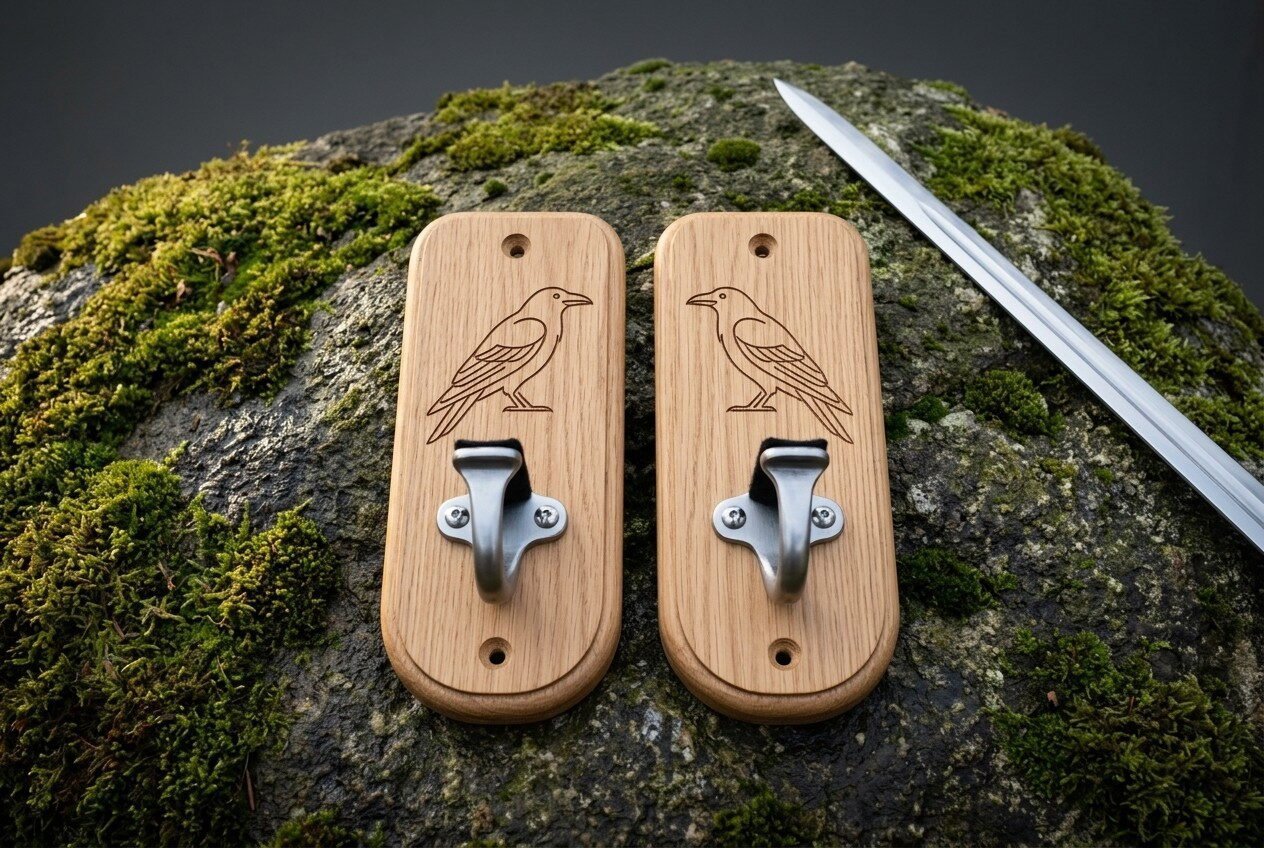
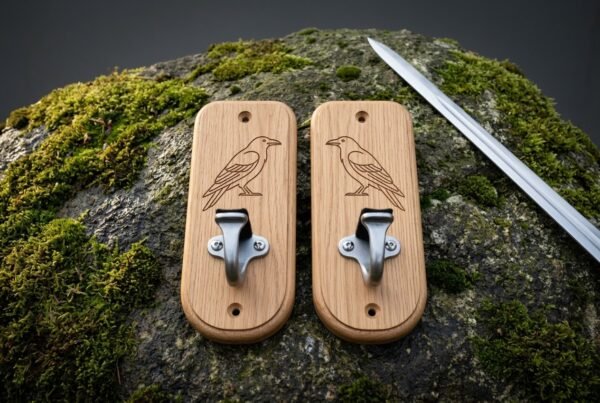
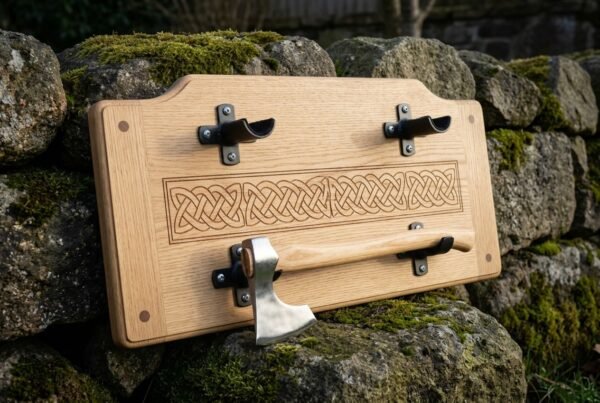
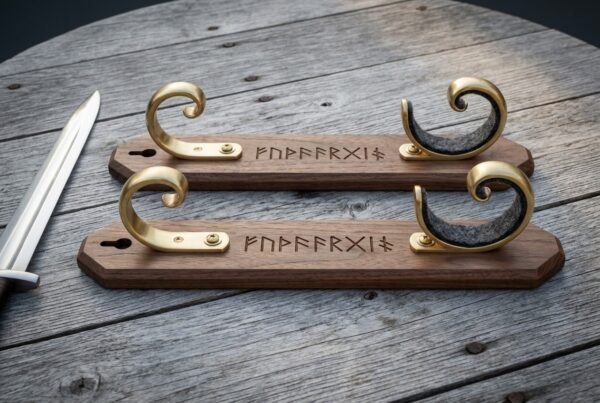
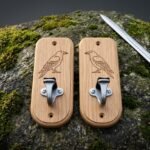
This is a matched pair of oak wall mounts for hanging a sword, an axe or a spear flat against a wall. Each plaque is cut from solid oak with rounded ends, and carries an engraved raven standing in profile, the wing feathers and tail picked out in fine line work. A brushed steel hook is screwed to the face of each plaque on a small base plate, and a countersunk screw hole above and below the hook takes the fixing into drywall or into a stud. Two plaques hold one long piece level. Four hold two pieces on the same wall.
The raven is on these for a reason. Odin kept two, Huginn and Muninn, thought and memory, and the poems describe them flying out over the world each morning and returning at night to speak into his ear. Raven imagery turns up on Viking age brooches, on the silver coins minted at York while the city was under Norse rule, and on the war banners recorded in the Anglo-Saxon Chronicle. Fixing a pair of ravens to a wall to carry a blade continues an old habit rather than inventing a new one.
Made and finished in the Czech Republic. The pair ships as two engraved oak plaques, two brushed steel hooks already fitted, and a bag of wall screws and plugs sized for drywall and for timber. This one is kept with the sword stands and displays, and the scabbards and sheaths sit right beside it.
Specifications
| Material | Solid oak with brushed steel hooks and hardware |
|---|
| Sold as | Matched pair, two plaques and two fitted hooks |
|---|
| Plaque shape | Long oak plaque with rounded ends |
|---|
| Engraving | Standing raven in profile on each plaque, the two birds facing each other |
|---|
| Finish | Clear oiled oak, natural grain and colour left visible |
|---|
| Hook | Brushed satin steel J hook with an upturned lip, on a base plate fixed with two screws |
|---|
| Fixing | Two countersunk screw holes per plaque, one above the raven and one below the hook |
|---|
| Included | Wall screws and wall plugs |
|---|
| Suits | Swords, axes, spears, staves and scabbarded blades |
|---|
| SKU | RK-1771 |
|---|
Why a pair of hooks holds better than one bracket
A sword hung on a single centre bracket pivots. Every time someone brushes past it, the blade swings, the finish gets rubbed, and the fixing works loose. Two hooks set apart stop that. The piece rests at two points, the load splits between two sets of screws, and the blade sits level and stays level. It is the same reason a shelf gets two brackets rather than one.
The upturned lip on the front of each hook is the second half of the design. A polished blade on a flat peg will creep sideways under its own weight, especially in a room that warms and cools through the day. The lip gives it a positive stop. You can lift the piece straight up and off, but it will not walk off on its own.
Spacing matters more than most people expect. Set the two hooks so they carry the piece close to a third of the way in from each end. For a sword that means one hook just forward of the guard and the other roughly two thirds of the way down the blade. That keeps the blade from sagging in the middle and keeps the weight off the tip. If you are hanging a scabbarded sword, hang the scabbard and let the sword sit inside it, so the hooks bear on leather rather than on a polished edge.
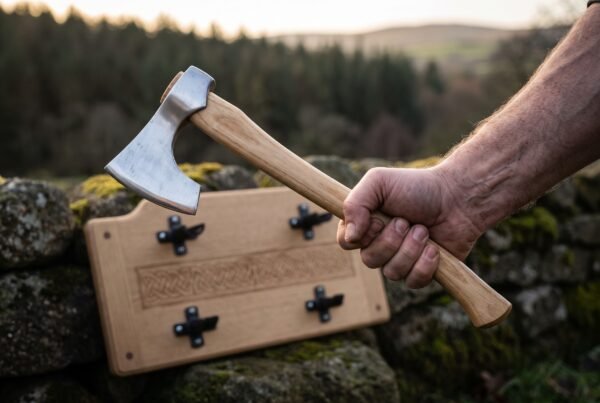
Hang an axe by the haft rather than by the head. A head resting on a steel hook takes a mark eventually. A hickory haft does not.
Oak, and why it is used here
Oak is dense, hard and stable, which is exactly what you want under a fixing that is carrying a few pounds of steel in shear. It holds a screw thread rather than crushing around it, and it does not dent when a guard knocks against it. Oak is also open grained, which is what gives these plaques the visible ray fleck and the warm streaking you can see in the photograph.
The engraving is cut into the face rather than printed on it, so the raven has real depth. Cut oak takes a line cleanly because the fibres are tight, and the walls of the cut catch light at a different angle to the flat face. That is what makes the bird read from across the room rather than only up close.
The finish is a penetrating oil, not a film lacquer. Oil soaks into the wood and hardens inside it, so it cannot chip off in a flake the way a varnish does. It also means you can refresh the finish yourself years from now with a rag and a few minutes rather than stripping anything back.
Engraving, runes and your own design
Use the rune converter on this page to turn a name, a date or a short phrase into Elder Futhark and we will cut it into the steel, the leather or the wood. If you would rather have a Viking pattern than a rune line, choose your own design in the engraving option above the add to cart button and tell us where it goes. Where a piece already carries an engraved design, your chosen engraving replaces it rather than sitting alongside it.
On these plaques the raven occupies the upper panel, so a rune line reads best across the lower panel below the hook, or in place of the raven if you want the runes to be the whole statement. Details are on the engraving page.
Mounting and display
Find your studs first. Drywall anchors will hold a light sword, but a heavy hand and a half sword or a bearded axe deserves at least one screw into timber per plaque. If you cannot hit a stud, use the toggle style anchors rather than the plastic push in plugs.
Mark one plaque, level it, fix it, then use a spirit level and a straight edge to set the second. Measure to the hook rather than to the top of the plaque, because it is the hooks that need to be level, not the wood. Hang the piece before you drive the second screw on the far plaque so you can nudge it a few millimetres if the balance looks off.
Height is a matter of taste, but a sword displayed above a doorway or a fireplace mantel usually reads best with the guard slightly higher than the tip, which gives the piece a sense of motion rather than looking like it is on a shelf. Keep it out of direct sun if you can. Sunlight fades oak and it will slowly bleach a leather scabbard.
Care
The oak wants a wipe with a dry cloth and, once a year or so, a thin coat of any furniture or food safe wood oil rubbed in and buffed off. Do not use a spray polish with silicone in it, because that builds a film that later resists oil.
The steel hooks need nothing beyond a dry wipe. If the room is humid, a smear of light oil on the hook keeps it bright. If a carbon steel blade is going to sit on the hook for months at a time, oil the blade first, and see our notes on steel care, because a bare blade left in still air will dull long before the hook does.
Made in the Czech Republic
The work behind this piece happens in a Czech Republic workshop that has kept to the old methods. Steel is forged and heat treated by hand, the grind is taken down by eye rather than by machine, and the handle, fittings and sheath are cut and finished one at a time. Because of that, every piece carries small marks of the hand that made it.
Ransack Viking is a United States company. We import direct, check each piece when it reaches us, and ship from our Chicago, Illinois warehouse. Engraving is added here in the United States after arrival, so the piece you receive is finished to your order.
A note on handmade variation
These are hand made rather than machine made or bulk produced, so what arrives will not be a pixel for pixel copy of the photograph. Oak is a natural material and every board is different. Grain runs where it runs, the ray fleck shows on one plaque and hides on the next, and the tone can sit anywhere from pale honey to a deeper amber depending on where in the board the piece was cut. The engraving is cut by hand so the raven has a hand made line rather than a printed one.
The material, the hardware and the build are the same every time. The character is not. That is the point of buying something made by a person. Read how to hang a blade on a wall when you have a minute, and safety and storage if you are still comparing.
Frequently asked questions
Is the sword in the photograph included?
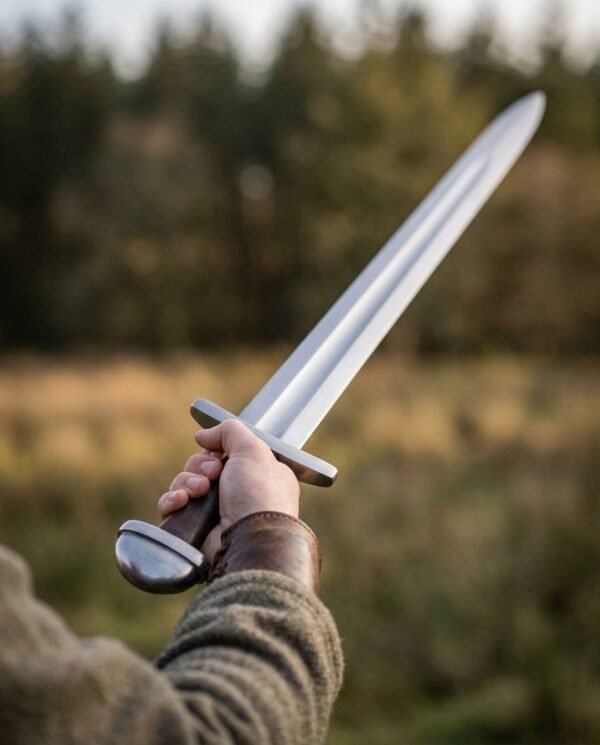
No. The photograph shows a blade for scale and context. You are buying the pair of oak plaques with their hooks and the wall fixings.
How much weight will the pair carry?
Fixed properly into a stud, a pair will comfortably hold a full sized sword, a bearded axe or a spear. Fixed into drywall with the supplied plugs alone, keep it to lighter pieces. The limiting factor is the wall, not the oak.
Can I hang a scabbarded sword on these?
Yes, and it is our preferred way to do it. Hanging the scabbard keeps the hook off the polished blade and lets you draw the sword without taking the whole thing down.
Do the hooks come already fitted?
Yes. The steel hooks are screwed to the plaques before they ship, so the only assembly is putting the plaques on the wall.
Can I have runes cut instead of the raven?
Yes. Use the rune converter on this page and tell us to replace the raven. Your engraving takes the place of the existing design rather than sitting next to it.
Will the two plaques match each other?
They are cut as a pair from the same board wherever possible, so they are a close match in tone and grain. They will not be identical, because wood is not identical.
What is in the box
- Two engraved oak wall plaques
- Two brushed steel hooks, already fitted
- Wall screws and wall plugs
- Care card for the oak and the steel
- Made and finished in the Czech Republic
Explore the range
See the rest of the sword stands and displays, the Viking home decor, the Viking swords that go on them, and the guides.
If this one is not it
For a straight comparison, see the Stavecradle sword stand. Worth putting side by side with this is the Runeledge sword stand. In the same category sits the Oakrest sword stand.
From the same corner of the shop, there is the Birchhollow Viking beer mug. Pick the steel, the length and the fittings yourself on the design your own page.

Bought this on a whim and it turned out to be one of my favorite purchases this year. Worth every penny.
Did not expect this level of quality for the price. Easily the best looking piece in my collection room now. Shipping was fast and everything arrived well packaged.
No regrets on this purchase at all. Looks fantastic mounted on the wall. Exactly the centerpiece I wanted. Can’t recommend this enough. It’s handmade in the Czech Republic but ships from a US warehouse so it arrived quicker than I expected.