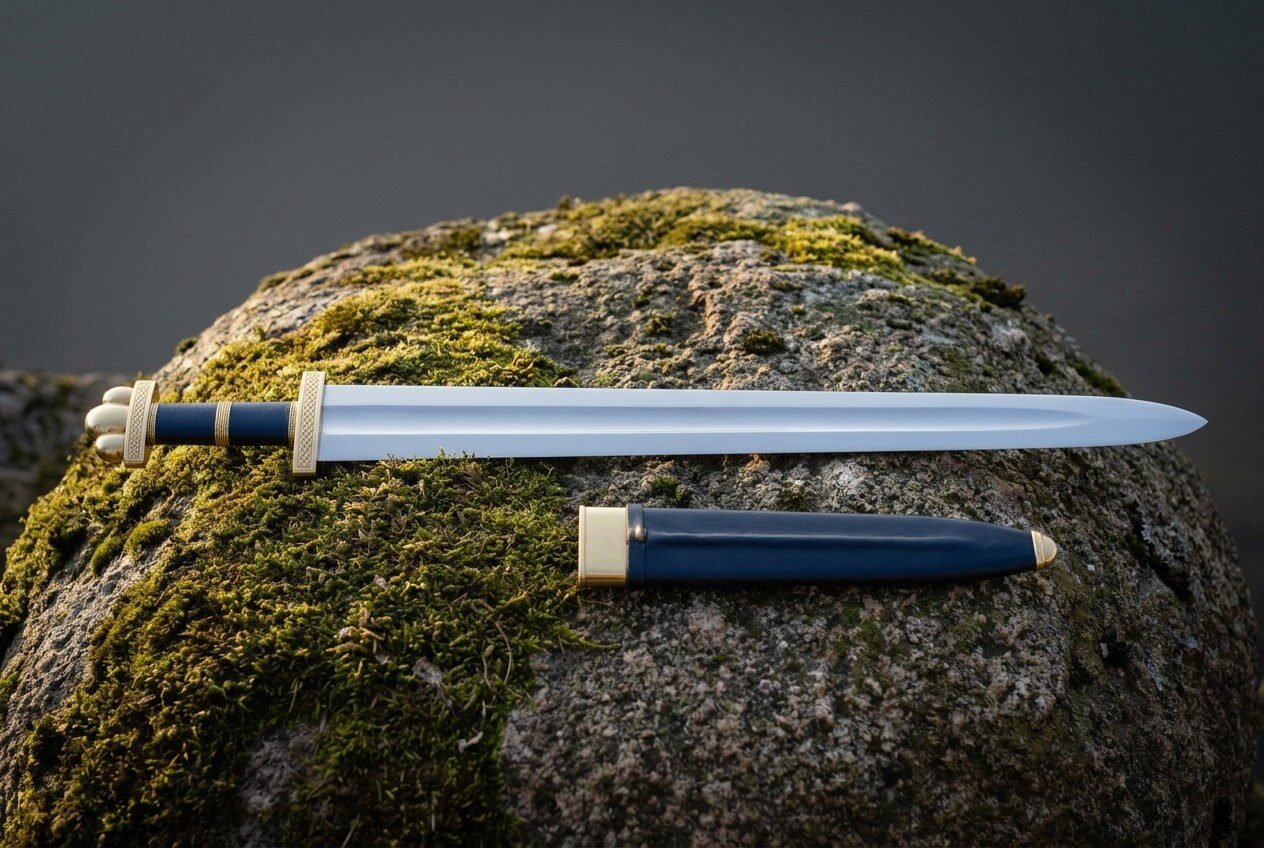
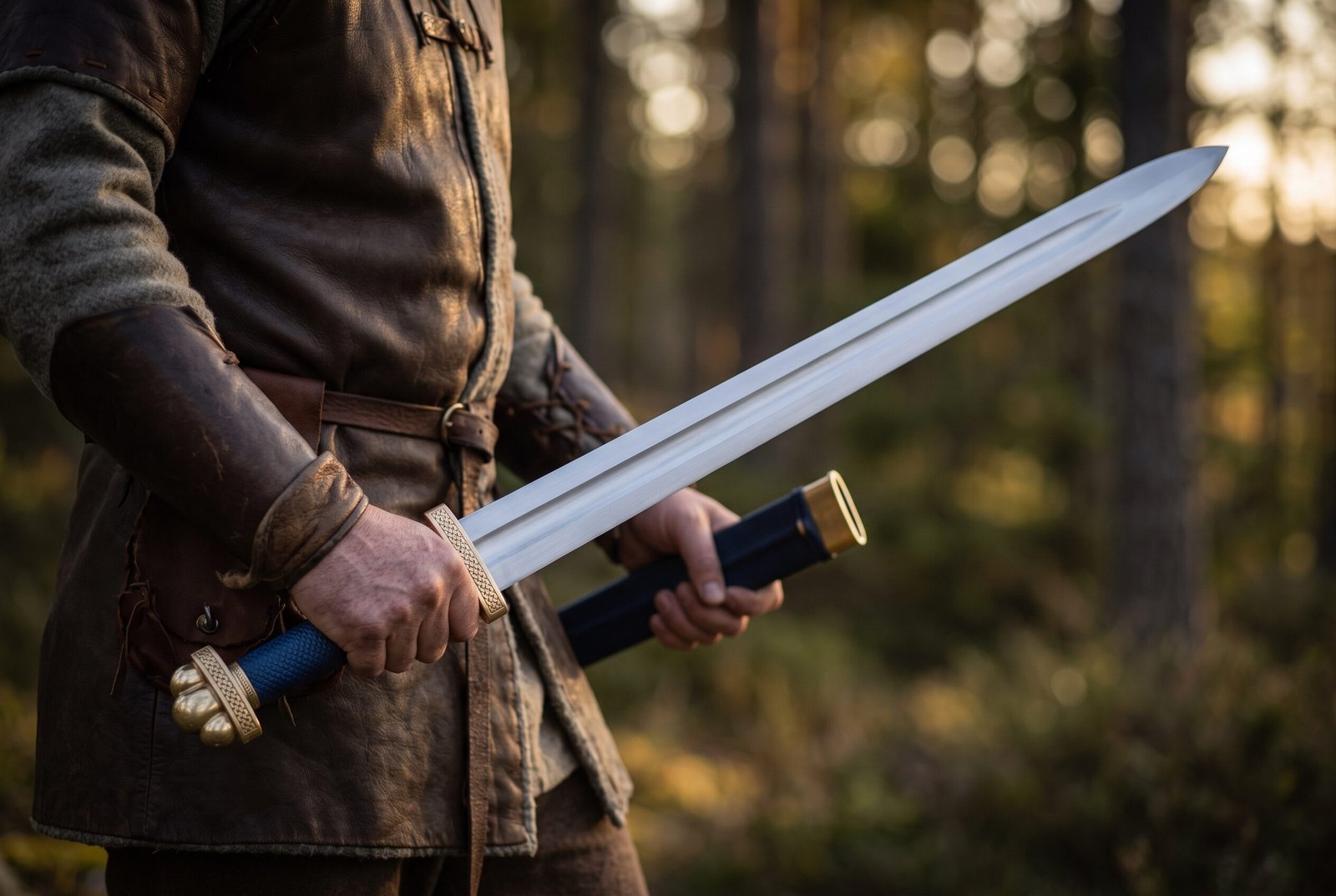
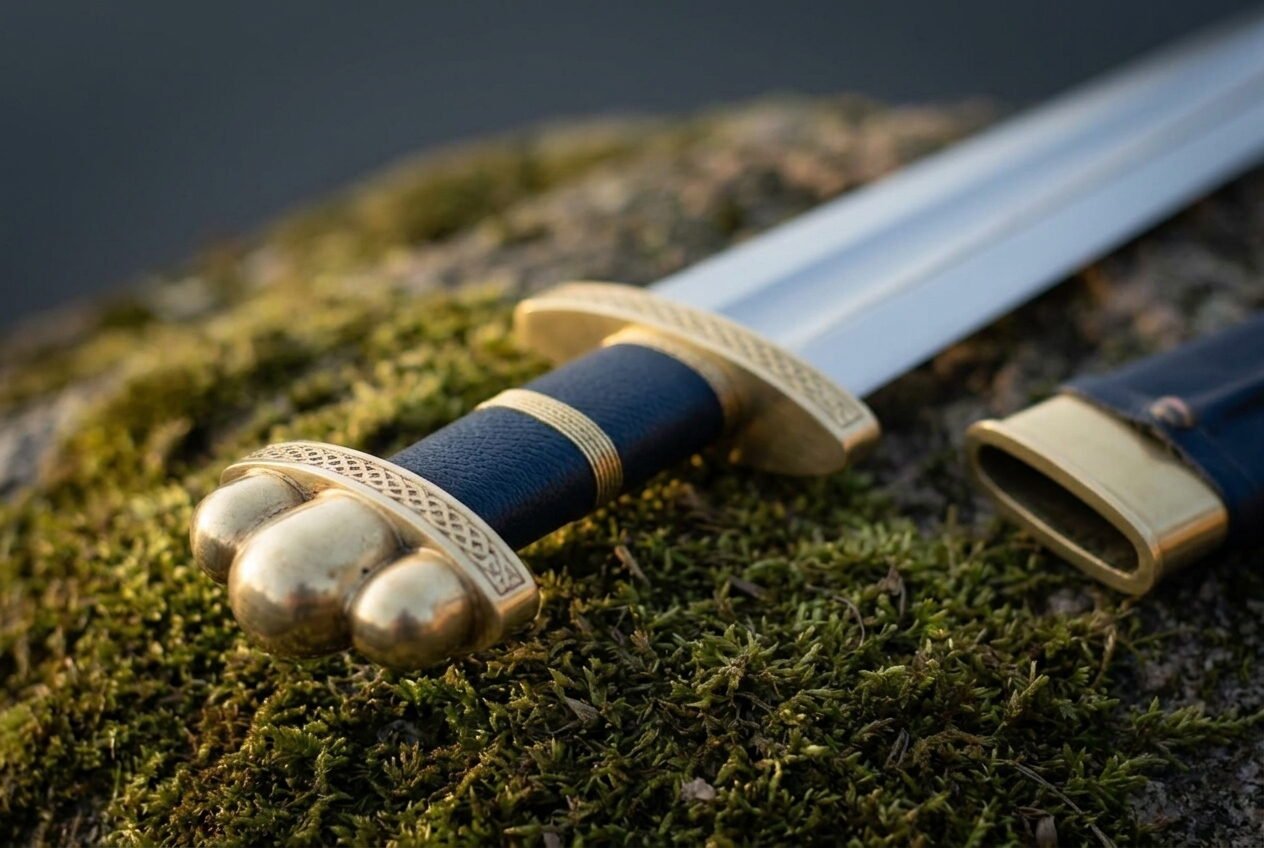
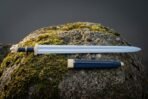
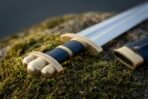
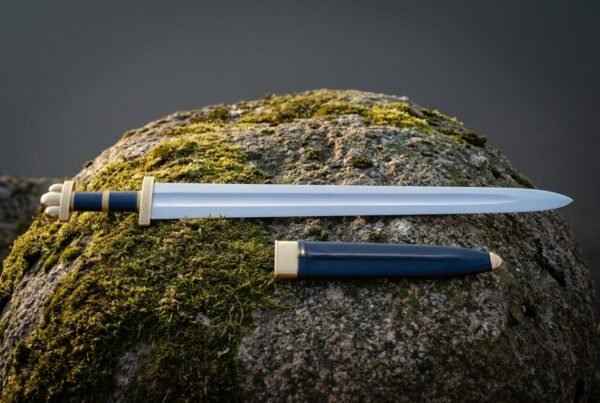
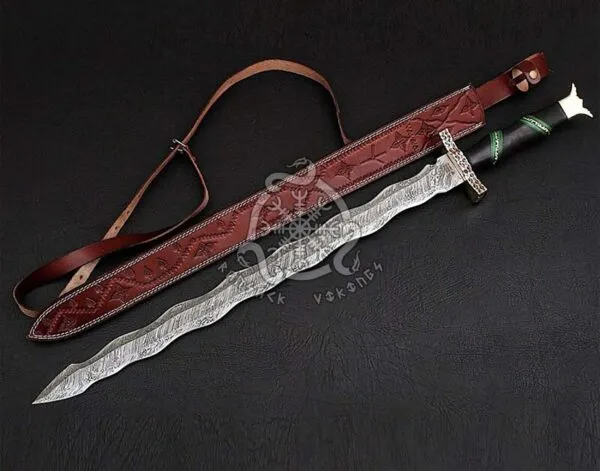
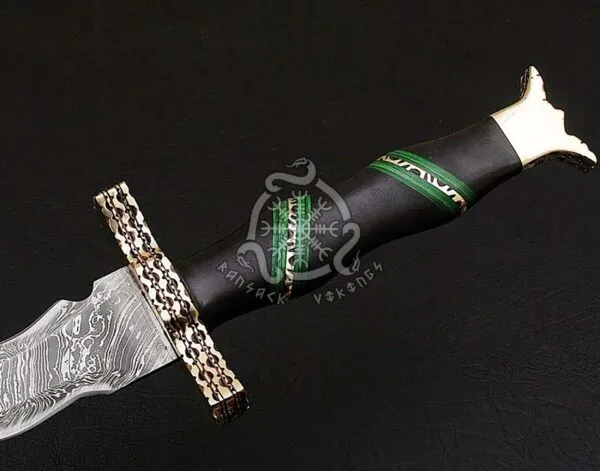
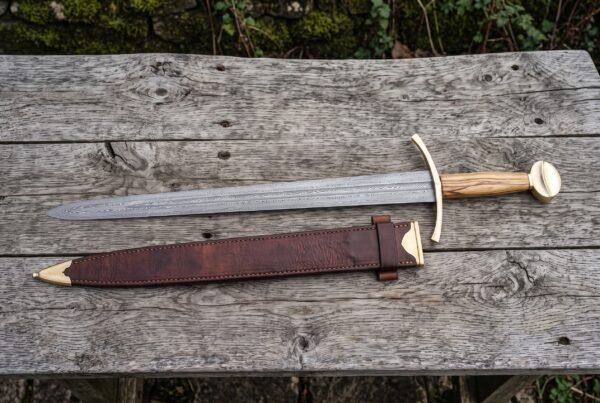
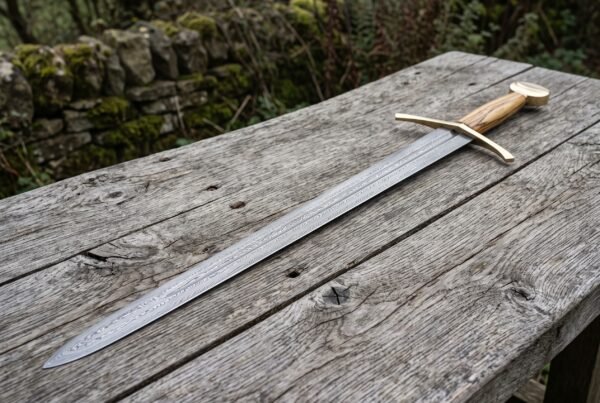
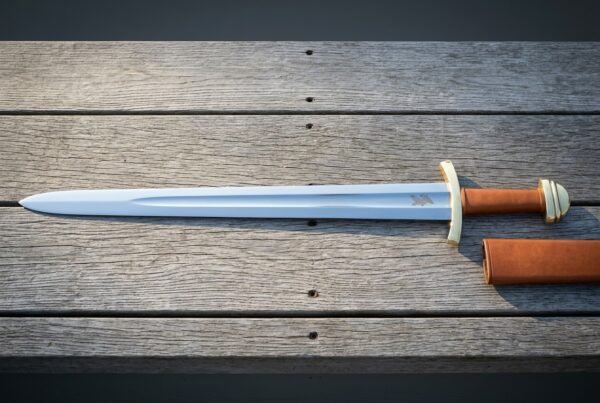
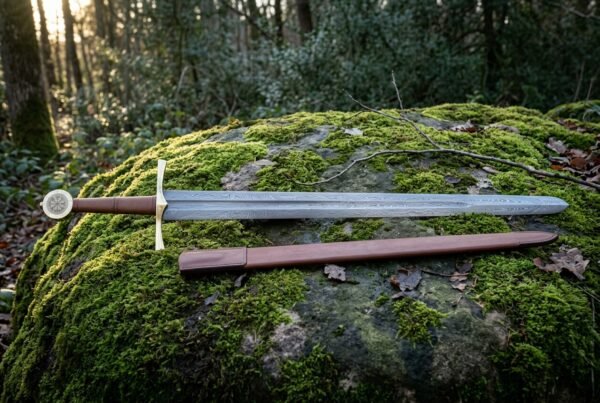
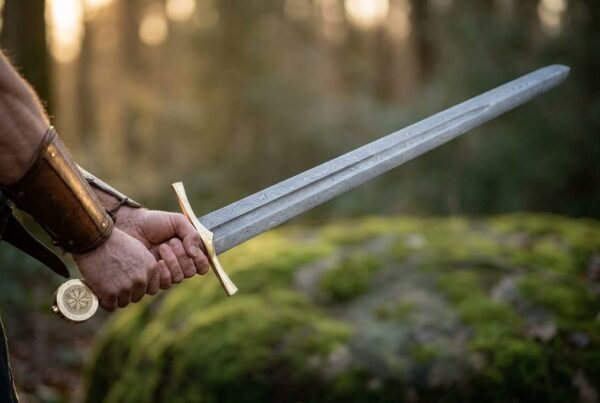
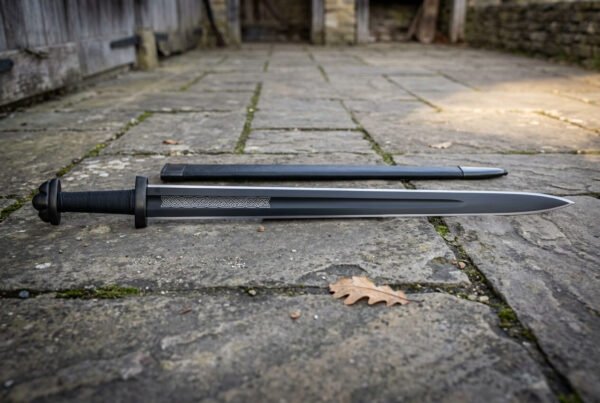
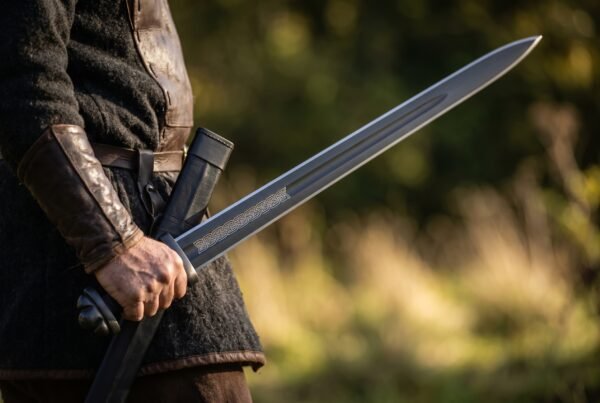
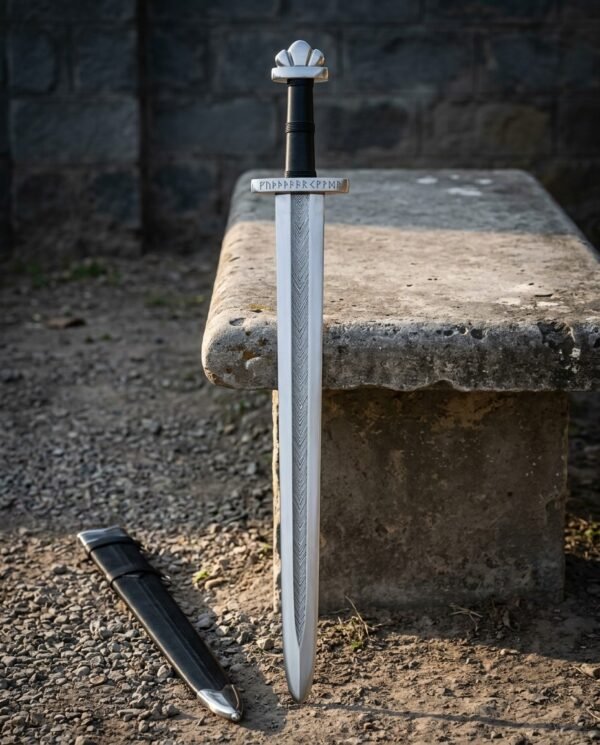
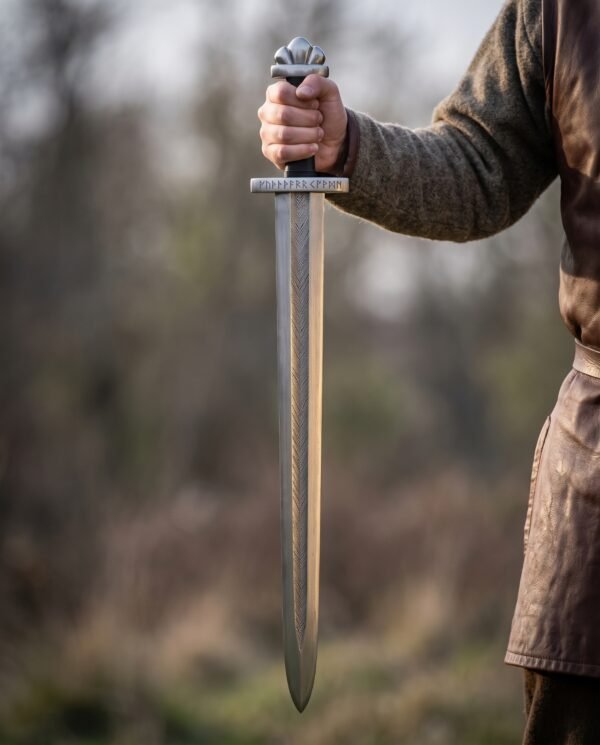
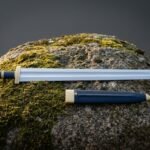
This is a Viking arming sword in the classic northern pattern. The blade is double edged with a broad shallow fuller running most of its length, ground bright and tapering to a point. The hilt is built around a straight brass lower guard and a lobed brass pommel, both cut with a fine knotwork border, with a deep blue leather grip bound between them and a brass band around its middle. It ships in a matching blue leather scabbard with a brass throat and a brass chape.
The single most misunderstood feature on this sword is the groove down the middle of the blade. It is not a blood groove and it has nothing to do with suction or with releasing anything from a wound. It is a fuller, and it is a stiffness trick. Removing material from the centre of the flat while leaving the edges intact turns a solid bar into something much closer to an I beam in cross section, so the blade keeps almost all of its resistance to bending while losing a real fraction of its weight. Norse smiths were working this out by feel five hundred years before anyone wrote down the engineering. This sword is forged, ground, fitted and mounted in a Czech Republic workshop. Kept with the Viking swords, and worth setting against the Norse arms before you decide.
Specifications
| Item type | Viking arming sword, double edged, single handed |
|---|
| Blade material | 1095 high carbon steel, polished |
|---|
| Hardness | 54 to 58 HRC |
|---|
| Blade form | Double edged with a broad shallow fuller, tapering to a point |
|---|
| Guard | Straight brass lower guard with a cut knotwork border |
|---|
| Pommel | Three lobed brass pommel over a brass upper guard, knotwork cut to match |
|---|
| Grip | Deep blue leather over a shaped core, with a brass band around the middle |
|---|
| Scabbard | Matching blue leather over a wooden core, brass throat and chape |
|---|
| Intended use | Display, collection and reenactment dress piece |
|---|
| SKU | RK-1639 |
|---|
Reading a Viking hilt
The shape of the pommel is how archaeologists date a Norse sword. Jan Petersen catalogued the Norwegian finds in 1919 and sorted the hilts into lettered types, and that system is still in use a century later, which tells you how consistent the smiths were. A pommel like the one here, a curved cap divided into lobes and sitting on a separate upper guard, belongs to the family that dominates the ninth and tenth centuries. Earlier hilts tend to be plainer and heavier, later ones drift towards the single tall brazil nut cap that leads into the medieval arming sword.
The lobes are not decoration alone. The pommel is a counterweight, and the lobed form gets mass out towards the sides where it does the most for the balance of the sword without adding depth that would foul the wrist. The guard is short and straight because a Viking fought behind a round shield rather than relying on the crossguard for protection, which is why the long crossguards of later medieval swords simply do not appear here.
The steel, the brass and the leather
The blade is 1095 high carbon steel, forged, ground, then hardened and tempered to 54 to 58 HRC. On a long blade that range matters more than it does on a knife. Push the hardness up and the blade holds an edge longer but becomes a brittle bar that can take a set or crack under a lateral load. Keep it in this range and the blade flexes and returns instead.
The fittings are solid brass rather than plated pot metal, which is why the knotwork border on the guard and pommel can be cut cleanly and why it will still be crisp in thirty years. Brass also has the useful property of being softer than the blade steel, so if a fitting ever needs to be reseated it can be worked without damaging the tang. The grip and the scabbard are leather over a shaped core. The core is what gives the scabbard its rigidity and its shape, and the leather is wet formed onto it so it dries tight rather than being wrapped loose.
Engraving, runes and your own design
Use the rune converter on this page to turn a name, a date or a short phrase into Elder Futhark and we will cut it into the steel or the leather. If you would rather have a Viking pattern than a rune line, choose your own design in the engraving option above the add to cart button and tell us where it goes. Where a piece already carries an engraved design, your chosen engraving replaces it rather than sitting alongside it. On a sword the usual placements are a rune line along the fuller, a name on the flat of the guard, or an inscription pressed into the scabbard. See the engraving page.
Handling and balance
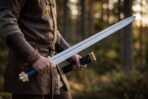
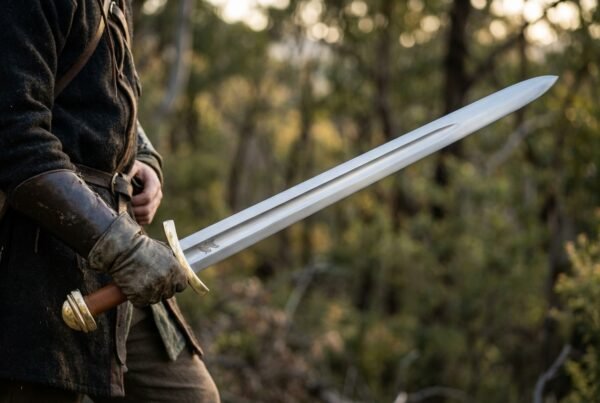
A Viking sword does not feel like a movie prop and it does not feel like a longsword. The mass sits forward of the guard but not far forward, and the lobed pommel pulls the balance point back towards the hand so the sword pivots around a point close to the wrist. That combination is what makes this pattern a cutting sword. It wants to be moved in arcs, and it recovers from a cut faster than its length suggests because the pommel is doing the work of stopping the blade.
Grip it lightly. The blue leather grip is shaped with a slight waist so it locates in the palm without needing to be clenched, and a light grip is what lets the edge align itself through a cut. Please treat this as a display, collection and reenactment dress piece. It is not a full contact sparring sword, it is not intended for edge on edge work against another blade, and we make no battle ready claim for it.
Care
The blade is high carbon steel and it will rust. Wipe it down after every handling session, because skin oil is acidic and a fingerprint left on bare steel etches itself in within days, then put a thin film of mineral oil or a light gun oil over the whole blade. Do not store the sword in the scabbard for long stretches. Leather is hygroscopic and a wooden core holds moisture, and a sword left sheathed in a humid room will come out with a rust bloom along one flat. Hang it or lay it out and keep the scabbard nearby instead. Feed the leather grip and scabbard with a little balm once or twice a year, and polish the brass when you want it bright, or leave it to warm into a soft gold. More detail is on the steel care page.
Made in the Czech Republic
This piece is made by hand in the Czech Republic, in a workshop that still works the old way. The steel is forged, ground, heat treated and finished by smiths who learned the trade from the people before them, and the wood, horn and leather are cut and fitted by hand rather than pressed out on a line. That is also why no two pieces come out exactly the same.
Ransack Viking is a United States company. We import these pieces ourselves, check every one when it lands and ship from our warehouse in Chicago, Illinois. Engraving is done here in the United States after the piece arrives, so your runes or your own design go on before it leaves for you.
A note on handmade variation
This sword is hand made, not machine made and not bulk produced, so what arrives will not be a pixel for pixel copy of the photograph. The fuller is ground by hand so its width and the way it fades out near the point vary between blades, the knotwork on the brass is cut by hand so the line spacing differs, leather takes dye unevenly by nature so the blue runs from deep navy to a slightly lighter tone across pieces, and the grip wrap carries the marks of being pulled tight by hand. The dimensions, the steel, the heat treat and the fittings are the same every time. The character is not. We wrote up the Norse symbols and what they meant separately, and there is a piece on the Viking swords collectors go for as well.
Frequently asked questions
Is it sharp when it arrives
It arrives with a working edge rather than a razor edge. That is standard for a sword of this pattern, and it is what you want on a piece that is going to be handled, hung and passed around.
Can I spar with it
No. This is a display, collection and reenactment dress piece. Edge on edge contact will chip any hardened blade, and a sword is not something to test on. Use a purpose built blunt trainer for contact work.
Is the fuller a blood groove
No, and nothing ever was. It is a stiffening and lightening feature that works the same way the web of an I beam does. The blood groove story is a modern invention.
Are the fittings solid brass or plated
Solid brass. They are cut, filed and fitted rather than cast in a soft alloy and coated, which is why the knotwork stays crisp and the pieces can be reseated if they ever need it.
Does it come with the scabbard
Yes. A matching blue leather scabbard over a wooden core with a brass throat and chape is included in the price.
How long does it take to arrive
One to two weeks of processing in the shop, then free shipping inside the United States. A long parcel sometimes needs a couple of extra days in transit.
What is in the box
- Hand forged 1095 steel Viking arming sword with fullered double edged blade
- Brass knotwork guard, brass upper guard and lobed brass pommel
- Blue leather grip with a brass band
- Matching blue leather scabbard with brass throat and chape
- Care card for high carbon steel, brass and leather
- Lifetime warranty against defects in forging, grind, heat treat and fittings
- Forged and finished in the Czech Republic
Explore the range
See more in the arming swords, the Viking swords and the scabbards and sheaths, or read the guides on Petersen hilt types and fullers.
Other pieces in this group
In the same category sits the Duskbrand Viking sword, forged from 1095. A near match for this one is the Redoath Viking sword, 36 inches overall. Closest to this in the range is the Emberhilt Viking sword, forged from 1095.
Fitting out further, the Plumescale arming sword belongs with it. Nothing here exactly right, build one to your own spec on the custom Viking sword page.
If sparring is on your mind, the Faskvar blunt arming sword is made for that job, and our HEMA arming swords is a useful next stop.

Photos don’t do this sword justice at all. Came in a nice gift box which made it feel even more special. Highly recommend this one.