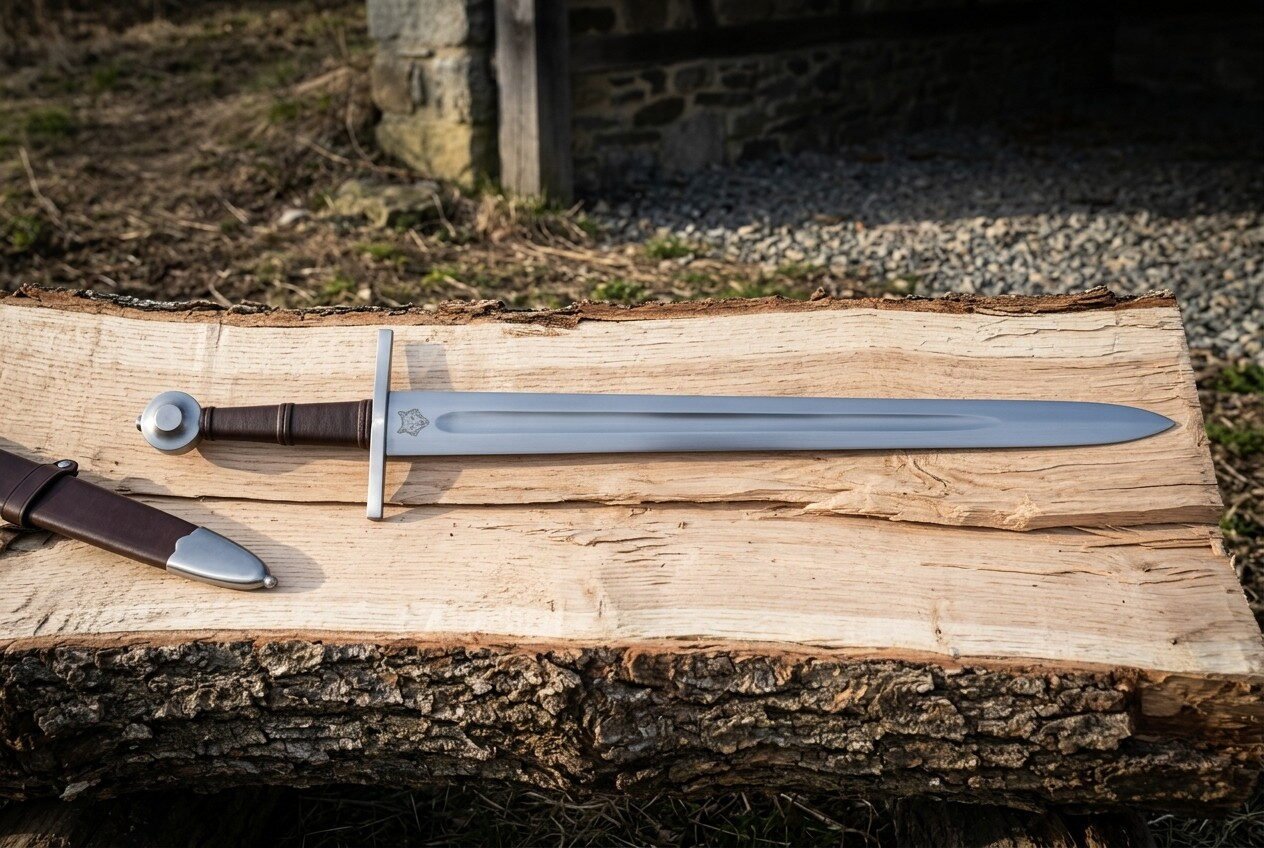
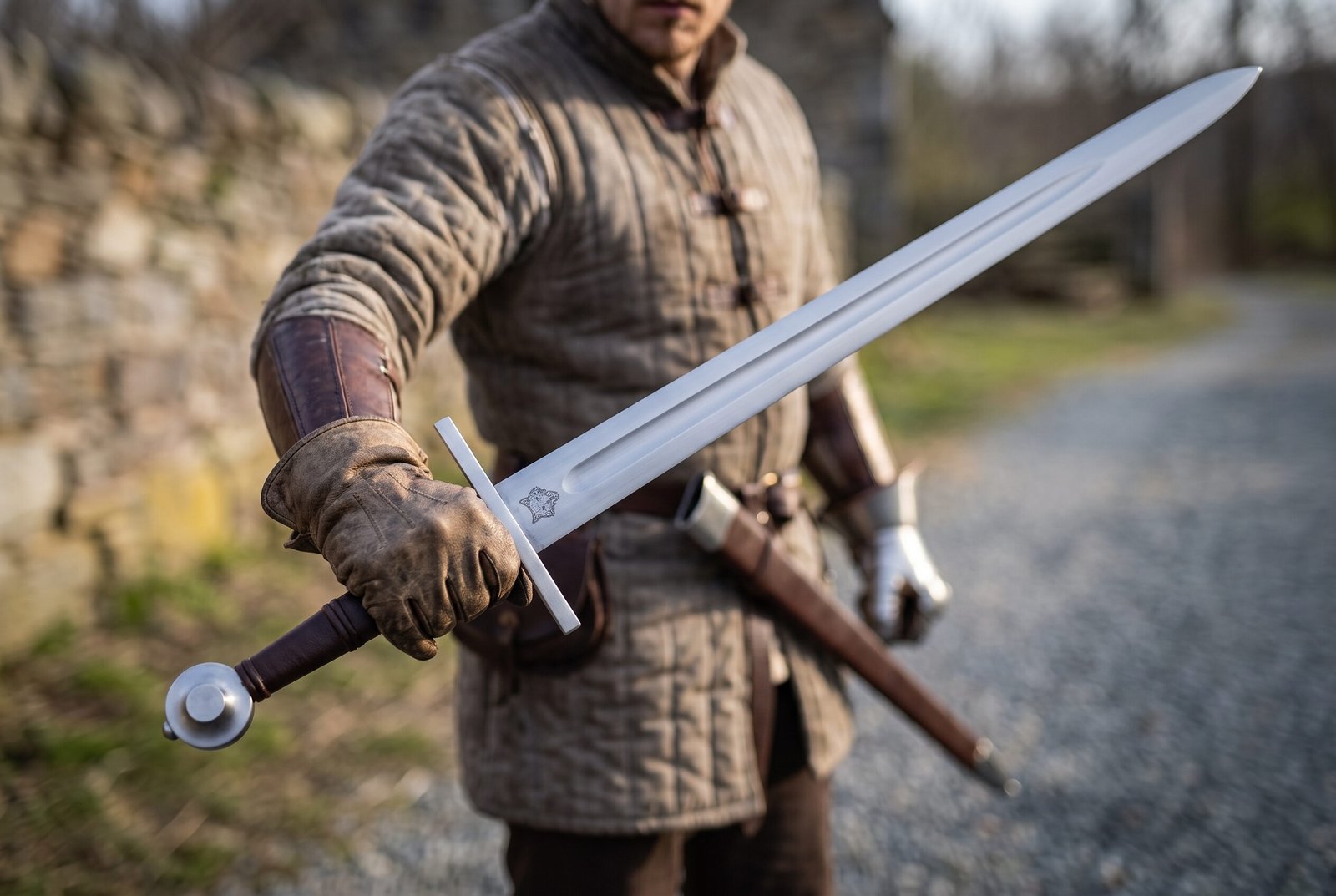
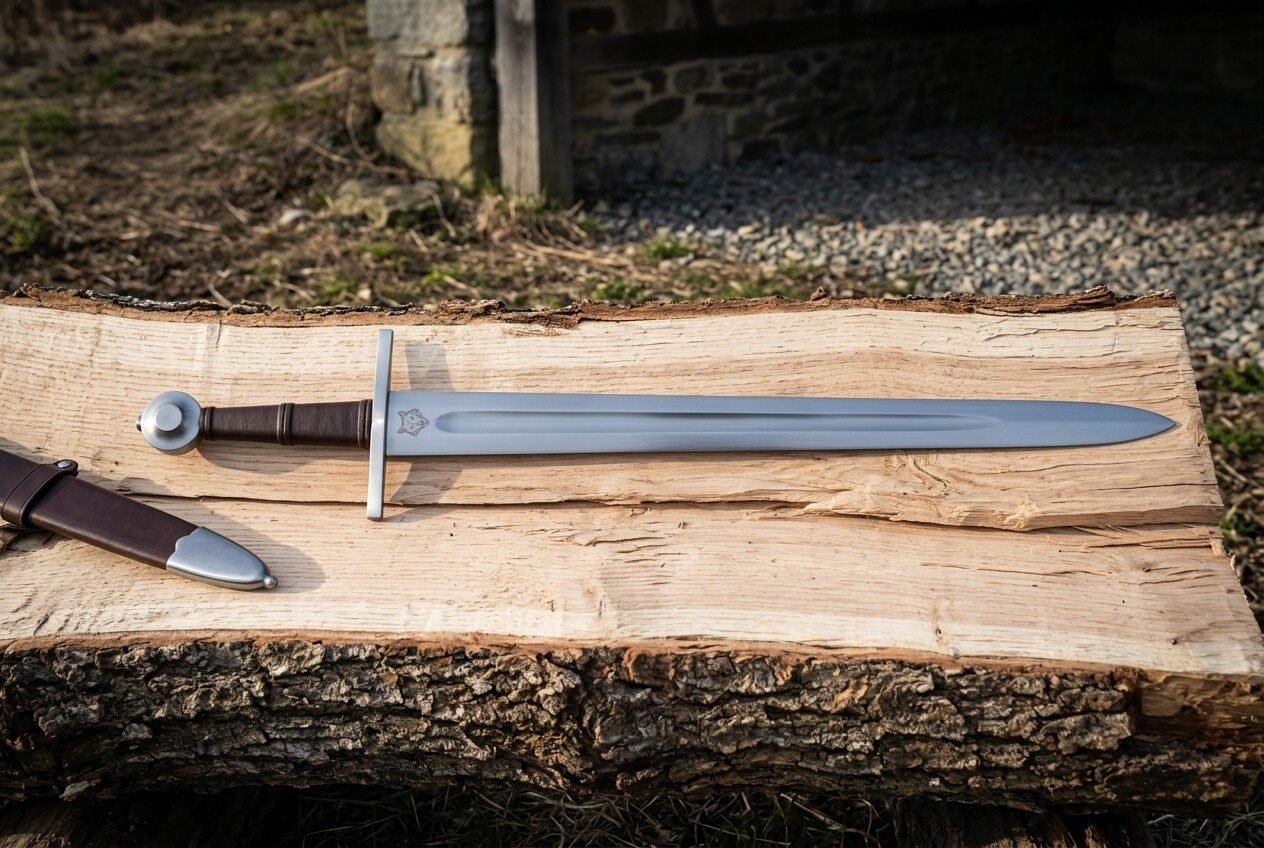
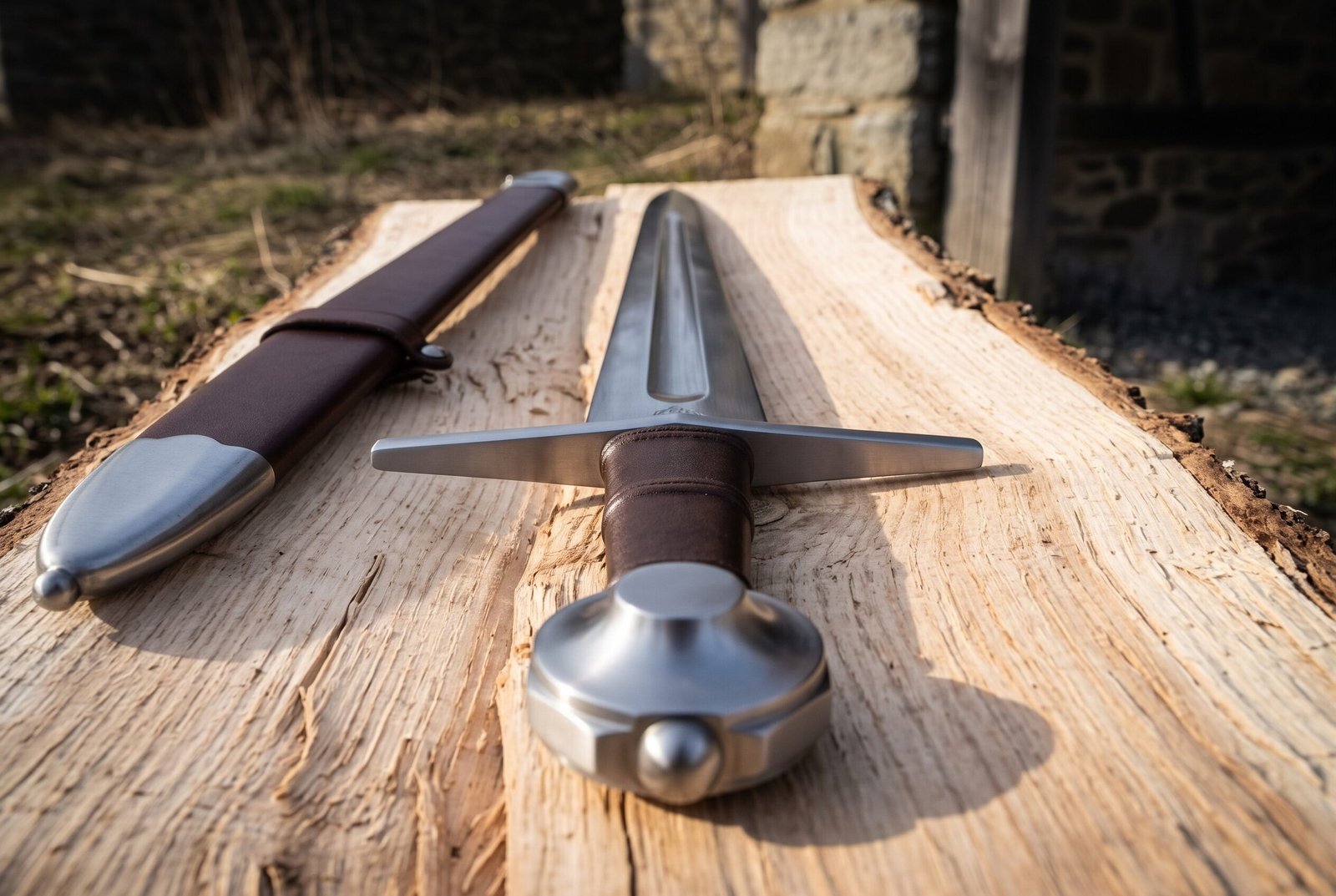
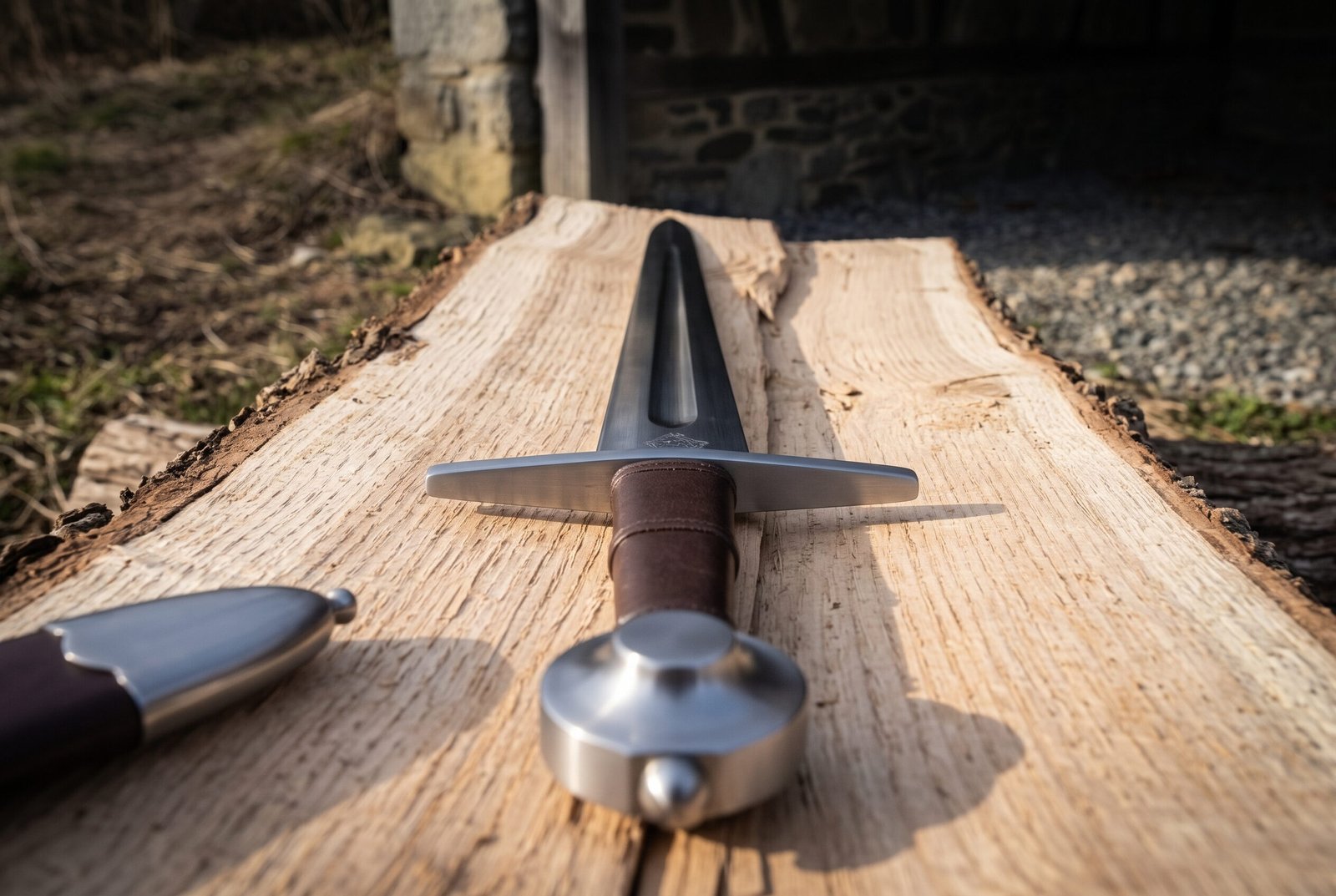
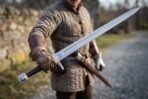
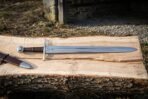
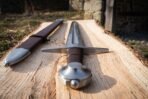
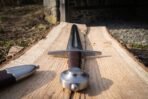
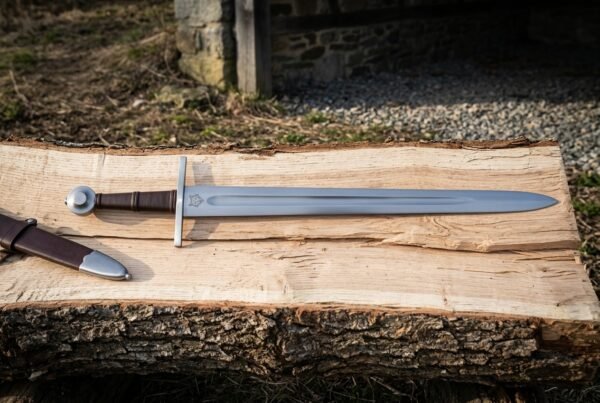
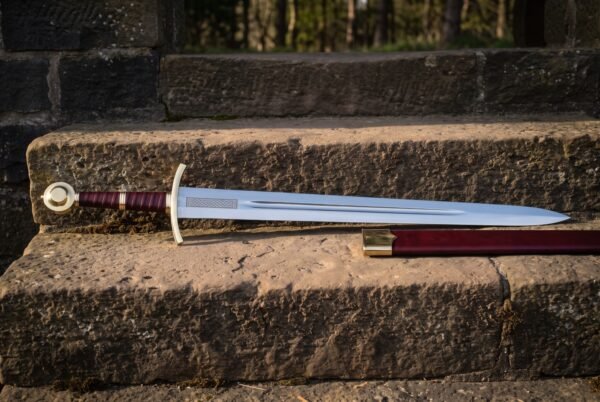
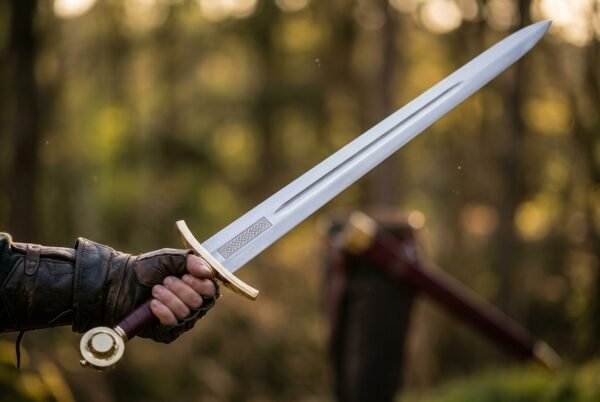
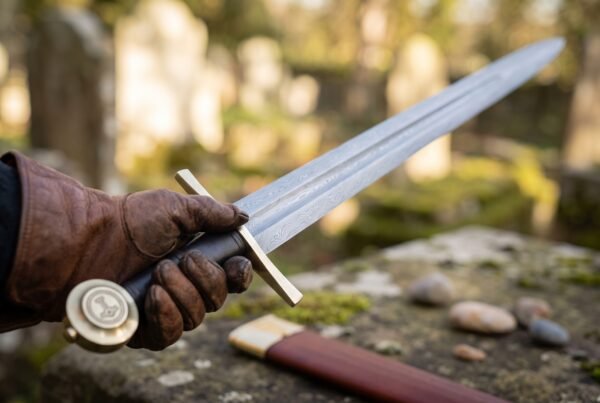
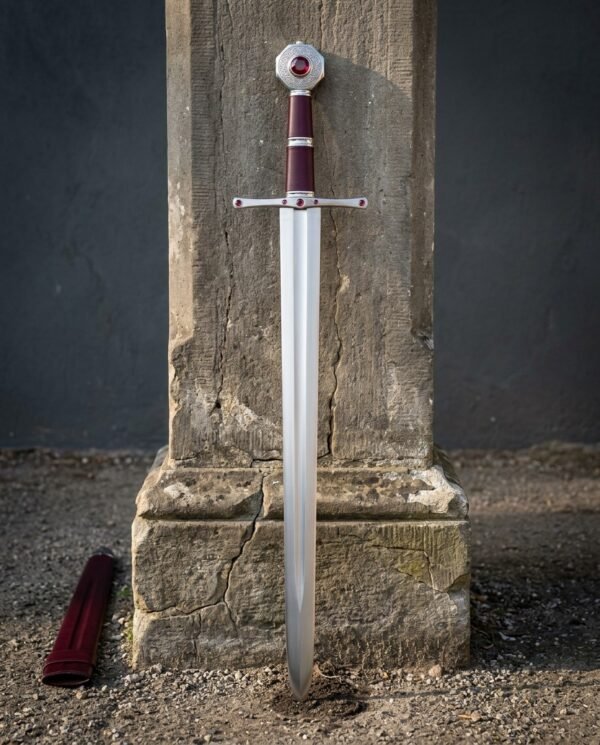
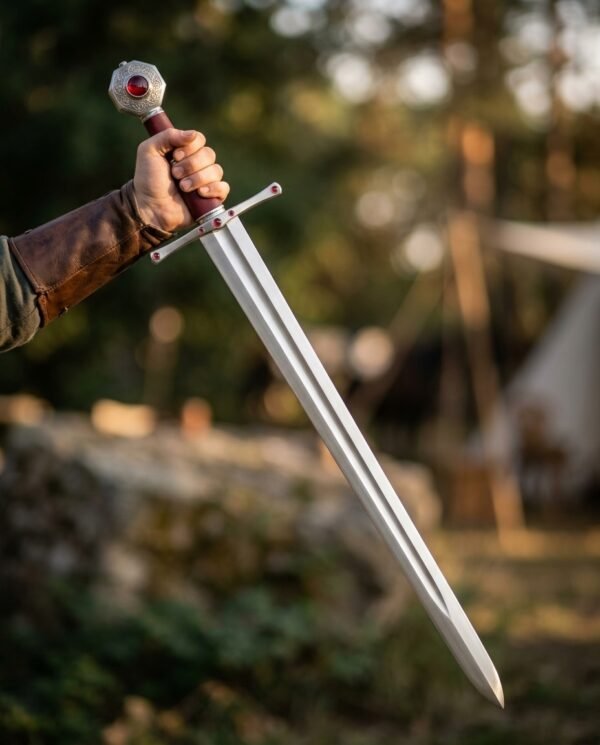
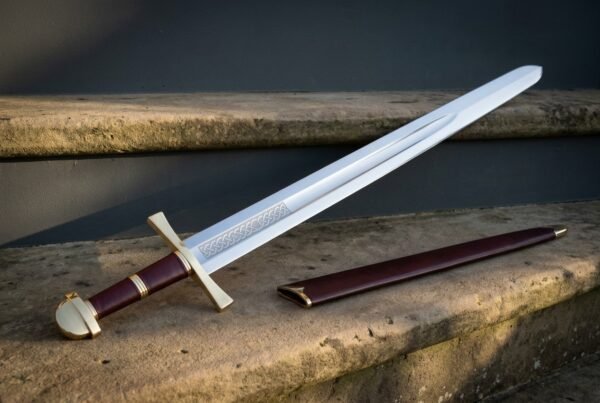
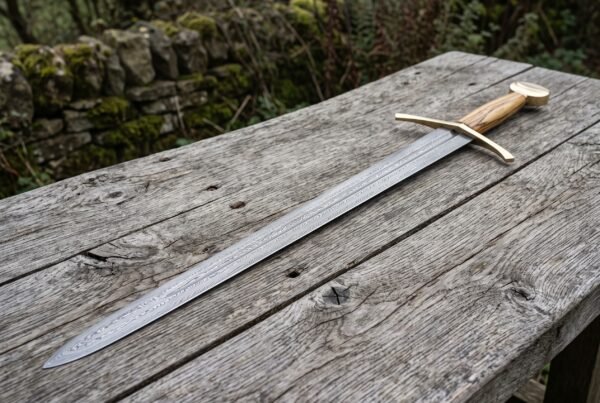
The Oathmark is a hand forged medieval arming sword of the knightly type, with a plain disc or wheel pommel, a long straight cross guard and a double edged blade carrying a narrow fuller that runs well down towards the point. The grip is brown leather over a wooden core, bound with a cord riser under the wrap so the hand has something to register against. A small maker mark is etched at the forte. It comes with a brown leather scabbard finished with a bright steel chape.
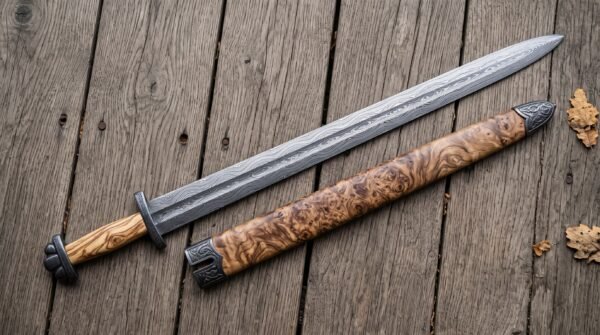
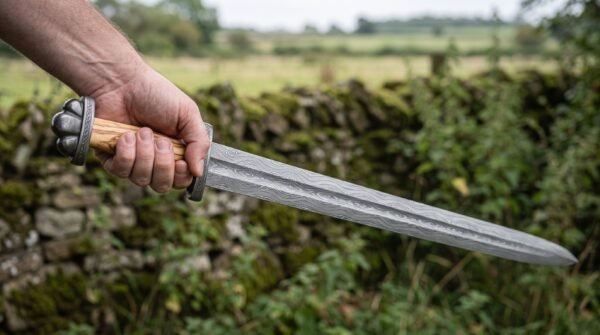
Set this beside a Norse sword and the changes tell a story about armour rather than about fashion. The Viking sword has a short guard because the fighter carried a metre wide linden shield and parried with that. As mail improved and shields shrank through the twelfth and thirteenth centuries, the hand came forward into danger and the guard grew out to meet it, which is why an arming sword cross is eight inches or more across. At the same time the lobed pommel flattened into a disc, because a wheel is easier to forge as a heavy counterweight and gives the offhand something to push against. This one is forged, ground, hardened and assembled in the Czech Republic. If the arming swords brought you here, the short swords are the obvious next stop.
Specifications
| Material | 1095 high carbon steel, hardened to 54 to 58 HRC |
|---|
| Overall length | Approximately 37 inches |
|---|
| Blade length | Approximately 30 inches |
|---|
| Blade | Double edged with a narrow central fuller and a hand ground distal taper |
|---|
| Cross guard | Approximately 8 inches, straight polished steel bar with slightly flared ends |
|---|
| Grip | Approximately 4 and a half inches, brown leather over a corded wooden core with raised risers |
|---|
| Pommel | Polished steel wheel with a raised centre boss, peened over the tang |
|---|
| Marking | Small etched maker mark at the forte |
|---|
| Scabbard | Brown leather over a wooden liner with a bright steel chape |
|---|
| Weight | Approximately 2 lb 10 oz bare |
|---|
| SKU | RK-1661 |
|---|
The wheel pommel and the long cross
The wheel is doing three separate jobs at once and that is why it lasted for four hundred years. It is a counterweight, so it pulls the balance point back towards the hand and makes a long blade feel manageable. It is a stop, so the hand cannot slide off the back of the grip during a hard pull. And it is a striking surface, which sounds strange until you read the medieval fighting manuals and find half swording and pommel strikes described as ordinary technique rather than as desperation.
The long cross is equally practical. Beyond protecting the hand it gives the blade something to hang from when the sword is used in the bind, since a cross that projects can catch and trap an opposing blade in a way a short Norse guard never could. Fiore dei Liberi and the German masters both build a great deal of their systems on that. None of this is decorative, and it is a good example of a sword whose shape is entirely the record of what it had to survive.
The steel and the assembly
The blade is 1095 high carbon steel, normalised, hardened and tempered to 54 to 58 HRC. On a blade this long that range buys resilience rather than the last few percent of edge holding, which is the correct trade. It carries a hand ground distal taper, meaning the steel thins from the guard to the point, and a narrow fuller that keeps stiffness while removing weight from the middle of the section.
The tang is full width and peened over the wheel pommel cold, hammered into the counterbore so the assembly locks up under compression. No thread, no nut and no epoxy anywhere in it. The grip is a wooden core in two halves glued to the tang, wrapped with a cord riser and then covered in leather, which is how the medieval originals were built and why they stay tight in a way a solid leather sleeve never does.
Engraving, runes and your own design
Use the rune converter on this page to turn a name, a date or a short phrase into Elder Futhark and we will cut it into the steel or the leather. If you would rather have a Viking pattern than a rune line, choose your own design in the engraving option above the add to cart button and tell us where it goes. Where a piece already carries an engraved design, your chosen engraving replaces it rather than sitting alongside it. On the Oathmark the maker mark at the forte is that existing design, and custom work takes its place there. The face of the wheel pommel is the other traditional spot and it suits a single initial, a cross or a short date. See the engraving page.
Handling and balance
Balance sits about four and a half inches ahead of the cross. That is a moderate forward balance and it gives a sword that cuts with authority but does not drag the point down when held at a guard for any length of time. The corded riser under the grip leather is what stops the hand rotating in a hard cut, and it is the single detail most often left out of cheaper swords.
This is a sharpened hand forged sword sold as a collector and display piece for careful solo handling. It is not a blunt sparring sword, it is not built for full contact fighting, and it should never be used against another blade or near other people. Store it out of reach of children.
Care
Plain high carbon steel will rust from a fingerprint left overnight in a humid room. Wipe the whole blade after handling, including the fuller where a cloth tends to bridge over rather than reach in, and leave a thin film of mineral oil on the steel. Do not keep the sword sheathed for months in a damp space, because leather holds moisture against steel. Fine steel wool and oil will lift any early surface rust without pitting. Feed the scabbard twice a year with a neutral cream and keep it out of direct sun. There is more on steel care.
Made in the Czech Republic
The work behind this piece happens in a Czech Republic workshop that has kept to the old methods. Steel is forged and heat treated by hand, the grind is taken down by eye rather than by machine, and the handle, fittings and sheath are cut and finished one at a time. Because of that, every piece carries small marks of the hand that made it.
Ransack Viking is a United States company. We import direct, check each piece when it reaches us, and ship from our Chicago, Illinois warehouse. Engraving is added here in the United States after arrival, so the piece you receive is finished to your order.
A note on handmade variation
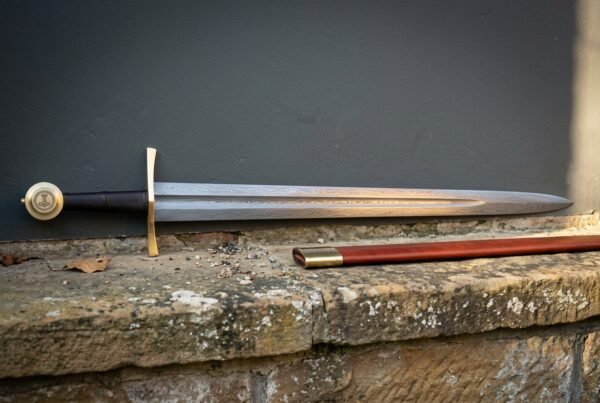
This sword is hand made, not machine made or bulk produced, so what arrives will not be a pixel for pixel copy of the photograph. The fuller is ground by hand and runs out at a slightly different point on each blade. The cord riser under the grip sits by feel rather than by measurement, so the wrap will read a little differently. The leather takes dye its own way on every hide. The length, the steel, the heat treat, the geometry and the build are the same every time. The character is not. There is more on that in why a full tang matters, and in the gap between a display sword and a battle ready one if you want the background.
Frequently asked questions
Is this a Viking sword
No. It is a later knightly arming sword, with a wheel pommel and a long cross guard rather than a lobed pommel and a short Norse guard.
Is it sharp when it arrives
Yes. Both edges are hand sharpened before it leaves the shop, so treat it as sharp on opening.
Can I use it for sparring
No. Sparring needs a blunt rebated blade built for contact. This is a sharp collector and display sword for solo handling.
What is the mark on the blade
A small etched maker mark at the forte, in the tradition of medieval smiths who stamped their work near the guard. It can be replaced with your own design.
Is the grip glued or wrapped
Both. A two part wooden core is fitted to the tang, corded, then covered in leather, which is how the originals were built.
How long is the lead time
One to two weeks of forging, grinding and assembly, then free shipping inside the United States.
What is in the box
- Oathmark medieval arming sword with a wheel pommel and long cross guard
- Brown leather scabbard with a wooden liner and a bright steel chape
- Care card for plain high carbon steel
- Leather feed note for the scabbard
- Lifetime warranty against defects, no receipt needed
- Forged and finished in the Czech Republic
Explore the range
Browse the rest of the arming swords, the longswords, everything under swords, and the guides for how a sword is assembled and peened.
Compare it with these
In the same category sits the Azurehold arming sword, 37 inches overall. A near match for this one is the Bluewake arming sword, 38 inches overall. Closest to this in the range is the Ivorycrest arming sword, 37 inches overall.
Fitting out further, the Stavelight Viking sword belongs with it. Pick the steel, the length and the fittings yourself on the custom Viking sword page.
If sparring is on your mind, the Storvekk kriegsmesser is made for that job, and our HEMA messer range is a useful next stop.

This sword is a genuine work of art. Fit and finish is museum quality. You can tell real craftsmen made this by hand. Ransack Viking’s attention to detail is honestly unmatched. Can’t recommend this enough.
My whole family was impressed when I unboxed it. If you’re on the fence just get it. You won’t regret it.
Was nervous ordering something like this online but so glad I did. Edge retention has been great even after regular use. The wood handle feels amazing and the balance is perfect. Worth every penny.