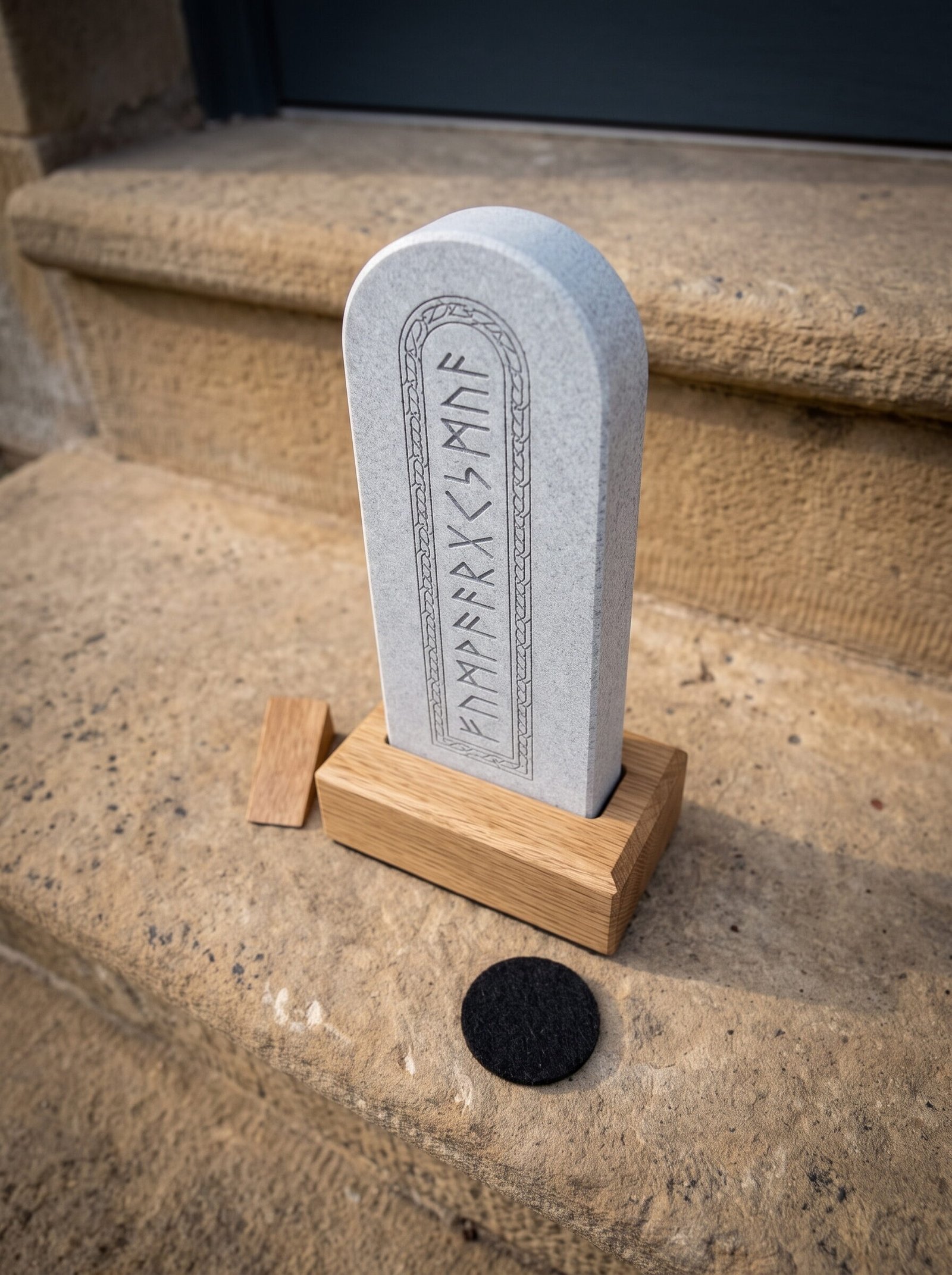
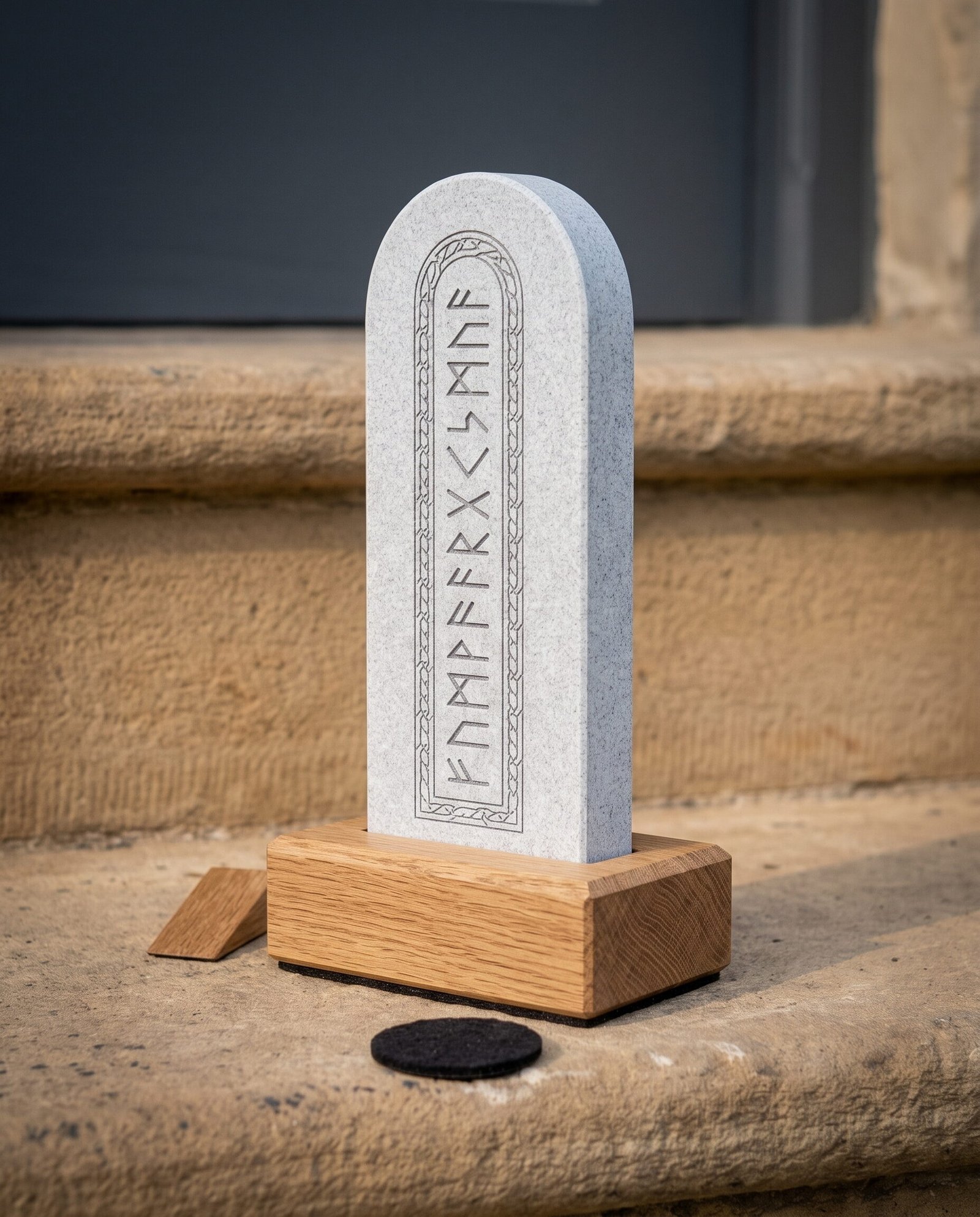
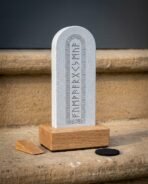
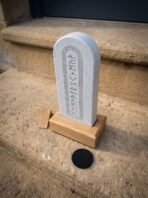
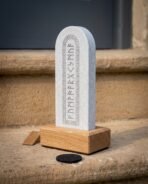
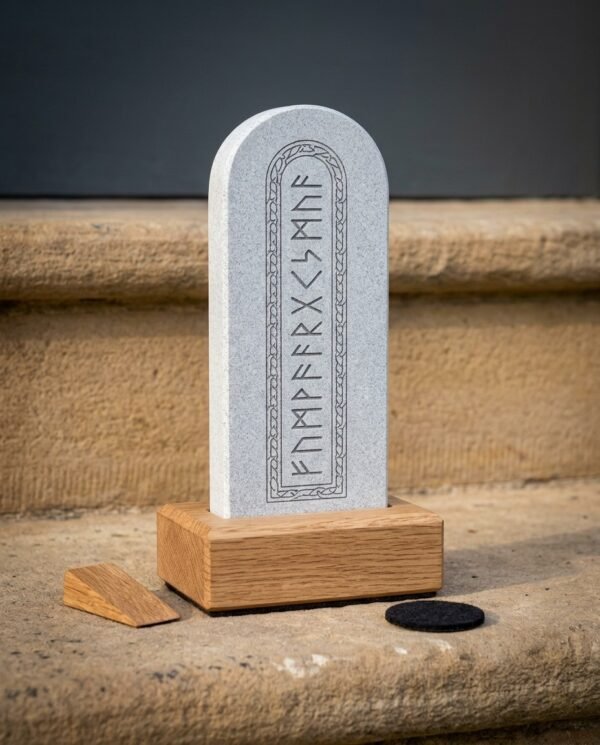
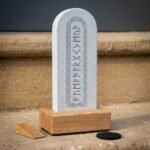
This is an engraved standing rune stone cut from pale grey stone, with a rounded arch top, a full row of Elder Futhark staves down the face and a fine interlaced knotwork border framing them in an arch. It sits in a solid oak base with a cut slot, so it stands upright on a shelf, a desk or a mantel without any fixing, and it lifts straight out if you want to move it.
Real rune stones are memorials, and the thing that surprises most people is how many there are. Sweden alone has roughly two and a half thousand, the great majority raised in the eleventh century, and they follow a formula so consistent that you can read one without knowing much Old Norse. Somebody raised this stone in memory of somebody, who was their father or brother or partner, and then often a line about how the dead man died or where he travelled. They are not magical objects. They are the eleventh century equivalent of a headstone and a public announcement combined, put up beside a road or a bridge where people would pass and read them. Several say so explicitly, ending with a note that the raiser also built the bridge.
Each stone is cut, ground, engraved and based by hand in a Czech Republic workshop, and the oak base is cut, slotted and finished at the bench. It ships with felt pads for the base and a care card. It lands in the rune stones and rune sets, with the Viking home decor pieces close enough that people usually look at both.
Specifications
| Material | Natural pale grey speckled stone, honed matt face |
|---|
| Shape | Upright slab with a rounded arch top and eased edges |
|---|
| Overall height | Approximately 10 inches standing in the base |
|---|
| Stone size | Approximately 8 inches tall and 4 inches wide with an arched top |
|---|
| Engraving | Single column of Elder Futhark staves running up the face, inside an interlaced knotwork arch border |
|---|
| Base | Solid oak block with a cut slot, oiled finish |
|---|
| Finish | Matt honed stone with eased edges, oiled oak |
|---|
| Weight | Approximately 2 lb 4 oz with the base |
|---|
| Included | Rune stone, oak base, felt pads, care card |
|---|
| SKU | RK-1705 |
|---|
How to read the row on the face
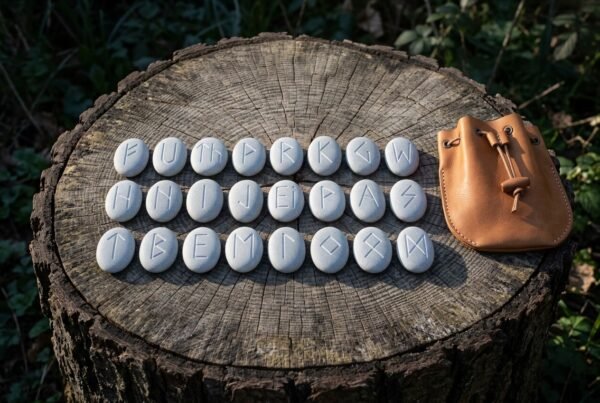
The staves running down the face are the Elder Futhark, the oldest runic alphabet, in its traditional order. That order is not alphabetical in our sense and it is not random. It is fixed, it appears in that sequence on inscribed objects from the third century onward, and the name futhark is simply the first six sounds of it read out, in the same way that alphabet comes from alpha and beta. Nobody knows why that particular order was chosen and it does not match any other writing system, which is one of the genuinely open questions in the field.
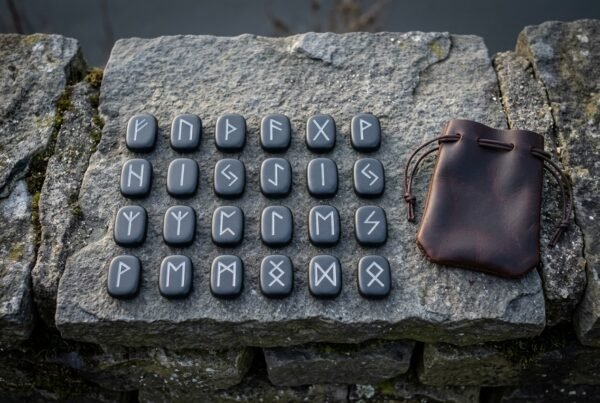
Twenty four staves make up the row, and they divide into three groups of eight called aettir. Each stave has a name that is also an ordinary word, so Fehu is cattle or wealth, Uruz is the aurochs, Thurisaz is the giant or the thorn, and so on down the row. The names survive because three medieval rune poems, one Old English, one Old Norwegian and one Old Icelandic, describe each stave in a line or two of verse for memorisation. They disagree with each other in places, which is how you can tell they are genuinely old rather than reconstructed.
The knotwork arch around the row is drawn from the framing you find on real Scandinavian rune stones, where the inscription usually runs inside the body of a stylised serpent or ribbon that loops around the face. On the great stones at Jelling in Denmark the band is unmistakably an animal.
The stone and the oak
The stone is a pale grey with a fine dark speckle running through it. It takes a cut stroke cleanly without crumbling at the edge of the line, it is dense enough to feel substantial, and its matt surface lets the engraved strokes read by shadow without any fill.
Tone runs from near white to a soft mid grey depending on the block, and the speckle falls differently on every face. Stone is tough in compression and brittle at an edge, so every corner and edge here is eased by hand.
The base is solid oak, chosen because it is heavy enough to keep a top heavy stone stable and hard enough that the slot does not wallow out with repeated lifting. It is oiled rather than lacquered, so it can be re fed rather than stripped when it eventually dries out. Oak is also the honest choice for a Norse piece, since it is the timber the ships and the halls were built from.
Engraving, runes and your own design
Use the rune converter on this page to turn a name, a date or a short phrase into Elder Futhark and we will cut it into the steel, the leather or the wood. If you would rather have a Viking pattern than a rune line, choose your own design in the engraving option above the add to cart button and tell us where it goes. Where a piece already carries an engraved design, your chosen engraving replaces it rather than sitting alongside it.
This is the piece people most often personalise, because a rune stone is a memorial object by nature. A name, a date, or a short line in memory of someone goes on the face in place of the standard futhark row, inside the same knotwork arch. We can also cut a short line into the front of the oak base and keep the full row on the stone. Say which you want in the order notes and see the engraving page for lettering and lead time.
Mounting and display
The stone is not glued into the base. It sits in a cut slot sized so it stands firm without rocking and lifts out cleanly, which means you can take it out to dust it or to move it without carrying an awkward assembly. Put the felt pads on the underside of the base before you stand it on a polished surface, because stone grit and oak are both harder than most furniture finishes.
It reads best with light coming from one side rather than straight on. Raking light throws shadow into the cut strokes and makes the runes legible from across a room, while flat frontal light flattens them out. A shelf with a window or a lamp to one side is close to ideal. The stone looks best against wood, plaster or fabric and worst against glass or mirror, which reflects up behind it and destroys the contrast the engraving relies on. Keep it out of sustained direct sun, which will slowly lighten the oak more than the stone and unbalance the pairing.
Care
Dust the stone with a dry brush or a soft cloth. If it needs more, use a barely damp cloth and dry it afterwards. Do not soak it, do not use household cleaners or descalers on it, and do not scrub the engraved lines with an abrasive pad, because the stone will polish unevenly where you rub hardest and leave a shiny patch that catches the eye.
Feed the oak base once a year with a hard wax oil or a furniture oil, applied thin and buffed off, especially if it lives in a heated room where the air is dry. If the slot ever feels loose after years of lifting the stone in and out, a thin strip of felt in the bottom of the slot takes up the slack without gluing anything.
Made in the Czech Republic
Every piece we sell is made by hand in the Czech Republic. The smiths there work the way the trade has been worked for a long time, heating and hammering the steel, taking the bevels down by eye, and fitting the handle and the leather one at a time. There is no automated line anywhere in it, so small differences from one piece to the next are normal and expected.
Ransack Viking is a United States company based in Chicago, Illinois. We bring the pieces in ourselves, inspect them on arrival and ship them from our own warehouse. If you add engraving, that is carried out here in the United States before your order goes out.
A note on handmade variation
This piece is hand made, not machine made and not bulk produced, so what arrives will not be a pixel for pixel copy of the photograph. This is quarried stone and every block runs its own grey, from near white to a soft mid grey, with a speckle that falls differently on every face. The engraving is cut by hand, so stroke weight varies slightly across the row and the knotwork border carries a human line rather than a machine one. Oak varies enormously in figure and colour, and the oil finish takes differently on each block. The dimensions, the material and the build are the same every time. The character is not. For the detail behind that, see the Elder Futhark, and what runestones were actually for alongside it.
Frequently asked questions
What do the runes on the face say?
They are the complete Elder Futhark row in its traditional order, not a phrase. If you want a name, a date or a line of your own, use the rune converter and it will be cut in place of the row.
Is it fixed into the base?
No. It sits in a cut slot sized to hold it upright without rocking, and it lifts straight out for cleaning or moving.
Can it go outside in a garden?
The stone can. The oak base is finished for indoor use and will grey and weather outdoors within a season. If you want it in a garden, stand the stone in soil or gravel and keep the base inside.
Is the engraving filled with paint?
No. The strokes are cut and left bare, which is why they read by shadow rather than by colour. That is how genuine carved rune stones work and it ages far better than a painted fill.
Will mine be exactly this grey?
Close, but not identical. Stone colour and speckle vary from block to block, and oak varies more than that. The size, the shape and the rune row do not vary.
How long does it take to arrive?
Making time is one to two weeks and United States shipping is free. Custom engraving adds a few days because it is cut after the stone is honed.
What is in the box
- One hand engraved pale grey rune stone with Elder Futhark row and knotwork arch border
- Solid oak display base with a cut slot
- Felt pads for the underside of the base
- Care card covering dusting, oak oiling and outdoor use
- Lifetime warranty against defects in the making
- Made and finished in the Czech Republic
Explore the range
See the rest of the rune stones and rune sets, the Viking home decor and the engraved and personalised pieces, or read the guides for more on the Elder Futhark and Scandinavian rune stones.
Others in the same line
Next along the rack is the Fatecast rune set. For a straight comparison, see the Thundermark rune set. Worth putting side by side with this is the Stonecast rune set.
If you are putting a set together, the Thornmaul Viking home decor sits alongside it. You can have this made your way instead on the design your own page.


This piece is fine. Just didn’t wow me. Decent quality overall though not amazing. Wouldn’t say no to it but wouldn’t rave about it either.