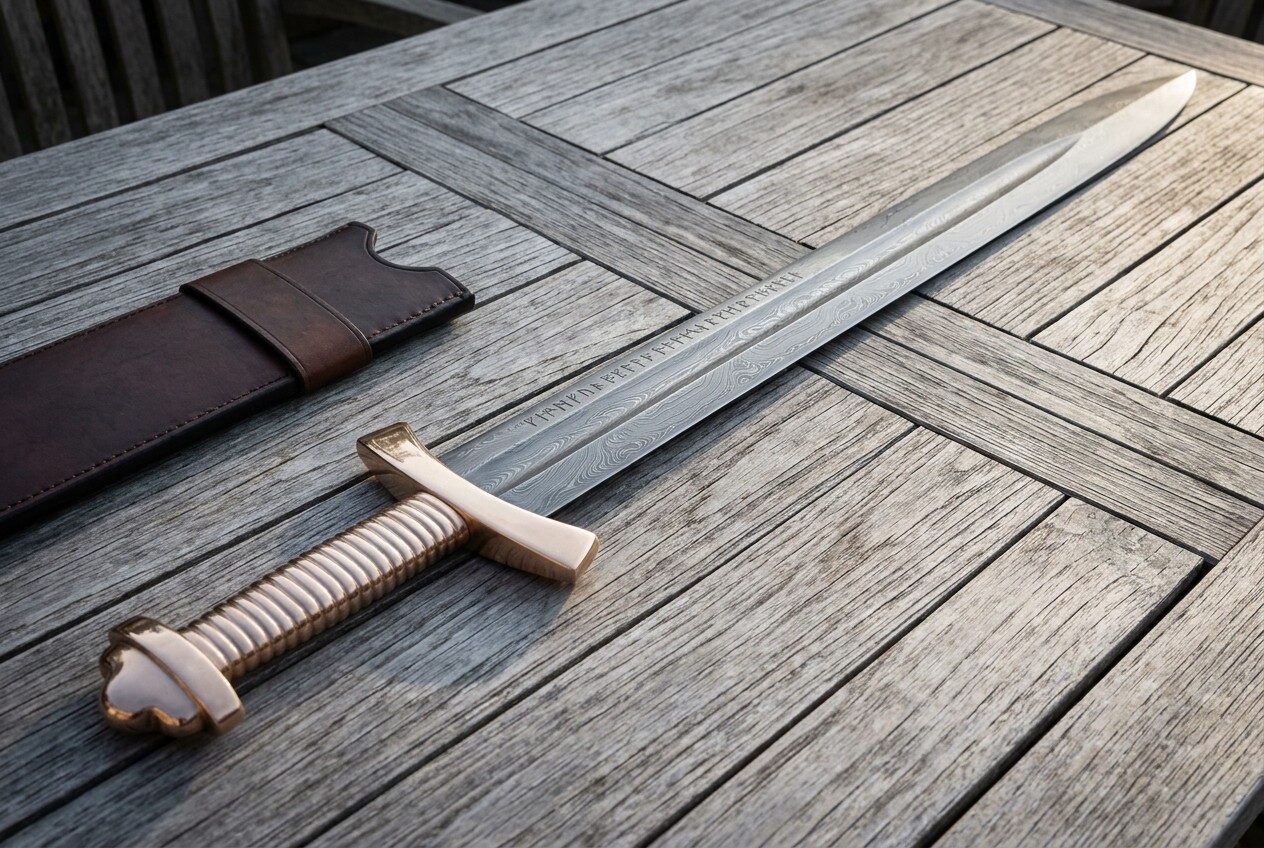
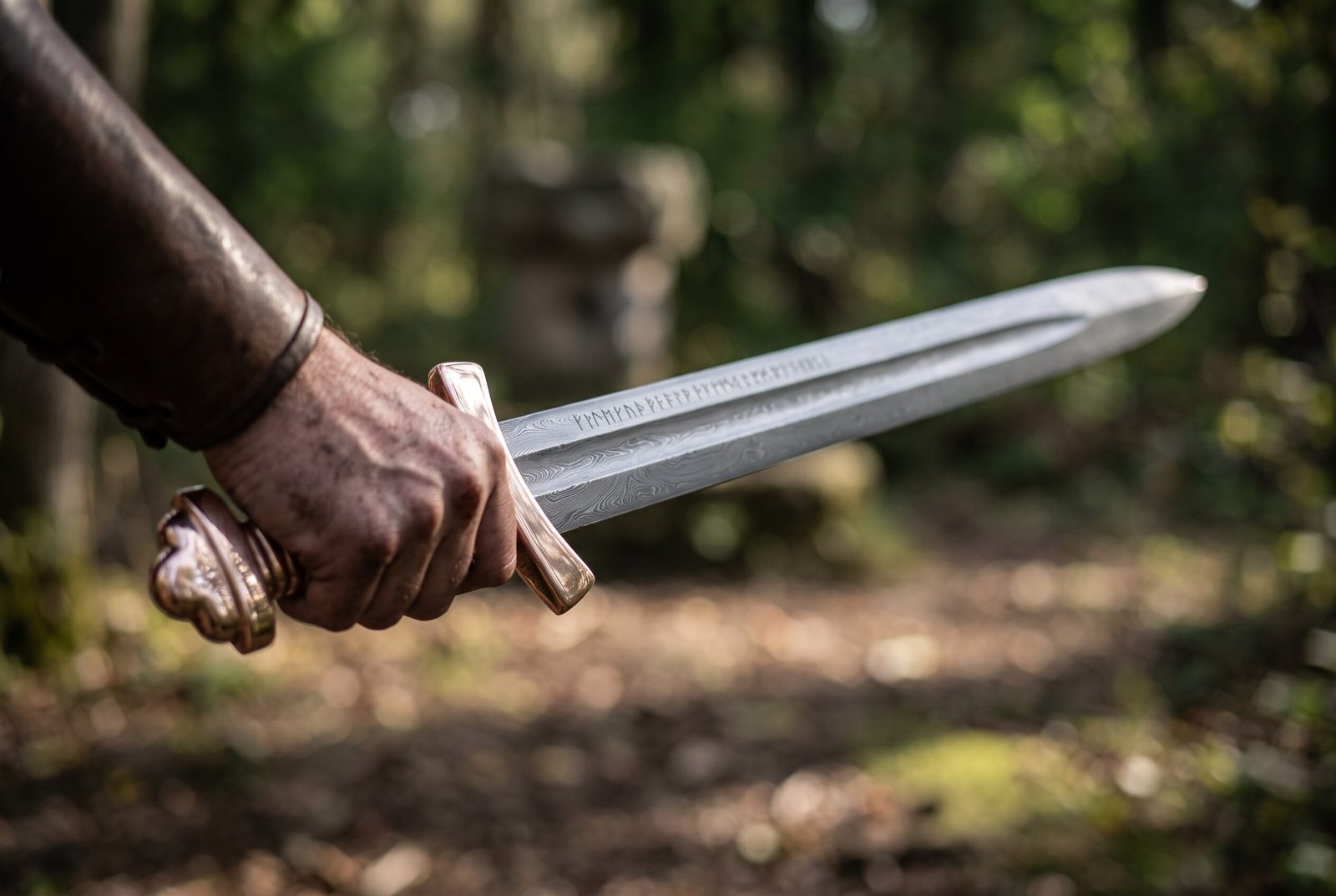
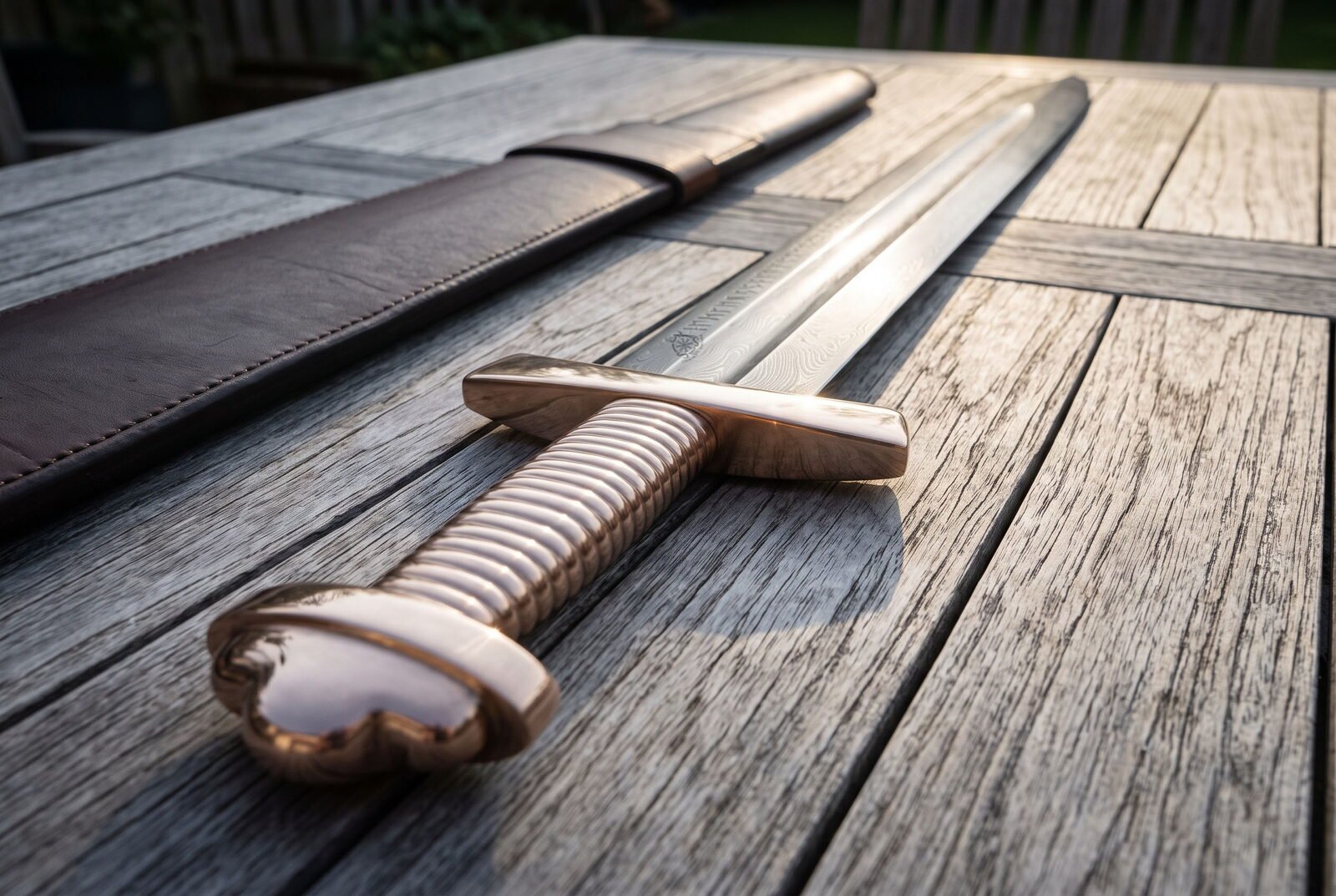
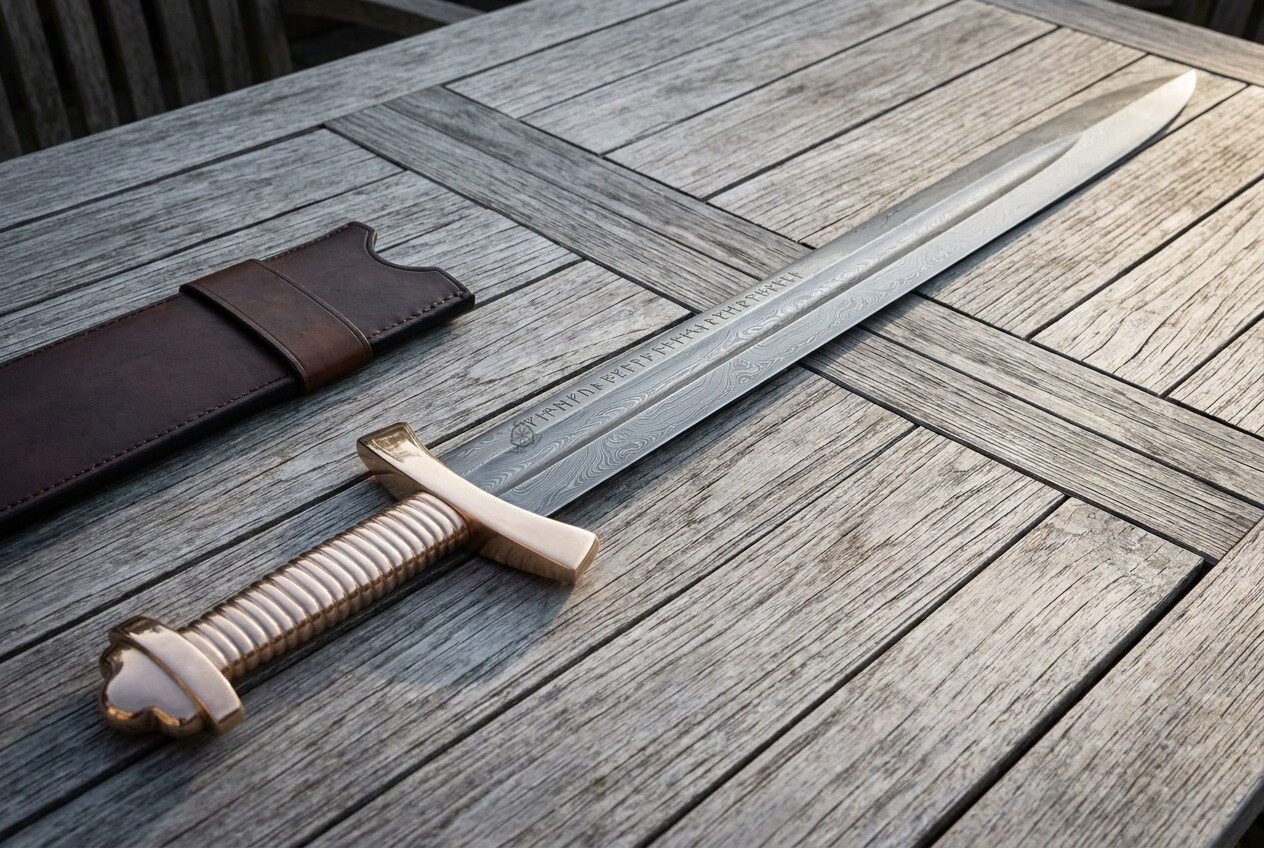
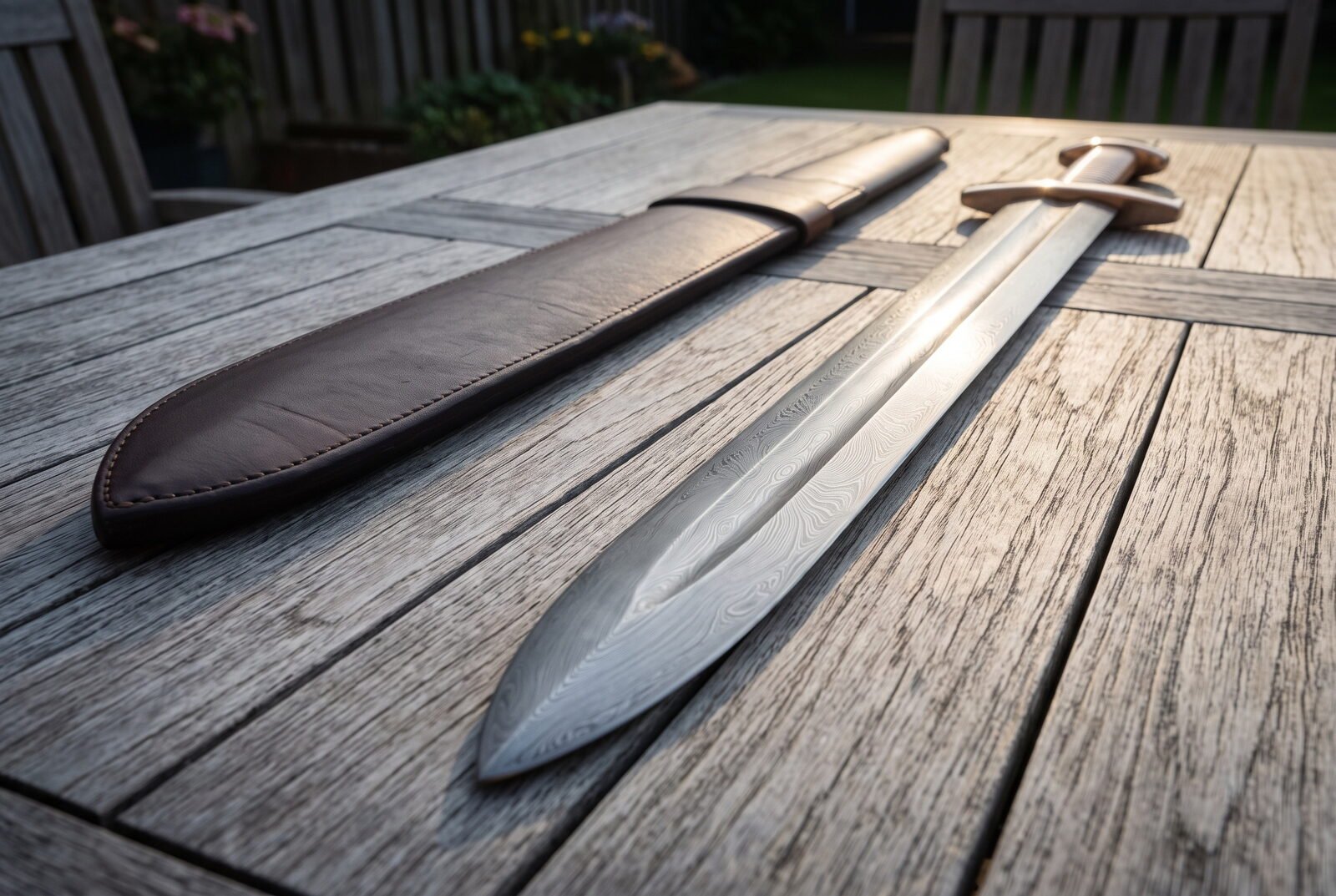
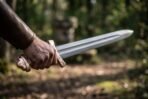
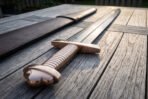
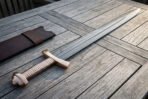
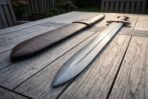
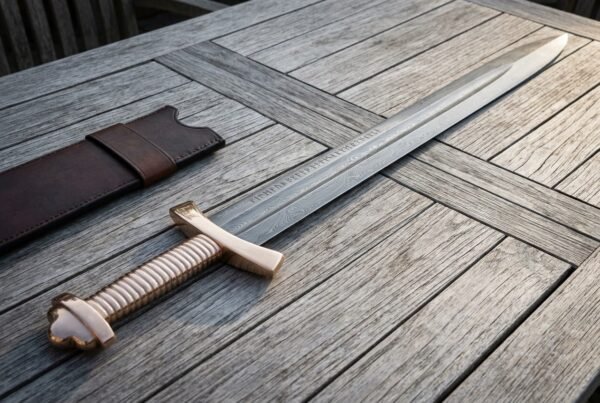
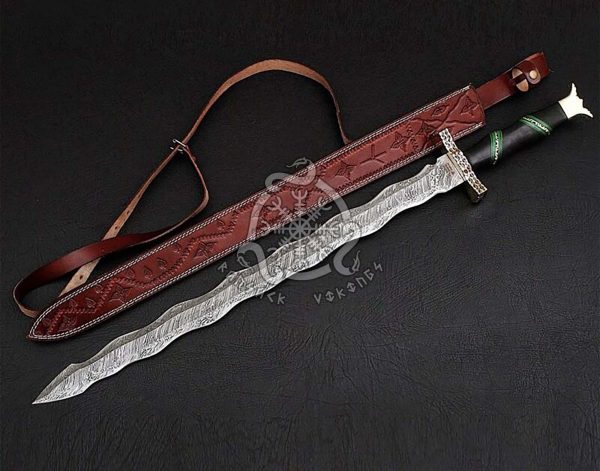
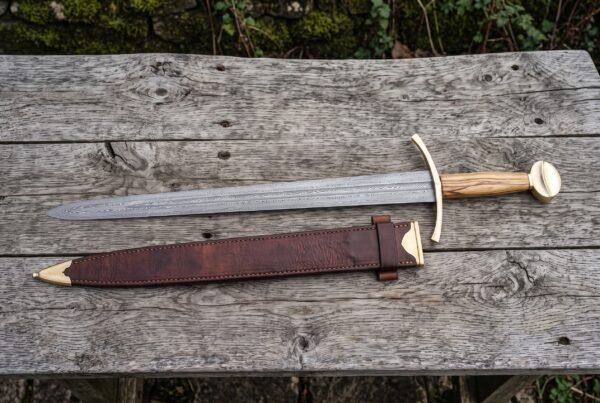
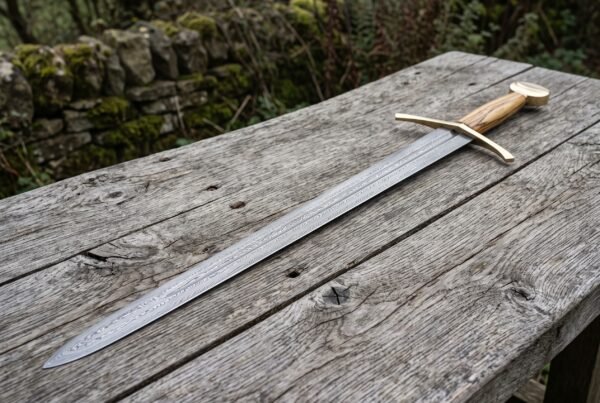
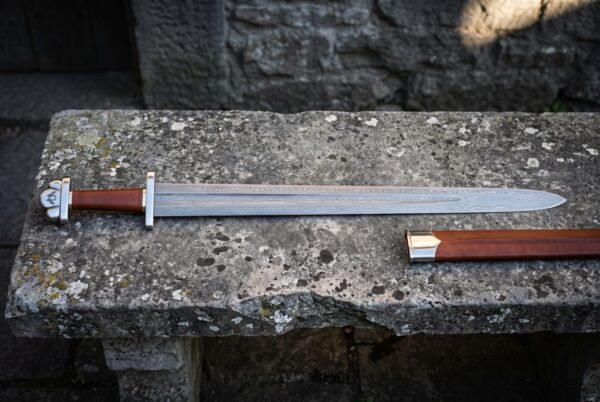
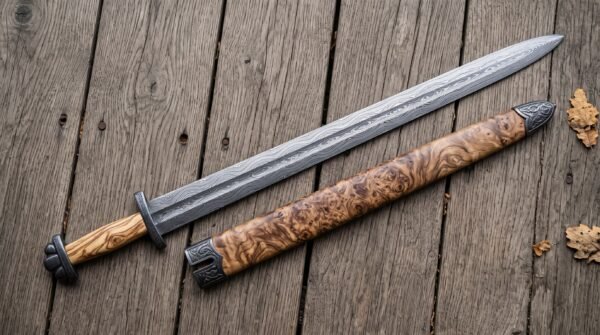
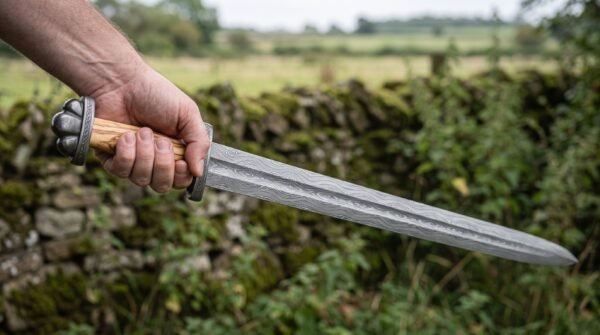
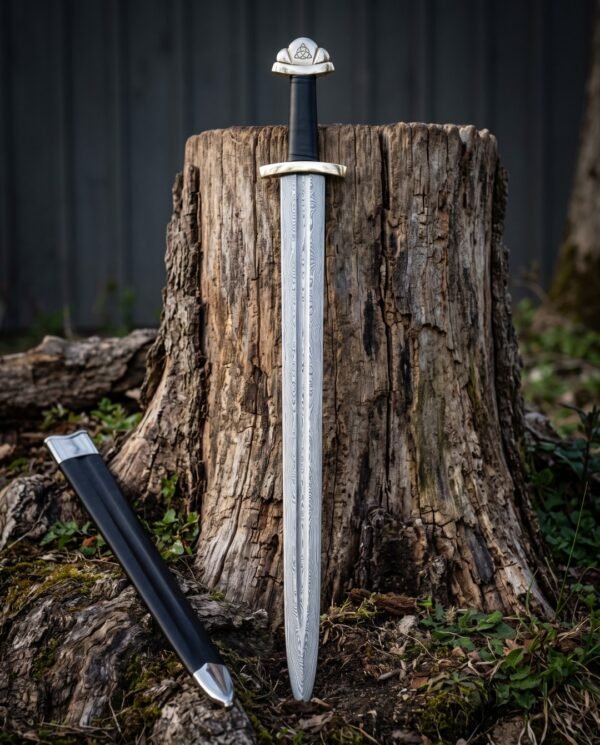
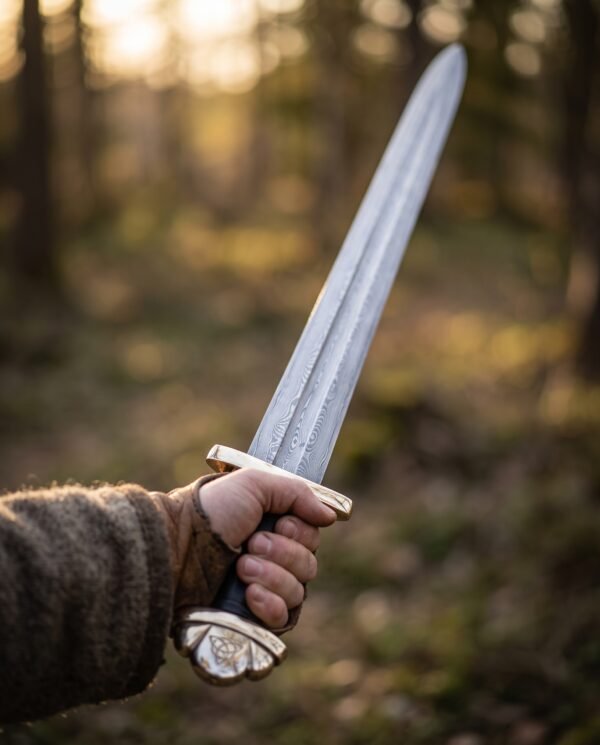
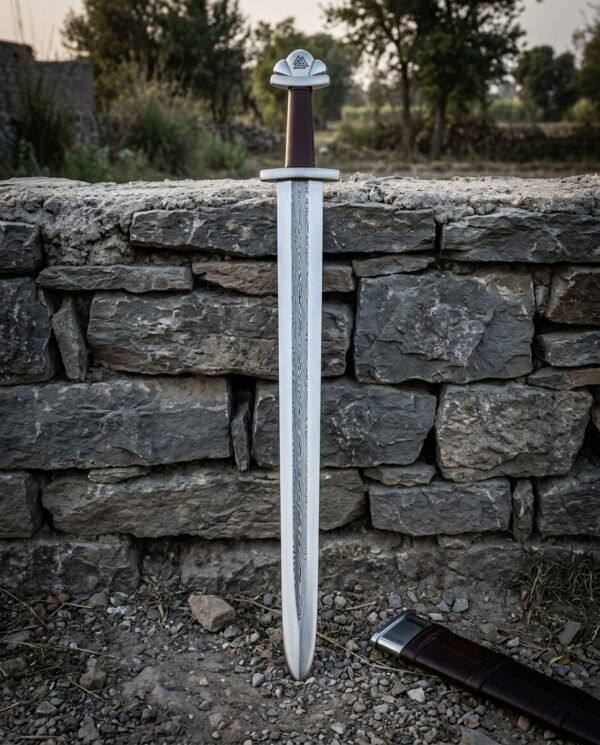
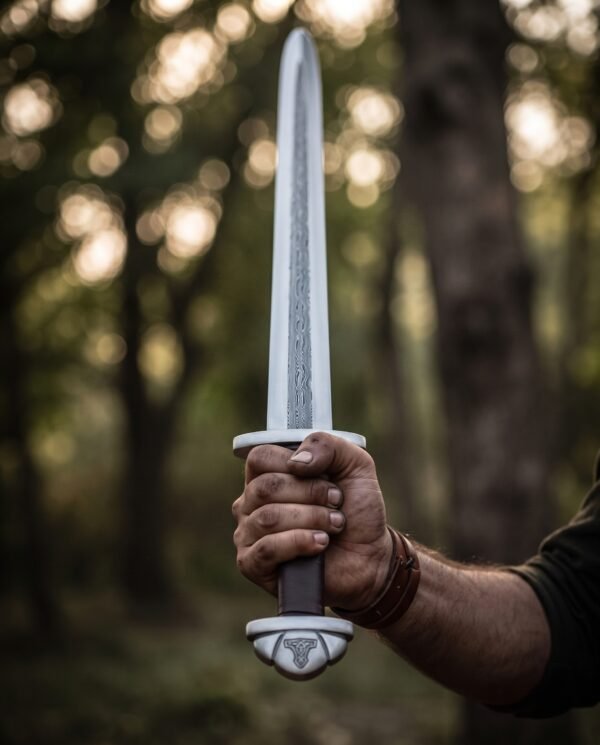
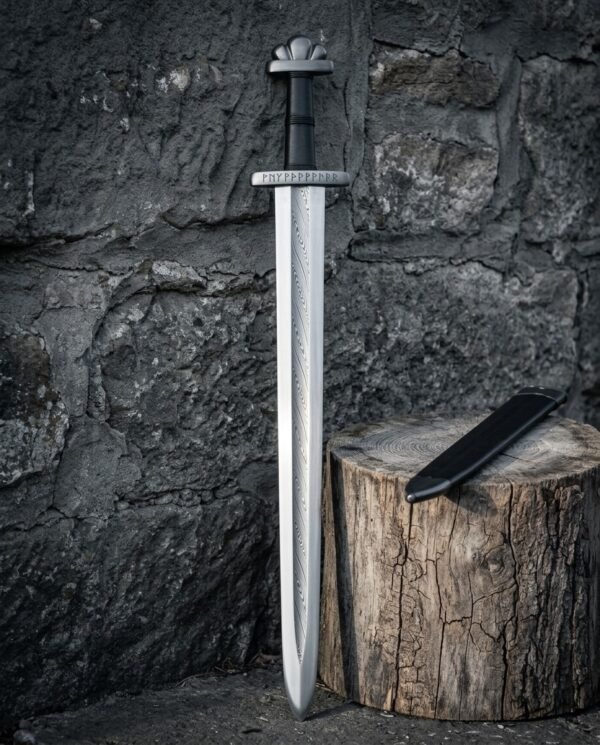
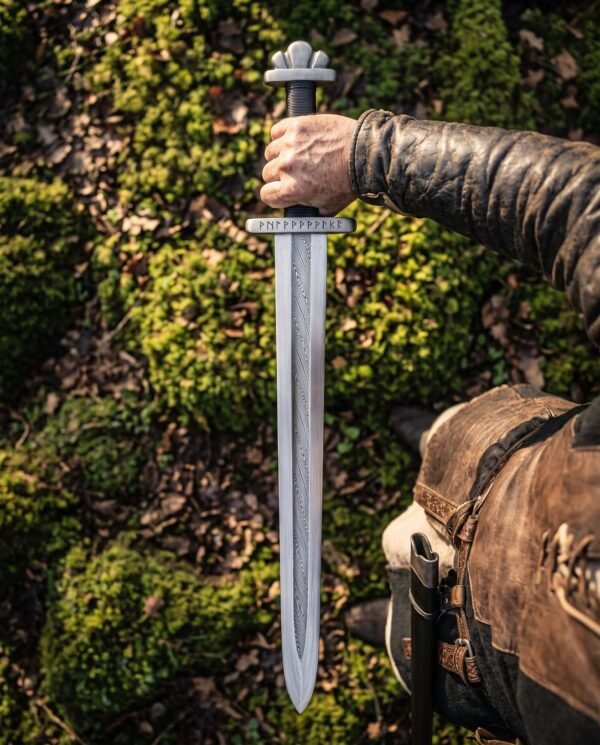
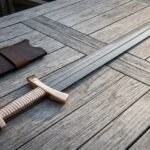
The Skaldbone is a full size Viking age sword built around a pattern welded Damascus blade, a ribbed brass grip and a lobed brass pommel. The blade carries a broad shallow fuller down the centre and a line of etched runes with a small emblem just above the guard, and it tapers to a rounded spear point in the way surviving tenth century blades do. It is a cutting sword first, and the profile says so honestly.
Here is something worth knowing about the originals. The lobed pommel that gives this sword its silhouette was not decoration for its own sake. On excavated Norse swords the lobes are usually separate pieces brazed or riveted onto a plain iron pommel bar, and the count of them, five, three or seven, tracks fairly closely with the region and the decade the sword came out of. Petersen built his whole 1919 typology on exactly this kind of fitting detail, because the blades themselves were traded so widely that they tell you far less about origin than the hilts bolted to them do. Your Skaldbone is forged, ground, heat treated, etched, fitted and sharpened by hand in the Czech Republic, and it ships with the brown leather scabbard shown.
Pommel, fuller and grip length are what separate a good Norse sword from a prop, and what to look for in a Viking sword goes through them. Damascus here means 1095 and 15N20 forge welded and etched, and what Damascus steel actually is covers how the layers get there. A board from the round shields is what usually stands beside one.
Specifications
| Blade material | 1095 and 15N20 Damascus, 58 to 60 HRC |
|---|
| Overall length | 36 inches |
|---|
| Blade length | 30 inches |
|---|
| Blade width at guard | 2 inches |
|---|
| Blade | Double edged, broad shallow fuller, rounded spear point, acid etched Damascus |
|---|
| Blade marking | Etched rune line and a small emblem just above the guard |
|---|
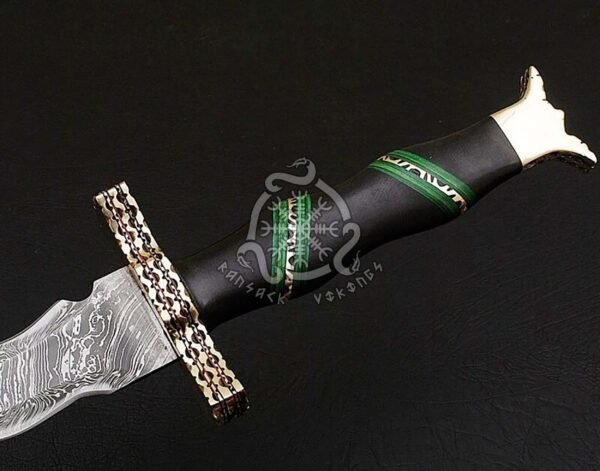
| Guard | Short, slightly arched polished brass lower guard |
|---|
| Grip | Ribbed polished brass, barrel shaped, single hand |
|---|
| Pommel | Lobed polished brass pommel |
|---|
| Edge | Sharpened, ready to use |
|---|
| Weight | Approximately 2 lb 10 oz |
|---|
| Scabbard | Dark brown leather |
|---|
| SKU | RK-1911 |
|---|
Why the lobed pommel matters to how it handles
People look at the lobes and see style. What they are actually looking at is ballast. A Viking sword blade of this length puts a great deal of steel out past the hand, and without a heavy counterweight behind the grip the point of balance would sit six or seven inches down the blade and the sword would feel like a club. The brass pommel on the Skaldbone pulls that balance point back to roughly four inches ahead of the guard, which is where a single hand cutting sword wants to be. You feel it as a sword that rolls from one cut into the next instead of dragging. The lower guard is short and slightly arched, which is correct for the period and also means nothing catches when you draw it across the body from a hip slung scabbard.
The ribbed brass grip is barrel shaped rather than straight, thicker in the middle and drawn in at each end. That shape is what lets a relaxed hand hold the sword without gripping it, and the ribs give the fingers purchase so the hilt does not turn in the hand.
The steel and the pattern
The blade is folded and forge welded from 1095 high carbon steel and 15N20 nickel alloy steel. Neither one looks like much on its own. Welded together in alternating layers, drawn out, cut, restacked and welded again, they build the layer count that the acid etch later reveals, because the nickel in the 15N20 resists the acid while the 1095 darkens. The bright lines you see are the 15N20 standing proud.
Hardness comes from the 1095. After the blade is ground it is normalised, brought up to critical temperature, quenched and then tempered back to 58 to 60 HRC. That range is chosen on purpose for a long blade. Harder than 60 and a sword this length starts to be brittle in a way you do not want in something that gets swung. Softer than 58 and the edge rolls. The Damascus pattern is what you see, but the heat treat is what the sword actually is.
Engraving, runes and your own design
Use the rune converter on this page to turn a name, a date or a short phrase into Elder Futhark and we will cut it into the steel or the leather. If you would rather have a Viking pattern than a rune line, choose your own design in the engraving option above the add to cart button and tell us where it goes. Where a piece already carries an engraved design, your chosen engraving replaces it rather than sitting alongside it. Full detail is on the engraving page.
Handling and balance
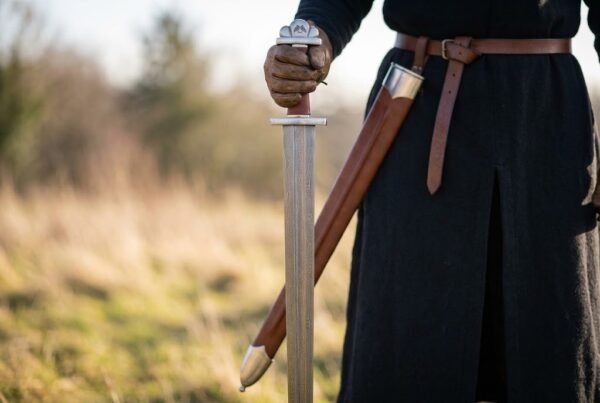
This is a one handed sword with a grip a little under four inches between guard and pommel, which is period correct and will feel short to anyone used to modern replicas built for large hands. Hold it with the heel of your hand against the pommel rather than choking up under the guard. Cuts land best in the last eight inches of the blade, where the mass and the edge geometry work together. The point is rounded rather than needle sharp, which is faithful to the originals and means this sword thrusts adequately and cuts extremely well, rather than the other way round.
The sword is sharp when it arrives. Handle it as a sharp tool. It is not intended for edge on edge contact against another blade, and steel to steel impact will chip any hardened edge including this one.
Care
Damascus wants oil. Wipe the blade down with a light machine oil or a dedicated blade oil after handling, because the acid etch that reveals the pattern also leaves the surface more open to fingerprints and moisture than a plain polished blade. Do not store it in the leather scabbard for months at a time, since vegetable tanned leather holds humidity against steel. Feed the scabbard occasionally with a neutral leather balm. Wipe the brass with a soft cloth and leave the natural darkening alone unless you want it bright, in which case a little metal polish on a rag brings it back. More detail on steel care is on the site.
Damascus wants oil more than plain steel does, because the etch that shows the pattern also opens the surface, and caring for a Damascus pattern covers what to use.
Made in the Czech Republic
Every piece we sell is made by hand in the Czech Republic. The smiths there work the way the trade has been worked for a long time, heating and hammering the steel, taking the bevels down by eye, and fitting the handle and the leather one at a time. There is no automated line anywhere in it, so small differences from one piece to the next are normal and expected.
Ransack Viking is a United States company based in Chicago, Illinois. We bring the pieces in ourselves, inspect them on arrival and ship them from our own warehouse. If you add engraving, that is carried out here in the United States before your order goes out.
A note on handmade variation
This sword is hand made, not machine made and not bulk produced, so what arrives will not be a pixel for pixel copy of the photograph. The Damascus pattern is different on every blade because no two billets draw out the same way, and the brass hilt takes on its own tone as it ages. Hammer texture, the exact depth of the etch and the precise shade of the brass all vary. The dimensions, the material and the build are the same every time. The character is not.
Frequently asked questions
Is the sword sharp when it arrives?
Yes. It ships with a working edge that will cut. If you want it left blunt for display or for handling at an event, say so in the order notes and we will finish it with a rounded edge instead.
Is the Damascus pattern etched on or is it real?
It is real pattern welded steel. The pattern runs all the way through the blade, which is why it stays visible when the edge is sharpened back. A surface print would disappear the first time you took steel off.
Can I use this for reenactment sparring?
No. This is a sharp collector and cutting sword, not a blunt reenactment trainer. Full contact work needs a purpose built blunt with rolled edges and a thicker cross section.
Will the brass grip tarnish?
Slowly. Brass darkens to a warm brown with handling and time. Leave it if you like the patina, or bring it back with a little metal polish on a soft cloth.
Can I have runes cut into the blade?
Yes. Use the rune converter on this page. On a Damascus blade the cut lines read as bright silver against the etched pattern, which looks very good.
How long until it ships?
One to two weeks for forging and finishing, then free shipping within the United States.
What is in the box
- One Skaldbone Damascus Viking sword
- Brown leather scabbard
- Care card with oiling instructions
- Lifetime warranty against defects in forging, grind, heat treat and fittings
- Forged and finished in the Czech Republic
Explore the range
See more in Viking swords, Damascus swords and scabbards and sheaths, or read the guides.
Others in the same line
A near match for this one is the Serpentweld Viking sword, 36 inches overall. Closest to this in the range is the Wolfrune Viking sword, 36 inches overall. If this one is not quite right, there is the Emberkeel Viking sword, 37 inches overall.
The Knotwake broadsword covers the other half of the same kit. You can have this made your way instead on the custom Viking sword page.

Reviews
There are no reviews yet