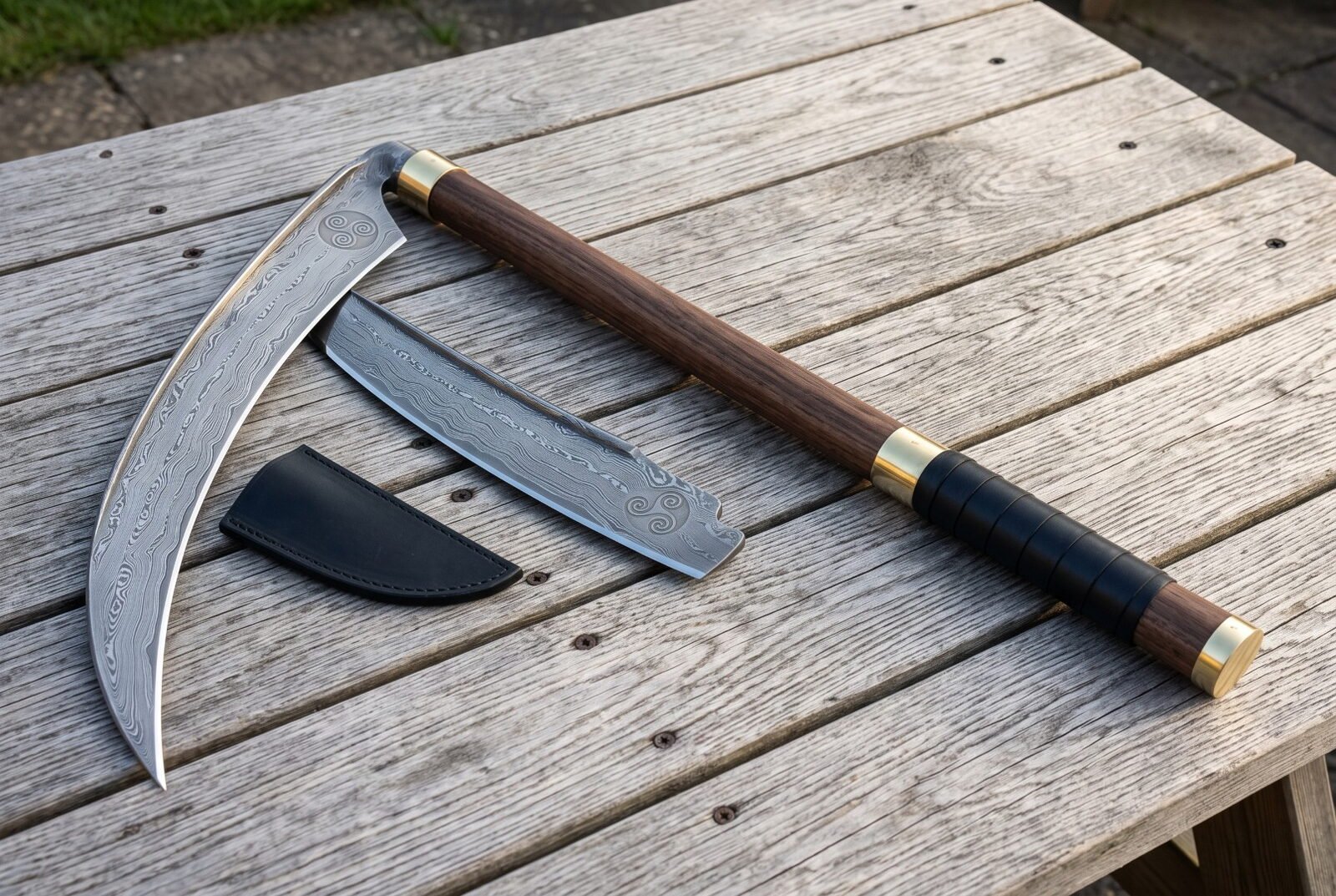
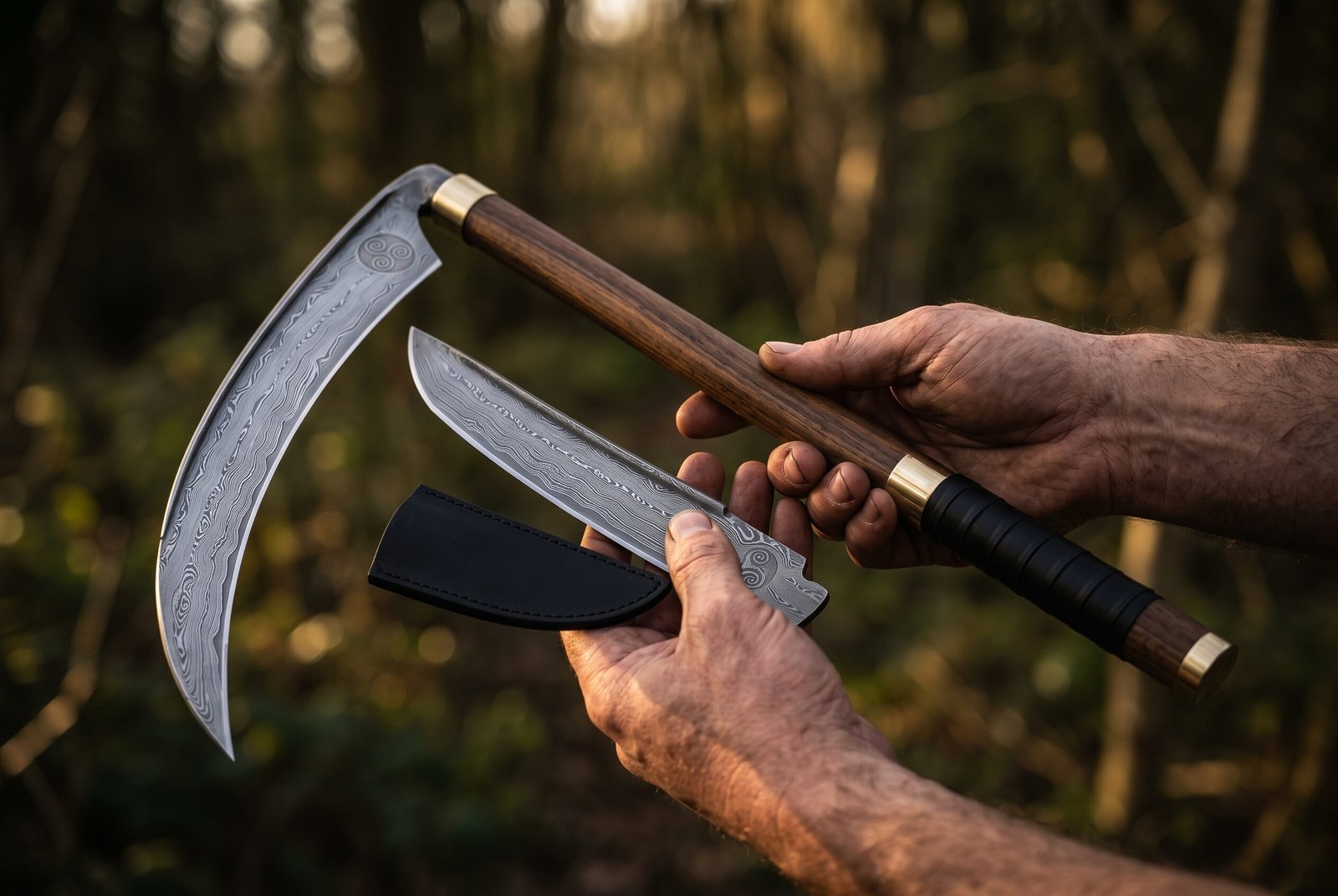
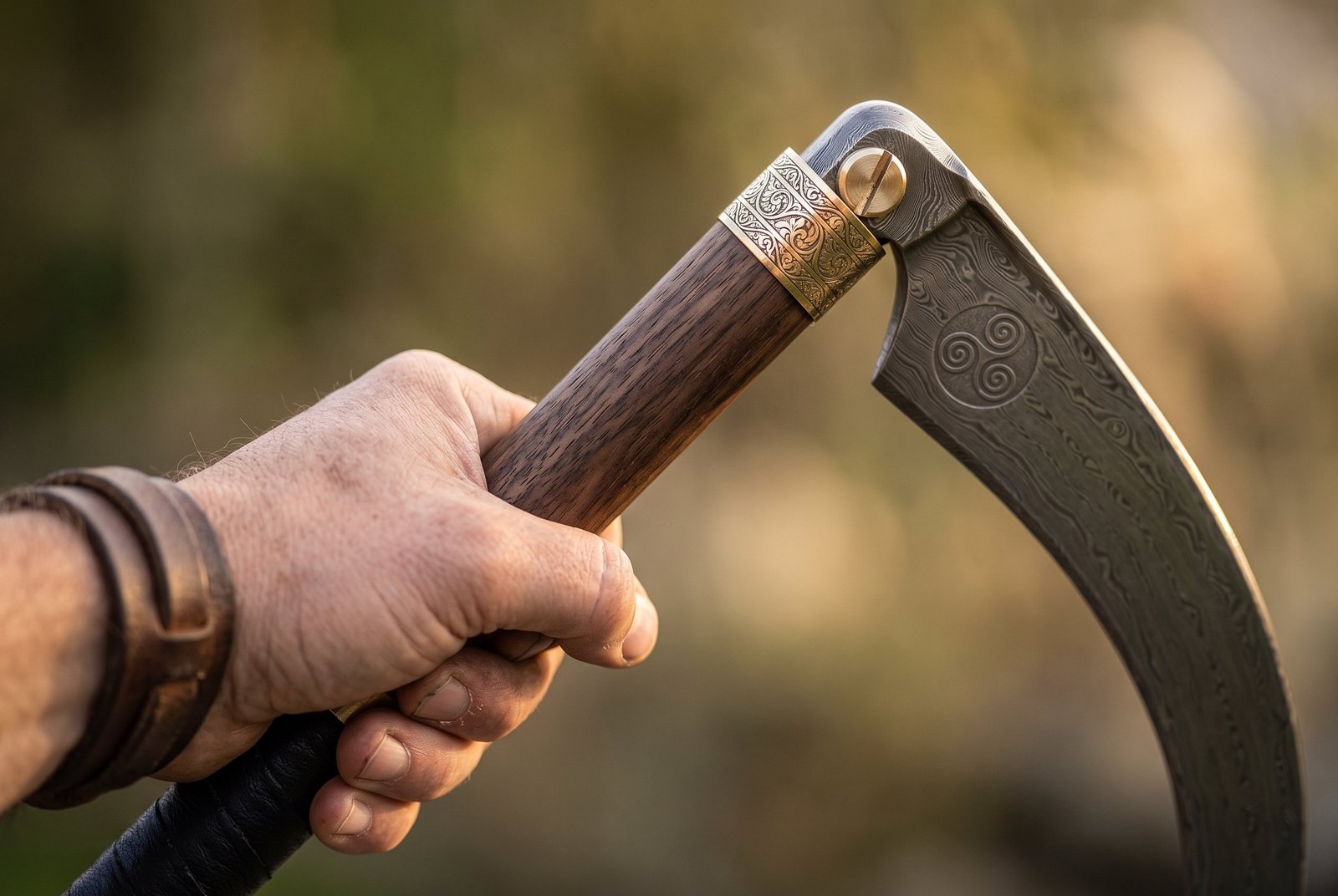
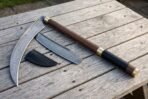
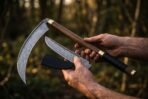
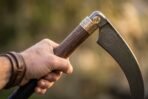
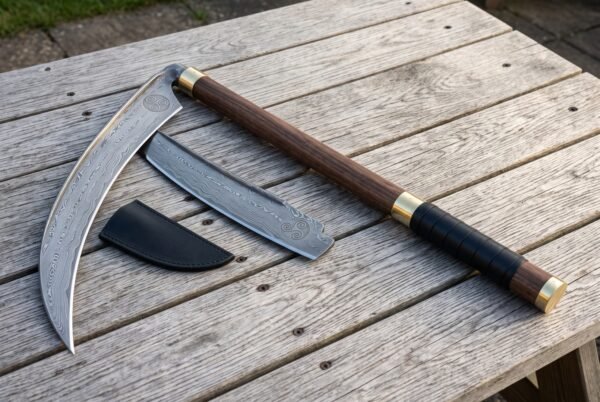
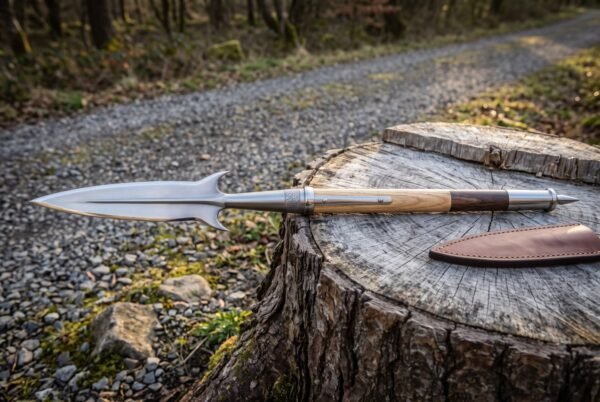
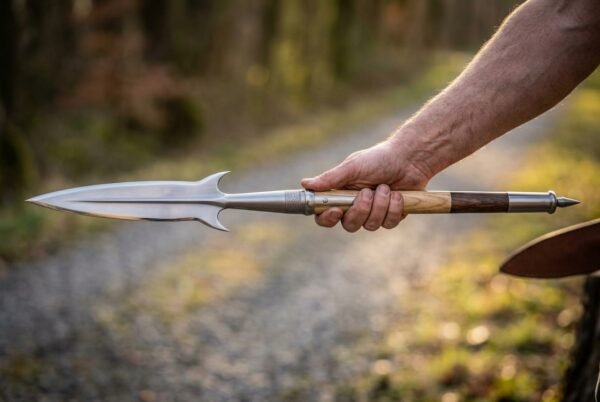
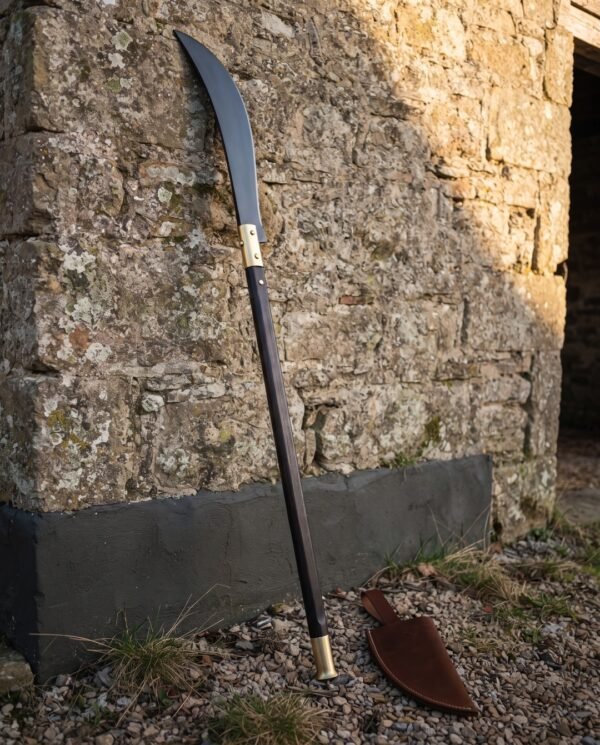
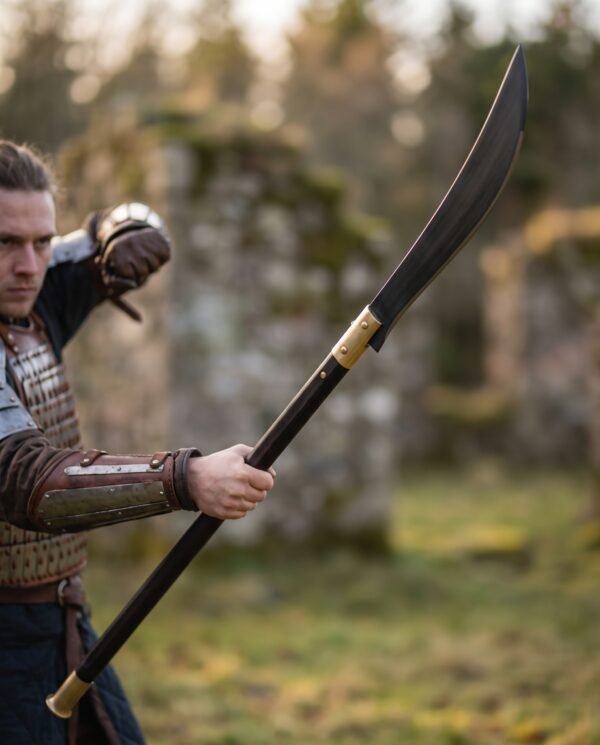
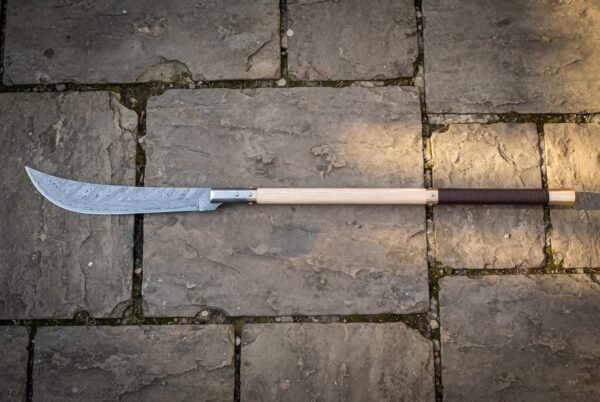
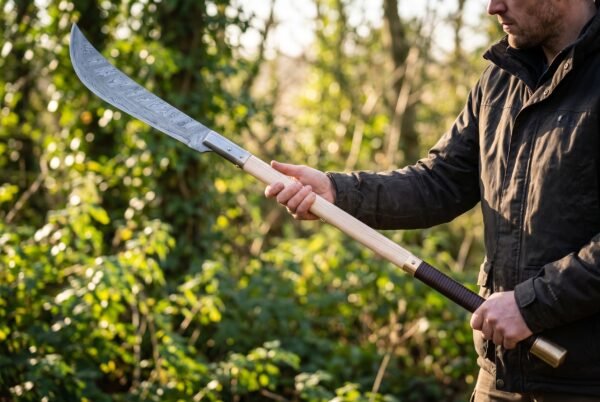
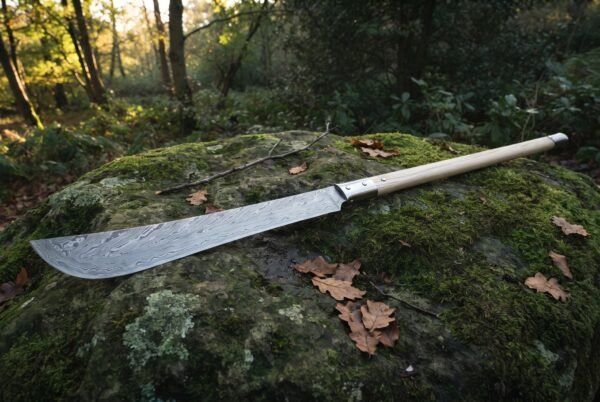
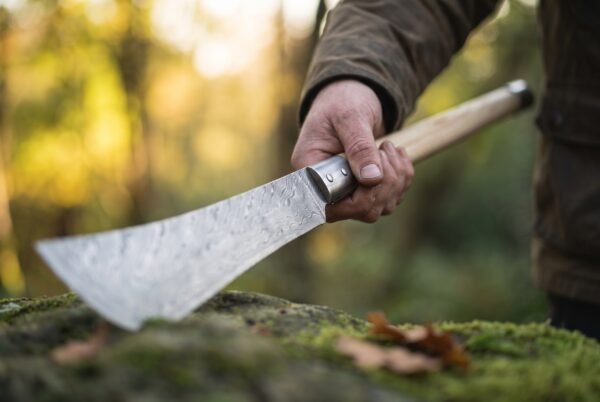
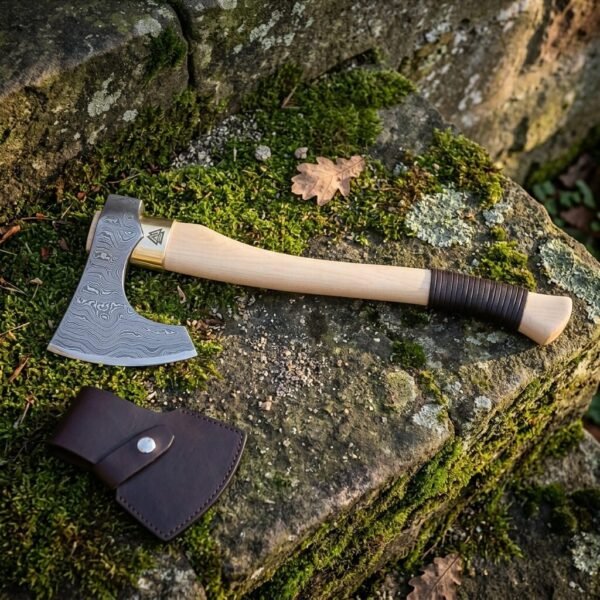
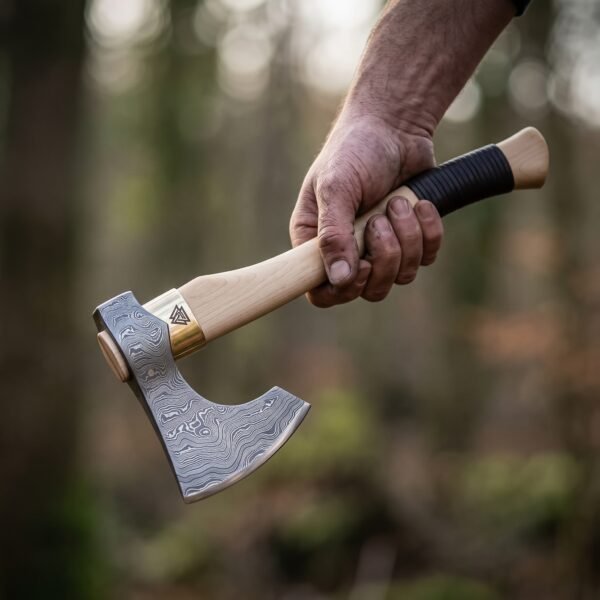
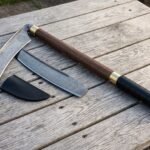
The Reapcurve is a two piece set. The first piece is a war scythe, a long inward curving Damascus blade socketed onto a straight hardwood haft with brass collars at the head and at the butt and a leather wrapped section where the lower hand sits. The second is a companion blade in the same pattern welded steel, straight backed with a squared off tip, supplied in a stitched black leather sheath. Both carry a small triple spiral cut near the base of the blade. You are buying both pieces together, not one of them.
The war scythe is one of the few genuine peasant arms in European history, and it worked. A farm scythe hangs its blade at right angles to the snath for mowing. Turn the blade to sit in line with the shaft and you have a polearm with a long cutting edge, enormous reach and a hook that catches. Polish scythemen fought at Raclawice in 1794 with exactly this conversion and took Russian guns with it, and the same conversion reappeared in risings across central Europe for another century. This set is forged and finished in the Czech Republic.
Hafted blades this long are display pieces, and display or battle ready spells out what that phrase means. For how a patterned blade compares with a plain one in use, Damascus against high carbon puts the two together. Shorter hafted heads of the same family sit with the poleaxes.
Specifications
| Pieces included | Two, a hafted war scythe and a companion blade with sheath |
|---|
| Material | 1095 and 15N20 pattern welded Damascus, hardened to 58 to 60 HRC |
|---|
| Haft length | 30 inches |
|---|
| Scythe head | 22 inches measured along the curve, inward curving, socketed and pinned through the head collar |
|---|
| Companion blade | 12 inches overall, straight backed with a squared tip |
|---|
| Haft material | Turned dark hardwood with an oiled finish |
|---|
| Fittings | Engraved brass collar at the head, plain brass band above the grip and a brass butt cap |
|---|
| Grip | Black leather wrap on the lower haft, below the brass band |
|---|
| Decoration | Triple spiral cut near the base of the scythe blade |
|---|
| Sheath | Stitched black leather, fitted to the companion blade |
|---|
| SKU | RK-1941 |
|---|
How a scythe becomes a polearm
The conversion is simple and that is the point. A mowing scythe has its blade set nearly square to the snath so that it sweeps parallel to the ground at ankle height. That geometry is useless against a man. Knock the tang round so the blade lies in the same plane as the shaft, wedge it and band it tight, and the tool becomes a polearm with a two foot cutting edge on the end of a five foot pole.
What made it effective was not novelty but reach and edge length. A spear puts a few inches of point at the end of the reach. A scythe puts a curved edge that is longer than most sword blades out there, and the inward curve means the edge draws through whatever it catches instead of glancing off. Against cavalry it was particularly nasty, because the same curve that catches a stalk catches a rein, a bridle or a leg.
The weakness of the historical version was the joint. A farm scythe tang was made to be knocked off and refitted every season, and battlefield accounts complain about heads working loose. Ours is a socketed head seated onto a shaped tenon and pinned, with a brass collar over the joint, so the head does not depend on a wedge staying tight.
The companion blade is included because a polearm alone leaves you nothing at close quarters, which is the oldest problem in the history of polearms. Its squared tip is not an unfinished point. A blunted, fully supported end is far stronger than a fine tip and it lets the blade be used as a draw knife or a heavy chopper without the risk of snapping a point off.
1095 and 15N20 Damascus and the hardwood haft
Both blades are welded from alternating layers of 1095 and 15N20 and hardened to 58 to 60 HRC. Nickel in the 15N20 resists the etching acid while the 1095 darkens, which is why the pattern shows. It is the real internal structure of the billet rather than a print or a stencil, and it runs all the way through the steel. On a blade this long the pattern stretches as the steel is drawn out, which is why the ripples on the scythe head run in long sweeps while the companion blade shows tighter figures.
The haft is turned hardwood, finished with oil rather than lacquer. Oil is the right choice on anything you hold, because it soaks in and can be refreshed, while a lacquer film gets slippery when your hand is damp and once it chips it lifts. The brass collars are structural. The one at the head covers and reinforces the socket joint, and the one at the butt stops the end grain from splitting if the haft is grounded hard.
The leather wrap on the lower haft is there so the rear hand has something with grip on it. On a two handed haft the front hand slides and the rear hand holds, and a bare polished shaft in the rear hand is the fastest way to lose control of the blade.
Engraving, runes and your own design
Use the rune converter on this page to turn a name, a date or a short phrase into Elder Futhark and we will cut it into the steel, the leather or the wood. If you would rather have a Viking pattern than a rune line, choose your own design in the engraving option above the add to cart button and tell us where it goes. Where a piece already carries an engraved design, your chosen engraving replaces it rather than sitting alongside it, so your runes take the place of the triple spiral on whichever blade you choose. The hardwood haft is also a good surface and takes a burned or cut line very cleanly. Tell us which of the two pieces you want marked. See the engraving page.
Handling and balance
A hafted scythe handles like nothing else. The mass is all at the far end, so it is slow to start and slow to stop, and it wants a long circular movement rather than a snap. Both hands stay spread apart on the haft with the rear hand doing the steering. If you have used a quarterstaff or a spear the movement is familiar, but the head weight will still surprise you the first time.
Say plainly what this is for. It is a hand forged collector and display piece with real blades on it, sold for display, photography and costume. It is not sparring equipment, it is not built for contact against another person or another blade, and a hafted scythe with a sharp two foot edge should never be swung anywhere near anyone. If you want to handle it, do it outdoors with a very wide clear space.
Care
Keep both blades lightly oiled with mineral oil or camellia oil and wipe them after handling. Etched Damascus holds moisture in its darkened layers and a blade put away damp will spot faster than a plain polished one would.
The haft wants a wipe with an oiled cloth once or twice a year, which keeps the timber from drying and shrinking away from the brass collars. Do not store the scythe leaning against a wall in a damp garage, because the end grain at the butt will wick moisture even through a collar. The companion sheath should be fed with a neutral leather balm twice a year and the blade should not live in it permanently. Our steel care page has the full routine.
Damascus wants oil more than plain steel does, because the etch that shows the pattern also opens the surface, and caring for a Damascus pattern covers what to use.
Made in the Czech Republic
This is a handmade piece from the Czech Republic, made in a workshop that still forges, grinds and finishes by hand instead of stamping parts out. The smiths there have kept the older way of working, and the wood, horn and leather are shaped and fitted by hand as well. Two pieces of the same design will never be identical, and that is part of what you are buying.
Ransack Viking is a United States company. We handle the import ourselves, look over every piece when it lands and ship from our warehouse in Chicago, Illinois. Engraving is done in the United States after the piece arrives, so your design goes on before we send it out.
A note on handmade variation
This set is hand made rather than machine made or bulk produced, so what arrives will not be a pixel for pixel copy of the photograph. Pattern welded steel never repeats, so the sweep of the ripples on both blades will be their own. The hardwood haft is a natural material and its grain, colour and figure vary from one to the next, sometimes considerably. The brass will start bright and go warm. The dimensions, the steel, the heat treat and the build are the same every time. The character is not.
Frequently asked questions
Is this one item or two?
Two, sold together as one set. You get the hafted war scythe and the companion Damascus blade with its leather sheath for the listed price.
Does the companion blade fit onto the haft?
No. It is a separate hand blade with its own sheath, not an interchangeable head. The scythe head is socketed and pinned and is not meant to be removed.
Are the blades sharp?
Yes, both arrive with a working edge. Given the size of the scythe a good number of buyers ask for it blunt, and we will do that at no charge if you say so in the order notes.
Can I use it for reenactment?
Not for combat. It is a sharp display and collector piece. Reenactment groups require blunt rebated gear built and inspected for contact, which this is not.
How does something this long ship?
In a long braced carton with the head protected separately. It travels as one parcel and it goes free within the United States.
Can I have runes on both blades?
Yes, tell us in the engraving notes and we will cut a matching line into each. Remember that your engraving replaces the triple spiral rather than sitting next to it.
What is in the box
- One Reapcurve war scythe with a Damascus head on a 30 inch hardwood haft
- One companion Damascus blade, 12 inches overall
- One stitched black leather sheath fitted to the companion blade
- A protective film of oil on both blades for transit
- Care notes for Damascus steel, oiled hardwood, brass and leather
- Lifetime warranty against defects in forging, grind, heat treat and fittings
- Forged and finished in the Czech Republic
Explore the range
More hafted work: glaives and polearms, Viking spears, Norse arms and halberds. Background reading lives in the guides.
Worth a look beside this
If this one is not quite right, there is the Tidefork polearm, pattern welded Damascus. Also in this group is the Talonreave polearm, 34 inches overall. Sitting beside it in the catalogue is the Reedfork polearm, forged from 1095.
From the same corner of the shop, there is the Stormlink mace. Or start from a blank sheet on the custom Norse arms page.

Bought this on a whim and it turned out to be one of my favorite purchases this year. Feels way more premium in person than the listing photos. Can’t recommend this enough.
Five stars isn’t even enough honestly. Exactly as described and clearly made with care. So worth it.
This piece is a genuine work of art. Packaging was excellent and it arrived in perfect condition. This is my third order from Ransack Viking and they never disappoint. Already planning my next purchase from this shop.
So happy I finally pulled the trigger on this one. The craftsmanship really shows in the small details. If you’re on the fence just get it. You won’t regret it.
Turned out better than I expected going in. Solid piece. Packaging could’ve been a bit sturdier. Would buy from this shop again.