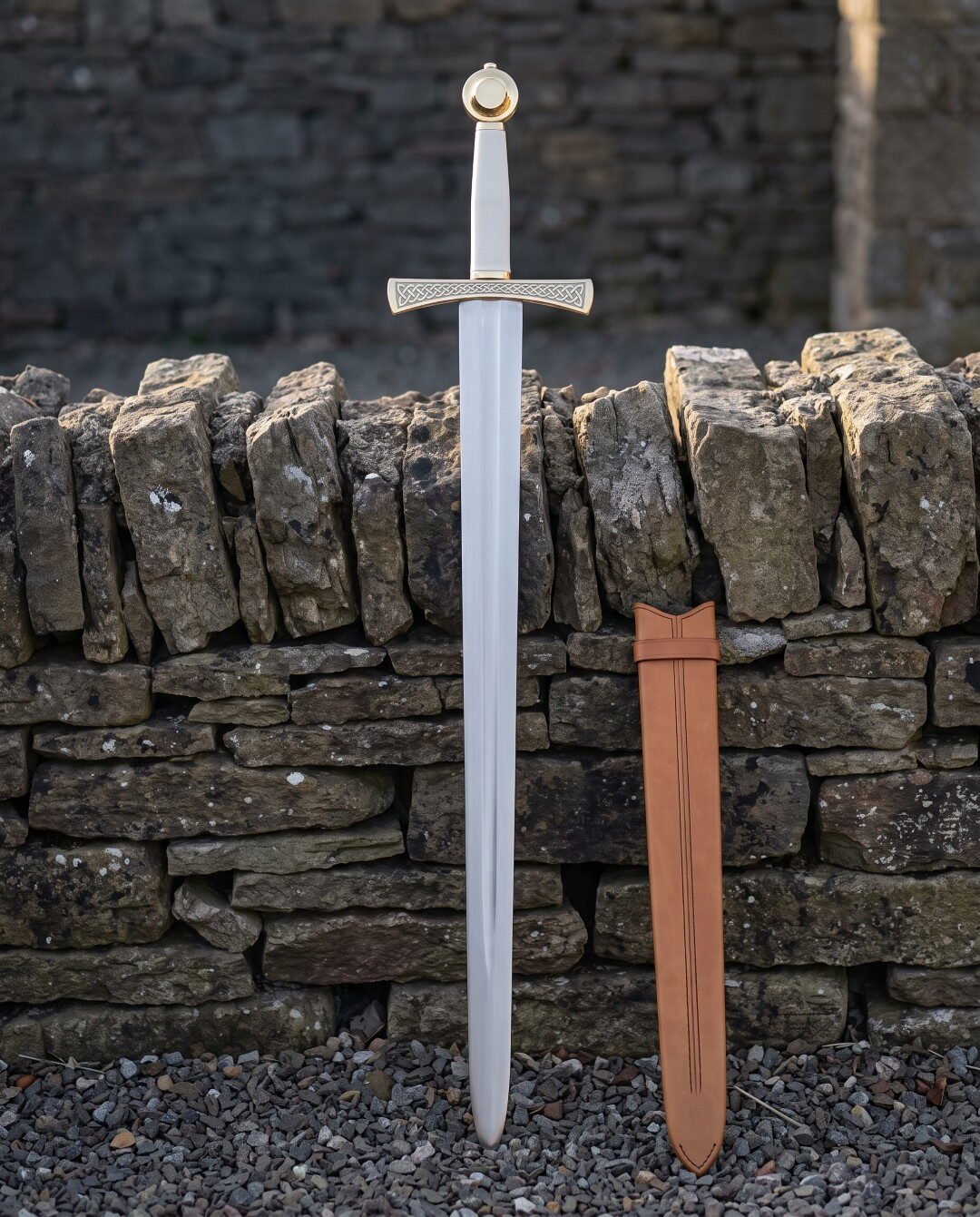
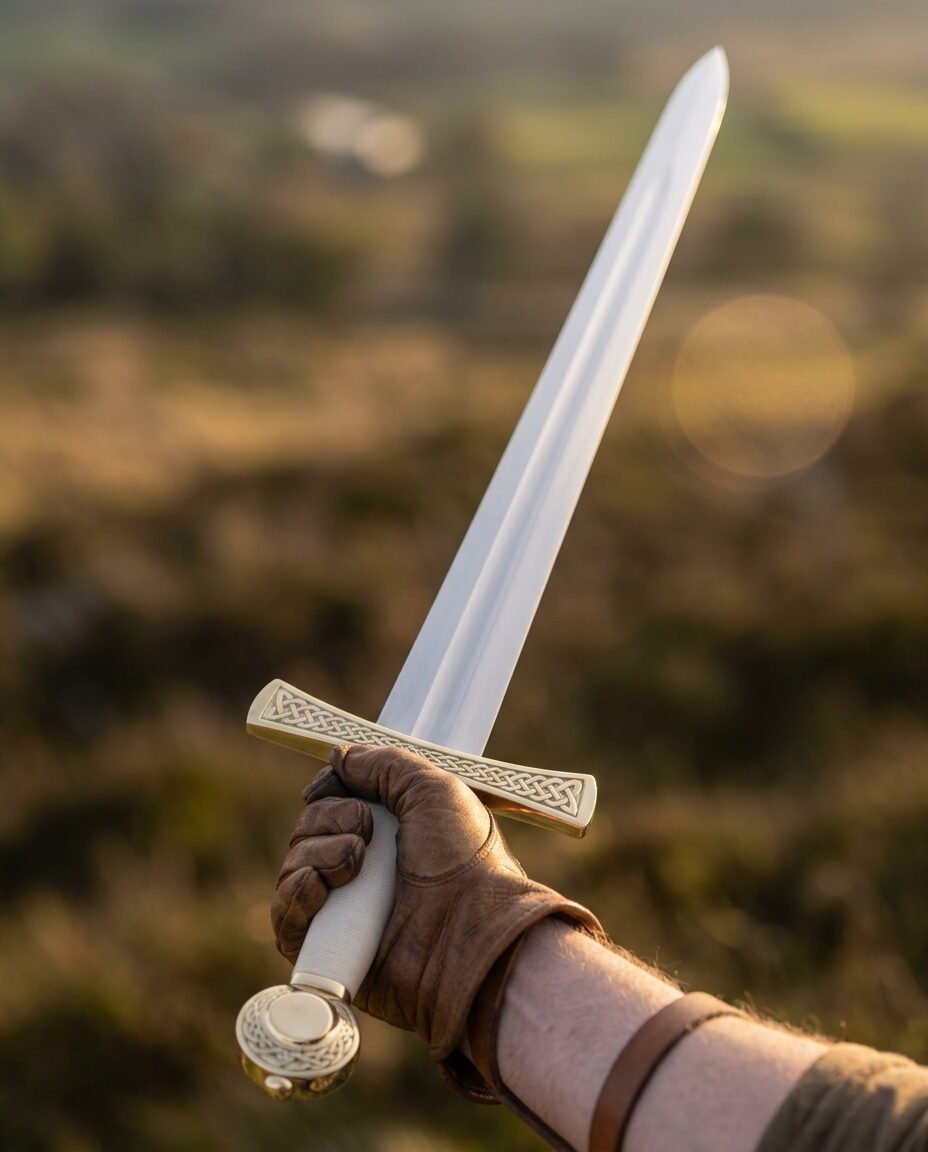
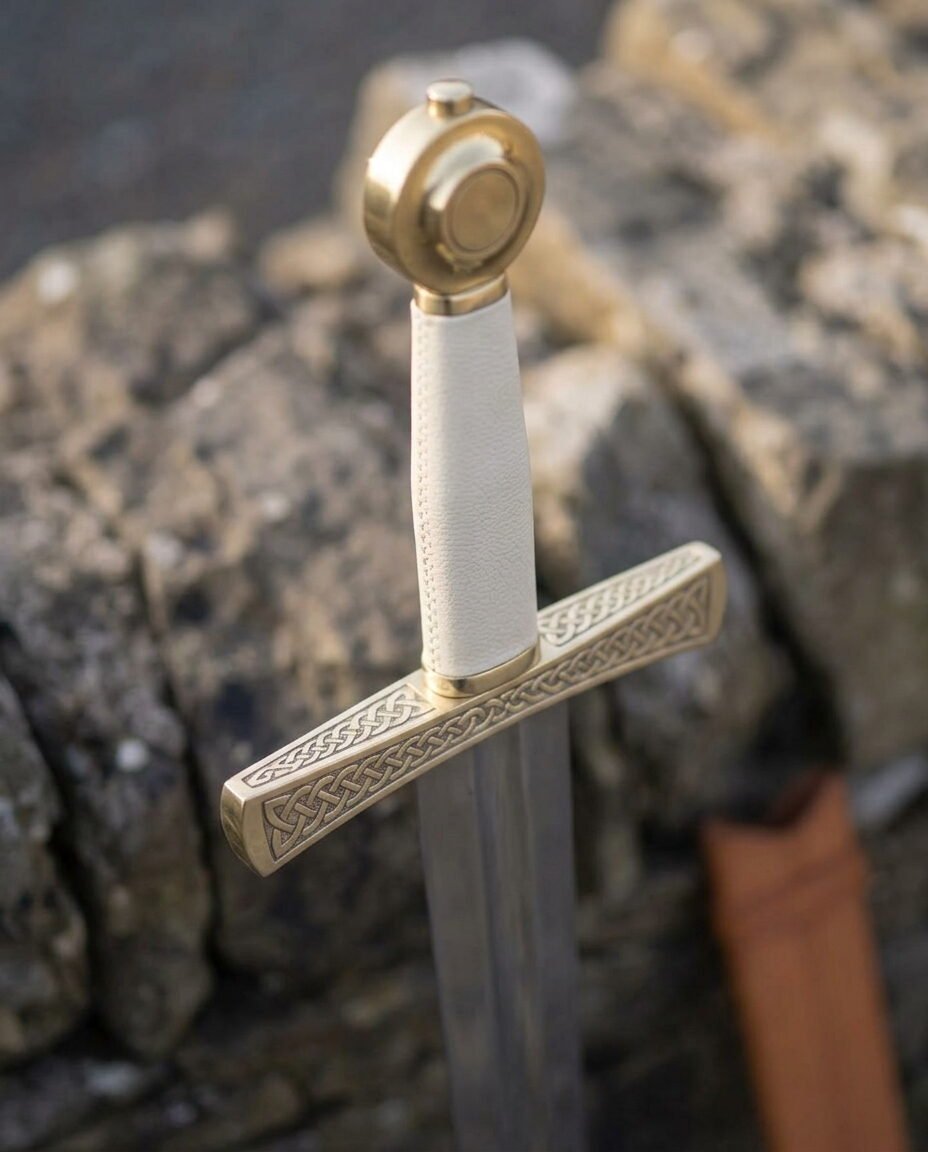
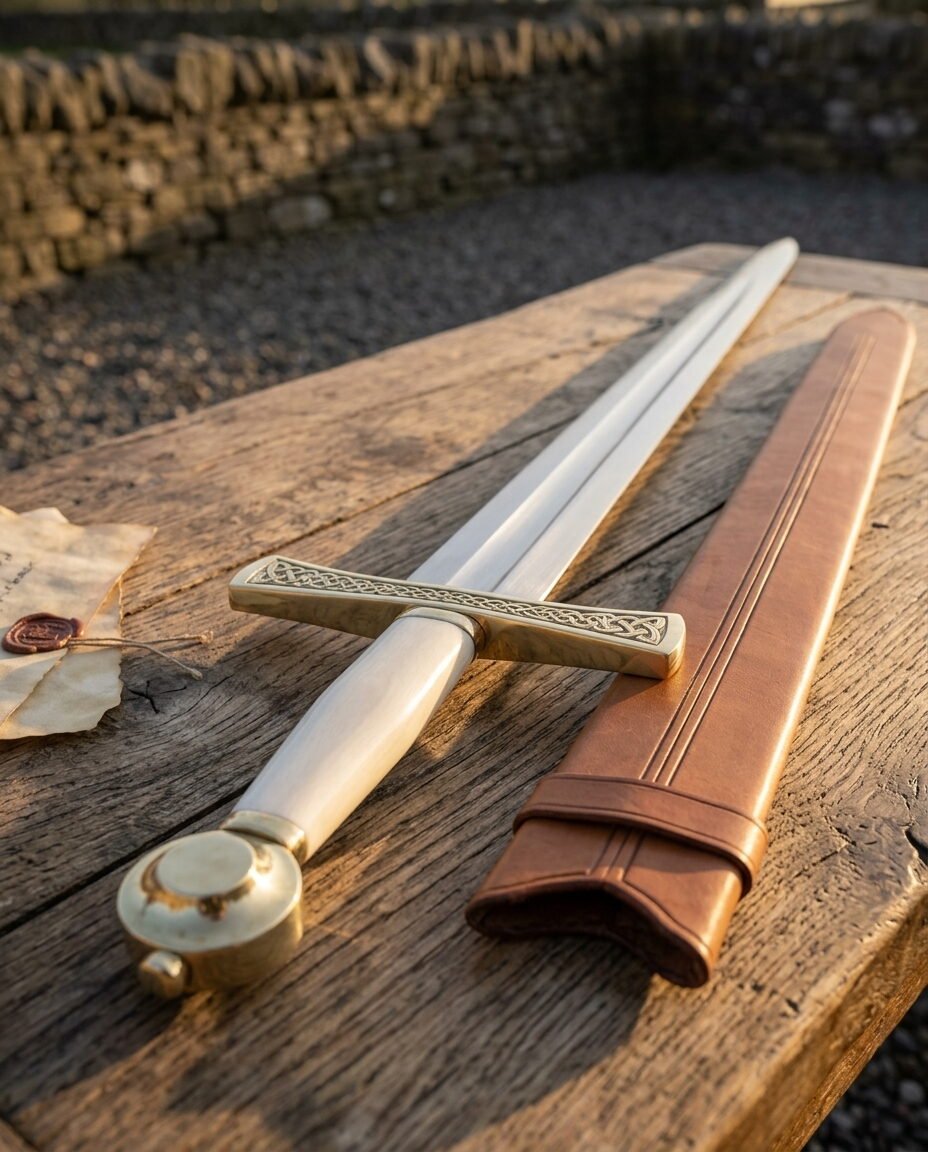
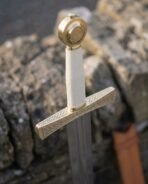
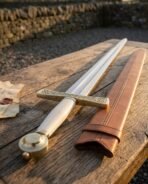
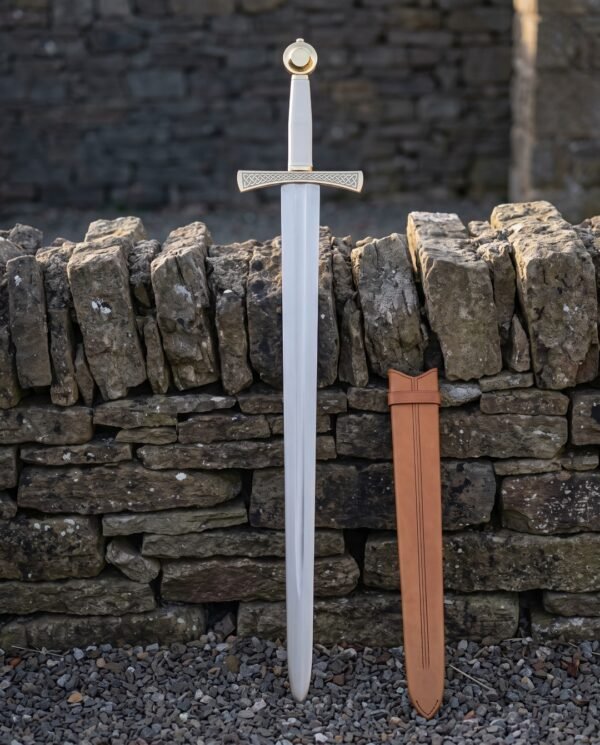
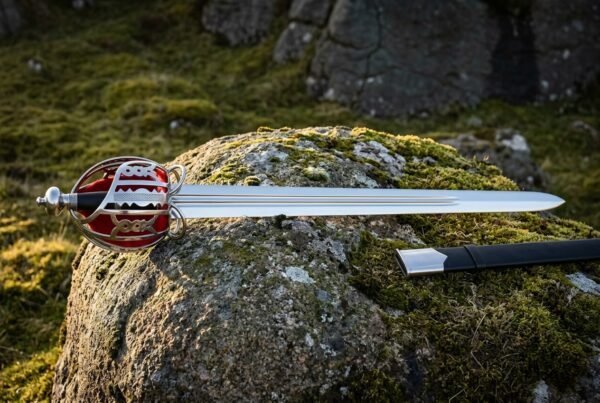
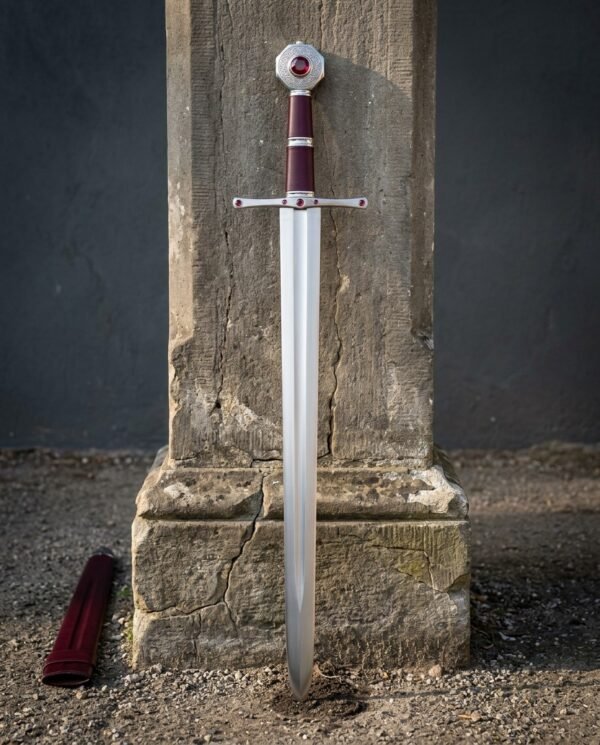
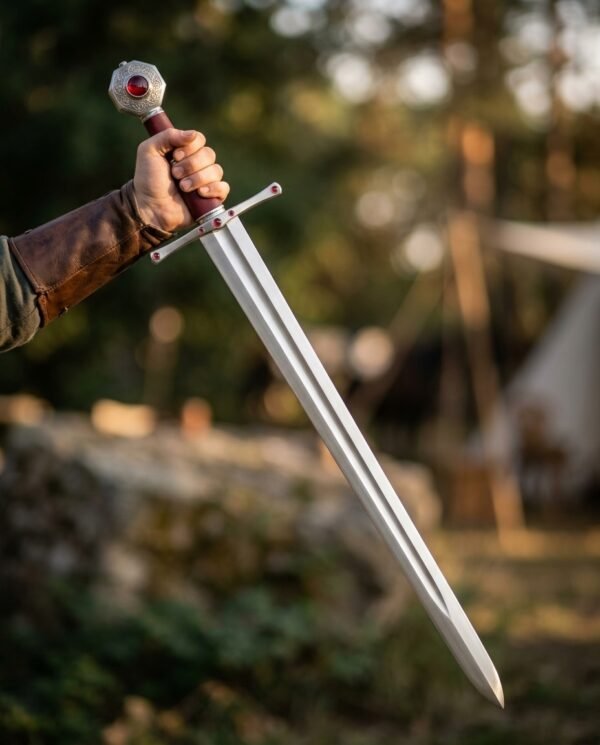
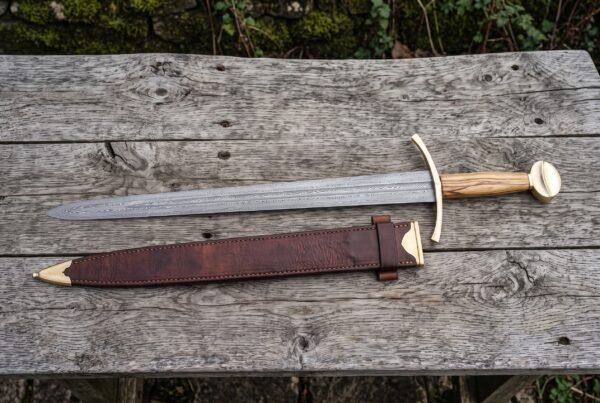
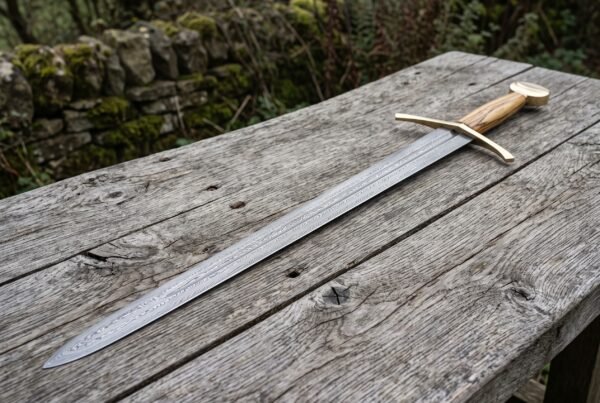
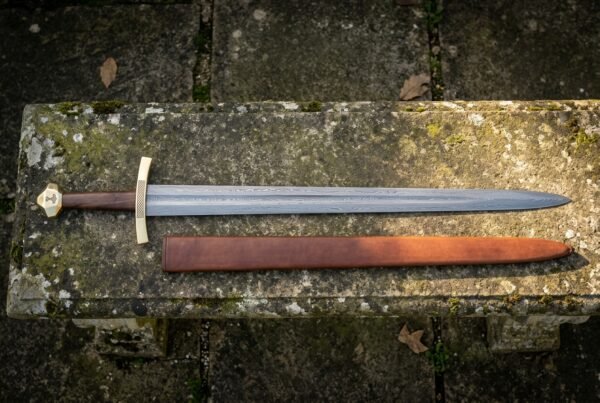
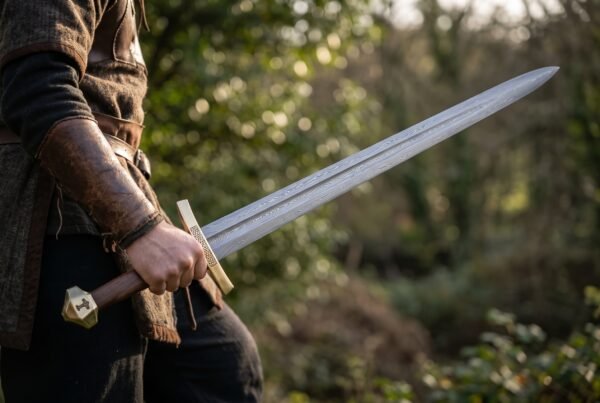
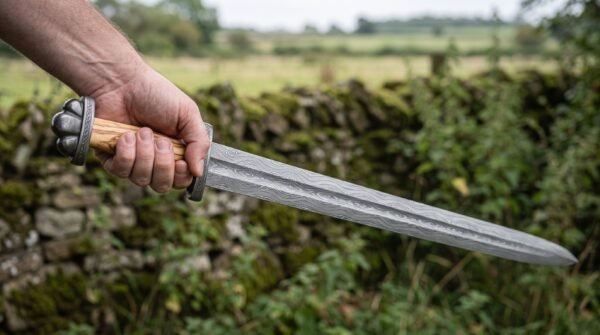
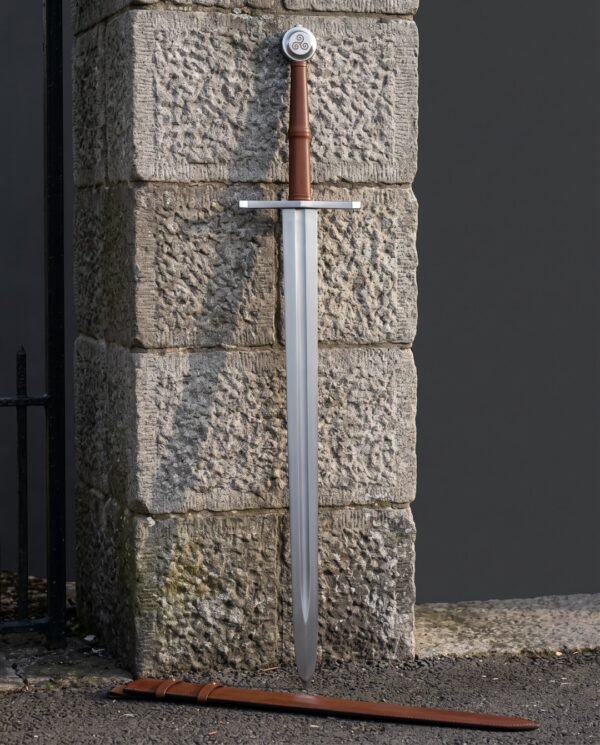
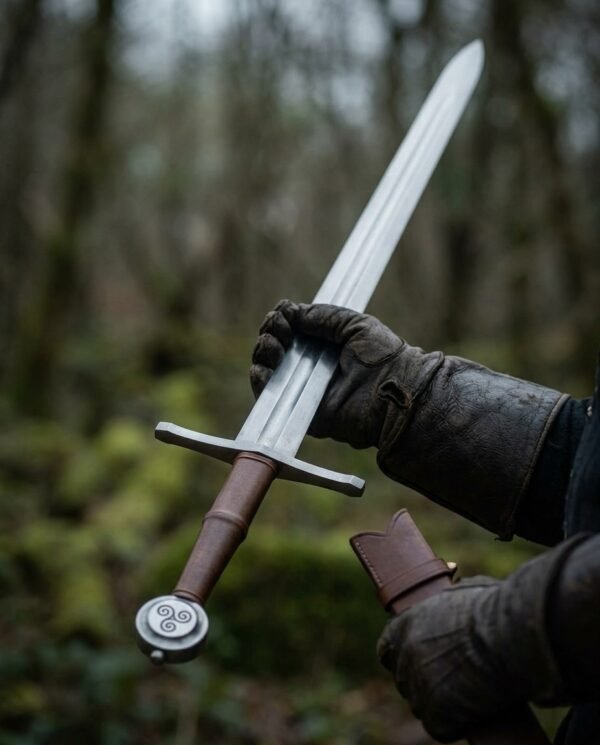
The Ivorycrest is a single hand arming sword of the classic high medieval pattern, with a broad fullered blade, a straight brass crossguard cut with a band of Celtic interlace, a smooth ivory toned polished grip collared in brass at both ends, and a heavy brass wheel pommel with a raised central boss. It comes with a fitted scabbard in tan vegetable tanned leather, closed along the back with a doubled seam and a pair of raised ribs.
A sword of this shape is held together by one thing, and it is not glue. The tang is a single continuous tail of the same bar the blade was forged from. It passes through a slot in the guard, then through the hollow grip, then through the pommel, and the last quarter inch of it is heated and hammered flat over the top of the pommel so it can never come back through. That hammered button is the peen, and it is the only fastener in the entire assembly. Get it right and the hilt is tighter than a bolted joint and stays tight for centuries. Get it wrong and the sword rattles apart on the third cut. Ivorycrest is forged, ground, heat treated, fitted and peened by hand in the Czech Republic, and it ships with its leather scabbard.
If you have seen the phrase battle ready and wondered what it covers, display or battle ready explains it. Insular knotwork travelled with the Norse and came back changed, and the symbols guide covers the shapes that recur. The medieval helmets are the obvious thing to hang beside it.
Specifications
| Material | 1095 high carbon steel, hardened to 54 to 58 HRC |
|---|
| Overall length | Approximately 37 inches |
|---|
| Blade length | Approximately 30 inches |
|---|
| Blade | Broad, double edged, hand polished, with a central fuller |
|---|
| Guard | Straight solid brass crossguard, approximately 8 inches wide, flared ends, engraved Celtic interlace |
|---|
| Grip | Approximately 4.5 inches, smooth polished ivory toned material with brass collars |
|---|
| Pommel | Solid brass wheel pommel with a raised turned boss, peened over the tang |
|---|
| Scabbard | Tan vegetable tanned leather, stitched back seam with raised ribs |
|---|
| Weight | Approximately 2 lb 12 oz bare |
|---|
| SKU | RK-1972 |
|---|
What a wheel pommel is actually for
People assume the pommel is decoration or, at best, a stop that keeps the hand from sliding off. It is neither. It is a counterweight, and it is the single component that decides how a sword feels. A bare blade of this length wants to balance around a third of the way up from the guard, which makes it nose heavy and slow to change direction. Hang a lump of brass off the far end of the hilt and you pull the balance point back towards your hand, which lets the sword pivot around the grip instead of around a point out in the blade.
The wheel form specifically, a flat disc with a thickened rim and a raised central boss, is the medieval answer to getting the most mass into the least length. A long tapered pommel puts weight further from the hand but eats grip length and digs into the wrist. A wheel keeps the weight compact and close, sits flat against the heel of the hand in a normal grip, and gives you something to brace against when you push a thrust home. It also gives the smith a broad flat face to decorate, which is why so many surviving examples carry inlaid crosses, arms and makers marks. The raised boss on this one is turned rather than cast, so the concentric tool marks catch light differently as the sword moves.
The steel and the fittings
The blade is 1095, a plain high carbon steel with roughly one percent carbon and very little else in it. It is the steel most sword smiths reach for when the job is a long cutting blade, because it hardens deep, takes a very fine edge and tempers back predictably. We run it at 54 to 58 HRC. That is deliberately softer than a kitchen knife. A sword needs to bend and come back rather than snap, and every point of hardness you add above that band buys edge retention you will never notice and trades away toughness you very much would.
The guard and pommel are solid brass, machined and then hand finished. Brass was the working alloy for medieval sword furniture for good reasons beyond looks. It is dense, so a small pommel weighs a lot. It is soft enough to file and chase by hand, which is how the interlace band on the guard is cut. And it does not rust, so the parts of the sword your hand touches most stay clean. It will darken to a warm patina over the years if you let it, and come straight back to bright with a little metal polish if you would rather it did not.
Engraving, runes and your own design
Use the rune converter on this page to turn a name, a date or a short phrase into Elder Futhark and we will cut it into the steel or the leather. If you would rather have a Viking pattern than a rune line, choose your own design in the engraving option above the add to cart button and tell us where it goes. Where a piece already carries an engraved design, your chosen engraving replaces it rather than sitting alongside it. On this sword the natural places are the fuller of the blade, the flat face of the brass pommel, or the leather of the scabbard. A wedding date on the pommel and a name in the fuller is the combination we cut most often. Details are on the engraving page.
Handling and balance
The balance point sits about four inches ahead of the guard, which is where a one handed sword of this era should be. In the hand it feels lively rather than heavy, and it changes line quickly. Hold it with the thumb and forefinger just under the guard doing the aiming and the last three fingers doing the holding, and let the pommel float against the heel of your palm. If you find yourself gripping hard, the sword is fighting you and you have probably let the pommel come away from your hand.
The blade is a broad cutting profile with a fuller running most of its length, so the mass is spread rather than concentrated. It cuts well and thrusts adequately, which is exactly the compromise the type was built around. This is a functional sharpened sword for cutting practice and display. It is not a blunt sparring sword and it must not be used in contact with another blade or against another person.
Care
Carbon steel rusts, and the sweat on your palm is the fastest way to start it. Wipe the whole blade after handling, then put a thin film of light oil on it with a rag. Once a month is plenty for a sword that lives on a wall in a dry room. Somewhere humid, do it more often. If you see orange speckling, work it off early with oil and a fine synthetic pad, always along the length of the blade so any marks follow the grain of the polish.
Feed the leather scabbard two or three times a year with a neutral leather cream or dubbin, worked in with your fingers and buffed off. Do not store the sword permanently in the leather in a damp room, since vegetable tanned leather holds moisture against steel. Brass wants a soft cloth and, if you want it bright, a wax based metal polish used sparingly so it does not build up in the engraved lines. More on all of this on our steel care page.
If it is going on a wall, hanging swords and axes safely covers mounts, fixings and what not to do.
Made in the Czech Republic
The work behind this piece happens in a Czech Republic workshop that has kept to the old methods. Steel is forged and heat treated by hand, the grind is taken down by eye rather than by machine, and the handle, fittings and sheath are cut and finished one at a time. Because of that, every piece carries small marks of the hand that made it.
Ransack Viking is a United States company. We import direct, check each piece when it reaches us, and ship from our Chicago, Illinois warehouse. Engraving is added here in the United States after arrival, so the piece you receive is finished to your order.
A note on handmade variation
This is a hand made sword, not a machine made or bulk produced one, so what arrives will not be a pixel for pixel copy of the photograph. The interlace on the guard is chased by hand and the depth and spacing of the cuts will be slightly its own. The polish will carry faint hand grinding lines under a strong light. The grip material varies in tone from warm cream to cool white. The leather of the scabbard takes dye differently across the hide, so yours may be a shade lighter or darker than the one photographed. The dimensions, the material and the build are the same every time. The character is not.
Frequently asked questions
Is it sharp when it arrives
Yes, it comes with a hand finished cutting edge. If you want it blunt for wall display or for a household with children, leave a note on the order and we will ship it unsharpened at no extra charge.
Is the grip real bone or ivory
We describe it honestly as an ivory toned polished grip. It is smooth, dense and uniform in colour with no visible grain. It is not elephant ivory and we make no claim that it is.
Can I use it for sparring or reenactment combat
No. This is a sharp sword. It is suitable for solo cutting practice on soft targets and for display, but it must never be used in contact with another blade or another person. Reenactment groups require blunt rebated blades for that.
Will the brass go dull
It will slowly warm to a darker patina, which many people prefer on a medieval sword. A wax based metal polish brings it straight back to bright whenever you want. Keep polish out of the engraved lines or it will dry white in them.
Does the scabbard come with a belt
No belt is included. The scabbard is a fitted sheath with a stitched back seam. If you want belt loops or a suspension rig added, message us before ordering and we will quote it.
How long does shipping take
Processing is one to two weeks, then free shipping inside the US with tracking from Chicago.
What is in the box
- Ivorycrest arming sword, sharpened unless you ask otherwise
- Fitted tan leather scabbard
- Care card and lifetime warranty note
- Forged and finished in the Czech Republic
Explore the range
See more in arming swords, longswords, scabbards and sheaths and swords, or read the guides for how a hilt is peened and why it matters.
If this one is not it
Also in this group is the Emberknot arming sword, 36 inches overall. Sitting beside it in the catalogue is the Oathmark arming sword, 37 inches overall. Another in the same line is the Wheelcrown arming sword, 37 inches overall.
For a different piece from the same family, look at the Thornwatch longsword. Pick the steel, the length and the fittings yourself on the custom Viking sword page.
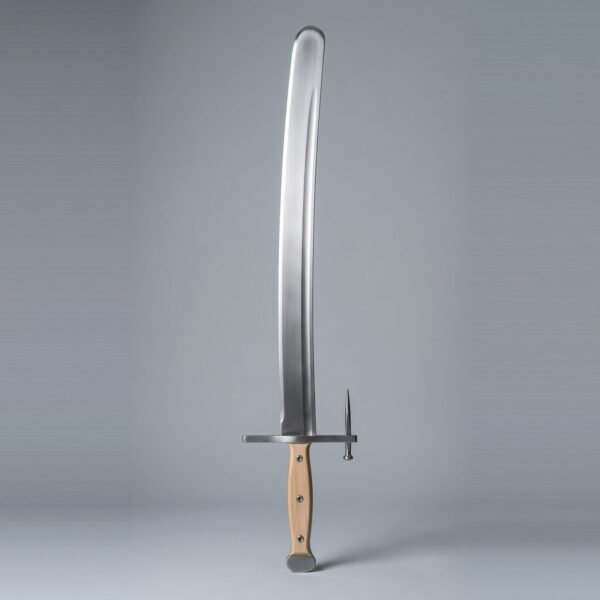
For a sharp historical pattern, see the Jarnfeld langes messer from our HEMA line, which is not made for sparring, and check our blunt versus sharp guide too.

Reviews
There are no reviews yet