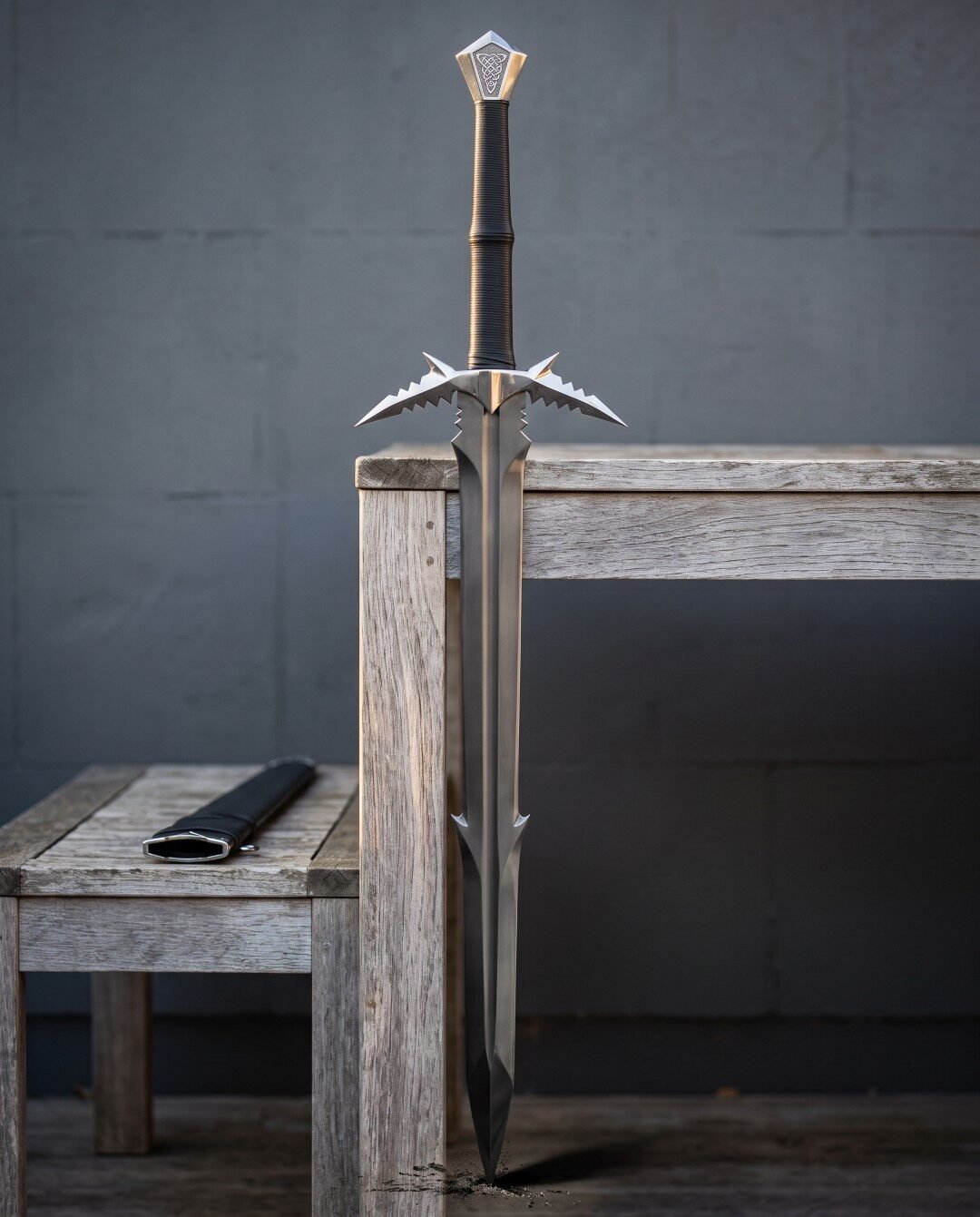
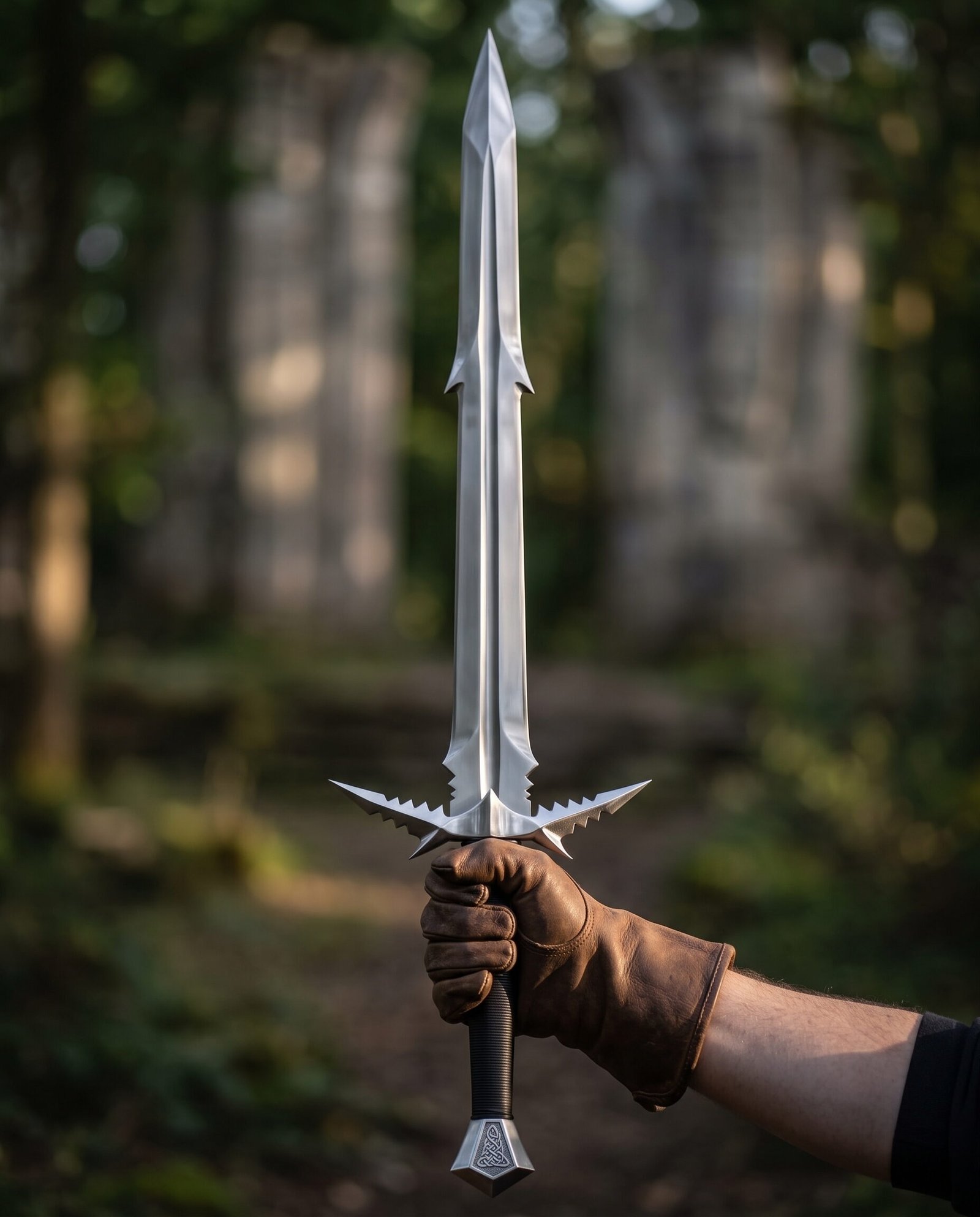
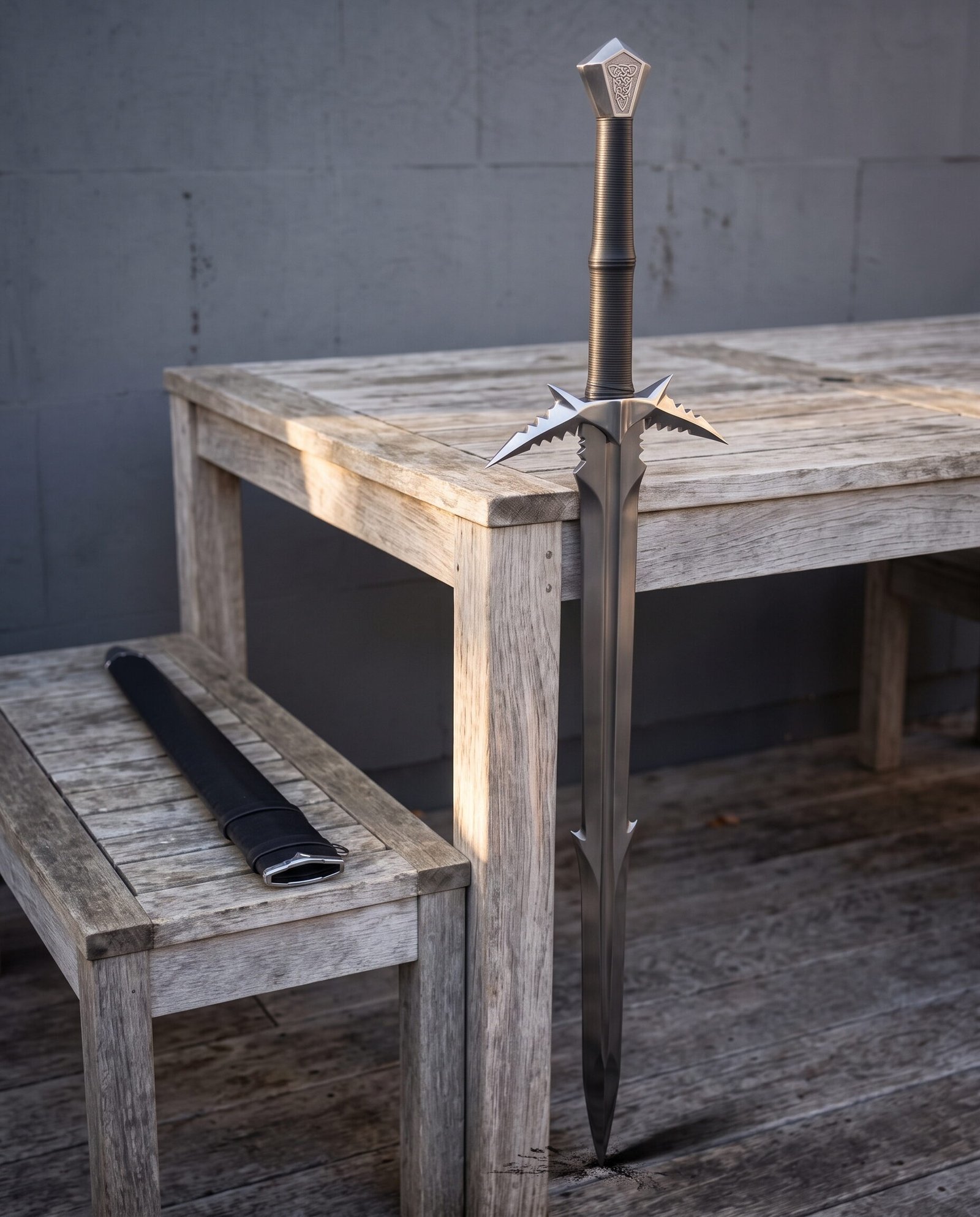
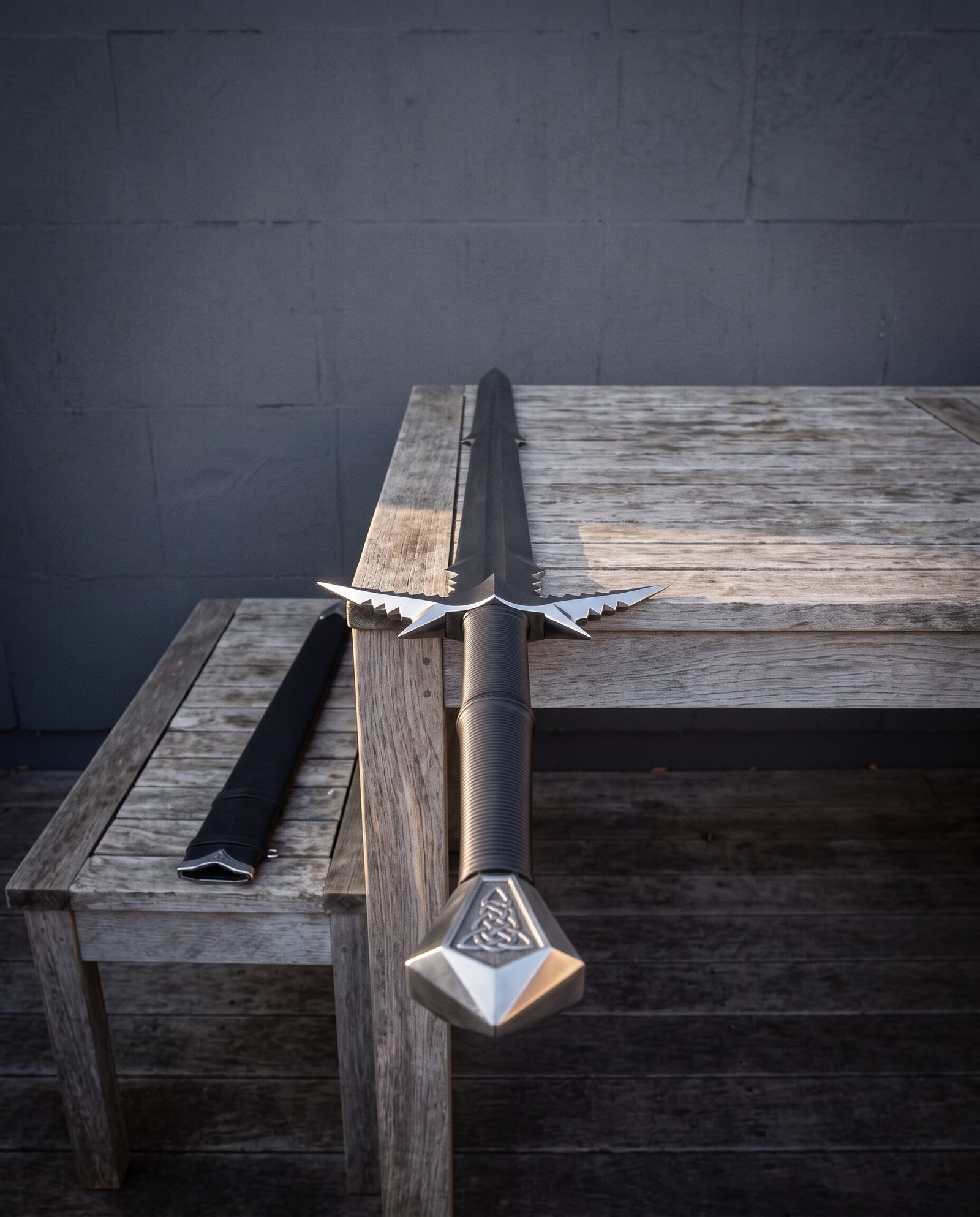
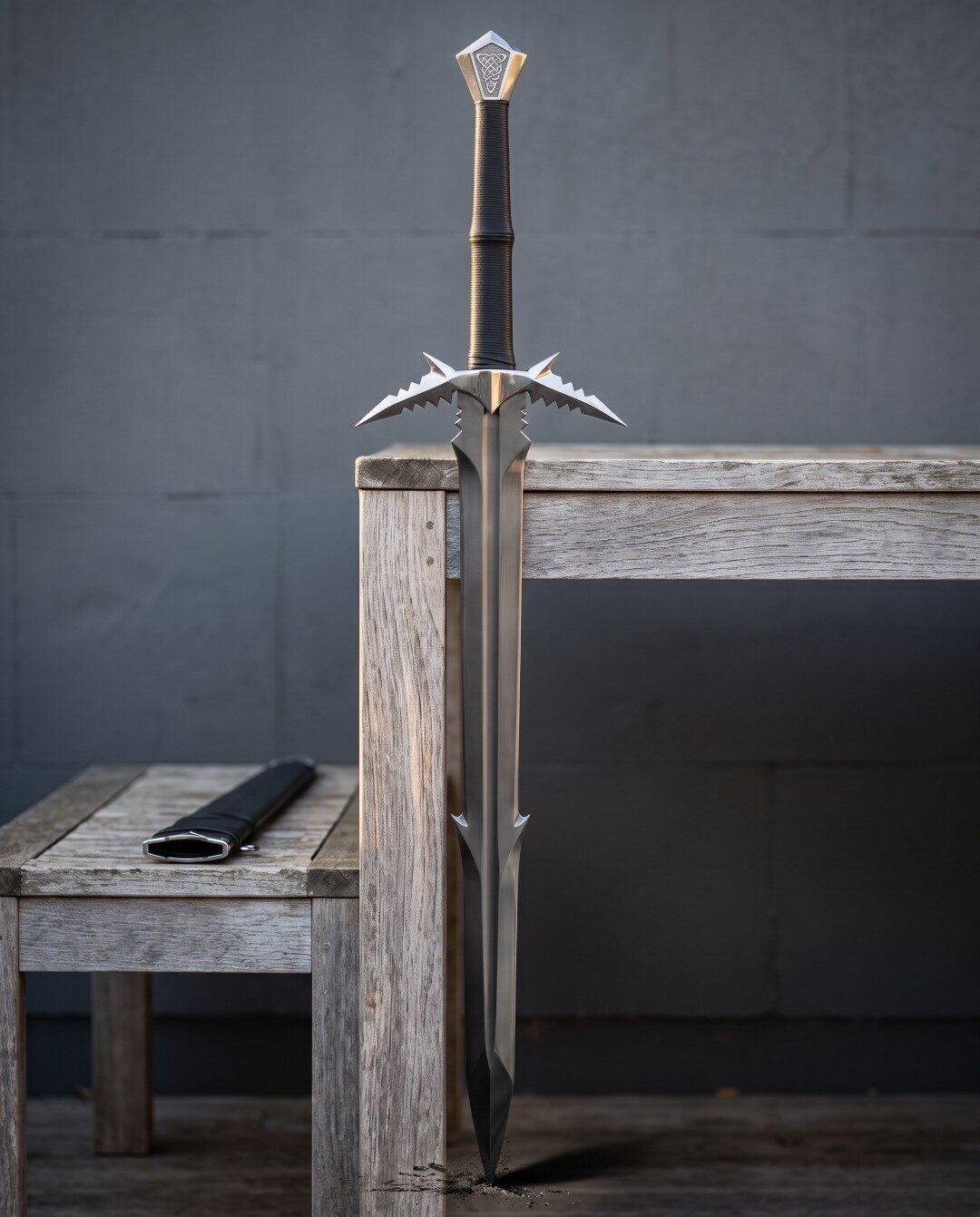
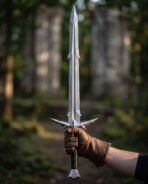
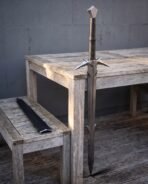
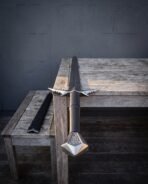
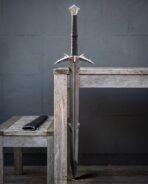
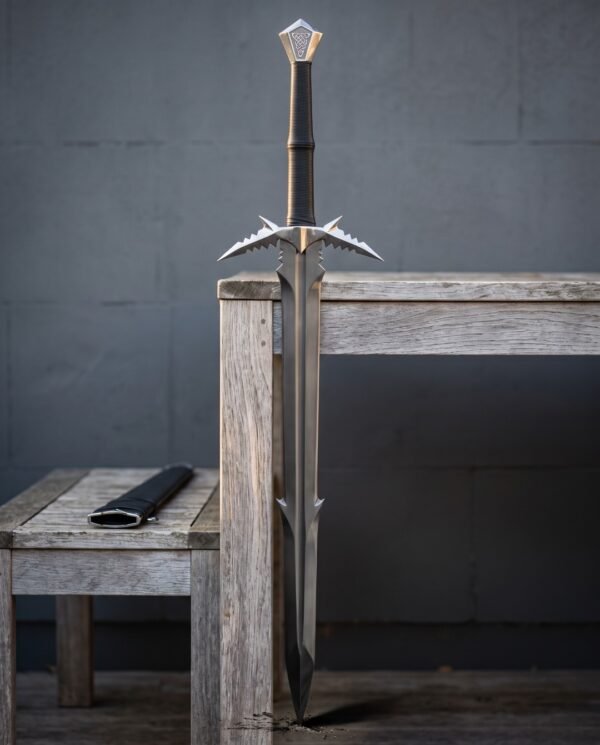
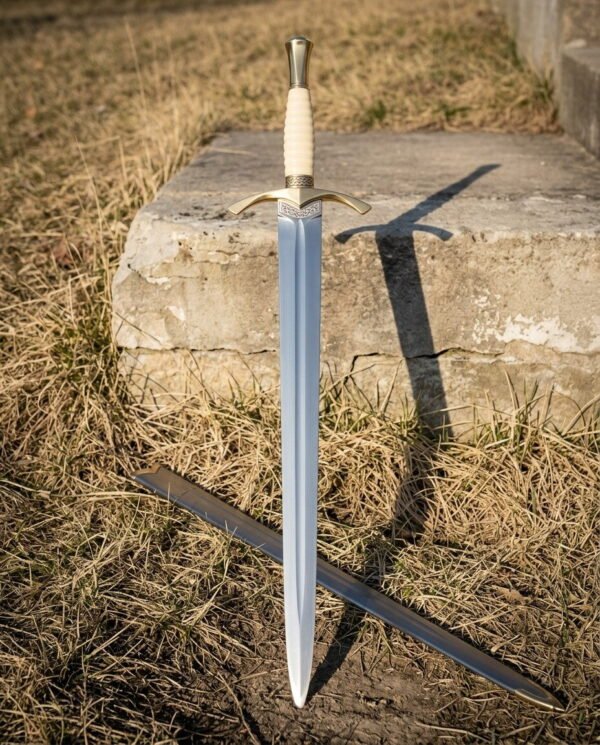
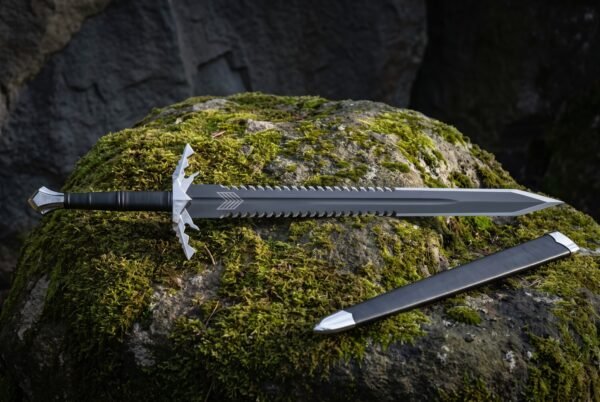
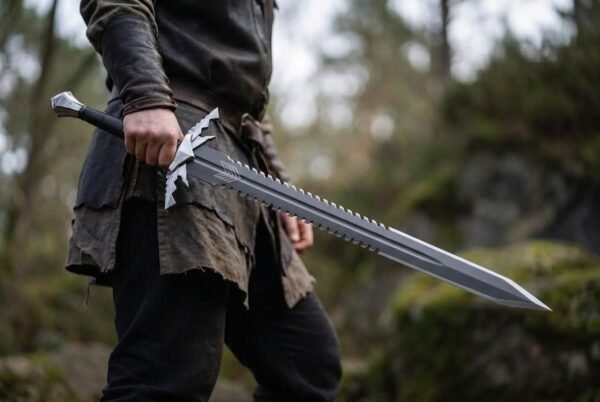
The Thornreaver is a fantasy sword built around a single idea, which is that everything on it points backwards. The crossguard is not a bar but a pair of swept wings, each cut into a row of teeth along its upper edge and drawn out to a spike at the tip. Below the guard the blade carries a short run of teeth on both edges, runs on as a long double edged blade with a raised central rib, and flares into two rear facing barbs in its lower third. The grip is tightly wound cord over a tapering core and the pommel is a faceted pentagon of polished steel carrying an engraved interlace knot. A plain black scabbard is included.
This is our own design and it is not connected to, licensed by or endorsed by any film, game or franchise. It is worth saying plainly, because a shape like this is a piece of visual storytelling rather than a reconstruction of anything that was dug out of a river. What it borrows from real swords is the language of the parting hook and the boar spear lug, features that exist to stop a blade travelling further than the wielder wants. What it does with them is turn them into silhouette. Thornreaver is forged, ground, heat treated and assembled by hand in the Czech Republic.
Nothing here claims to be historical, and display or battle ready is worth reading before you decide what you want it to do. 1095 is the plain carbon steel we work in, and the steel glossary explains what the number means and why it takes an edge. If you would rather have something historical at the same length, look at the claymores.
Specifications
| Material | 1095 high carbon steel, hardened to 54 to 58 HRC |
|---|
| Overall length | Approximately 42 inches |
|---|
| Blade length | Approximately 32 inches, double edged with a raised central rib |
|---|
| Blade detail | Short run of teeth on both edges just below the guard, and a pair of rear facing barbs in the lower third of the blade |
|---|
| Guard | Swept steel wings toothed along the upper edge and drawn to spiked tips, with two short upward spikes at the centre |
|---|
| Handle | Approximately 7 inch grip, tightly wound dark cord over a tapered core with a raised band at the middle |
|---|
| Pommel | Faceted pentagonal steel with an engraved interlace knot panel |
|---|
| Scabbard | Black leather over a shaped core with a steel throat |
|---|
| Weight | Approximately 3 lb 4 oz bare |
|---|
| Included | Sword, black scabbard, care card |
|---|
| SKU | RK-1978 |
|---|
Barbs, lugs and why real swords mostly avoid them
The barb is one of the oldest ideas in blade making and it turns up on harpoons and arrowheads thousands of years before it turns up on anything else. The logic is simple. A plain point goes in and comes out. A barbed point goes in and stays, because the rearward facing spur catches on the way back. For a harpoon that is the entire purpose, since you want the thing you hit to remain attached to your line.
For a sword it is a much worse trade, and that is why swords in the real world almost never carry them. A blade you cannot withdraw is a blade you have lost, and a sword fight is not a fishing trip. Where you do see rearward projections on serious blades they are doing the opposite job. The lugs on a boar spear and the wings on a Frankish winged spear are stops, placed to prevent the head sinking so far that a wounded animal can run up the shaft at you. The parrying hooks on a Renaissance great sword catch an opponent’s blade rather than an opponent. All of them are about controlling depth, not about causing damage on the way out. Thornreaver takes that vocabulary and uses it for shape rather than for function, which is exactly what a fantasy piece is allowed to do as long as nobody pretends otherwise.
The steel
The blade is 1095 high carbon steel with roughly one percent carbon, hardened and tempered back to 54 to 58 HRC. That is the same band we use on our working swords, because even a piece bought for display gets picked up, and a sword that is too hard is a sword that can crack rather than bend if it is ever dropped point first. The blade is distal tapered so it is thicker at the guard than at the point, which keeps a long wide blade from feeling dead in the hand, and the raised central rib does the same job a fuller does on a flatter blade, adding stiffness along the centre line without adding much mass.
The guard is cut from plate, filed to shape and dressed by hand, which is why the teeth along the upper edge are not perfectly uniform. The pommel is turned and faceted, then engraved and peened over the tang so that the whole hilt is held together by a hammered button of steel rather than by adhesive. The cord grip is wound under tension over a tapered core and can be rewrapped if it ever wears.
Engraving, runes and your own design
Use the rune converter on this page to turn a name, a date or a short phrase into Elder Futhark and we will cut it into the steel, the leather or the wood. If you would rather have a Viking pattern than a rune line, choose your own design in the engraving option above the add to cart button and tell us where it goes. Where a piece already carries an engraved design, your chosen engraving replaces it rather than sitting alongside it. On this sword the pommel already carries the knot panel, so a design ordered for the pommel takes its place. The wide flat of the blade between the teeth and the barbs is the most legible surface for a rune line and is our usual recommendation here. See the engraving page.
Handling, display and honest limits
The balance point is roughly five inches ahead of the guard and the long grip gives room for a second hand, so it handles like a hand and a half sword. It is heavier in the forward third than a historical blade of the same length because the barbs and the wide base put steel where a real sword would not have it, and that is a design choice rather than a fault.
Be clear about what this piece is for. It is a collector and display sword. It is not battle ready, it is not for sparring, and the barbs and toothed guard make it unsuitable for cutting practice, because anything that catches on a target under load turns a controlled cut into an uncontrolled one. Hang it, stand it, photograph it, hand it round at a table. Do not swing it at anything and do not put it in contact with another blade. It is supplied with a working edge for the look of the thing rather than because it is meant to be used, and we are happy to ship it blunt if you would rather.
Care
Wipe the steel down after handling and keep a thin film of light oil on it. The teeth on the guard and the inside faces of the barbs are the places rust starts, because they are awkward to reach and they trap the moisture from a hand. Use a cotton bud or a rag over a stick to oil into those corners every few weeks rather than relying on a wipe over the flats.
The engraved panel on the pommel wants the same treatment and a soft brush to keep dust out of the lines. The cord grip should be brushed dry rather than oiled. Feed the leather scabbard with a neutral cream twice a year. If the sword is going on a wall, mount it so the blade is not resting edge down on a bracket. Our steel care page covers rust removal in detail.
If it is going on a wall, hanging swords and axes safely covers mounts, fixings and what not to do.
Made in the Czech Republic
This piece is made by hand in the Czech Republic, in a workshop that still works the old way. The steel is forged, ground, heat treated and finished by smiths who learned the trade from the people before them, and the wood, horn and leather are cut and fitted by hand rather than pressed out on a line. That is also why no two pieces come out exactly the same.
Ransack Viking is a United States company. We import these pieces ourselves, check every one when it lands and ship from our warehouse in Chicago, Illinois. Engraving is done here in the United States after the piece arrives, so your runes or your own design go on before it leaves for you.
A note on handmade variation
This sword is hand made, not machine made or bulk produced, so what arrives will not be a pixel for pixel copy of the photograph. The teeth on the guard are filed individually and their spacing and depth will differ slightly from the one shown. The sweep of the barbs is worked by eye. Hammer texture shows under raking light on the flats, the depth of the engraved knot varies, and the leather of the scabbard takes dye differently across a hide. The dimensions, the material and the build are the same every time. The character is not.
Frequently asked questions
Is this from a film or a game
No. It is our own design. It is not an official, licensed or endorsed product of any franchise and we make no claim of any connection to one.
Is it battle ready
No. It is a display and collector sword. It is a real forged blade, not a cast wall hanger, but the barbed geometry makes it unsuitable for cutting practice and it must never be used for sparring or contact of any kind.
Does it arrive sharp
It ships with a working edge unless you ask otherwise. Given what it is, plenty of buyers prefer it blunt. Say so in the order notes and we will ship it that way at no extra charge.
Will it fit a standard sword stand
Yes, on a horizontal two or three tier stand. On a vertical stand check the cradle depth first, because the swept guard is wider than a plain crossguard.
Can I have the pommel knot changed
Yes. Pick the engraving option and tell us what you want on the pommel. Your design replaces the knot rather than sitting beside it. Runes are usually better placed on the blade flat.
How soon does it ship
One to two weeks of processing, then free tracked shipping inside the US.
What is in the box
- Thornreaver barbed fantasy sword
- Fitted black scabbard
- Care card and lifetime warranty note
- Forged and finished in the Czech Republic
Explore the range
See more in fantasy swords, longswords, sword stands and displays and swords, or read the guides.
Close to this one
Another in the same line is the Silverthorn movie sword. Next along the rack is the Brasslight movie sword, forged from 1095. For a straight comparison, see the Wyrmfold movie sword, pattern welded Damascus.
The Ironlotus scimitar covers the other half of the same kit. Nothing here exactly right, build one to your own spec on the design your own page.

This sword beat every expectation I had. Edge retention has been great even after regular use. Weight and balance make it feel like a real functional piece not some cheap replica. Couldn’t be happier with this.