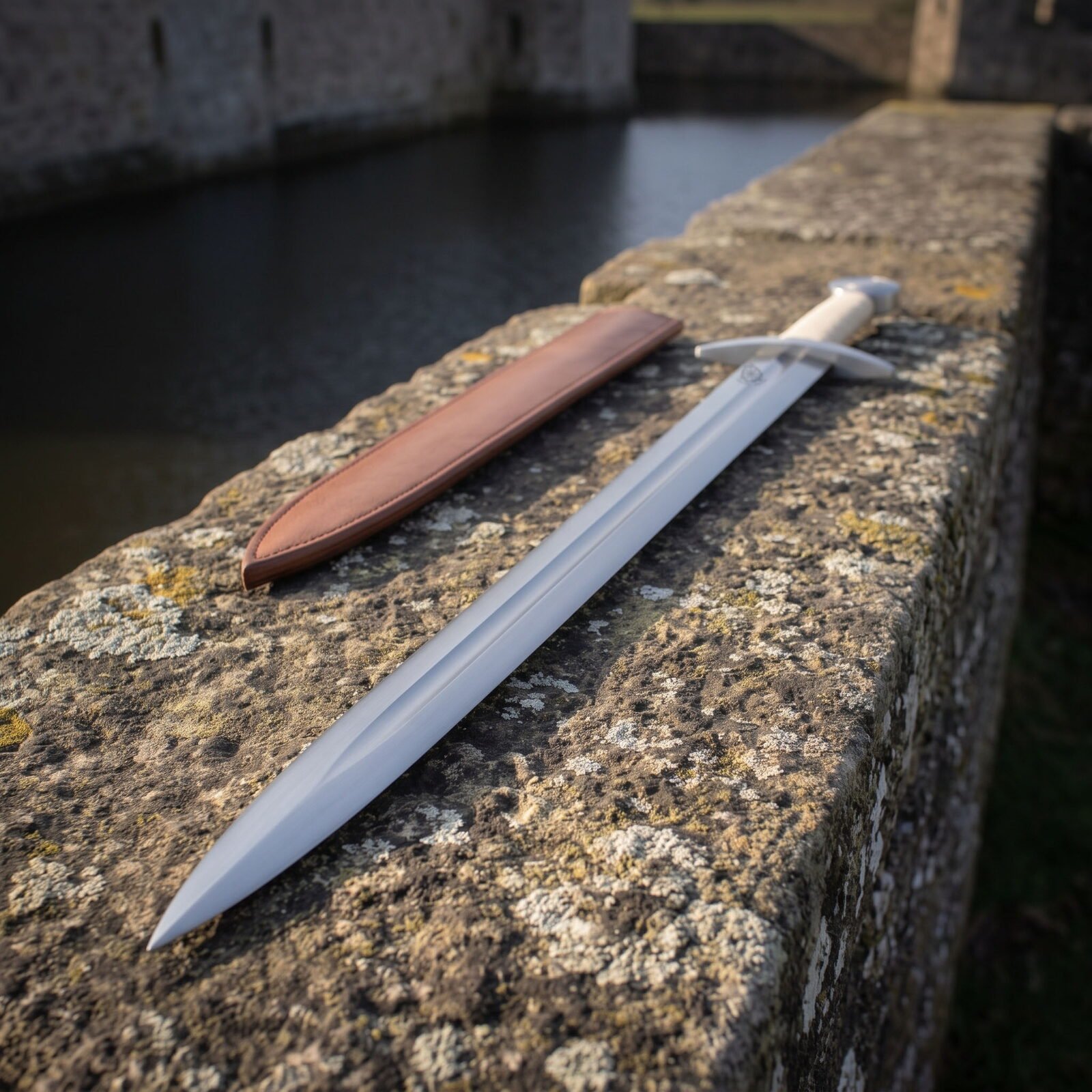
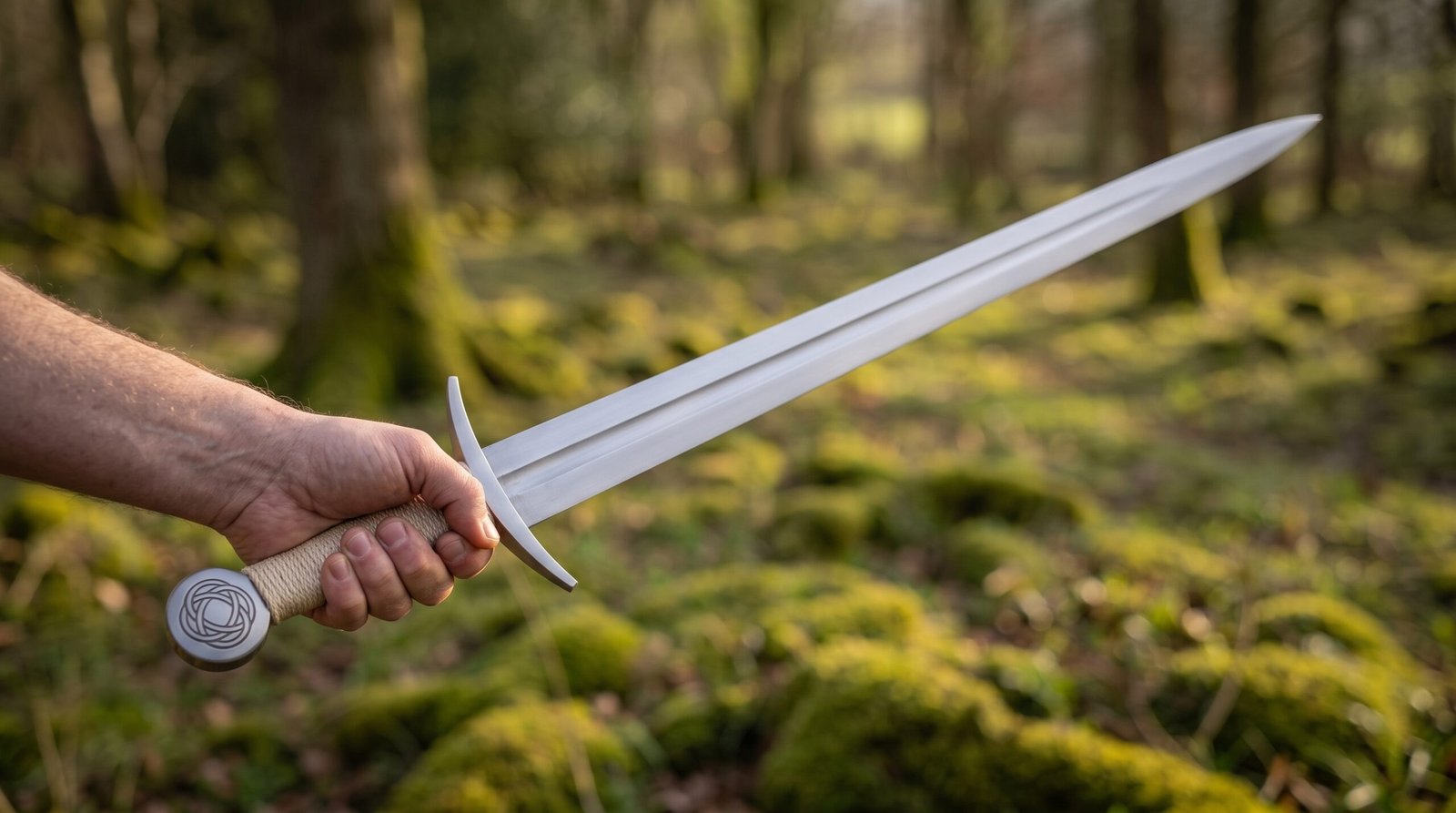
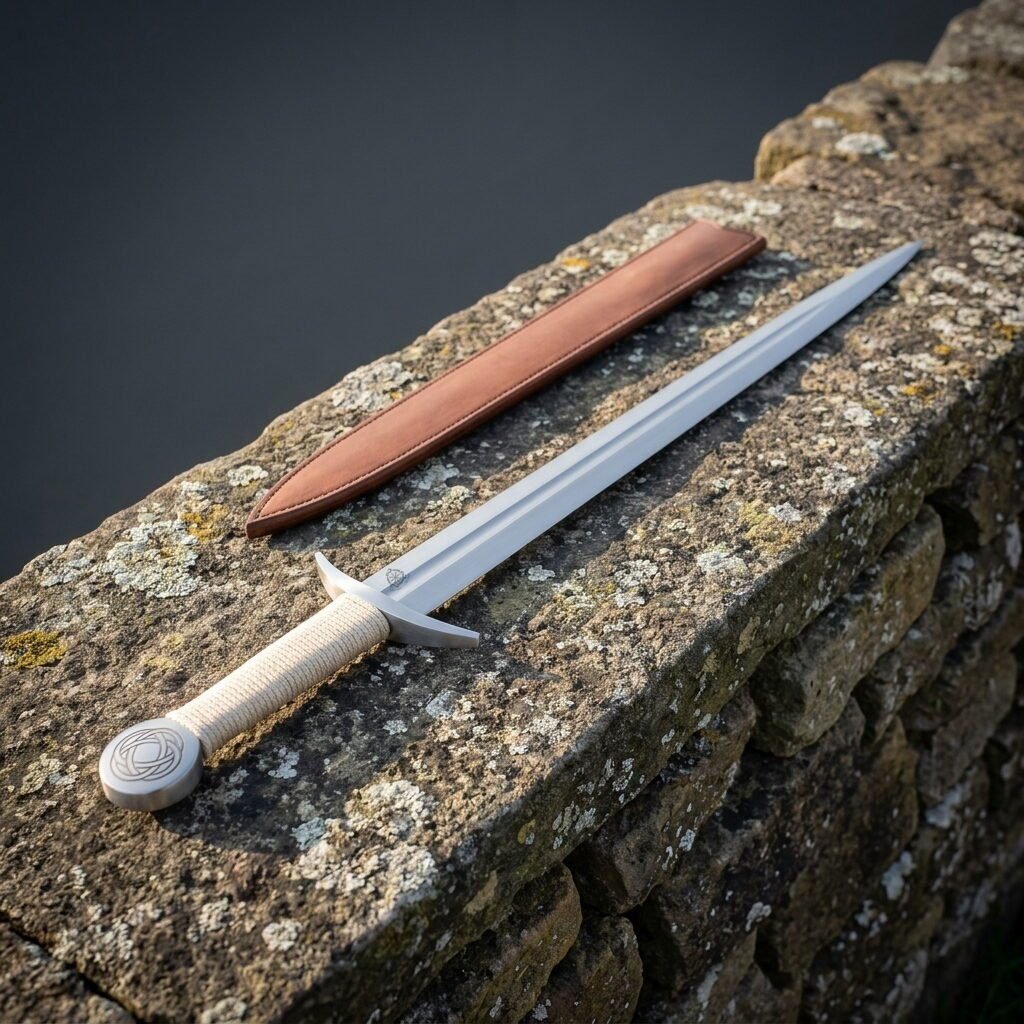
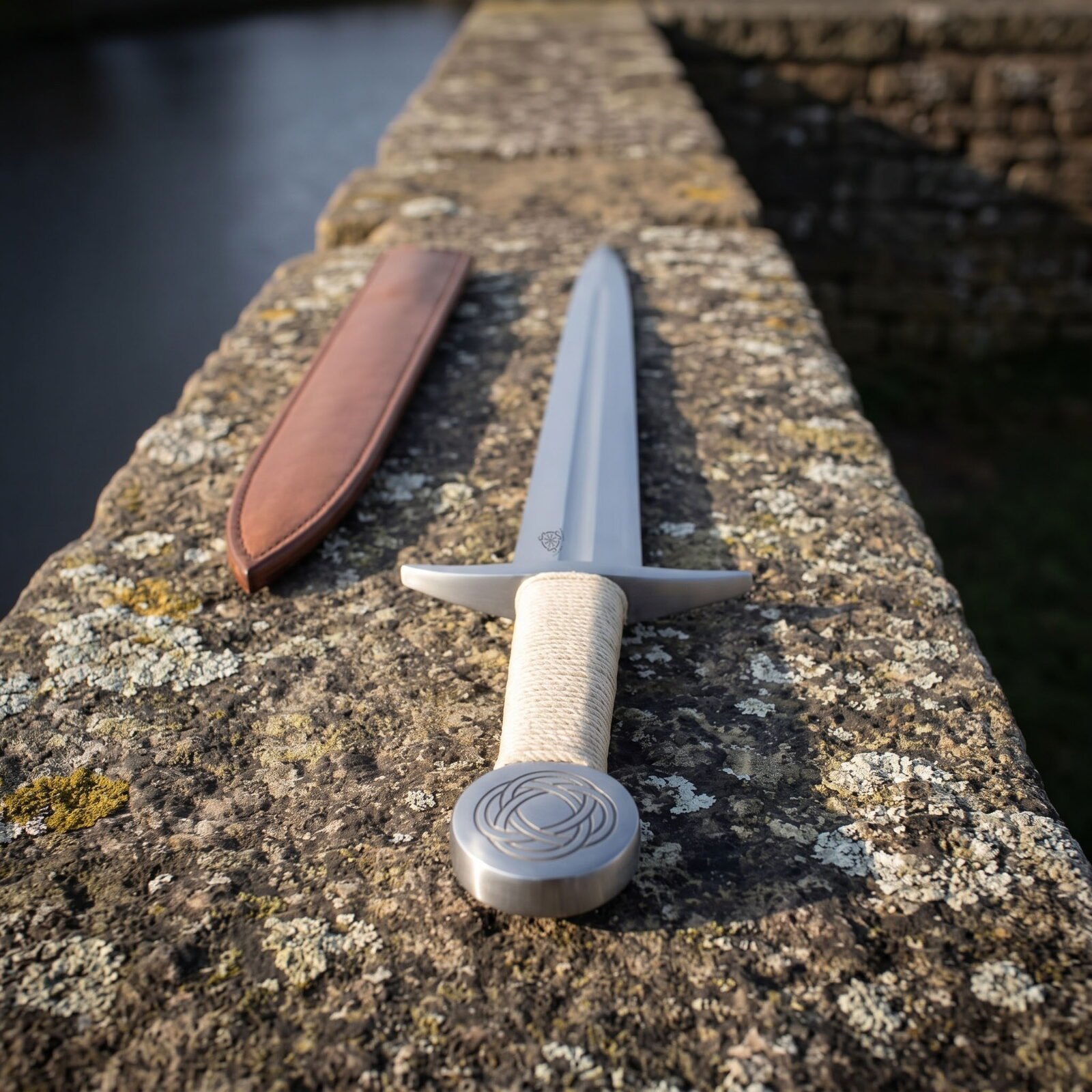
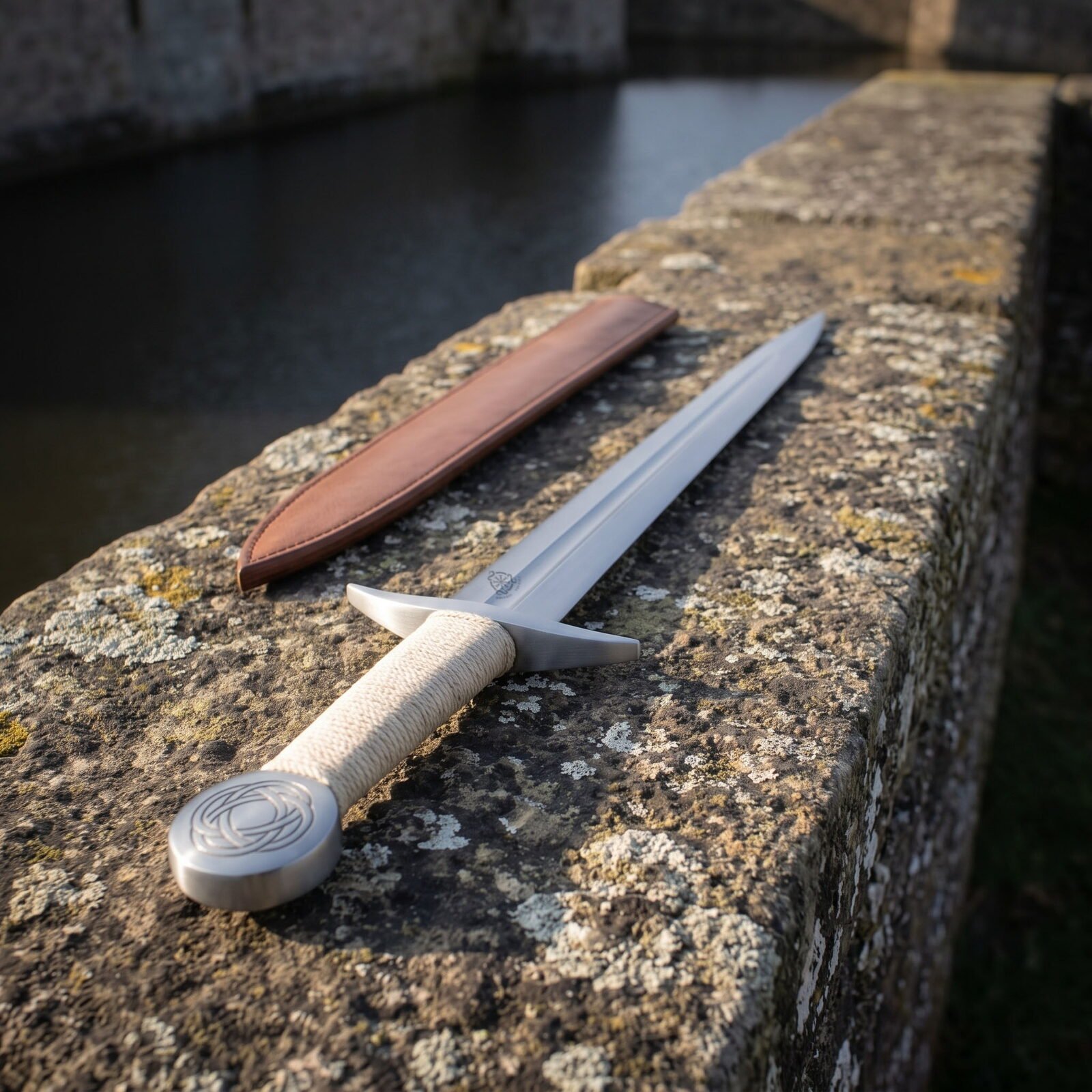
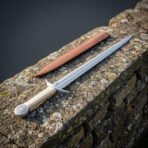
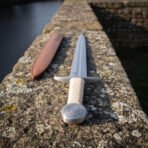
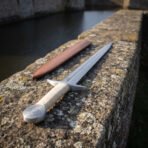
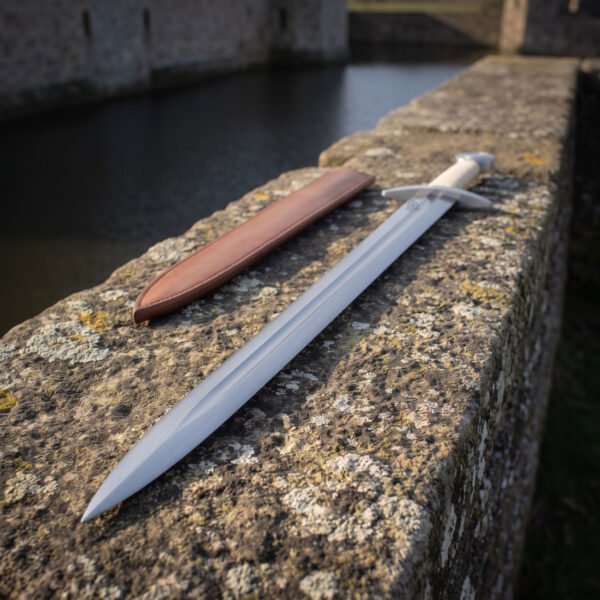
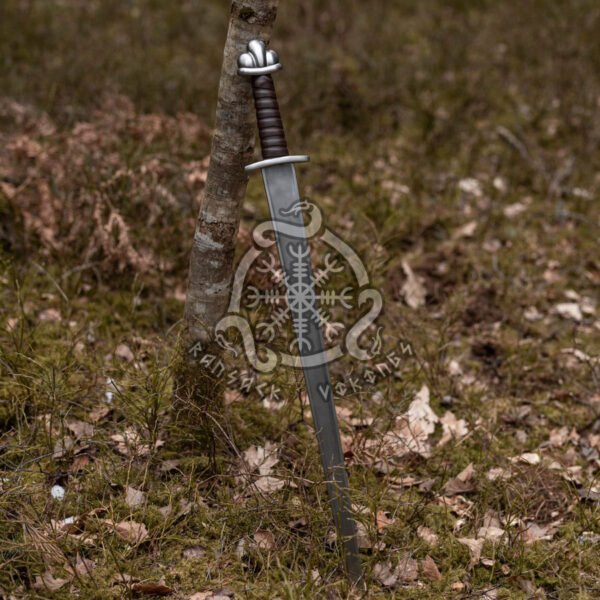
Flaxwhorl is a single hand arming sword built in the Celtic manner, with a pale cord wrapped grip, a round steel disc pommel carved with a circular interlace knot, and a short cross guard whose arms sweep gently down towards the blade. The blade itself is the unusual part. There is no fuller on it at all. Instead a strong central ridge runs from the shoulder almost to the point, with flat bevels falling away on either side, and a small etched knot mark sits on the flat just below the guard. It comes with a tan vegetable tanned leather scabbard, stitched down the welt and left plain, with no metal throat or chape.
The ridge is the detail worth knowing about. A fullered blade is hollowed down the middle to save weight and it is the right answer for a sword built mostly to cut. A ridged blade does the opposite, piling the steel up along the centre line so the cross section becomes a flattened diamond, and a diamond resists bending far better than a flat bar of the same weight. That makes the point stiff enough to be driven rather than just swung, which is why ridged sections turn up on Bronze Age and Celtic leaf blades and then come back again in the later medieval thrusting swords. It also changes how the sword feels in the hand, because the weight sits closer to the centre line and the blade rolls between cuts more willingly. This sword is made by hand in the Czech Republic. Ransack Viking imports it, checks the grind, the wrap and the fit in the scabbard, and ships it from our warehouse in Chicago, Illinois.
Insular and Norse fittings get mixed up constantly on screen, and the arms on screen rated for accuracy sorts out which is which. Insular knotwork travelled with the Norse and came back changed, and the symbols guide covers the shapes that recur. Wider blades of the same centuries sit in the broadswords.
Specifications
| Blade material | 1095 high carbon steel, hardened to 54 to 58 HRC |
|---|
| Overall length | Approximately 31 inches |
|---|
| Blade length | Approximately 26 inches |
|---|
| Blade type | Double edged, no fuller, raised central ridge, flattened diamond section, tapering to an acute point |
|---|
| Blade mark | Small etched knot mark on the flat just below the guard |
|---|
| Grip | Natural cream cord, tightly wrapped over a core, single hand |
|---|
| Pommel | Round steel disc, brushed finish, engraved circular interlace knot |
|---|
| Guard | Steel cross guard, short arms sweeping towards the blade, rounded ends |
|---|
| Finish | Satin polished blade, brushed steel fittings |
|---|
| Scabbard | Tan vegetable tanned leather, stitched welt, no metal fittings |
|---|
| Included | Sword and matching leather scabbard |
|---|
| SKU | RK-2033 |
|---|
Dimensions are nominal. Each sword is worked by hand so the figures move slightly from one to the next.
Why a cord wrap instead of leather
Most sword grips get a cord or braid wound onto the wooden core and then a leather cover glued and stitched over the top, which is where the raised risers on a medieval grip come from. Leaving the cord bare, as here, is a different decision and an old one. Dry cord grips far better than smooth leather when a hand is wet, because the fibres bite and the winding gives the palm dozens of small edges to hold against rather than one continuous slippery surface. The Japanese solved the same problem with a lacquered ray skin underlayer and a cross braid over it, and Celtic and early European hilts frequently used plain cord or a twisted organic wrap for the same reason. The trade off is honesty about wear. Pale cord shows dirt, absorbs hand oils, and will go from cream towards a warm honey colour with use, and there is no getting round that. Owners either wash it back or let it darken. The cord on this sword is wound tight and finished at both ends so it does not creep under load.
Steel, wrap and leather
The blade is 1095 high carbon steel, hardened and tempered to 54 to 58 HRC, which keeps a long blade tough enough to flex and return rather than brittle. It is finished satin rather than mirror, which suits the plain lines of the piece and hides handling better. Carbon steel is not stainless and it will take a patina and spot with rust if it is put away damp. The pommel and guard are steel with a brushed finish, and the pommel is engraved rather than cast, so the knot sits as clean cut lines in the metal surface. The scabbard is vegetable tanned leather with a stitched welt down the edge, dyed a warm tan and left without a metal throat or chape. Vegetable tanned leather is the right choice for a scabbard because it can be wet formed to the exact section of the blade, but it is also acidic, which is precisely why you should not store a carbon steel blade inside it for months on end.
Engraving, runes and your own design
Use the rune converter on this page to turn a name, a date or a short phrase into Elder Futhark and we will cut it into the steel, the leather or the wood. If you would rather have a Viking pattern than a rune line, choose your own design in the engraving option above the add to cart button and tell us where it goes. Where a piece already carries an engraved design, your chosen engraving replaces it rather than sitting alongside it. On this sword that means the interlace knot on the face of the pommel is the thing your engraving would replace if you choose the pommel. Most people leave the knot alone and put their rune line on the flat of the blade below the guard instead, or have it stamped into the plain tan leather of the scabbard, which takes a cut line beautifully. Engraving is done here in the United States after the piece arrives, so you see a proof before anything is cut. See the engraving page for what the converter does with modern letters.
Handling and balance
This is a shorter sword than a full knightly one and it feels it in the hand. Less blade in front of the guard means the balance point sits close in, the sword turns quickly, and the disc pommel back weights it further. The ridged section makes the blade feel stiffer than its width suggests. The guard arms sweeping towards the blade are more than decoration, because a quillon angled forward will catch and hold an incoming edge sliding down towards the hand rather than letting it run straight off the end. Wrap the fingers, keep the thumb along the grip, and let the cord do the holding rather than squeezing.
It is a display and reenactment piece. We do not describe it as battle ready and we do not suggest full contact sparring with it. If you want something for cutting practice, buy a purpose built cutter and keep this one for the wall.
Care
Wipe the blade after handling and put a thin film of mineral oil, gun oil or camellia oil on it with a cloth. Once a month is enough for a sword kept indoors. Rust freckles lift with fine steel wool or a green pad and a drop of oil, and the satin finish hides the repair well. The cord grip is the part that needs a different approach. Do not oil it, because oil traps grit. If it gets grubby, work a little mild soap into a damp cloth, wipe along the winding rather than across it, and let it dry away from heat. Expect it to darken over the years and treat that as the sword ageing rather than as damage. Feed the leather scabbard with a neutral cream once or twice a year, keep it out of direct sun and away from radiators, and store the blade out of it for the long term. There is more on rust, patina and oiling on steel care.
If it is going on a wall, hanging swords and axes safely covers mounts, fixings and what not to do.
Made in the Czech Republic
This sword is made by hand in the Czech Republic. Nothing here comes out of an importer catalogue and nothing ships without being looked at. Ransack Viking brings the pieces in, checks each one over, and holds them in the Chicago warehouse until they sell. Processing takes one to two weeks, which is the real figure, and an order with engraving on it sits at the longer end because we proof the layout with you before we cut. Shipping inside the United States is free. Returns are open for seven days. The lifetime warranty against defects in forging, grind, heat treat and fittings has no end date and no receipt is needed.
A note on handmade variation
This sword is hand made rather than machine made or bulk produced, so it will not be a pixel for pixel copy of the photograph. The cord is wound by hand, so the pitch of the winding and the exact number of turns differ, and natural cord runs from a cool off white to a warm cream depending on the batch. The engraved knot on the pommel is cut by hand and its lines will not land in identical positions. Leather is a natural material and the tan on the scabbard varies between hides, sometimes reading pink and sometimes reading orange in daylight. Grind lines, ridge height and the curve of the guard arms all move a little because a person made them. Dimensions, material and build stay the same every time. The character does not.
Frequently asked questions
Will the pale cord grip get dirty
Yes, and it is meant to. Natural cord takes up hand oils and darkens towards honey with use. A damp cloth with a little mild soap, wiped along the winding, brings it back a long way if you would rather keep it light.
Why does this blade have no fuller
Because it uses a raised central ridge instead. A ridge stiffens a blade for thrusting where a fuller lightens it for cutting. They are two different answers to the same problem and this sword uses the older one.
Does the scabbard have a metal throat or chape
No. It is plain vegetable tanned leather, wet formed to the blade and stitched down the welt, with no metal fittings at either end. That is period correct for a lot of early scabbards and it keeps the weight down.
Can I have the pommel knot replaced with runes
Yes. Your engraving replaces the existing knot rather than sitting beside it, so say so clearly when you order. Most buyers keep the knot and put runes on the blade or the scabbard instead.
Is the edge sharp out of the box
It arrives with a finished edge that is not honed to a shaving edge. This is a display and reenactment piece and we do not describe it as battle ready.
How long from order to delivery
Processing is one to two weeks in our Chicago warehouse, plus transit, and shipping within the United States is free. Engraved orders take a few days longer because of the proof.
What is in the box
- One Flaxwhorl Celtic arming sword with a cord wrapped grip and an engraved disc pommel
- One tan vegetable tanned leather scabbard, stitched welt, no metal fittings
- A protective film of oil on the blade for transit
- Wrapping and a carton cut to length for the sword
- Hand made in the Czech Republic, shipped from our Chicago, Illinois warehouse
Explore the range
Browse the arming swords, the Anglo Saxon and Celtic pieces, the scabbards and sheaths and the guides.
Near neighbours in the shop
Sitting beside it in the catalogue is the Oathstone Anglo Saxon piece. Another in the same line is the Knotbone Anglo Saxon piece, 14 inches overall. Next along the rack is the Axebloom Anglo Saxon piece.
Fitting out further, the Ramcrest Damascus skinner knife belongs with it. You can have this made your way instead on the custom seax page.




So happy I finally pulled the trigger on this one. Weight and balance make it feel like a real functional piece not some cheap replica. Already telling my friends to check this out.
This sword is a genuine work of art. Steel blade holds a razor edge right out of the box. Already telling my friends to check this out.
Absolutely blown away by this sword. If you’re on the fence just get it. You won’t regret it.
Been eyeing this sword for months and it did not disappoint. Nice touch that it ships from within the US even though it’s crafted in the Czech Republic. Can’t recommend this enough.
Really happy with this sword overall. Blade quality is solid. Arrived a bit less sharp than expected but a few passes on a strop fixed it. Ransack Viking usually delivers solid quality and this was no exception. Still very happy with it and would recommend.
Absolutely blown away by this sword. Edge retention has been great even after regular use. Shipping was fast and everything arrived well packaged.
Five stars isn’t even enough honestly. Edge retention has been great even after regular use. Beyond happy with how this turned out.
Best sword I’ve ever owned. The wood handle feels amazing and the balance is perfect. Love it.
Bought this on a whim and it turned out to be one of my favorite purchases this year. Came in a nice gift box which made it feel even more special. Edge retention has been great even after regular use. Steel blade holds a razor edge right out of the box. Beyond happy with how this turned out.
It’s a decent sword. Nothing extraordinary though. Not bad, not amazing either.