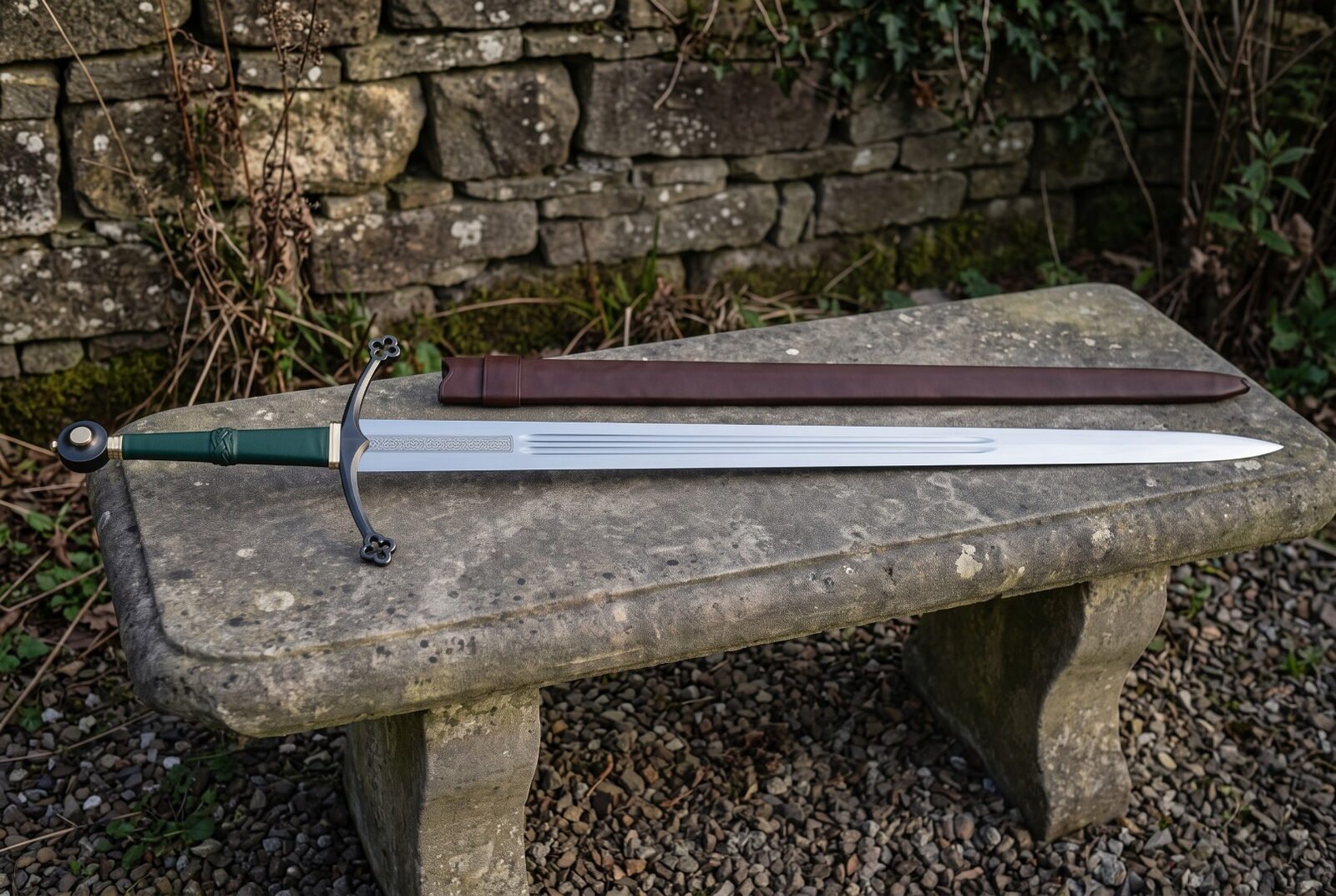
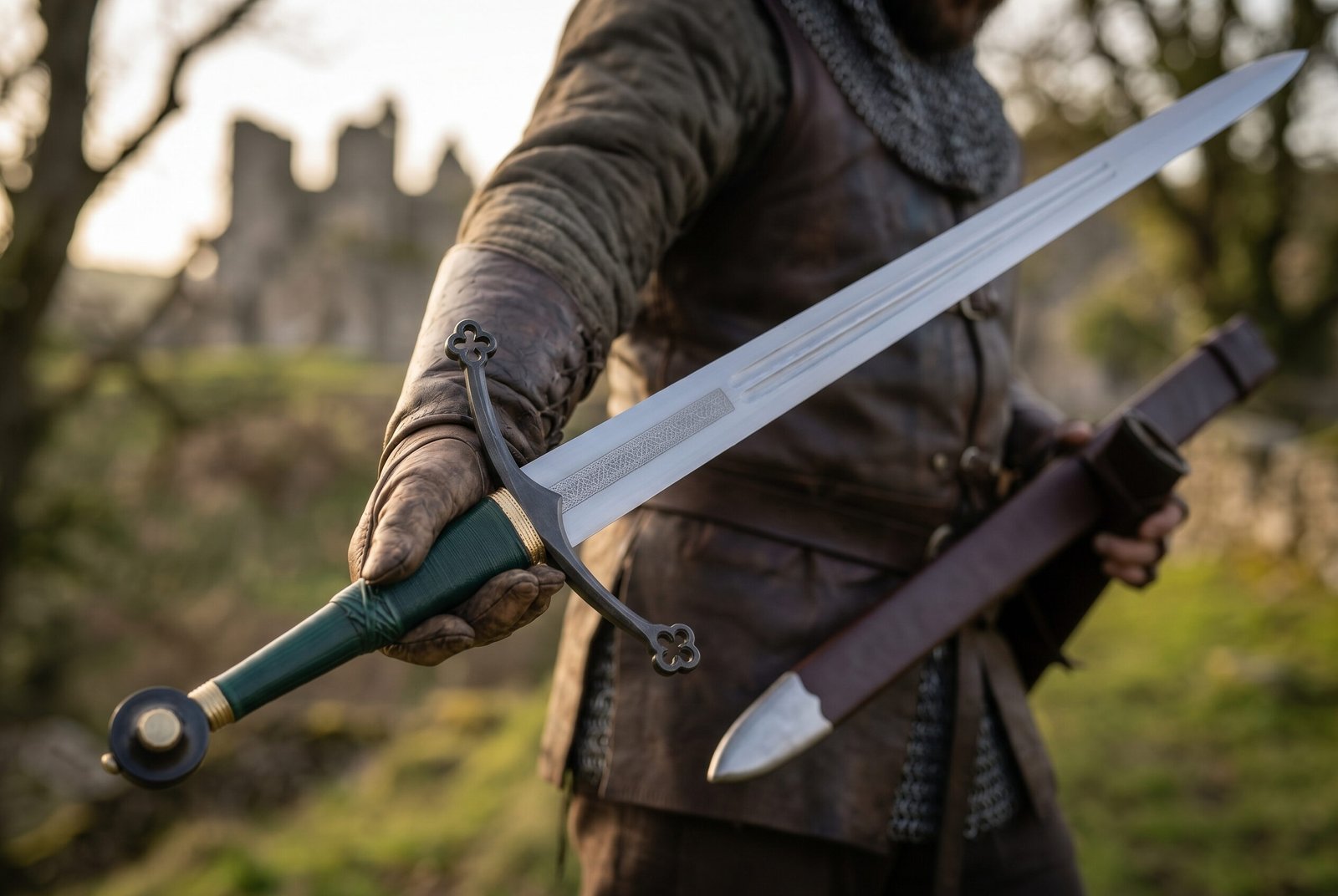
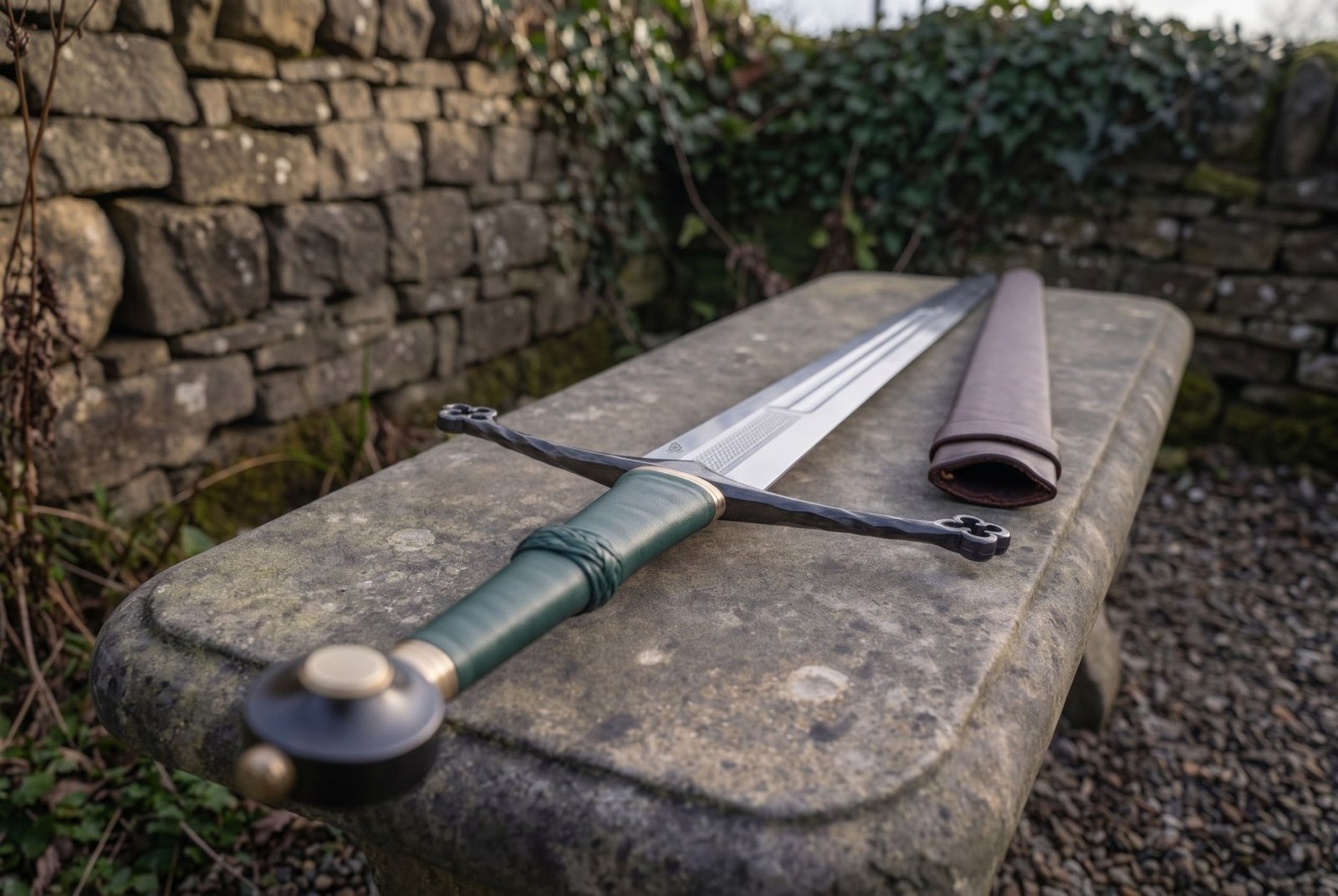
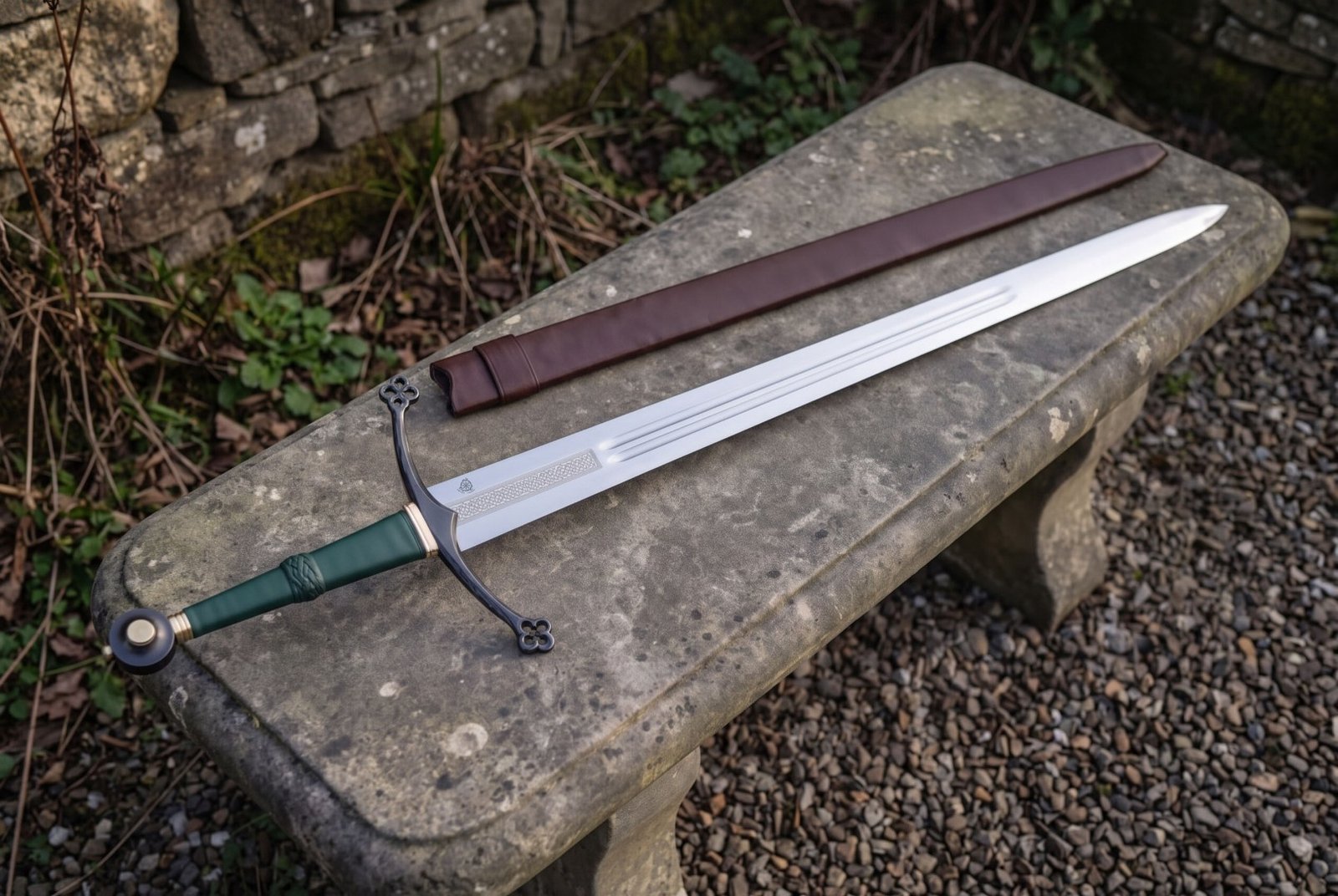
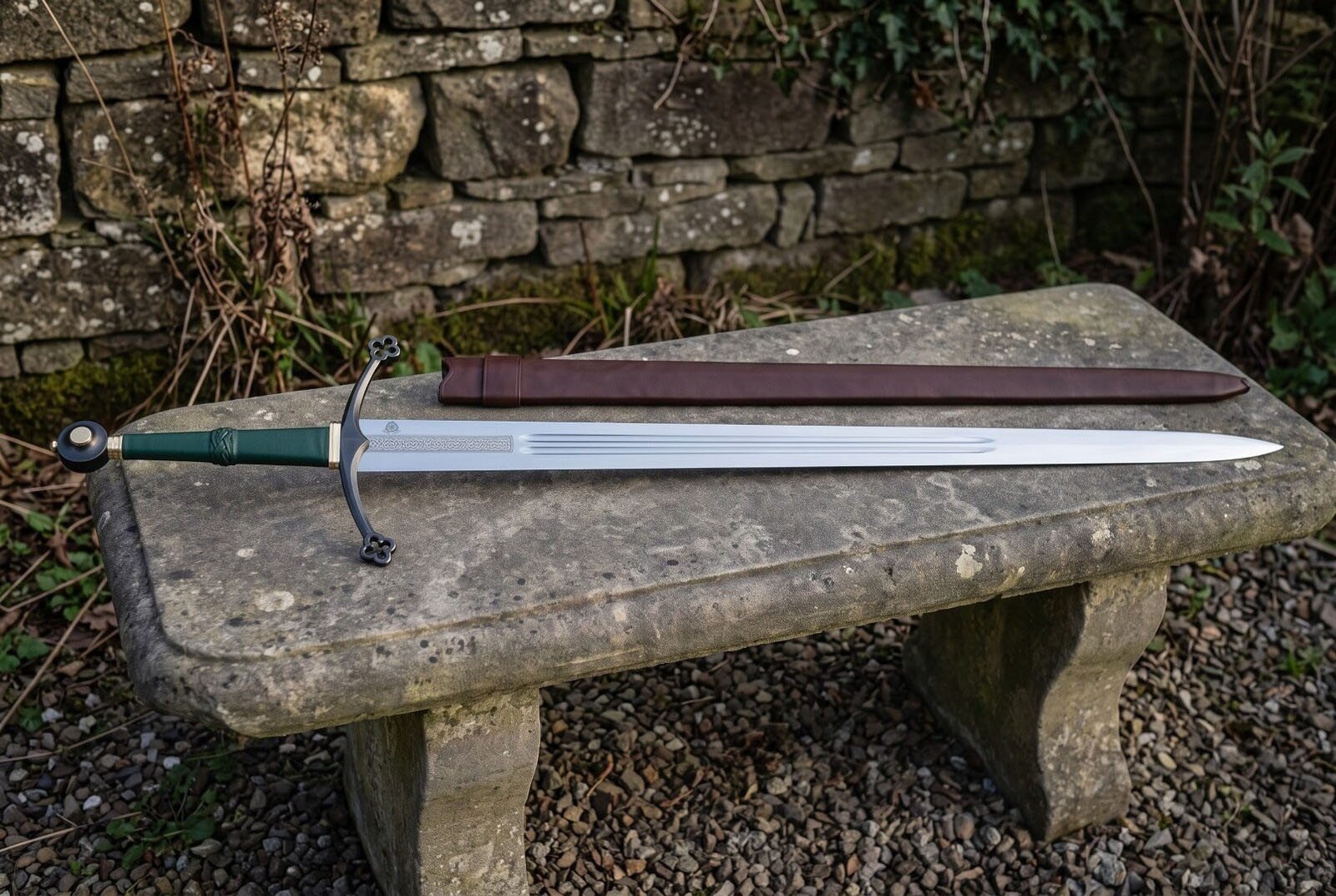
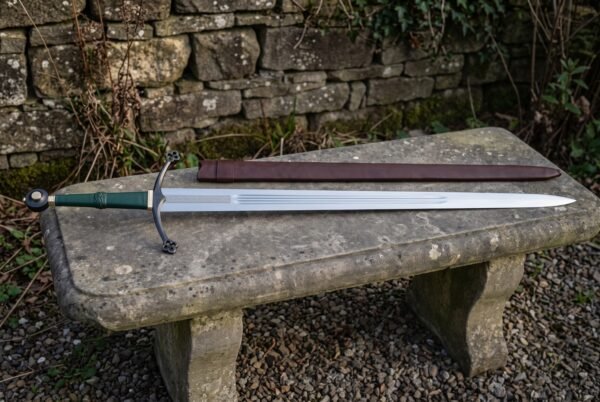
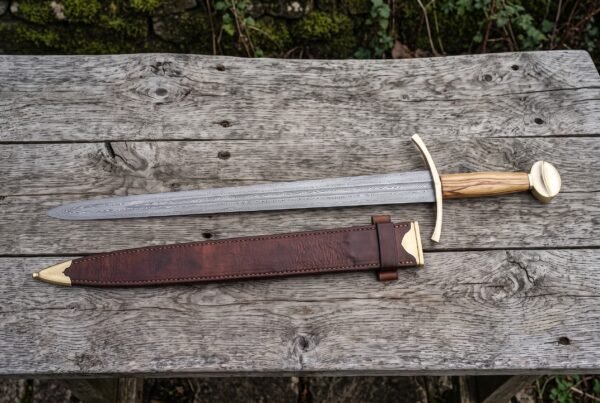
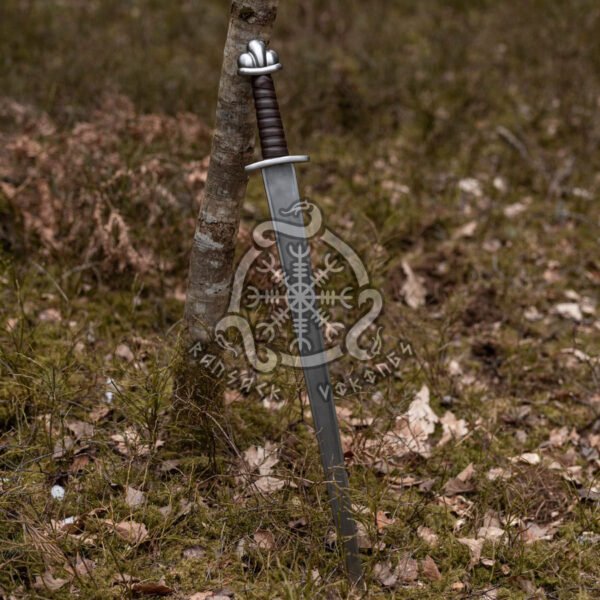
The Cloverhilt is an arming sword built around three narrow fullers, a blackened crossguard ending in scrolled quatrefoil lobes, and a green leather grip bound with a decorative knot band between two brass ferrules. The blade is plain high carbon steel taken to a bright polish, with an etched band of Celtic interlace framed above the ricasso and the three grooves running away from it down the length. The pommel is a dark disc with a brass button at the centre, which picks up the brass at either end of the grip.
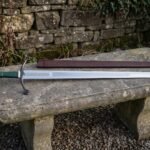
The colour scheme is the first thing people notice. Blackened steel against green leather and brass is not the usual medieval palette of bright steel and brown, and it gives the sword a much cooler and quieter look than the standard build. The quatrefoil terminals on the guard are lifted straight out of medieval architecture, where the four lobed opening is one of the most common tracery forms in Gothic windows and appears endlessly in heraldry and manuscript borders. The Cloverhilt is made by hand in the Czech Republic, imported and checked by Ransack Viking, and shipped from our Chicago, Illinois warehouse. It comes with the fitted brown leather scabbard shown in the photograph.
A single handed sword is the piece reenactors ask about most, and what reenactors actually want covers what gets used and what gets shelved. 1095 is the plain carbon steel we work in, and the steel glossary explains what the number means and why it takes an edge. The medieval helmets are the obvious thing to hang beside it.
Specifications
| Type | Arming sword, medieval knightly form, with a long grip |
|---|
| Blade | 1095 high carbon steel, 54 to 58 HRC, bright polished |
|---|
| Blade profile | Straight double edged blade with three narrow parallel fullers |
|---|
| Blade etching | Framed Celtic interlace band above the ricasso |
|---|
| Guard | Blackened steel crossguard with scrolled arms curving toward the blade and quatrefoil terminals |
|---|
| Grip | Green leather over a shaped core with a bound knot band at the centre |
|---|
| Fittings | Brass ferrules at both ends of the grip |
|---|
| Pommel | Blackened disc pommel with a brass centre button |
|---|
| Scabbard | Dark brown leather with a steel chape |
|---|
| Included | Arming sword and fitted brown leather scabbard |
|---|
| SKU | RK-2079 |
|---|
Why three narrow fullers instead of one wide one
Most people have seen a sword with a single broad fuller down the middle. Three narrow ones side by side is a different solution to the same problem, and in engineering terms it is arguably the better one.
A fuller lightens a blade by taking steel out of the centre, where it contributes least to stiffness. The catch is that a single wide fuller takes out one continuous strip, so the blade becomes thin across the whole middle section. Cut three narrow grooves instead and you leave two ribs of full thickness steel standing between them. Those ribs run the length of the blade and act exactly like the webs in a corrugated panel, resisting bending far better than a single thinned section of the same total area. You remove the same weight and keep more stiffness.
There is nothing modern about this. Multiple fullers appear on migration period and Viking Age blades across northern Europe, and pattern welded swords from the sixth to the ninth centuries frequently carry two or three grooves rather than one. The form persisted into the medieval period on lighter blades where the smith wanted the weight saving without giving up rigidity.
The quatrefoil guard and what blackening actually is
The four lobed shape on the ends of this crossguard is a quatrefoil, and it is one of the most persistent motifs in medieval European design. It fills the tracery of Gothic windows, it appears in heraldry as a charge, it borders manuscript pages and it turns up cast into buckles, mounts and sword furniture. Four lobes arranged around a centre reads as a clover, as a flower, and in a religious context as the cross, which is a large part of why it spread so far.
The dark finish on the guard and pommel is a blackened steel finish, not paint and not a plating. Blackening steel means growing a controlled oxide layer on the surface rather than adding a coating to it, and the traditional methods use heat, oil or a chemical bath to convert the outer skin of the metal into a stable black oxide. Because it is part of the steel rather than sitting on top of it, it does not chip the way paint does, but it is thin and it will wear bright at the high points with handling. Many collectors like that, since it gives the fittings an aged look over time.
One consequence worth knowing: a blackened finish offers only mild corrosion protection and none at all once it is worn through. Treat the black parts the same way you treat the blade, with a wipe and a light oil.
Polished carbon steel and green leather
The blade is plain 1095 high carbon steel at 54 to 58 HRC, ground and polished bright. It is not pattern welded, there is no Damascus figure in it, and we would rather state that plainly than let the photograph do the implying. A bright polish on a triple fullered blade is the correct historical choice, because the whole visual effect of multiple fullers depends on reflected light.
The grip is leather dyed green over a shaped core, with a bound knot band worked into the middle. Green is a difficult colour on vegetable tanned leather because the natural tan is warm and pulls a blue green dye towards olive, which is why leather of this colour varies in shade more than black or brown does. The brass ferrules at each end trap the leather and stop the edges lifting, and they do the same job at the pommel end that a bolster does on a knife.
Engraving, runes and your own design
Use the rune converter on this page to turn a name, a date or a short phrase into Elder Futhark and we will cut it into the steel, the leather or the wood. If you would rather have a Viking pattern than a rune line, choose your own design in the engraving option above the add to cart button and tell us where it goes. Where a piece already carries an engraved design, your chosen engraving replaces it rather than sitting alongside it. On the Cloverhilt that means a rune line above the ricasso takes the place of the Celtic interlace band already etched there. The scabbard leather is another option if you would rather leave the blade as it is. Everything is on the engraving page.
Handling and balance
The grip is long enough for a full fist with room to spare toward the pommel, and the disc pommel behind the hand acts as a counterweight. The triple fullers take enough weight out of the middle of the blade that the balance sits close in, a short way forward of the guard, which gives a light responsive point and a quick recovery.
The scrolled quatrefoil arms are more than decoration in the hand. They curve forward slightly, which means an incoming edge sliding down the guard is turned outwards rather than running towards the fingers. The knot band on the grip gives the hand a reference point so you always know where you are holding it without looking.
This is a hand made collector and display sword with a real edge. It is not sold as a full contact sparring sword and should not be used against another blade or for cutting practice on hard targets.
Care
Wipe the blade after handling and keep a light film of oil on it. A bright polish shows fingerprints and skin acid will etch a permanent shadow into the surface within days if it is left, so this matters more here than on an etched blade. Use a soft cloth and a thin mineral or blade oil, wiped almost dry.
Treat the blackened guard and pommel gently. Do not use polish or abrasive compound on them, because the black is a thin oxide layer and polishing will cut straight through it to bright steel. A dry cloth and a trace of oil is all they need. Feed the green leather grip and the scabbard with a light leather cream once or twice a year, and keep the sword out of the scabbard for long term storage. Our steel care guide covers the rest.
If it is going on a wall, hanging swords and axes safely covers mounts, fixings and what not to do.
Made in the Czech Republic
This sword is made by hand in the Czech Republic. Ransack Viking imports it, checks the polish, the fullers, the guard seating, the grip binding and the scabbard fit before it is listed, and ships it from our Chicago, Illinois warehouse. Nothing here is drop shipped from an importer catalogue without being seen. Shipping across the United States is free. Processing usually takes one to two weeks and engraving adds to that. Returns are accepted within seven days. The lifetime warranty against defects in forging, grind, heat treat and fittings has no end date and needs no receipt.
A note on handmade variation
This sword is hand made rather than machine made or bulk produced, so what arrives will not be a pixel for pixel copy of the photograph. Green dyed leather varies more than most colours, so the exact shade of your grip and the depth of the tone will differ from the one shown. The blackened finish varies a little in evenness because it is a chemical conversion of the surface rather than a sprayed coat. The three fullers are cut by hand and their exact width and stopping point vary slightly, and the etched interlace band sits a fraction differently. The dimensions, the material and the build are the same every time. The character is not.
Frequently asked questions
Is the blade Damascus
No. It is plain 1095 high carbon steel with a bright polish. There is no pattern welding in this blade and we do not describe it as Damascus.
Why does this blade have three grooves
Three narrow fullers remove the same weight as one wide one while leaving ribs of full thickness steel between them, so the blade stays stiffer for the same weight saving. Multiple fullers are found on migration period and Viking Age blades and are entirely historical.
Will the black finish rub off
It will wear bright at the high points with handling, because blackening is a thin oxide layer grown into the surface rather than a coating sitting on top. Most collectors like the way that ages. It will not chip or flake the way paint does.
Is the green grip real leather
Yes, it is dyed leather over a shaped core, bound with a knot band and trapped at both ends by brass ferrules. Shade varies from piece to piece because green is a hard colour to hold consistently on tanned leather.
Can I hang it on a wall
Yes, and it suits wall display particularly well because the three fullers catch light in separate lines. Keep it off damp exterior walls and away from kitchens and bathrooms, and give it an oil wipe every few months.
How soon will it ship
Processing is normally one to two weeks from our Chicago warehouse, then free standard shipping inside the United States. If you add engraving it is cut here first, so allow extra days.
What is in the box
- Cloverhilt polished steel arming sword with triple fullers
- Fitted brown leather scabbard
- Light protective oil film on the blade
- Hand made in the Czech Republic, shipped from our Chicago, Illinois warehouse
Explore the range
More in arming swords, swords, longswords and engraved and personalised pieces, or read the guides.
Other pieces in this group
Another in the same line is the Stonecleave arming sword, 38 inches overall. Next along the rack is the Ashenwheel arming sword, 36 inches overall. For a straight comparison, see the Brasswake arming sword, forged from 1095.
The Kingsbarrow longsword covers the other half of the same kit. Nothing here exactly right, build one to your own spec on the custom Viking sword page.




Reviews
There are no reviews yet