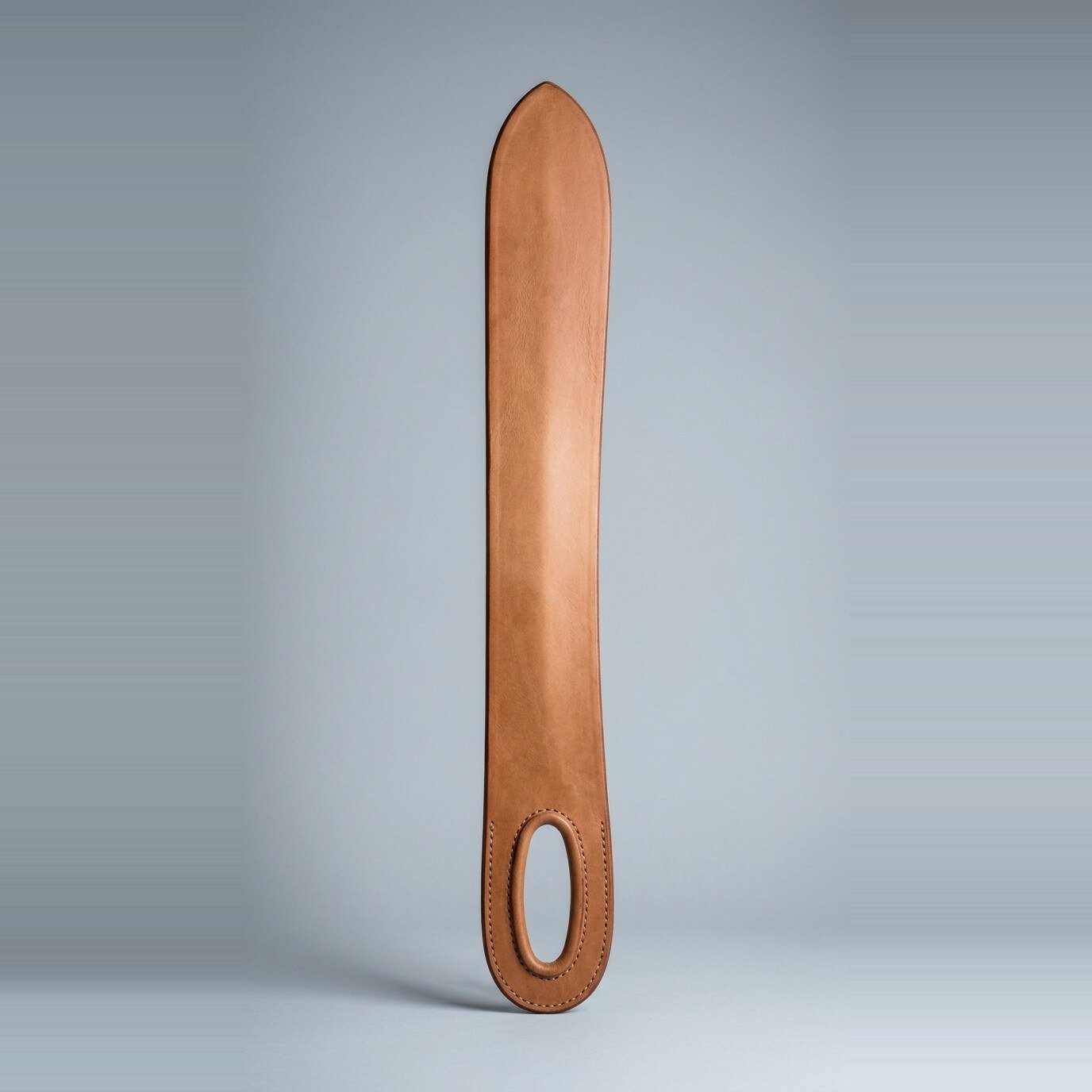
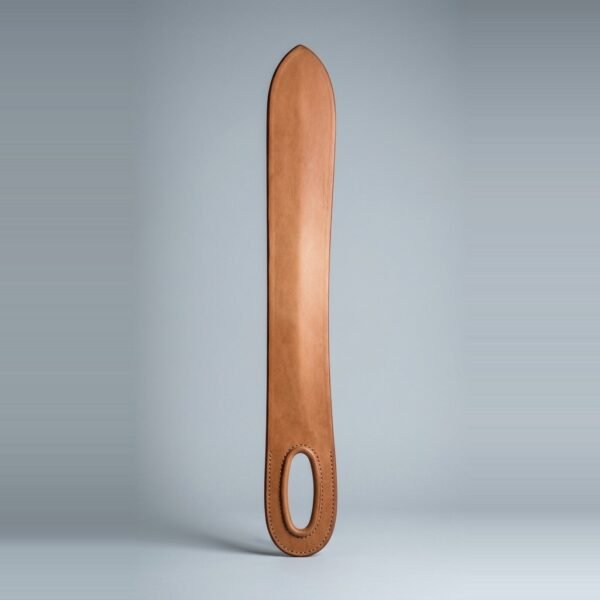
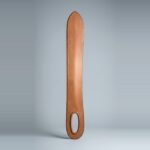
The Reifholm is a leather dussack, cut from one slab of thick vegetable tanned hide. There is no steel in it anywhere. No nagel, no rivets, no cross, no butt cap, nothing bolted or peened on. The whole thing is a single piece of leather shaped into a curved single edged profile, with an oval hole cut clean through the wide end to take your hand and a raised rolled rim worked up around that hole so the edge of the cut never sits against your fingers.
Two lines of matching brown stitching run along that rolled rim and hold the roll in shape. You put your hand through the hole, close it on the thickness of the leather, and the slab is your grip, your guard and your blade all at once. It is the simplest fencing tool in the whole HEMA line and it is also the one most clubs actually own.
New to the form, or wondering where it sits beside a steel trainer? Start with the dussack guide, then synthetic versus steel trainers for how a soft tool fits into a steel club. The curved single edged pieces are grouped in HEMA sabres. The dussack sits beside the single edged military forms in the sabre guide.
Specifications
Every figure below is a nominal build figure. This is cut and stitched by hand, so treat each one as close rather than exact.
| Material | Thick vegetable tanned leather, one slab, no steel |
|---|
| Overall length | About 26 inches, hand made so it varies a little piece to piece |
|---|
| Blade section | About 19 inches of curved profile forward of the hand hole |
|---|
| Blade type | Curved single edged profile cut from the slab, flat section |
|---|
| Edge | Leather, cut and finished, with no cutting edge of any kind |
|---|
| Tip | Rounded leather point, soft to the touch |
|---|
| Guard | None. The thickness of the leather around the hand hole is the only hand cover |
|---|
| Grip | Oval hole cut clean through the wide end, raised rolled rim around it |
|---|
| Stitching | Two lines of matching brown stitching along the rolled rim |
|---|
| Flex | Leather flex. It bends under a hard blow and comes back |
|---|
| Included | The dussack and a care card. It is not a scabbard and does not come with one |
|---|
| SKU | RK-3044 |
|---|
The dussack in Meyer and the German schools
Joachim Meyer printed his fencing book in Strasbourg in 1570, and the dussack sits in it as a full section of the syllabus alongside the longsword and the rapier. It is not a footnote. Meyer treats the dussack as the teaching tool for curved single edged play, the place where a student learns the cuts, the guards and the openings before anything sharp is involved. Fencing guilds of the German speaking lands used it the same way, because a hall full of students swinging soft tools can train hard without anyone going home missing a finger.
What is being taught with it is the messer and duelling sabre material in gentler form. The cuts have the same names, the guards sit in the same places, and the bind works the same way, so a student who has learned the dussack plays can pick up a curved steel trainer and already know the shape of the art.
In a modern club the dussack does two jobs. It is the tool you hand a beginner on their first night, and it is the tool experienced members reach for to drill flat out at speed.
One slab of vegetable tanned leather, and why it is not a sheath
Vegetable tanned leather is tanned with bark and plant tannins rather than chrome salts. It comes out dense, firm and able to hold a shape, which is exactly what you want in something that has to behave like a blade rather than drape like a jacket. A slab of it cut thick has real stiffness across the flat and still gives under a hard blow instead of transmitting the whole hit into a hand.
The hand hole is the part people ask about, so here is the plain answer. It is a hole cut through the leather, not a pocket and not a channel. Nothing slides into it and nothing is stored in it. A scabbard or a sheath is a hollow thing with two faces and a mouth, made to hold a blade and keep an edge off you. This has one face. It is solid leather from one side to the other except where the hole passes clean through, and the hole is sized for a hand, not a blade. Calling it a sheath describes an object this is not.
The rolled rim around the hole is there for comfort and for strength. Rolling the edge of the cut and stitching it down gives you a rounded bearing surface where the web of your hand takes the load, and it stops the cut edge stretching out of shape over a few hundred hours of use.
Engraving, runes and your own design
Use the rune converter on this page to turn a name, a date or a short phrase into Elder Futhark and we will cut it into the steel or the grip. On this one the marking is pressed and cut into the leather rather than the steel, and the widest clear field is the flat beside the hand hole. Elder Futhark has no sign for every sound in English, so the converter maps what it can and we cut what it gives back. If you want to read the alphabet before you choose, the Elder Futhark runes guide sets it out.
Engraving is priced by what you ask for. Text and runes are $19, a symbol is $39 and a family crest is $49. All of it is cut in the United States after the piece has landed and passed inspection, so nothing leaves the Czech Republic already marked.
If you would rather have your own design than a rune line, choose your own design in the engraving option above the add to cart button and tell us where it goes. Where a piece already carries an engraved design, your chosen engraving replaces it rather than sitting alongside it. More on the engraving page.
Handling and balance
A leather dussack handles nothing like a steel one, and that is the point. It is light, it is quiet, and the mass that is there sits close to your hand rather than out at the point, so the cuts are fast and the recovery is almost free. You can drill at a tempo that would be reckless with steel and stop worrying about what happens when someone misjudges a distance.
We do not publish a weight or a point of balance. The photographs carry no scale and we do not weigh every hide that goes through the cutter. What we will say is that the piece is stiff enough to hold a line in a bind and soft enough that a clean hit to an unarmoured arm stings rather than injures, which is the balance the form has always asked for.
Care
Leather care is different from steel care. Keep it dry and keep it out of direct sun and away from radiators, because heat is what makes vegetable tanned leather go hard and brittle. If it gets wet, let it dry slowly at room temperature and never speed that up with a heater or a hair dryer. A light leather conditioner once or twice a year is plenty, and too much of it will soften the slab and take away the stiffness you paid for.
Store it flat or hanging by the hand hole rather than folded, since a fold held for months will set a crease. Watch the stitching along the rolled rim and tell us if a line ever starts to pull, because stitching failure is a defect and defects are ours to fix with no end date and no receipt. General storage advice is in the safety and storage guide.
Made in the Czech Republic
Made by hand in the Czech Republic and imported by Ransack Viking. Nothing here is drop shipped out of an importer catalogue straight to a customer. Every one is checked for hilt tightness, pommel seating and blade straightness at our North Babylon, New York warehouse, and ships from there. Shipping in the United States is free, returns run for seven days, and the lifetime warranty against defects in the forging, the grind, the heat treat and the fittings has no end date and needs no receipt.
If you want the longer version of how the line is sourced and what we do and do not claim about it, the country of origin page lays it out, and order and shipping information covers timings.
A note on handmade variation
This is made by hand. It is not machine made, not cast and not bulk produced, so what arrives will not be a pixel for pixel copy of the photograph on this page.
Leather varies more than steel does. Colour shifts between hides and between batches of the same hide, grain and small natural marks come with the material, the curve of the profile is cut by eye, and the stitch spacing is not identical on any two pieces. Thickness across one slab is not perfectly even either. None of that is a defect.
Frequently asked questions
Whether there is any steel in this
None at all. No nagel, no rivets, no cross, no butt cap and no ferrule. It is one slab of vegetable tanned leather with a hole cut through it and two lines of stitching.
Whether this is a scabbard or a sheath
No. The hole goes clean through the leather and is sized for a hand, not for a blade. There is no pocket, no mouth and no second face, so nothing can be put inside it.
What it is used for
Cutting and binding drills for curved single edged play, Meyer dussack plays, and full speed sparring with light gear. It is also the standard first night tool in a lot of clubs.
Whether gear is still needed with it
Yes. A mask and gloves at minimum. Leather is softer than steel but a hard cut to a bare hand or head will still hurt you, and eyes are eyes.
Whether it is tournament legal
That depends on the ruleset. Some events run dussack with synthetics or leather and some do not. Check the gear rules of the event you are entering and do not take our word for it.
How long it lasts
Years of club use if it is kept dry and out of the sun. The stitching is the part that shows wear first, and stitching failure is covered under the warranty.
What is in the box
- The Reifholm leather dussack, about 26 inches overall
- A care card covering leather storage and conditioning
- The warranty terms against defects in the cutting and the stitching
- Your engraving slip if you ordered personalisation
Explore the range
The curved single edged pieces sit together in HEMA sabres, with the full training line in HEMA swords. If you want the same plays in steel, look at HEMA messers or the older catalogue in sabres. The written material is collected in the guides hub.
Other pieces in this group
In this part of the line you will also find Sturvang three bar sabre, about 37 inches overall, Ostrevak steel dussack, about 31 inches overall, Kjeldhar stirrup hilt sabre, about 36 inches overall, Hallvarn sharp bauernwehr, about 24 inches overall and Skaldrun spadroon, about 37 inches overall.
Everything else sits in the HEMA sabre category and in the HEMA sword hub, and the custom sword builder builds to your own numbers.

Reviews
There are no reviews yet