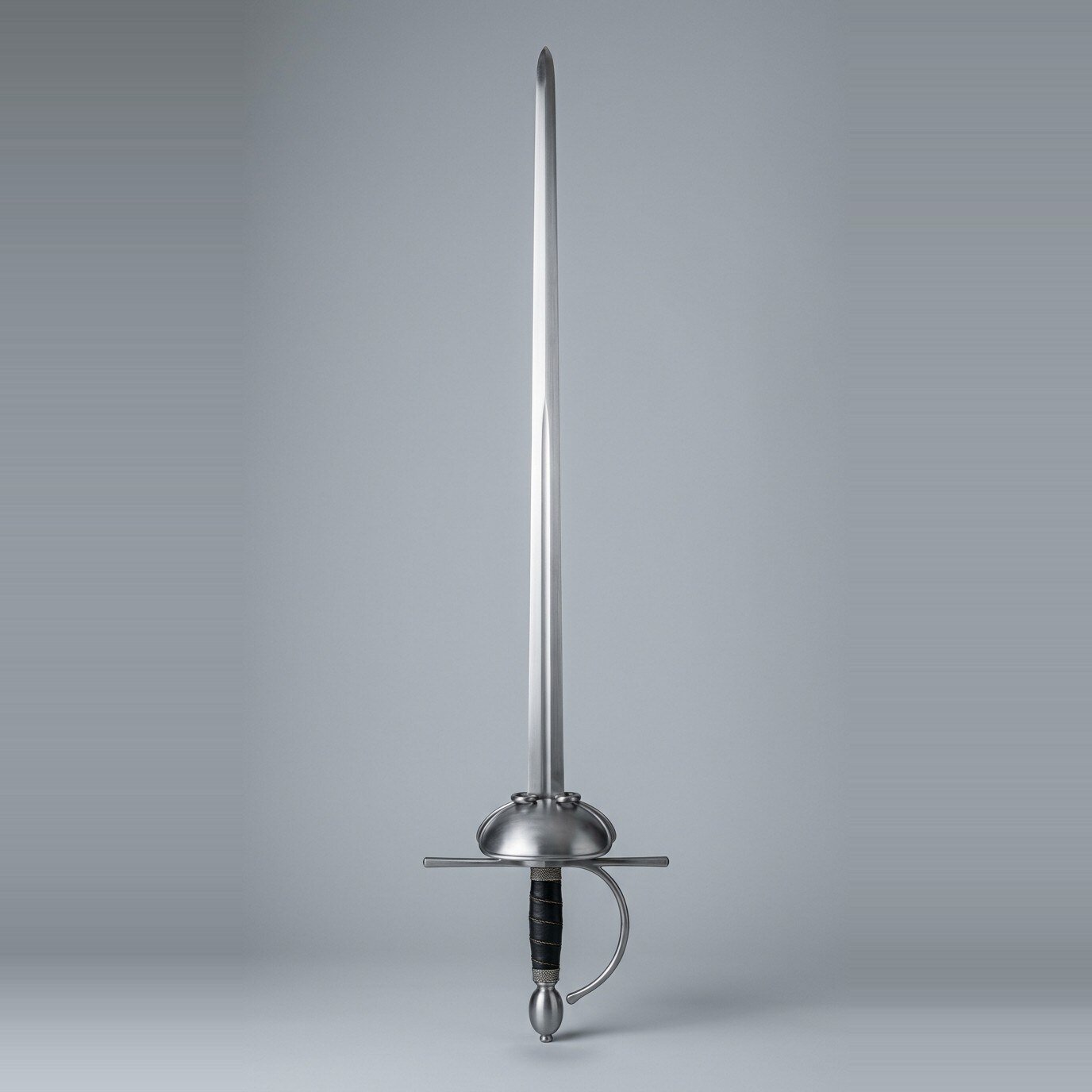
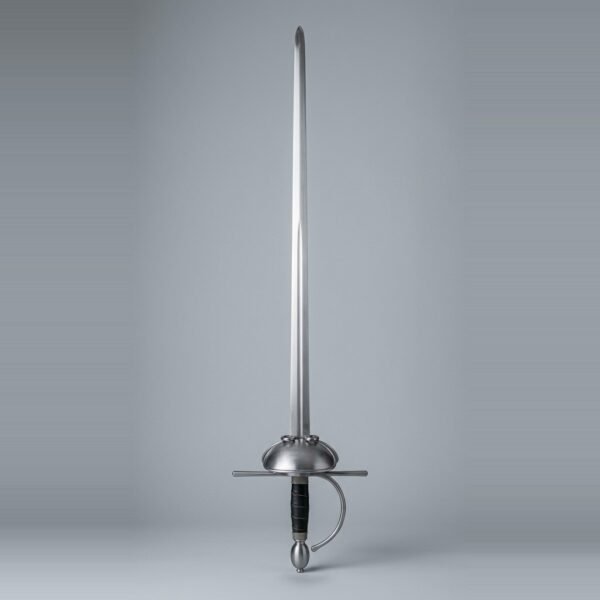
The Fenrholt is a rapier, and it is worth saying that plainly at the top of the page because the shell guard leads some people to read it as a smallsword. It is not one. The blade is long, the reach is long and the hilt carries a pair of quillons that run out unusually far on both sides, all of which belongs to the rapier and not to the short court blade that replaced it.
The guard is a dished shell with two small rings set on it. Those rings are part of the guard structure and part of the look of the piece. They are not finger rings and they are not sized to take a finger over the quillon block, so do not buy this expecting to hook a forefinger through one. Grip it the way the type asks: forefinger over the quillon and inside the shell, thumb along the flat.
If you are deciding between this and a cut and thrust blade, read rapier versus sidesword, and if this is your first long thrusting blade read how to choose your first HEMA sword before you commit. The rest of the long steel sits in HEMA rapiers.
Specifications
These are the proportions of the piece rather than certified measurements. Every one is finished by hand and the figures move a little.
| Material | 51CrV4 spring steel, hardened to 49 to 52 HRC |
|---|
| Overall length | About 47 inches, hand made so it varies a little piece to piece |
|---|
| Blade length | About 40 inches |
|---|
| Blade type | Narrow and thrust oriented, raised central ridge, no fuller |
|---|
| Edge | Blunted, about 2.5 mm flat land, not sharpened |
|---|
| Tip | Rolled and flared, about 15 mm across |
|---|
| Guard | Dished shell with two small rings, unusually long quillons |
|---|
| Pommel | Olive shaped, seated on the tang and peened over |
|---|
| Grip | Black leather over a wood core, single handed |
|---|
| Flex | Medium tier |
|---|
| Included | Cloth wrap and a care card, no scabbard |
|---|
| SKU | RK-3039 |
|---|
Rapier fencing and the guard that made it possible
The rapier came out of civilian life rather than the battlefield. It was the blade a man wore in town with ordinary clothes, and because it was worn rather than issued it grew long, narrow and specialised in a way no soldier’s sword ever could. By the end of the sixteenth century the schools were teaching a fencing system built almost entirely around the thrust, the line and the control of the opposing blade.
That system only works if the hand is safe. A long blade held out at arm’s length puts the fingers closer to the opponent than any other part of the fencer, so hilts grew outward to meet the problem. Rings, counterguards, swept bars and eventually the solid dish and the cup all exist for that one job. This piece takes the dished shell route, which closes off the whole front of the hand with a single curved plate rather than a cage of bars.
The quillons on this hilt are long, and that length is doing work. Long quillons give you something to catch and turn an incoming blade against, and they give the off hand a reference point when it comes across to the blade. They also make the hilt read as a rapier at a glance, because the short stubby quillon belongs to the later smallsword.
The long quillons, the blade section and the flex you want
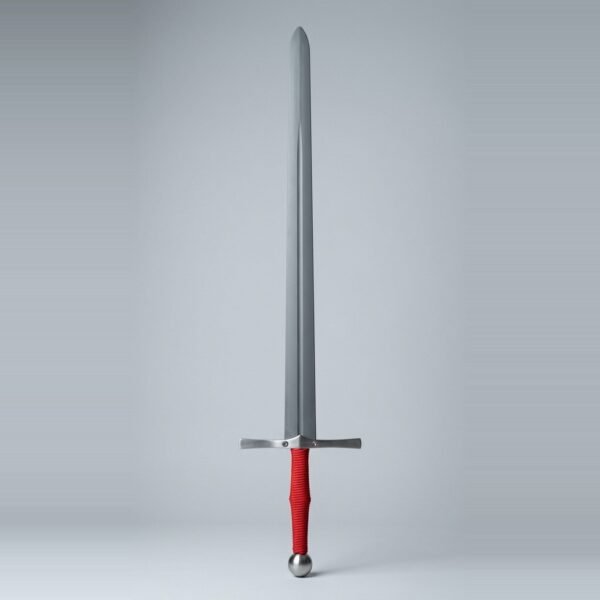
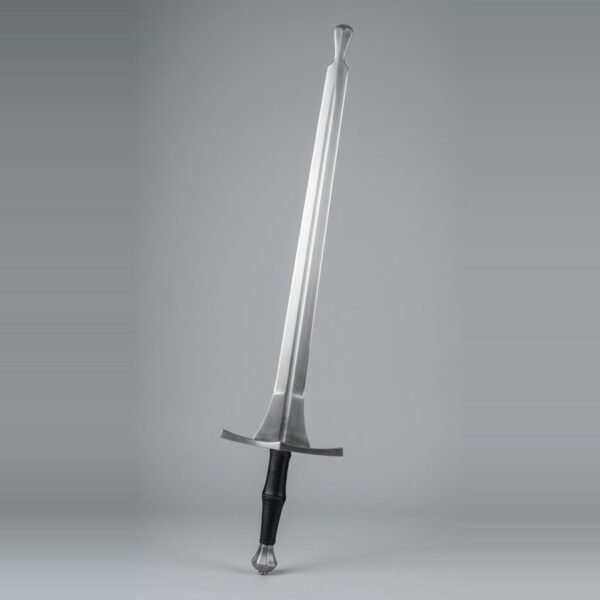
The blade is 51CrV4 spring steel hardened to 49 to 52 HRC. That is the choice for every blunt in this line, and on a rapier the reason is at its clearest: spring steel bends and returns instead of taking a set or snapping under a hard bind. A rapier blade is long and narrow and the entire system drives thrusts down its length, so a blade that held a bend would be useless after a single session.
The section is a raised central ridge running out to flat sides, with no fuller cut into it. On a blade this narrow a fuller would take away more stiffness than it saved in weight. A ridge does the opposite. It deepens the cross section along the middle of the blade, which is where bending load concentrates, so the blade resists buckling sideways while still flexing cleanly along its length.
Flex is in the medium tier. That is the usual place for a rapier trainer: enough give that a thrust to the body folds the blade instead of driving into it, and enough spine that the point still arrives where you sent it. The market labels tiers as light, medium, strong or tournament, and stiff for harness work, and we give you the tier rather than a number because we do not test each blade on a scale.
The tip is rolled and flared to about 15 mm across. That is not decoration either. The Berlin HEMA Cup gear requirements ask for spatulated or rolled tips of at least 1.5 cm in diameter and specifically do not allow merely rounded tips on rapier and sabre. Other events set their own rules, so read the ruleset for the event you plan to enter rather than taking any single figure as blanket permission.
Engraving, runes and your own design
Use the rune converter on this page to turn a name, a date or a short phrase into Elder Futhark and we will cut it into the steel or the grip. On a rapier the flat of the blade just below the shell takes a rune line well, and the underside of the shell itself is the quiet place to put a name if you would rather nobody sees it across the salle.
If you would rather have your own design than a rune line, choose your own design in the engraving option above the add to cart button and tell us where it goes. Where a piece already carries an engraved design, your chosen engraving replaces it rather than sitting alongside it. More on the engraving page.
Handling and balance
It is long. That is the first thing anyone notices picking up a rapier after a longsword, and it changes everything about where you stand. The point is a long way from your hand, so small movements at the hilt become large movements at the tip, and the whole skill of the form is learning to make those movements small enough.
The dished shell carries its weight close to the hand, and the long quillons sit right at the balance point, so the hilt acts as a counterweight to a blade that would otherwise be nose heavy. The result is a piece that feels lighter in the hand than its length suggests and that comes back on line faster than it looks like it should.
The grip wants a forefinger over the quillon, inside the shell, with the thumb flat on the other side and the remaining fingers wrapped lightly. Do not try to put a finger through either of the two small rings on the shell. They are not sized for it. We do not publish a weight or a point of balance, because the photograph carries no scale and every piece is finished by hand.
Care
51CrV4 is not stainless. Wipe the blade down after every session and keep a light film of oil on the steel between uses. Mineral oil or a light gun oil is plenty.
The dished shell is where this piece needs attention. The inside of the dish holds moisture against the quillon block and the tang, and the two rings create seams that a cloth skates straight over. Dry the inside of the shell properly, get into the ring junctions, and oil them as well as the blade.
The leather grip should be let dry after a session rather than sealed into a bag, and treated once or twice a year with a leather balm. Check the pommel and the shell for movement every few months and stop using the piece if anything shifts, because a loose hilt on a blade this long gets worse quickly. The full method is in the knife care guide.
Made in the Czech Republic
Made by hand in the Czech Republic and imported by Ransack Viking. Nothing here is drop shipped out of an importer catalogue straight to a customer. Every one is checked for hilt tightness, pommel seating and blade straightness at our North Babylon, New York warehouse, and ships from there. Shipping in the United States is free, returns run for seven days, and the lifetime warranty against defects in the forging, the grind, the heat treat and the fittings has no end date and needs no receipt.
A note on handmade variation
This is hand forged. It is not machine made, not cast and not bulk produced, so what arrives will not be a pixel for pixel copy of the photograph on this page. The shell is raised by hand, so its exact dish depth and the line of its rim vary from one to the next. The two rings are fitted individually and will not sit at the same angle on every piece. The quillons are drawn out on the anvil and one may run a fraction longer than the other. None of that is a fault and none of it changes how the rapier fences.
Frequently asked questions
Whether this is a rapier or a smallsword
It is a rapier. The blade length, the reach and the long quillons all belong to the rapier. A smallsword is much shorter, carries stubby quillons and is built on a hollow ground triangular blade.
Whether the two rings take a finger
No. They are part of the guard structure, not finger rings, and they are not sized for a finger. Hook the forefinger over the quillon and inside the shell in the usual way.
Whether the blade is sharp
No. It is a blunt trainer with a flat edge land of about 2.5 mm and a rolled, flared tip. We will not sharpen it on request.
What the tip is built to
Rolled and flared to about 15 mm across, which matches the Berlin HEMA Cup requirement of a spatulated or rolled tip of at least 1.5 cm. Read the ruleset for any event you enter, because requirements differ.
Whether a scabbard is included
No. Nothing in this line ships with a scabbard. It arrives wrapped for transit with a care card in the box.
Whether it can be engraved
Yes. Runes, your own text or your own design, cut in the United States after the piece lands here. Text and runes are $19, a symbol is $39 and a family crest is $49.
What is in the box
- One Fenrholt rapier trainer, hand made in the Czech Republic.
- A cloth wrap for transit.
- A care and storage card.
- Your warranty and returns information.
Explore the range
The rest of the long thrusting steel is in HEMA rapiers, the cut and thrust blades are in HEMA sideswords, the wider catalogue is in rapiers and the short court blades are in smallswords and spadroons. Every guide we have written sits in the guides hub.
Near neighbours in the shop
Its closest neighbours on the rack are Velstrand cup hilt rapier, about 47 inches overall, Corvalde rapier, about 48 inches overall, Ceravalt rapier, about 47 inches overall and Valdris sidesword, about 41 inches overall.
The HEMA rapier category and the HEMA sword hub hold the remainder, and you can order a one off on the custom sword builder.








Reviews
There are no reviews yet