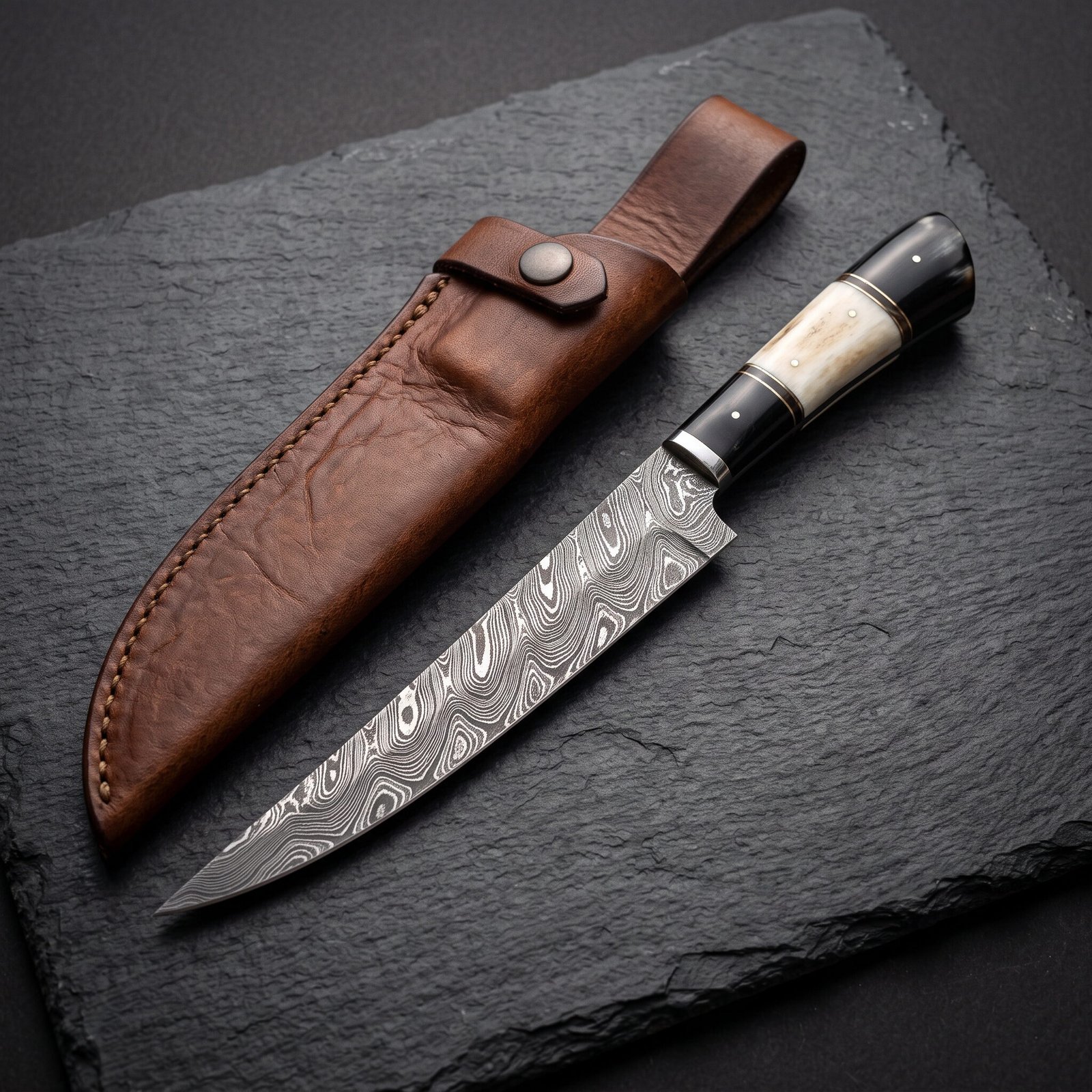
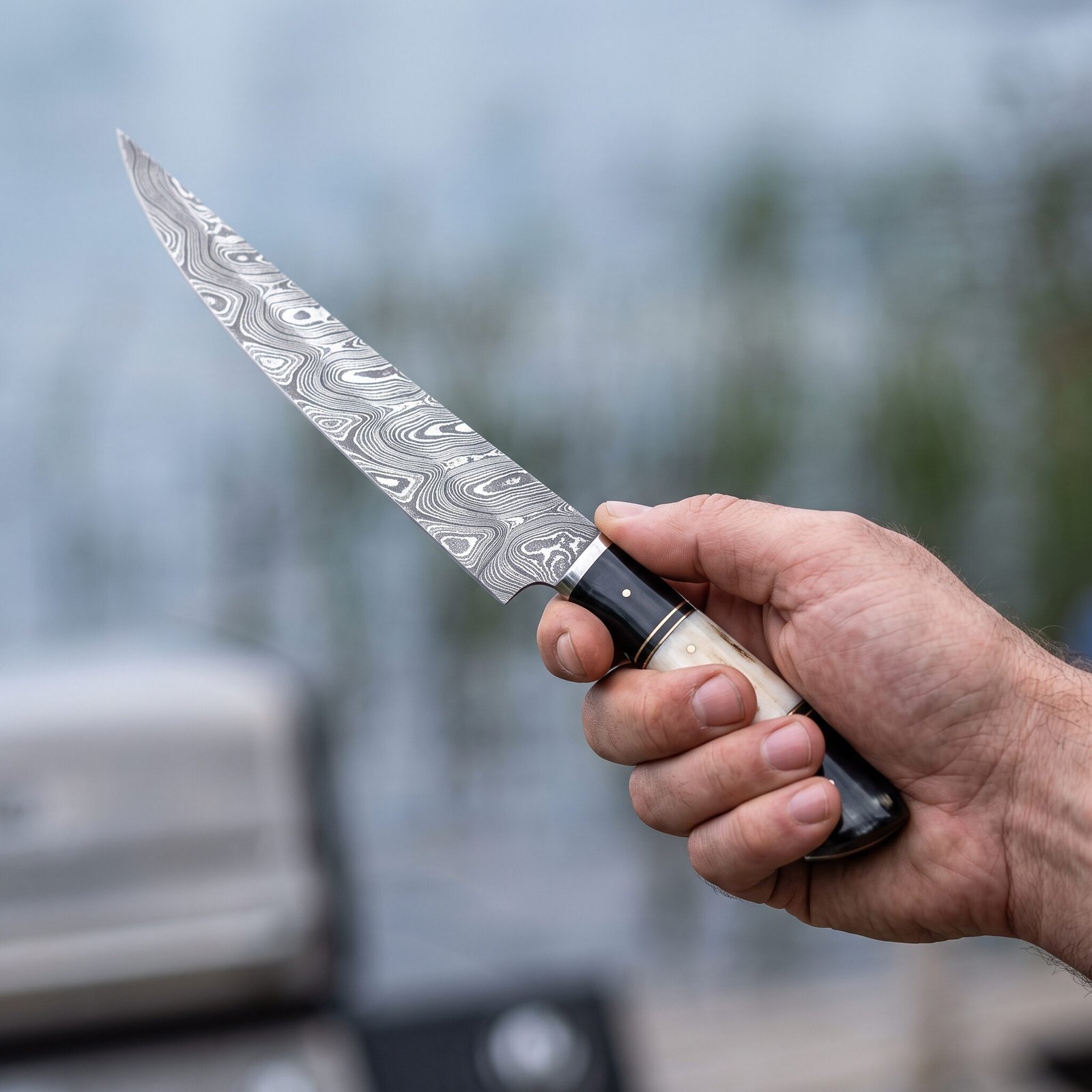
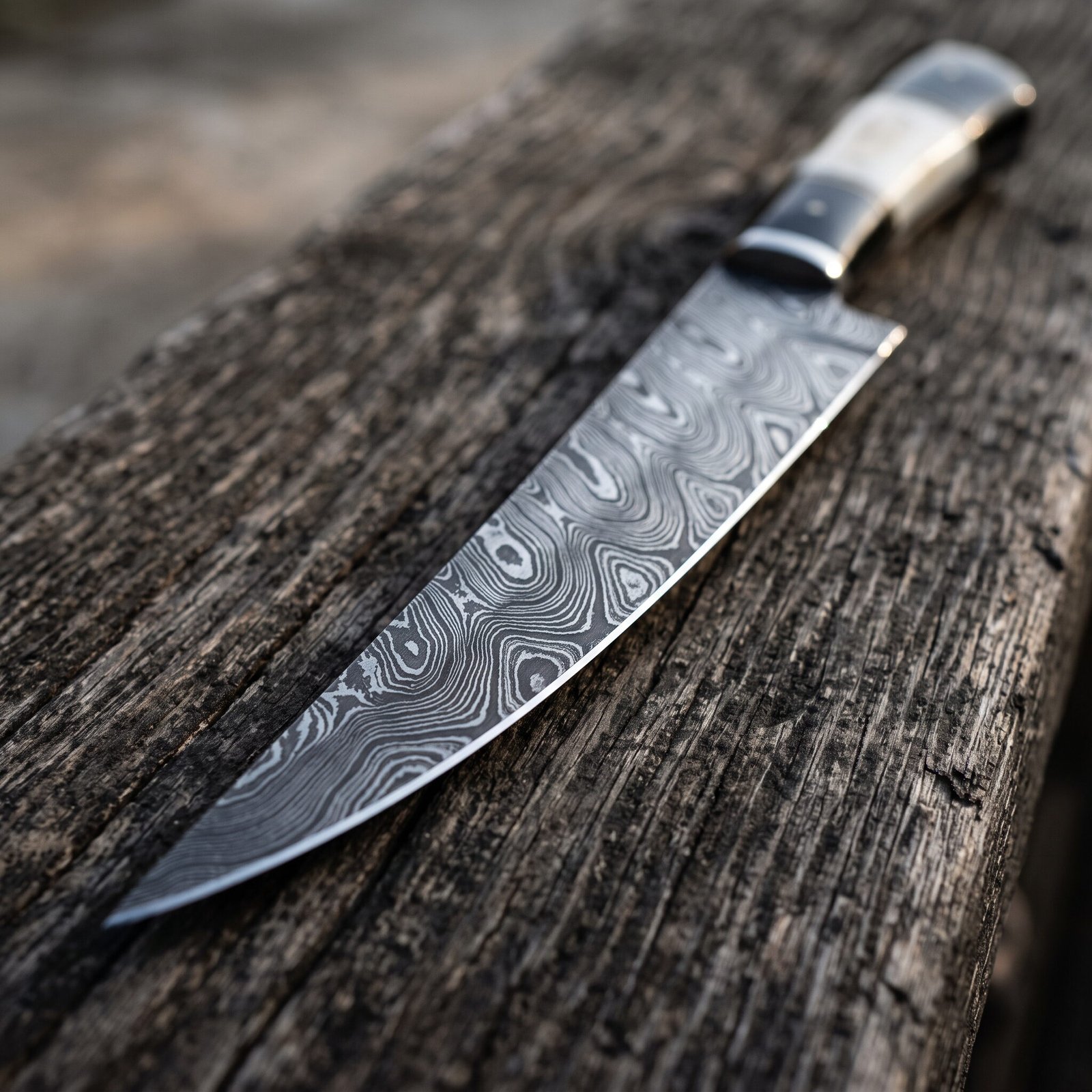
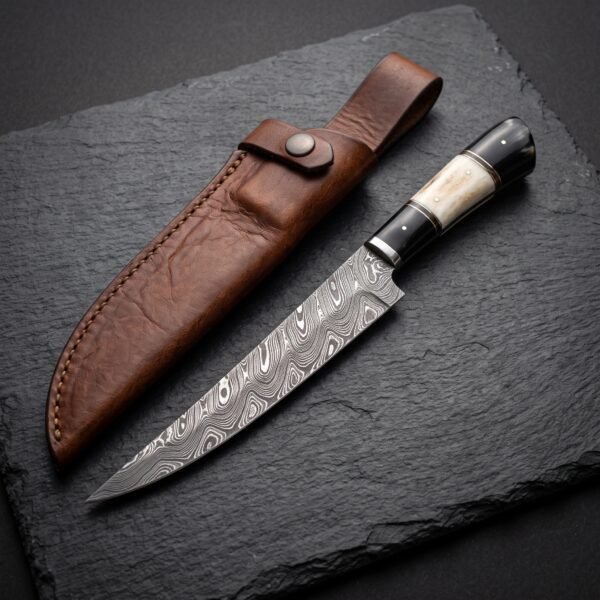
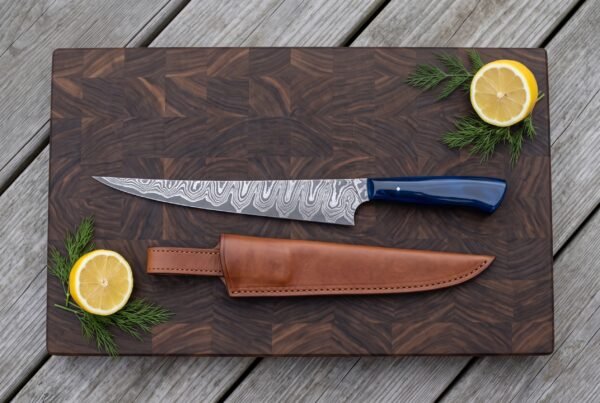
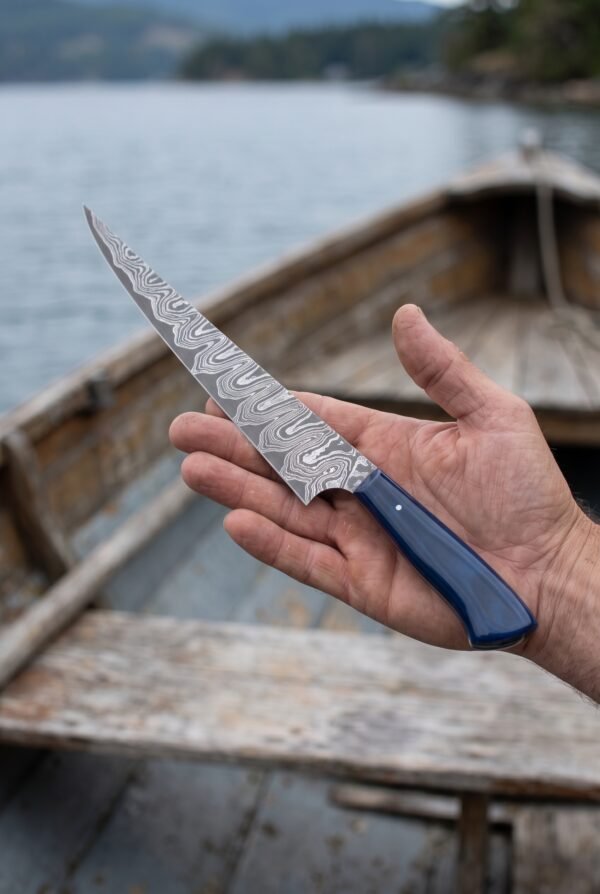
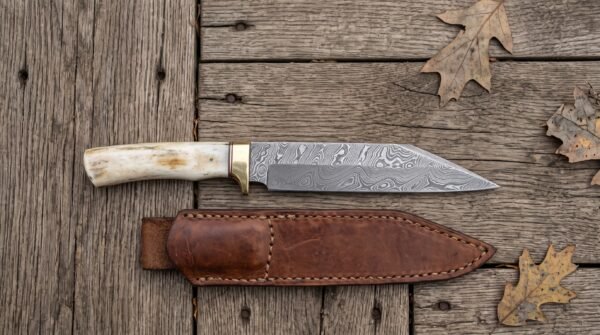
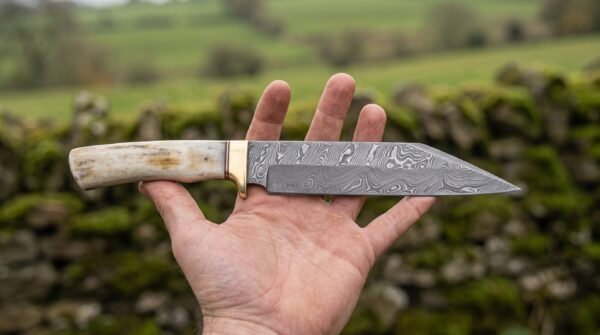
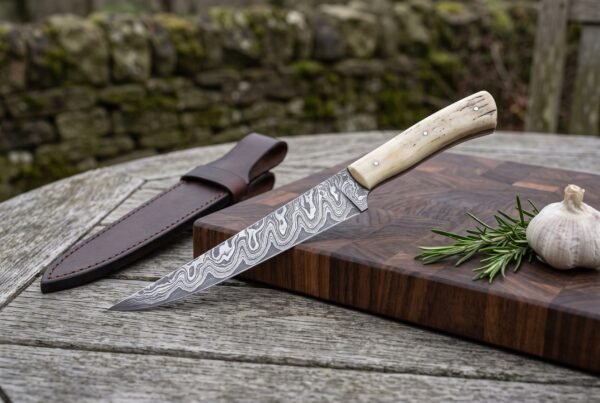
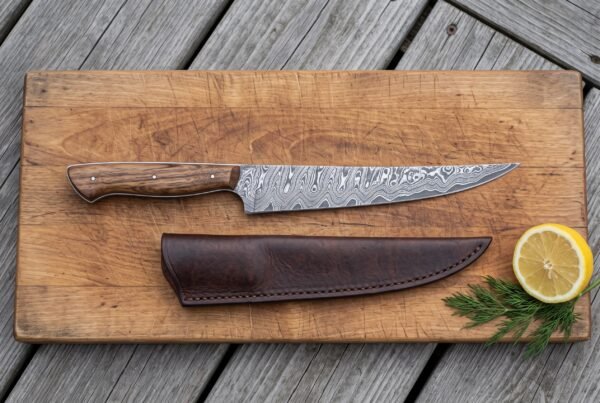
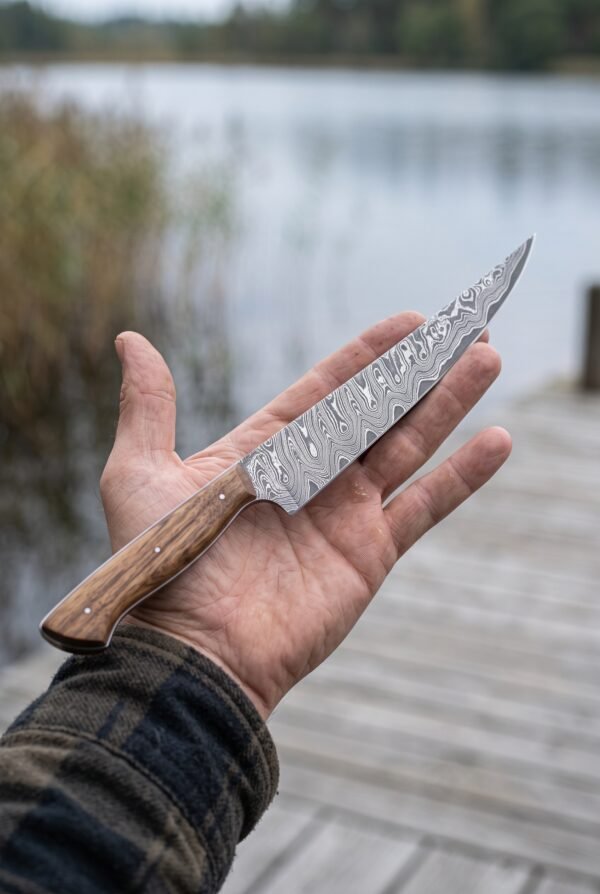
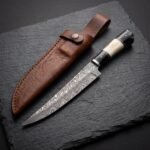
The Riverstag is a hand forged Damascus fish fillet knife with a flexible 7 inch blade and a handle of stag horn set with bone and acrylic. Eleven inches overall on a 4 inch handle, drawn from a 393 layer billet, it feels heavier in the hand than it looks on the screen, which is exactly what you want on a knife you are steering along a spine. Length and flex decide how a fillet knife behaves, as choosing flex and length explains.
Filleting was one of the first jobs anyone ever industrialised, and it produced its own vocabulary. On the Grand Banks and in the Lofoten cod fishery, a splitting table was worked by a team of three with a specialised knife each: the header took the head off, the gutter opened and cleaned the fish, and the splitter removed the backbone in a single pass. A good splitter was the most valuable man on the table and was paid accordingly, and the whole point of his knife was that it was narrow, thin and flexible enough to ride the bone instead of cutting through it. Every fillet knife made since is a descendant of that tool, and the design brief has not changed: waste nothing, and let the fish tell the blade where to go.
Forged and finished in the Czech Republic. It ships with a leather sheath, protective packaging and an edge that is already cutting.
Specifications
| Steel | Hand forged Damascus, 1095 and 15N20 |
|---|
| Hardness | 58 to 60 HRC |
|---|
| Damascus layers | 393 layers |
|---|
| Overall length | 11 inches |
|---|
| Blade length | 7 inches, flexible |
|---|
| Handle length | 4 inches |
|---|
| Blade shape | Narrow fillet blade with a slim upswept point |
|---|
| Bolster | One polished steel bolster at the front of the handle |
|---|
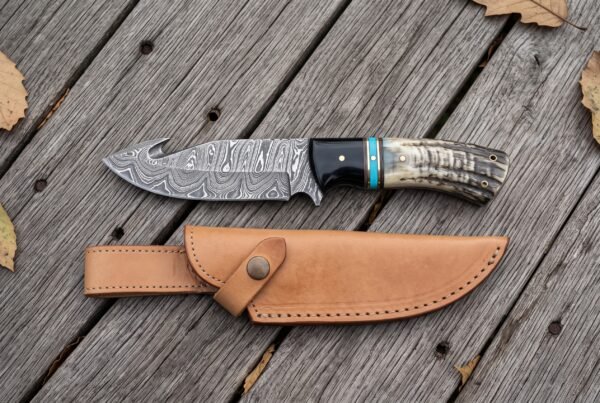
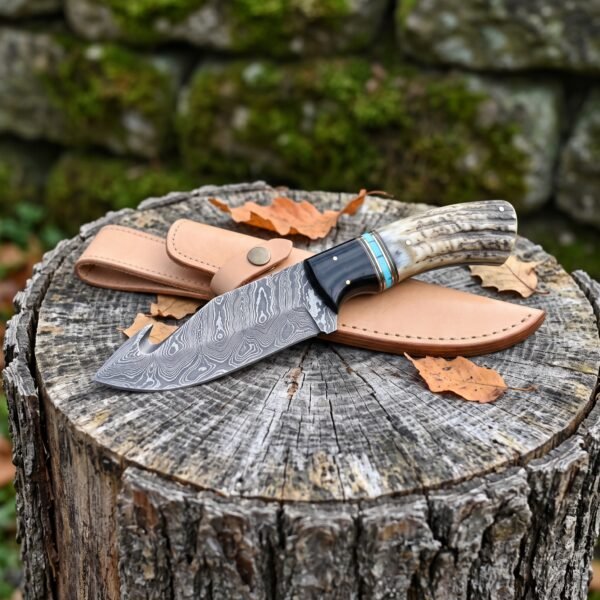
| Handle | Pale stag horn and bone centre between black acrylic front and butt sections |
|---|
| Spacers | Brass and black spacers between each handle section |
|---|
| Pins | Brass pins through each section |
|---|
| Sheath | Brown leather sheath with a snap strap |
|---|
| SKU | RK-421 |
|---|
Why a fillet blade flexes
Flex is the defining property of this pattern and it is the one thing people get wrong when they try to fillet with a kitchen knife. A rigid blade goes where you push it. A flexible blade goes where the fish lets it, and that difference is worth several ounces of meat per fish.
The job is to run the edge along the rib cage and the backbone, taking everything above the bone and leaving nothing behind. Those bones are not straight and they are not evenly spaced. A blade with the right amount of flex will deflect off a rib rather than cutting into it, then spring back down onto the bone line, so the cut follows the actual skeleton of the animal instead of an average of it. That is what produces a fillet with a clean underside and a frame with nothing left on it.
The narrowness matters just as much. A narrow blade can be turned inside the body cavity and pushed flat against the rib cage in a way that a tall kitchen blade physically cannot. The length gives you the reach to take a whole side in one pass rather than sawing, which is what leaves the ragged edge that marks an amateur fillet.
Flex is a spectrum rather than a switch. Too stiff and it will not follow the bone; too soft and it wanders and you lose control of depth. Seven inches is the length most people find most useful across the range from panfish to a decent salmon, and this blade is ground to flex through the front two thirds while staying stiff enough at the ricasso to steer. Away from the water it doubles as a boning knife for poultry and lamb.
Why Damascus and not stainless
Damascus here means 1095 and 15N20 forge welded together and drawn out to 393 layers, which gives a harder edge and a longer working life than a soft stainless blade, at the cost of needing a wipe of oil now and then. On a fillet knife the edge is doing precise work under very little pressure, so a keen apex matters more than on almost any other pattern in the catalogue.
There is an honest argument for stainless on a fishing knife and it should be said plainly: this blade lives around salt water, and salt water is the harshest environment carbon steel ever meets. If you fillet on a boat in the sea and cannot commit to rinsing and drying the knife before it goes back in the bag, stainless will serve you better. If you can spend one minute on it after the job, this blade will out cut anything stainless at the same price and keep doing it for decades. We set the trade out plainly in Damascus versus stainless.
Stag horn, bone and acrylic in the grip
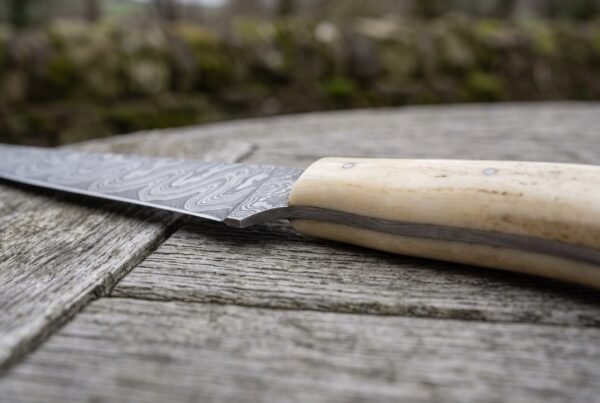
This handle is stag horn with bone and acrylic, cut and fitted by hand. Stag is the grip material: it has a natural texture that works better when your hands are wet, slimy or cold, which is the only condition a fillet knife is ever used in. Because it came from an animal rather than a mould, the grain, the colour and the ridging are unique to your piece.
The bone and acrylic sections are there for contrast and for stability, and the acrylic in particular is completely unaffected by water. The stag and bone are natural materials and want a little care: keep the handle out of long soaks, rinse and dry it after a session, and give it a light coat of mineral oil once or twice a year so it does not dry and check. The routine carries over from wooden handle care.
Engraving, runes and your own design
Use the rune converter on this page to turn a name, a date or a short phrase into Elder Futhark and we will cut it into the steel or the handle. If you would rather have a Viking pattern than a rune line, choose your own design in the engraving option above the add to cart button and tell us whether it goes on the blade or the handle. Where a piece already carries an engraved design, your chosen engraving replaces it rather than sitting alongside it. A long narrow blade takes a rune line particularly well because the lettering can run the length of the flat. See the engraving page.
Care and sharpening
This is the knife in the range that most rewards discipline. Rinse it in fresh water immediately after use, especially after salt water, wash with warm water and mild soap, dry it completely including the join at the handle, and put a thin film of mineral or camellia oil on the steel. Never leave it wet in a tackle box or a bag.
Sharpening a flexible blade needs a lighter touch than a stiff one, because pressure bends the blade and changes the angle you are holding. Support the flat with your fingers close to the stone, use light passes, and let the abrasive do the work. A 1000 grit stone raises the burr and a 3000 refines it. Keep the knife out of the leather sheath for long storage, since leather traps moisture and tanning salts against steel. Both jobs are covered in steel care and sharpening with a whetstone.
Made in the Czech Republic
This piece is made by hand in the Czech Republic, in a workshop that still works the old way. The steel is forged, ground, heat treated and finished by smiths who learned the trade from the people before them, and the wood, horn and leather are cut and fitted by hand rather than pressed out on a line. That is also why no two pieces come out exactly the same.
Ransack Viking is a United States company. We import these pieces ourselves, check every one when it lands and ship from our warehouse in Chicago, Illinois. Engraving is done here in the United States after the piece arrives, so your runes or your own design go on before it leaves for you.
A note on handmade variation
The Riverstag is hand forged, not machine made and not bulk produced, so what arrives will not be a pixel for pixel copy of the photograph on this page. Stag is the most variable material we work with: colour runs from pale cream through to deep brown, the surface ridging is wherever the animal grew it, and the crown of one piece never matches another.
The bone alongside it has its own tone, the acrylic takes light differently depending on how it was ground, and at 393 layers the Damascus pattern falls out of the billet differently every time. The dimensions, the steel, the hardness and the build are the same on every one. The character is not.
Frequently asked questions
How much does the blade flex
Enough to ride a rib cage and spring back, and not so much that you lose control of depth. It is a medium flex by fillet knife standards, which is the most useful setting for a general purpose 7 inch blade.
Can I use it in salt water
Yes, but rinse it in fresh water the moment you are done. Salt is the fastest way to damage carbon steel. If you fish saltwater constantly and will not commit to that habit, a stainless fillet knife is the honest recommendation.
What size fish does a 7 inch blade suit
It covers most of what people actually catch, from a good crappie up to a salmon or a mid size striper. For panfish a shorter blade is easier; for a large tuna or halibut you want more length.
Is it also a boning knife
It works well as one for poultry and lamb, where a narrow flexible blade is exactly what you want around a joint. A dedicated boning knife is stiffer and better for heavy work on beef.
Will the stag handle survive being wet constantly
Yes, provided it is rinsed and dried rather than left soaking. Stag is a dense natural material and it handles wet work well, but it should not sit in standing water or dry out completely in the sun.
Does it come with a sheath
Yes, a leather sheath cut and stitched to this knife. Use it for transport and blade protection, and store the knife out of it between trips so moisture is not trapped against the steel.
What is in the box
- One Riverstag Damascus fish fillet knife
- Leather sheath
- Protective packaging
- Care notes for carbon steel, stag horn and bone
- Forged and finished in the Czech Republic
Explore the range
See the rest of the fish fillet knives, the chef knives and the hunting knives if you want a blade for game as well as fish. Sharpening and steel care are covered in the guides.
Other pieces in this group
For a straight comparison, see the Bluetide fish fillet knife, pattern welded Damascus. Worth putting side by side with this is the Palebone fish fillet knife, pattern welded Damascus. In the same category sits the Streamwood fish fillet knife, pattern welded Damascus.
From the same corner of the shop, there is the Blockbreaker chef knife. Nothing here exactly right, build one to your own spec on the custom Damascus knife page.

Showed up right on time and looked even better than the photos.
This thing is a beast in the best way. Worth every penny.
Showed up right on time and looked even better than the photos. Came in a nice gift box which made it feel even more special. Couldn’t be happier with this.