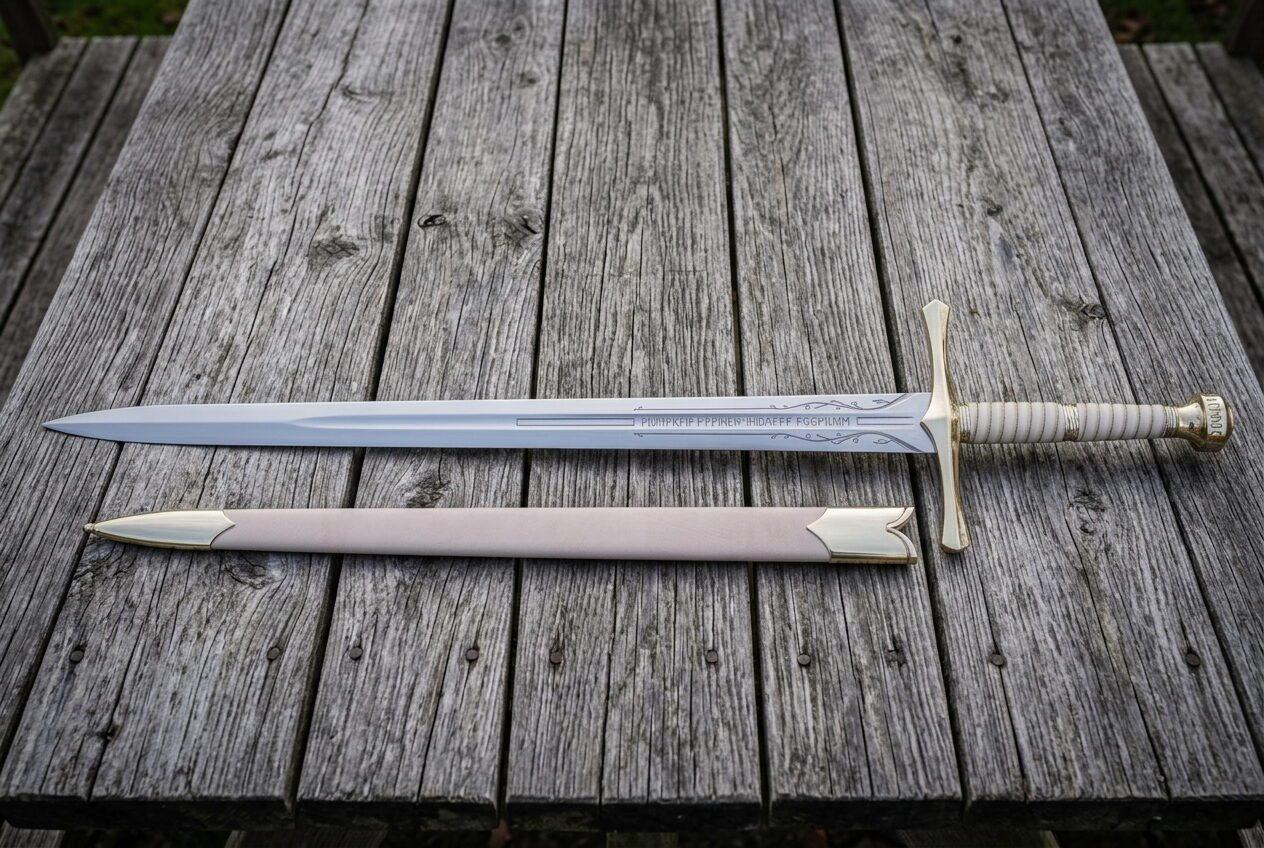
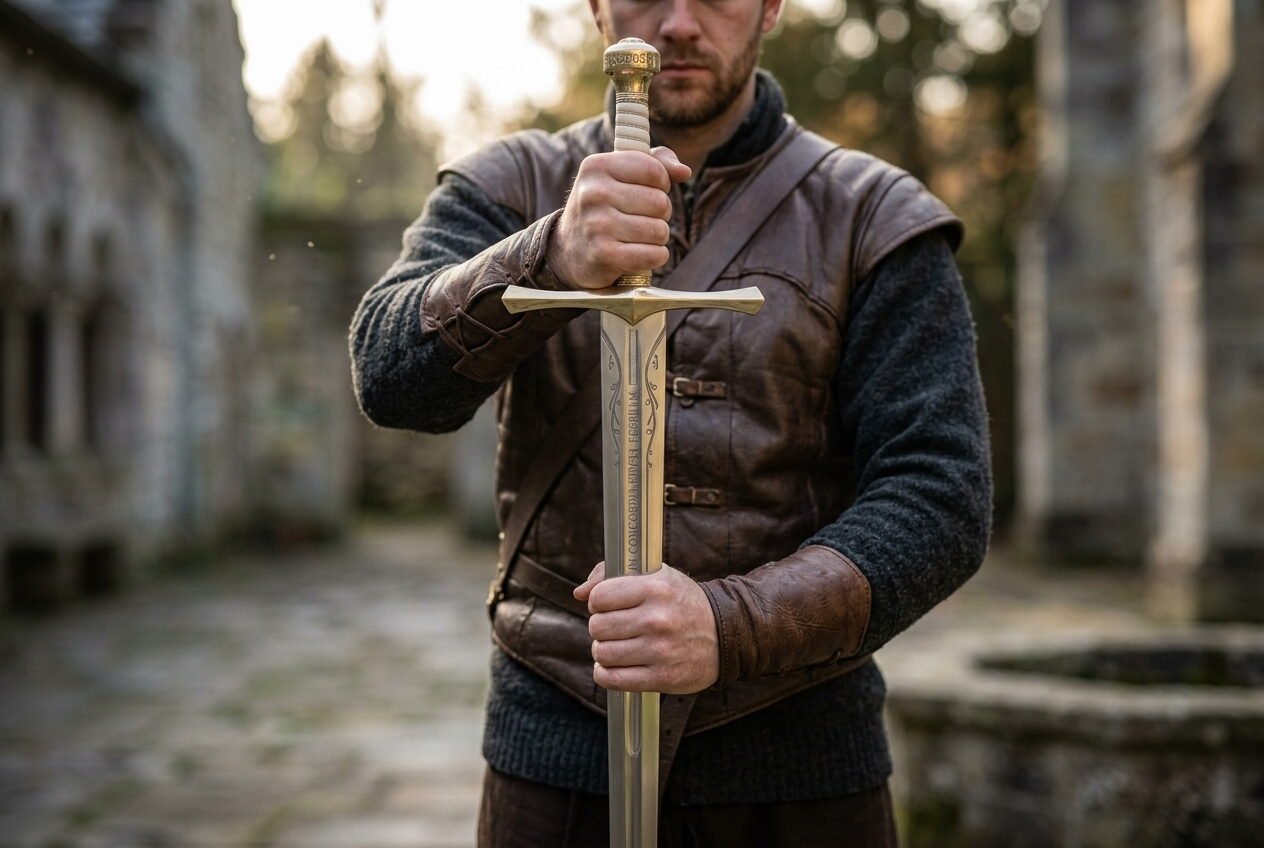
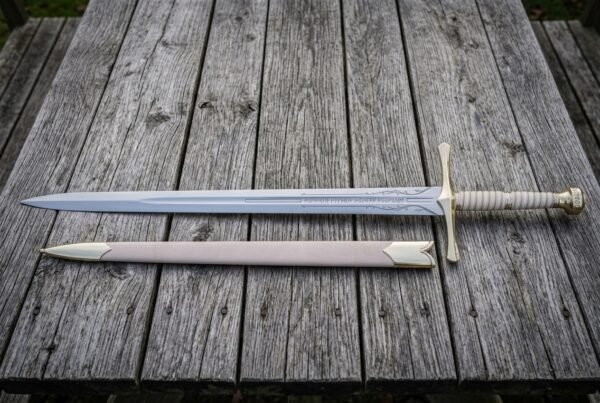
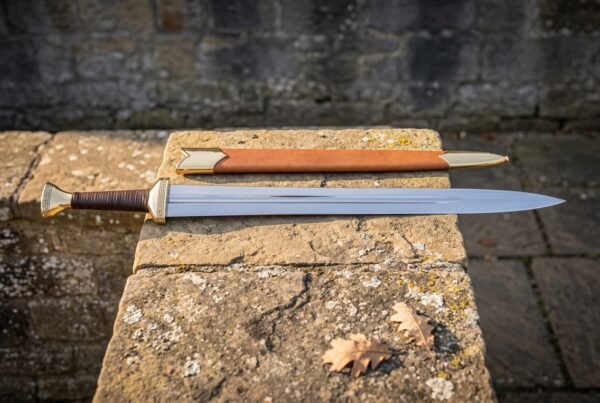
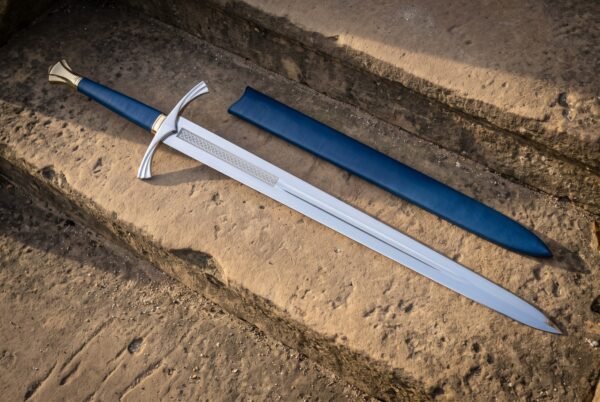
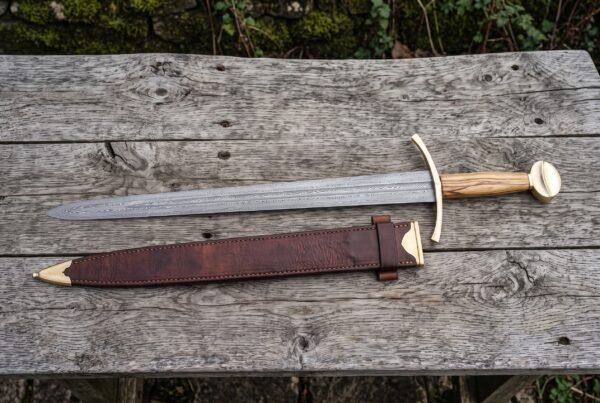
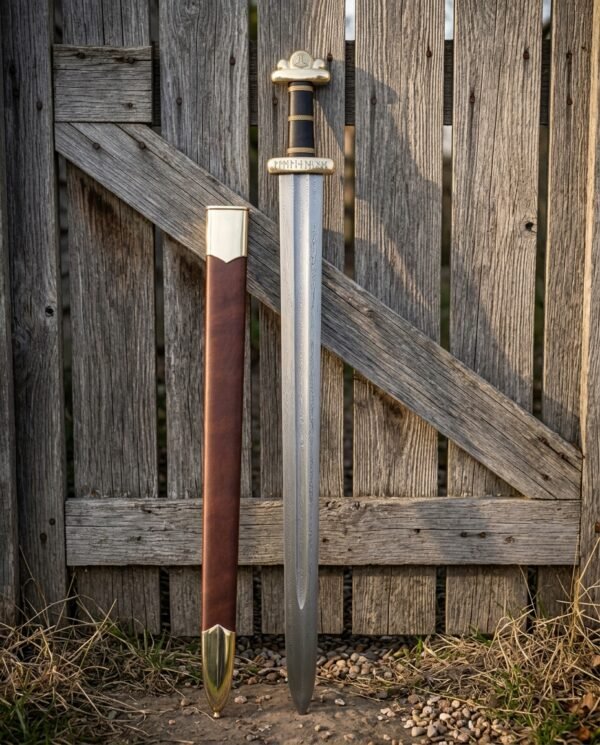
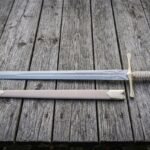
The Elmshade is a straight double edged longsword with an engraved inscription cut along the fuller and a light beige leather scabbard built around a wooden core. The scabbard is worth as much attention as the blade. A proper sword scabbard has never been a leather tube. It is two thin laths of split wood hollowed to the exact section of the blade, glued edge to edge, lined with fleece or wool left in the grease, and only then covered in leather. The lanolin in unwashed wool is mildly water repellent and slightly alkaline, which is why swords stored in period scabbards came out oiled rather than rusted, and it is why this scabbard is lined the same way. The two sword setup makes no practical sense, and the Witcher sword setup explains why.
Everything is forged, ground, heat treated, polished and fitted by hand in the Czech Republic. The Elmshade ships with its wood cored light beige leather scabbard, a protective oil film on the blade, a care card, and free shipping anywhere in the United States.
Specifications
| Steel | 1095 high carbon steel, oil quenched and tempered |
|---|
| Hardness | 54 to 58 HRC |
|---|
| Overall length | 43 inches |
|---|
| Blade length | 34 inches |
|---|
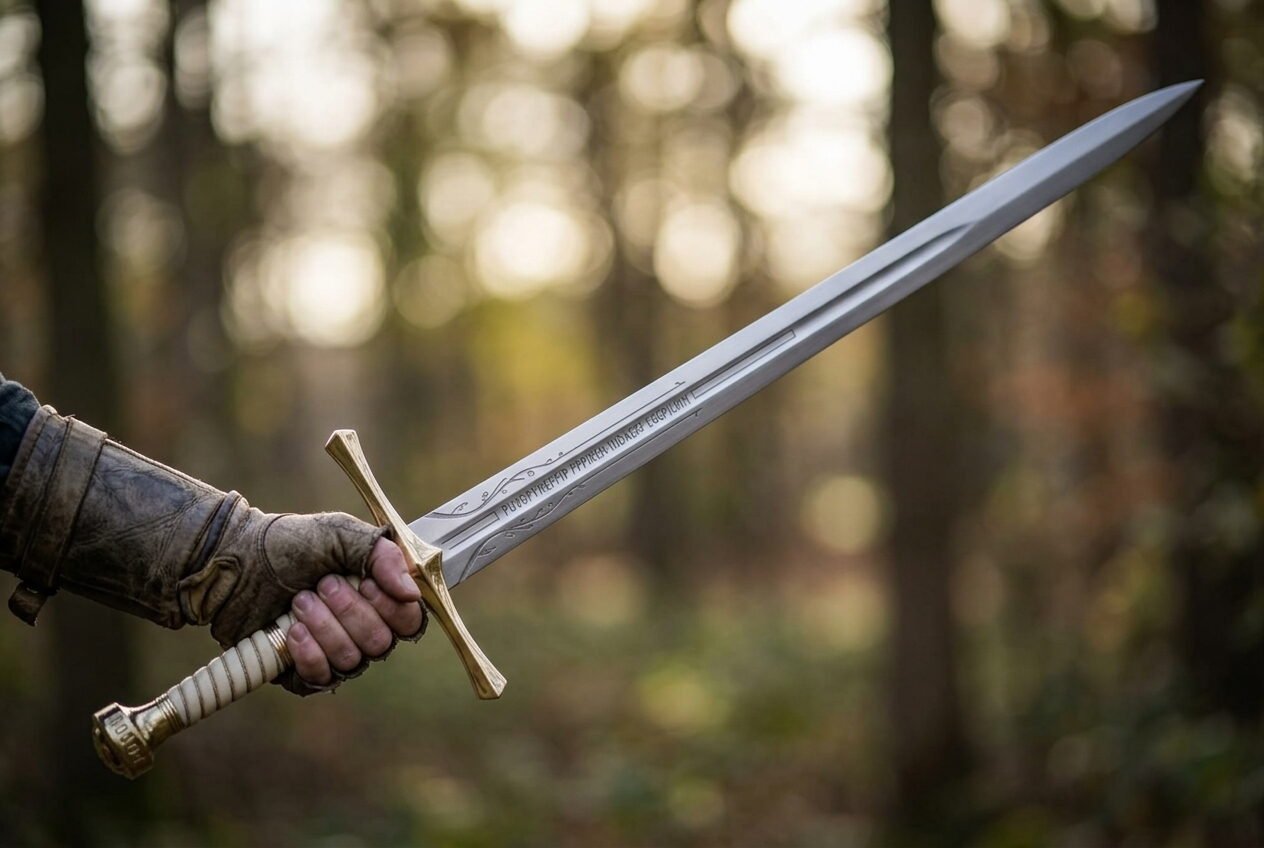
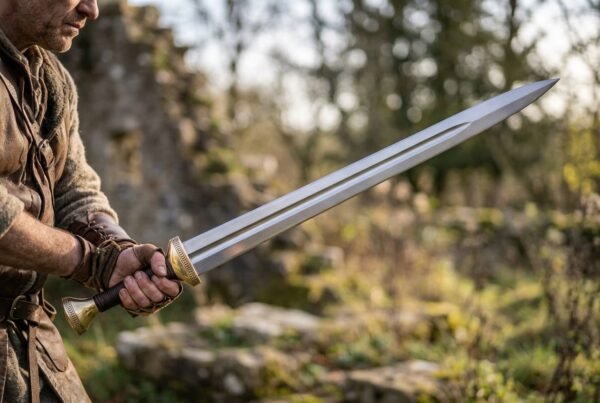
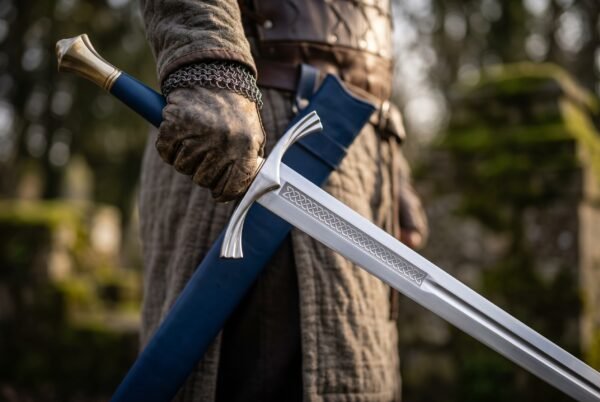
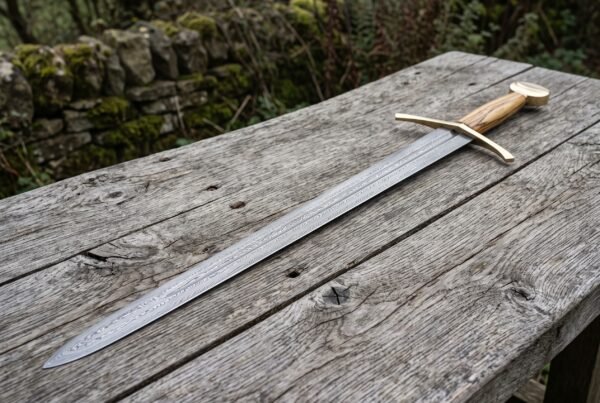
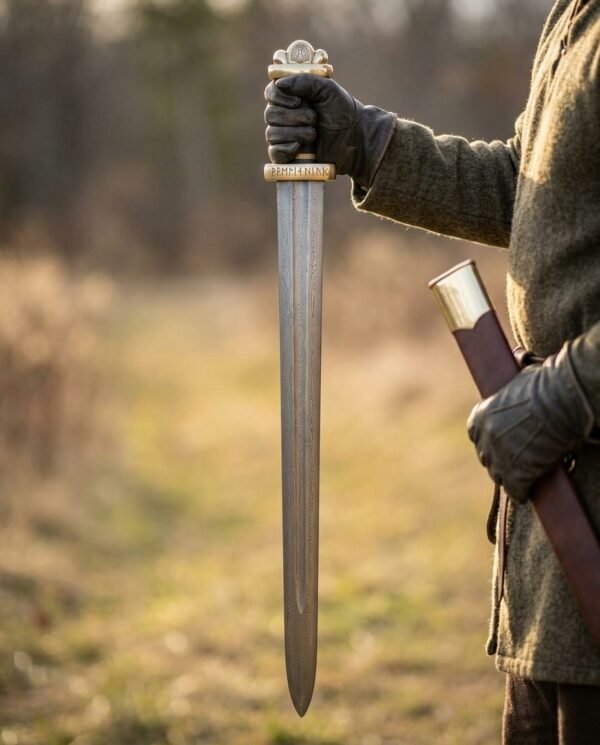
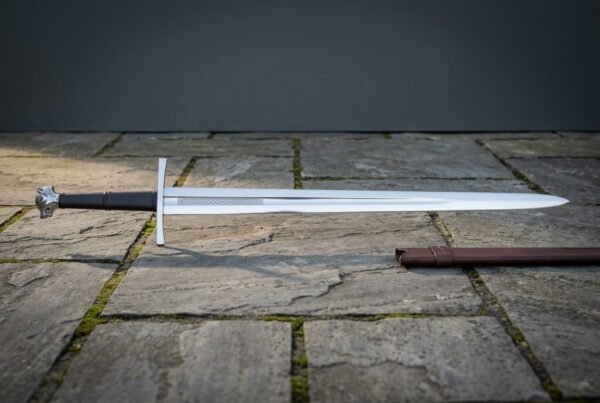
| Blade | Straight, double edged, with a central fuller carrying an etched inscription and scroll work |
|---|
| Blade width | 1.8 inches at the shoulder |
|---|
| Blade thickness | 5 mm at the guard, tapering toward the point |
|---|
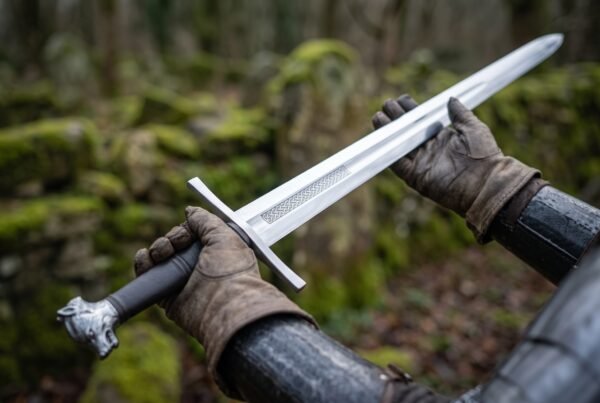
| Guard | Straight brass toned crossguard with flared ends and a centre point over the blade |
|---|
| Grip | Cream leather over ribbed cord on a hardwood core, brass toned ring at the middle |
|---|
| Pommel | Faceted brass toned pommel, tang peened over the top |
|---|
| Scabbard | Light beige leather over a wool lined wooden core, brass toned throat and chape |
|---|
| Weight | Approximately 3 lb 3 oz |
|---|
| Edge | Display edge as standard, sharpened on request |
|---|
| SKU | RK-1252 |
|---|
How a wood cored scabbard is actually built
Start with the blade, not the leather. Two slats of straight grained poplar or basswood are planed thin and the profile of the blade is carved into the inner face of each with a gouge, working from the widest section at the throat down to the point. The two halves have to close on the blade with a whisper of clearance, tight enough that the sword does not rattle, loose enough that a slightly humid day does not swell the wood onto the steel. They are glued edge to edge, the outside is rasped down to a slim oval section, and a lining goes in.
The leather is then wet formed over the finished core, which is why a good scabbard shows the ridge of the blade through the covering rather than sagging like a sleeve. The throat and chape at each end are fitted last. They are not decoration. The throat stops the mouth of the scabbard splitting when the blade goes in at a slight angle, and the chape protects the tip of the wooden core from being punched through, which is exactly where a badly made scabbard fails first. The whole assembly grips the blade at the mouth, not down its length, so the sword can be drawn cleanly rather than dragged.
Why 1095 and not stainless
The chromium that makes stainless steel stainless also makes it comparatively brittle in long thin sections, because it throws out hard carbides that break up the grain. That matters very little in a kitchen knife and a great deal in a thirty four inch blade, where failure means a snap rather than a bend. 1095 is a plain high carbon steel, and tempered back to 54 to 58 HRC for a long blade it bends and recovers rather than snapping. It flexes and recovers, takes an edge, and polishes bright. In exchange it needs oiling, because it will take a patina if you leave it damp. The full technical comparison, including where Damascus sits between the two, is on our page covering Damascus versus stainless.
The grip and how it is put together
Two shaped halves of hardwood clamp the full tang, cord is wound over them to raise the ribs, and leather goes over that. The ribbing is not a texture pattern. It lets your hand read edge alignment through the grip without looking down, which is the whole reason period grips were risered rather than smooth. The tang runs the entire length of the handle and is peened over the pommel cap, hammered cold until the head spreads and locks the assembly under compression. Every part of the hilt is squeezed together permanently. Nothing is threaded and nothing can rattle loose after a year on the wall.
Hardwood moves with humidity, so keep the sword away from direct sun, radiators and unheated garages. An occasional wipe and a light oil on the wood, as described in our notes on wooden handle care, will keep the core stable and the leather supple.
Engraving, runes and your own design
Use the rune converter on this page to turn a name, a date or a short phrase into Elder Futhark and we will cut it into the steel or the handle. If you would rather have a Viking pattern than a rune line, choose your own design in the engraving option above the add to cart button and tell us whether it goes on the blade or the handle. Where a piece already carries an engraved design, your chosen engraving replaces it rather than sitting alongside it. On the Elmshade that means your line goes into the fuller in place of the standard inscription. We can also blind stamp a short line into the scabbard leather instead, which some buyers prefer for a gift. Details and lead times are on the engraving page.
Care and sharpening
Handle the blade, then wipe the blade. That single habit prevents most of the corrosion we ever see, because a fingerprint is a small deposit of salt and acid sitting on bare steel. Two or three times a year, wipe a thin film of mineral or camellia oil over the flats with a cloth. Store the sword out of the scabbard for long periods. Leather is cured with salts and holds humidity against steel, which is the one situation where a well made scabbard works against you. The full routine is set out on our steel care page. If you order the sharpened edge, maintain it with a coarse then fine stone worked steadily along the bevel, supporting the blade so it cannot flex, as covered in our guide to sharpening with a whetstone.
Made in the Czech Republic
This is a handmade piece from the Czech Republic, made in a workshop that still forges, grinds and finishes by hand instead of stamping parts out. The smiths there have kept the older way of working, and the wood, horn and leather are shaped and fitted by hand as well. Two pieces of the same design will never be identical, and that is part of what you are buying.
Ransack Viking is a United States company. We handle the import ourselves, look over every piece when it lands and ship from our warehouse in Chicago, Illinois. Engraving is done in the United States after the piece arrives, so your design goes on before we send it out.
A note on handmade variation
This sword is hand forged. It is not machine made and it is not bulk produced, so what arrives will not be a pixel for pixel copy of the photograph on this page. Leather takes dye differently from hide to hide, wooden grips carry their own grain, and the etched inscription sits a little deeper or a little lighter depending on how long it stayed in the mordant. Every one of those things varies because each sword is worked by hand from natural materials. The dimensions, the steel, the heat treatment and the build are identical every time. The character is not, and that is what you are buying.
Frequently asked questions
Does the sword come sharpened?
It arrives with a display edge as standard, which is blunt and safe to handle. Select the sharpened option and we will put a working cutting edge on before it ships.
Is the scabbard just leather, or is there wood inside?
There is a carved wooden core inside, lined and then covered in leather. That is why the sword sits without rattling and draws cleanly. A leather only sleeve would sag and would let the point work through the bottom.
Can I have runes engraved on it?
Yes. Use the rune converter above. Your Elder Futhark line replaces the existing blade inscription, or it can be blind stamped into the scabbard leather instead if you would rather keep the blade as it is.
Will mine be identical to the one photographed?
No. The steel, geometry and dimensions are the same, but the leather tone, the wood grain and the exact depth of the etch differ on every piece because each is finished by hand.
What is the difference between this and a claymore?
A claymore is the Scottish two handed sword, noticeably longer and heavier, with forward angled quillons ending in quatrefoils and a grip built for a wide two handed swing. This is a lighter European style longsword: shorter, faster in the point, and far easier to display in a normal room.
How quickly does it ship?
Free shipping in the United States, with in stock swords leaving Chicago in two to three business days. Custom engraving adds two to three weeks.
What is in the box
- Elmshade hand forged 1095 longsword with engraved fullered blade
- Light beige leather scabbard over a wool lined wooden core with throat and chape
- Protective oil coat on the blade for transit
- Care and sharpening card
- Rune engraving certificate where personalisation was ordered
- Forged and finished in the Czech Republic
Explore the range
See the full fantasy and movie style sword range, the rest of the longswords, our Viking swords and the scabbards and sheaths made to fit them. Everything we have written on steel and care is in the guides.
Worth a look beside this
Worth putting side by side with this is the Palethorn longsword. In the same category sits the Grimfell longsword, 47 inches overall. A near match for this one is the Wolfcrown longsword, forged from 1095.
For a different piece from the same family, look at the Grimhook zweihander. Or start from a blank sheet on the custom Viking sword page.

Showed up right on time and looked even better than the photos. Already planning my next purchase from this shop.
This thing is a beast in the best way. This is going straight into my display case.
Pretty impressed. Just a couple minor things I’d tweak. Blade quality is solid. Arrived a bit less sharp than expected but a few passes on a strop fixed it. Minor nitpicks aside, good quality piece.