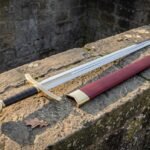
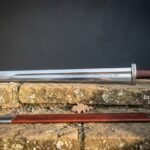
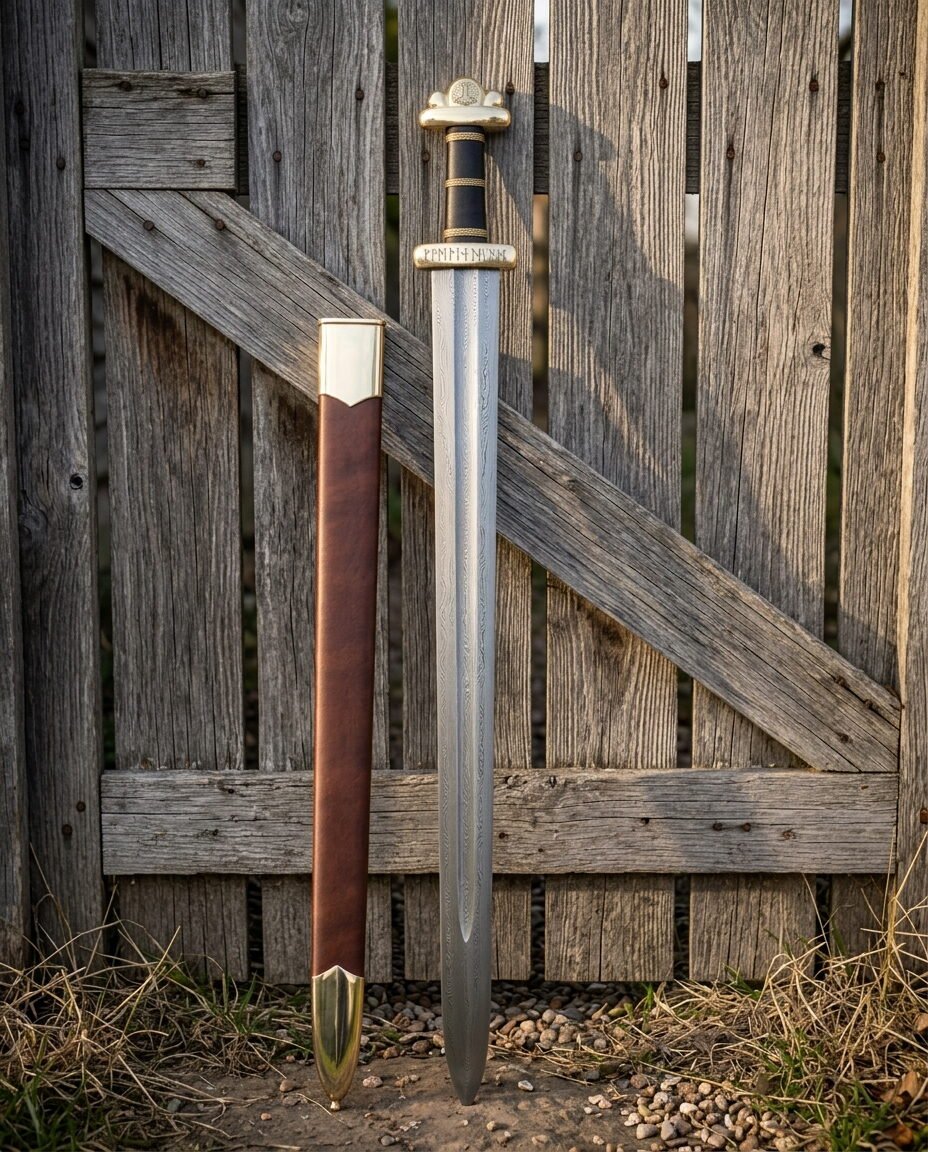
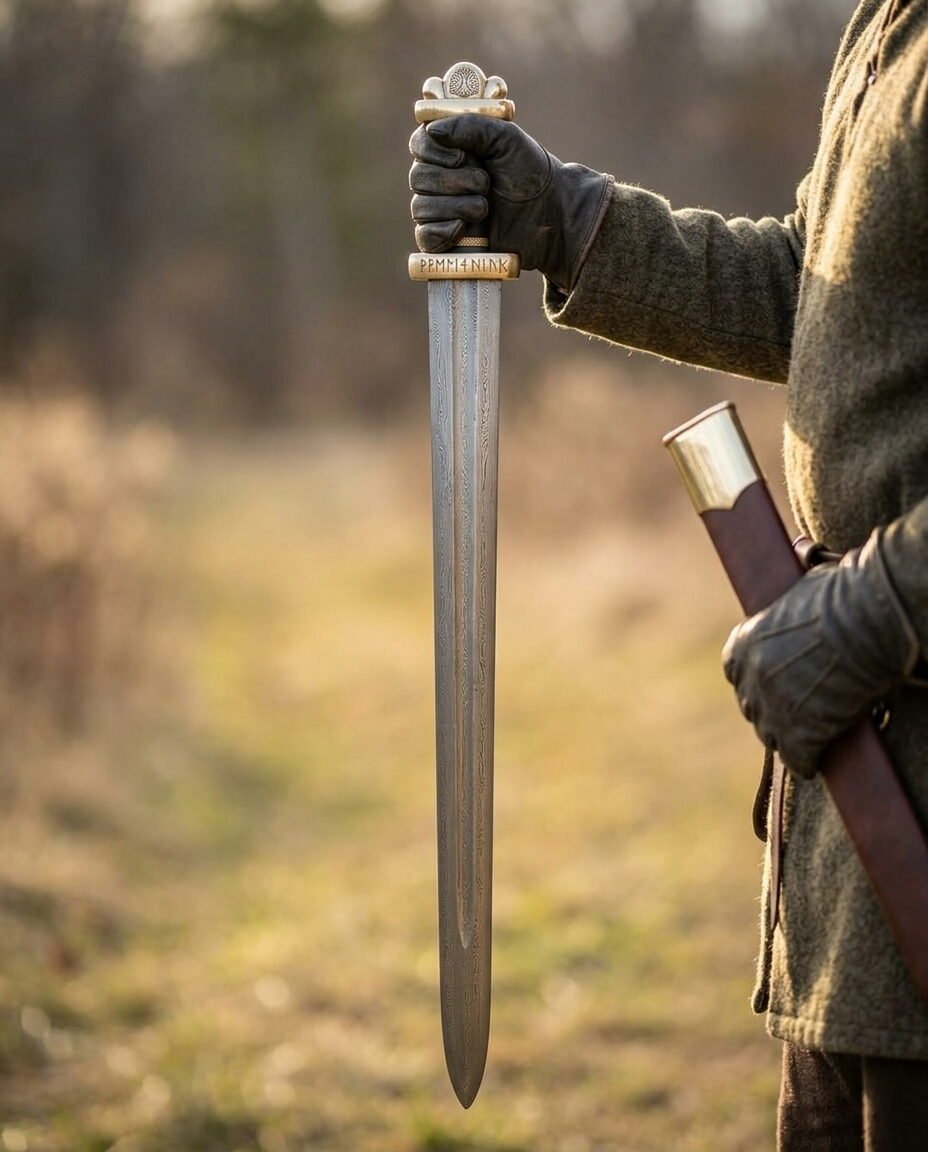
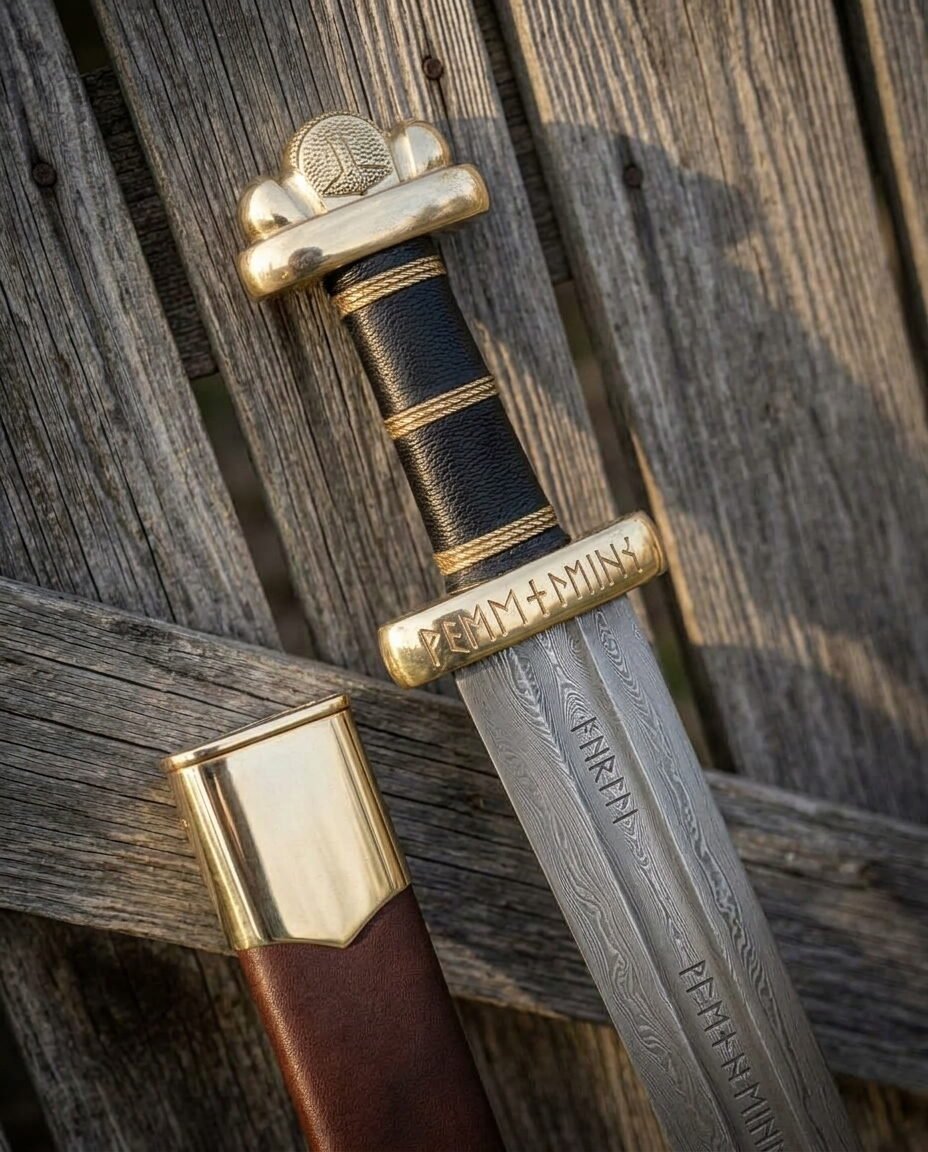
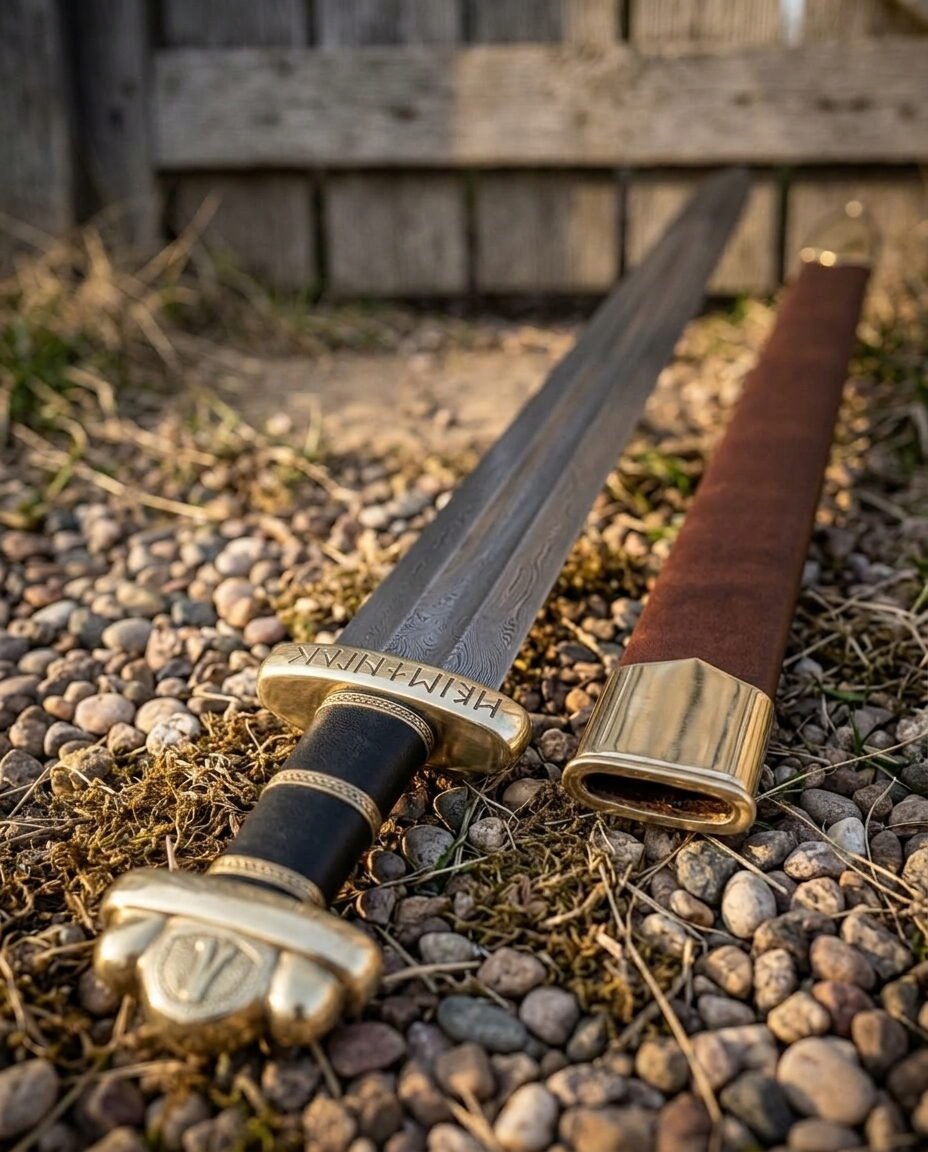
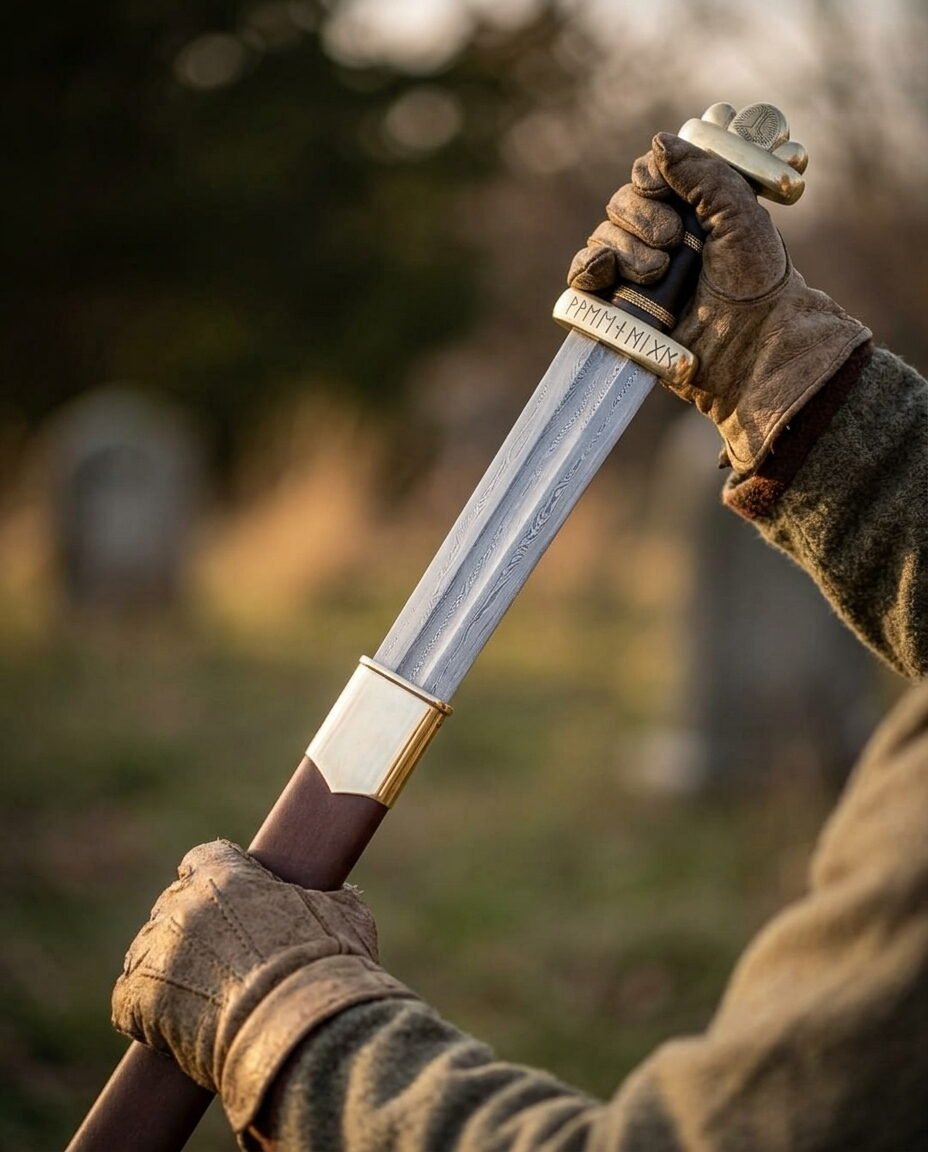
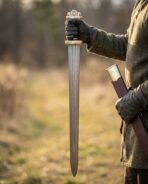
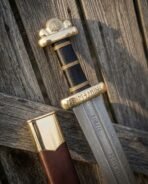
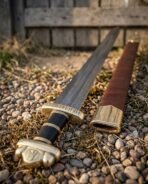
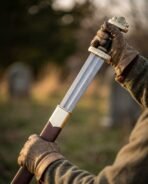
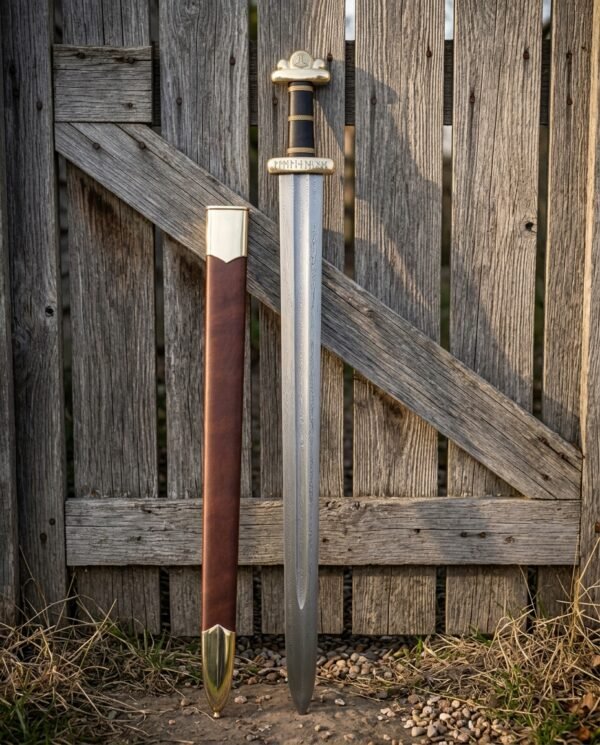
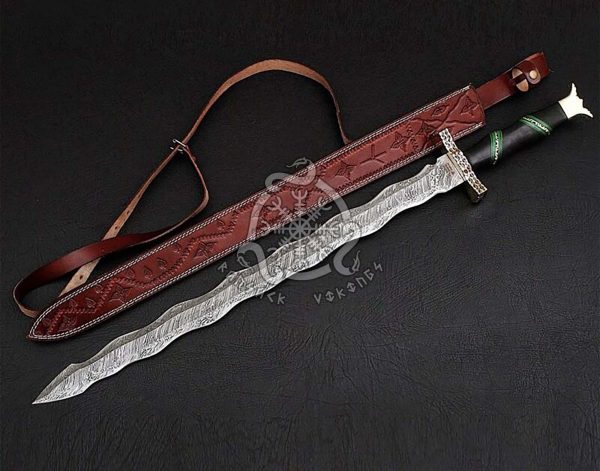
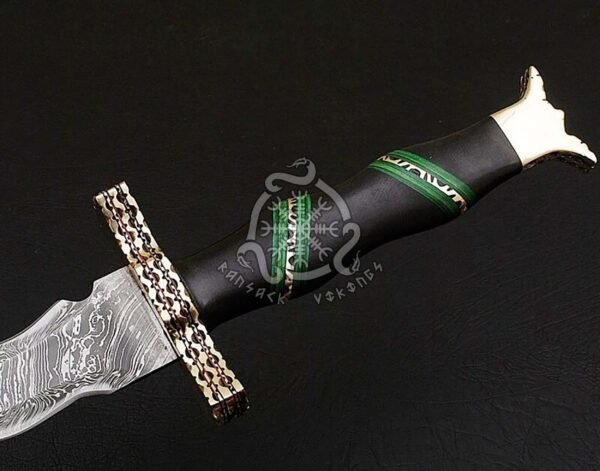
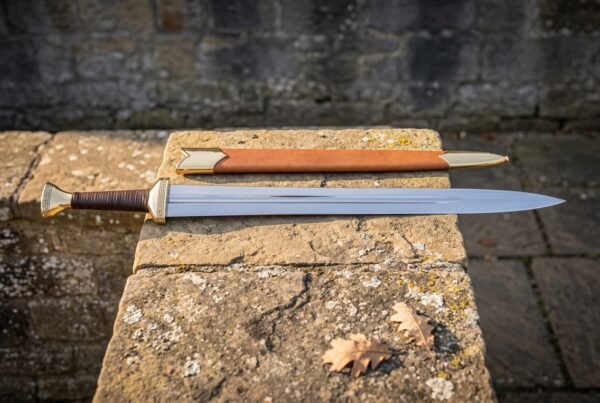
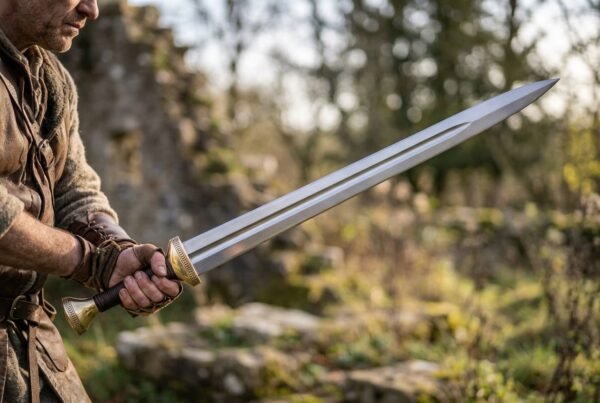
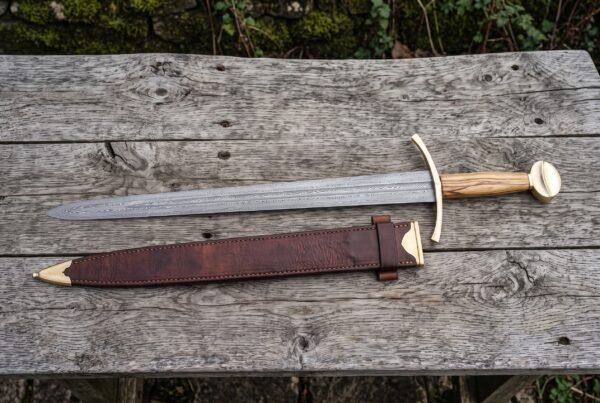
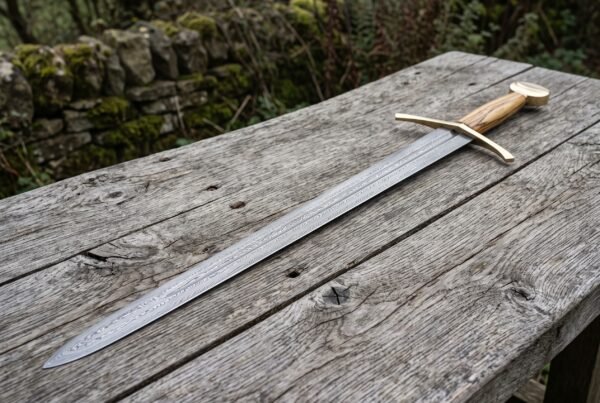
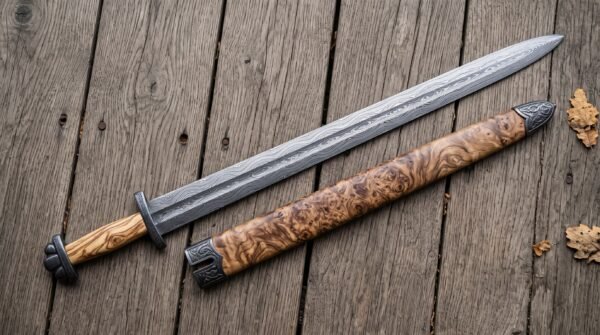
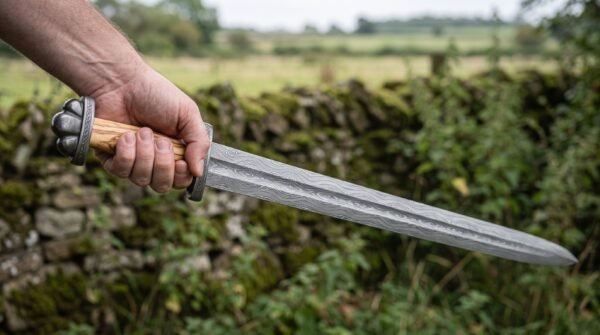
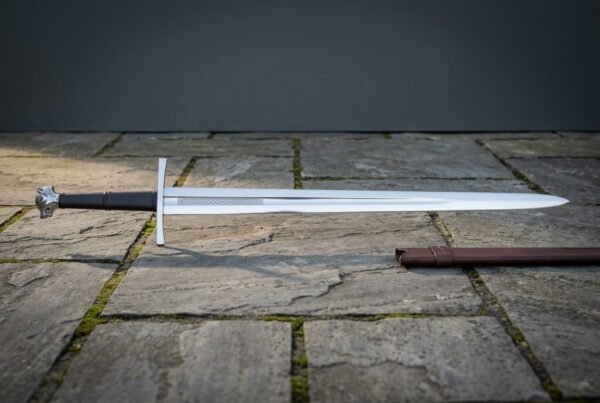
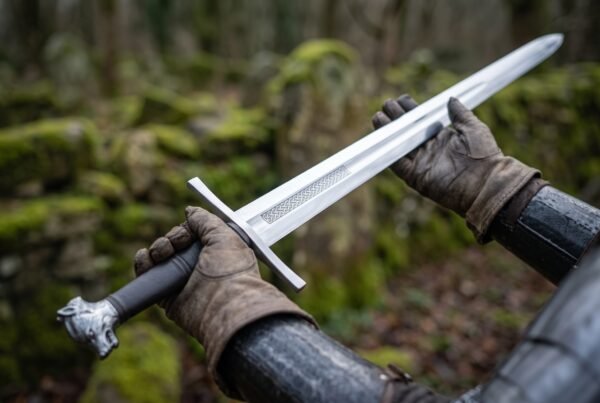
The Thornwatch is a Viking sword replica: a straight double edged Damascus blade with a rune engraved fuller, a brass guard cut with runes, a lobed brass pommel, a black leather grip ringed in brass and a brown leather scabbard. Swords of this kind are lighter than almost anyone expects. The persistent myth that a Viking or medieval sword weighed fifteen or twenty pounds comes from Victorian antiquarians, not from the objects. Weigh the surviving examples in the Wallace Collection or the Royal Armouries and the great majority of single hand and hand and a half swords come in between two and a half and four pounds. Anything heavier is either a ceremonial bearing sword, never meant to be swung, or a modern reproduction with the balance wrong. The phrase battle ready gets used loosely, and display against battle ready explains what it should mean.
The Thornwatch is forged, ground, heat treated, polished and assembled by hand in the Czech Republic. It ships with a fitted brown leather scabbard over a wooden core, a protective oil film on the blade, a care and sharpening card, and free shipping anywhere in the United States.
Specifications
| Steel | Damascus, 1095 and 15N20 forge welded, etched |
|---|
| Hardness | 58 to 60 HRC |
|---|
| Overall length | 41 inches |
|---|
| Blade length | 32 inches |
|---|
| Blade width | 1.8 inches at the shoulder |
|---|
| Blade thickness | 5 mm at the guard, distally tapered |
|---|
| Blade | Straight double edged Viking blade with a wide fuller engraved with runes |
|---|
| Guard | Straight polished brass guard cut with a line of runes |
|---|
| Grip | Black leather over a hardwood core, three twisted brass wire bands |
|---|
| Pommel | Lobed brass pommel with an upper bar, the centre lobe stamped with a knot motif, peened tang |
|---|
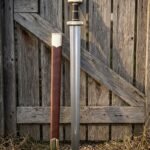
| Scabbard | Brown leather over a wooden core with polished brass throat and chape |
|---|
| Weight | Approximately 2 lb 15 oz |
|---|
| Edge | Display edge as standard, sharpened on request |
|---|
| SKU | RK-1257 |
|---|
The sweet spot, and why a sword has one
Hold a sword loosely by the grip and tap the flat of the blade at different points with a piece of wood. Near the tip and near the guard the hilt buzzes in your hand. Somewhere around two thirds of the way up it does not, and the blade instead swings cleanly without transmitting a shock. That quiet point is the centre of percussion, and next to it sits a vibration node, a place on the blade that stays almost still while the rest of it flexes back and forth after an impact.
That is the part of the blade you want to cut with. Strike with the sweet spot and the energy goes into the target rather than into your wrist. Strike six inches nearer the tip and a startling amount of the blow comes straight back up the hilt. Where the sweet spot falls is decided by the mass distribution: the blade taper, the weight of the guard and the mass of the pommel together. It is not a thing you can add afterward, it is a consequence of getting the whole sword right, and it is the single clearest test of whether a maker knew what they were doing. On the Thornwatch it sits roughly seven inches back from the point.
Why Damascus and not stainless
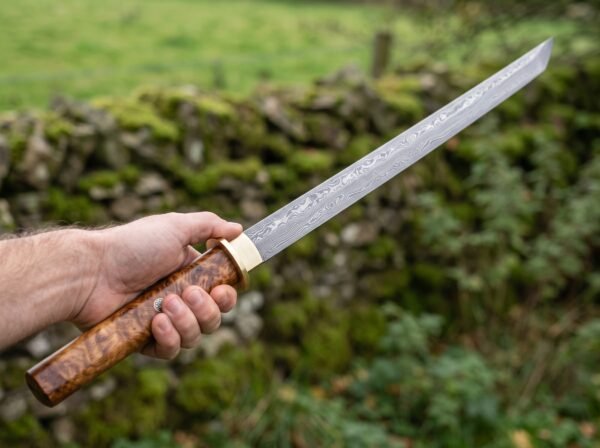
The blade is Damascus: 1095 high carbon steel and 15N20 nickel steel forge welded into one billet, hardened to 58 to 60 HRC and etched. The etch darkens the 1095 and leaves the 15N20 bright, which is where the flowing pattern along the flats comes from. It is a cross section of the steel rather than a print, so it cannot wear off. Stainless works the other way. Twelve percent or more chromium buys corrosion resistance at the cost of a grain structure interrupted by hard carbides, and in a thirty two inch blade that trades a bend for a break. We would rather hand you a sword that wants an oily cloth now and then. The comparison is set out properly on our page covering Damascus versus stainless.
The grip, and why the tang runs the whole way
Under the leather is a shaped hardwood core clamped around a tang that runs the full length of the handle at nearly its full width, and is peened over the pommel at the end. That matters more than any other single construction detail. A great many swords sold as decorative use a rat tail tang, a thin rod welded to the base of the blade and threaded into the pommel, and it is the join that fails first when such a sword is swung. A full peened tang has no weld and no thread. The hilt is squeezed together and stays that way.
The leather over the core is stitched along the back edge of the grip so the seam sits away from the palm, and the core underneath is wood, which moves with humidity. Keep the sword out of direct sun and away from radiators, and treat the handle occasionally as described in our notes on wooden handle care.
Engraving, runes and your own design
Use the rune converter on this page to turn a name, a date or a short phrase into Elder Futhark and we will cut it into the steel or the handle. If you would rather have a Viking pattern than a rune line, choose your own design in the engraving option above the add to cart button and tell us whether it goes on the blade or the handle. Where a piece already carries an engraved design, your chosen engraving replaces it rather than sitting alongside it. On the Thornwatch that means your line goes into the fuller in place of the standard engraving, and there is also room on the flats either side of the fuller if you want something longer. We can blind stamp the scabbard leather as well. Details and lead times are on the engraving page.
Care and sharpening
Damascus is carbon steel at heart, and carbon steel rusts. Wipe the blade after handling, because a fingerprint left overnight in humid weather etches a permanent mark into polished steel. Two or three light coats of mineral or camellia oil a year is enough for a piece hanging indoors, more if it lives near the coast or in a room that swings between damp and dry. Do not store the sword inside the scabbard for months, since tanned leather holds moisture against the blade. Everything we know about keeping carbon steel clean is on our steel care page. If you order the sharpened edge, hold a consistent angle and work the whole length of the bevel, following our guide to sharpening with a whetstone.
Made in the Czech Republic
This piece is made by hand in the Czech Republic, in a workshop that still works the old way. The steel is forged, ground, heat treated and finished by smiths who learned the trade from the people before them, and the wood, horn and leather are cut and fitted by hand rather than pressed out on a line. That is also why no two pieces come out exactly the same.
Ransack Viking is a United States company. We import these pieces ourselves, check every one when it lands and ship from our warehouse in Chicago, Illinois. Engraving is done here in the United States after the piece arrives, so your runes or your own design go on before it leaves for you.
A note on handmade variation
This sword is hand forged. It is not machine made and it is not bulk produced, so what arrives will not be a pixel for pixel copy of the photograph on this page. Brown vegetable tanned leather takes dye differently on every hide and darkens further with handling, the grain in the wooden grip is unique to that piece of timber, the etched line runs a shade deeper or lighter with time in the mordant, and the profile of the point is finished by eye. All of that varies because each sword is worked by hand from natural materials. The dimensions, the steel, the heat treatment and the build are the same every time. The character is not, and that is what separates a forged sword from a stamped one.
Frequently asked questions
Is it sharp when it arrives?
No. It comes with a display edge as standard, blunt and safe to handle. Choose the sharpened option and we will put a working cutting edge on it before it ships.
Can I cut with it or spar with it?
Sharpened, it will cut tatami mats and water bottles perfectly well, since it has a full peened tang and a properly tempered Damascus blade. It is not made for edge on edge sparring against another steel sword, which damages any blade and is done with blunt trainers for that reason.
Can I have runes engraved on it?
Yes. Use the rune converter on this page. Your Elder Futhark line replaces the standard fuller engraving, or we can stamp it into the scabbard leather if you would rather leave the blade alone.
Will mine look exactly like the photo?
No. Same steel, same dimensions, same geometry, but leather tone, wood grain and etch depth differ on every piece because each is finished by hand.
What is the difference between this and a bastard sword?
A bastard sword has a grip long enough for a second hand but is normally heavier through the forte so it can be used in one hand at need. This is a lighter and quicker blade with a shorter grip, closer to a single hand Viking sword than to a hand and a half.
How long does shipping take?
Free within the United States. Stocked swords leave Chicago in two to three business days. Custom engraving adds two to three weeks.
What is in the box
- Thornwatch hand forged Damascus Viking sword with rune engraved fuller
- Brown leather scabbard over a wooden core with fitted throat and chape
- Protective oil coat on the blade for transit
- Care and sharpening card
- Rune engraving certificate where personalisation was ordered
- Forged and finished in the Czech Republic
Explore the range
See the rest of the Viking swords, our Damascus swords, our arming swords, the fantasy and movie style swords and the scabbards and sheaths we build to fit them. Steel, edges and care are covered in the guides.
Close to this one
Also in this group is the Fernstride longsword, 42 inches overall. Sitting beside it in the catalogue is the Palefrost longsword, forged from 1095. Another in the same line is the Longwake longsword, 42 inches overall.
For a different piece from the same family, look at the Emberfall falchion. Nothing here exactly right, build one to your own spec on the custom Viking sword page.

It’s a decent sword. Nothing extraordinary though. Handle material felt a bit different than pictured. Might work for casual use or display.