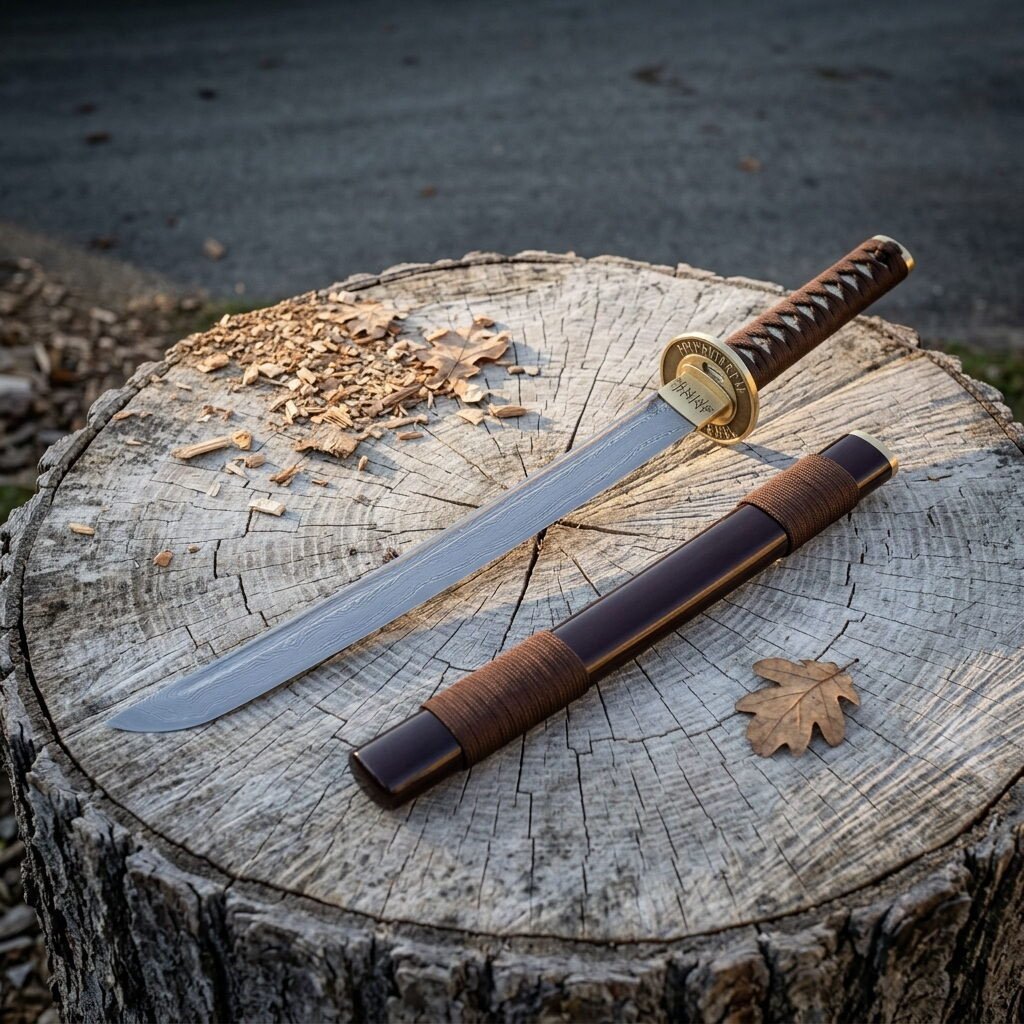
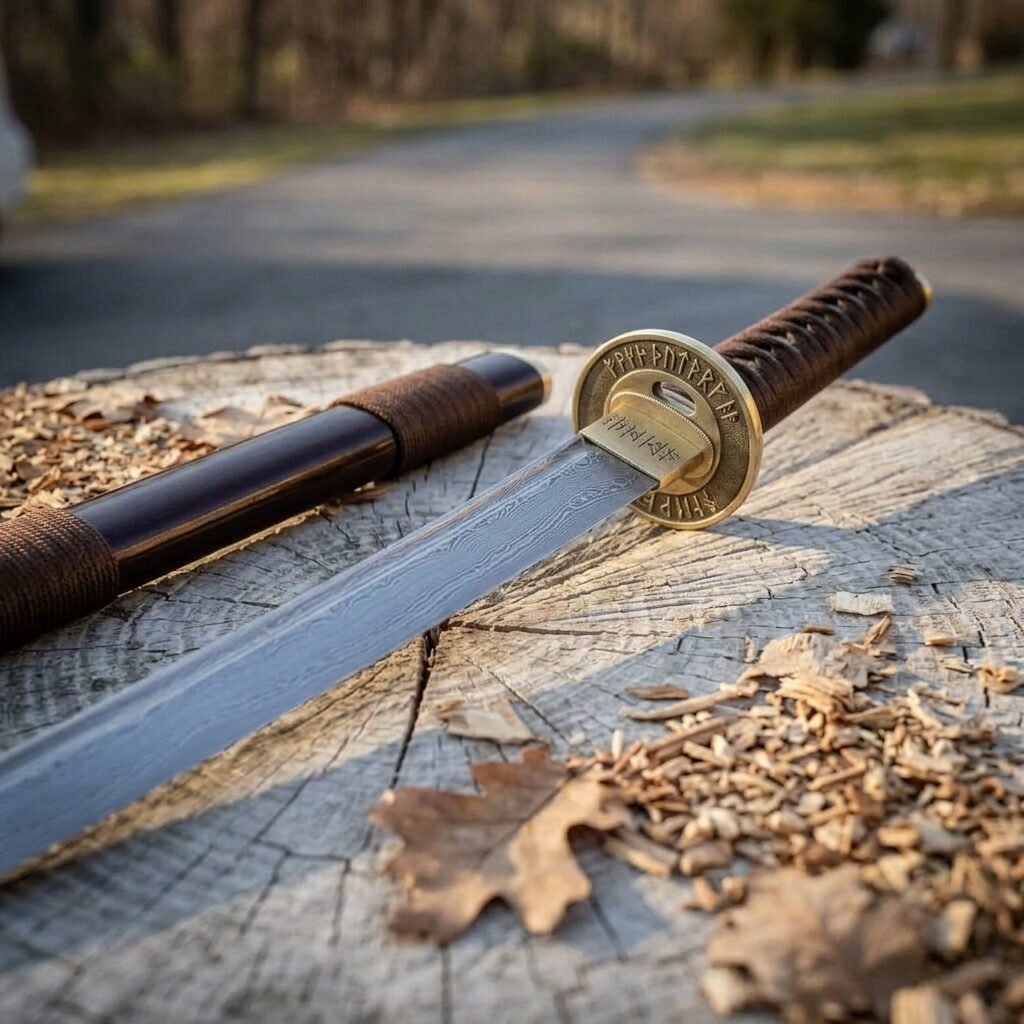
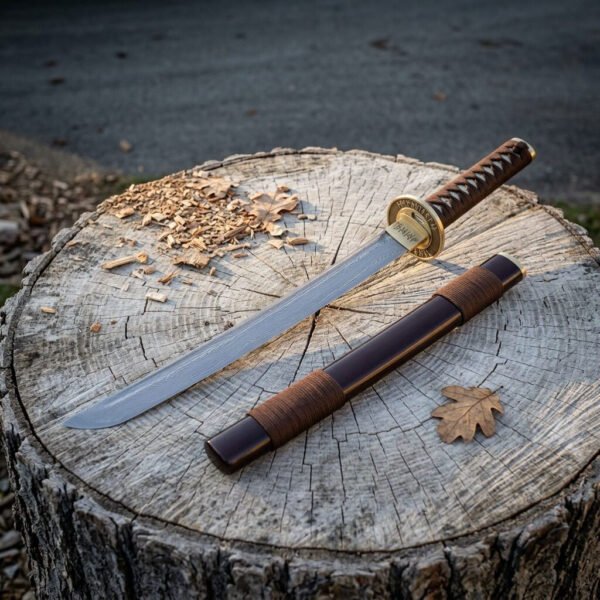
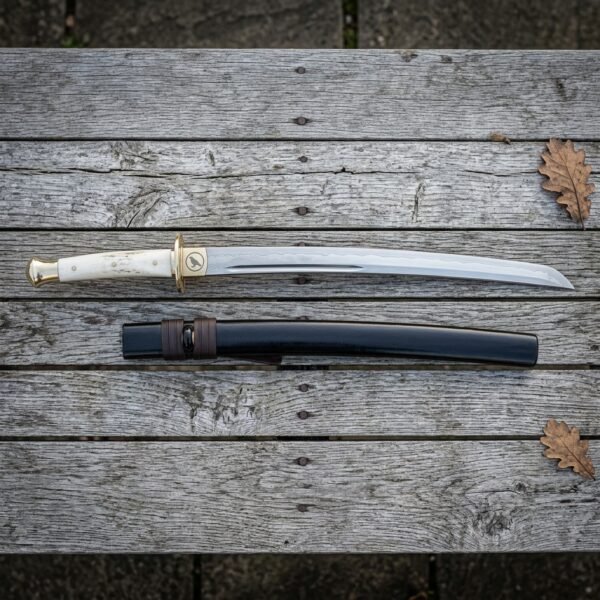
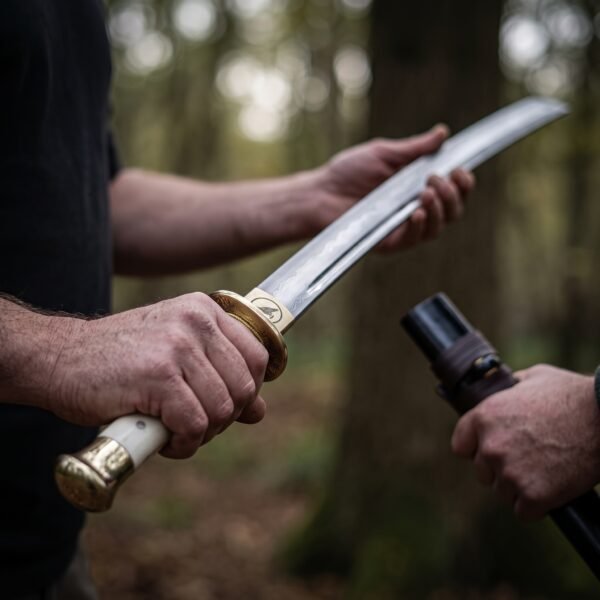
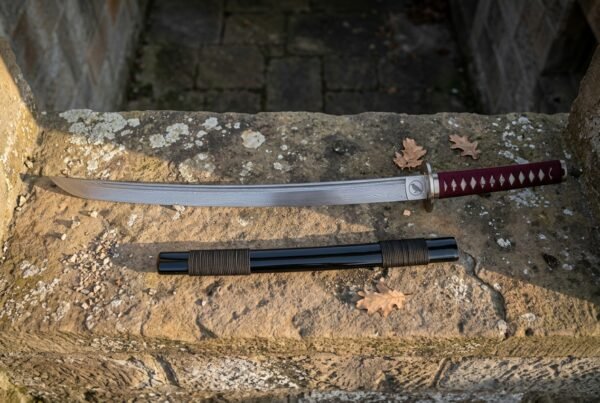
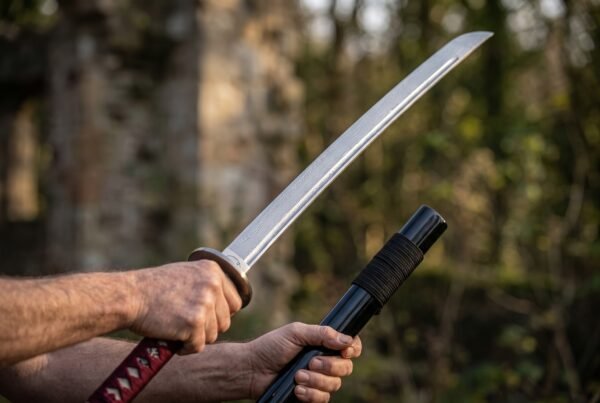
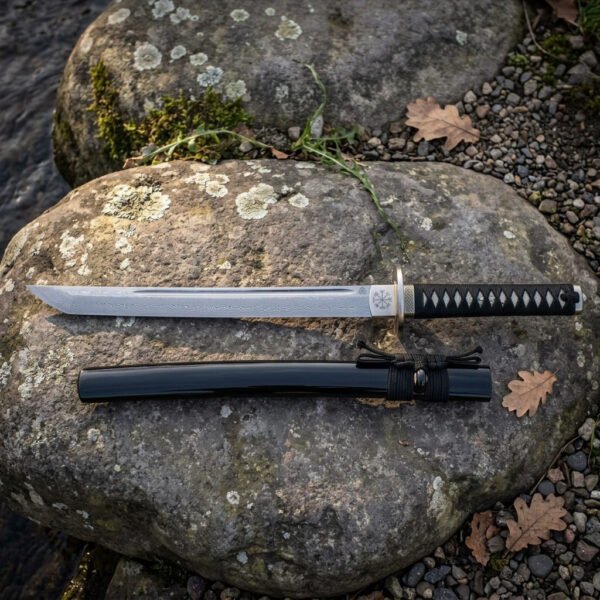
A Japanese scabbard is a more considered object than it looks. It is not a tube. It is made from a single piece of light close grained wood, split down its length, hollowed out on both halves to the exact section of the blade with the tip of a chisel, then glued back together so the seam disappears. Nothing inside touches the polished steel. The blade floats down a channel cut a fraction wider than it is, and the entire grip on the sword comes from the mouth of the scabbard closing on the brass collar at the base of the blade. That is why an old saya still holds a sword firmly after a century, and why a scabbard that grips the blade itself will have polished the finish off it in a fraction of that time. Amberoak sits in one of those, finished in dark brown gloss with two cord wrapped bands, over a 15 inch blade of hand forged 1095 and 15N20 Damascus hardened to 58 to 60 HRC. Where the tanto shape came from is covered in the tanto explained.
Forged, ground, heat treated and mounted by hand in the Czech Republic. It ships with the cord banded wooden saya shown in the photographs and a light protective coat of oil on the blade. Shipping inside the United States is free.
Specifications
| Steel | Hand forged Damascus, 1095 and 15N20 |
|---|
| Hardness | 58 to 60 HRC |
|---|
| Overall length | 21.5 inches |
|---|
| Blade length | 15 inches |
|---|
| Handle length | 6.5 inches |
|---|
| Blade profile | Gently curved with an angled point, Damascus pattern along the flat |
|---|
| Handle | Hardwood tsuka wrapped in brown cord with a brass pommel cap |
|---|
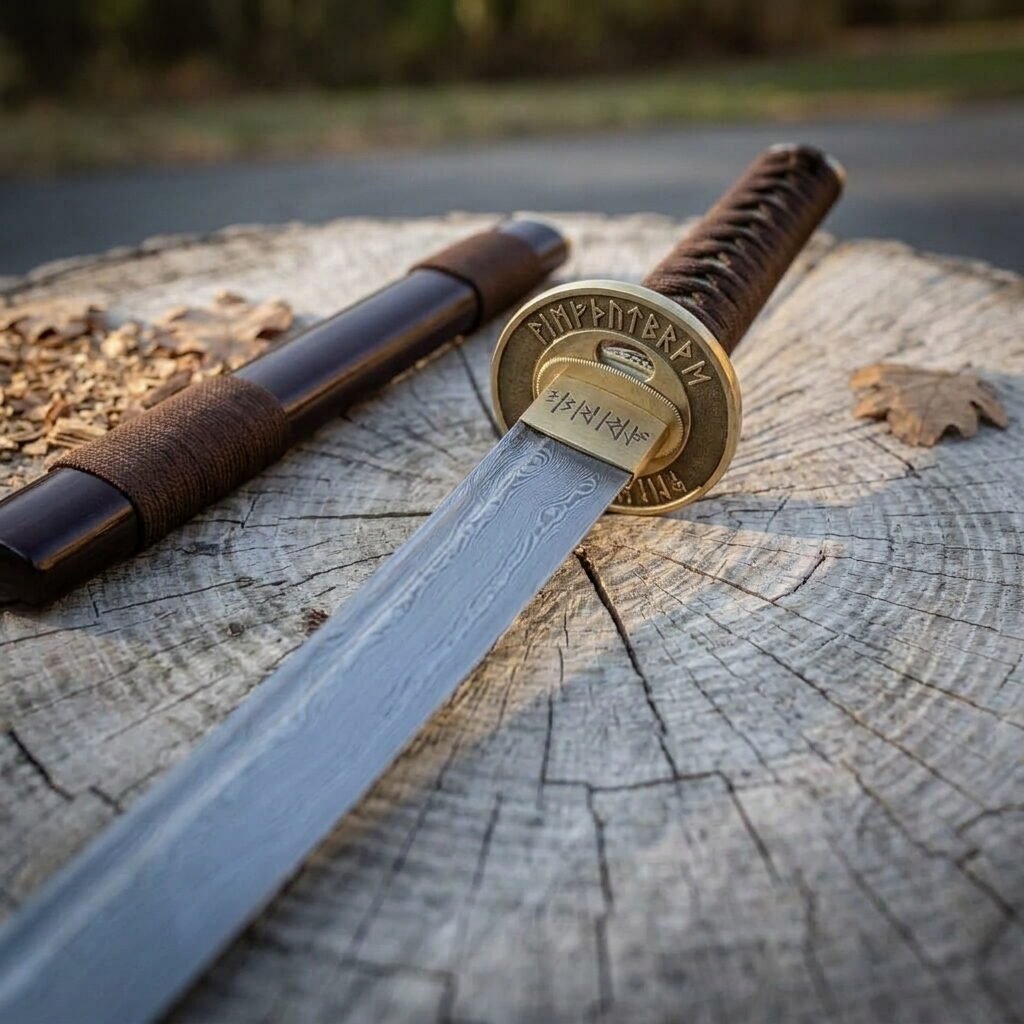
| Guard | Round brass tsuba engraved with runes, rune engraved brass habaki |
|---|
| Scabbard | Hollowed wooden saya in dark brown gloss with two cord wrapped bands and a brass collar at the mouth |
|---|
| Weight | Approximately 1.2 pounds bare, 1.7 pounds in the saya |
|---|
| SKU | RK-1279 |
|---|
The blade shape
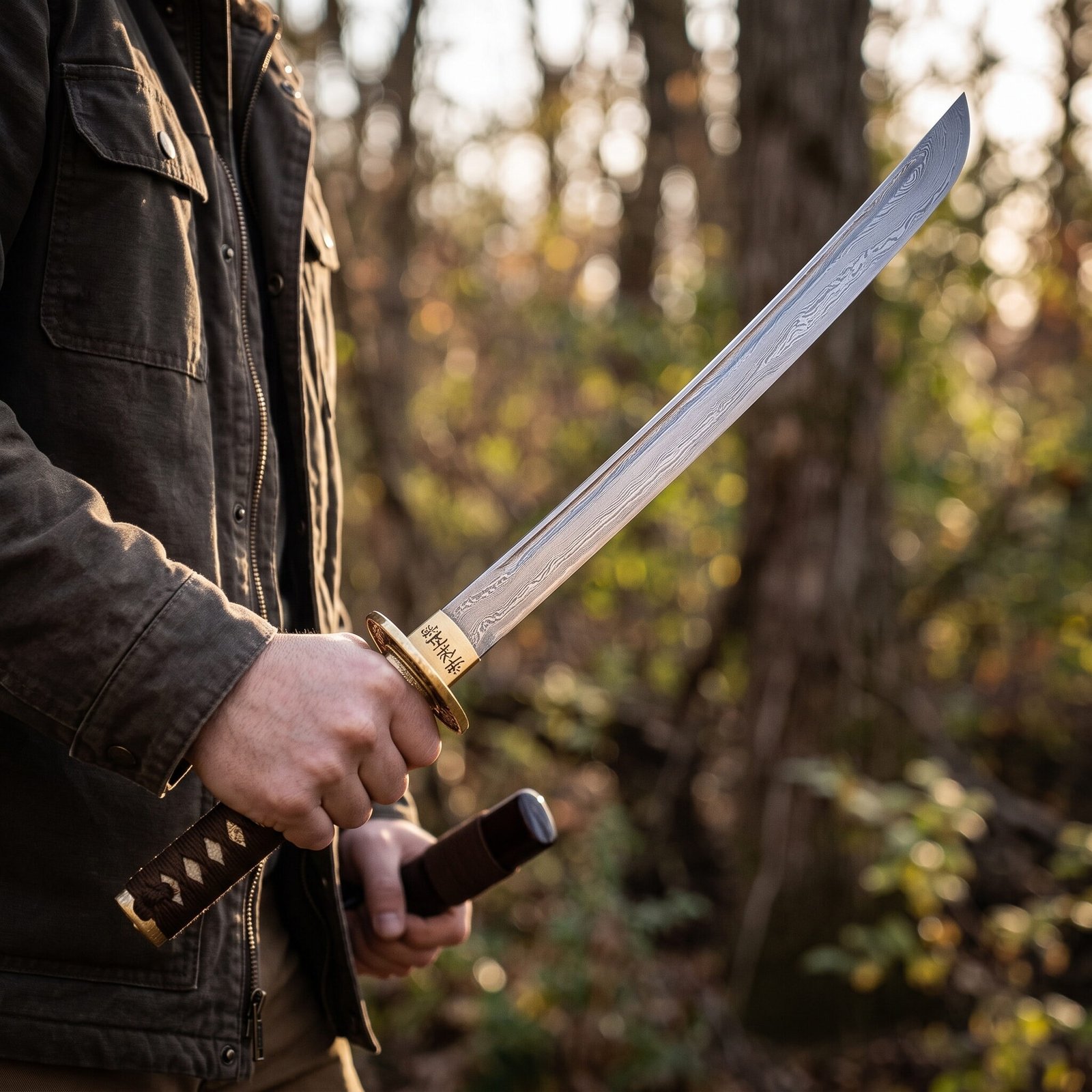
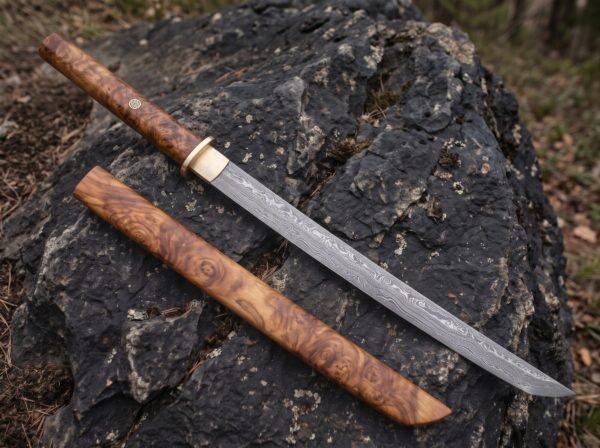
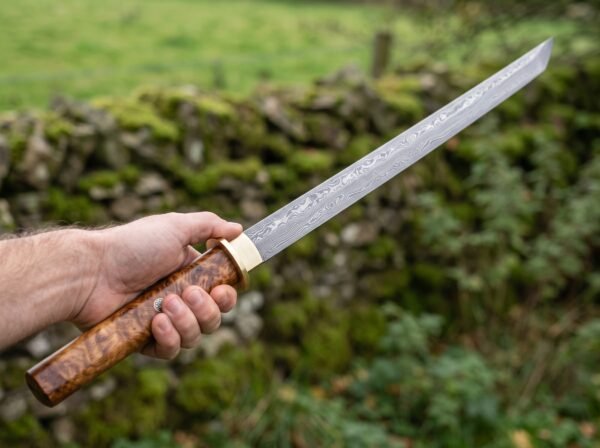
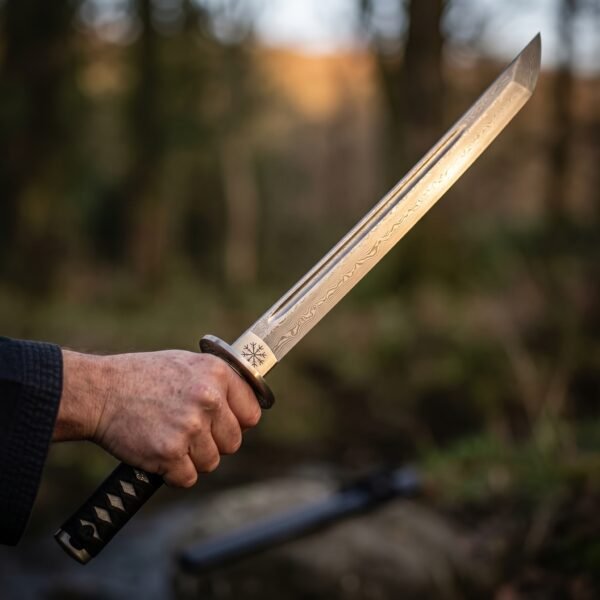
The blade runs almost straight out of the brass habaki, with a gentle curve toward an angled point. It is long enough to handle like a short sword and short enough for close control, and the long straight run of edge keeps drawing cuts on line.
Why Damascus and not stainless
The blade is forge welded from 1095 and 15N20, folded, drawn out and etched, which is what brings up the flowing pattern you can see along the flat. The 1095 supplies the carbon that takes a keen edge and the 15N20 supplies nickel that stays bright under the etch. Hardened to 58 to 60 HRC it holds an edge well and sharpens back on an ordinary whetstone. It is not stainless, so it will rust if left wet or covered in fingerprints, and that is what the oil and the wipe are for. The full argument is in our steel and hardness notes.
Wood, cord and brass
The handle core is hardwood shaped in two halves to the full length tang and wrapped in brown cord, with a brass cap at the pommel and a rune engraved brass tsuba and habaki at the guard. The saya is wood, hollowed the way described above, finished in a dark brown gloss with two bands of brown cord wrap that give your hand something to hold.
Keep the saya out of prolonged wet and wipe the gloss with a soft dry cloth. The wood wants what all wood wants, which is described in handle and sheath care. Brass darkens with handling into a warmer tone and polishes back if you prefer bright.
Engraving, runes and your own design
Use the rune converter on this page to turn a name, a date or a short phrase into Elder Futhark and we will cut it into the steel or the handle. If you would rather have a Viking pattern than a rune line, choose your own design in the engraving option above the add to cart button and tell us whether it goes on the blade or the handle. Where a piece already carries an engraved design, your chosen engraving replaces it rather than sitting alongside it. The wide flat of this blade takes a long line comfortably, and the engraving page covers depth and layout.
Care and sharpening
Wipe the blade after handling, particularly around the brass habaki where moisture collects between two dissimilar metals. Light mineral oil on a cloth does the job. Do not leave the blade sheathed and wet, because wood and cord both hold moisture and will hold it against the steel.
The edge sharpens on ordinary water stones at the angle it was ground at. Follow the gentle curve of the edge rather than trying to hold the blade flat, which is the usual mistake on a curved edge, then finish on a fine stone and strop. Both jobs are covered in steel care and sharpening with a whetstone.
Made in the Czech Republic
This is a handmade piece from the Czech Republic, made in a workshop that still forges, grinds and finishes by hand instead of stamping parts out. The smiths there have kept the older way of working, and the wood, horn and leather are shaped and fitted by hand as well. Two pieces of the same design will never be identical, and that is part of what you are buying.
Ransack Viking is a United States company. We handle the import ourselves, look over every piece when it lands and ship from our warehouse in Chicago, Illinois. Engraving is done in the United States after the piece arrives, so your design goes on before we send it out.
A note on handmade variation
Amberoak is hand forged. It is not machine made and it is not bulk produced, so what arrives will not be a pixel for pixel copy of the photograph. The Damascus pattern comes out of every billet differently, the cord wrap takes its own shade of brown, the brass will have its own tone, the polish carries light in its own way, and the grain of the wood in the handle core belongs to that piece of timber. The curve of the edge varies a little because it is ground by eye. Dimensions, steel and build are the same every time. The character is not.
Frequently asked questions
Is this a tanto or a short wakizashi?
It sits at the top of the tanto range. At 15 inches of blade it is longer than a classic tanto and shorter than a wakizashi, which in Japanese terms would make it an o tanto. It handles like a very large working knife rather than like a sword.
Does it arrive sharp?
Yes, sharpened and ready to use. If you would rather have it blunt for display, ask in the order notes and there is no extra charge.
Can I take it outdoors and use it?
Yes, and the wooden saya protects the edge on the move. It will handle camp cutting, brush and soft target work. Keep it off bone, metal and stone, do not use it as a pry bar and do not throw it.
How do I look after the saya?
Keep it out of prolonged wet, dry it slowly if it does get soaked, and wipe the gloss with a soft dry cloth. If a cord band ever works loose, tighten it before it unwinds.
Can I have runes engraved on it?
Yes. Use the rune converter on this page for Elder Futhark or choose your own Viking pattern in the engraving option above the add to cart button. The broad flat of this blade suits a longer line than most pieces this size.
How long does shipping take?
Free inside the United States. One to two weeks in the shop, longer with engraving, then two to five days in transit.
What is in the box
- Amberoak hand forged Damascus tanto
- Dark brown wooden saya with two cord wrapped bands
- Protective oil coat on the blade
- Care card covering steel, cord and wood
- Elder Futhark rune engraving where selected
- Forged and finished in the Czech Republic
Explore the range
Browse the longer wakizashi, the full katana and Japanese sword range, the Damascus swords, or read the guides.
Worth a look beside this
A near match for this one is the Shadowreed tanto knife, 19 inches overall. Closest to this in the range is the Trinesaya tanto knife, pattern welded Damascus. If this one is not quite right, there is the Knotguard tanto knife, high carbon steel.
The Bonewarden Viking seax covers the other half of the same kit. Or start from a blank sheet on the custom hunting knife page.

Five stars isn’t even enough honestly. Packaging was excellent and it arrived in perfect condition. Feels way more premium in person than the listing photos. This shop clearly takes pride in their work.