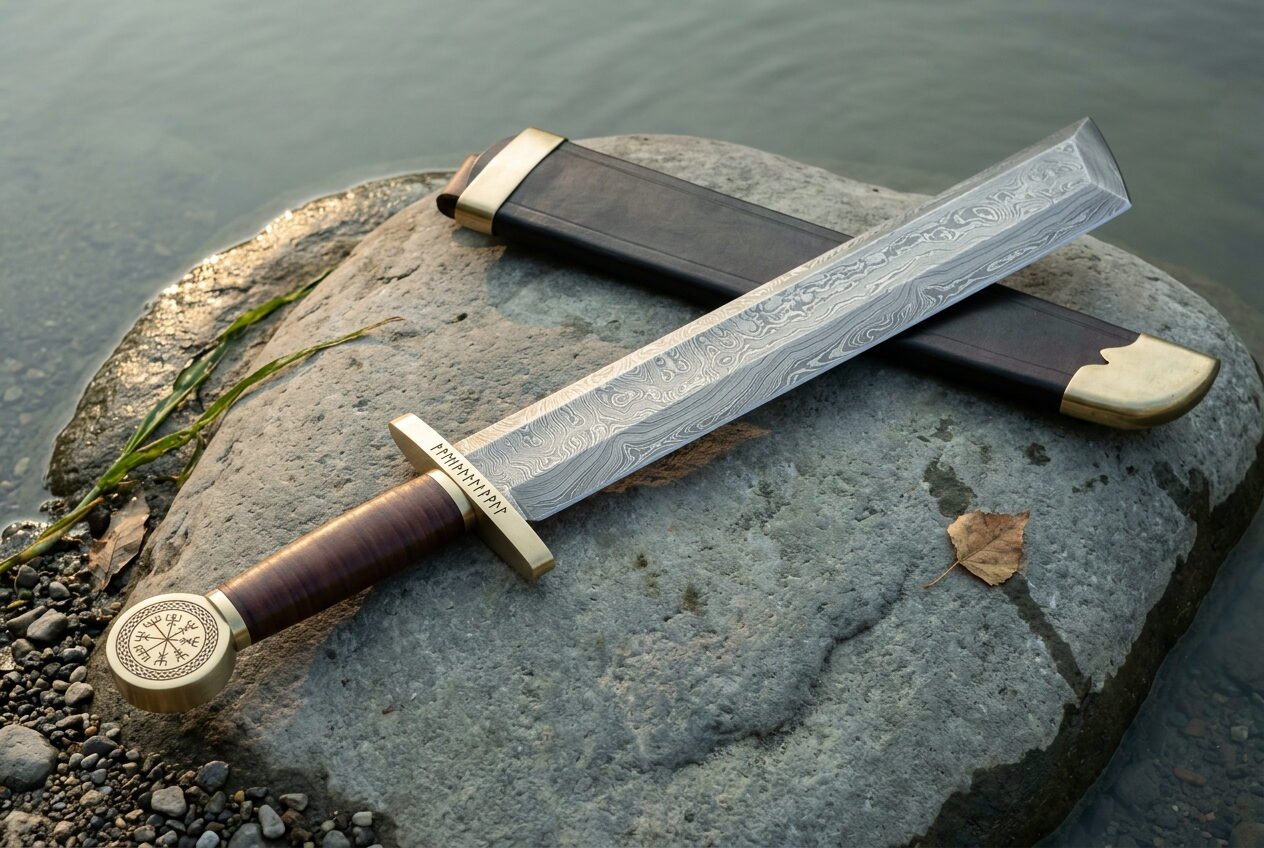
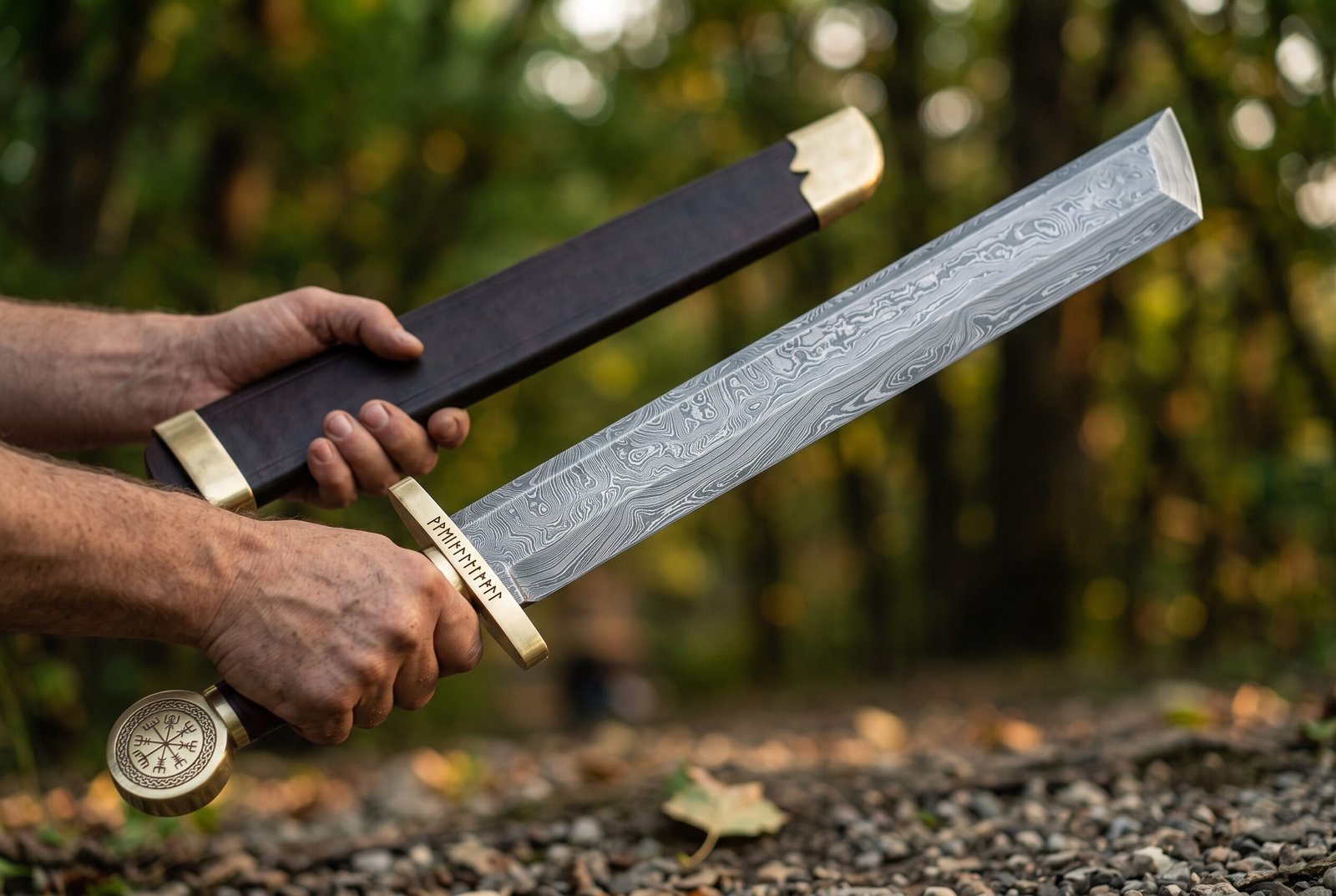
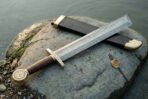
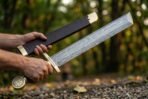
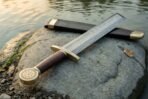
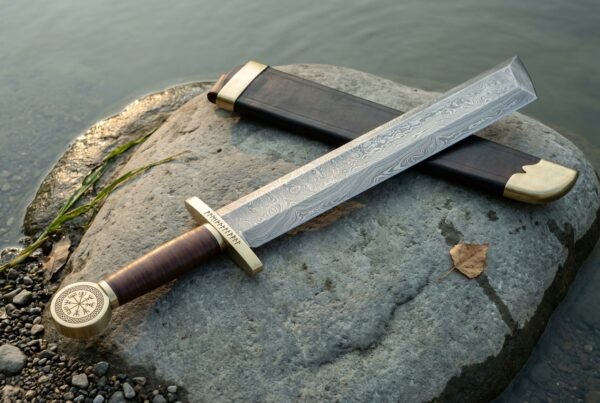
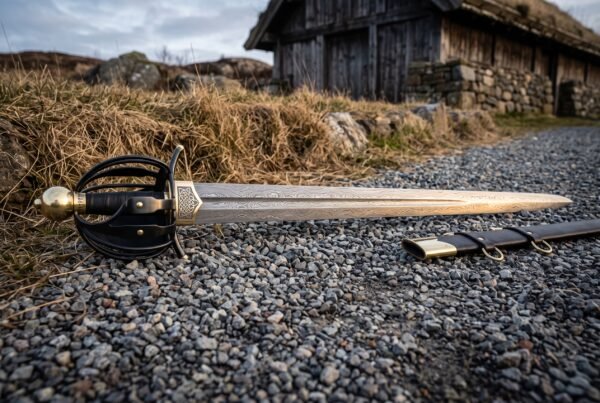
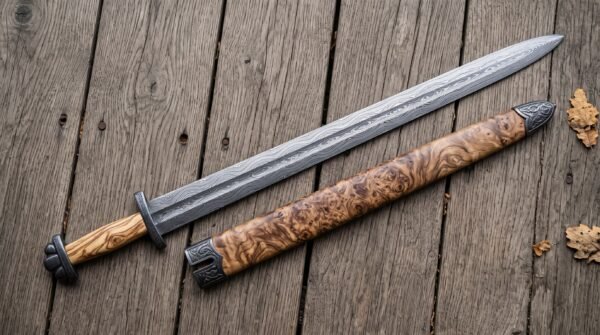
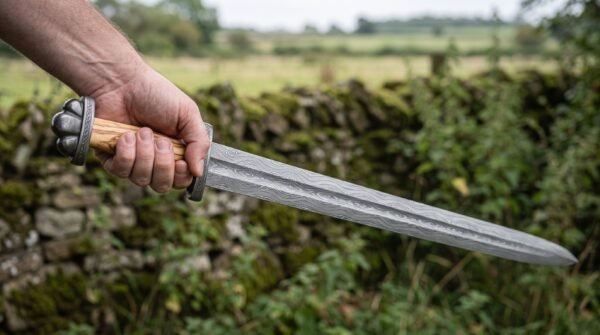
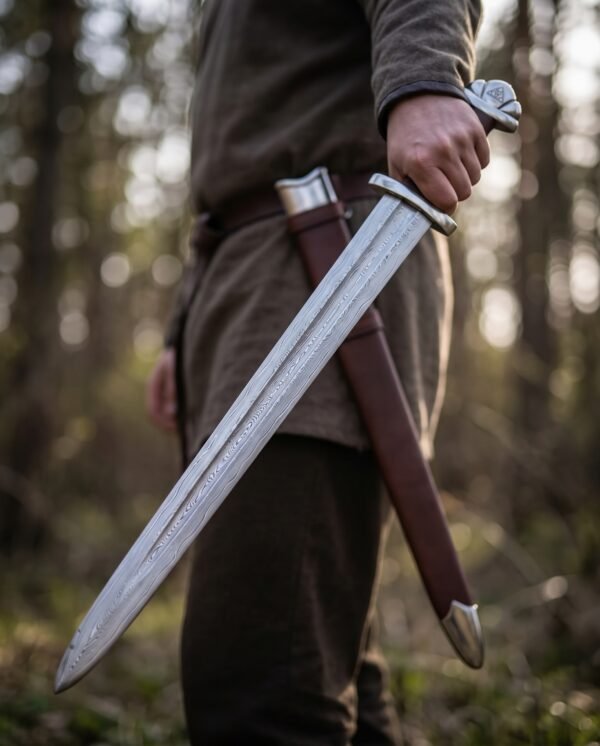
This is a broad Damascus short sword in the Norse manner, forge welded from 1095 and 15N20 into a blade that keeps its full width almost to the end and then cuts away in a single angled clip to the point. That clipped tip is the interesting part. It is the same solution the Norse and Anglo Saxon world reached on the langseax, where a broad heavy blade is finished with a straight angled front edge rather than a symmetrical taper. It keeps mass right out at the far end of the sword, which is where a cut wants weight, while still giving you a usable point for a thrust. Symmetrical blades give that mass up in exchange for a finer tip. This one does not, and you feel it the moment you pick it up, because the balance sits noticeably further forward than a knightly arming sword of the same length.
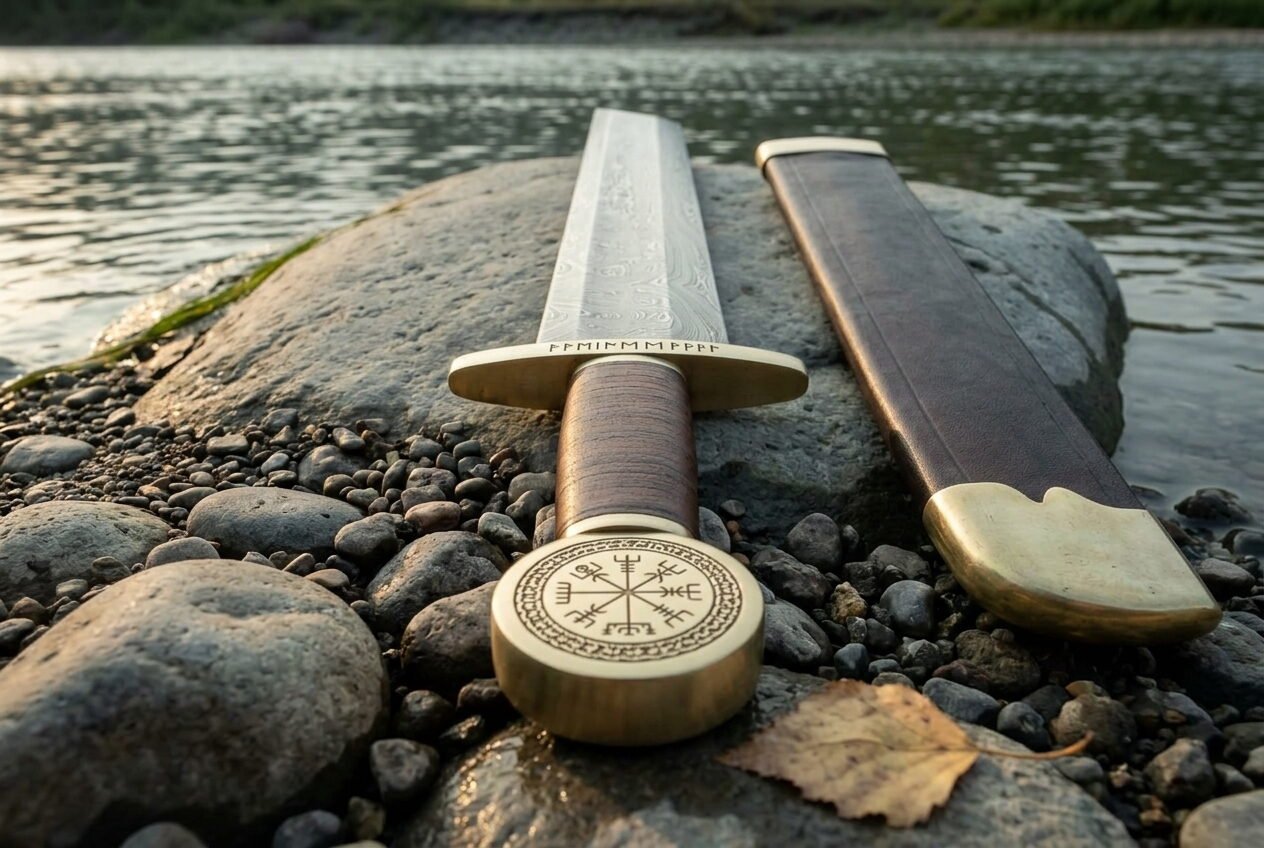
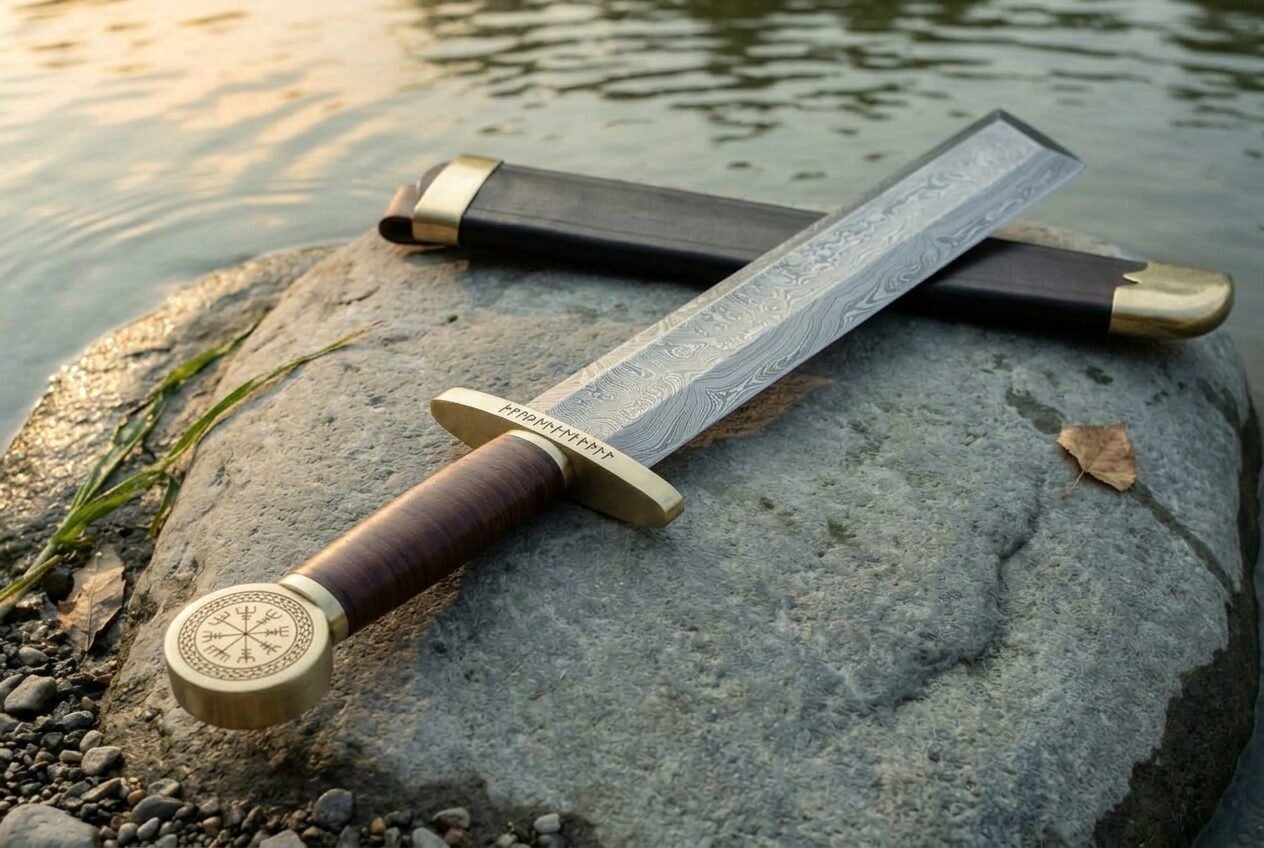
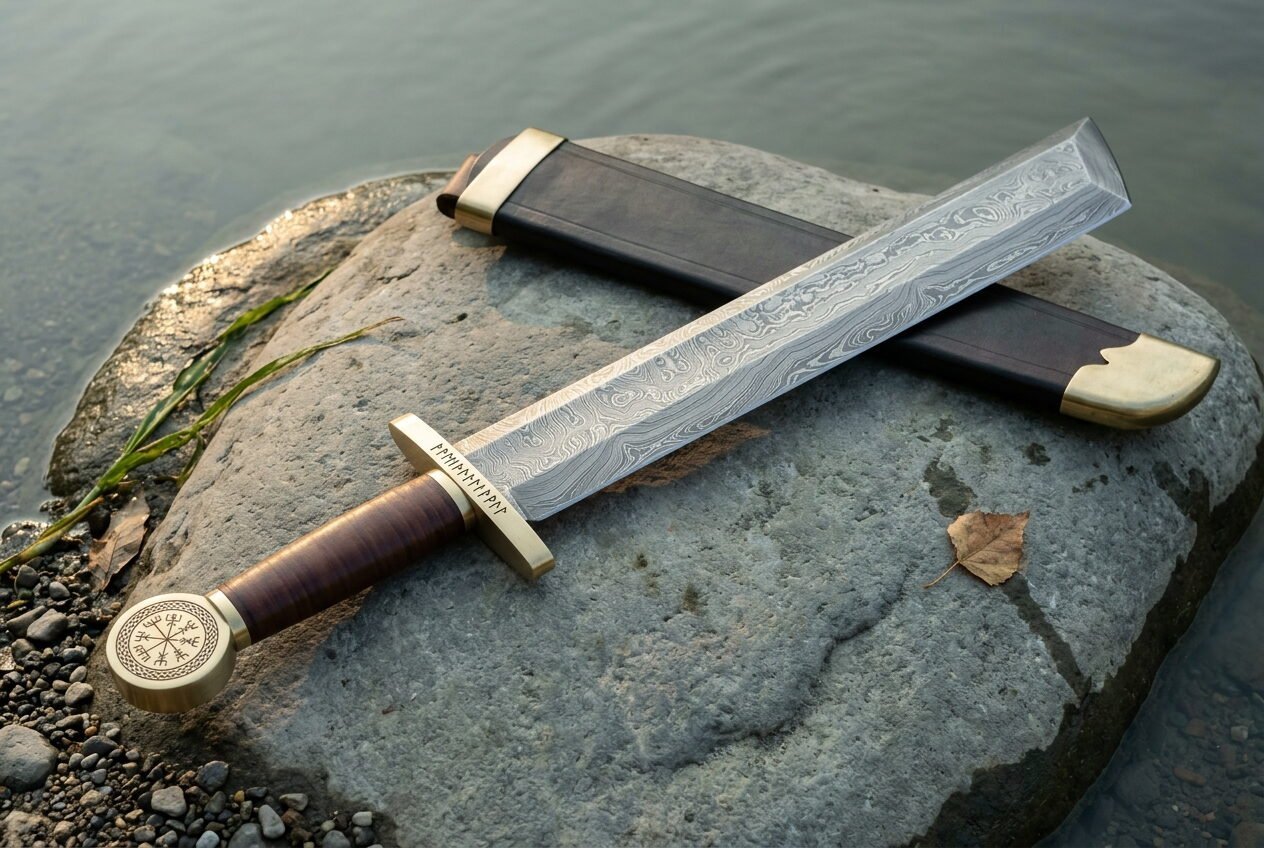
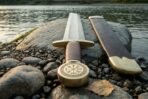
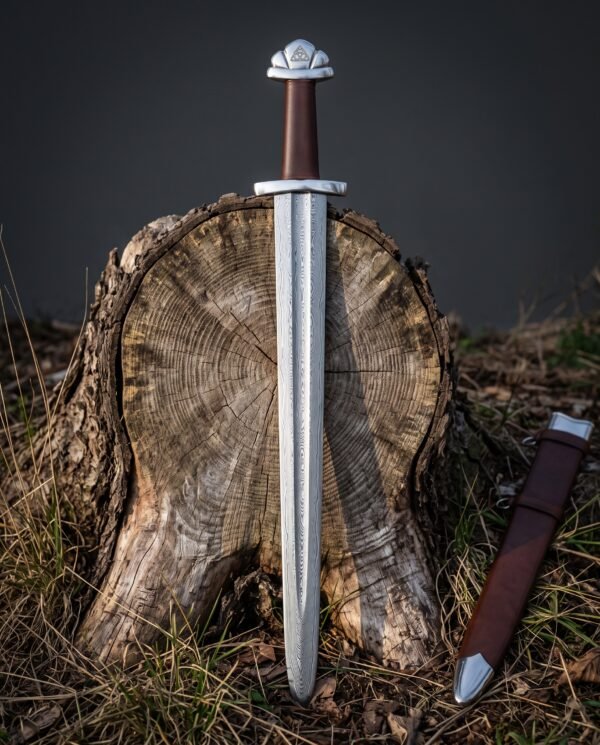
The blade is stacked, welded, drawn and etched by hand in the Czech Republic. The hilt is a stacked leather washer grip between a straight brass guard carrying a line of Elder Futhark and a heavy brass disc pommel engraved with a Vegvisir stave. It ships in a wide dark leather scabbard with a deep brass throat and a brass chape. Shipping inside the United States is free.
Specifications
| Steel | 1095 and 15N20 forge welded Damascus, hand etched flowing pattern |
|---|
| Hardness | 58 to 60 HRC |
|---|
| Overall length | 28 inches |
|---|
| Blade length | 21 inches |
|---|
| Blade width | 2.25 inches, near parallel with a clipped angular point |
|---|
| Guard | Straight brass cross guard engraved with a line of Elder Futhark |
|---|
| Grip | Stacked brown leather washers between brass ferrules |
|---|
| Pommel | Thick brass disc engraved with a Vegvisir stave inside a knotwork ring |
|---|
| Tang | Full length, peened over the pommel |
|---|
| Scabbard | Wide dark brown leather with a deep brass throat and brass chape |
|---|
| SKU | RK-1334 |
|---|
Why the clipped point and the wide blade go together
A sword this short only has so much length to work with, so everything depends on where the mass sits. Grind the blade to a long symmetrical point and you take metal off exactly the part that does the cutting, and you end up with something that handles like a large knife. Leave the width and clip the front instead and the centre of percussion moves out toward the last third, so a cut lands with real authority for a twenty one inch blade. The trade is that the point is not a needle. It is a working point, stiff and blunt shouldered, good for driving through leather or a padded jack and poor at threading a mail ring.
The other half of the design is the counterweight. That heavy brass disc pommel is not there to look Norse. Without it a forward balanced blade would drag the wrist and be slow to recover between cuts. Put a substantial pommel on the end of a short tang and you bring the balance point back to somewhere useful and you also lock the whole hilt assembly under compression when the tang is peened over. The stacked leather grip between them compresses slightly under the hand, which is why leather washer grips stay comfortable through a long session where a bare wooden grip beats the palm.
On the Vegvisir and the runes
We are straight about this. The Vegvisir stave engraved on the pommel is Icelandic, but it is not Viking age. It appears in the Huld manuscript compiled in 1860 and in a couple of related Icelandic grimoires, and the tradition around it, that the bearer will not lose his way in bad weather, belongs to early modern Icelandic folk magic rather than to the tenth century. The Elder Futhark line on the guard is the older system, in use from roughly the second to the eighth century before it gave way to the shorter Younger Futhark in Scandinavia. We use both because customers ask for both, and we would rather tell you where each one comes from than pretend the sword is an archaeological reproduction.
Why Damascus and not stainless
The blade is a forge welded laminate of 1095 and 15N20. Nickel in the 15N20 resists the ferric chloride etch and stays bright, the 1095 next to it darkens, and that contrast is the pattern. It is a carbon steel and it behaves like one, so it takes a patina and it will rust if you neglect it. What you get for that is a fine grain refined by every fold and a hardness of 58 to 60 HRC with genuinely long edge life. Stainless earns its corrosion resistance with a heavy chromium load, which at this blade width and length costs toughness where a sword needs it most, and stainless cannot be etched to a visible pattern, so stainless Damascus is a printed surface rather than a welded billet. Read Damascus versus stainless for the full argument.
The stacked leather grip
The grip is built from leather washers punched and threaded onto the tang, glued, compressed and then turned true. It is one of the oldest hilt constructions there is and it survives because it works. Leather takes the shock of a heavy cut in a way that solid wood does not, it is warm and slightly tacky in the hand even when wet, and if the sword is dropped the grip dents rather than splits. Over years of handling the stack darkens and polishes where your fingers sit, which is the honest patina of a used sword.
Keep it dry and wipe it down after handling. Once or twice a year a light dressing of neatsfoot or a leather balm keeps the washers from drying out and shrinking, which is what eventually loosens a stacked grip. Do not soak it and do not leave it in a hot car. The brass guard and pommel will dull to an antique gold on their own, and come back to bright with a light metal polish whenever you want them to.
Engraving, runes and your own design
Use the rune converter on this page to turn a name, a date or a short phrase into Elder Futhark and we will cut it into the steel or the handle. If you would rather have a Viking pattern than a rune line, choose your own design in the engraving option above the add to cart button and tell us whether it goes on the blade or the handle. Where a piece already carries an engraved design, your chosen engraving replaces it rather than sitting alongside it. On this sword that means your rune line takes the place of the standard Elder Futhark on the brass guard, or your chosen pattern replaces the Vegvisir on the pommel, whichever you pick. Details are on the engraving page.
Care and sharpening
Dry the blade after handling and wipe it with light machine oil or a hard paste wax before it goes away. An etched Damascus surface is slightly open and will take a fingerprint mark quickly in a humid room. Do not store the sword sheathed for long stretches, because tanned leather holds moisture and salts against steel. A haze lifts with a clean cloth and oil and will not damage the pattern, which runs through the blade rather than sitting on it. See steel care. To take the edge back, work a coarse then a fine stone at a shallow angle along the full length as set out in sharpening with a whetstone, then re oil.
Made in the Czech Republic
The work behind this piece happens in a Czech Republic workshop that has kept to the old methods. Steel is forged and heat treated by hand, the grind is taken down by eye rather than by machine, and the handle, fittings and sheath are cut and finished one at a time. Because of that, every piece carries small marks of the hand that made it.
Ransack Viking is a United States company. We import direct, check each piece when it reaches us, and ship from our Chicago, Illinois warehouse. Engraving is added here in the United States after arrival, so the piece you receive is finished to your order.
A note on handmade variation
This short sword is hand forged. It is not machine made and it is not bulk produced, so what arrives will not be a pixel for pixel copy of the photograph. The Damascus figure is unique to the billet and differs between the two faces of the same blade. The colour of the leather washers, the depth of the engraving, the tone of the brass and the exact angle of the clipped point all vary because each one is worked by hand from natural materials. The dimensions, the steel and the build are the same every time. The character is not.
Frequently asked questions
Is this a gladius?
No. The blade width and length are in the same ballpark, but the hilt is Norse rather than Roman, with a cross guard and a disc pommel instead of a guard block and a globular pommel, and the clipped point is a northern European solution rather than a Roman one. If you want a Roman sword, look at our Mainz and Pompeii pattern gladii.
Is it sharp?
Yes, it ships with a keen working edge. Ask in the order notes for a blunt display or reenactment edge and we will leave a rounded quarter inch instead at no extra cost.
Can I use it for test cutting?
On soft targets, yes, and it is genuinely good at it because of where the mass sits. Bottles, mats and noodles are fine. Do not cut into steel, hardwood or bone, do not spar with it and never throw it.
Can I have my own runes on the guard?
Yes. That is the natural place on this sword. Use the rune converter above the add to cart button and your line replaces the standard Elder Futhark row we cut as stock.
Will the brass tarnish?
It will, and most owners let it. Brass goes to a soft antique gold within a few months of handling. If you prefer it bright, a small amount of metal polish on a cloth brings it back in a minute without touching the engraving.
How long does shipping take?
Free inside the United States. Ten to fourteen working days in the shop, then two to five days in transit, plus about a week for custom engraving.
What is in the box
- One hand forged 1095 and 15N20 Damascus Norse short sword, 28 inches overall
- Wide dark leather scabbard with brass throat and brass chape
- Light protective oil coat on the blade for transit
- Care and sharpening card for pattern welded steel
- Forged and finished in the Czech Republic
Explore the range
See the rest of the short swords, every pattern welded blade in Damascus swords, our Viking swords and everything under swords. Background reading is in the guides.
Compare it with these
Closest to this in the range is the Silverhilt short sword, 26 inches overall. If this one is not quite right, there is the Trinecrown short sword, 31 inches overall. Also in this group is the Trinelobe short sword, 28 inches overall.
If you are putting a set together, the Valkhilt bastard sword sits alongside it. Pick the steel, the length and the fittings yourself on the custom Viking sword page.
Did not expect this level of quality for the price. Even the small engravings are crisp and clean. Shipping was fast and everything arrived well packaged.
Can’t stop showing this off to everyone who comes over. Fit and finish is museum quality. You can tell real craftsmen made this by hand. Damascus blade holds a razor edge right out of the box. Edge retention has been great even after regular use. This shop clearly takes pride in their work.
Bought this on a whim and it turned out to be one of my favorite purchases this year. Weight and balance make it feel like a real functional piece not some cheap replica. So worth it. Love that this is Czech craftsmanship and shipping from the US meant it showed up in just a few days.
This sword is a genuine work of art. Edge retention has been great even after regular use. Already telling my friends to check this out.
This is exactly what I wanted and then some. Already planning my next purchase from this shop.