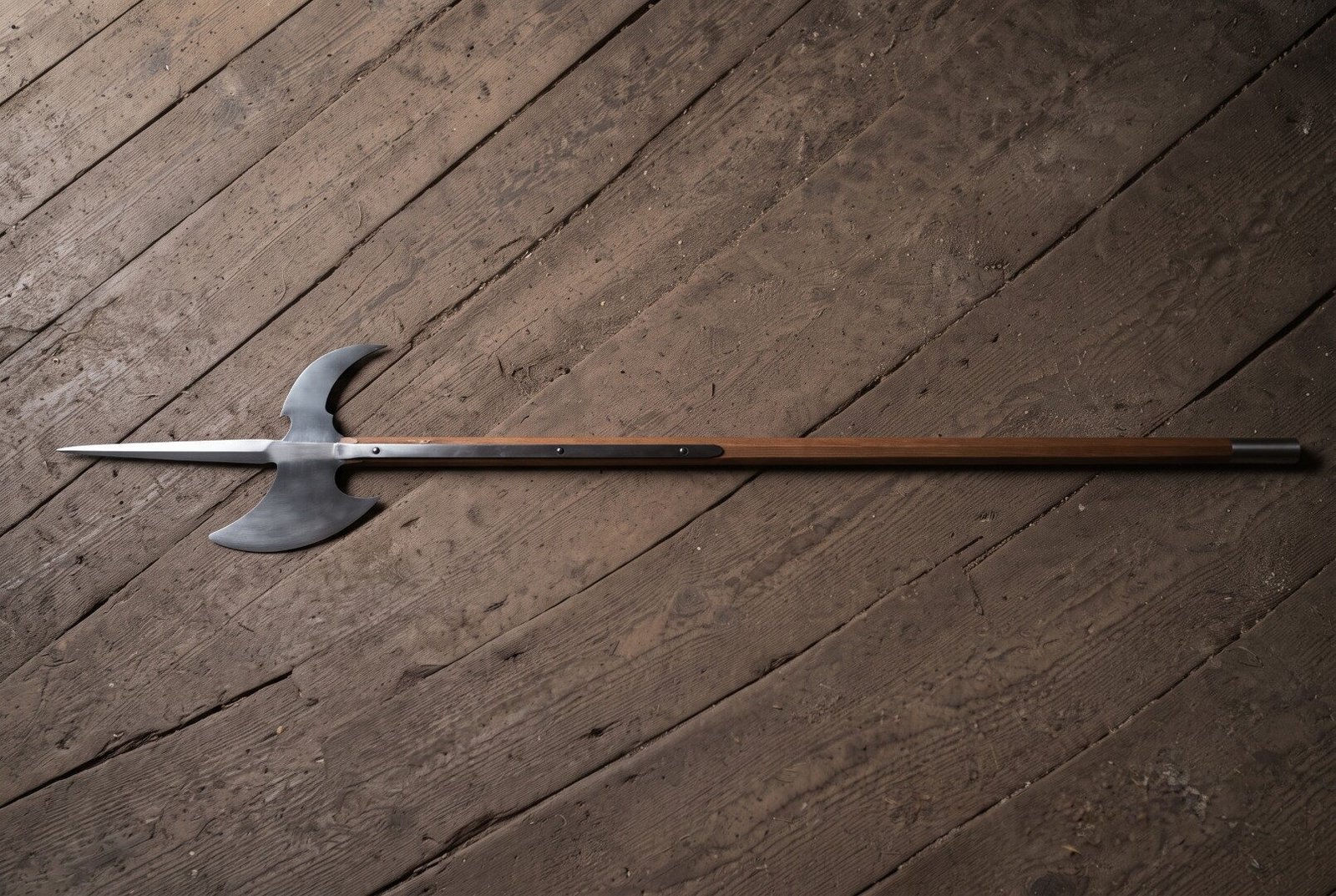
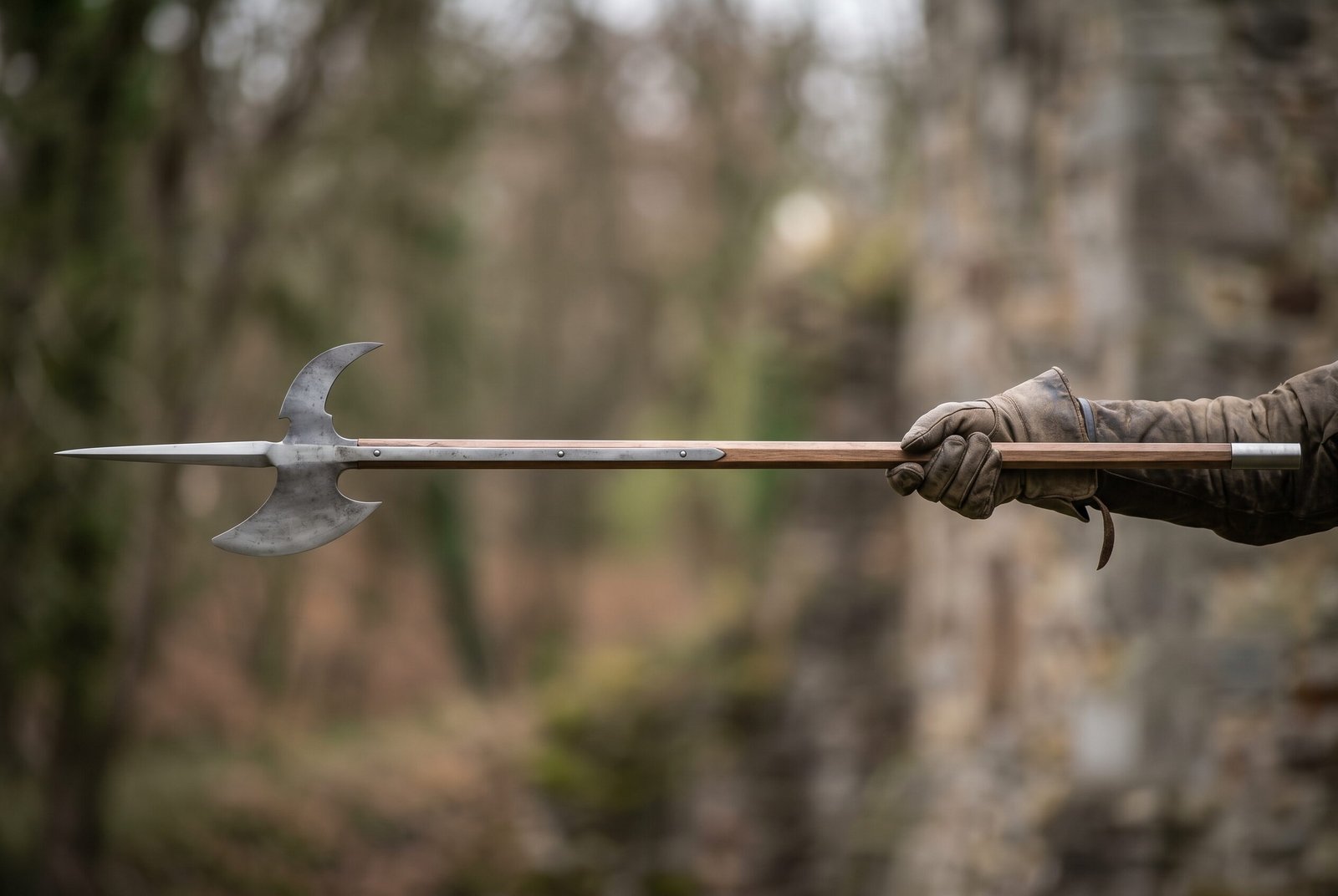
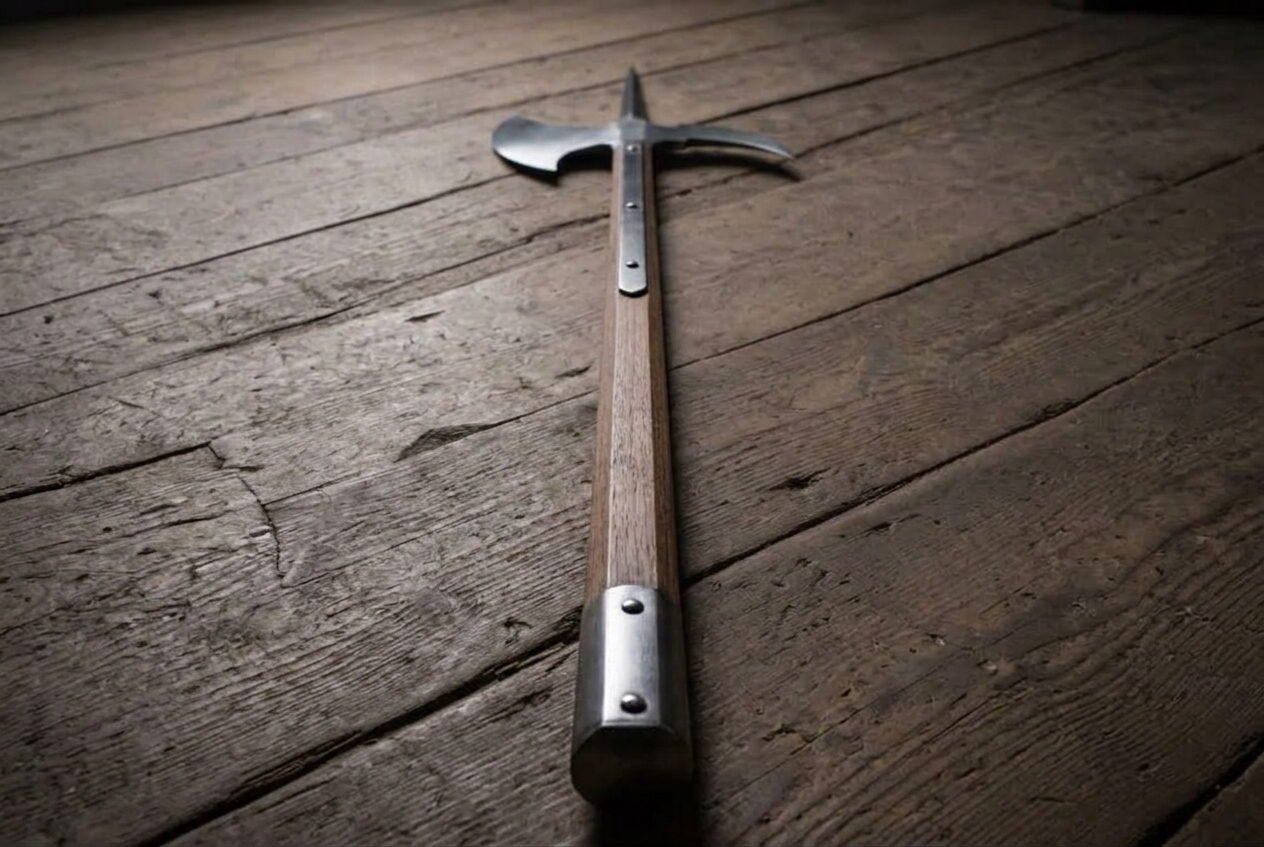
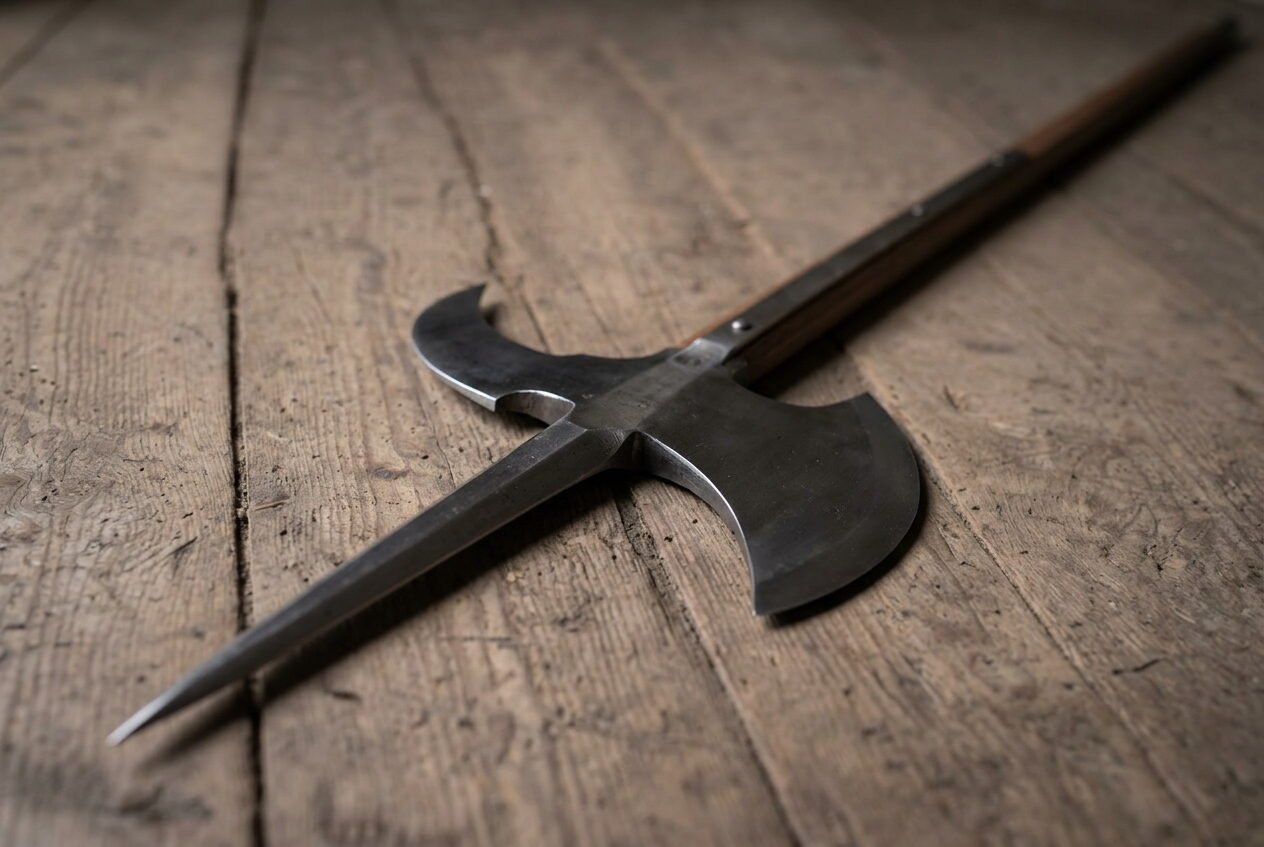
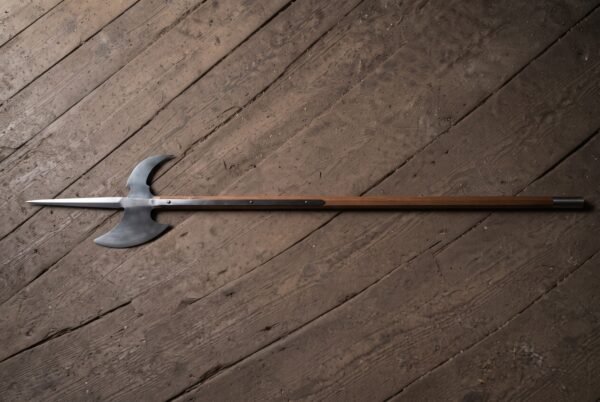
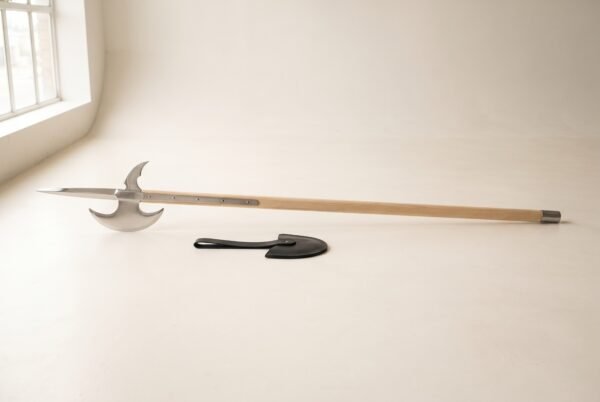
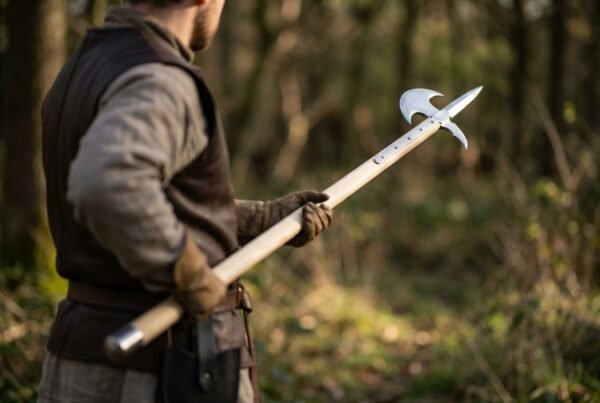
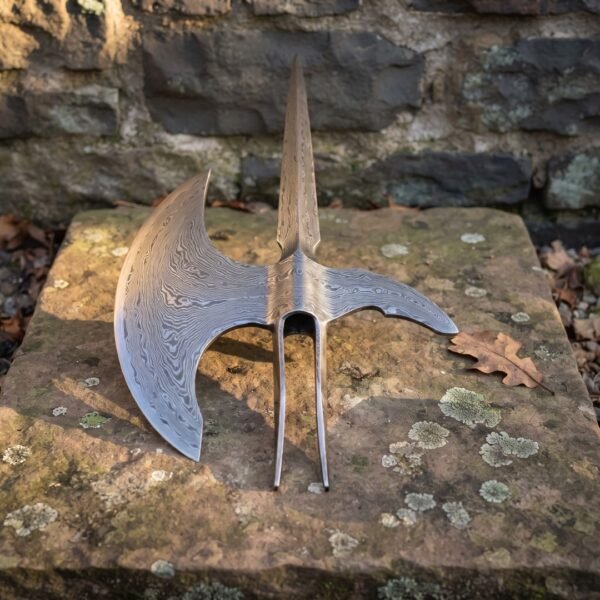
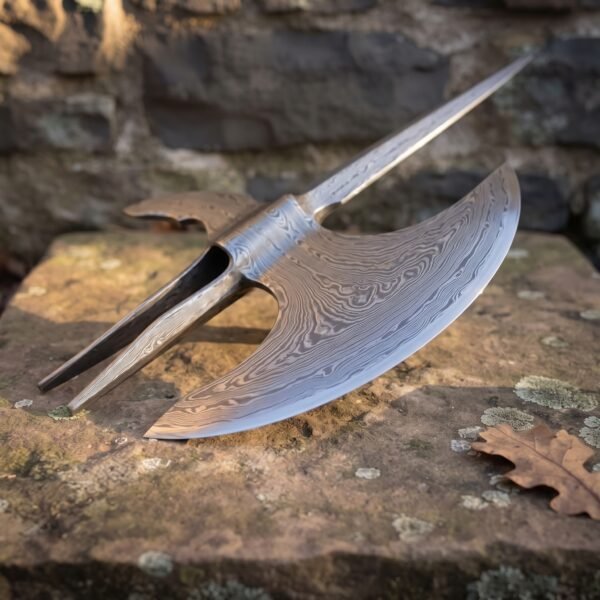
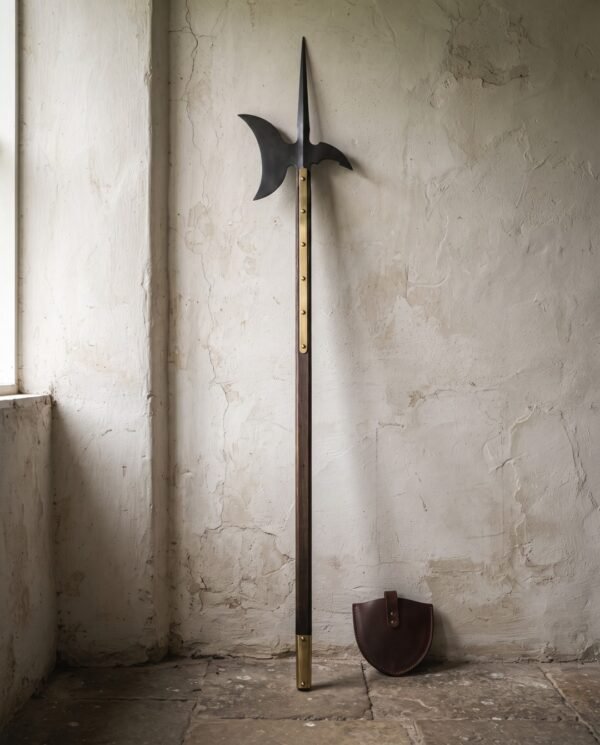
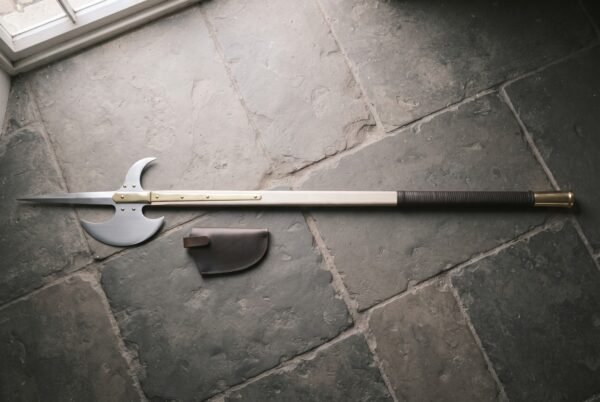
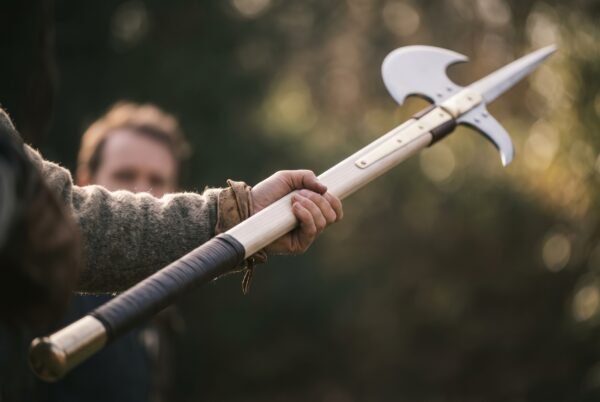
A long hafted battle halberd with a compact head, which is a combination that tells you what it was for. The head is 1095 high carbon steel with an axial spike, a crescent blade and a hooked rear fluke, kept deliberately small and light, mounted on a long hardwood stave with steel langets. Halberd heads got smaller as the sixteenth century wore on and the hafts got longer, because the enemy that mattered had changed from armoured men on foot to cavalry and then to musketry, and reach was worth more than head weight.
Forged, heat treated and finished by hand in the Czech Republic, hardened and drawn to 54 to 58 HRC and satin finished. It ships free anywhere in the United States and it can be engraved with Elder Futhark runes or a Viking pattern of your choosing before it leaves the bench.
Specifications
| Item type | Battle halberd, long hafted polearm |
|---|
| Steel | 1095 high carbon steel, plain satin finish |
|---|
| Hardness | 54 to 58 HRC |
|---|
| Overall length | 64 inches |
|---|
| Head | 15 inches overall: long tapered top spike, 6 inch crescent cutting edge and a curved rear fluke |
|---|
| Fittings | Long steel langets running down the haft, riveted through |
|---|
| Haft | Close grained hardwood, faceted, oil finished |
|---|
| Butt | Steel butt cap on the lower end of the haft |
|---|
| Weight | Approximately 5.2 lb |
|---|
| Sheath | None |
|---|
| SKU | RK-1366 |
|---|
Where the balance point sits and why it matters
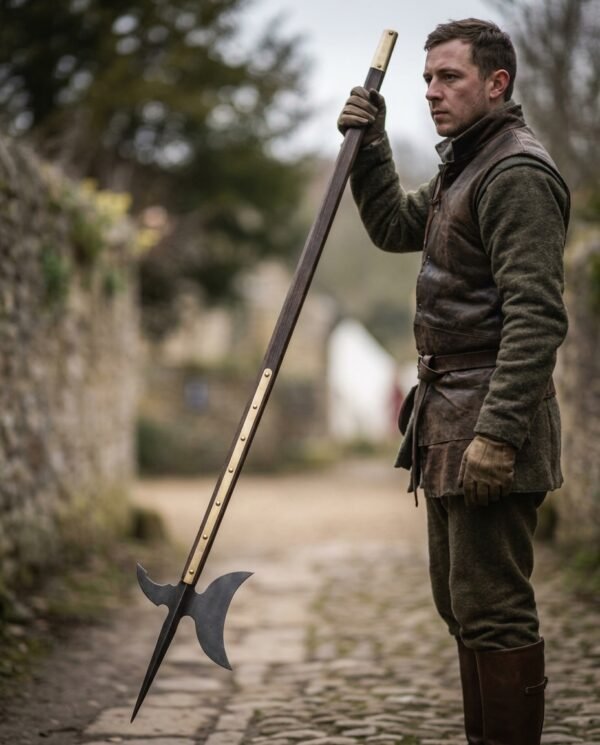
Pick this up and the first thing you notice is that it does not feel like five pounds. The balance point sits about twenty inches ahead of the rear hand, roughly a third of the way up the stave, and that is the whole trick of a long polearm. A halberd balanced close to the hands can be moved with the wrists. One balanced far out has to be moved with the shoulders, and by the time you have done that the moment has gone.
Halberd makers controlled this with the head, not the haft, because a stave has to be a certain thickness to survive at all. A smaller, thinner head with material cut away behind the horns and a hollow ground spike brings the balance back without shortening the halberd. That is the reasoning behind the compact head on this one. It also means the piece stands well on a wall bracket or in a corner without wanting to topple forward, which is how most owners actually live with a six foot polearm.
Why 1095 high carbon steel and not stainless
Every plain steel piece in this group is forged from 1095, a simple high carbon steel with roughly one percent carbon and very little else in it. That plainness is the point. A steel with nothing but iron and carbon to argue about moves predictably under the hammer, takes a clean quench, and comes back to a hardness a smith can actually hold to. These are hardened and drawn to 54 to 58 HRC, which is deliberately a touch softer than a kitchen knife. A head that has to survive impact wants to bend and rebound rather than chip, and 1095 in that range absorbs a bad hit instead of losing a piece of itself.
Stainless alloys buy their rust resistance with chromium, and above about thirteen percent that chromium ties up carbon in carbides that make the steel harder to forge and more brittle at the edge. On a small folding knife that trade is fine. On a head that lands with the weight of a haft behind it, it is not. The cost of choosing 1095 is that it will rust if you leave it wet. Wipe it, oil it, and it will outlast you. There is more on that trade in our guide to Damascus versus stainless.
The hardwood haft
The haft is close grained hardwood, turned to a slight taper so the hand finds the same place on it every time and sanded through the grits before it takes its oil finish. Dense hardwood is chosen over a softwood for a reason that has nothing to do with looks. A dense stave carries the shock of a heavy head into the wood rather than letting it stop at your palm, and it holds a ferrule or a langet tight for years instead of shrinking away from the fitting after one dry winter.
The finish is oil, not lacquer, which is a deliberate choice. Lacquer looks perfect until it chips, then water gets under it and you cannot fix it without stripping the whole handle. Oil wears gradually and is repaired by wiping more oil on. Once or twice a year, a thin coat of boiled linseed or a proprietary handle oil, twenty minutes to soak, then wipe off what has not gone in. See wooden handle care.
Engraving, runes and your own design
Use the rune converter on this page to turn a name, a date or a short phrase into Elder Futhark and we will cut it into the steel or the handle. If you would rather have a Viking pattern than a rune line, choose your own design in the engraving option above the add to cart button and tell us whether it goes on the blade or the handle. Where a piece already carries an engraved design, your chosen engraving replaces it rather than sitting alongside it.
Engraving is cut by hand after the piece is finished and before final oiling, so keep the line short and let it sit where the eye already goes. Names, dates, a line of a poem, a maker mark, a unit or a crew number all work. If you are unsure where a line should sit, send us the text and we will suggest a placement before we cut. Full details and examples are on the engraving page.
Care and sharpening
Carbon steel rusts. That is the only demanding thing about owning it. Wipe the steel down after handling, because fingerprints are salt and moisture and they will etch a bright surface in a week if you let them sit. A thin film of mineral oil, gun oil or paste wax on the metal is enough to keep it stable indoors. If the piece lives on a wall in a room that swings between damp and dry, check it every few months and re oil. Left alone in a garage or a basement it will spot, and once it spots the mark is permanent even after the rust is removed.
The edge is finished sharp from the forge and does not need attention until it stops biting. When it does, a coarse then fine whetstone, kept wet, held at the angle the bevel already carries, will bring it back in a few minutes. Do not take a powered grinder to it. Our guides cover steel care and sharpening with a whetstone in more detail.
Made in the Czech Republic
The work behind this piece happens in a Czech Republic workshop that has kept to the old methods. Steel is forged and heat treated by hand, the grind is taken down by eye rather than by machine, and the handle, fittings and sheath are cut and finished one at a time. Because of that, every piece carries small marks of the hand that made it.
Ransack Viking is a United States company. We import direct, check each piece when it reaches us, and ship from our Chicago, Illinois warehouse. Engraving is added here in the United States after arrival, so the piece you receive is finished to your order.
A note on handmade variation
This is hand forged. It is not machine made, not cast and not bulk produced, so what arrives will not be a pixel for pixel copy of the photograph on this page. The grain of the wood, the tone the steel takes from the fire and the oil, the exact run of a pattern, the precise curve of a profile, all of it shifts a little from one piece to the next because each one is worked by hand from natural materials. Two hafts cut from the same board will not read the same. Two etched blades from the same billet will not carry the same swirl.
What does not change is the specification. Dimensions, steel, hardness, fittings and build are the same every time. The character is the part that is yours alone, and it is the reason to buy something forged rather than something stamped.
Frequently asked questions
Is it sharp?
The crescent edge is ground and honed to a working sharpness and the spike is brought to a point. The inner curve of the hook is left blunt on purpose, because it works by catching and dragging rather than by cutting.
Can I hang it on a wall?
Yes, and it is what most owners do. Support it at two points, one under the head and one on the lower stave, and let the weight sit on the lower bracket. A single hook under the head will bow the haft over years.
Can I have runes engraved on it?
Yes. Use the rune converter on this page for Elder Futhark or choose your own Viking pattern in the engraving option. The flat of the crescent blade is the usual place, and the langets take a shorter line.
Will mine look like the photograph?
The head profile, the length and the steel will match. The hardwood haft is turned from a different board each time, so its colour and figure will differ, and a hand ground satin finish is never twice identical.
What is the difference between this and a glaive?
A glaive is a single long curved blade on a haft with no spike and no hook, closer to a sword on a pole. A halberd carries three tools on one head. The glaive cuts better, the halberd does more jobs.
How long does shipping take?
Two to three business days if it is in stock, two to three weeks if it is being made or engraved. It ships as one piece in a braced long carton and shipping in the United States is free.
What is in the box
- One hand forged battle halberd in 1095 high carbon steel
- Hardwood haft with riveted steel langets
- Care, oiling and sharpening notes
- Forged and finished in the Czech Republic
Explore the range
More in halberds, glaives and polearms, poleaxes and Norse arms, and read the guides.
If this one is not it
For a straight comparison, see the Nightward halberd, 66 inches overall. Worth putting side by side with this is the Cleftcrown halberd, high carbon steel. In the same category sits the Brasscrest halberd, high carbon steel.
From the same corner of the shop, there is the Moonreave polearm. Pick the steel, the length and the fittings yourself on the custom Norse arms page.

Photos don’t do this polearm justice at all. Haft feels sturdy and well balanced for the size of the head. Worth every penny.
Pretty impressed. Just a couple minor things I’d tweak. Head is well made. Just wish the wood grain was a bit more even. Still very happy with it and would recommend.
Knew this polearm was special the second I opened the box. Steel head is heavy in a good way. You can tell it’s not hollow. Haft feels sturdy and well balanced for the size of the head. Finish on the metal is even and clearly hand forged. This will be a family heirloom for sure.
This thing is a beast in the best way. Finish on the metal is even and clearly hand forged. Great for reenactment or just display. Either way it looks amazing. Couldn’t be happier with this.
This polearm beat every expectation I had. Great for reenactment or just display. Either way it looks amazing. Steel head is heavy in a good way. You can tell it’s not hollow. Love it.