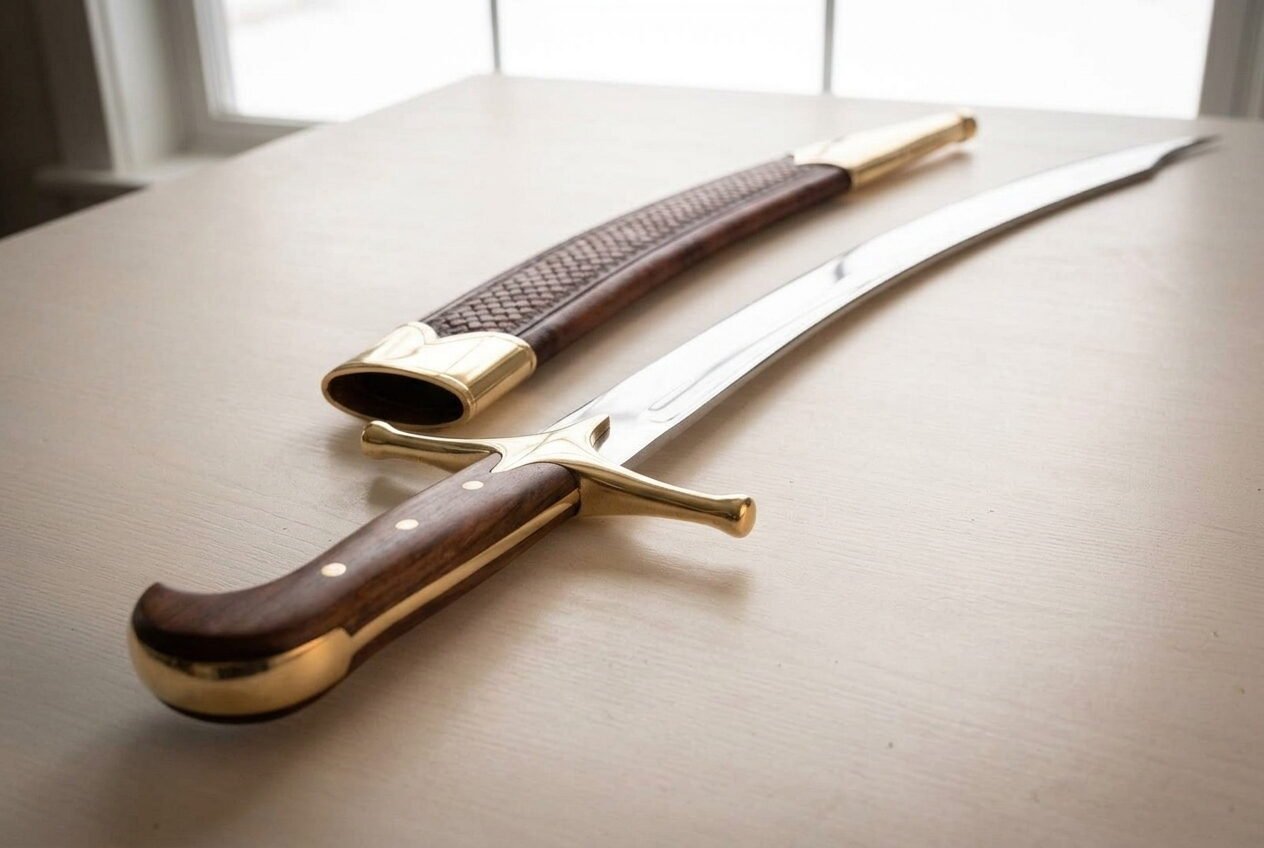
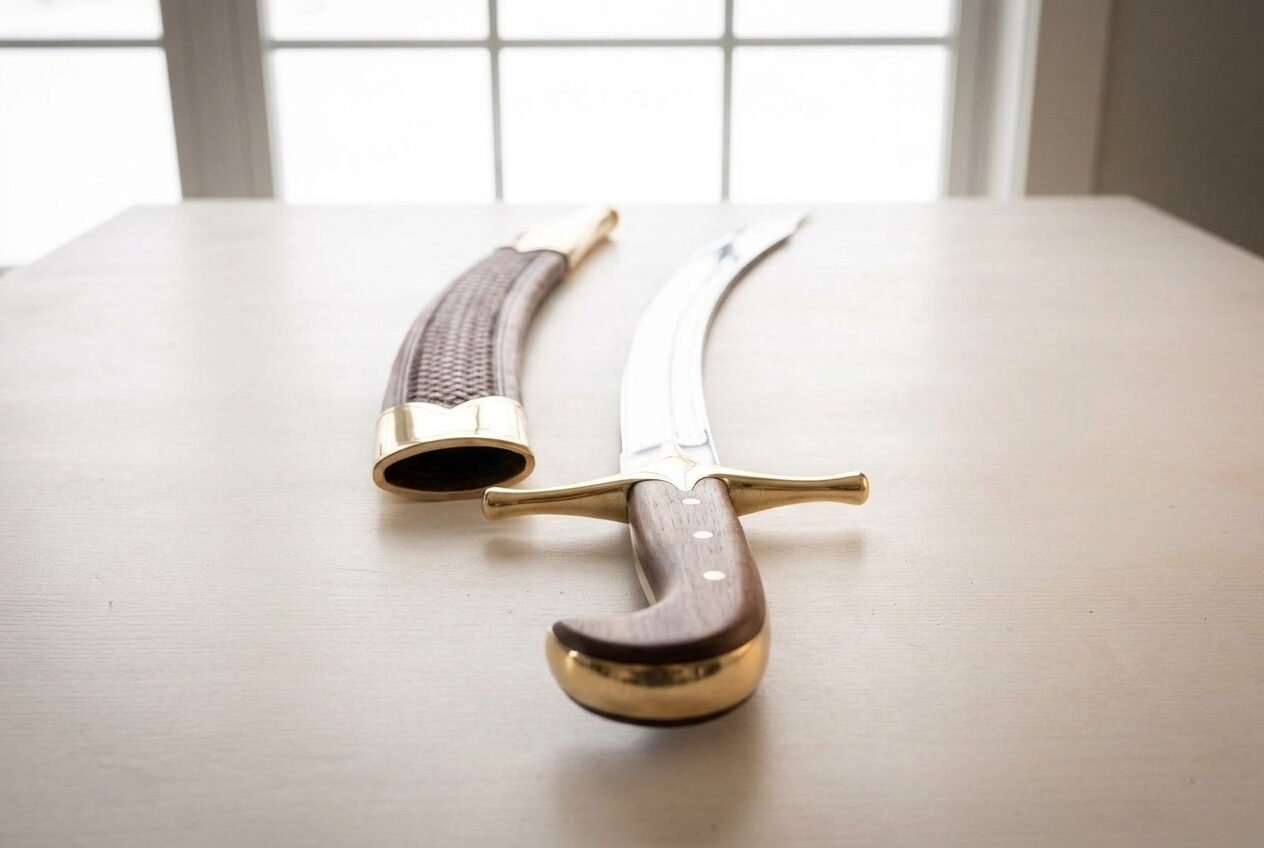
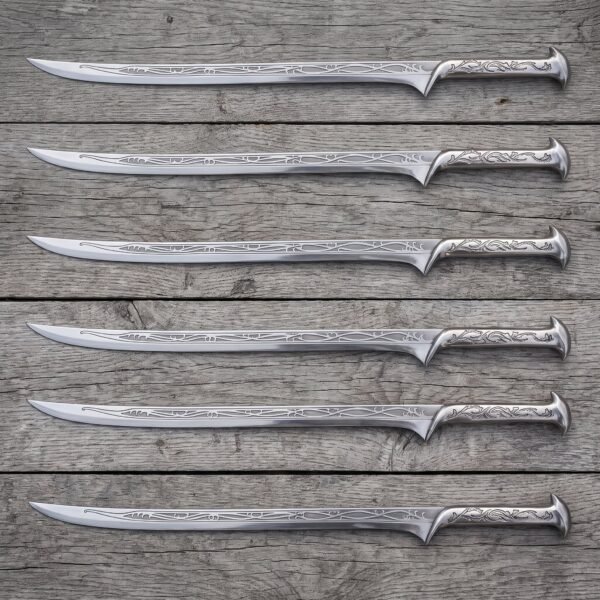
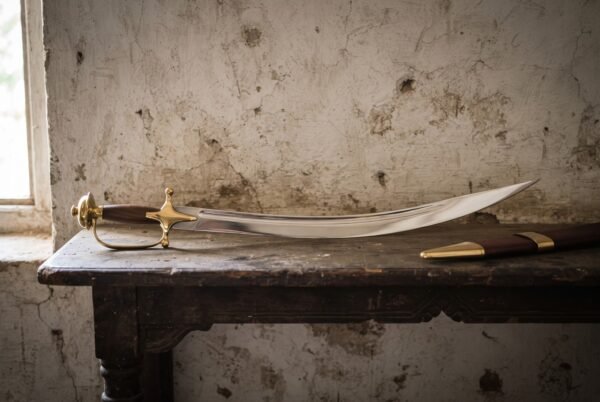
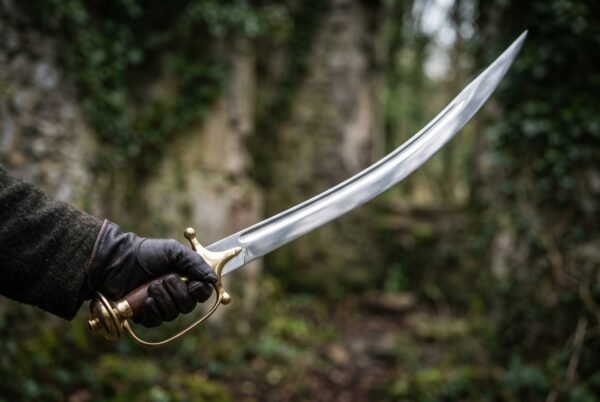
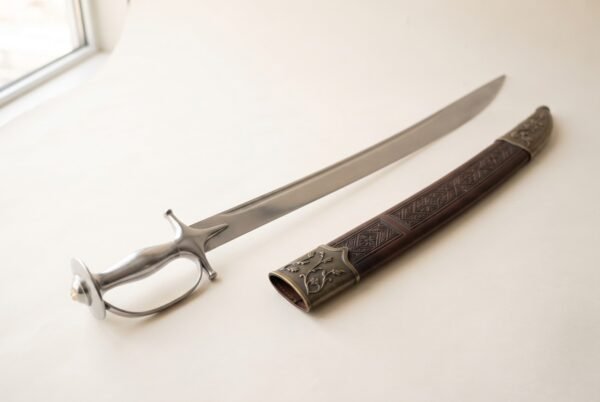
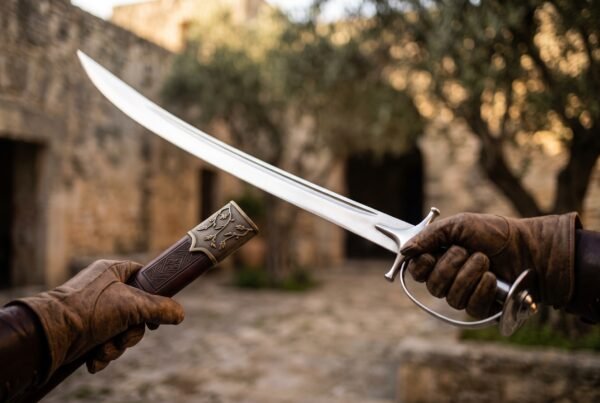
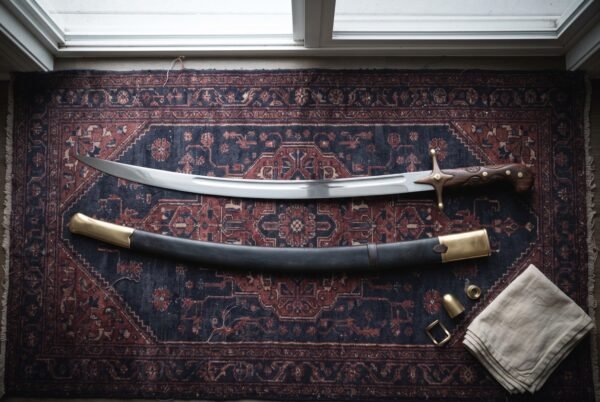
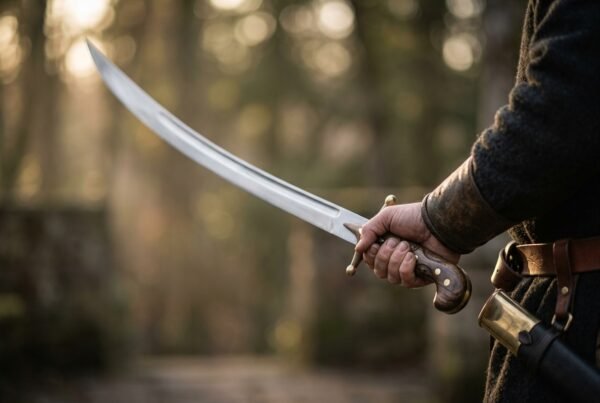
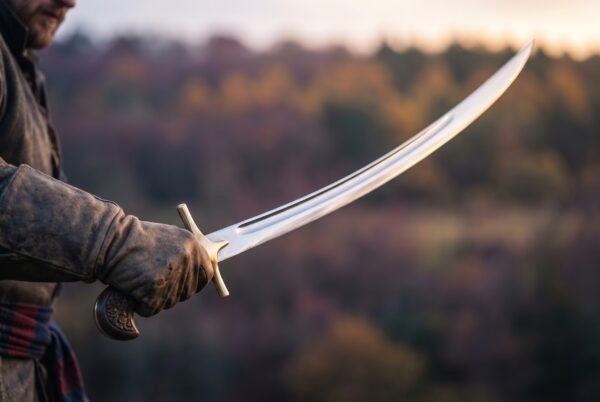
The Weavewind is a shamshir, the Persian curved sword that gave Europe its idea of what an eastern blade looks like. A true shamshir is narrow, of nearly constant width from guard to point, and curved so evenly that if you continued the line of the edge it would close into a circle. There is no flare, no widened belly, no clipped tip. The Persian name is usually glossed as lion tail, and once you have seen a good one laid flat the description makes sense. Persian smiths reached this shape by the sixteenth century and then stopped changing it, because for the job it was built to do there was nothing left to improve.
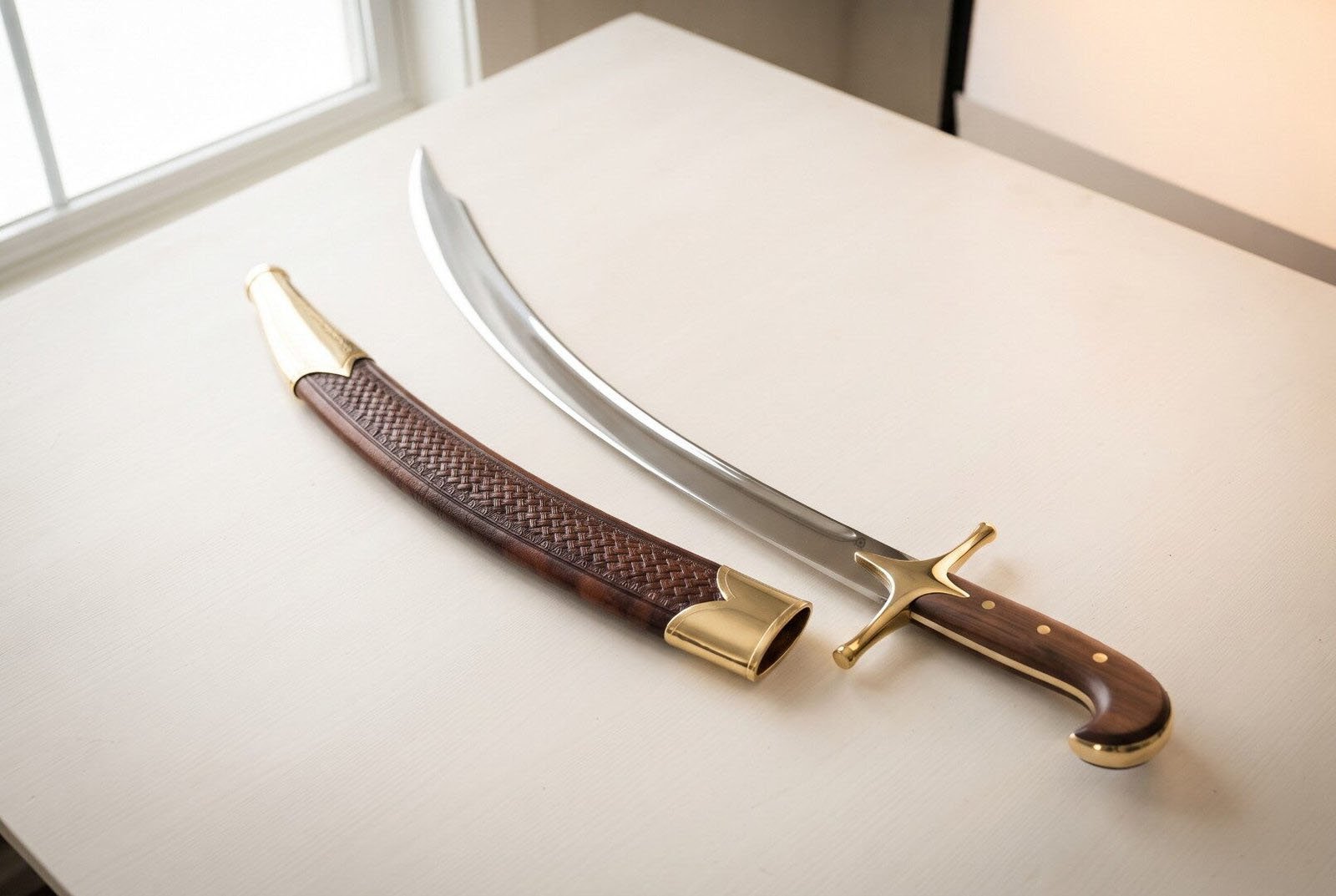
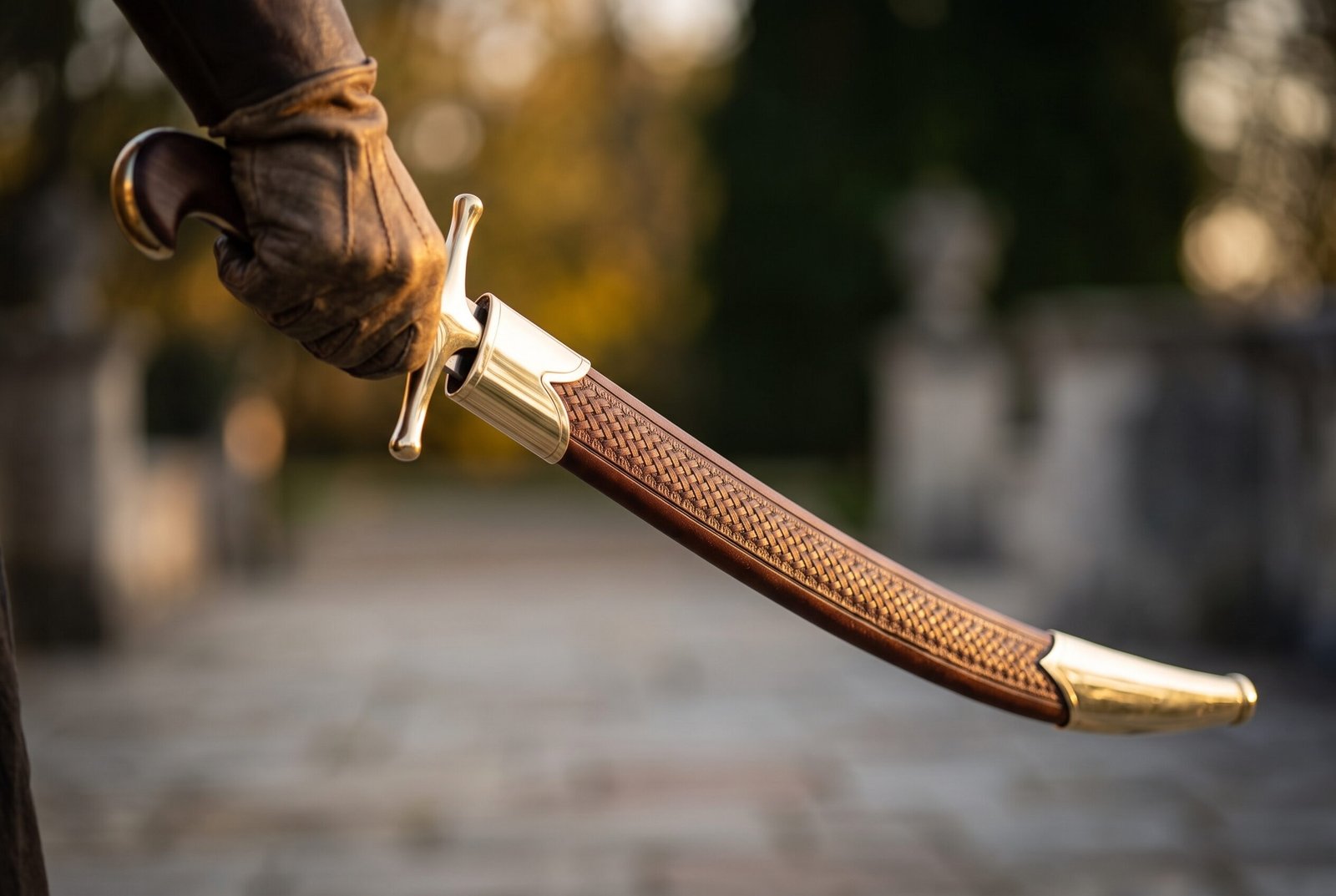
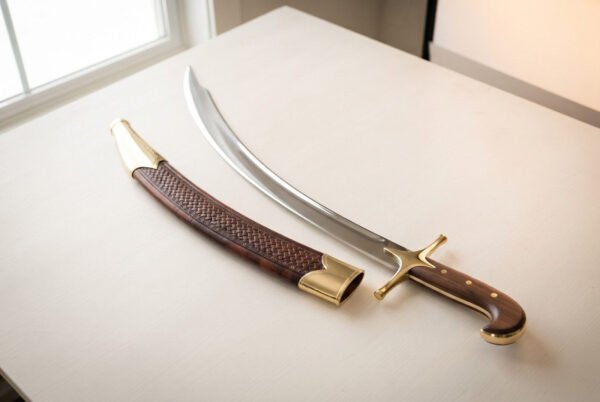
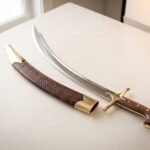
This one is forged and finished in the Czech Republic. The blade is 1095 high carbon steel, hardened, tempered and taken to a mirror polish. The hilt is rosewood scales riveted in brass between drooping brass quillons and the hooked pommel that a shamshir has to have. It ships in a leather scabbard tooled in a basketweave pattern with brass throat and chape, with a care card, and shipping inside the United States is free.
Specifications
| Steel | 1095 high carbon steel |
|---|
| Hardness | 54 to 58 HRC |
|---|
| Overall length | 37 inches |
|---|
| Blade length | 31 inches |
|---|
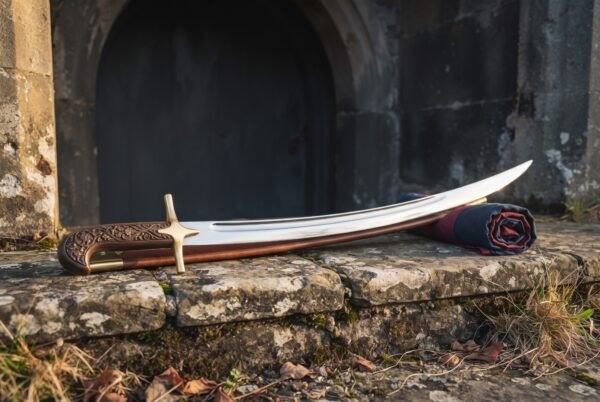
| Blade finish | Mirror polished, narrow blade with deep even curve and a narrow fuller along the spine |
|---|
| Guard | Brass cross guard with knobbed quillons and short langets |
|---|
| Handle | Rosewood scales with three brass rivets and brass edge strips |
|---|
| Pommel | Hooked rosewood pommel with a brass cap |
|---|
| Scabbard | Basketweave tooled brown leather with brass throat and chape |
|---|
| SKU | RK-1394 |
|---|
Why a shamshir has to be drawn along its curve
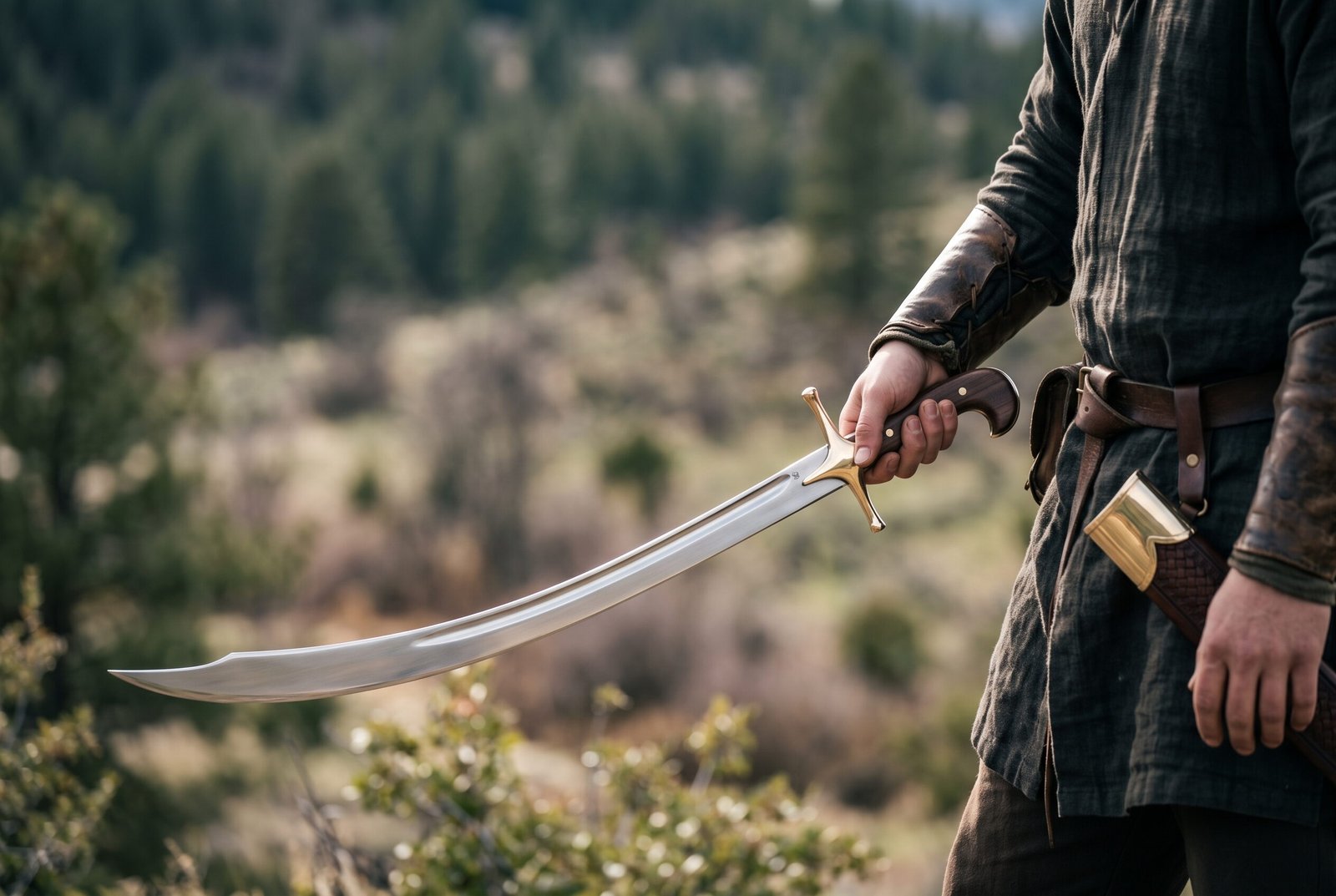
Here is the detail that tells you whether you are looking at a real shamshir or something merely curved. Because the blade is a constant section of a circle, it cannot come out of its scabbard in a straight line. Pull directly and it binds within a few inches. The sword has to be drawn along the arc it was forged to, rotating the wrist as it comes, and a properly made shamshir scabbard is curved to exactly the same radius so that the blade travels its own path out.
That constraint shaped how the sword was carried and used. Shamshirs hang edge down from two suspension rings on a belt, well forward on the hip, precisely so that the arc of the draw and the arc of the first cut are the same movement. A rider could clear the scabbard and be cutting in one continuous action. It is also why a shamshir cannot thrust in any meaningful way. The point is so far off the axis of the grip that pushing forward simply turns the blade. Persian cavalry did not consider that a fault, because the sword was never intended to thrust. It is a drawing cut given a physical form.
The narrow, unflared blade follows from the same reasoning. There is no need to widen the belly to restore power near the point, because the whole edge is passing through the target in sequence. Every inch does its share.
Why 1095 high carbon steel and not stainless
1095 is a plain carbon steel with just under one percent carbon and nothing significant added. That is exactly what a narrow blade like this needs. It hardens evenly through a thin section, its fine grain allows an edge to come to a true apex, and tempered to 54 to 58 HRC it holds that edge while keeping enough spring to flex and return.
Stainless steel resists corrosion because of chromium, and chromium ties carbon into hard carbides. That is a good trade in a kitchen knife and a bad one in a thirty one inch blade, particularly one this slim, where those carbides make the steel more likely to chip and to crack. What you accept with 1095 is that it will rust if neglected, which a cloth and a bottle of oil solve. There is a longer treatment on Damascus versus stainless.
The rosewood grip and the hooked pommel
The grip is rosewood in two scales, riveted through a full width tang in brass, slim and slightly waisted. Shamshir grips are noticeably narrower than European sword grips of the same period and they can look inadequate until you understand that they are not meant to be gripped hard.
The hook at the end of the grip is what makes that possible. It curls down and back over the heel of the hand and physically blocks the sword from rotating forward out of your fingers when a cut lands off the axis of the grip, which on a blade this curved is every single cut. A European sword solves the same problem with a heavy pommel acting as a counterweight. A shamshir cannot afford one, because any mass at the back would fight the forward reach of the blade, so it uses a mechanical stop instead. That single decision is why the sword can be so slim, so light for its length and still perfectly controllable. Rosewood is stable and oily by nature, but it will still appreciate a wipe of oil once or twice a year, especially in dry heated rooms, as set out on wooden handle care.
Engraving, runes and your own design
Use the rune converter on this page to turn a name, a date or a short phrase into Elder Futhark and we will cut it into the steel or the handle. If you would rather have a Viking pattern than a rune line, choose your own design in the engraving option above the add to cart button and tell us whether it goes on the blade or the handle. Where a piece already carries an engraved design, your chosen engraving replaces it rather than sitting alongside it. On a shamshir a line of text running out from the guard follows the curve naturally and looks like it belongs there, which is exactly what Persian smiths did with inscription cartouches. See the engraving page.
Care and sharpening
Mirror polished carbon steel needs wiping down after handling and a thin film of light oil kept on it. Fingerprints etch. On a blade this narrow the whole surface is visible at a glance, so marks show more than they would on a broad blade, which is an argument for a monthly routine with an oiled rag rather than an occasional panic. Store the sword drawn rather than sheathed, because leather holds moisture against steel. The full routine is on steel care.
Sharpening a shamshir is the clearest case of following the arc rather than fighting it. Work three or four inches at a time, keep the bevel angle constant, and sweep the blade along the stone so the contact point travels the same way it does in a cut. Because the curve is even, the whole edge should get identical treatment. Finish on a fine stone and strop it. See sharpening with a whetstone.
Made in the Czech Republic
The work behind this piece happens in a Czech Republic workshop that has kept to the old methods. Steel is forged and heat treated by hand, the grind is taken down by eye rather than by machine, and the handle, fittings and sheath are cut and finished one at a time. Because of that, every piece carries small marks of the hand that made it.
Ransack Viking is a United States company. We import direct, check each piece when it reaches us, and ship from our Chicago, Illinois warehouse. Engraving is added here in the United States after arrival, so the piece you receive is finished to your order.
A note on handmade variation
This shamshir is hand forged. It is not machine made and it is not bulk produced, so what arrives will not be a pixel for pixel copy of the photograph on this page. The rosewood figure changes between boards, the brass takes its own tone, the basketweave tooling is stamped by hand into leather that accepts it unevenly by nature, and the exact radius of the curve moves a fraction between blades because it is set under a hammer. The dimensions, the steel and the build are the same every time. The character is not.
Frequently asked questions
Is it sharp?
It ships with a genuine working edge rather than a razor edge, which is the sensible state for a thirty seven inch sword. Ask in the order notes if you want it keener before it goes out.
Why will it not pull straight out of the scabbard?
Because the blade is a section of a circle. Draw it along its curve, rotating the wrist as it comes, and it slides out easily. It is not a fault, it is how the sword works.
What is the difference between a shamshir and a talwar?
The shamshir is Persian, narrow, evenly curved and finished with a hooked pommel. The talwar is Indian, usually broader with a flare near the point, and always has a disc pommel. Both are scimitars in the loose sense of the word.
Can I have runes engraved on it?
Yes. Use the rune converter for Elder Futhark or choose your own design in the engraving option, and tell us blade or handle. Allow an extra week.
Will mine look like the photograph?
Closely, but not identically. Wood, brass and hand tooled leather all vary. The steel, the dimensions and the build do not.
How long does shipping take?
Free inside the United States. Two to three business days for a sword in stock, two to three weeks for one that is engraved.
What is in the box
- Weavewind hand forged 1095 high carbon steel shamshir
- Basketweave tooled leather scabbard with brass throat and chape
- Care card with oiling and storage instructions
- Certificate of hand forging
- Forged and finished in the Czech Republic
Explore the range
Browse the other scimitars, the full swords collection, the sabres and the scabbards and sheaths, or read the guides.
Compare it with these
For a straight comparison, see the Silkmoon scimitar, 38 inches overall. Worth putting side by side with this is the Hollowmoon scimitar, 36 inches overall. In the same category sits the Vinecrest scimitar, 39 inches overall.
From the same corner of the shop, there is the Nightbriar longsword. Pick the steel, the length and the fittings yourself on the design your own page.


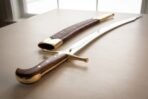
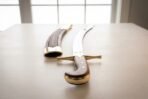
My whole family was impressed when I unboxed it. Ransack Viking’s attention to detail is honestly unmatched.
Absolutely blown away by this piece. The craftsmanship really shows in the small details. If you’re on the fence just get it. You won’t regret it. It’s handmade in the Czech Republic but ships from a US warehouse so it arrived quicker than I expected.
My husband was speechless when he opened this. Feels way more premium in person than the listing photos. Exactly as described and clearly made with care. Couldn’t be happier with this.