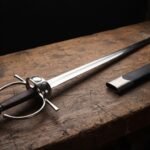
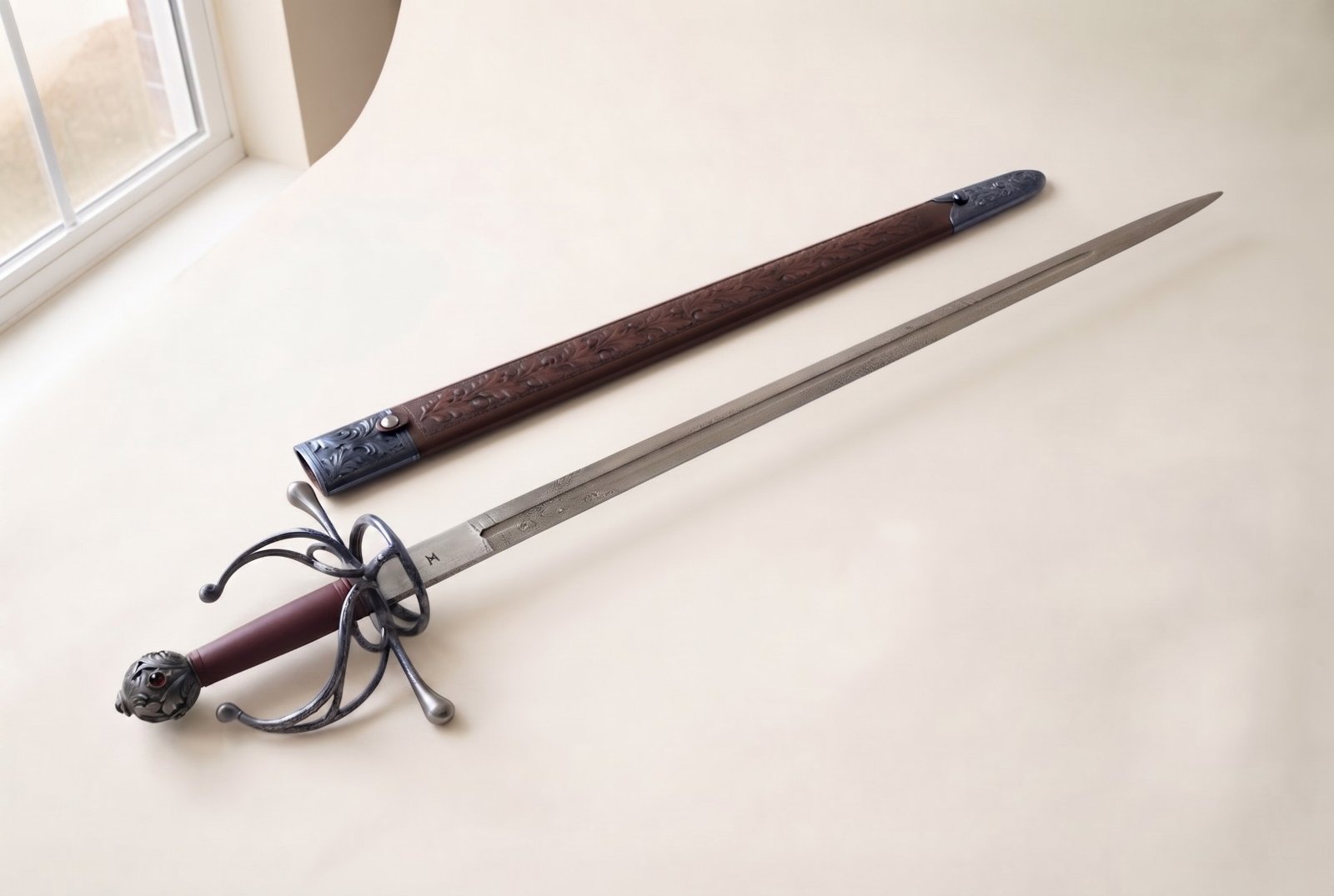
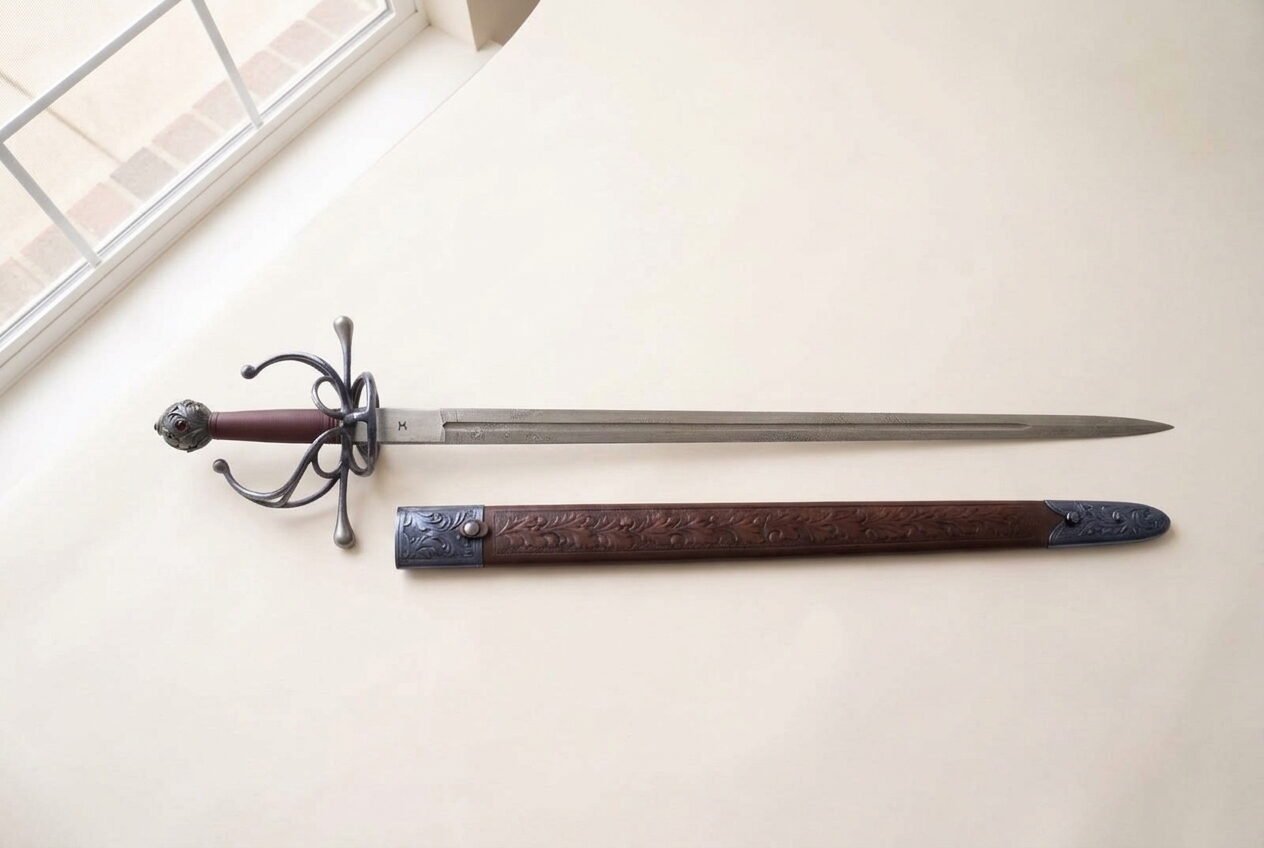
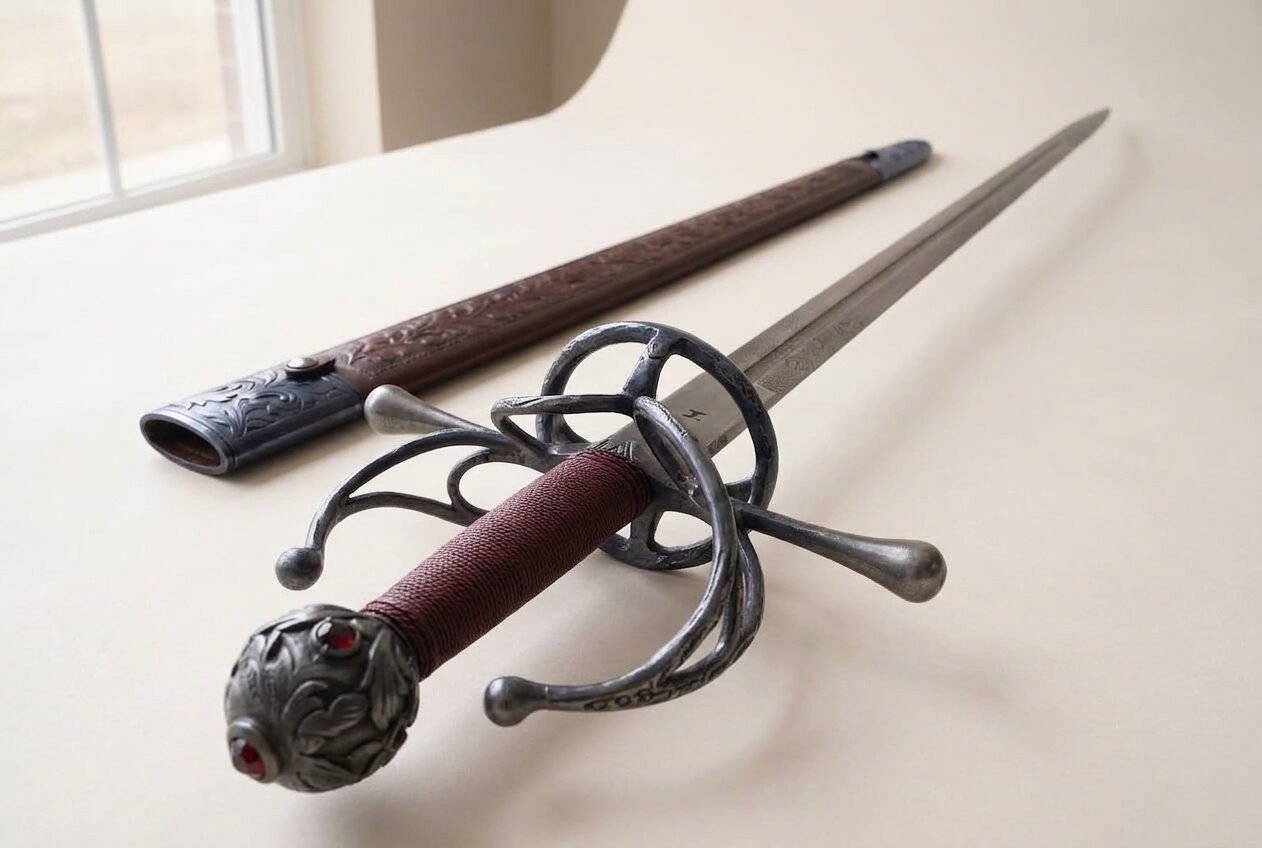
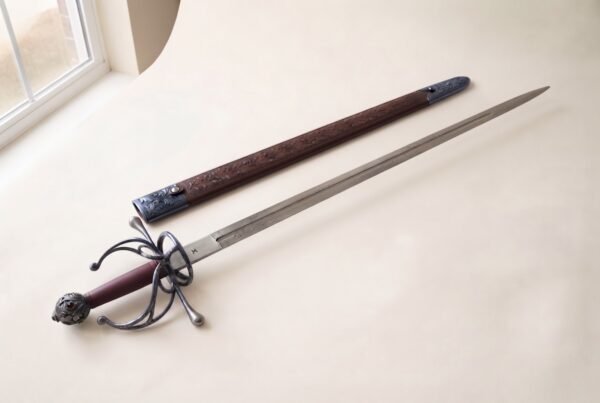
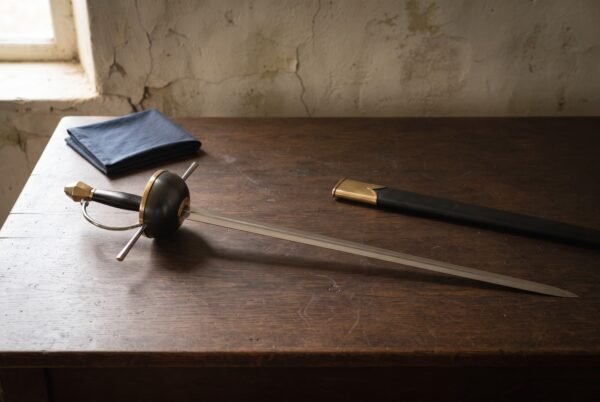
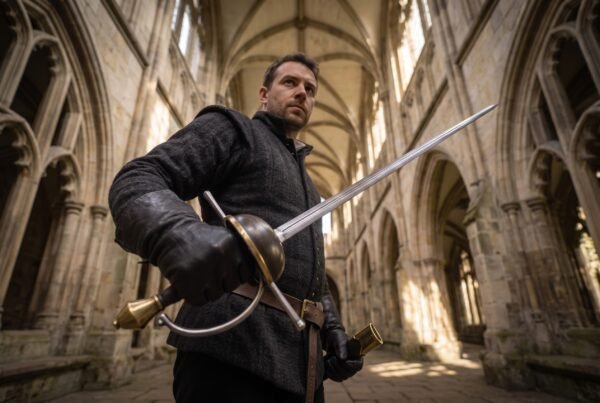
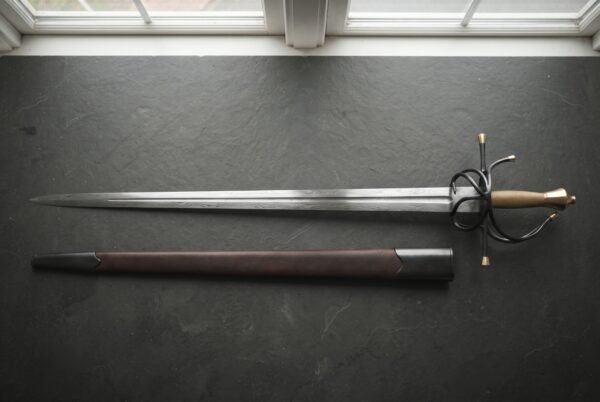
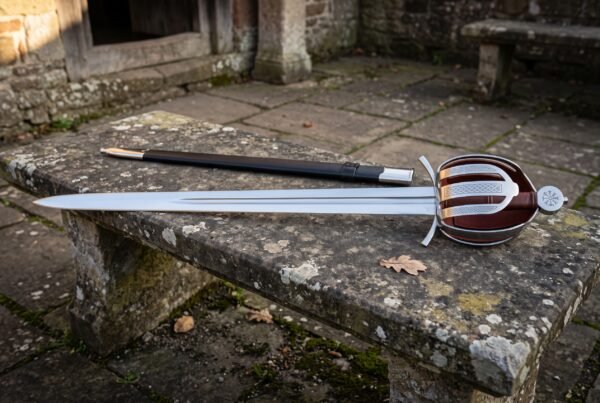
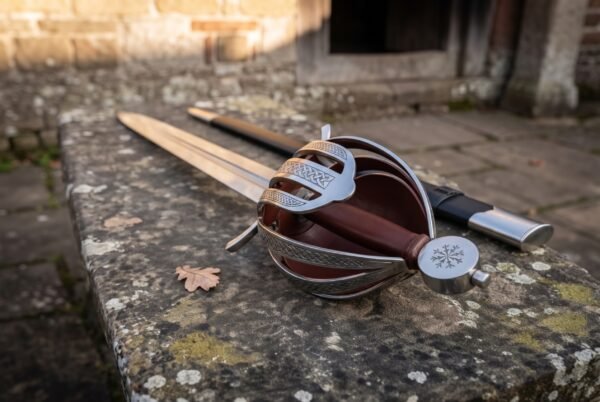
The Emberleaf is a hand forged renaissance rapier finished in the antique, which is to say the steel is not left as a mirror but taken down to the soft grey a four hundred year old blade actually has in a museum case. Very few surviving rapiers look shiny. Centuries of cleaning, oxidation and gentle wear leave a fine matte surface with the ghosts of etched decoration still readable near the ricasso, and that is what this blade imitates. The swept hilt is blackened, the ball pommel is chased with leaf relief and set with red stones, and the scabbard is tooled with an oak leaf and acorn pattern under blued and engraved steel mounts. It is the sort of sword that reads as an object with a history rather than a new thing from a shop.
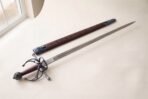
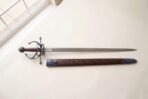
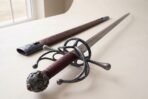
It is forged and finished in the Czech Republic. The blade is 1095 high carbon steel, hardened and tempered, ground with a narrow fuller and an etched panel below the ricasso, then given an aged satin surface rather than a polish. The grip is oxblood leather. It ships with the fitted tooled leather scabbard shown, mounted with a blued engraved throat and chape.
Specifications
| Steel | 1095 high carbon steel |
|---|
| Hardness | 54 to 58 HRC |
|---|
| Overall length | 44 inches |
|---|
| Blade length | 36.5 inches |
|---|
| Blade profile | Straight double edge with narrow fuller, etched panel below the ricasso and antique mottled satin finish |
|---|
| Guard | Blackened steel swept hilt with side rings, swept bars and pear tipped quillons |
|---|
| Pommel | Blackened ball pommel with raised leaf relief, set with red stones |
|---|
| Grip | Oxblood leather over wood core |
|---|
| Scabbard | Oak leaf and acorn tooled brown leather with blued engraved steel throat and chape |
|---|
| SKU | RK-1412 |
|---|
How a sword scabbard is actually built
Most people assume a scabbard is a leather tube. It is not, and the difference decides whether your sword is protected or slowly destroyed. A proper scabbard is built around a core of two thin wooden slats, each hollowed to the exact profile of the blade it will hold, glued together along their edges with the blade acting as the pattern. Only then is the leather stretched over the outside, wet, and worked down until it dries tight to the wood.
The wood matters because it holds the shape and, crucially, because it does not touch the edges. A well made core grips the blade along its flats and leaves the edges suspended in air, so the sharpened parts never rub against anything on the way in or out. Push a sharp blade into a soft leather sleeve and it will cut its own way through the seam within a year. The mouth of the scabbard is where the retention comes from as well. It should be tight enough that the sword stays put when the scabbard is upside down and loose enough to draw cleanly, and that fit is set by the wood, not the leather.
The metal mounts do the rest. The throat protects the mouth, which takes all the wear from the blade going in and out, and it is where the belt hardware anchors. The chape at the tip stops the point punching out of the bottom, which is the most common way an untipped scabbard fails. On this one both are blued rather than bright, and engraved, and they were fitted to this scabbard rather than pulled from a bin of generic parts. The oak leaf and acorn tooling on the body is worked into damp leather with hand stamps before it is fitted to the core.
Why 1095 high carbon steel and not stainless
An antique finish only works on a steel that ages honestly, and stainless does not. It also makes a poor rapier for structural reasons. The chromium that keeps stainless bright forms coarse carbides through the steel, and in a long slender blade those become the flaws where a flex turns into a fracture. Manufacturers get around it by leaving the blade soft, so it bends and stays bent.
1095 is simple iron and carbon. It hardens deeply, tempers to a predictable figure, and at 54 to 58 HRC gives a rapier the two things it needs at once: enough hardness to keep a point and enough elasticity to spring back straight. The trade is rust. On an antiqued blade that is less alarming than on a mirror polish, since the finish already reads as aged, but oil is still the answer. See Damascus versus stainless for the detail.
The grip, the wood core and the pommel
Under the oxblood leather is a shaped wooden core. The wrap is deliberately narrow in the waist so the hand indexes without looking, and the leather is left with a little texture rather than burnished smooth. As with any wooden handled piece, keep it out of damp storage and away from radiators and direct sun, since both shrink a core and slacken the covering over it. There is a full routine in wooden handle care.
The pommel is a round ball chased with raised leaf work and set with red stones in small bezels. A large pommel like this counterweights the long blade, which is how period smiths made an ornate hilt that still balanced in the hand.
Engraving, runes and your own design
Use the rune converter on this page to turn a name, a date or a short phrase into Elder Futhark and we will cut it into the steel or the handle. If you would rather have a Viking pattern than a rune line, choose your own design in the engraving option above the add to cart button and tell us whether it goes on the blade or the handle. Where a piece already carries an engraved design, your chosen engraving replaces it rather than sitting alongside it. The Emberleaf already carries an etched panel below the ricasso and engraving on the scabbard mounts, so tell us which surface you want yours to take over. See the engraving page.
Care and sharpening
An antique finish is more forgiving than a mirror, because it does not show fingerprints the same way, but it is not rustproof and the texture holds moisture slightly more readily. Wipe the blade after handling and keep a thin film of mineral or camellia oil on it. Do not scrub the surface with an abrasive to brighten it, because the aged finish is the finish. The tooled leather scabbard should be kept dry and given a light conditioner once or twice a year, worked in with a fingertip so it does not fill the tooling. Details on the steel care page.
The edge arrives sharp enough to handle with care. To refresh it, use a whetstone and follow the existing bevel with light passes. Sharpening will leave a bright line along the edge that contrasts with the aged flats, which is exactly how a genuine antique looks after a sharpening, so it is not something to worry about. See sharpening with a whetstone.
Made in the Czech Republic
The work behind this piece happens in a Czech Republic workshop that has kept to the old methods. Steel is forged and heat treated by hand, the grind is taken down by eye rather than by machine, and the handle, fittings and sheath are cut and finished one at a time. Because of that, every piece carries small marks of the hand that made it.
Ransack Viking is a United States company. We import direct, check each piece when it reaches us, and ship from our Chicago, Illinois warehouse. Engraving is added here in the United States after arrival, so the piece you receive is finished to your order.
A note on handmade variation
This piece is hand forged, not machine made or bulk produced, so what arrives will not be a pixel for pixel copy of the photograph. Antiqued finishes are the least repeatable of all, because the depth and mottling of the surface depend on how the steel takes the treatment on the day. The oak leaf tooling is stamped by hand and its rhythm shifts, the leather takes dye differently hide to hide, and the stones in the pommel vary in tone. The dimensions, the steel and the build are the same every time. The character is not.
Frequently asked questions
Is the blade rusty or damaged
No. The grey mottled surface is a deliberate antique finish applied to a sound hardened blade. It is meant to look like a sword that has been cared for over centuries rather than one made last month.
Can I polish it bright if I prefer
You can, but you will remove the finish permanently and the etched panel with it. We would advise against it. If you want a mirror polished rapier, choose one that is built that way from the start.
Is it sharp
It arrives with a working edge and a real point. It is a functional sword rather than a wall hanger, and should be handled accordingly.
Can I have runes engraved on it
Yes. Use the rune converter for Elder Futhark or choose your own design in the engraving option. Because this piece already carries etched decoration, tell us which surface your engraving should replace.
What is the difference between a renaissance rapier and a smallsword
Roughly a century and a great deal of weight. A renaissance rapier is long, has a wide complex hilt and a blade with real edges. A smallsword is the eighteenth century descendant, much shorter and lighter, with a small shell guard and a triangular hollow ground blade that has no cutting edge at all.
How long does shipping take
Free shipping in the United States. In stock pieces ship within a few days. It takes three to five weeks in the shop because of the ageing and the scabbard tooling, plus a few days for engraving.
What is in the box
- Emberleaf hand forged 1095 high carbon steel renaissance rapier with antique finish
- Fitted oak leaf tooled leather scabbard with blued engraved steel throat and chape
- Care card covering oiling, antique finish upkeep and leather care
- Elder Futhark rune engraving or your own Viking design if selected at checkout
- Forged and finished in the Czech Republic
Explore the range
Browse the rapiers, the scabbards and sheaths, the short swords and the full sword range, or read the guides.
If this one is not it
Closest to this in the range is the Gildthorn rapier, 5 inches overall. If this one is not quite right, there is the Shellgrain rapier, 45 inches overall. Also in this group is the Swiftcoil rapier, 45 inches overall.
If you are putting a set together, the Gildcage Damascus sword sits alongside it. Pick the steel, the length and the fittings yourself on the design your own page.
If you want to spar rather than display, the Lindmoor smallsword is the blunt trainer built for it, and our smallswords and spadroons is worth a look.

Got this as a birthday gift and the reaction was priceless. If you’re on the fence just get it. You won’t regret it. Ransack Viking is quickly becoming my go to shop for anything Norse themed.
Nice piece for the price. Wood handle looks great though it’s a little smaller than I imagined. Sheath is nice. Wish it had more padding but it does the job. Still very happy with it and would recommend.
This is exactly what I wanted and then some. The wood handle feels amazing and the balance is perfect. Even the small engravings are crisp and clean. So worth it.