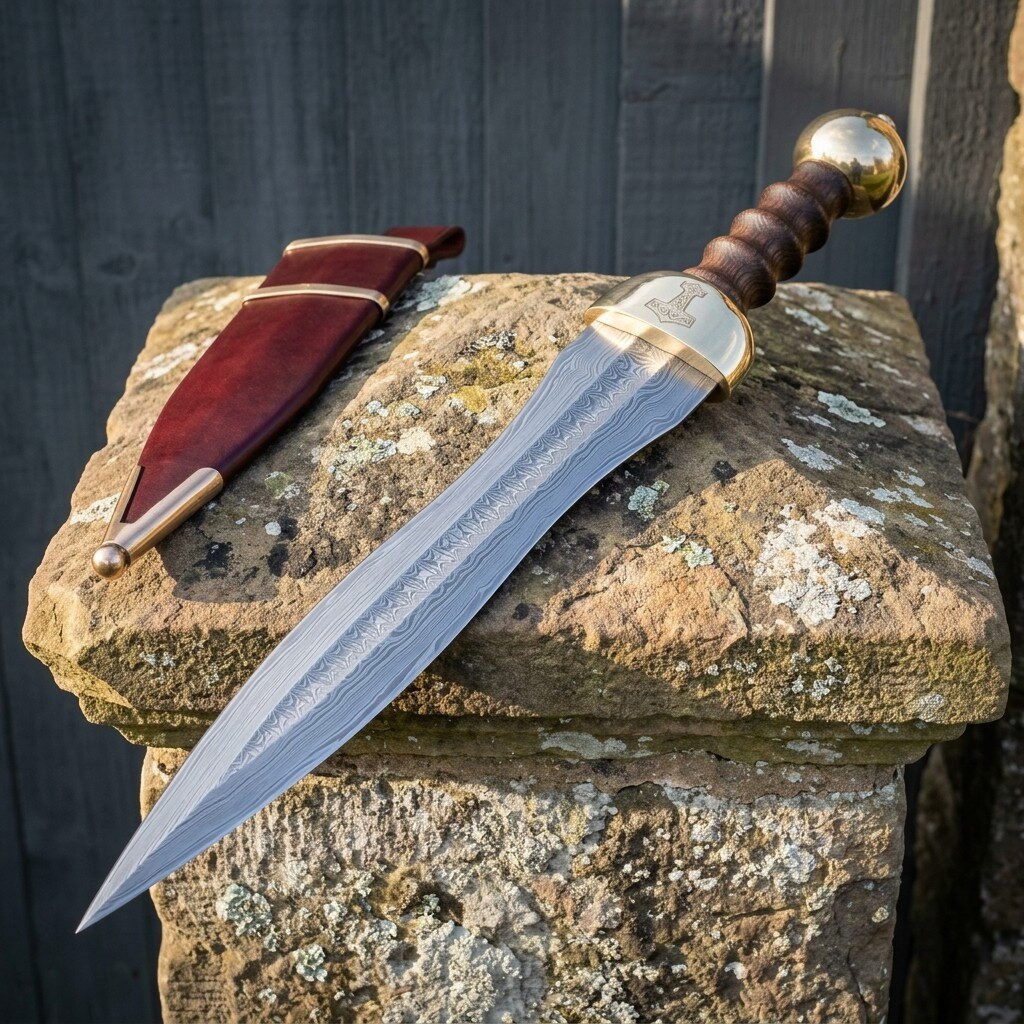
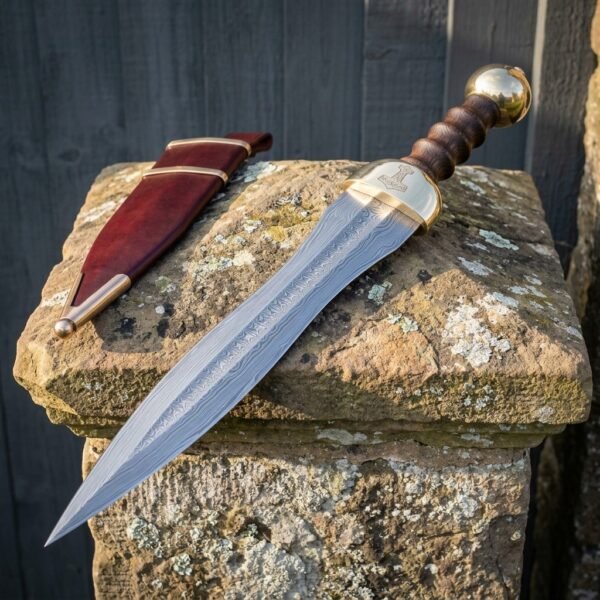
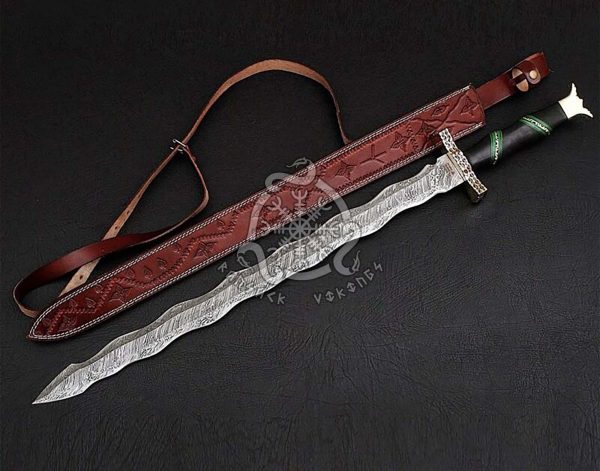
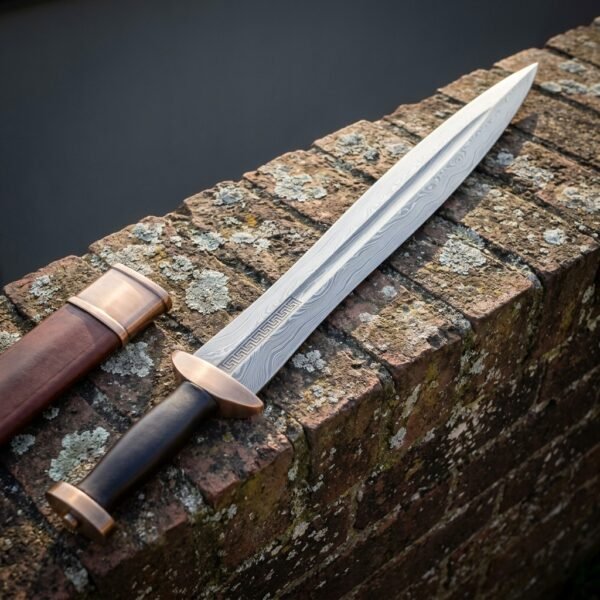
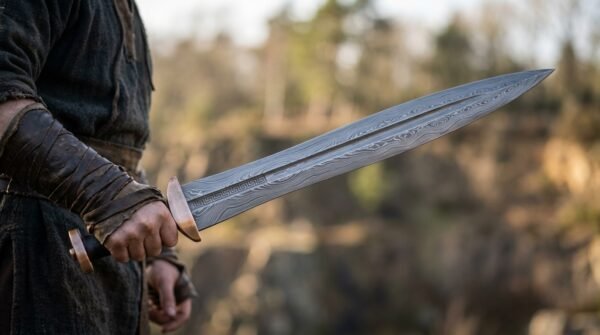
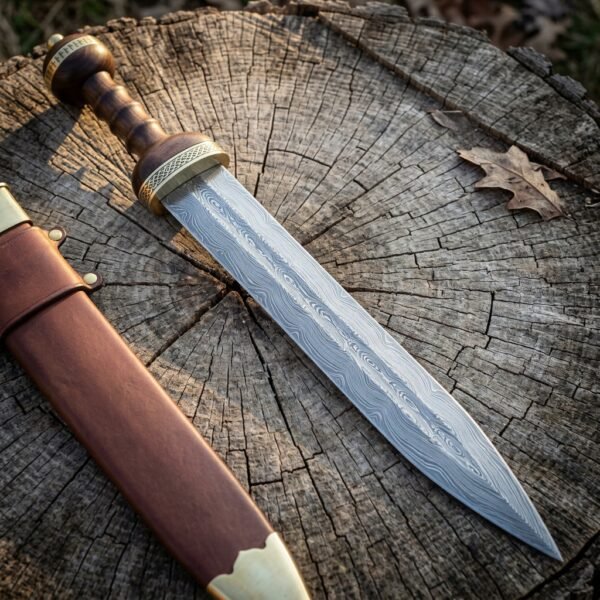
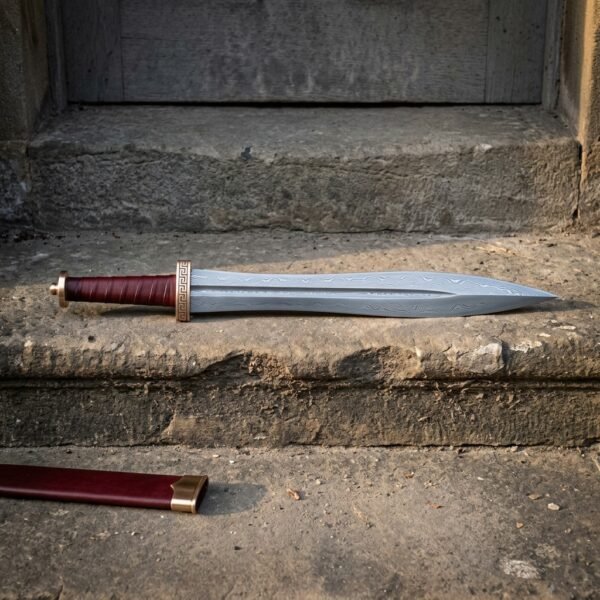
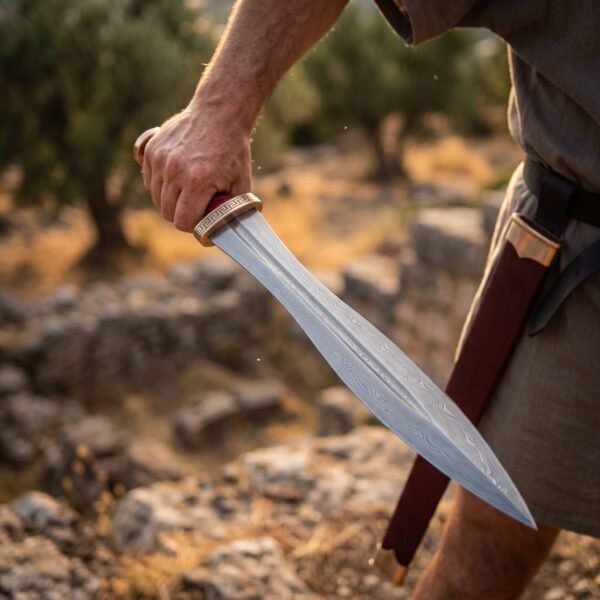
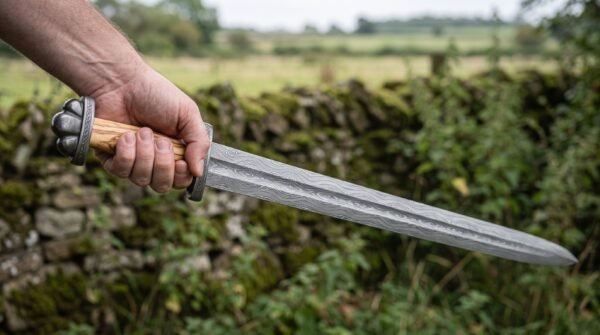
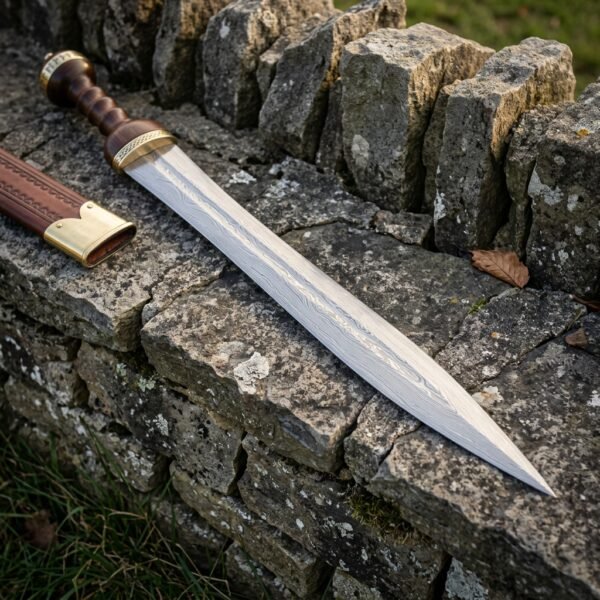
The Legionward is a gladius, the short thrusting sword the Roman legions carried from the late Republic into the early Empire. This one follows the Mainz pattern, with a blade that pinches in at the waist, swells again toward the front and then runs out into a long triangular point. The waist is not decoration. It pulls mass back toward the hand so the sword recovers fast in the close, shield to shield press where a legionary actually used it.
Roman writers were blunt about how this sword was meant to work. Vegetius wrote that a thrust of a couple of inches was usually enough, and that recruits were drilled to push the point rather than swing the edge, because a cut turned by a shield rim wasted a beat while a thrust did not. That is why the gladius is short, stiff and heavy in the forward third rather than long and whippy. This one is forged and finished in the Czech Republic from 1095 and 15N20 folded into Damascus, fitted with solid brass at the guard and pommel over a turned hardwood grip, and it ships in an oxblood leather scabbard with brass mounts. You will find it filed with the gladius blades, along with the rest of the Damascus swords.
Specifications
| Material | 1095 and 15N20 Damascus blade, solid brass fittings, turned hardwood grip |
|---|
| Overall length | Approximately 27 in / 69 cm |
|---|
| Blade length | Approximately 20 in / 51 cm |
|---|
| Blade profile | Mainz pattern waisted leaf with a long triangular point |
|---|
| Hardness | 58 to 60 HRC |
|---|
| Guard | Brass plate guard carrying an engraved hammer motif |
|---|
| Grip | Turned hardwood with cut ribs for the fingers, brass ferrule |
|---|
| Pommel | Large spherical brass counterweight |
|---|
| Scabbard | Oxblood vegetable tanned leather, brass throat bands and brass tipped chape |
|---|
| Finish | Hand etched Damascus, hand polished brass |
|---|
| Included | Sword and fitted leather scabbard |
|---|
| SKU | RK-1671 |
|---|
Why a gladius is shaped the way it is
Look along the edge and you can see the profile taper working. The blade leaves the guard wide, narrows through the middle, then widens slightly before the point. Roman smiths used that shape for two reasons at once. The narrow waist takes weight out of the middle of the blade, which is the part that does the least work on a thrust, and the swell in front of it keeps enough steel behind the point to drive it through padded linen and mail links without the tip folding.
The result is a sword with its balance point close to the guard. Pick it up and it feels alive in the wrist rather than heavy at the end, which is exactly what you want in a formation where the shield is doing the defending and the sword only has room to move a short distance. The long triangular point is the business end. It is ground thick along the spine so it stays rigid under load, and the diamond section behind it stops the tip from wandering off line when it meets something hard.
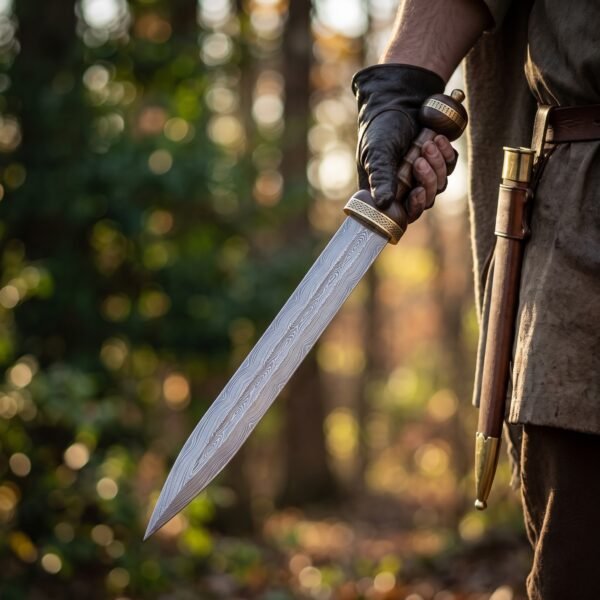
The big brass ball pommel is doing real work too. It sits behind the hand and pulls the balance back, and it also stops the grip sliding out of a sweating palm on a hard thrust. The ribs turned into the hardwood grip do the same job from the other direction, giving the fingers something to sit between rather than a smooth cylinder.
The steel and the brass
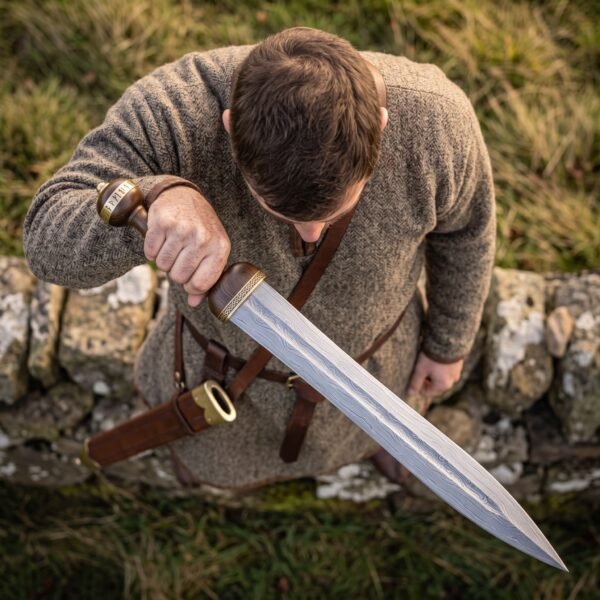
The blade is 1095 and 15N20 forge welded together and then folded, drawn out and folded again. The two steels take an etch differently, which is where the pattern comes from. 1095 is a plain high carbon steel and etches dark, 15N20 carries nickel and stays bright, so the boundary between every layer shows up as a line once the finished blade goes into acid. What you see on the flat is a genuine record of how the billet was worked, not a print or a laser mark.
Heat treated and tempered, the blade sits at 58 to 60 HRC. That is hard enough to take and keep a working edge and still tough enough that the long point is not brittle. Damascus of this kind is not stainless. It will spot if you leave it wet or handle it and put it away, which is why the care section below matters.
The guard plate, the ferrule and the ball pommel are solid brass, filed and polished by hand rather than cast and buffed on a wheel. Brass was the right choice historically and it is the right choice now, because it is soft enough to be fitted tight against the tang without cracking and it takes a deep shine that only gets better as it wears. The scabbard is vegetable tanned leather dyed oxblood, formed wet over the blade so it grips the sword rather than rattling on it, and finished with brass bands and a brass tipped chape.
Engraving, runes and your own design
Use the rune converter on this page to turn a name, a date or a short phrase into Elder Futhark and we will cut it into the steel, the leather or the wood. If you would rather have a Viking pattern than a rune line, choose your own design in the engraving option above the add to cart button and tell us where it goes. Where a piece already carries an engraved design, your chosen engraving replaces it rather than sitting alongside it. If you are not sure where an engraving sits best on a gladius, the wide flat above the waist and the scabbard throat are the two places that read clearly. Full details are on the engraving page.
Handling and balance
This is a short sword and it handles like one. The balance point sits a couple of inches ahead of the guard, so the sword turns from the wrist and comes back on line quickly. If you are used to a longer arming sword the gladius will feel stubby and front light by comparison, which is the point of it.
Hold it with the web of the hand against the underside of the pommel ball rather than choked up against the guard. That is how the fittings are laid out and it puts the point where your knuckles are aiming. The sword arrives sharp enough to cut, and we would rather you treated it as a collector and display piece and a cutting piece on soft targets than for sparring. It is not made for full contact work against another sword and we do not sell it as such.
Care
Wipe the blade down after handling and put a thin film of oil on it before it goes back in the scabbard. Fingerprints are slightly acidic and Damascus will pick them up as grey ghosts if you leave them. A light mineral oil or a dedicated blade oil is enough, and a soft cloth is better than paper. Do not store the sword in the leather scabbard for months at a time in a damp room, because vegetable tanned leather holds moisture against steel.
If a spot of rust does appear, take it off gently with oil and a fine synthetic pad rather than anything abrasive, working with the pattern rather than across it. Brass wants nothing more than a dry cloth and the occasional touch of metal polish, and you can leave it to tone down naturally if you prefer a warmer look. Feed the scabbard once or twice a year with a leather balm. Full guidance is in our steel care notes.
Made in the Czech Republic
This piece is made by hand in the Czech Republic, in a workshop that still works the old way. The steel is forged, ground, heat treated and finished by smiths who learned the trade from the people before them, and the wood, horn and leather are cut and fitted by hand rather than pressed out on a line. That is also why no two pieces come out exactly the same.
Ransack Viking is a United States company. We import these pieces ourselves, check every one when it lands and ship from our warehouse in Chicago, Illinois. Engraving is done here in the United States after the piece arrives, so your runes or your own design go on before it leaves for you.
A note on handmade variation
This gladius is hand made rather than machine made or bulk produced, so what arrives will not be a pixel for pixel copy of the photograph. The Damascus pattern is different on every blade because no two billets are folded or drawn exactly the same way, the grain and tone of the hardwood grip vary because it is cut from real timber, the brass will show its own file and polish marks, and the leather takes dye a little differently from hide to hide. The dimensions, the steel, the hardness and the build are the same every time. The character is not. More on what Damascus steel actually is elsewhere on the site, along with keeping Damascus from staining.
Frequently asked questions
Is it sharp out of the box
Yes. It arrives with a working edge along both sides and a stiff, fully formed point. Handle it as you would any sharp sword and keep it out of reach of children.
Is the Damascus pattern real or etched on
It is real. The blade is forge welded from 1095 and 15N20 and the pattern is the layer structure showing through after an acid etch. Grind into the blade and the pattern continues into the steel.
Can I use this for sparring or reenactment combat
No. It is sharp and it is not built for edge to edge contact against another blade. For display, collecting and controlled cutting on soft targets it is fine.
Does the scabbard come with a belt
The scabbard is included and it is fitted to this blade. A belt or baldric is not included.
Will mine look exactly like the photograph
The pattern, the timber grain and the leather tone will be slightly different because each one is worked by hand. The shape, size and construction will match.
How long does it take to arrive
Processing is one to two weeks, then free shipping inside the United States. If you have added an engraving, allow the longer end of that window.
What is in the box
- Legionward Damascus gladius, 1095 and 15N20, 58 to 60 HRC
- Fitted oxblood leather scabbard with brass mounts
- Care card for Damascus steel and vegetable tanned leather
- Lifetime warranty against defects in forging, grind, heat treat and fittings
- Forged and finished in the Czech Republic
Explore the range
See more in gladius, damascus swords, short swords and swords, or read the guides.
Close to this one
Closest to this in the range is the Stormleaf gladius, 28 inches overall. If this one is not quite right, there is the Legionfold gladius, 26 inches overall. Also in this group is the Bronzetide gladius, 27 inches overall.
If you are putting a set together, the Broadkeel zweihander sits alongside it. Nothing here exactly right, build one to your own spec on the custom Viking sword page.

Incredible craftsmanship on this one. Even the small engravings are crisp and clean. The wood handle feels amazing and the balance is perfect. If you’re on the fence just get it. You won’t regret it.