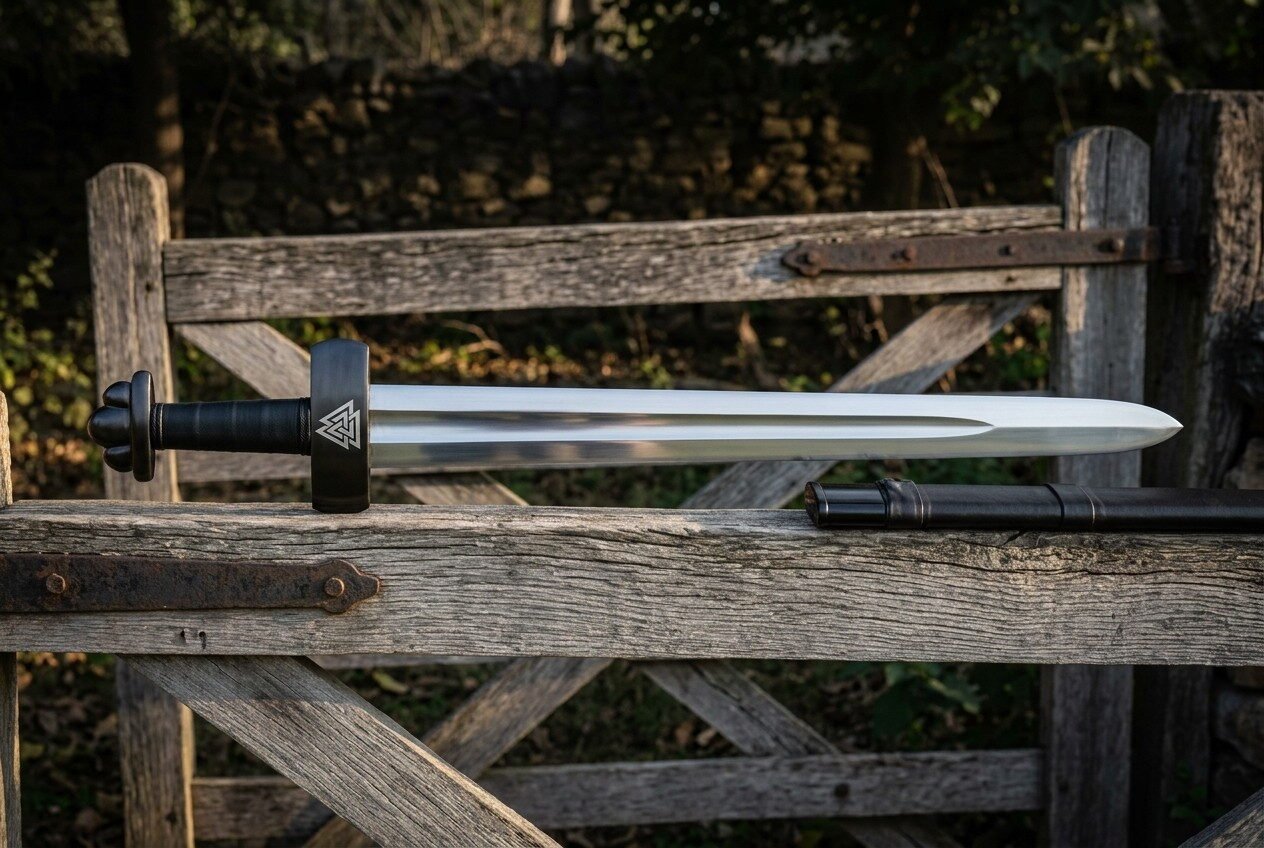
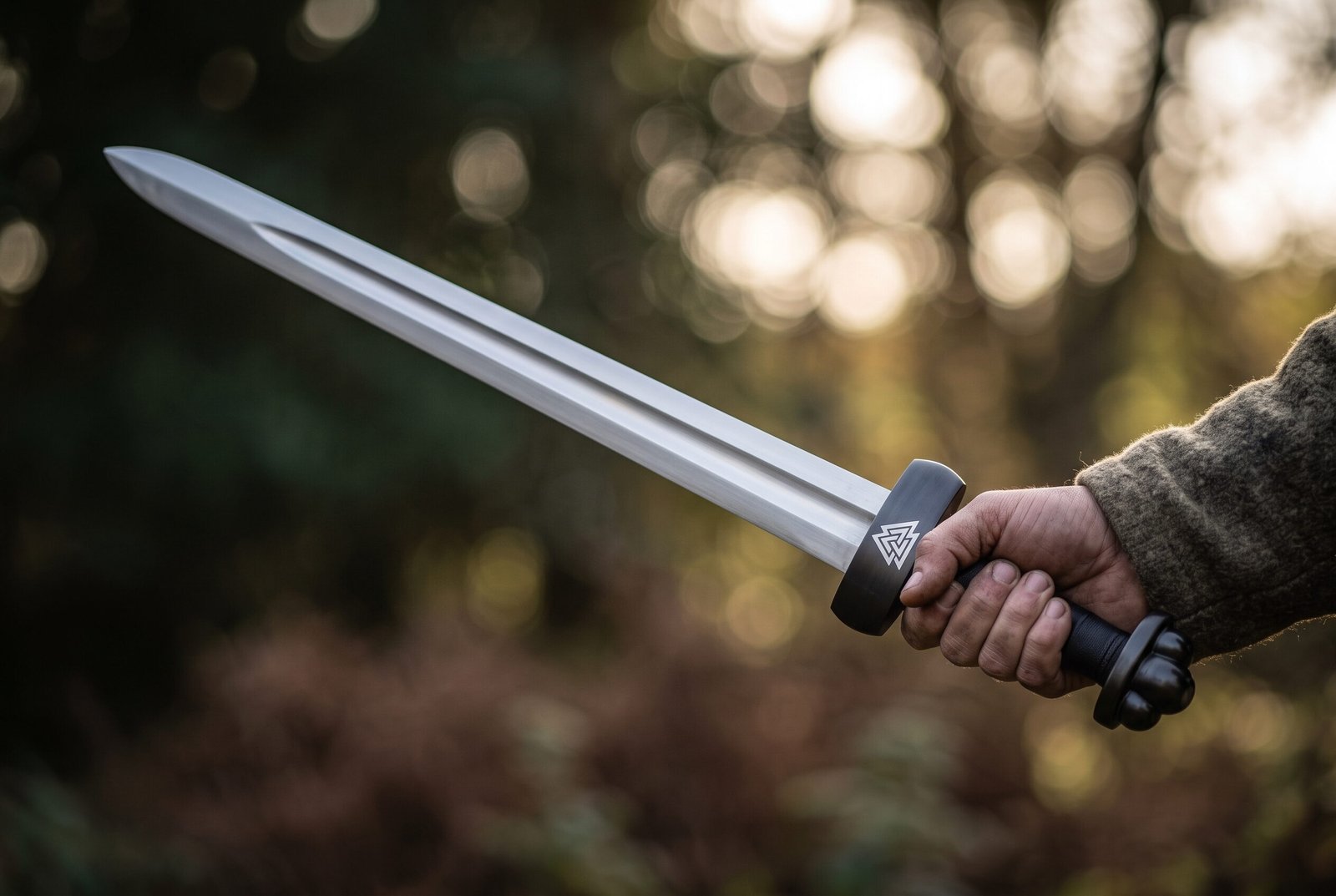
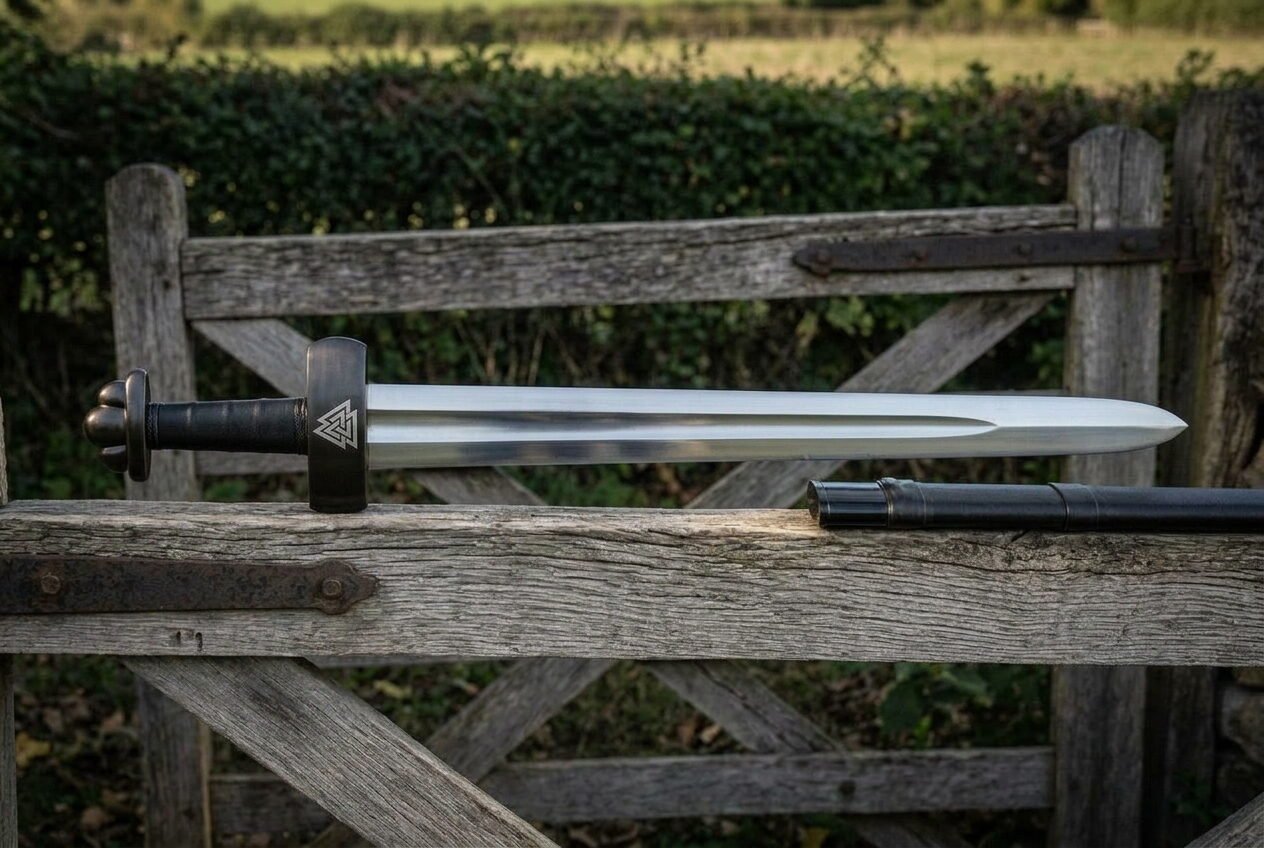
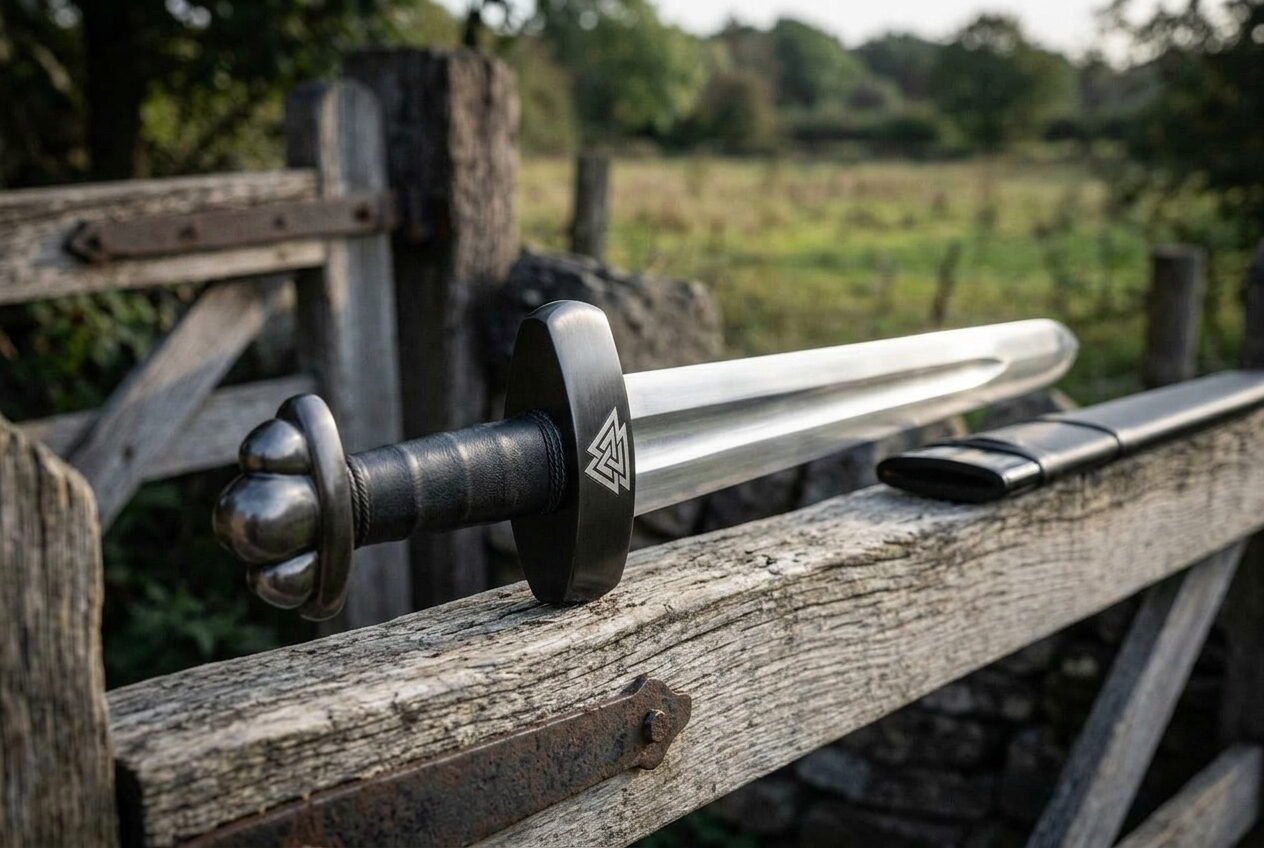
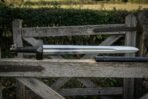
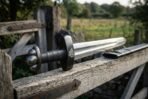
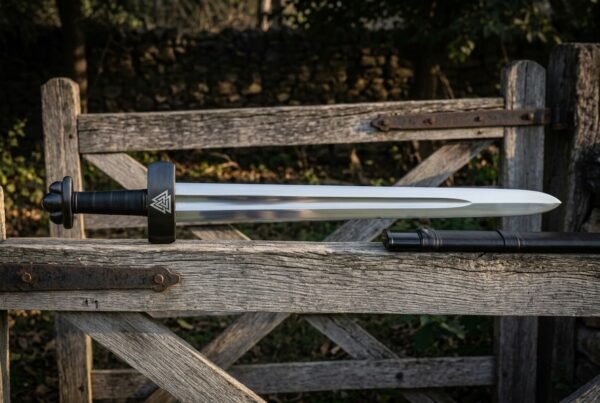
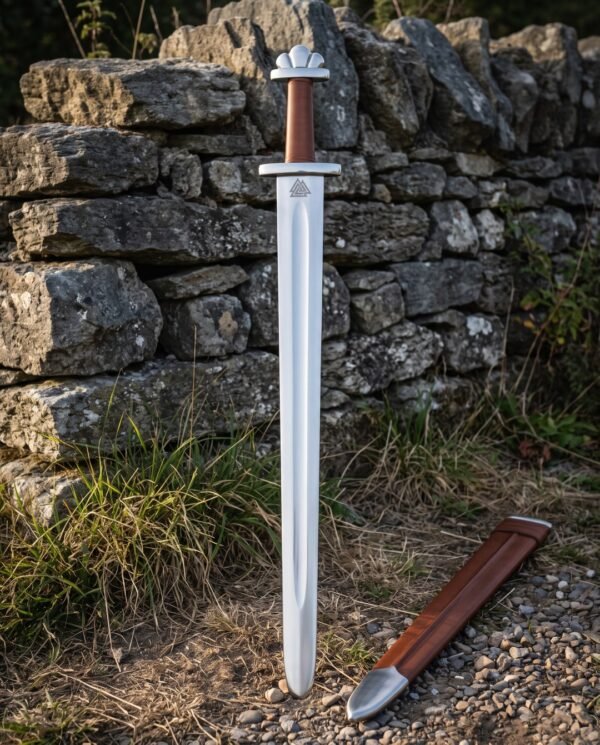
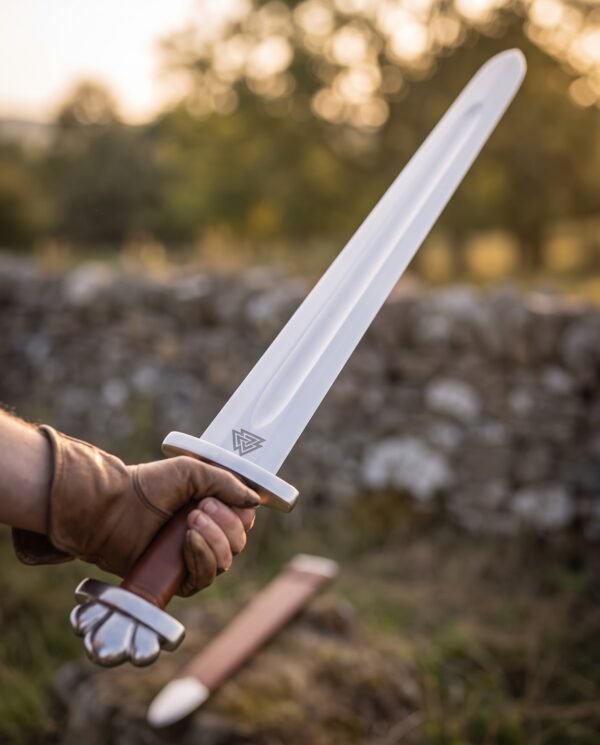
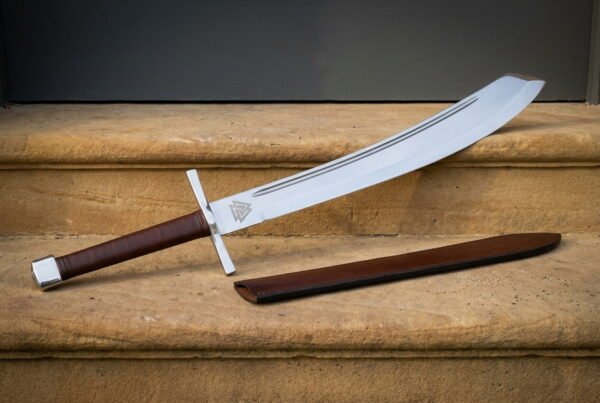
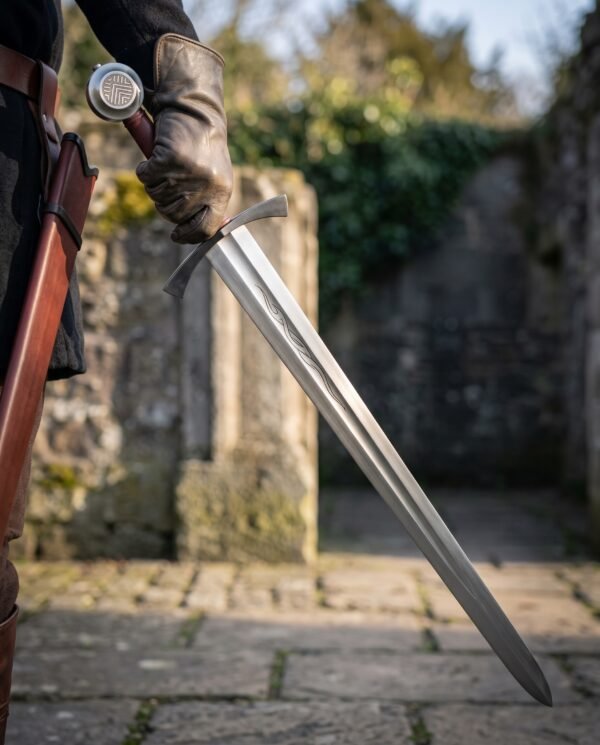
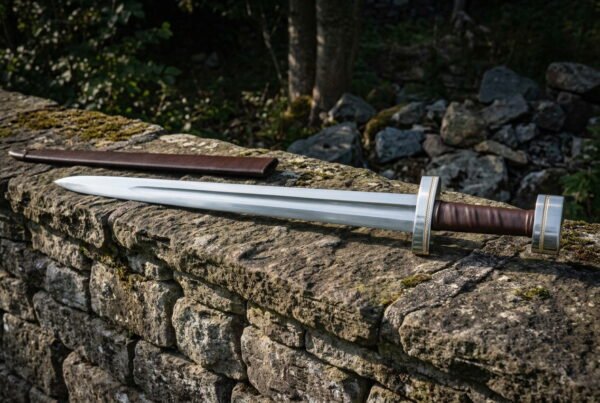
The Valkbrand is a single hand Viking sword built on the pattern that dominated northern Europe from the ninth century to the eleventh: a broad, wide fullered blade that tapers gently, a short thick lower guard, a grip barely longer than a closed fist, and a heavy pommel that does the balancing. The lower guard on this one is blackened and carries a Valknut cut into the face, three interlocked triangles, and the grip is wrapped in black leather over a wood core. It ships with a black scabbard with blackened fittings.
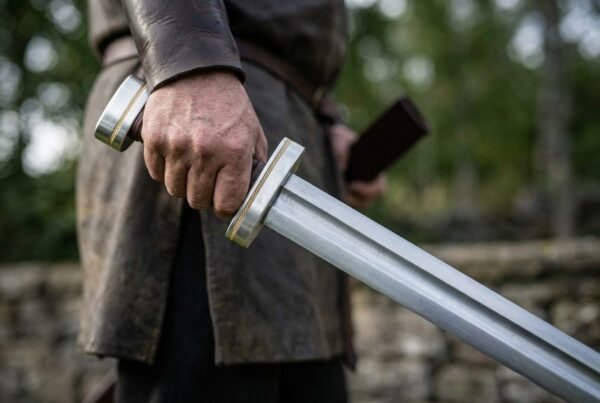
The thing that surprises people who pick up a real Viking sword for the first time is how short the grip is. Four inches or so, with the hand jammed between guard and pommel and no room to slide. That is not poor design. The sword was carried alongside a shield and the wrist did the work, so the hilt was built to lock the hand in one place and let the heavy pommel throw the point back on line after a cut. Every Valkbrand is forged, ground, heat treated, hilted and polished by hand in the Czech Republic. It is part of the Viking swords, and the Damascus swords are put together the same way.
Specifications
| Material | 1095 high carbon steel, hardened to 54 to 58 HRC |
|---|
| Overall length | Approximately 37 inches |
|---|
| Blade length | Approximately 30 inches, broad with a wide central fuller |
|---|
| Guard | Short thick oval guard in blackened steel, Valknut engraved bright on the face |
|---|
| Grip | Approximately 4 inches, black leather over a wood core with twisted black cord bands at each end |
|---|
| Pommel | Blackened steel lobed pommel on an oval base bar |
|---|
| Finish | Satin polished blade against blackened furniture |
|---|
| Tang | Full tang, peened over the pommel |
|---|
| Scabbard | Black scabbard with blackened steel fittings, included |
|---|
| SKU | RK-1753 |
|---|
The fuller and the Valknut
The wide groove down the centre of the blade is a fuller, and it is not a blood groove. Nothing drains through it and no sword ever stuck in a body for want of one. A fuller is a stiffness trick borrowed from the same physics that gives a steel I beam its strength. Move steel away from the neutral axis in the middle of the blade and out towards the edges, and you keep almost all the stiffness while losing a real slice of the weight. On a blade thirty inches long that is the difference between a sword you can recover after a cut and a bar of steel you swing once.
The Valknut on the guard is three triangles locked through one another. It appears on the Stora Hammars picture stones on Gotland and on the Oseberg ship burial, almost always in scenes involving Odin, the dead, and horses or ships. Nobody living knows what the Norse called it or exactly what it meant. The modern name is a nineteenth century coinage from the Norwegian for knot of the slain. Read honestly, it is a mark associated with Odin and with those given over to him, which is why it turns up on warrior gear rather than on cooking pots.
The steel and the heat treat
Forged from 1095 high carbon steel and drawn back to 54 to 58 HRC. On a wide, thin, fullered blade that hardness band is the right answer. Harder steel holds an edge longer but a sword is not a chisel: it flexes hard when it is swung and stopped, and a blade taken past 58 across its whole length gets brittle in exactly the place you do not want brittle. At 54 to 58 the blade takes a working edge, springs back to straight, and can be brought back with a stone rather than a machine.
The blackening on the guard and pommel is a controlled oxide finish rather than paint, so it will not chip off in a flake the way a coating does. It will lighten at the high points over years of handling, which is what happens to any dark finish on steel that gets held, and most owners find that a Viking sword looks better for it.
Engraving, runes and your own design
Use the rune converter on this page to turn a name, a date or a short phrase into Elder Futhark and we will cut it into the steel, the leather or the wood. If you would rather have a Viking pattern than a rune line, choose your own design in the engraving option above the add to cart button and tell us where it goes. Where a piece already carries an engraved design, your chosen engraving replaces it rather than sitting alongside it. On the Valkbrand that means a chosen design takes the place of the Valknut on the guard, or your line can be cut into the fuller instead if you would rather keep the Valknut where it is. Details are on the engraving page.
Handling and balance
Balance sits around four to five inches ahead of the guard, which is a little further forward than most modern reproductions and closer to the surviving originals. The sword feels heavier at rest and lighter in motion than people expect. The reason is the pommel: it is not a decoration, it is a counterweight, and it lets you stop a cut and reverse it with the wrist rather than hauling the whole blade back with the shoulder.
Grip it with the hand filling the whole space between guard and pommel and the thumb along the flat. There is no room to change grip mid fight, which is exactly how the original was used, with a shield in the other hand doing the defending. This is a forged and heat treated sword with a real edge. It suits cutting practice on soft targets, reenactment display and collection. It is not a blunt trainer and it is not intended for full contact sparring against another steel blade.
Care
1095 has no chromium and will rust if it is left wet or handled and put away. Wipe the blade down every time you touch it and keep a light film of mineral oil, camellia oil or a purpose made blade oil on the steel. Do not store the sword in the scabbard for months at a time, because a closed scabbard traps humidity against the blade. Feed the leather grip and the scabbard once or twice a year with a neutral conditioner and keep both away from radiators. Any rust spot comes off with brass wool and oil rather than abrasive paper. There is more on our steel care page.
Made in the Czech Republic
This is a handmade piece from the Czech Republic, made in a workshop that still forges, grinds and finishes by hand instead of stamping parts out. The smiths there have kept the older way of working, and the wood, horn and leather are shaped and fitted by hand as well. Two pieces of the same design will never be identical, and that is part of what you are buying.
Ransack Viking is a United States company. We handle the import ourselves, look over every piece when it lands and ship from our warehouse in Chicago, Illinois. Engraving is done in the United States after the piece arrives, so your design goes on before we send it out.
A note on handmade variation
This sword is made by hand and not machine produced in bulk, so what arrives will not be a pixel for pixel copy of the photograph. The fuller is ground by hand and its width wanders slightly along the blade the way it does on originals. Hammer texture near the tang, the exact depth of the Valknut cut, the tone of the black leather and the way the blackening sits on the guard all vary from one sword to the next. The length, the steel and the build are the same every time. The character is not. The long form of that is the Viking swords collectors go for, with the arms in Vikings and The Last Kingdom next to it.
Frequently asked questions
Is it sharp out of the box
Yes, it arrives with a working edge. If you want it blunted for display or for a household with children, say so in the order notes and we will roll the edge before it ships at no extra cost.
Can I use it for reenactment combat
Not against another steel blade. It is a sharp forged sword and it is right for display, for kit that has to look correct on a field, and for cutting practice on soft targets. Full contact steel on steel needs a purpose built blunt trainer and this is not one.
Does the scabbard come with it
Yes. The black scabbard with blackened fittings shown in the photograph is included. It is built to this blade rather than picked from a generic size, which is part of why the lead time is what it is.
What does the Valknut mean
Honestly, nobody knows for certain. It appears on Gotland picture stones and in the Oseberg ship burial in scenes tied to Odin and to the dead. The name is modern. We can tell you where it appears and what it is associated with, and anyone who tells you more than that is guessing.
Can I have runes cut into the blade
Yes. The rune converter on this page turns a name or a date into Elder Futhark and we cut it into the fuller, or into the guard in place of the Valknut if you prefer. Your own Viking pattern can go in instead of runes.
How long until it ships
One to two weeks of processing because the sword is made rather than picked from a shelf, plus a few days if you have ordered engraving. Shipping in the United States is free and returns are accepted within seven days.
What is in the box
- Valkbrand Viking sword in 1095 high carbon steel
- Black scabbard with blackened steel fittings, built to this blade
- Care sheet with oiling and storage instructions
- Lifetime warranty against defects in forging, grind, heat treat and fittings
- Forged and finished in the Czech Republic
Explore the range
See the rest of the Viking swords, the arming swords, the full range of swords, and the guides.
Worth a look beside this
If this one is not quite right, there is the Sableknot Viking sword, 37 inches overall. Also in this group is the Vinehewn Viking sword, 36 inches overall. Sitting beside it in the catalogue is the Serpentcrown Viking sword, 36 inches overall.
From the same corner of the shop, there is the Sootbrand arming sword. Or start from a blank sheet on the custom Viking sword page.
Anyone moving from display pieces to sparring can start with the Faskvar blunt arming sword, and our blunt versus sharp guide fills in the rest.

Overall a good buying experience. Second time ordering from Ransack Viking and still happy overall. Good product. Just not quite perfect.