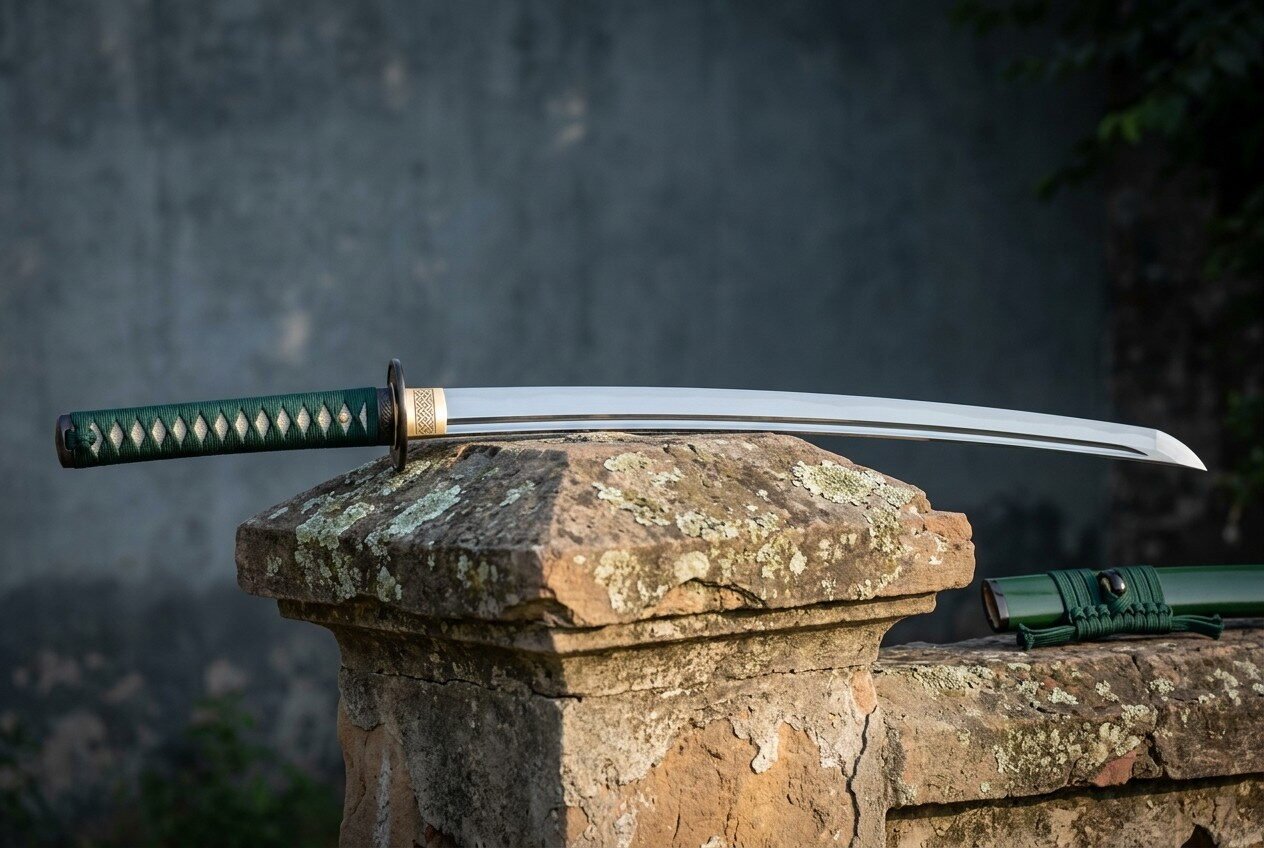
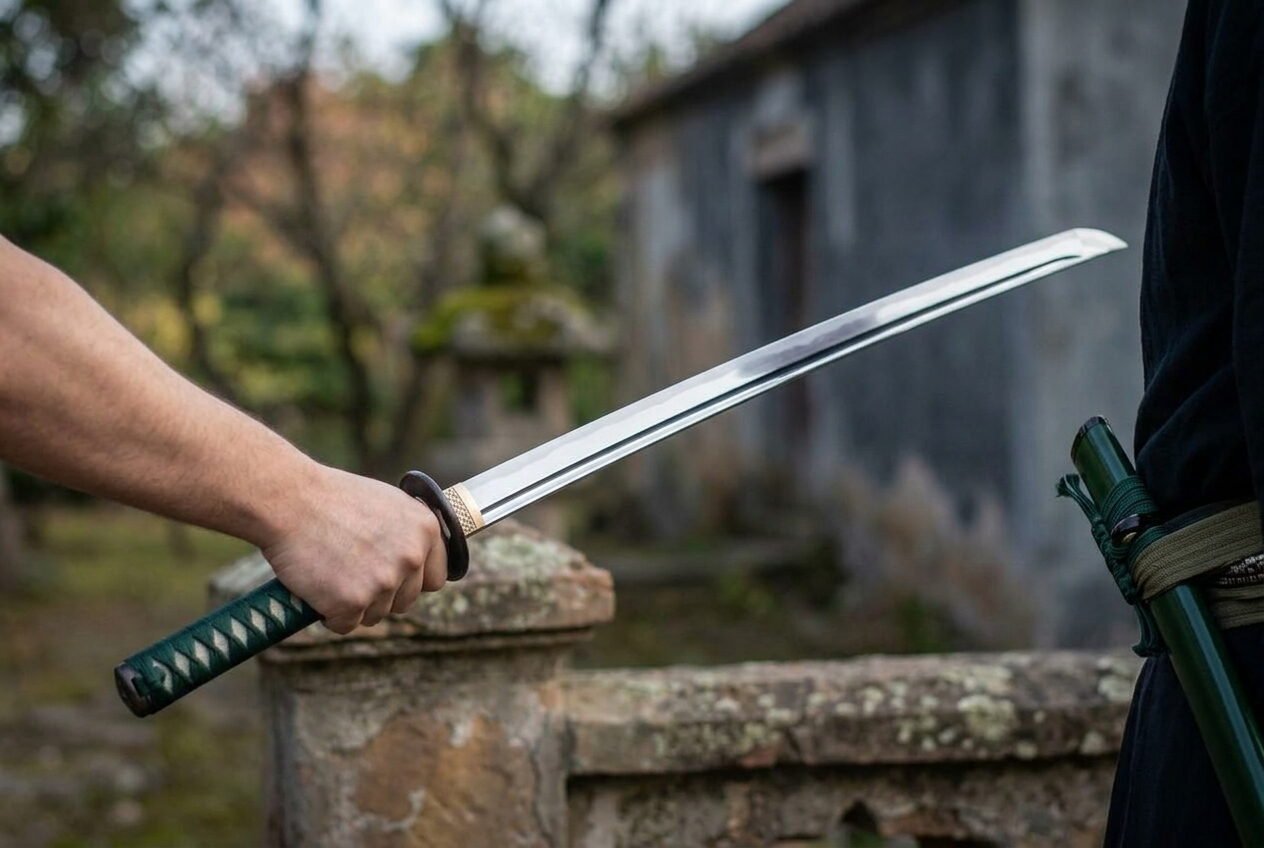
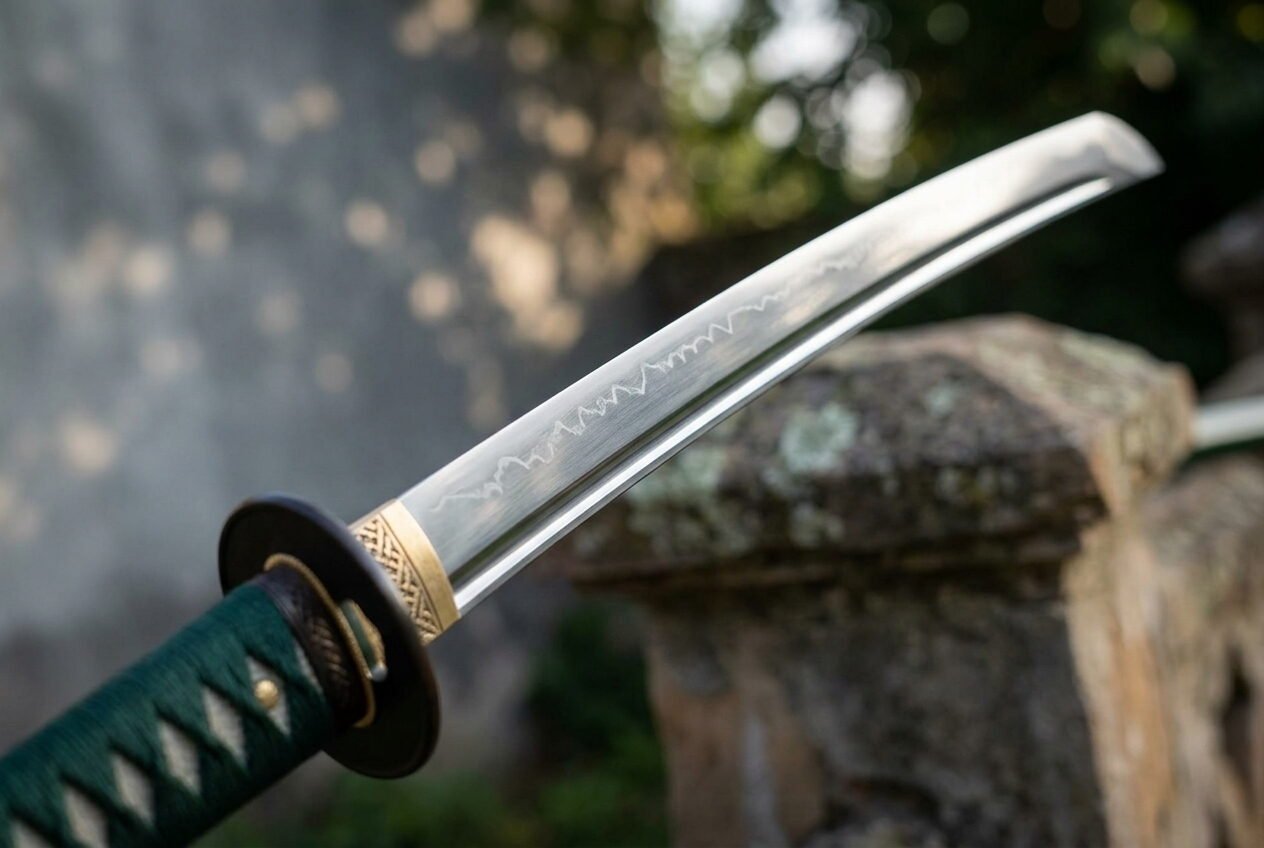
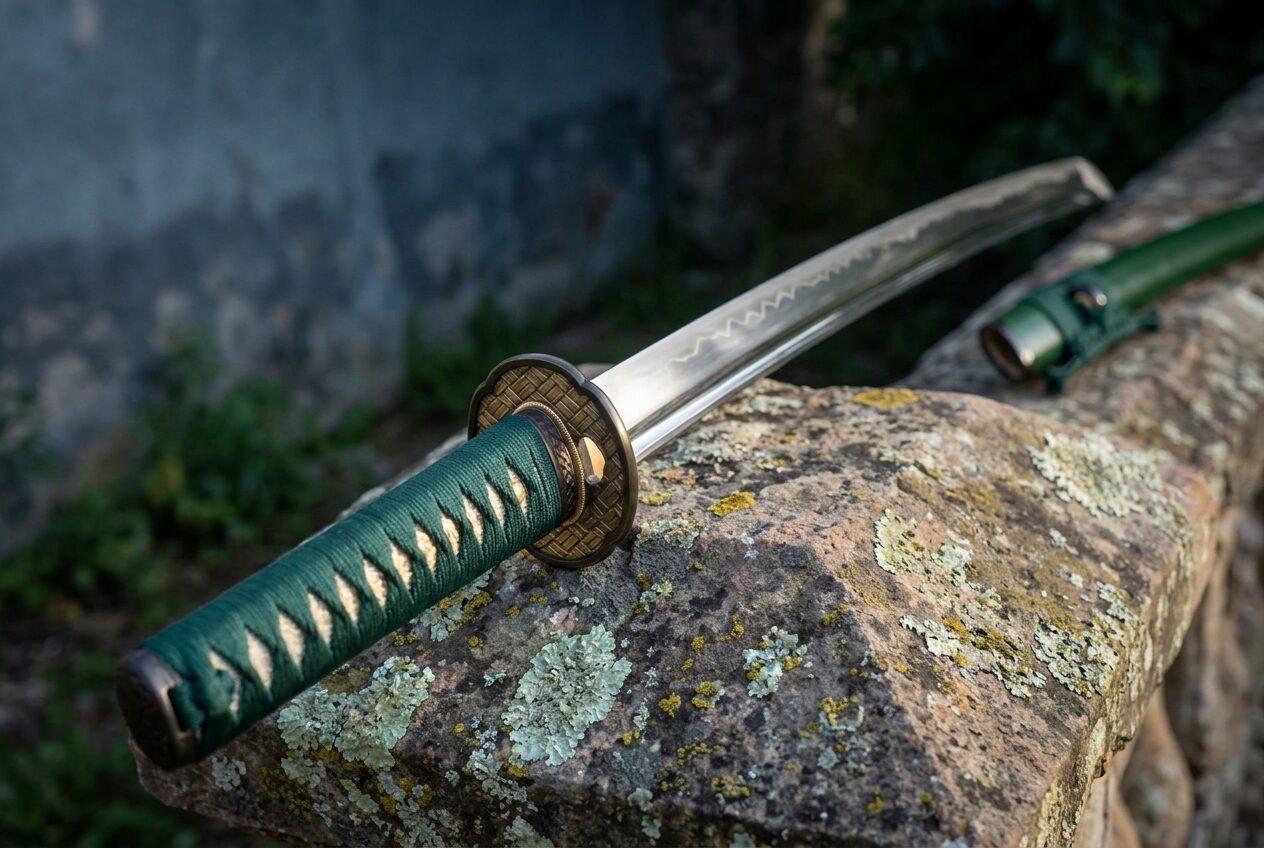
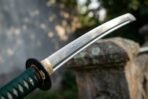
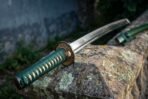
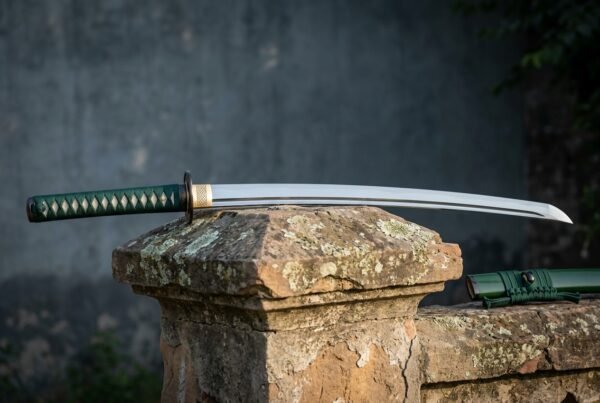
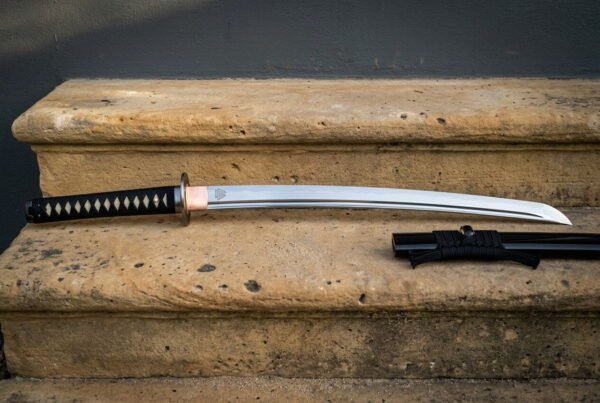
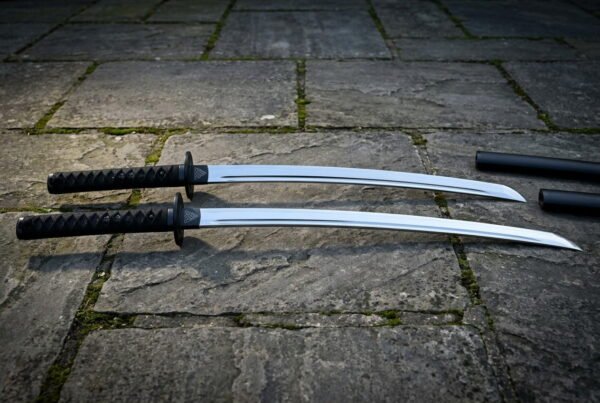
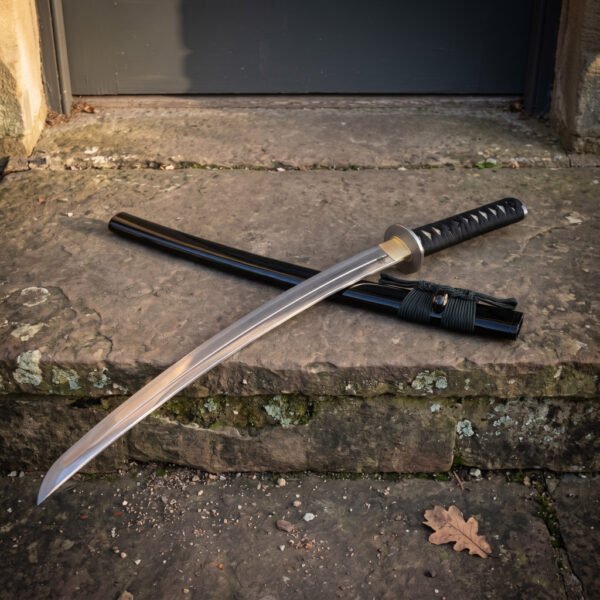
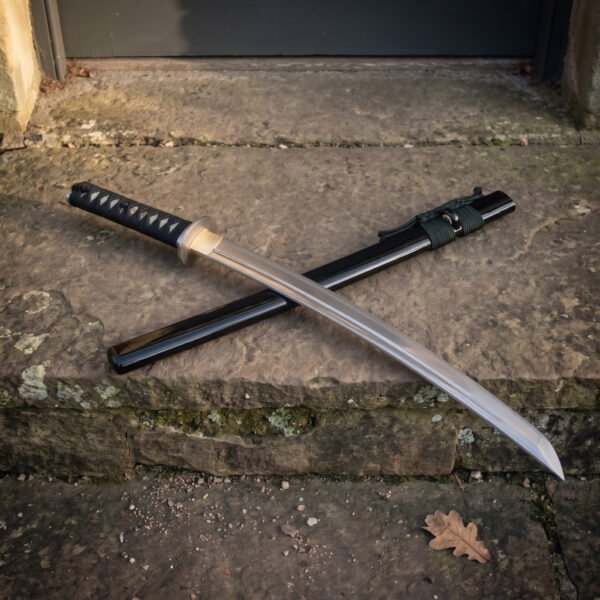
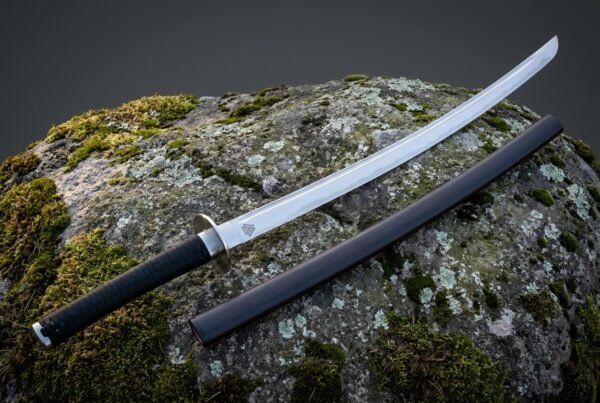
This is a hand forged katana with a single edged curved blade in 1095 high carbon steel, a round dark iron tsuba, a brass habaki, a dark metal collar and end cap, and a tsuka wrapped in deep green cord over a pale textured underlay in the traditional alternating diamond pattern. It comes with a matching green lacquered saya. It is built as a collection and display sword, and the fittings are assembled the way Japanese fittings are meant to be assembled, on a mekugi peg rather than glue.
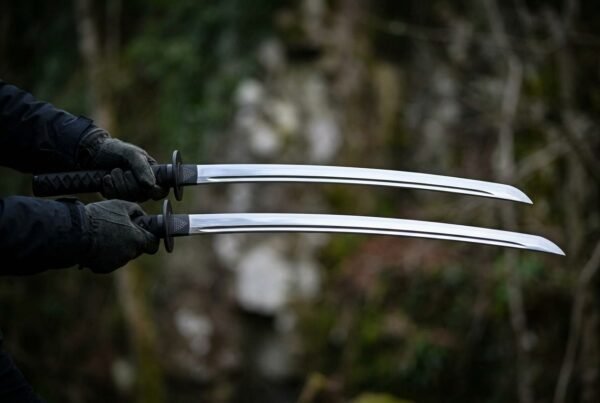
The curve is the part people assume is decorative. It is not, and originally it was not even intentional. Traditional Japanese blades are differentially treated, with a clay slurry laid thicker along the spine and thinner along the edge before quenching. The thin edge cools fast and transforms to hard martensite, which occupies more volume than the steel it came from. The thick spine cools slowly and stays softer. The edge expanding against a spine that has not moved is what bends the blade backward into its curve during the quench, and smiths learned to control an accident until it became the defining line of the form. The curve then turned out to be excellent for drawing and for cutting on a draw, which is why it stayed.
Each katana is forged, ground, heat treated, polished and mounted in a Czech Republic workshop, and the tsuka is wrapped by hand there. It ships in its saya with a care kit. It is part of the Japanese swords, and the wakizashi blades are put together the same way.
Specifications
| Item type | Japanese style katana, single edged curved blade |
|---|
| Blade material | 1095 high carbon steel, hardened and tempered to 54 to 58 HRC |
|---|
| Overall length | Approximately 40 inches in the saya |
|---|
| Blade length | Approximately 28 inches, single edged with a shinogi ridge line |
|---|
| Handle | Approximately 11 inch tsuka, deep green cord ito over a pale textured underlay in the diamond pattern |
|---|
| Tsuba | Round dark iron guard |
|---|
| Fittings | Brass habaki with an engraved pattern, dark metal fuchi and kashira, bamboo mekugi peg |
|---|
| Saya | Green lacquered wooden scabbard with a dark koiguchi mouth and a green sageo cord |
|---|
| Finish | Satin polished blade, oiled iron and polished brass |
|---|
| Weight | Approximately 2 lb 6 oz without the saya |
|---|
| Included | Katana, saya, blade oil, cleaning cloth, care card |
|---|
| SKU | RK-1697 |
|---|
The mekugi peg, and why a katana comes apart
Look at the small tapered peg through the side of the handle. That is the mekugi, and it is the only thing holding the blade in the tsuka. It is traditionally bamboo, and it is bamboo here, which strikes most Western buyers as alarmingly casual for a sword. It is not. Bamboo has extraordinary shear strength along its fibres, it does not corrode, and crucially it fails predictably and visibly. A bamboo peg that is tired looks tired. A hidden steel pin that is tired looks fine right up until it does not.
The deeper reason is that a Japanese sword is designed to be taken apart. Push the peg out and the whole mounting slides off the tang so the blade can be cleaned, oiled and inspected, and so the mounting can be replaced without touching the blade. Japanese practice treats blade and mounting as separate objects with separate lives, and old blades are routinely found in mountings centuries younger. Everything about the assembly, the tapered peg, the friction fit habaki, the koiguchi that grips the blade rather than the tsuba, follows from that idea.
Check the peg before you handle the sword and once or twice a year afterward. It should be snug and flush. If it ever loosens, replacement bamboo pegs cost almost nothing and take a minute to fit.
The steel and the polish
The blade is 1095, a simple high carbon steel that is the honest modern equivalent of a traditional high carbon tamahagane blade in the properties that matter to an owner. It is hardened and tempered to 54 to 58 HRC, which on a long curved blade is the range that gives edge retention without brittleness. A katana blade is long and thin in section and it will flex under load. Steel taken harder than this holds an edge marginally longer and snaps instead of bending, which is the wrong trade on a sword.
The blade is finished to a satin polish that shows the shinogi ridge line and the geometry of the grind cleanly. It is a working polish, not a traditional multi stage togishi polish, which is a separate craft that takes weeks per blade and costs more than the sword. We would rather describe it accurately than pretend otherwise.
1095 is carbon steel and not stainless, so it will rust if it is left bare and handled. That is why a cleaning kit ships with it.
Engraving, runes and your own design
Use the rune converter on this page to turn a name, a date or a short phrase into Elder Futhark and we will cut it into the steel, the leather or the wood. If you would rather have a Viking pattern than a rune line, choose your own design in the engraving option above the add to cart button and tell us where it goes. Where a piece already carries an engraved design, your chosen engraving replaces it rather than sitting alongside it.
On a katana the traditional place for an inscription is the nakago, the tang, which is hidden inside the handle and is where a smith signs his work. We can cut a name or a date there, which is the quiet and correct option, or along the flat above the habaki where it is visible. Tell us which in the order notes and see the engraving page for lettering and lead time.
Handling and balance
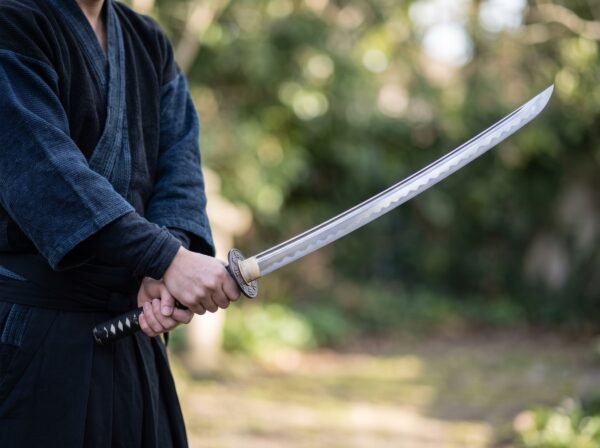
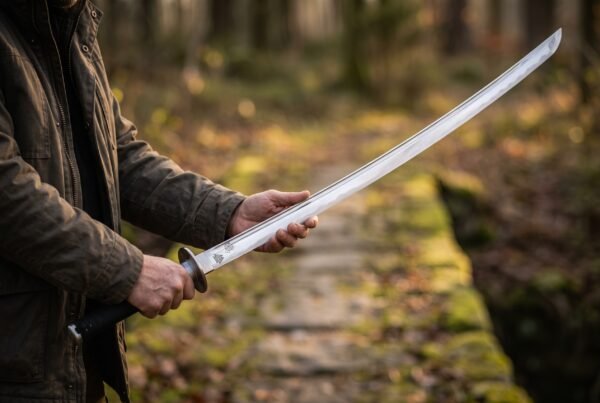
The balance point sits roughly five inches ahead of the tsuba. That is forward for a sword of this weight and it is correct for the form, because a katana is a cutting sword and it wants mass out toward the monouchi, the last third of the blade where the cut is made. The long handle is not there for two hands to sit side by side, it is there so the hands can be spread, which turns the sword into a lever and lets the left hand pull while the right hand pushes.
This is a hand forged display and collection piece. We do not sell it for sparring and it should not be used in contact against another blade or against a person. If you practise cutting, use a sword bought for that purpose from a maker who tests to that standard, and get instruction first. Draw and sheathe slowly. The koiguchi grips the blade and a fast careless sheathe is the classic way people cut their own hand.
Care
Wipe the blade with the cloth and oil it after any handling, working from the habaki to the tip with the edge away from you. Never wipe toward the edge. A fingerprint on bare 1095 will start etching within days in a humid room. Store the sword horizontally with the edge upward if it is on a stand, which keeps the blade from resting its weight on the koiguchi.
Do not store the blade in the saya for long periods in a humid house. Wood holds moisture and a sealed scabbard is the most common place a good blade quietly rusts. Take it out every few months, inspect it, oil it and put it back. Wipe the lacquered saya with a dry cloth and keep it out of direct sun, which will fade the green. There is more detail in steel care.
Made in the Czech Republic
This is a handmade piece from the Czech Republic, made in a workshop that still forges, grinds and finishes by hand instead of stamping parts out. The smiths there have kept the older way of working, and the wood, horn and leather are shaped and fitted by hand as well. Two pieces of the same design will never be identical, and that is part of what you are buying.
Ransack Viking is a United States company. We handle the import ourselves, look over every piece when it lands and ship from our warehouse in Chicago, Illinois. Engraving is done in the United States after the piece arrives, so your design goes on before we send it out.
A note on handmade variation
Every katana here is hand made rather than machine made or bulk produced, so what arrives will not be a pixel for pixel copy of the photograph. The ito wrap is tensioned by hand, so the diamond openings sit with tiny differences in size and spacing along the tsuka. The green of the cord and the green of the lacquer vary slightly between dye and lacquer batches. The iron tsuba takes its own surface tone as it oxidises. The curve is put into the blade by heat treatment, so it falls where the steel puts it and no two are identical to the millimetre. The length, the steel, the heat treat and the build are the same every time. The character is not. The long form of that is what makes a katana a katana, with sharpening a curved blade next to it.
Frequently asked questions
Is it sharp out of the box?
It arrives with a finished cutting edge rather than a razor hone. Treat it as sharp from the moment you open the box and draw it slowly.
Does it have a real hamon?
We do not claim one. The blade is through hardened 1095 with a satin working polish. Anything sold to you as a hamon that is actually an acid etched line is decoration, and we would rather not do that.
Can I use it for cutting practice or sparring?
No. It is a display and collection sword. We do not sell it as a tameshigiri or sparring blade and it must not be used in contact against another sword or person.
Is the saya included?
Yes. The green lacquered wooden saya ships with the sword and is fitted to that specific blade, which is why they should stay together.
Can the handle be taken off?
Yes. Push out the bamboo mekugi peg and the mounting slides off the tang. That is by design, so the blade can be inspected and oiled properly.
How long does shipping take?
Making time is one to two weeks and United States shipping is free. Custom engraving on the tang or the blade flat adds a few days.
What is in the box
- One hand forged 1095 carbon steel katana with green ito wrap and iron tsuba
- Matching green lacquered wooden saya
- Blade oil and cleaning cloth
- Care card covering oiling, storage and mekugi checks
- Lifetime warranty against defects in forging, grind, heat treat and fittings
- Forged and finished in the Czech Republic
Explore the range
Browse the katana and Japanese swords, the wakizashi and the wider sword range, or read the guides for more on heat treatment, curve and blade care.
Worth a look beside this
A near match for this one is the Jadewake Japanese sword, 40 inches overall. Closest to this in the range is the Moonedge Japanese sword, forged from 1095. If this one is not quite right, there is the Duskwake Japanese sword, 40 inches overall.
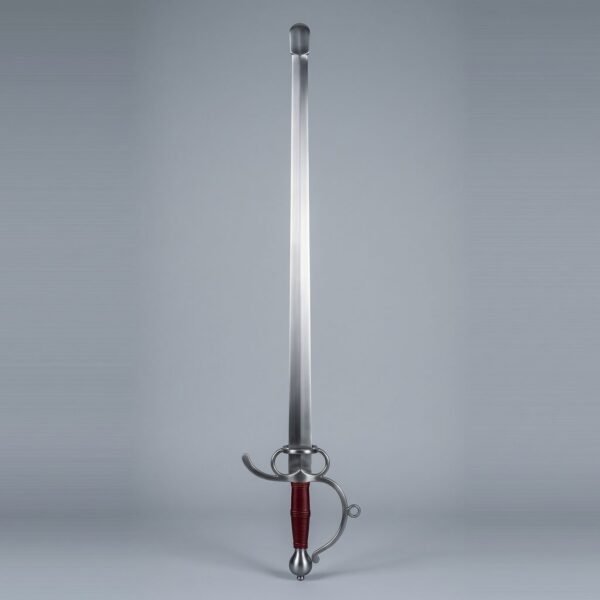
The Hornreach sabre covers the other half of the same kit. Or start from a blank sheet on the design your own page.

Reviews
There are no reviews yet