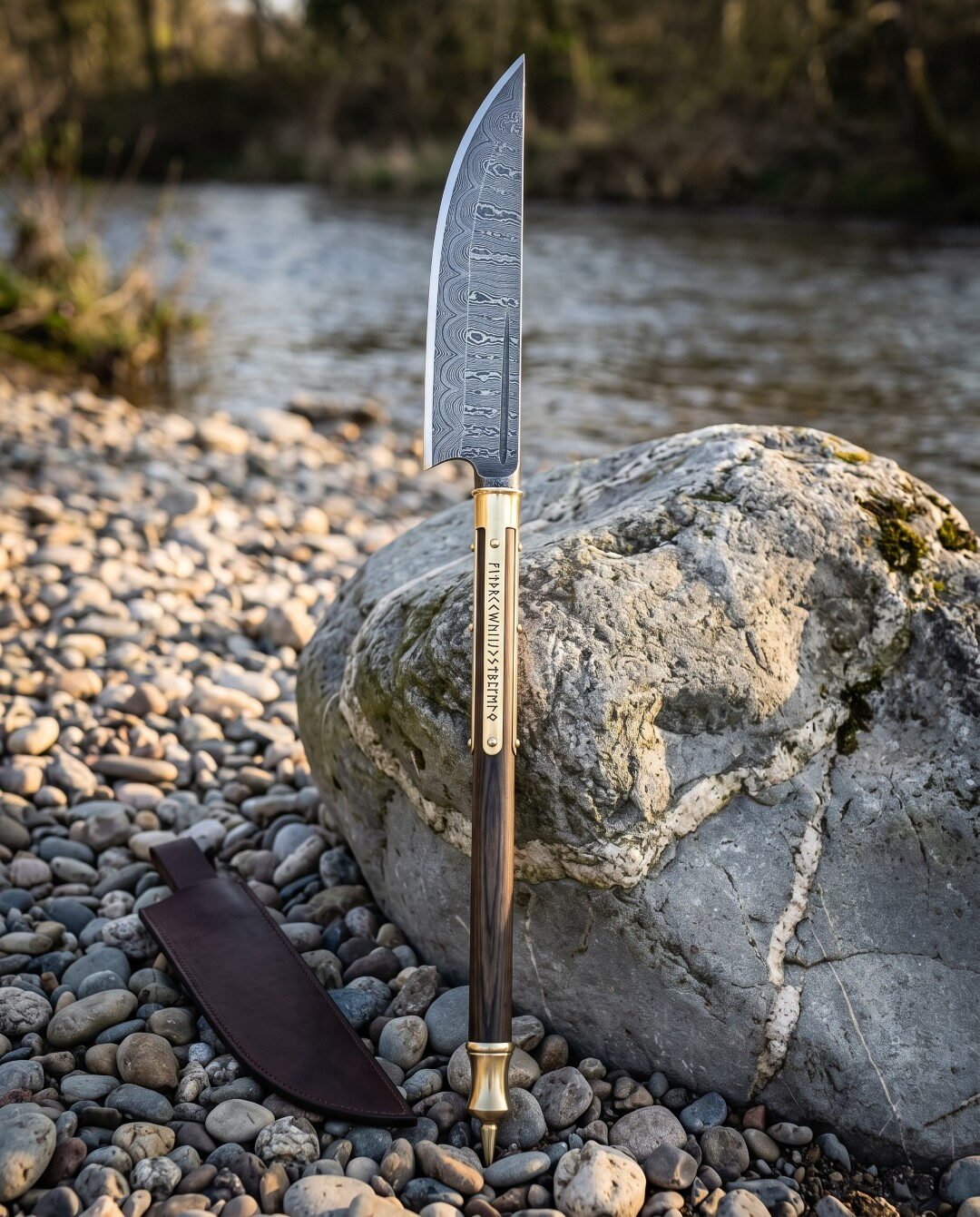
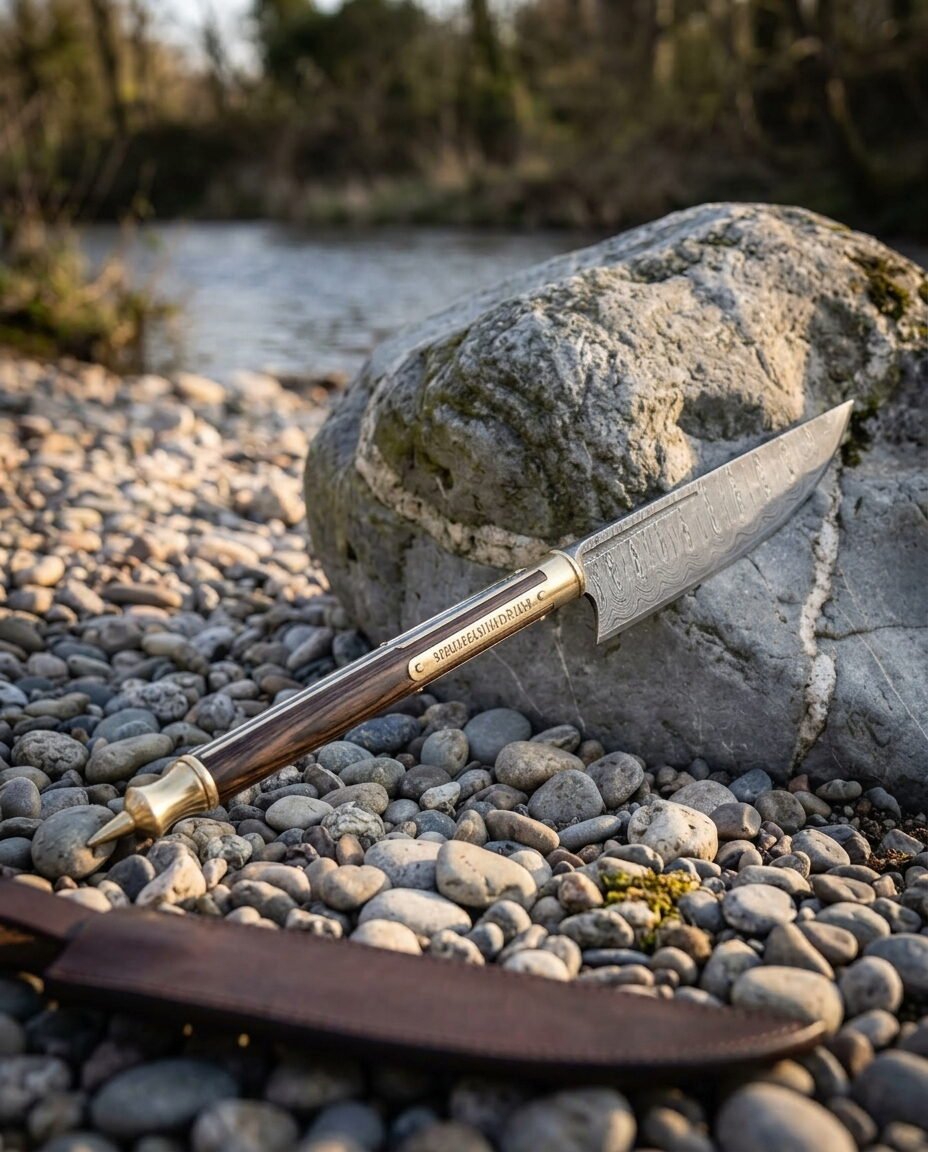
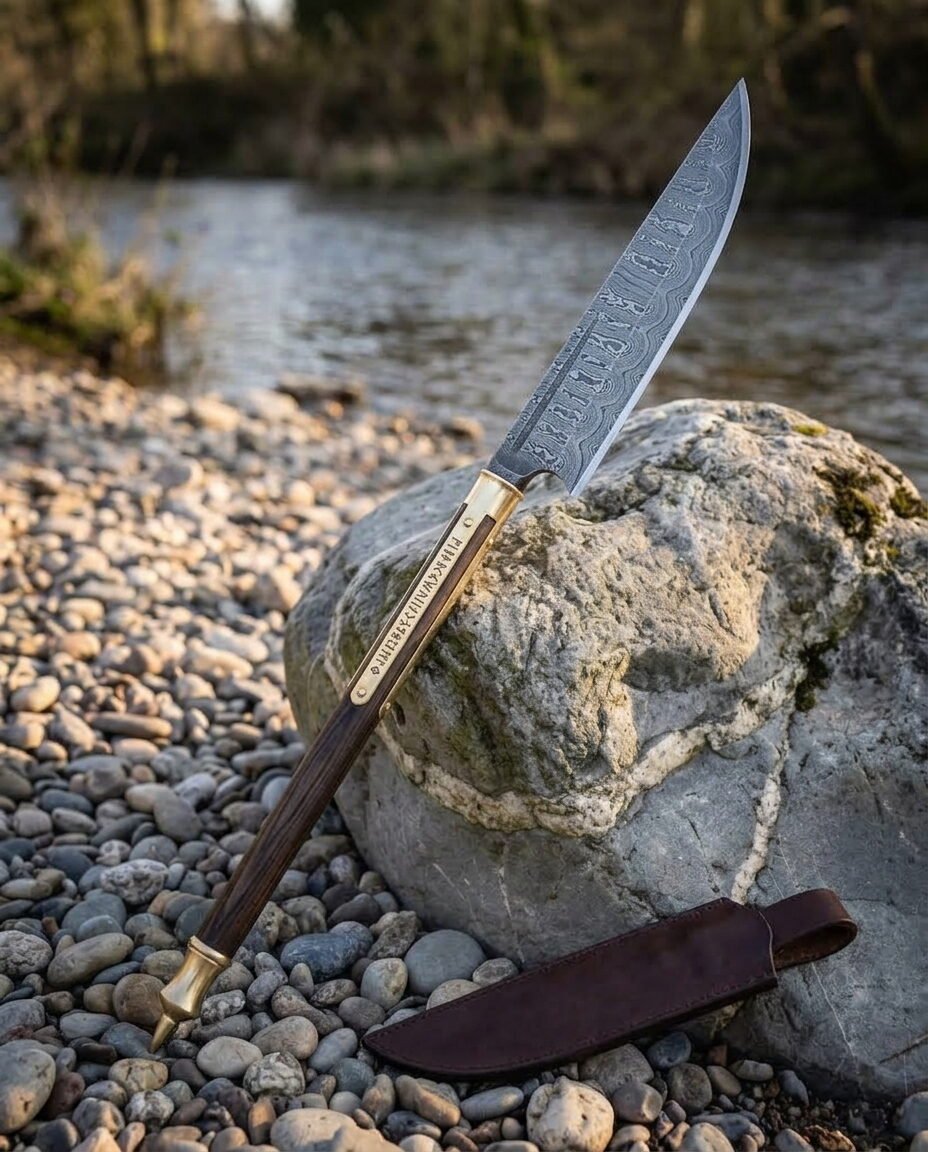
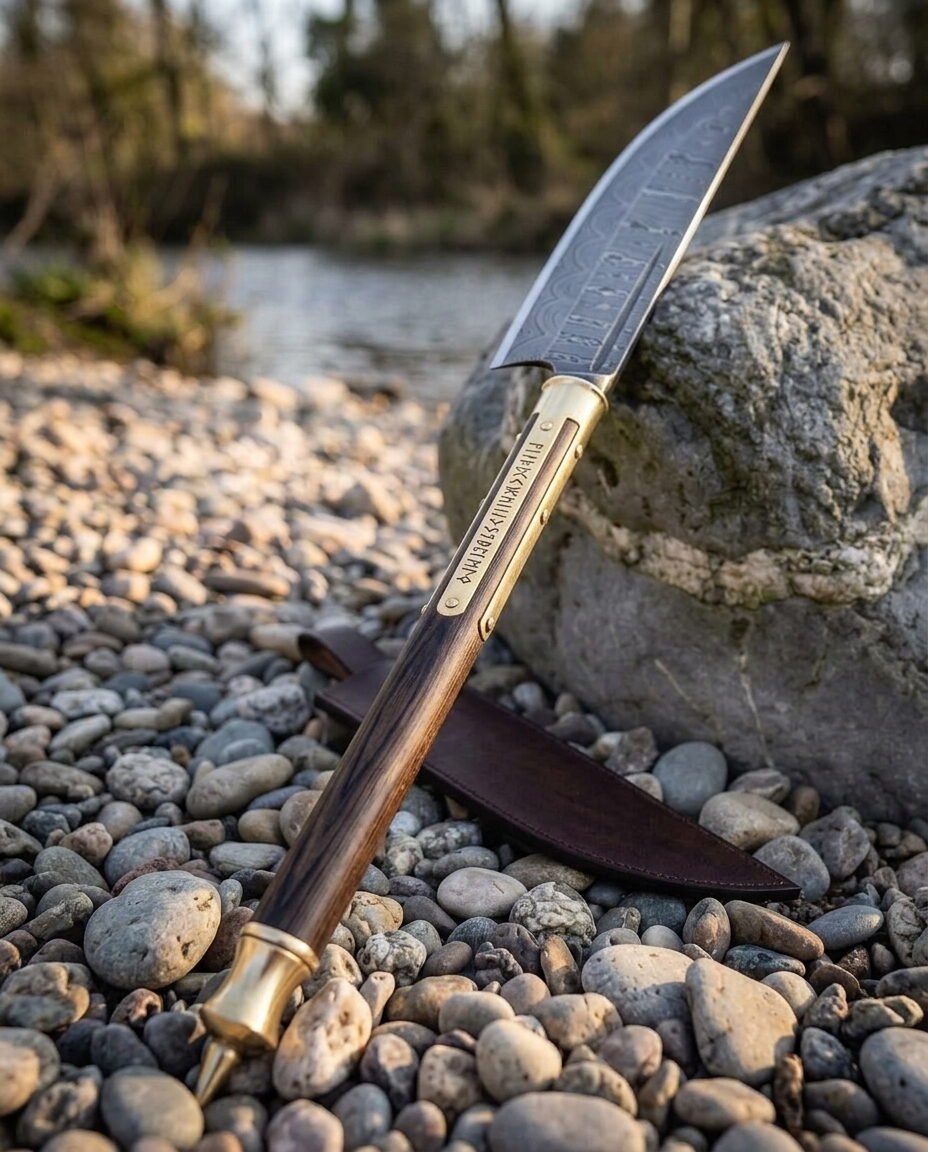
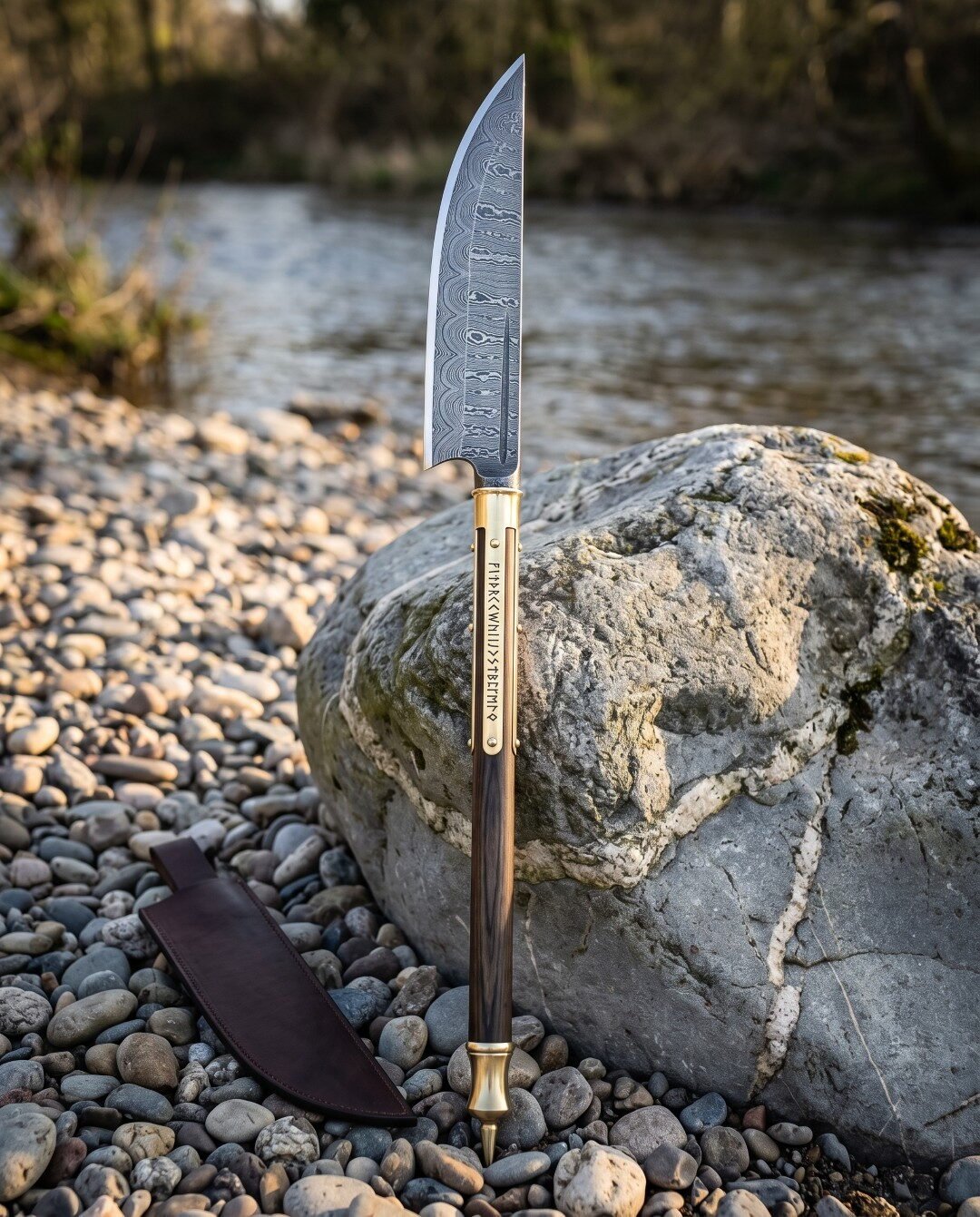
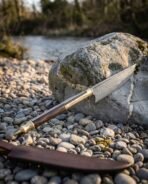
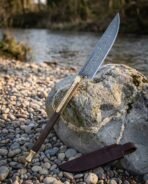
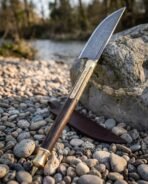
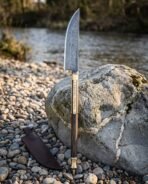
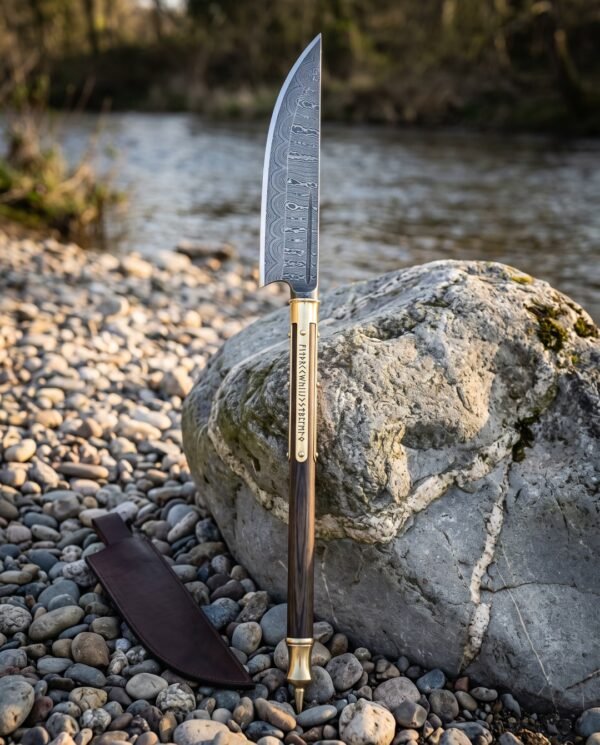
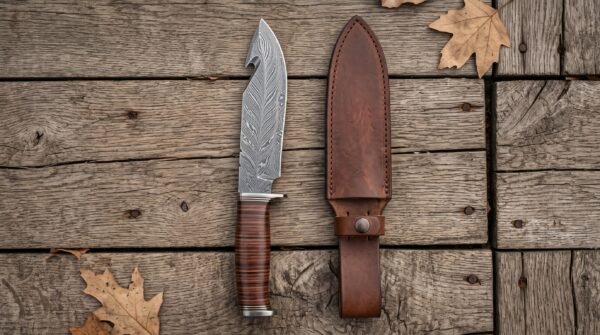
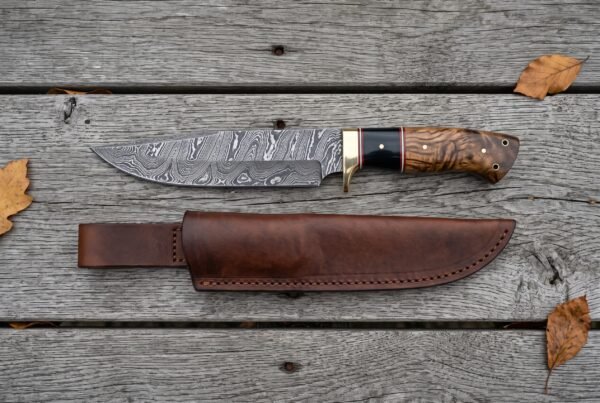
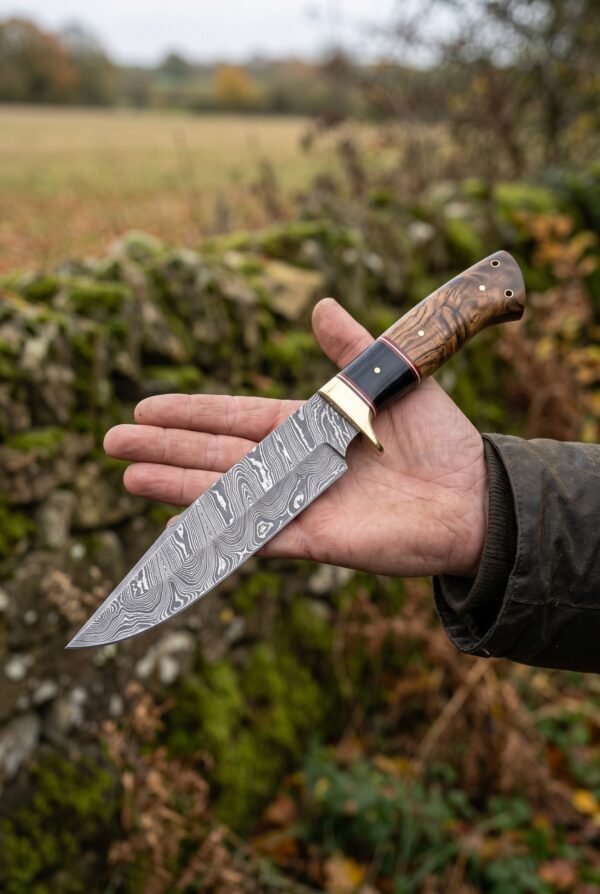
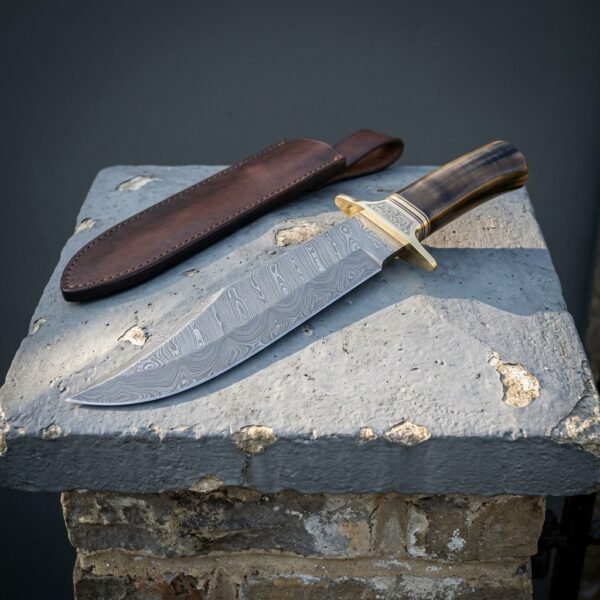
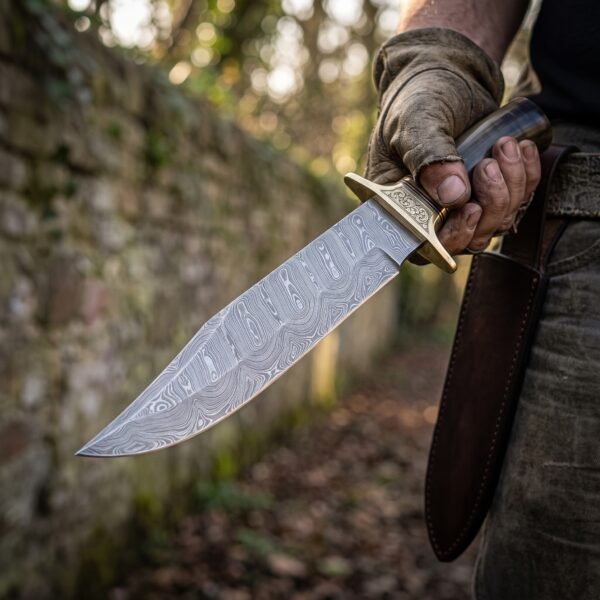
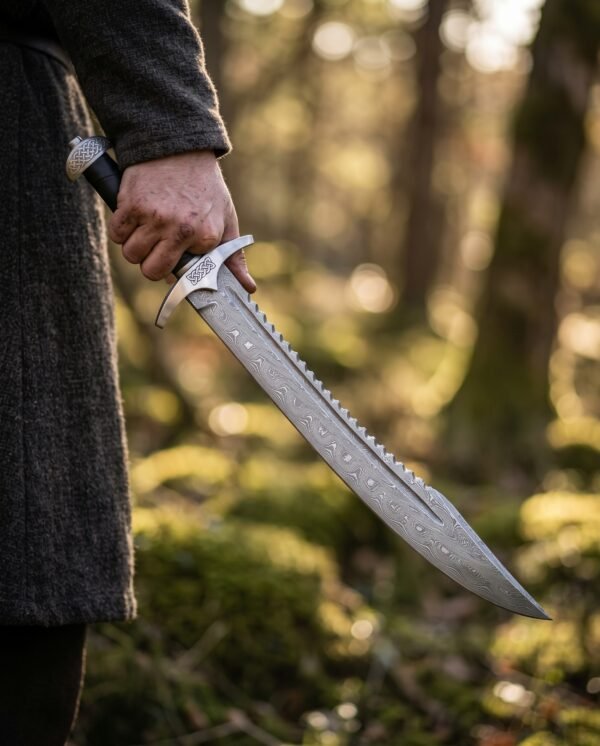
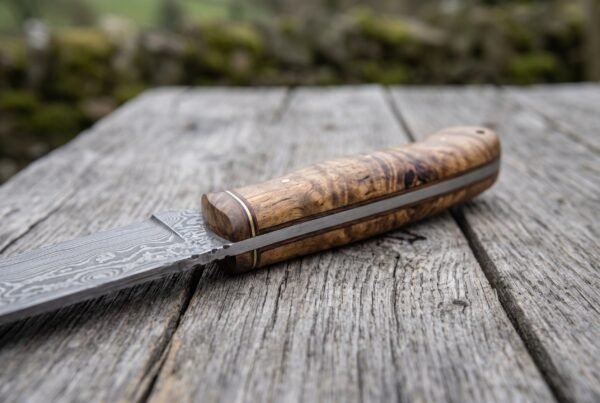
A large bowie in 1095 and 15N20 pattern welded steel, with a deep bellied blade, a long clip running back from the point and a run of Elder Futhark cut across the flat near the spine. The handle is dark rosewood carried between a brass bolster and a brass pommel cap, with a second line of runes cut into the bolster itself, and it comes with a stitched brown leather belt sheath.
The bowie is a genuinely American shape with a genuinely violent origin. It gets its name and its fame from a sandbar on the Mississippi outside Natchez in 1827, where a formal duel collapsed into a general brawl and Jim Bowie, shot and stabbed, killed a man with a big knife and walked away. The newspapers carried it across the country and every smith in the south spent the next decade making something they could call a bowie. The Arkansas smith James Black is the one usually credited with fixing the classic profile: heavy spine, deep belly, long clip. This one is forged, ground, heat treated, etched and fitted in the Czech Republic. It is catalogued with the Bowie knives, and the Damascus knives sit one click away.
Specifications
| Blade steel | 1095 and 15N20 pattern welded damascus, hardened to 58 to 60 HRC |
|---|
| Overall length | Approximately 14 inches |
|---|
| Blade length | Approximately 9 inches, clip point with a deep belly |
|---|
| Handle | Rosewood on a through tang, brass bolster and brass pommel cap |
|---|
| Engraving | Elder Futhark cut across the blade flat and along the brass bolster |
|---|
| Fittings | Solid brass, pinned |
|---|
| Finish | Etched damascus with a hand polished edge bevel |
|---|
| Sheath | Stitched full grain leather, belt carry |
|---|
| Edge | Sharpened and ready to use |
|---|
| SKU | RK-1736 |
|---|
What makes a bowie a bowie
Three features, and every one of them does a job. The first is the clip. The last few inches of the spine are cut away in a concave sweep, which drops the point down towards the centre line of the blade and takes weight off the tip. A knife with a clip point pierces where you are aiming rather than where the mass wants to go, and it gives you a fine point on a knife that is otherwise heavy.
The second is the belly. The edge on this blade does not run straight, it swells outward before it turns up to the point. That curve is what does the work when you are skinning or cutting through hide, because a curved edge presents a slicing angle to the material instead of pushing straight into it. A straight edge on a big knife wants to wedge. A bellied one wants to slice.
The third is the mass. A bowie is heavy behind the edge on purpose, so that a chopping stroke carries through instead of bouncing. That is why it became a camp knife rather than only a fighting knife, and it is why a knife of this size is genuinely useful for splitting kindling, cutting cordage and dressing game rather than being an ornament that happens to have an edge.
Damascus, rosewood and brass
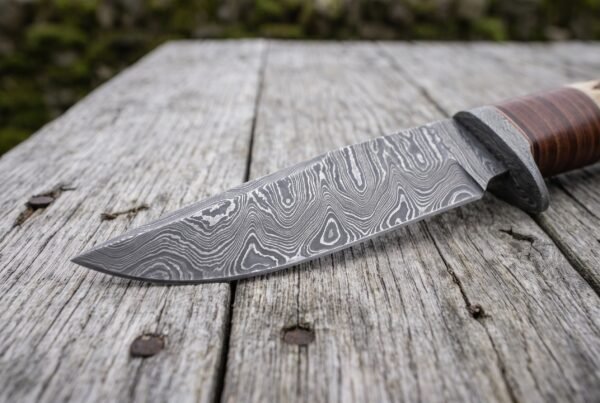
The pattern in the blade is the structure of the steel. Alternating layers of 1095 and 15N20 are forge welded into a billet and then drawn, cut and folded until the layer count is in the hundreds. Manipulating the billet before the final forging is what produces the different patterns: pressing the surface with a die and grinding it back gives a ladder, twisting the bar gives a rose, and simply drawing it out flat gives the long running waves you see here. Once the blade is ground the etch does the rest, darkening the 1095 and leaving the nickel bearing 15N20 bright.
The handle is a single piece of rosewood rather than two scales, drilled and drawn onto a tang that runs the whole way through and is captured by the brass pommel cap. Rosewood is chosen because it is dense, oily and stable, so it does not swell and shrink around the tang the way an open grained timber does, and it takes a polish straight off the abrasive without needing a lacquer. Brass at both ends does two things: it adds weight behind the hand to balance the blade, and it gives a soft non ferrous surface where the hand meets the steel.
The runes are cut into the brass bolster rather than stamped, so they have a clean shoulder and they hold a shadow. Cutting brass takes a slower feed than cutting steel and the swarf has to be cleared constantly, which is why so many production knives print their marks on the blade instead.
Engraving, runes and your own design
Use the rune converter on this page to turn a name, a date or a short phrase into Elder Futhark and we will cut it into the steel, the leather or the wood. If you would rather have a Viking pattern than a rune line, choose your own design in the engraving option above the add to cart button and tell us where it goes. Where a piece already carries an engraved design, your chosen engraving replaces it rather than sitting alongside it. On this knife that means your text takes the place of the Futhark row on the brass bolster, or the row on the blade flat, whichever you pick. See the engraving page.
Handling and balance
The brass at both ends of the handle pulls the balance back towards the bolster, so the knife does not hang forward the way an unbalanced big blade does. Held normally the pivot sits close to the front of the grip, which means the point is easy to place and the belly still has enough mass to chop with.
For fine work, choke up so your thumb sits on the spine behind the clip. The spine is left with a square shoulder there rather than rounded off, which gives the thumb something to press against and stops it sliding forward. For chopping, slide the hand back so the pommel cap sits under the heel of your palm and let the weight of the blade do the work rather than swinging harder.
The sheath is a belt sheath with a welt in the seam, which is the strip of leather sandwiched between the two faces along the edge side. The welt is what keeps the edge from cutting the stitching from the inside, and a sheath made without one will saw itself apart within a season.
Care
Carbon steel damascus is not stainless and it will rust if you let it. Wipe the blade dry after every use, and especially after cutting anything acidic or after handling it with bare hands, because skin oil will etch a fingerprint into an etched flat within a couple of days. Then put a thin film of mineral oil over it. There is more detail on steel care.
Do not store the knife in the leather sheath for long periods. Vegetable tanned leather is slightly acidic and it holds moisture, and a knife left sheathed in a damp garage will come out spotted. Feed the sheath with a leather balm two or three times a year and let it dry properly if it ever gets soaked. Sharpen on a stone at the angle the bevel already carries rather than trying to reprofile it, and finish with a few passes on a strop.
Made in the Czech Republic
This is a handmade piece from the Czech Republic, made in a workshop that still forges, grinds and finishes by hand instead of stamping parts out. The smiths there have kept the older way of working, and the wood, horn and leather are shaped and fitted by hand as well. Two pieces of the same design will never be identical, and that is part of what you are buying.
Ransack Viking is a United States company. We handle the import ourselves, look over every piece when it lands and ship from our warehouse in Chicago, Illinois. Engraving is done in the United States after the piece arrives, so your design goes on before we send it out.
A note on handmade variation
This knife is hand made, not machine made and not bulk produced, so what arrives will not be a pixel for pixel copy of the photograph. Damascus never repeats. The waves in your blade will run at their own spacing and turn at their own places, because the billet moved its own way under the hammer. Rosewood varies from near black to a deep red brown and the grain will be its own. The leather will take the dye at its own depth. The dimensions, the steel and the build are the same every time. The character is not. If you want the longer version, look at the Bowie knives worth having and then at the blade shapes guide.
Frequently asked questions
Is it sharp out of the box
Yes. It arrives with a working edge straight off the stone and the strop.
Is the sheath included
Yes. The stitched full grain leather belt sheath comes with the knife.
Can I actually use it or is it a display piece
Use it. This is a working bowie with a proper heat treat and a welted sheath, sized for camp and field work as much as for a shelf.
Will the damascus pattern wear off
No. The pattern is the layer structure of the steel and it goes all the way through. Sharpening reveals fresh pattern rather than removing it.
How do I stop it rusting
Wipe it dry after use and keep a thin film of oil on the blade. Do not store it in the sheath.
Can I have a name cut into the bolster
Yes. Use the rune converter above for Elder Futhark, or choose your own design in the engraving option. Your text replaces the existing rune row.
What is in the box
- Riverclaw hand forged damascus bowie knife
- Stitched full grain leather belt sheath with a welted seam
- Blade wiped and oiled for transit
- Lifetime warranty against defects in the forging, the grind, the heat treat and the fittings, with no end date and no receipt needed
- Forged and finished in the Czech Republic
Explore the range
See the rest of the bowie knives, the Viking knives, the hunting knives and the guides.
Also in this part of the catalogue
Worth putting side by side with this is the Bonecreek bowie knife, 15 inches overall. In the same category sits the Bonecliff bowie knife, 13 inches overall. A near match for this one is the Cordfang bowie knife, 12 inches overall.
For a different piece from the same family, look at the Ringwolf Anglo Saxon piece. Or start from a blank sheet on the custom Damascus knife page.

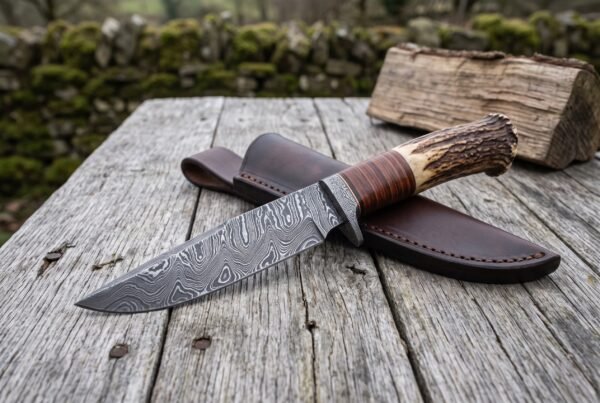
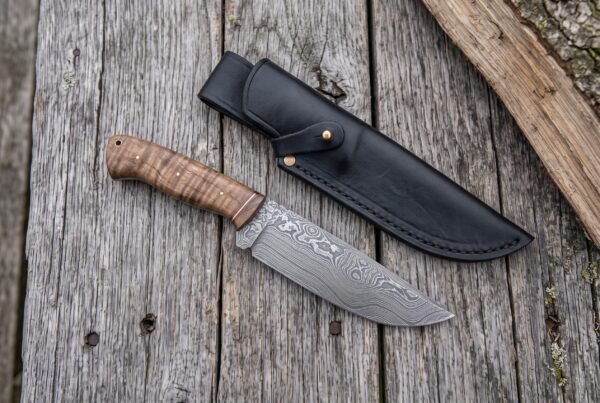
Was nervous ordering something like this online but so glad I did. This is my third order from Ransack Viking and they never disappoint. Shipping was fast and everything arrived well packaged.
Was nervous ordering something like this online but so glad I did. Leather sheath is thick and well stitched. Not the cheap stuff you usually get. Already planning my next purchase from this shop.
I collect stuff like this and this knife is on another level. Weight and balance make it feel like a real functional piece not some cheap replica. Even the small engravings are crisp and clean. Leather sheath is thick and well stitched. Not the cheap stuff you usually get. Shipping was fast and everything arrived well packaged.
Five stars isn’t even enough honestly. Damascus blade holds a razor edge right out of the box. Fit and finish is museum quality. You can tell real craftsmen made this by hand. Leather sheath is thick and well stitched. Not the cheap stuff you usually get. Great buy overall.
This knife is a genuine work of art. Weight and balance make it feel like a real functional piece not some cheap replica. Can’t recommend this enough.
Photos don’t do this knife justice at all. Leather sheath is thick and well stitched. Not the cheap stuff you usually get. Came in a nice gift box which made it feel even more special. Fit and finish is museum quality. You can tell real craftsmen made this by hand. Couldn’t be happier with this.
I collect stuff like this and this knife is on another level. Came in a nice gift box which made it feel even more special. This will be a family heirloom for sure.
Perfect gift. Perfect quality. No complaints. Love that this is Czech craftsmanship and shipping from the US meant it showed up in just a few days.
Showed up right on time and looked even better than the photos. Couldn’t be happier with this.
Absolutely blown away by this knife. Edge retention has been great even after regular use. Fit and finish is museum quality. You can tell real craftsmen made this by hand. The rosewood handle feels amazing and the balance is perfect. Worth every penny.