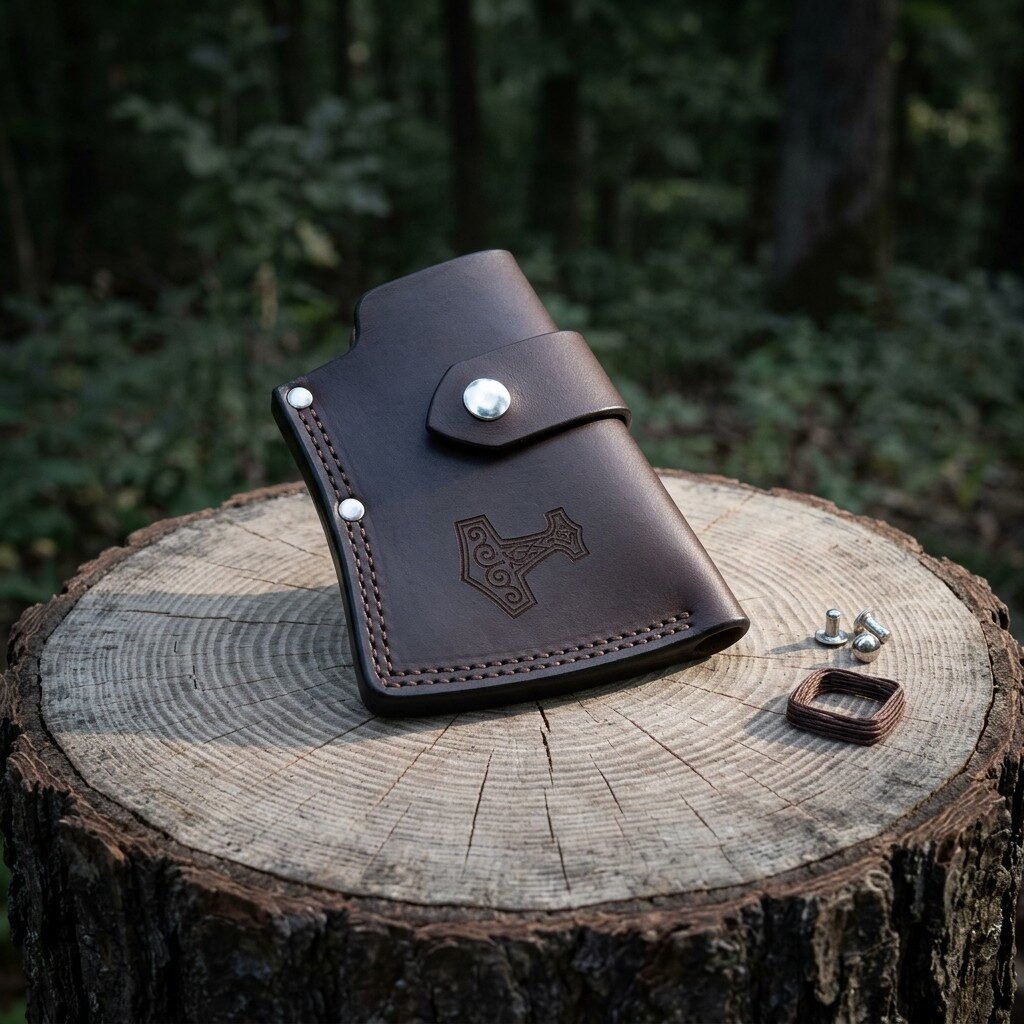
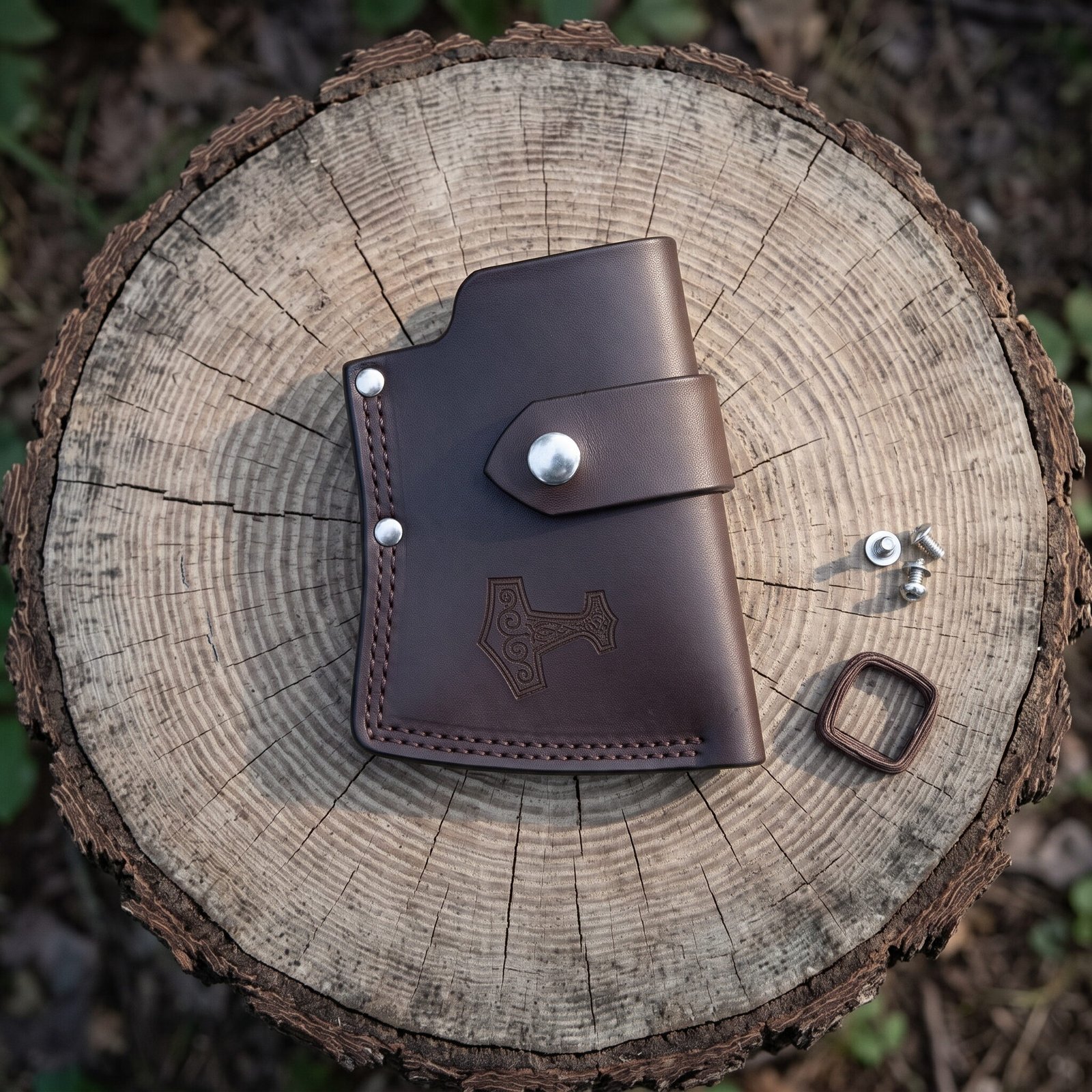
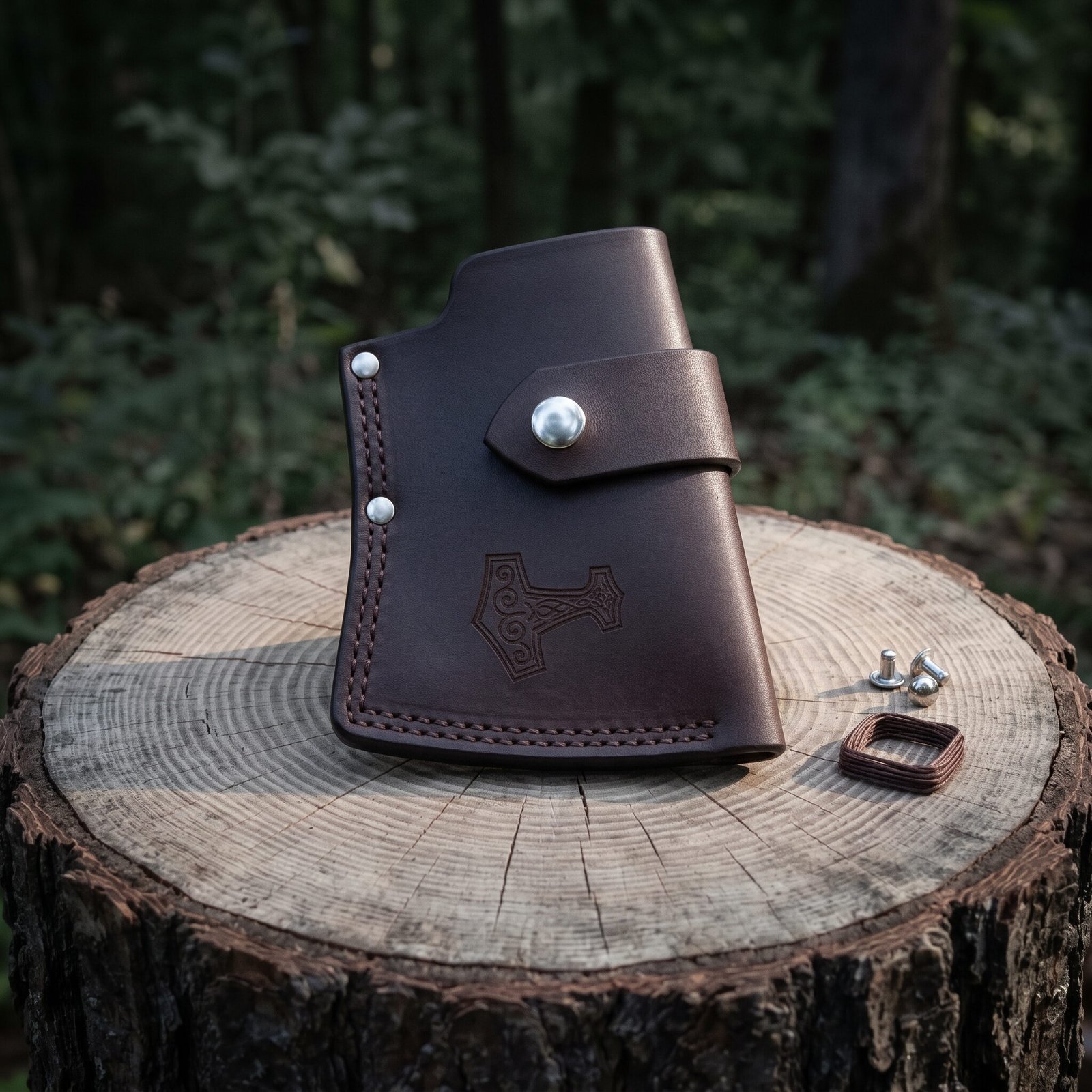
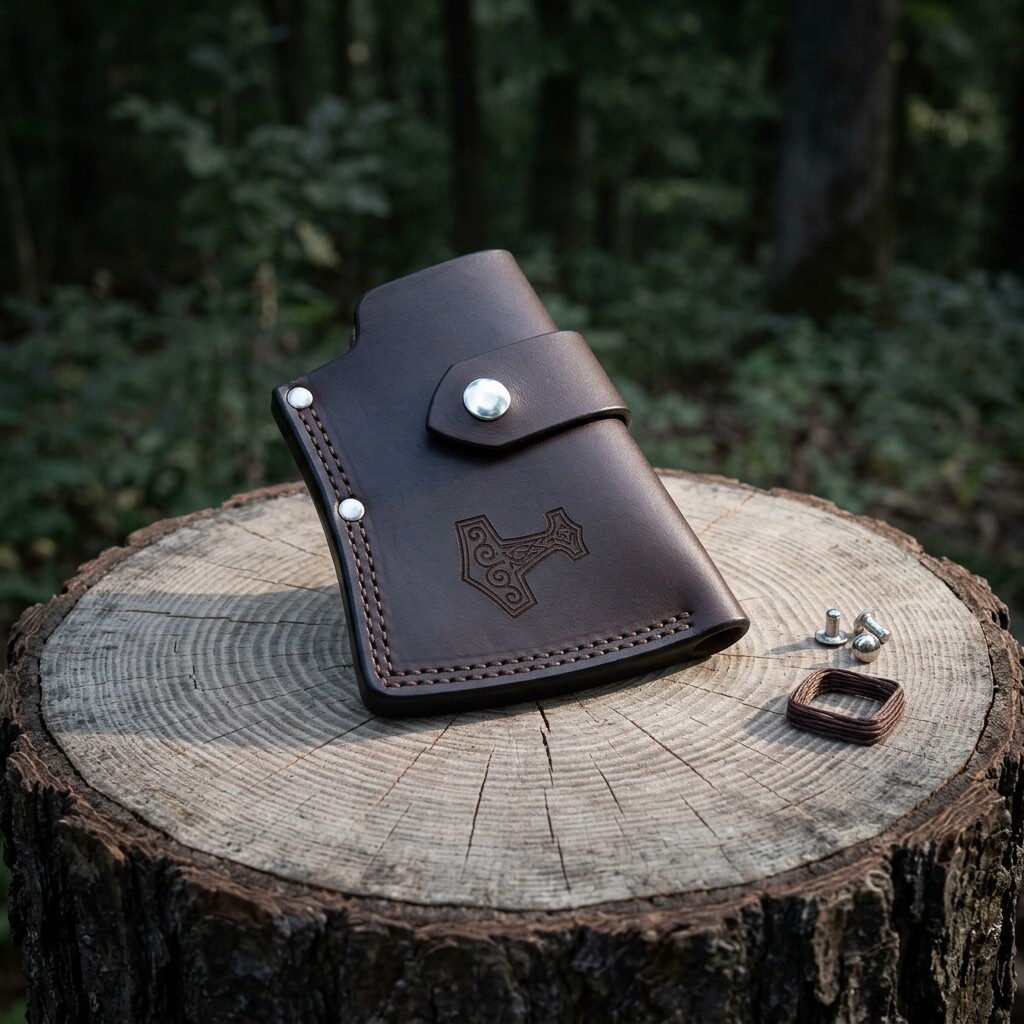
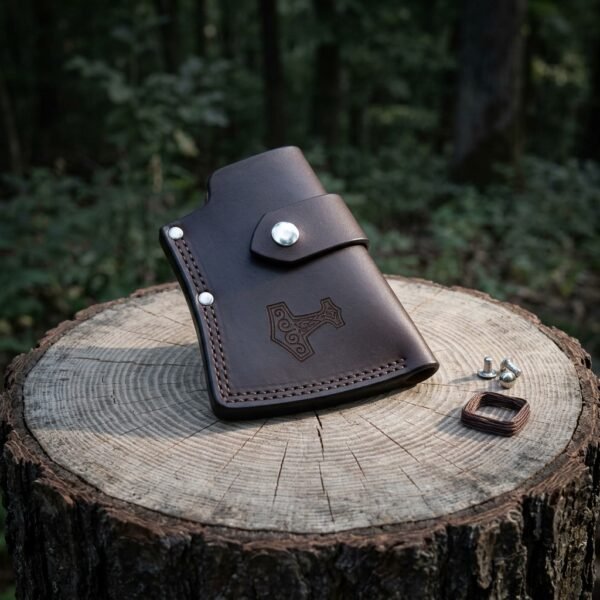
The Haftmask is an axe head sheath, sometimes called a mask or an edge guard, cut from dark brown vegetable tanned bridle leather and closed with a steel snap strap that wraps behind the haft. A Mjolnir is tooled into the face. The body is shaped with a notch at the back so it sits over a bearded head and hugs the beard rather than gapping away from it. It is sold on its own. The axe in the photographs is not included.
An axe mask does two jobs and most people only think about one of them. The obvious job is protecting you, your pack, the inside of a car boot and anything else in reach from an exposed edge that is designed to split wood. The less obvious job is protecting the axe. A bare edge knocking around in a bag or a rack rolls and nicks, and every nick is metal you have to grind away later. Norse and later Scandinavian carpenters kept their heads sheathed for the same reason a joiner keeps chisels in a roll.
Cut, tooled, wet formed, stitched and burnished in the Czech Republic. It ships with a spare pair of snap studs and a care card. It lands in the axe handles and hafts, with the Viking axes close enough that people usually look at both.
Specifications
| Material | Dark brown vegetable tanned bridle leather, roughly 9 to 10 ounce weight |
|---|
| Fits | Bearded and straight axe heads up to roughly a 6 inch cutting edge |
|---|
| Shape | Notched at the back to sit over a bearded head and follow the beard |
|---|
| Closure | Leather strap with a single steel snap, passing behind the haft and fastening on the face |
|---|
| Construction | Wet formed body around a full leather welt |
|---|
| Stitching | Two rows of hand saddle stitching along the edges |
|---|
| Rivets | Two steel rivets reinforcing the back edge |
|---|
| Tooling | Mjolnir with knotwork, stamped and cut into the face panel |
|---|
| Finish | Hand burnished and slicked edges, sealed and waxed |
|---|
| Included | Axe sheath, spare snap studs, care card. Axe not included |
|---|
| SKU | RK-1721 |
|---|
Why an axe mask is wet formed rather than just stitched flat
Vegetable tanned leather has a property that chrome tanned leather does not, which is that it can be soaked, shaped over a form and dried, and it will hold that shape permanently. The technical name is wet forming or moulding, and it works because the collagen fibres in vegetable tanned hide are relatively free to move when they are wet with warm water and then lock in place as the leather dries and the tannins set around them.
For an axe mask this is the whole trick. A flat envelope stitched from two panels will fit an axe head loosely, rock on the bit and eventually work itself off in a pack. A wet formed body has the shoulders of the axe pressed into it, so the leather grips the cheeks of the head and the notch at the back sits down into the hollow behind the beard. That is what stops it walking off. It also means the mask stands up on a bench rather than collapsing, which is why the one in the photograph is standing on its own. The same full welt used on our knife sheaths runs around the cutting edge so the stitching is never in the path of the edge.
The leather and the hardware
This is 9 to 10 ounce bridle leather, roughly four millimetres thick, which is a step heavier than the hide used for knife sheaths. An axe edge concentrates a great deal of weight behind a short cutting edge and it deserves the extra material. Bridle leather is vegetable tanned hide that has then been stuffed with waxes and oils through the full thickness, which is why it feels dense and slightly waxy in the hand and why it darkens with age instead of drying out and cracking at the fold.
The hardware is steel. The snap studs are set through both faces at the stress points, and the strap is long enough to pass behind the haft and pull the mask down tight against the cheeks rather than just hanging on the bit. Every stitch is a hand saddle stitch in waxed thread, two needles through one hole, which is the only stitch that does not unravel when a single thread is cut. Machine lock stitch will run if it is nicked. Saddle stitch will not.
Engraving, runes and your own design
Use the rune converter on this page to turn a name, a date or a short phrase into Elder Futhark and we will cut it into the steel, the leather or the wood. If you would rather have a Viking pattern than a rune line, choose your own design in the engraving option above the add to cart button and tell us where it goes. Where a piece already carries an engraved design, your chosen engraving replaces it rather than sitting alongside it.
The face of this mask is a good sized flat panel and it takes a rune line very cleanly along the lower edge under the hammer, or up the closure strap. Names and dates are the usual request, often on an axe given as a gift. If you want your own design in place of the Mjolnir, it replaces the Mjolnir rather than sharing the panel. See the engraving page.
Fit and sizing
It is cut to fit axe heads with a cutting edge up to about six inches, measured from toe to heel around the curve of the bit, and a head depth of up to about four and a half inches from edge to eye. That covers most bearded axes, most hand axes and most hatchets. It will fit a smaller head than that happily, because the strap takes up the slack behind the haft.
What it will not fit is a broad axe, a felling axe or a double bit head. Measure yours before ordering. Lay a tape along the curve of the edge for the first figure and across the cheek from edge to eye for the second. If either is close to the limits, put the numbers in the order notes and we will check before we cut, or make it to your measurements if it needs to be a size up.
Care
Feed the leather two or three times a year with a neutral leather balm or conditioner, worked in with the fingers, left to soak in and buffed off. Bridle leather is already stuffed with wax so it needs less than a dry hide would, but the fold at the strap is the place that will crack first if it is neglected.
Do not store the axe head in the mask when the steel is wet or the leather is damp. Leather holds moisture against steel and vegetable tanned hide is faintly acidic, which is a recipe for rust spots on a carbon steel bit. Dry and oil the axe head first, then sheath it. If the mask itself gets soaked, dry it slowly at room temperature and away from any heat, never on a radiator or in a hot car, or it will go hard and stay hard.
Made in the Czech Republic
Every piece we sell is made by hand in the Czech Republic. The smiths there work the way the trade has been worked for a long time, heating and hammering the steel, taking the bevels down by eye, and fitting the handle and the leather one at a time. There is no automated line anywhere in it, so small differences from one piece to the next are normal and expected.
Ransack Viking is a United States company based in Chicago, Illinois. We bring the pieces in ourselves, inspect them on arrival and ship them from our own warehouse. If you add engraving, that is carried out here in the United States before your order goes out.
A note on handmade variation
This is hand made, not machine made and not bulk produced, so what arrives will not be a pixel for pixel copy of the photograph. Leather is skin, and every hide carries its own grain, its own healed marks and its own way of taking dye. Dark brown can land anywhere from a warm chestnut to something close to espresso depending on where in the side the panel was cut.
The Mjolnir is stamped by hand so its impression sits a fraction differently every time, and the wet forming leaves each body with its own slight character around the shoulders. What stays the same is the leather weight, the welt, the saddle stitch, the hardware and the fit range. The rest is the difference between a made object and a moulded one. For the detail behind that, see keeping Damascus from staining, and safety and storage alongside it.
Frequently asked questions
Is an axe included
No. This listing is the leather axe sheath on its own. The axe shown in the photographs is a separate product.
Will it fit my axe
If the cutting edge is no more than about six inches around the curve and the head is no deeper than about four and a half inches, yes. Measure both before ordering and give us the numbers in the order notes if either is close to the limit.
Will it stay on in a pack
Yes. The body is wet formed to grip the cheeks of the head and the snap strap passes behind the haft and pulls it down tight, so it does not walk off the way a loose flat envelope does.
Can I leave the axe stored in it
Yes, as long as both are dry. Leather holds moisture against steel, so oil the head and make sure the leather is dry before you sheath it for a long period.
Can I have runes instead of the hammer
You can have runes as well as the hammer, along the lower edge or the strap, or you can have your own design in place of the Mjolnir. Your chosen design replaces the hammer rather than sitting beside it.
How long does shipping take
One to two weeks, because it is cut, tooled, formed and stitched after you order. US shipping is free.
What is in the box
- One hand made dark brown bridle leather axe sheath with a tooled Mjolnir
- Wet formed body with a full welt and a steel snap closure strap
- Spare pair of steel snap studs and a care card
- Lifetime warranty against defects in the making
- Made and finished in the Czech Republic
Explore the range
See the rest of the scabbards and sheaths, the axe handles and hafts, the viking axes, and the guides for more on caring for an axe.
Others in the same line
Worth putting side by side with this is the Bindwood haft. In the same category sits the Knotgrain haft.
For a different piece from the same family, look at the Twinbite battle axe. You can have this made your way instead on the custom Viking axe page.


Got this as a birthday gift and the reaction was priceless. Came in a nice gift box which made it feel even more special. Highly recommend this one.
This axe is a genuine work of art. Leather sheath is thick and well stitched. Not the cheap stuff you usually get. 10/10 would buy again.
Showed up right on time and looked even better than the photos. Steel blade holds a razor edge right out of the box. Shipping was fast and everything arrived well packaged.
Been eyeing this axe for months and it did not disappoint. The wood handle feels amazing and the balance is perfect. Couldn’t be happier with this.
Knew this axe was special the second I opened the box. The wood handle feels amazing and the balance is perfect. Leather sheath is thick and well stitched. Not the cheap stuff you usually get. So worth it.