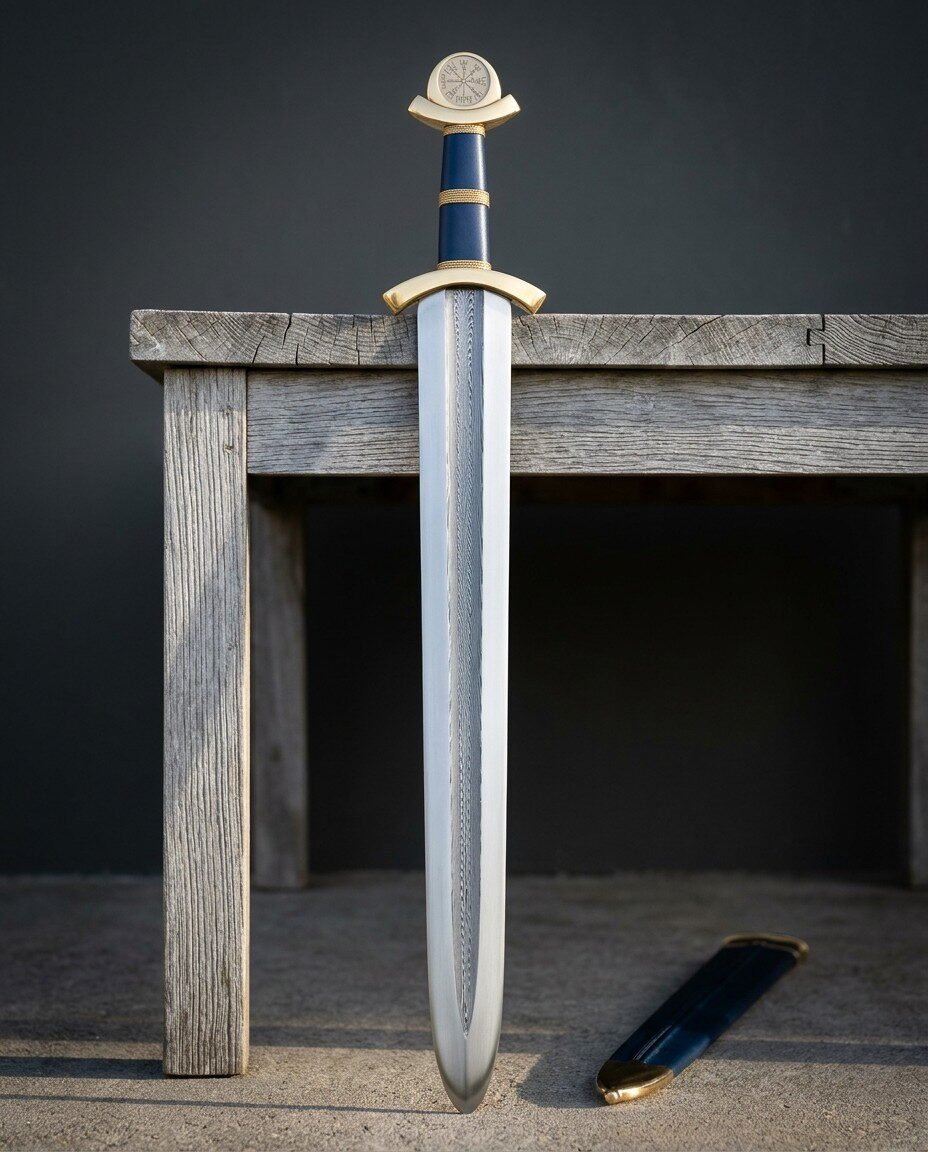
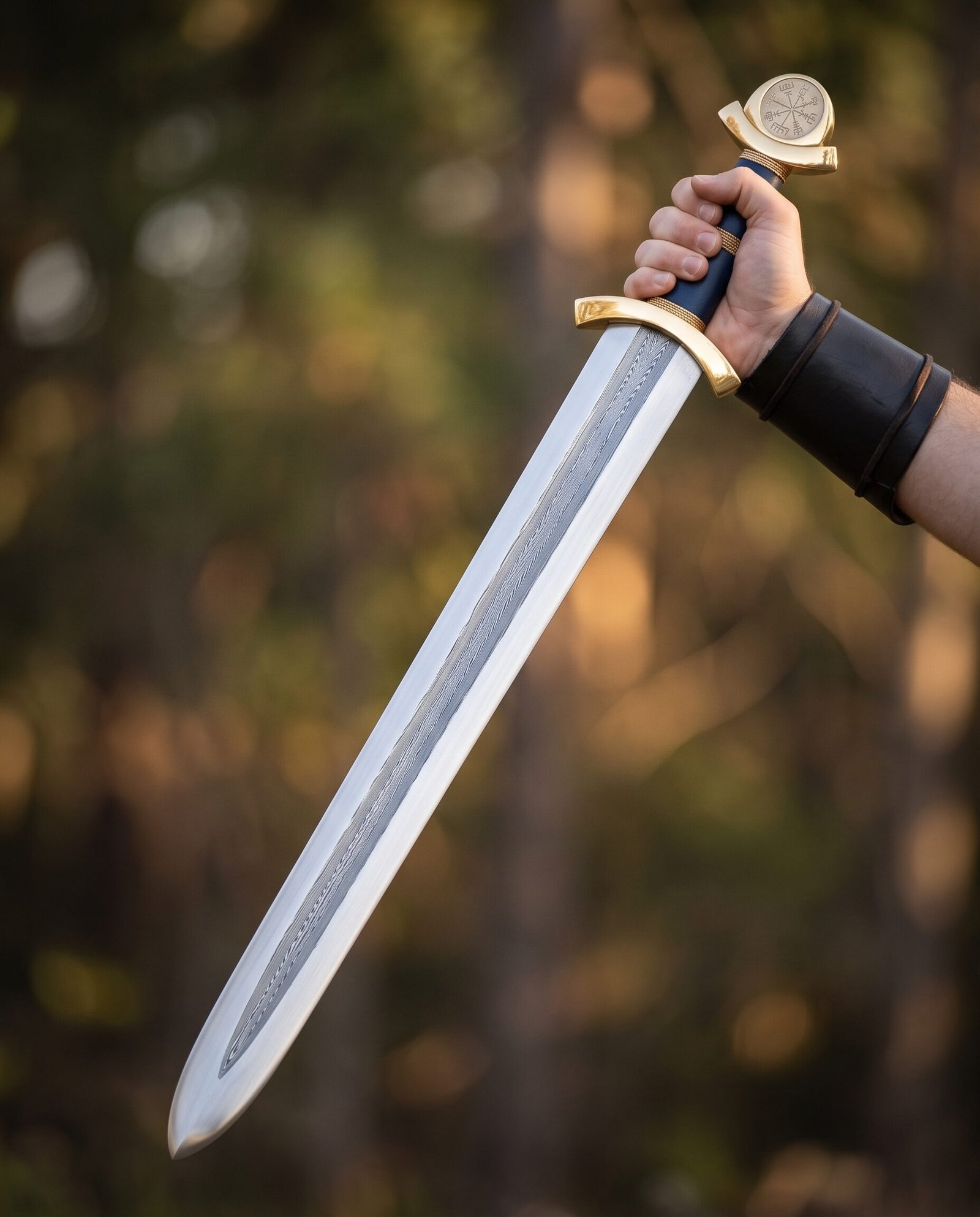
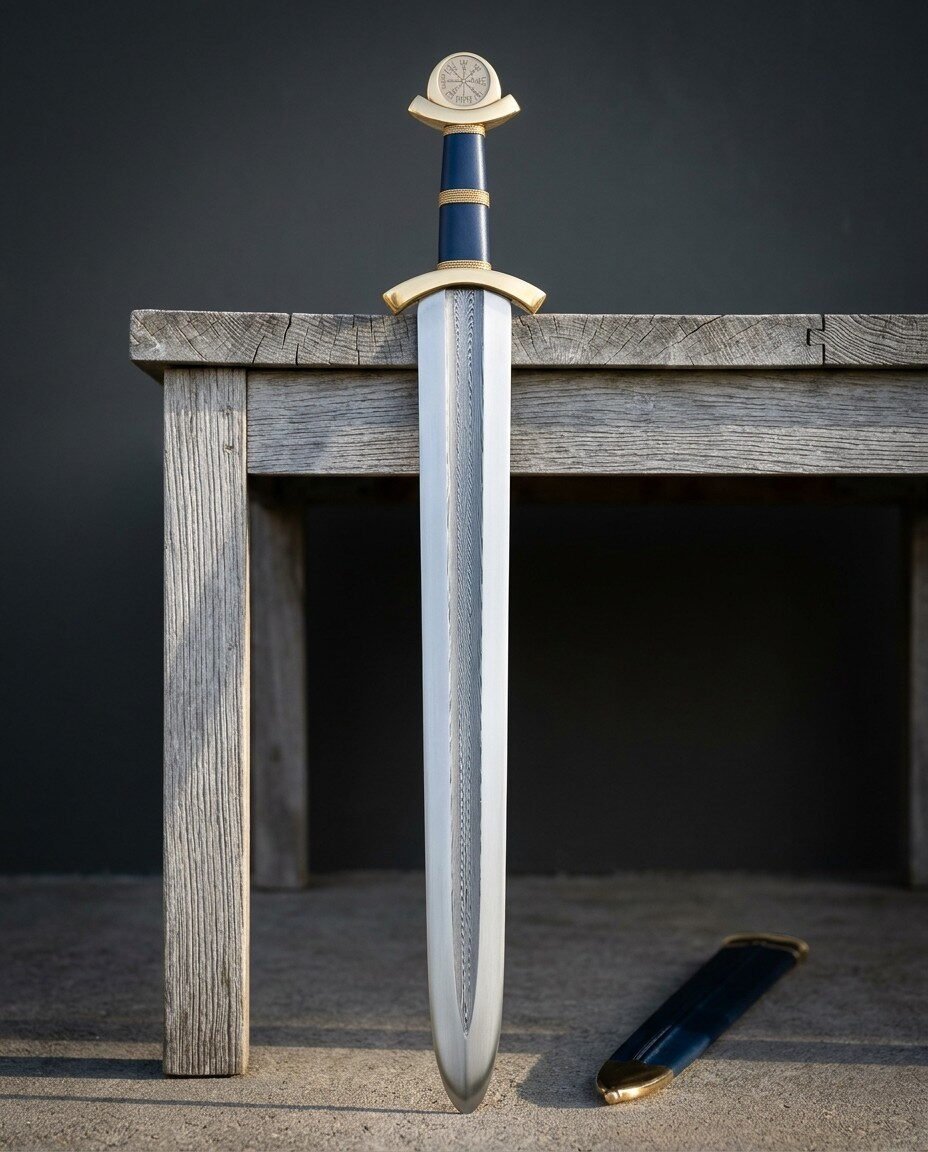
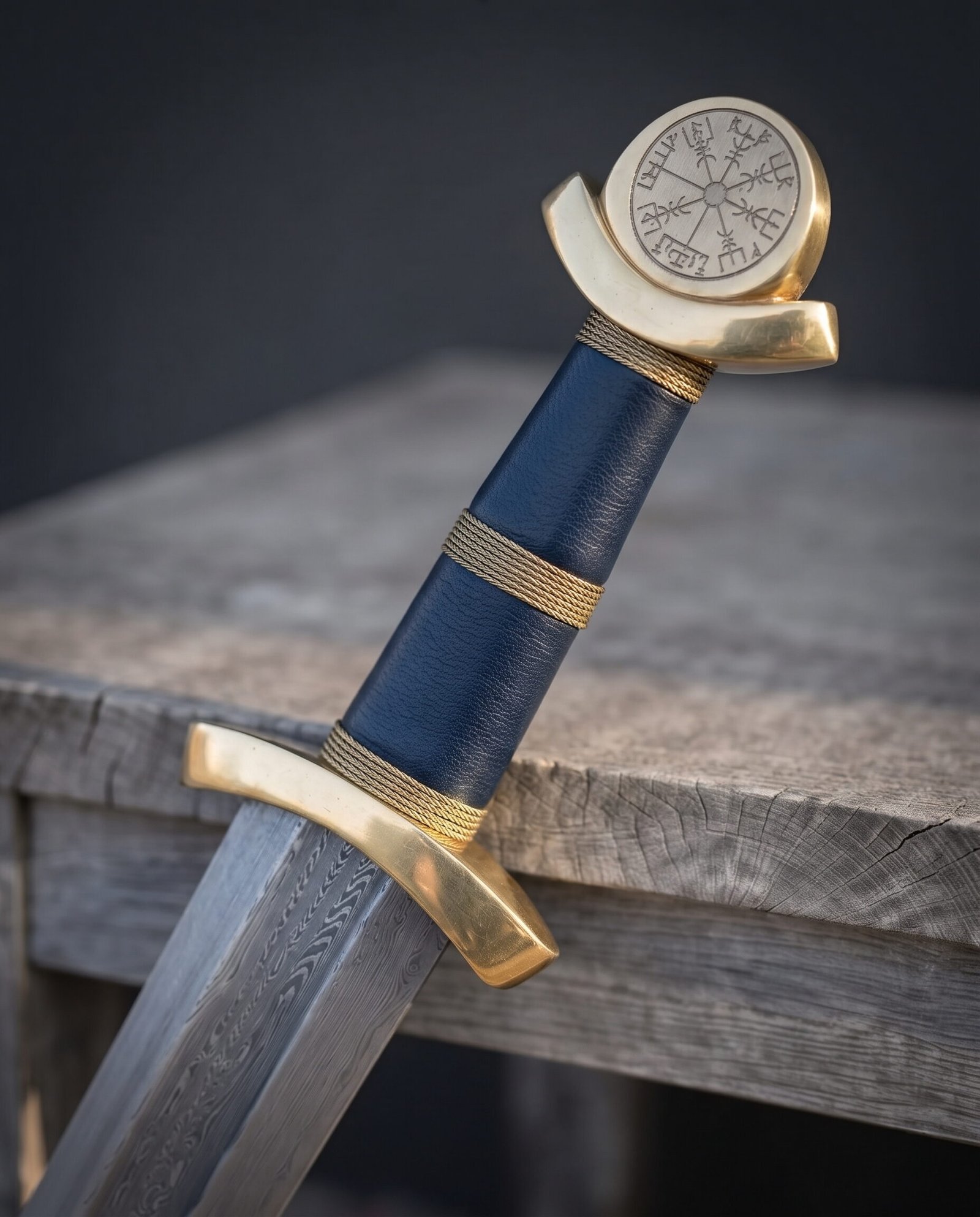
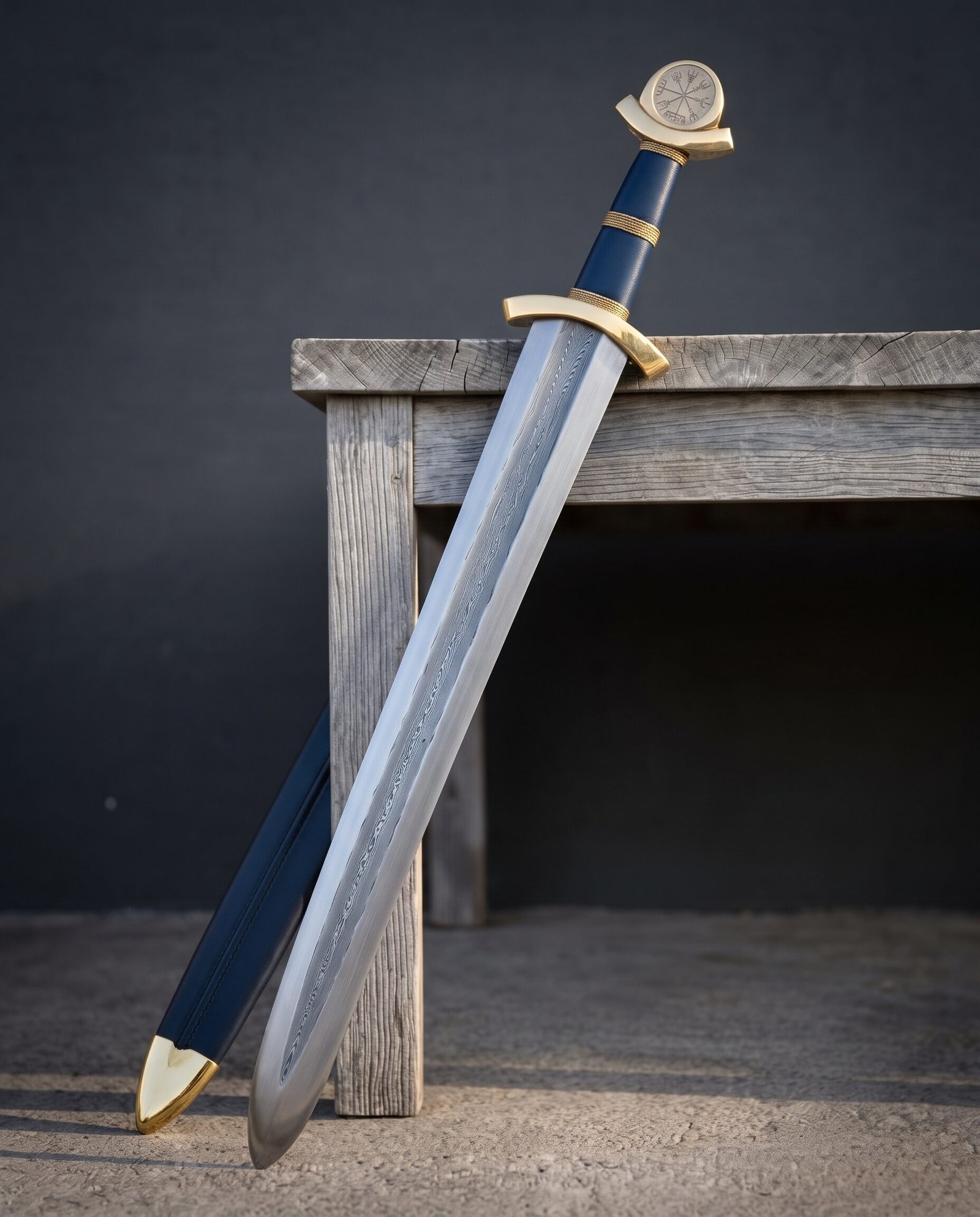
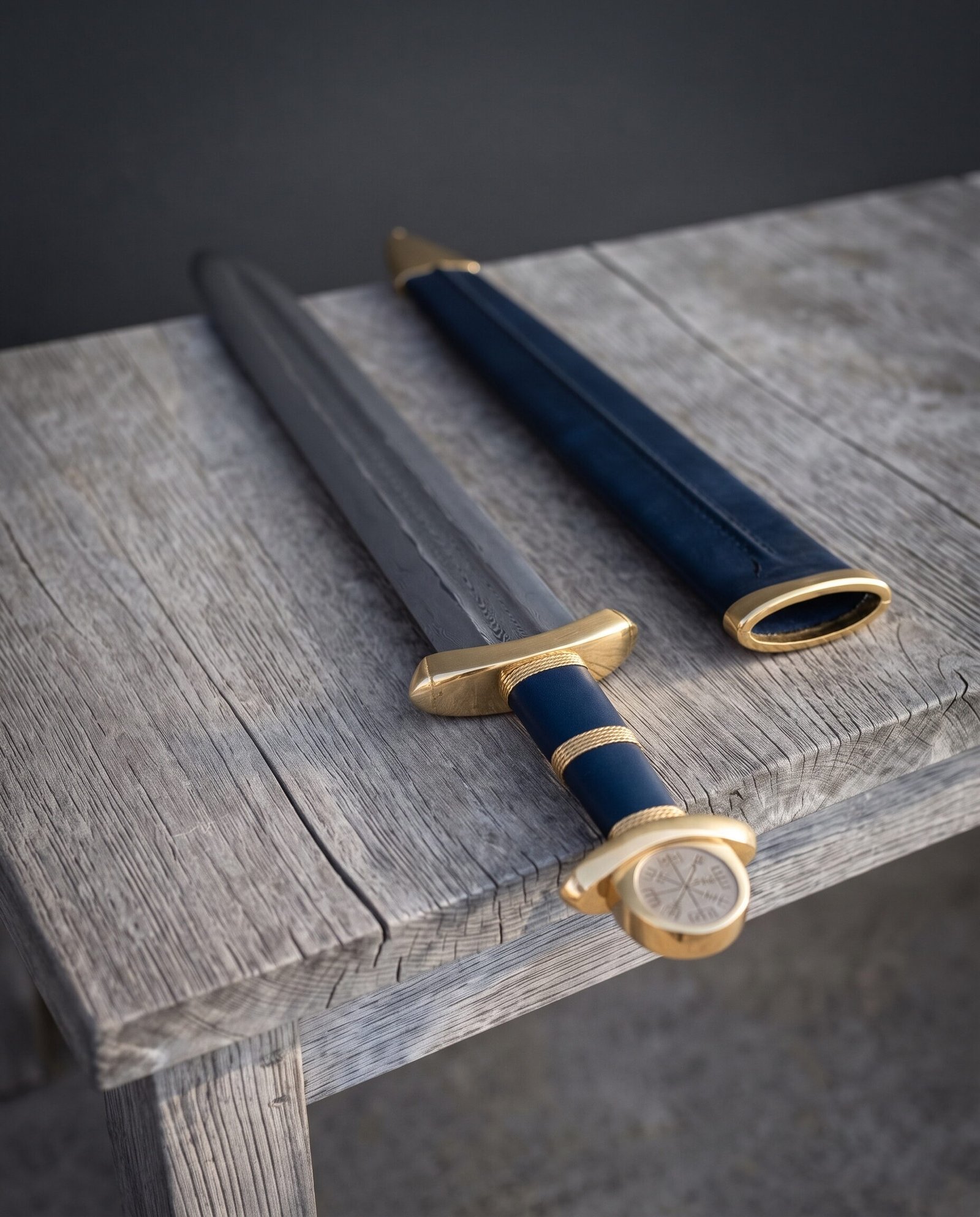
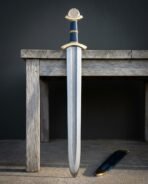
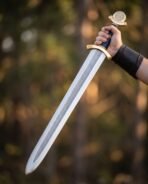
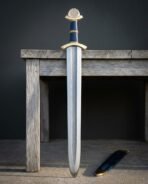
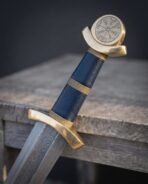
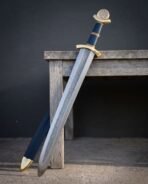
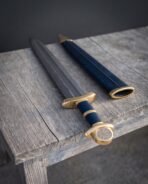
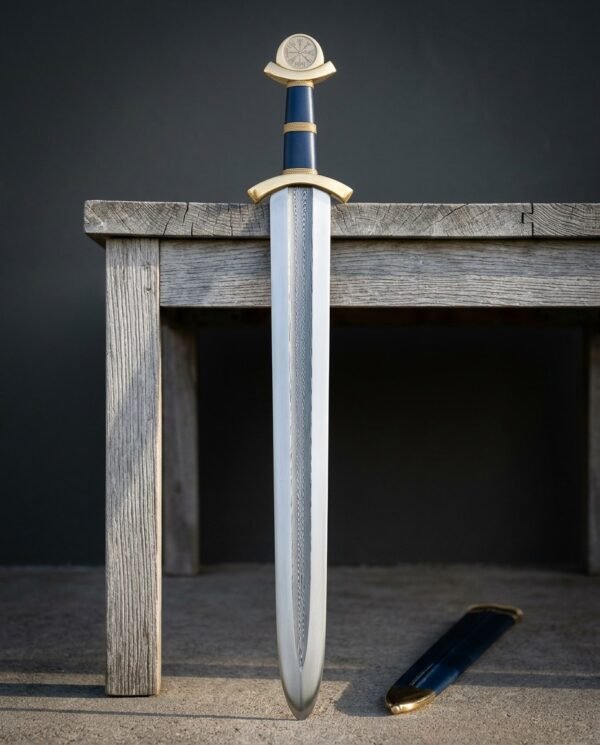
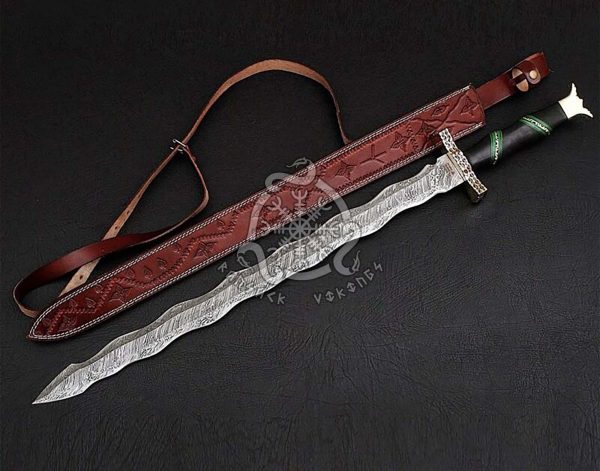
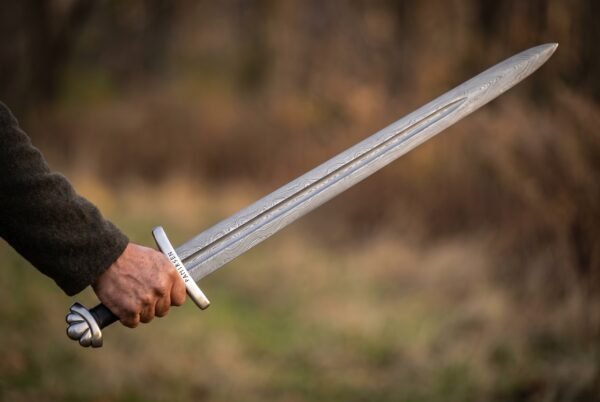
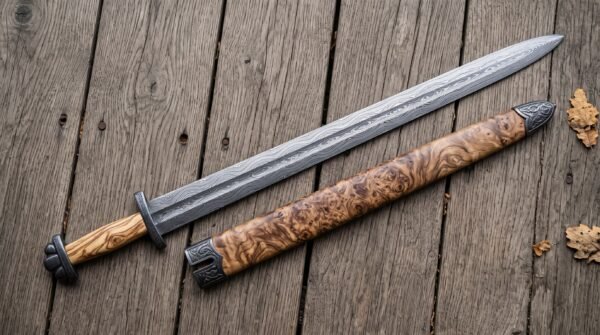
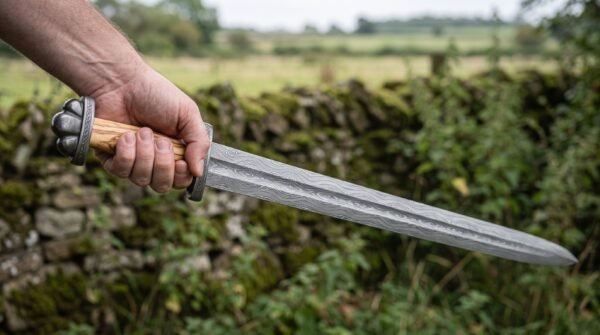
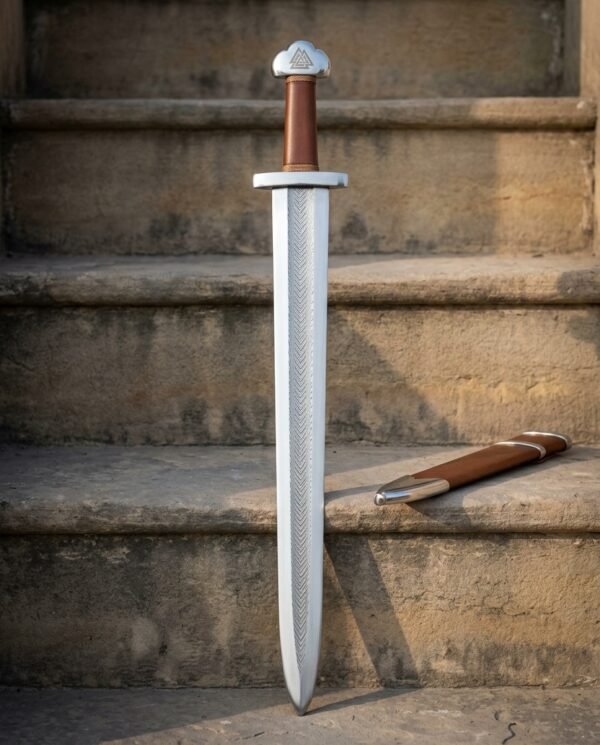
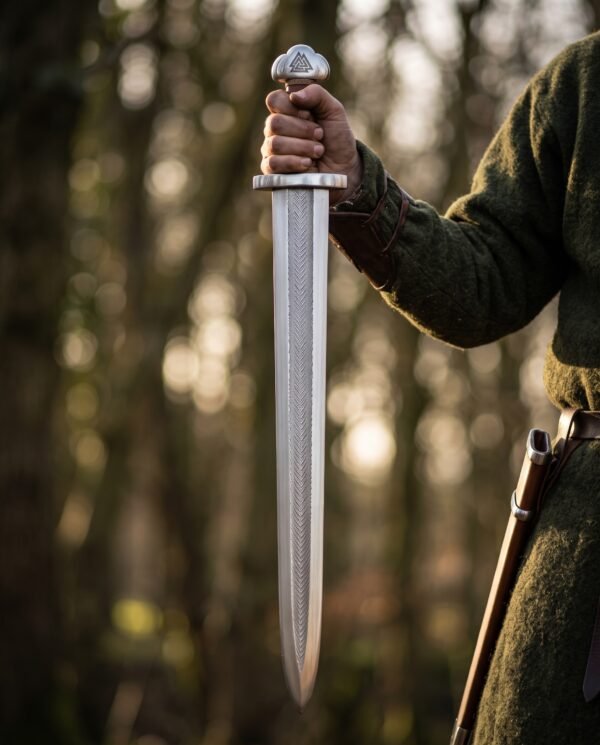
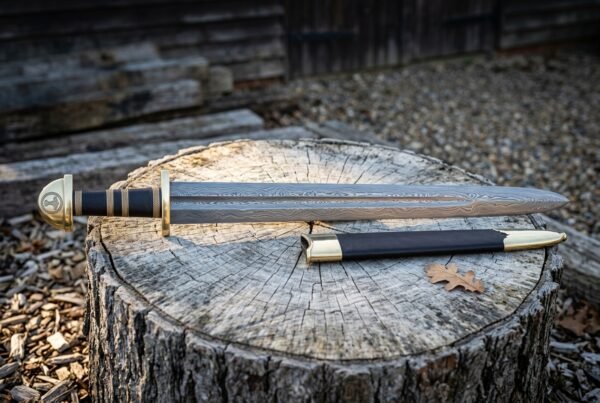
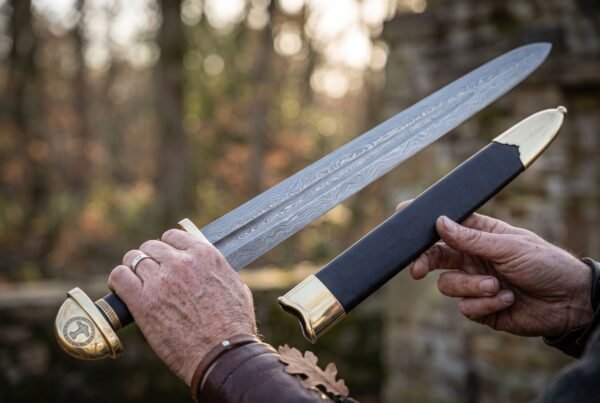
This is a Viking sword with a pattern welded core. The blade is broad, double edged and leaf profiled, and running down the middle of it is a narrow band of forge welded 1095 and 15N20 that shows as a fine chevron pattern in a shallow fuller. The hilt is brass throughout, a curved crescent lower guard, twisted brass wire rings binding a blue leather grip, and a brass disc pommel set in a crescent upper guard, carrying an engraved runic compass stave on its face. It ships in a blue leather scabbard with a brass throat and chape.
The core is not a decoration and it is the reason a sword like this existed. Viking age smiths were working in a world where good steel was scarce, expensive and unevenly carburised, so they built blades out of several pieces rather than one. Rods of iron and steel were twisted, forge welded side by side to make a core, and then hard high carbon edges were welded onto either side of that core. The result was a blade with a tough, flexible spine and a hard cutting edge, made from materials that individually could not have done both. When the finished sword was polished and etched, the twisted rods showed as a rippling pattern down the centre, and the sagas call that the serpent in the blade.
Forged, welded, ground, heat treated, etched, hilted and finished by hand in the Czech Republic, and shipped with its scabbard. Kept with the Damascus swords, and worth setting against the Viking swords before you decide.
Specifications
| Blade steel | 1095 and 15N20 Damascus, pattern welded, hardened to 58 to 60 HRC |
|---|
| Overall length | 34 inches nominal |
|---|
| Blade length | 27 inches nominal, broad and double edged |
|---|
| Blade profile | Leaf shaped with a shallow central fuller carrying the pattern welded core band and a rounded point |
|---|
| Guard | Curved brass lower guard, crescent shaped and sweeping toward the blade |
|---|
| Grip | Blue leather over a wooden core, bound with two twisted brass wire rings and brass wire at both ends |
|---|
| Pommel | Brass disc set in a crescent brass upper guard, the disc face engraved with a runic compass stave, peened over the tang |
|---|
| Finish | Satin polished blade with an etched core pattern, polished brass fittings |
|---|
| Scabbard | Blue leather with brass throat and brass chape |
|---|
| SKU | RK-1785 |
|---|
The twisted core, and what the pattern is telling you
Look closely at the band running down the centre of the blade and you will see repeating chevrons rather than a random swirl. That shape is the fingerprint of a twisted rod. Take a bundle of thin alternating bars, forge weld them into a single square rod, twist it while hot, then flatten it and grind the surface back. Every twist brings a different layer to the surface, and the ground face reveals a regular herringbone.
Norse smiths went further than that. They twisted rods in opposite directions and laid them side by side so the chevrons met and mirrored, they alternated twisted and straight sections along a blade, and on the very best surviving pieces they built patterns that repeat down the whole length with real precision. This is not folk art. It is a controlled process by people who knew exactly what they were doing.
Two things follow from it. The first is that the pattern is proof of construction rather than an applied finish. It exists because of how the steel was built and it goes all the way through. The second is that the pattern is not the strength. The strength comes from the hard edge steel welded on either side of that core. The core provides the spine.
The famous Ulfberht swords of the ninth and tenth centuries are the interesting counterpoint. Many of them abandon the pattern welded core entirely because the smiths had access to steel of a quality that made the trick unnecessary. The pattern survived anyway, because by then people wanted it.
Steel and hardness
The pattern welded band is 1095 and 15N20. The two are chosen because 15N20 carries about two percent nickel, which does not react to the acid etch, while the 1095 darkens in it. Etch the polished blade and the alternating layers separate visually. Without that difference you would have a perfectly sound weld and nothing to look at.
The blade is hardened to between 58 and 60 HRC. That is at the hard end of what we do, and it is possible here because the blade is broad and the geometry is stiff. It gives you a genuinely keen edge that holds.
Neither steel contains chromium, so this blade will rust if it is neglected, and an etched surface holds a little more moisture in its texture than a mirror polish does. It wants a cloth and a light oil, the same as every historical sword ever made.
Engraving, runes and your own design
Use the rune converter on this page to turn a name, a date or a short phrase into Elder Futhark and we will cut it into the steel, the leather or the wood. If you would rather have a Viking pattern than a rune line, choose your own design in the engraving option above the add to cart button and tell us where it goes. Where a piece already carries an engraved design, your chosen engraving replaces it rather than sitting alongside it.
The pommel already carries a runic compass stave, so an engraving ordered there takes its place. The brass lower guard is the other good surface, and it holds a short line beautifully. We avoid cutting into the pattern welded band itself, because engraving there breaks the very thing the etch exists to show, and we will say so if you ask for it. See the engraving page.
Handling and balance
This is a single hand sword and a broad one. The blade carries its width well down its length, which means it hits hard for its size, and the brass disc pommel is heavy enough to pull the balance back close to the guard so the weight does not run away from you.
Hold it with the web of the thumb against the guard and the last two fingers doing most of the gripping. A Viking sword is a cutting blade rather than a thrusting one, and the point is rounded rather than acute, so the mechanics of using it are all about edge alignment. If the edge is not square to the line of the cut, a broad blade will turn in your hand and tell you about it immediately.
It arrives sharp. It is a real forged and hardened sword. We do not sell it for full contact sparring or reenactment combat, which need blunt rebated blades, and edge to edge contact will chip any hardened steel. Use it for controlled cutting against soft targets, for collecting and for display.
Care
Wipe the blade after every handling and keep a thin film of mineral, gun or camellia oil on it, working from guard to tip with the cloth on the flat rather than the edge. An etched Damascus surface needs slightly more attention than a plain polish because rust finds the texture first. Our steel care notes cover the full routine.
Never use an abrasive pad or a scouring cream on the blade. The etch that reveals the core pattern lives in the top fraction of a millimetre and abrasives take it off permanently.
Brass does not rust but it will tarnish to a deeper gold. Polish it with metal polish on a soft cloth if you want it bright, and keep polish off the leather. Feed the grip and scabbard with a leather conditioner once or twice a year, and do not store the sword in the scabbard for months, because leather holds moisture and the tanning is mildly acidic.
Made in the Czech Republic
Every piece we sell is made by hand in the Czech Republic. The smiths there work the way the trade has been worked for a long time, heating and hammering the steel, taking the bevels down by eye, and fitting the handle and the leather one at a time. There is no automated line anywhere in it, so small differences from one piece to the next are normal and expected.
Ransack Viking is a United States company based in Chicago, Illinois. We bring the pieces in ourselves, inspect them on arrival and ship them from our own warehouse. If you add engraving, that is carried out here in the United States before your order goes out.
A note on handmade variation
This sword is hand made rather than machine made or bulk produced, so what arrives will not be a pixel for pixel copy of the photograph. No two pattern welded cores are the same. The chevrons sit at their own interval, the contrast between the light and dark layers shifts with the etch, and the band wanders a fraction as the steel moves under the hammer. Brass castings finish differently one to the next, and leather takes dye unevenly, so the blue on your grip and scabbard may run deeper or lighter than the picture.
The steel, the hardness, the dimensions and the build are the same every time. The pattern is yours alone. We wrote up how steel and hardness actually work separately, and there is a piece on the Ulfberht blades as well.
Frequently asked questions
Is the pattern real or etched onto the surface?
Real. The core is built from forge welded and twisted layers, so the pattern goes through the steel. Etching only reveals what is already there and it survives sharpening and polishing.
Is it sharp out of the box?
Yes. It ships with a working cutting edge along both edges and should be handled as a live blade from the moment you open it.
Is the whole blade Damascus or just the middle?
The pattern welded band runs down the centre in the historical arrangement, with the edges forged for hardness. That is how Viking pattern welded swords were actually built and it is why the pattern sits where it does.
Is the scabbard included?
Yes. The blue leather scabbard with its brass throat and chape ships with the sword at no extra cost.
Will the blue leather fade?
Direct sunlight will lighten it over years, as it will any dyed leather. Keep the sword out of a sunny window and feed the leather occasionally and it will hold its colour.
Can I have runes cut into the guard?
Yes. The brass lower guard takes a short line cleanly, and the pommel will take one in place of the existing stave. We do not cut into the pattern welded band.
What is in the box
- Fjordgleam Viking sword, pattern welded core, sharpened
- Blue leather scabbard with brass throat and chape
- Light protective oil coat on the blade
- Damascus, brass and leather care card
- Forged and finished in the Czech Republic
Explore the range
See the rest of the Viking swords, the Damascus swords, the sword stands and displays, and the guides.
Near neighbours in the shop
A near match for this one is the Wolfrune Viking sword, 36 inches overall. Closest to this in the range is the Emberkeel Viking sword, 37 inches overall. If this one is not quite right, there is the Ravenmark Viking sword, 36 inches overall.
The Brassfeather arming sword covers the other half of the same kit. You can have this made your way instead on the custom Viking sword page.

Reviews
There are no reviews yet