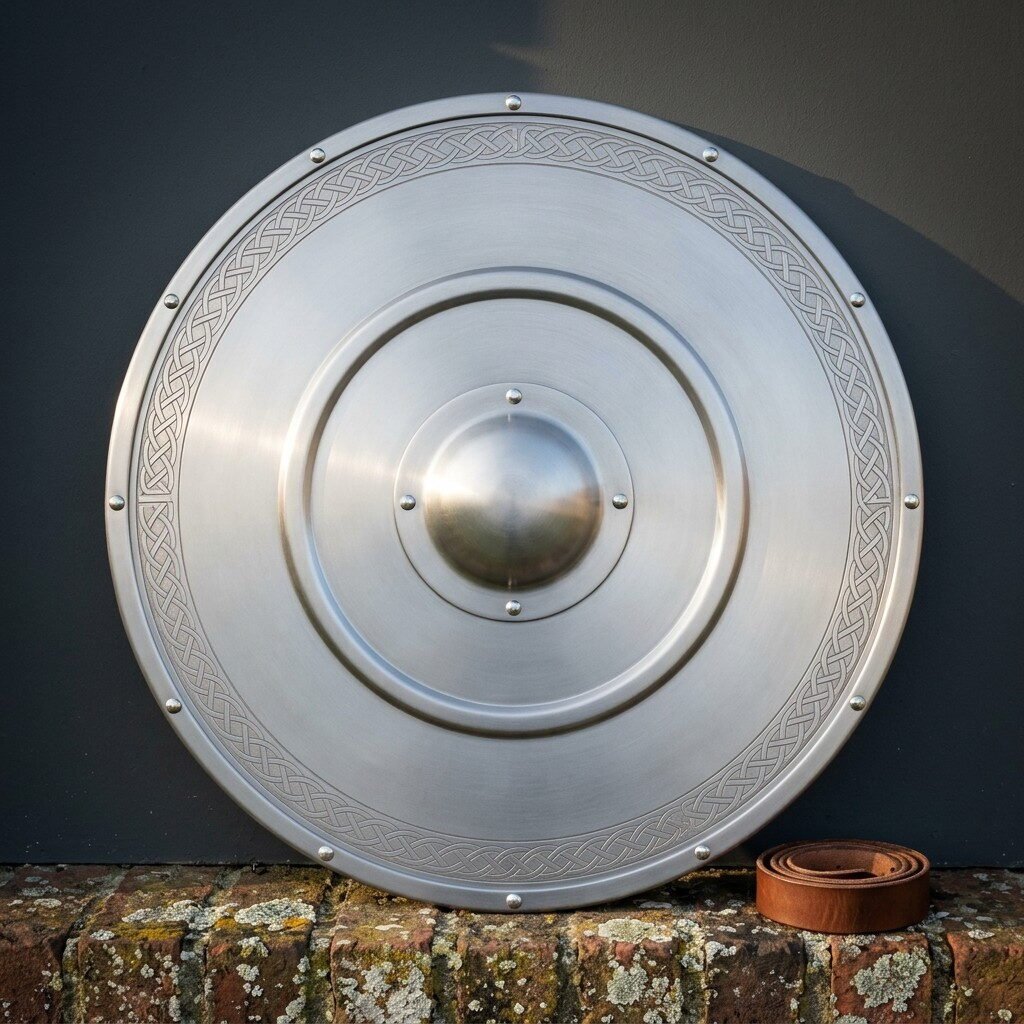
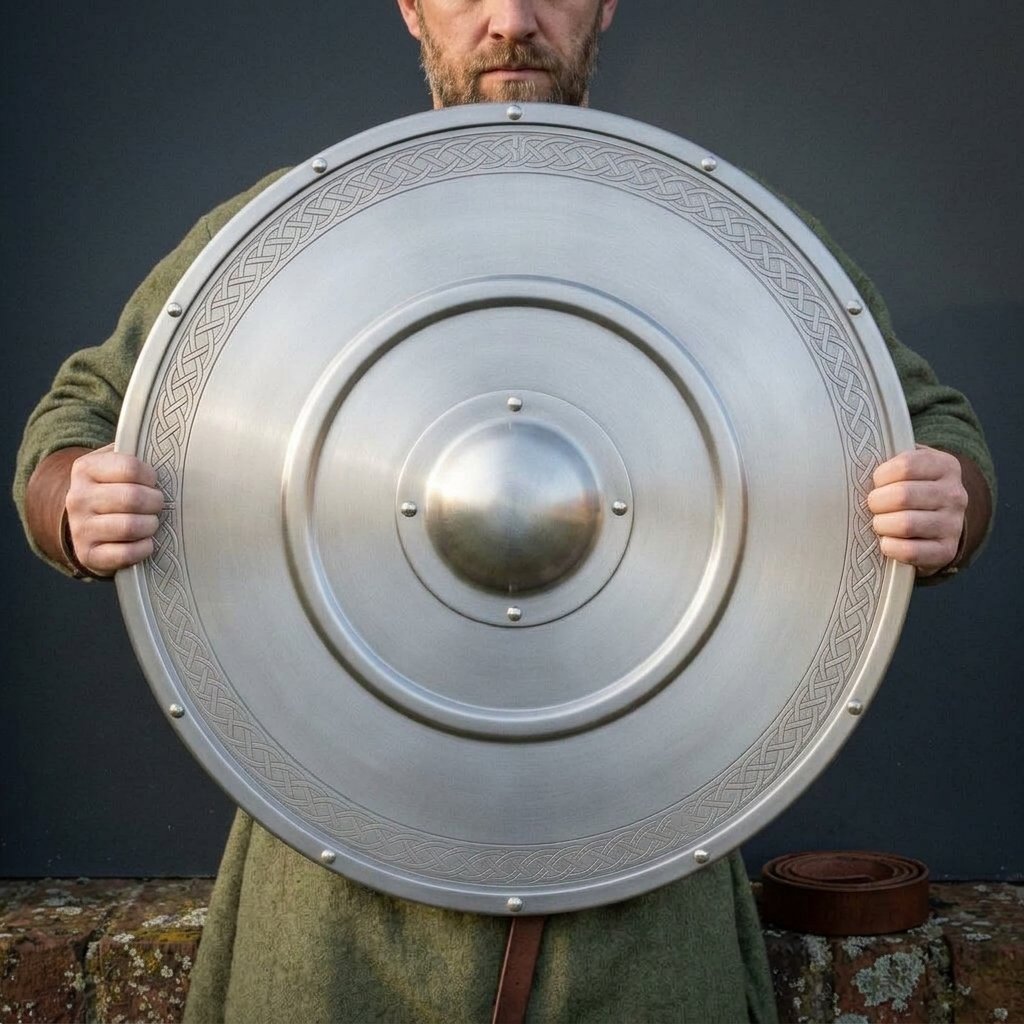
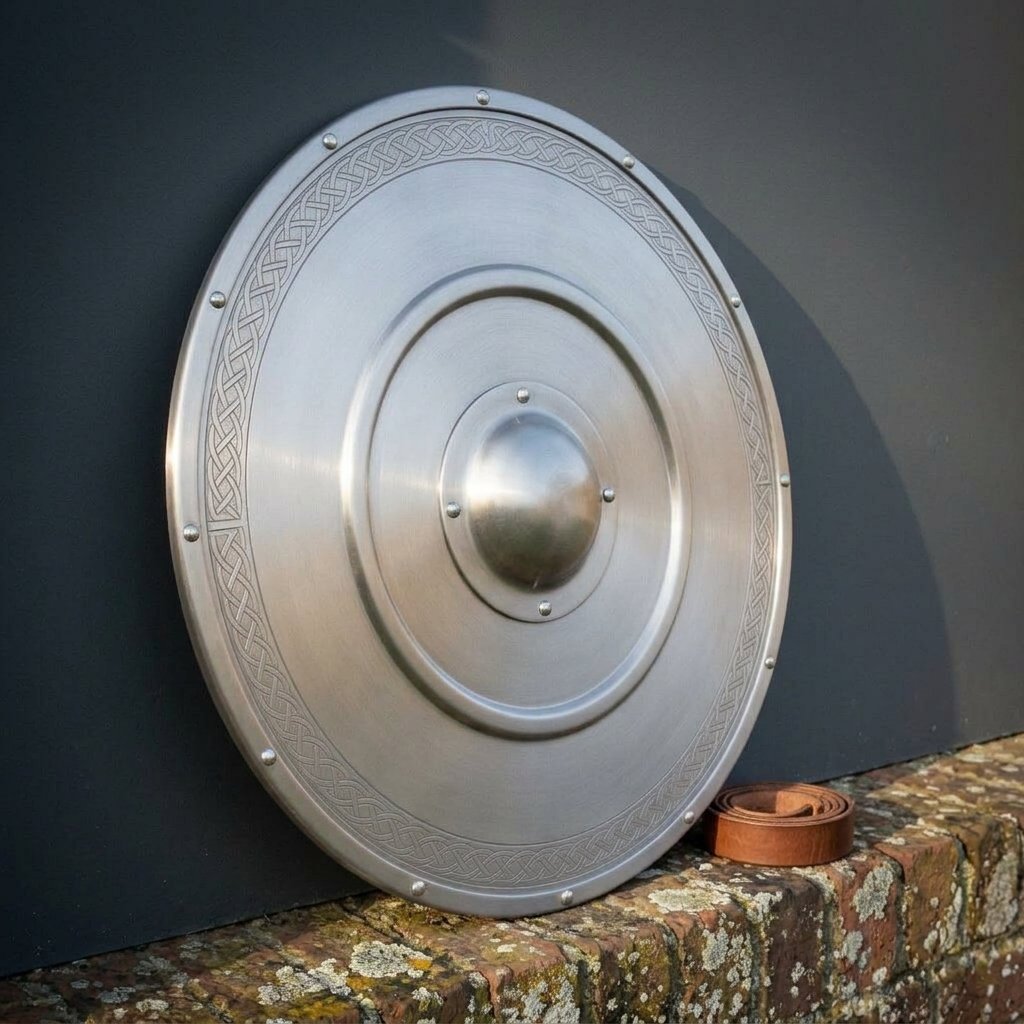
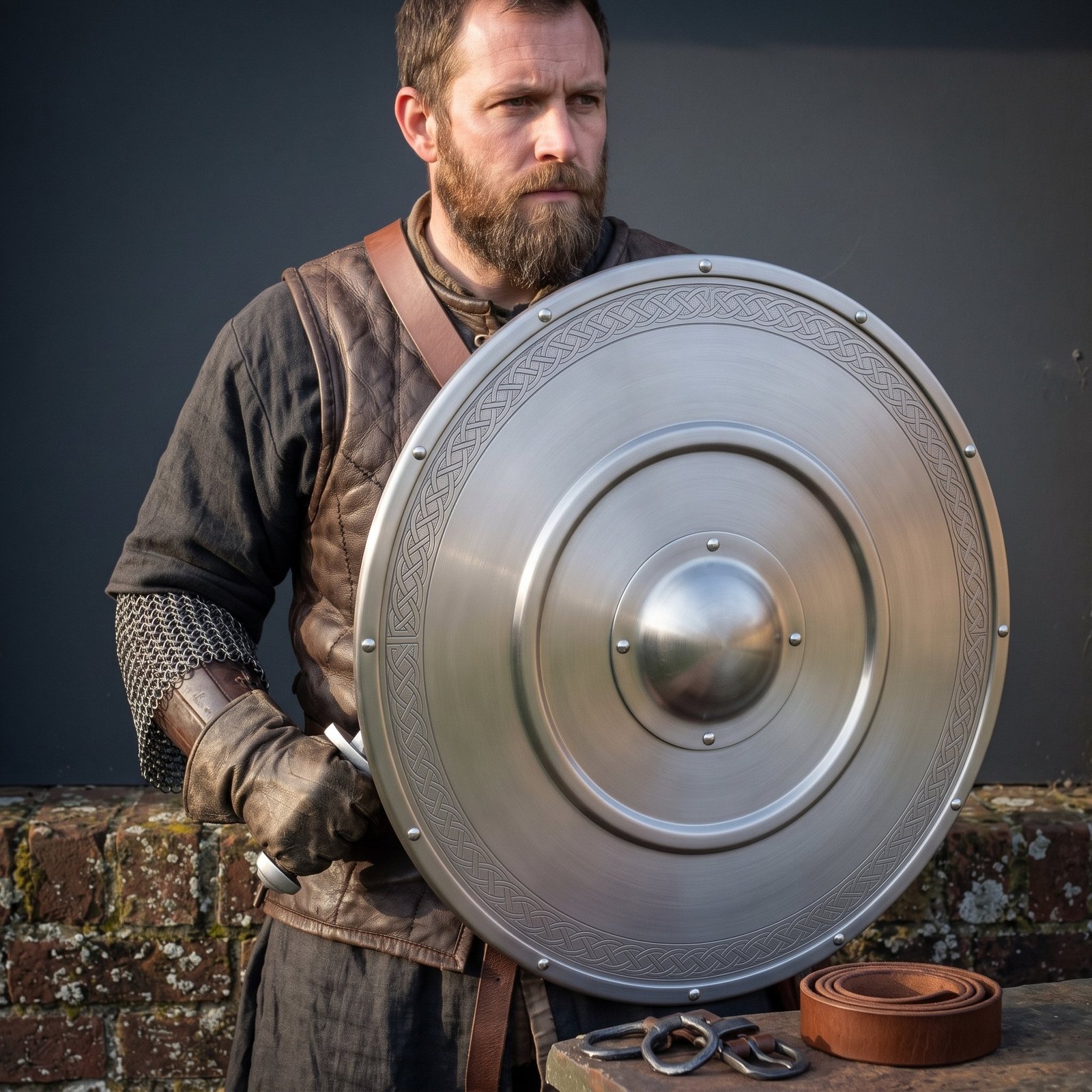
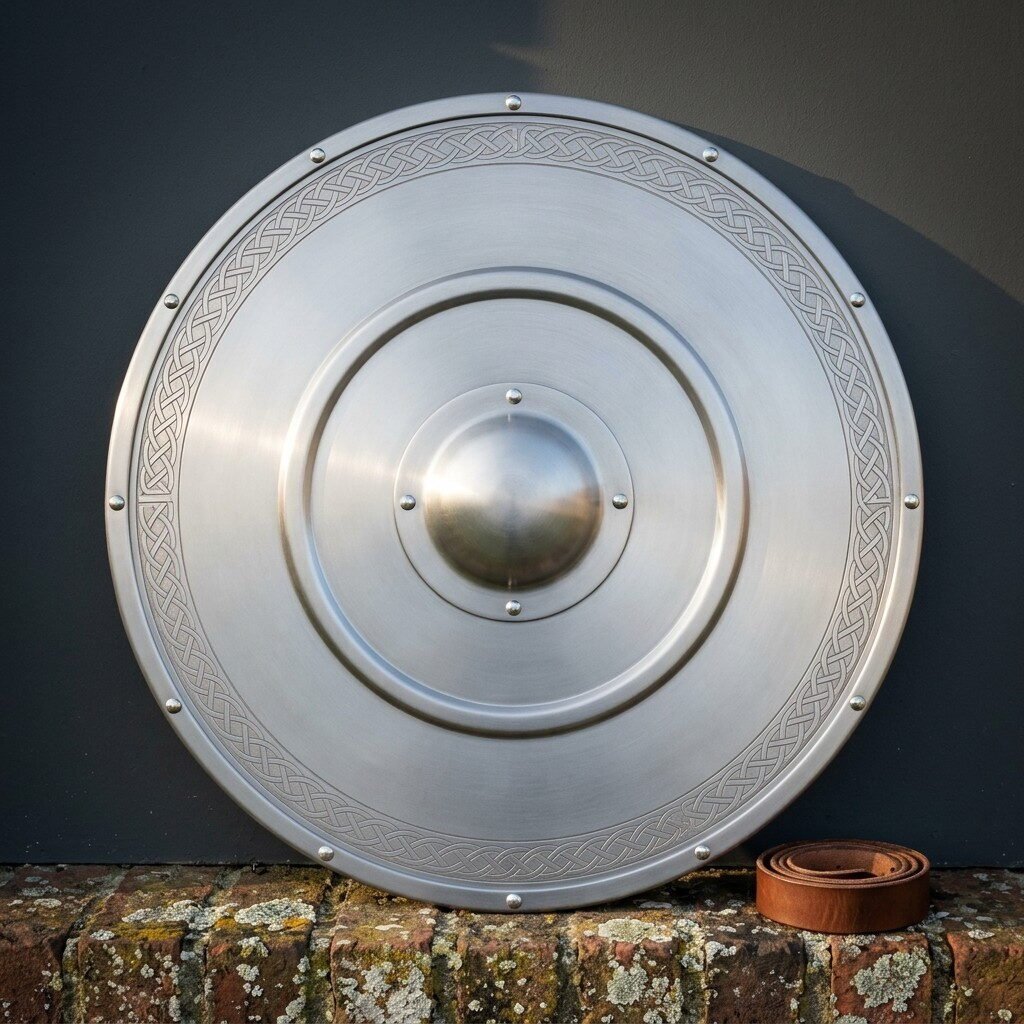
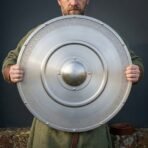
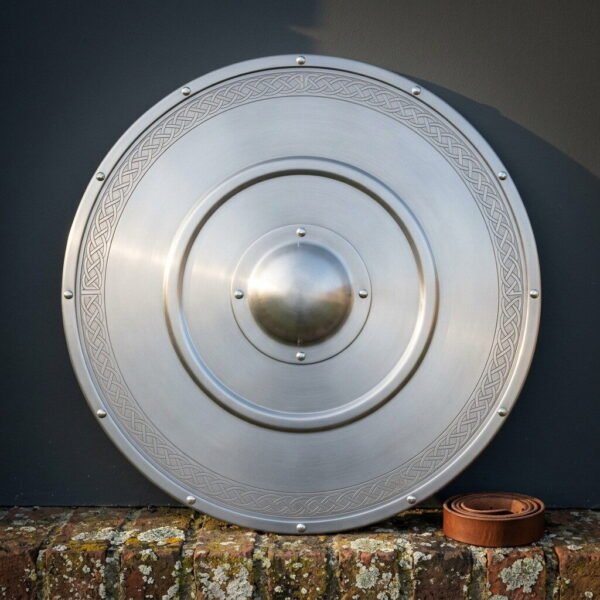
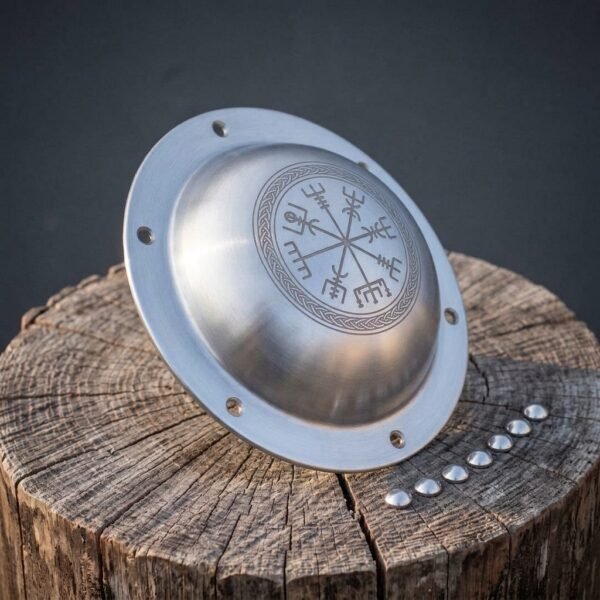
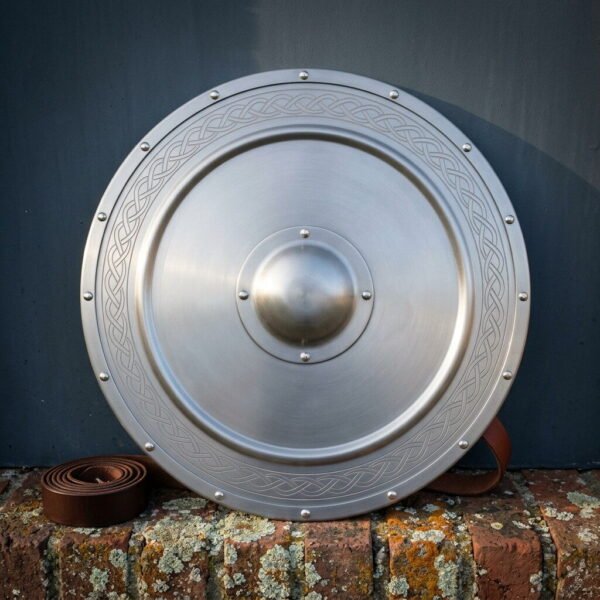
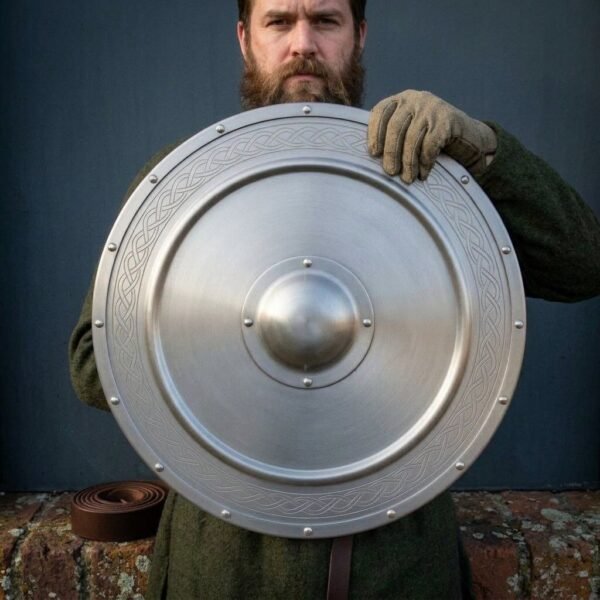
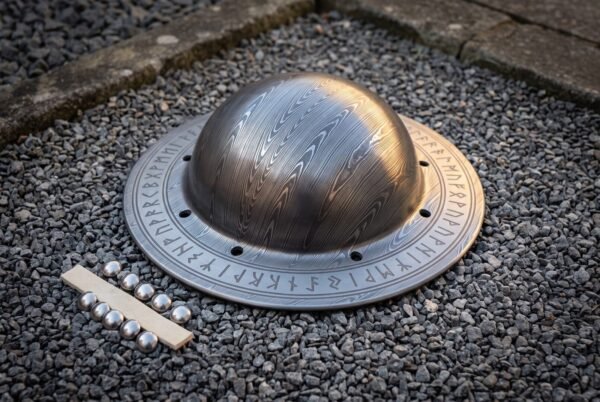
A Viking round shield built in steel rather than planked timber. The face is raised into a series of concentric steps that step up towards a domed centre boss, the outer margin is turned over and set with dome headed rivets all the way round, and a band of engraved Norse knotwork runs the full circumference just inside the rim. The finish is a brushed satin that catches light softly rather than throwing it back. A brown leather arm strap comes with it.
Historically a Viking shield was not steel, and it is worth saying so plainly. The real ones were butted planks of linden, fir or poplar, usually around a centimetre thick, faced with hide or linen, bound at the rim with rawhide or leather, and pierced in the middle for a hand grip that was covered by an iron boss. They were light and they were consumable, made to catch a blow, split and be replaced. A steel shield is a display object descended from later parade and tournament pieces rather than a copy of a raiding shield, and that is what this is. Made and finished by hand in the Czech Republic. Look for it with the Viking shields, and take in the Viking swords on the way past.
Specifications
| Material | Formed steel, brushed satin finish |
|---|
| Construction | Two raised concentric rings stepping up to a domed centre boss |
|---|
| Boss | Domed centre boss on a flanged base, held with six rivets |
|---|
| Rim | Turned outer margin set with dome headed rivets around the full circumference |
|---|
| Engraving | Continuous band of Norse plait knotwork worked just inside the rim |
|---|
| Strap | Brown leather arm strap supplied with the shield |
|---|
| Finish | Hand brushed satin steel with hand cut engraving |
|---|
| Intended use | Wall display and collection, not a contact reenactment shield |
|---|
| Included | Shield, leather arm strap, care card |
|---|
| SKU | RK-1797 |
|---|
What the boss is for, and why every round shield has one
The dome in the centre is the single most important part of a round shield and it is not decorative. On a historical shield the boards were cut away behind it to leave a round hole, and the hand went into that hole and closed around a bar running across it. The boss was the armoured cover over your knuckles. Everything else about the shield follows from that one decision. Because the hand is at the centre rather than strapped to the forearm, the shield can be rotated freely around the fist, punched forward to bind an incoming blade, or angled to deflect rather than absorb. That is centre grip construction and it is what separates a Viking shield from a later strapped kite or heater shield, where the arm is fixed and the shield mostly hangs.
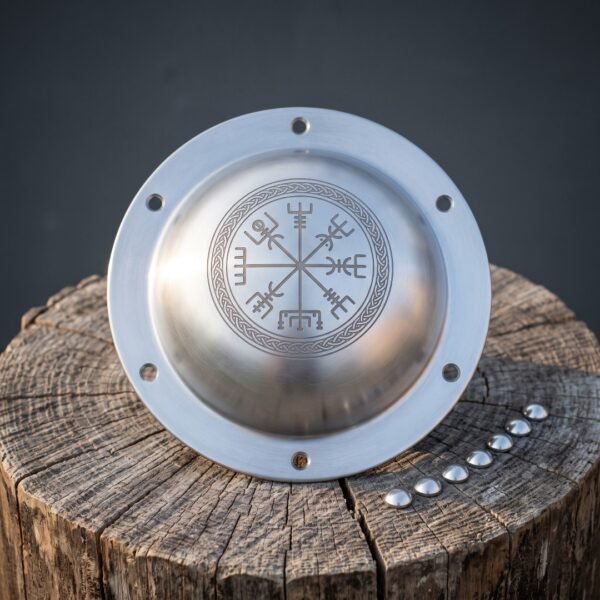
On this steel version the boss is raised and riveted rather than being a separate iron cup over a hole, since the piece is built for display. The concentric steps around it do the job that a real shield’s curved face did, which is to stiffen a broad thin panel against flexing.
The steel, the raising and the engraving
The face is formed from sheet steel rather than assembled from parts, which means the concentric rings and the central dome are raised out of a single panel by working it in stages. Steel work hardens as you move it, so each stage has to be annealed before the next or the metal cracks. That is slow and it is the reason a raised steel shield costs what it does compared with a stamped one.
The knotwork band is cut by hand into the finished surface. Because the band is continuous around a circle it has to be laid out so the pattern closes on itself with no visible join, which is harder than it sounds on a curved surface. The brushed satin finish is applied after engraving so the cut lines read grey against the brushed field.
Engraving, runes and your own design
Use the rune converter on this page to turn a name, a date or a short phrase into Elder Futhark and we will cut it into the steel, the leather or the wood. If you would rather have a Viking pattern than a rune line, choose your own design in the engraving option above the add to cart button and tell us where it goes. Where a piece already carries an engraved design, your chosen engraving replaces it rather than sitting alongside it. On this shield the two obvious placements are a rune ring set inside the existing knotwork band, or a single symbol cut into the flat between the boss and the first step. Full detail is on the engraving page.
Mounting and display
This shield is made to be seen from the front on a wall, and it wants a plain surface behind it and light coming from one side rather than head on. Raking light is what makes the concentric steps and the engraved band read. Under flat overhead light a polished steel disc goes blank.
Hang it on two picture hooks or a French cleat sized to the weight, taking the load through the turned rim rather than through the boss. Do not hang it from the leather arm strap alone, since a leather strap under constant static load will stretch and eventually tear at its fixing. The strap is there so the shield can be picked up and held, and for photography and costume use. Steel against a painted wall will mark it, so a couple of felt pads at the bottom edge are worth the trouble.
Care
Brushed steel wants very little. Dust it with a dry microfibre cloth going with the direction of the brushing, never across it. Fingerprints on the boss will show, and they wipe off with a barely damp cloth followed by a dry one. In a humid room or anywhere near a coast, a very light wipe of mineral oil once or twice a year keeps the surface clean, applied thinly and buffed off so it does not sit and attract dust. Do not use abrasive cream cleaners, which will cut through the brushed grain and leave a bright patch you cannot blend back. Feed the leather arm strap with a leather conditioner once a year. General guidance on caring for steel is under steel care.
Made in the Czech Republic
The work behind this piece happens in a Czech Republic workshop that has kept to the old methods. Steel is forged and heat treated by hand, the grind is taken down by eye rather than by machine, and the handle, fittings and sheath are cut and finished one at a time. Because of that, every piece carries small marks of the hand that made it.
Ransack Viking is a United States company. We import direct, check each piece when it reaches us, and ship from our Chicago, Illinois warehouse. Engraving is added here in the United States after arrival, so the piece you receive is finished to your order.
A note on handmade variation
This shield is hand made, not machine made or bulk produced, so what arrives will not be a pixel for pixel copy of the photograph. Raising steel by hand leaves faint planishing texture that lands differently every time. The knotwork is cut freehand so the line weight and the exact repeat will not match panel for panel. Rivet spacing is laid out by hand and varies a fraction. The leather strap will take dye differently hide to hide. The dimensions, the material and the build are the same every time. The character is not. You can carry on with choosing a shield for display, or look at how a round shield was built while you are there.
Frequently asked questions
Can I use this in reenactment combat
No. This is a display and collection piece. Contact reenactment uses planked wooden shields for good reason, because they absorb and split rather than transmitting a blow into the arm.
Is the arm strap included
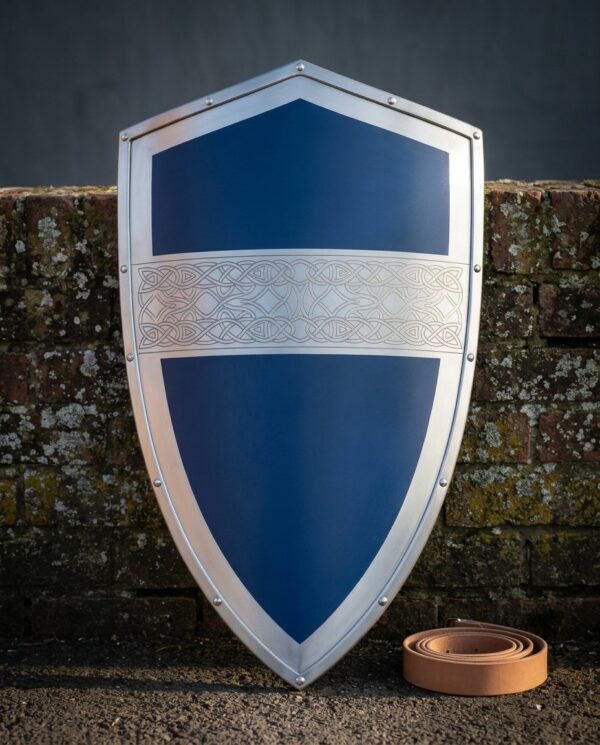
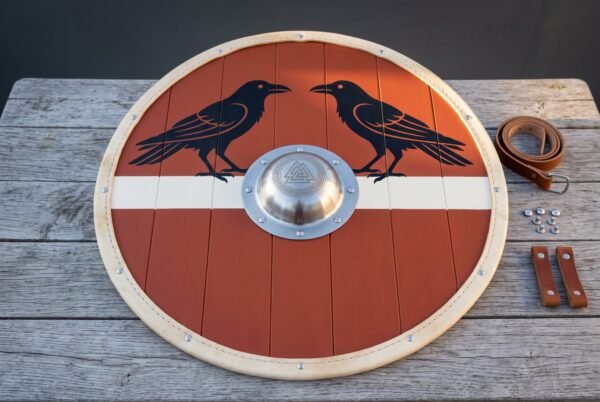
Yes. A brown leather arm strap ships with the shield and is shown in the photograph.
Were Viking shields really made of steel
No. Real ones were butted wooden planks with an iron boss over a centre hand grip. This is a display piece in the round shield form rather than a historical reconstruction, and we would rather be clear about that.
How do I hang it on a wall
Take the weight through the turned rim on two hooks or a cleat rated for it. Do not hang it by the leather strap, which will stretch under constant load.
Will it rust
Only if it is neglected in a damp room. A dry dust and an occasional very thin wipe of mineral oil is all it needs indoors.
Can I have runes engraved around it
Yes. Use the rune converter on this page. A rune ring inside the existing knotwork band is the placement that works best on a circular face.
What is in the box
- Hand raised steel Viking round shield with a domed centre boss
- Riveted turned rim with dome headed rivets around the full circumference
- Hand cut Norse plait knotwork band worked into the face
- Brown leather arm strap
- Care card covering dusting, oiling and leather feeding
- Lifetime warranty against defects in forging, grind, heat treat and fittings
- Made and finished in the Czech Republic
Explore the range
See the rest of the Viking shields, the Viking armour, the Viking home decor and the guides.
If this one is not it
Another in the same line is the Cobaltward Viking shield. Next along the rack is the Ringwall Viking shield. For a straight comparison, see the Kiteward Viking shield.
The Nightband plate armor covers the other half of the same kit. Pick the steel, the length and the fittings yourself on the design your own page.


This is exactly what I wanted and then some. Rivets and trim are all solid. Nothing feels flimsy. Already planning my next purchase from this shop.
This shield fell a little short for me. Some of the rivets were a little uneven. Fit was off from the sizing chart listed. Might work for someone less picky than me.
Got this as a birthday gift and the reaction was priceless. Made overseas in the Czech Republic yet shipped from a US location so no long customs wait. Fit is excellent and the steel gauge feels genuinely protective. Great buy overall.
It’s a decent shield. Nothing extraordinary though. Decent for occasional wear or display but not the sturdiest. It’s Czech made and US shipped. Packaging was just okay though. Not bad, not amazing either.
This thing is a beast in the best way. Padding and straps make it comfortable to wear for hours. You can tell it’s real Czech blacksmith work and shipping from the States made delivery painless. Highly recommend this one.
Feels way more premium than the price suggests. Exactly the look I wanted for my collection. Love it.
Pretty impressed. Just a couple minor things I’d tweak. Good solid build. Finish could be a touch more even. Would still tell others to give this a try.
Can’t stop showing this off to everyone who comes over. Exactly the look I wanted for my collection. Padding and straps make it comfortable to wear for hours. Rivets and trim are all solid. Nothing feels flimsy. I keep coming back to Ransack Viking because it’s always this good. This will be a family heirloom for sure.
This thing is a beast in the best way. Fit is excellent and the steel gauge feels genuinely protective. Looks incredible with the rest of my reenactment kit. Shipping was fast and everything arrived well packaged. You can tell it’s real Czech blacksmith work and shipping from the States made delivery painless. Ordered from Ransack Viking before and the quality stays consistent every time.
This shield is a genuine work of art. Rivets and trim are all solid. Nothing feels flimsy. Exactly the look I wanted for my collection. Can’t recommend this enough.